Verity Summary, Characters and Themes
Verity by Colleen Hoover is a psychological thriller built around authorship, obsession, grief, desire, and the uncertainty of written truth.
The story follows struggling writer Lowen Ashleigh after she accepts an unusual assignment to complete bestselling novelist Verity Crawford’s unfinished series following Verity’s devastating car accident. What begins as professional research becomes increasingly disturbing when Lowen discovers a private manuscript containing apparent confessions of cruelty and murder. Her growing attraction to Verity’s husband, Jeremy, further complicates her judgment. By presenting two incompatible accounts of Verity’s past, the novel ultimately asks whether written words reveal truth or simply create convincing versions of it.
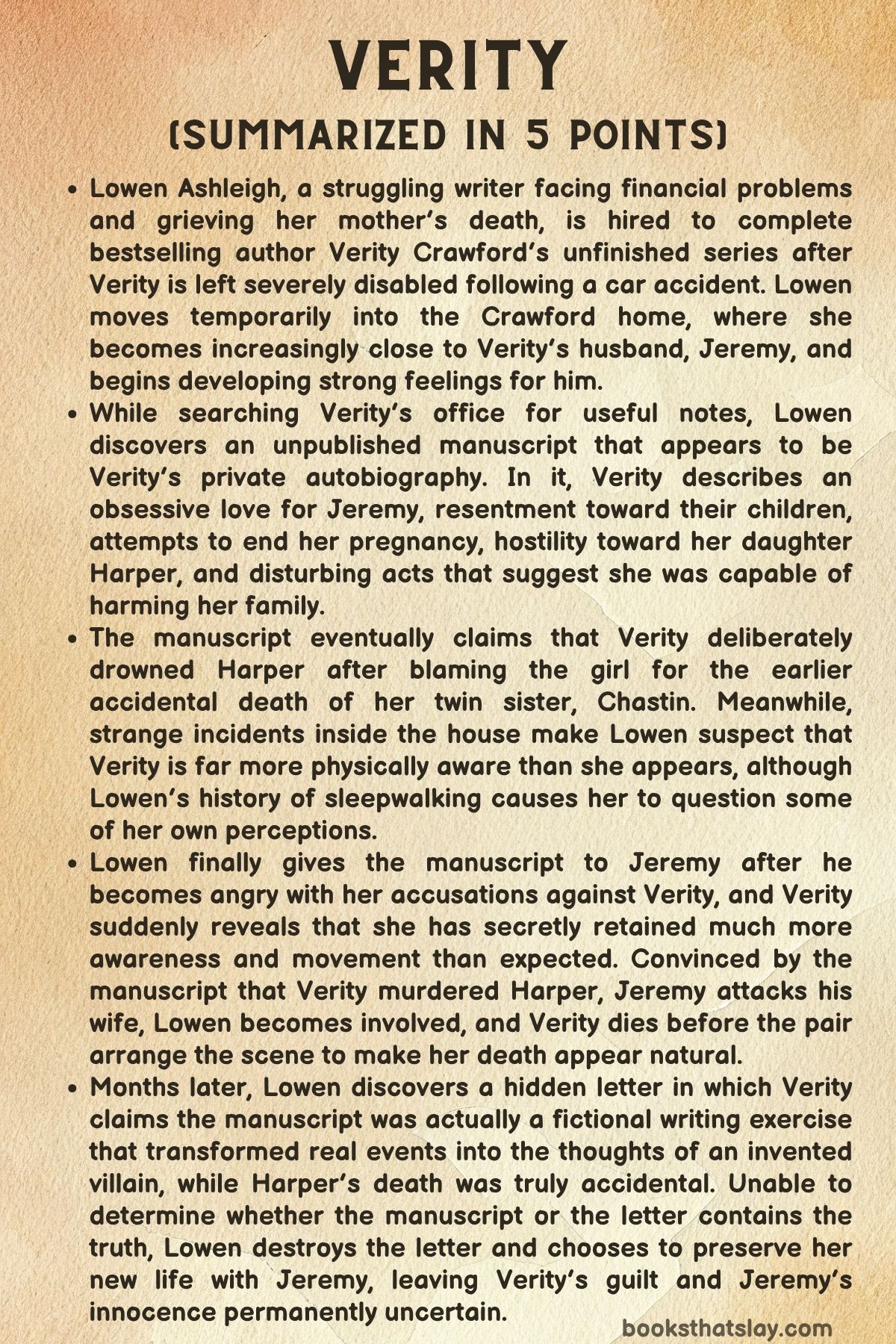
Summary
Lowen Ashleigh is walking through Manhattan on her way to an important publishing meeting when she witnesses a pedestrian being struck and killed by a truck. Covered in blood and shaken by what she has seen, she is helped by a stranger named Jeremy, who takes her into a coffee shop, cleans her face, and gives her his shirt.
Their brief conversation reveals that both are carrying recent grief. Lowen has just lost her mother after months of caring for her, while Jeremy reveals that one of his young daughters died five months earlier, creating an immediate but restrained emotional connection between two strangers who assume they will never meet again.
Lowen soon arrives at Pantem Press and discovers that Jeremy is attending the same meeting. He is the husband of Verity Crawford, a bestselling author who has been left severely incapacitated after a car accident, and the publisher wants Lowen to finish the remaining novels in Verity’s successful series.
Lowen initially dislikes the publicity requirements attached to the job, but Jeremy explains that he personally recommended her because he admired one of her novels. He also encourages her to negotiate for better terms and invites her to the Crawford home in Vermont, where Verity’s office may contain notes useful for completing the books.
Financial desperation ultimately convinces Lowen to accept. Her career has stalled, she is facing eviction, and the contract offers the stability she badly needs, although her agent and former lover Corey warns her that the concentration of tragedies around the Crawford family is unsettling.
At the Vermont house, Lowen meets Jeremy’s surviving son, Crew, and sees Verity for the first time. Verity appears almost completely unresponsive, requiring constant care after the accident, which makes Lowen uncomfortable about occupying the office and career of a woman who remains physically present in the house.
While searching Verity’s office, Lowen discovers a manuscript titled So Be It. It appears to be an autobiography in which Verity promises to record the ugliest and most private parts of herself without presenting a flattering version of her life.
The manuscript begins with Verity describing her intense relationship with Jeremy. Her love quickly takes the form of emotional dependency and obsession, and she explains that her happiness depends heavily on remaining the central person in Jeremy’s life.
That balance changes when Verity becomes pregnant with twins. According to the manuscript, she sees the unborn babies not as additions to the family but as rivals for Jeremy’s attention, and her jealousy becomes severe enough that she attempts to cause a miscarriage.
The attempt fails, and the twin girls, Chastin and Harper, are born. Verity claims that she never develops equal maternal affection for them and instead becomes increasingly resentful as Jeremy devotes himself to fatherhood, measuring her own importance according to how much attention and desire he continues to give her.
Lowen is horrified by these revelations, yet she repeatedly returns to the manuscript. Her professional reason for remaining in Vermont gradually becomes secondary to her fascination with Verity, her growing concern for Crew, and her increasing attraction to Jeremy.
The present-day house also begins producing unsettling incidents. Crew makes strange comments suggesting his mother has spoken or interacted with him, Lowen notices details that make her question whether Verity is truly unaware of her surroundings, and at one point Lowen believes she sees Verity watching from an upstairs window.
Lowen cannot completely trust herself, however, because she has a history of severe sleepwalking. After waking one night in Verity’s bed without knowing how she arrived there, she becomes aware that some of the frightening events around her might have explanations connected to her own unstable sleep rather than Verity.
Meanwhile, the manuscript becomes increasingly disturbing. Verity describes trying to choke infant Harper because she convinces herself that Harper will eventually harm Chastin, yet she stops when Jeremy unexpectedly appears and then disguises what she has been doing.
Her relationship with the twins remains divided. Chastin receives more affection, while Harper becomes the focus of Verity’s resentment, particularly as Jeremy begins noticing the unequal treatment and criticizes Verity’s parenting.
Later, Verity lies to Jeremy about being pregnant in order to recover his attention. She quickly plans either to become pregnant for real or fake a miscarriage, but she soon conceives Crew, allowing the deception to disappear without being exposed.
While Lowen continues reading, her connection with Jeremy becomes more intimate. He reveals that he was the person who originally read and admired Lowen’s work, and his professional respect for her makes their developing attraction feel even more personal.
On Lowen’s birthday, Jeremy makes her a cake, and their growing attraction results in a kiss. Immediately afterward, Lowen looks toward the stairs and believes she sees Verity standing upright and watching them before apparently returning to her bedroom.
Jeremy finds Verity lying helplessly in bed and cannot believe Lowen’s account. Lowen herself begins questioning what she saw, yet her fear grows because she has accumulated several incidents that seem to indicate Verity may possess far more awareness and physical control than the family believes.
Lowen returns to the manuscript and reaches the sections surrounding the deaths of the Crawford daughters. Chastin dies from an allergic reaction to peanuts during a sleepover, and Verity claims she becomes convinced that Harper deliberately caused her sister’s death.
Instead of blaming herself for Chastin’s death, Verity begins wishing she had killed Harper earlier. She imagines that removing Harper would have prevented Chastin’s death and transforms her grief into further justification for the hostility she has already directed toward her surviving daughter.
Six months later, Verity describes taking Harper and Crew onto the lake in a canoe. According to the manuscript, she deliberately tips the canoe, protects Crew, and allows Harper to remain trapped underwater, pretending afterward that she had desperately attempted to rescue her.
Jeremy recovers Harper’s body and is devastated. Verity claims she performs the role of a grieving mother, but rather than restoring her closeness with Jeremy, Harper’s death creates greater emotional distance because Jeremy begins questioning the circumstances of the drowning.
The manuscript concludes with Verity wondering whether Jeremy suspects her. She imagines several possible endings for herself, including driving her car into a tree if Jeremy becomes convinced that she murdered Harper, a statement that seems to explain the later crash that caused her apparent disability.
Lowen now considers the manuscript a confession. She is increasingly convinced that Verity killed Harper and may still pose a danger to Crew, particularly if her physical condition is being exaggerated or completely fabricated.
During this period Lowen and Jeremy finally begin a sexual relationship. Jeremy admits that his marriage had already deteriorated before Verity’s accident, while Lowen starts imagining that she could build a different kind of family with him and Crew.
Lowen eventually uses a monitor to watch Verity and searches for evidence that she can move. When Jeremy later discovers Lowen confronting Verity and attempting to provoke a reaction, he becomes furious and decides that Lowen has become dangerously obsessed with his helpless wife.
Jeremy begins packing Lowen’s belongings and orders her to leave. Desperate to make him understand, Lowen finally gives him the hidden autobiography and tells him to read what Verity wrote about their daughters.
After reading it, Jeremy confronts Verity. Verity suddenly reveals that she has retained far more awareness and physical ability than she has allowed others to believe, confirming that at least one significant part of her condition has been deceptive.
Jeremy reacts violently to what he believes is proof that Verity murdered Harper. During the confrontation, he attacks Verity, Lowen becomes involved, and together they cause Verity’s death before arranging the circumstances so that she appears to have died naturally in her sleep.
Lowen and Jeremy agree that the truth about Verity’s death can never be discussed. The manuscript is destroyed, and the two become permanently connected not merely by attraction and love but by the secret of what they have done.
Seven months later, Lowen has successfully taken over Verity’s series and is living with Jeremy and Crew in North Carolina. She is pregnant with Jeremy’s daughter, and they appear to have begun constructing the stable family life Lowen once imagined.
They return to the Vermont house to collect possessions, and Crew inadvertently reveals that Verity used to hide things beneath loose floorboards. Lowen searches the hiding place and finds photographs, a knife, and a handwritten letter addressed to Jeremy.
The letter transforms the entire story. Verity claims that So Be It was never an autobiography or confession but an exercise called antagonistic journaling, supposedly taught to her by an editor named Amanda, in which actual events are rewritten through the perspective of the darkest possible fictional version of oneself.
According to the letter, Verity never hated her children and never murdered Harper. She claims the canoe genuinely overturned, Harper became trapped in a submerged fishing net, and Verity tried unsuccessfully to save her.
Verity further claims that Jeremy found the manuscript after Harper’s death and mistakenly treated it as literal truth. Believing his wife had murdered their daughter, Jeremy allegedly tried to choke Verity before arranging the car crash intended to kill her.
After surviving, Verity says she pretended to suffer catastrophic brain damage because she was terrified Jeremy would try again. Her plan was eventually to escape with Crew, and the letter was meant to explain the truth to Jeremy.
Lowen is horrified because the letter creates an entirely different interpretation of everything that has happened. If Verity is truthful, then Jeremy had already tried to murder his innocent wife once, and Lowen later helped him complete the act.
She also remembers Jeremy’s reaction when she first gave him the manuscript and begins wondering whether he had already seen it. His words at the time no longer seem to prove that the document was new to him.
Yet the letter cannot be independently proven either. Verity was a skilled writer capable of creating convincing perspectives, meaning the manuscript could be a genuine confession disguised afterward as fiction, while the letter could itself be a final attempt to manipulate Jeremy.
Lowen chooses not to pursue certainty. She destroys the letter so Jeremy will never read it and decides to protect the family she has created with him, even though she now understands that her life is built upon an unanswered question.
The story therefore ends without establishing which document contains the truth. Lowen leaves Vermont with Jeremy, Crew, and their unborn daughter while carrying knowledge that could either expose a terrible injustice or reveal one final deception by a woman whose greatest talent was making invented voices seem completely real.
Characters
Lowen Ashleigh
Lowen Ashleigh is the central consciousness through which Verity develops its uncertainty, and her position as both writer and outsider makes her especially vulnerable to interpreting the Crawford family through narrative rather than objective evidence. She arrives financially desperate, recently bereaved, socially withdrawn, and professionally insecure, making Jeremy’s attention and the opportunity to continue a famous author’s work unusually powerful influences on her decisions.
Her curiosity initially appears professional, yet reading the private manuscript quickly becomes a personal fixation. Lowen repeatedly recognizes that she is violating Verity’s privacy, but each disturbing revelation gives her a new reason to continue, showing how easily curiosity can transform into moral justification.
Lowen’s attraction to Jeremy further affects her judgment. As she becomes emotionally invested in him, the version of Verity presented in the manuscript increasingly serves Lowen’s desire to see Jeremy as someone who deserves freedom from his marriage.
Her sleepwalking is important because it weakens her confidence in her own perceptions. She cannot always distinguish between what she has consciously experienced and what might have happened while she was asleep, making her an intentionally uncertain observer.
Her final choice reveals the greatest change in her character. After spending most of the story seeking truth about Verity, she deliberately destroys the letter because truth has become threatening to the family and future she wants, placing emotional security above certainty.
Jeremy Crawford
Jeremy initially appears in Verity as compassionate, protective, and deeply damaged by loss. His first interaction with Lowen shows him comforting a stranger after a traumatic accident even though he is carrying the far greater personal grief of losing two daughters.
His devotion to Crew strengthens the image of a loving father. He is attentive, patient, and deeply involved in his son’s life, while his grief over Chastin and Harper demonstrates that fatherhood occupies an essential part of his identity.
Jeremy’s relationship with Lowen gradually moves from professional admiration to emotional and physical attraction. His admission that he personally recommended her work gives their connection a foundation that existed before their life together in Vermont, yet his willingness to begin a relationship while Verity remains alive introduces moral uncertainty into his character.
The manuscript initially presents Jeremy as the victim of a wife who has deceived him and murdered one of their children. Under that interpretation, his eventual violence toward Verity emerges from unbearable grief and rage, although his decision to conceal the killing still shows his willingness to cross legal and moral boundaries.
The final letter creates a far darker possibility. If Verity’s account is truthful, Jeremy had already attempted to murder his wife before Lowen arrived, meaning the gentle man Lowen loves may also be capable of calculated violence whenever he becomes convinced of another person’s guilt.
Verity Crawford
Verity Crawford is simultaneously a character, an absent voice, a possible murderer, a possible victim, and the source of nearly every major uncertainty in Verity. Although physically silent through most of the present-day story, she dominates events because her manuscript determines how Lowen interprets the Crawford family.
The Verity portrayed in So Be It is consumed by obsessive love for Jeremy. She treats her children as competitors for his attention, attempts to end her pregnancy, tries to harm Harper as an infant, manipulates Jeremy with a false pregnancy, and eventually describes deliberately drowning Harper.
This version of Verity is frightening because she repeatedly converts selfish desires into explanations that allow her to avoid remorse. Even when she describes extreme cruelty, her primary concern remains Jeremy’s affection and whether her actions will cause him to leave her.
The letter beneath the floorboards reverses that characterization. There, Verity presents herself as a writer whose fictional exercise was mistaken for confession and as a terrified woman who pretended to be disabled after surviving an attempted murder by her husband.
Neither account can be fully confirmed. Her importance comes from this unresolved duality, because the reader must confront the possibility that a talented writer can produce two completely persuasive versions of herself without providing a reliable method for choosing between them.
Crew Crawford
Crew is the surviving Crawford child and one of the strongest sources of present-day tension in Verity. His innocence makes him emotionally important to Lowen because she increasingly fears that whatever happened to his sisters could eventually place him in danger.
His fragmented comments about his mother create suspicion without providing certainty. Because he is young, he cannot explain events with the clarity adults want, and his references to Verity speaking, moving, or interacting with him become clues that are always open to more than one interpretation.
Crew also humanizes Jeremy. Their affectionate relationship provides Lowen with repeated evidence that Jeremy is a caring father, which contributes to her growing attraction and strengthens her belief that he deserves a new life.
The final letter gives Crew another role: he becomes the child Verity supposedly intended to take with her when she escaped. This possibility turns him into part of the unresolved conflict between Verity and Jeremy, since either parent may have believed they were protecting him from the other.
Harper Crawford
Harper is physically absent from Verity, yet her death stands at the center of the book’s moral mystery. In the manuscript, she becomes the target of Verity’s resentment from infancy and is treated as inherently threatening to the family.
Verity’s hostility toward Harper intensifies after Chastin dies. She convinces herself that Harper intentionally caused her twin’s fatal allergic reaction and uses that belief to justify the drowning described later in the manuscript.
Harper therefore becomes especially important because both competing documents offer completely different explanations of her death. The manuscript describes deliberate murder, while the letter claims Harper accidentally became trapped underwater after the canoe overturned.
Because Harper cannot speak for herself, she represents the human cost of the novel’s uncertainty. Every major adult interpretation depends upon deciding what happened to her, yet the one person who could never manipulate the story is also the person who cannot provide testimony.
Chastin Crawford
Chastin is one of Verity and Jeremy’s twin daughters and dies after consuming peanuts during a sleepover. Her death is officially understood as a tragic allergic reaction, but within the manuscript it becomes the event that radically intensifies Verity’s hostility toward Harper.
The manuscript portrays Chastin as the daughter Verity prefers. This favoritism matters because it reveals how Verity divides her children according to the emotional meanings she assigns to them rather than responding to them equally as individuals.
Chastin’s facial scar also becomes significant to Lowen. After reading about Verity’s attempts to end the pregnancy, Lowen wonders whether the scar could have resulted from prenatal injury, allowing a physical detail from the family’s past to reinforce her belief in the manuscript.
Even though Chastin is absent from the present narrative, her death continues shaping the behavior of everyone who survives her. Jeremy’s grief, Verity’s alleged resentment toward Harper, and Lowen’s interpretation of the family all depend partly on what Chastin’s loss has come to represent.
Corey
Corey is Lowen’s agent and former lover, providing an important connection to the life she had before entering the Crawford household. His role is relatively limited, yet he immediately recognizes that the assignment involves unusual personal circumstances.
He warns Lowen about the concentration of tragedy surrounding Jeremy’s family. Two children have died, Verity has suffered a catastrophic accident, and the available details produce enough unease that Corey advises Lowen to collect what she needs and leave quickly.
His caution contrasts with Lowen’s later behavior. Where Corey views the Crawford household from a practical distance, Lowen becomes emotionally absorbed in it, illustrating how proximity and desire alter her ability to maintain professional boundaries.
Their finished romantic history also emphasizes the significance of Lowen’s attraction to Jeremy. Corey belongs to a previous part of her life that no longer satisfies her emotionally, while Jeremy becomes associated with the future she gradually begins wanting.
April
April is one of Verity’s caregivers and contributes to the appearance that Verity is genuinely incapacitated. She participates in the daily routine of feeding, moving, and caring for Verity, reinforcing the medical reality that Lowen is repeatedly tempted to question.
Her presence also gives Lowen opportunities to observe inconsistencies. Small details involving Verity’s room or daily care become suspicious because Lowen begins comparing what caregivers report with what she personally notices.
April remains largely outside the central emotional conflict, which makes her useful as a reminder that Verity’s condition is not witnessed only by Lowen and Jeremy. Professionals and caregivers have also accepted the appearance of profound disability over an extended period.
This makes Verity’s eventual revelation of awareness more disturbing. Her deception, whatever its motive, required remarkable patience and control in front of people responsible for observing her closely.
Myrna
Myrna is another caregiver who enters the Crawford household during Lowen’s stay. Like April, she contributes to the ordinary structure surrounding Verity’s medical care and helps establish that the apparently helpless woman is constantly attended by people who believe her condition to be genuine.
Her presence allows Lowen and Jeremy more freedom to leave the house together. This indirectly contributes to the development of their emotional relationship because caregiving responsibilities temporarily stop defining Jeremy’s every movement.
Myrna does not possess enough information to resolve any of the central mysteries. Instead, her limited role emphasizes how easily people can participate in a situation without understanding the hidden conflicts determining its meaning.
She therefore belongs to the outer circle of the story, witnessing the consequences of the Crawford tragedy without gaining access to the private documents that reshape Lowen’s understanding of it.
Amanda
Amanda appears only through Verity’s final letter, yet her existence is crucial to Verity because she supposedly provides the explanation capable of changing the meaning of the entire manuscript. Verity identifies her as the editor who introduced her to the technique of antagonistic journaling.
According to the letter, Amanda taught Verity to take real events and rewrite them through the consciousness of an imagined villain. If this claim is true, So Be It becomes a writing exercise rather than a confession, fundamentally changing the moral identities of both Verity and Jeremy.
The difficulty is that Amanda never appears directly to confirm the explanation. Her absence prevents the letter from functioning as definite proof and preserves the uncertainty upon which the ending depends.
Amanda therefore represents a possible route to truth that the story deliberately leaves unexplored. Lowen could potentially investigate the claim, but she chooses destruction instead, making Amanda significant precisely because the possibility of verification exists but is never pursued.
Themes
Truth, Fiction, and the Power of Narrative
The central conflict of Verity depends on the uncomfortable fact that convincing writing is not necessarily truthful writing. Lowen spends much of the story treating the manuscript as direct access to Verity’s hidden mind because its specificity, emotional intensity, and private nature make it feel more trustworthy than ordinary fiction.
That assumption becomes dangerous because Lowen is herself a novelist and should understand better than most people that writers can convincingly inhabit minds unlike their own. Nevertheless, she gradually stops treating So Be It as crafted language and begins treating it as evidence, allowing a document to shape her judgment of a living person.
The final letter destroys the apparent reliability of the manuscript by offering an equally coherent explanation. If the antagonistic-journaling story is true, the very qualities that made the manuscript persuasive are evidence of Verity’s skill rather than evidence of guilt.
The theme extends beyond Verity’s writing because Lowen also constructs narratives. She interprets Jeremy as victim, herself as protector, and Verity as danger, creating a story that makes her affair and later participation in Verity’s death increasingly acceptable to her.
The ending refuses to provide a final authority capable of separating fact from fiction. Instead, the novel leaves readers with two documents, both written by the same skilled storyteller, and asks how certainty can exist when every available truth has been shaped by language.
Obsession, Possession, and Romantic Love
Love repeatedly becomes dangerous when characters confuse devotion with possession. In the manuscript, Verity’s attachment to Jeremy is presented not as a stable partnership but as a need to remain the exclusive center of his emotional world, making every competing bond feel like rejection.
Motherhood therefore becomes threatening because Jeremy’s love expands rather than remaining focused entirely on his wife. His affection for the twins does not reduce the amount of love available in any objective sense, yet the manuscript’s Verity experiences the children as people who have stolen something that belonged to her.
Lowen develops a different but related form of emotional possession. As she becomes attached to Jeremy, Verity’s presence begins to feel increasingly inconvenient, and Lowen starts imagining herself occupying the roles of partner, mother figure, and emotional companion within the Crawford family.
This makes the supposed conflict between Lowen and Verity more complicated than a simple struggle between good and evil. Both women, depending on which account is believed, become capable of interpreting Jeremy through desire and using that desire to justify decisions they might otherwise condemn.
Jeremy also participates in this pattern because his response to perceived betrayal becomes violent. Whether he is avenging Harper or attacking an innocent wife, the story repeatedly shows how love can become destructive when grief, jealousy, fear, and ownership replace trust.
Grief and Moral Distortion
Grief shapes nearly every important decision in Verity, but it rarely produces simple sympathy. Lowen arrives after losing her mother, Jeremy has lost two daughters, Crew has lost his sisters, and Verity is either a grieving mother hiding behind fictional cruelty or a mother responsible for one of the losses herself.
Jeremy’s grief is particularly important because it determines how he interprets the manuscript. If the letter is truthful, the loss of Harper makes him vulnerable to believing the darkest possible explanation, and his certainty becomes powerful enough to justify attempted murder.
Lowen is also influenced by grief and instability before entering the Crawford home. Her mother’s death, financial insecurity, isolation, and history of sleepwalking leave her emotionally unsettled, which may help explain why she becomes so intensely attached to Jeremy and so receptive to the manuscript’s terrifying version of Verity.
Grief also creates a desire for explanations. Random tragedy is psychologically difficult to accept, while guilt provides a target, allowing characters to replace helplessness with certainty about who caused their suffering.
The danger is that certainty formed through grief can become morally destructive. Jeremy acts against Verity, Lowen assists him, and both later build a life together without ever establishing whether the belief that justified their violence was actually true.
Complicity, Self-Justification, and the Choice Not to Know
Lowen’s transformation is defined by increasingly serious acts that she explains to herself as necessary. She first justifies reading a private manuscript as professional research, then explains continued reading as concern for Jeremy and Crew, and eventually participates in Verity’s death because she believes she is helping protect a family.
Each step makes the next one easier because her moral boundaries adjust to circumstances. By the time Verity dies, Lowen no longer evaluates her actions from the detached position she occupied when she first entered the house.
The final letter forces her to confront the possibility that every earlier justification may have rested on false assumptions. Instead of investigating, showing Jeremy the letter, finding Amanda, or attempting to establish whether the antagonistic-journaling explanation is credible, Lowen deliberately destroys the evidence.
That decision gives the theme its greatest force. Ignorance is no longer something imposed on Lowen; it becomes something she actively chooses because uncertainty is easier to live with than a truth that might destroy her relationship and force her to confront her own responsibility.
The ending therefore turns complicity into an ongoing condition rather than a single violent act. Lowen protects Jeremy, protects herself, protects the family she wants, and preserves a version of reality that can survive only because she has chosen to eliminate the document capable of challenging it.