Zlata’s Diary Summary and Analysis
Zlata’s Diary: A Child’s Life in Wartime Sarajevo by Zlata Filipović is a wartime diary that records the life of a young girl in Sarajevo during the Bosnian War. It begins with ordinary concerns such as school, friends, music lessons, birthdays, and family outings, then slowly shows how violence takes over daily life.
What makes this book so powerful is its clear, direct perspective: Zlata writes as a child trying to understand events far larger than herself. Her diary preserves not only fear and loss, but also routine, humor, affection, and the need to stay human under constant danger. It stands as both a personal record and a witness account of war.
Summary
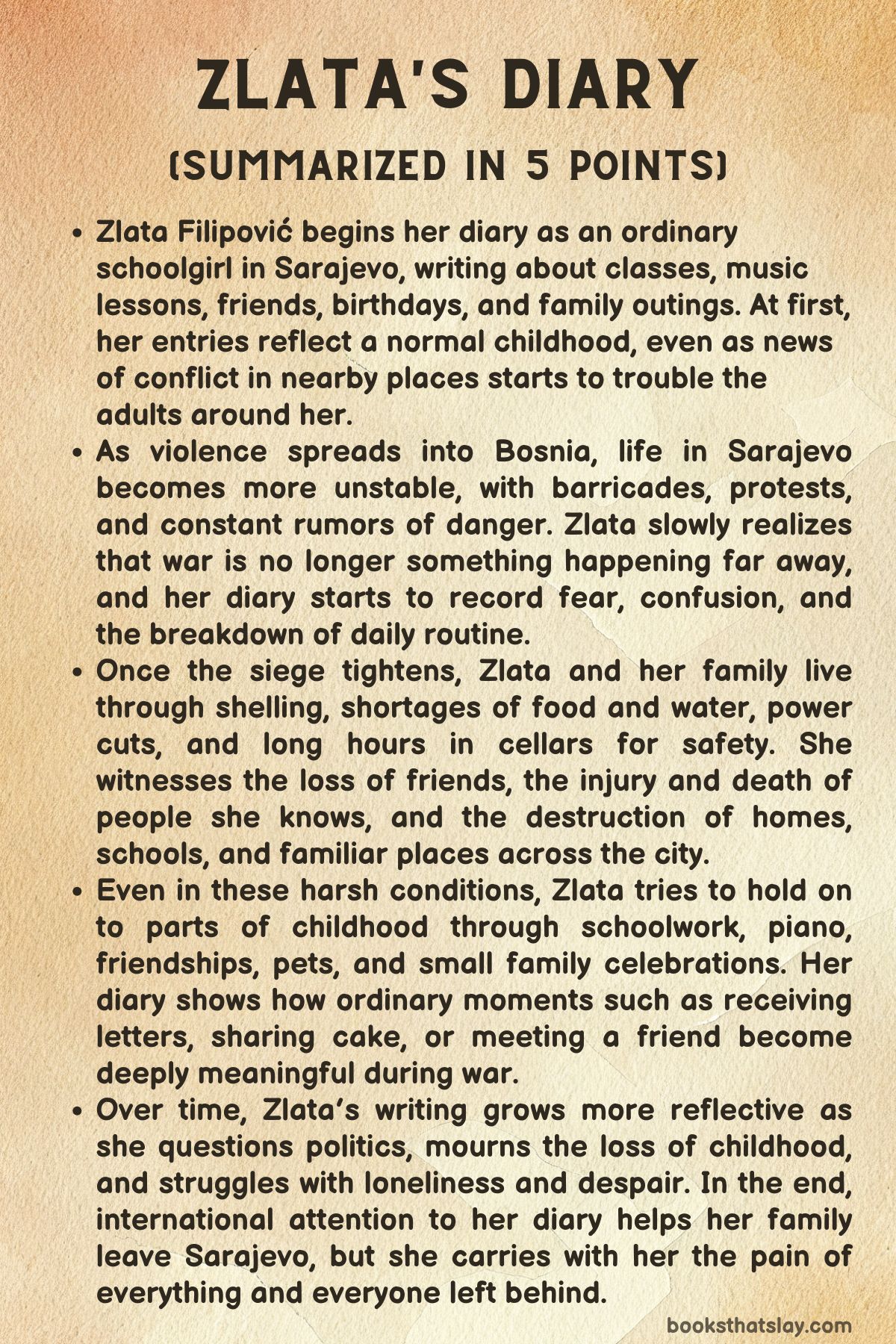
Zlata’s Diary follows Zlata Filipović, a young girl living in Sarajevo, as her ordinary childhood is overtaken by war. At the beginning, her life is full of familiar pleasures and responsibilities.
She is starting a new school year, thinking about classmates she has not seen over the summer, taking piano and music lessons, playing tennis, going to birthday parties, and enjoying family routines. She writes about television, pop culture, homework, and vacations with the excitement and irritation of a typical child.
Her world is comfortable, social, and full of plans.
At first, the signs of conflict seem distant, even though adults around her are growing uneasy. Her father is called into the reserves, family trips are postponed, and conversations increasingly turn to politics and fighting in other parts of the former Yugoslavia.
News from Dubrovnik is especially upsetting for the family because they know people there and have personal ties to the city. They hear of shelling, shortages of water and electricity, and the breakdown of normal life.
Zlata senses that something serious is happening, but she still moves between worry and ordinary childhood concerns. She gets sick around her birthday, thinks about television programs and music stars, and tries to catch up with schoolwork.
Even during the holidays, when the family usually celebrates fully, tension hangs over everything.
As the months pass, public life in Sarajevo becomes more unstable. Barricades go up, protests break out, and rumors spread.
Zlata attends demonstrations with her parents and follows political arguments on television, though the language of leaders and parties feels remote from the world she knows. She cannot understand why people who once lived together are now divided by labels.
Around this time she gives her diary a name, inspired by Anne Frank, which signals that her private writing is becoming a place where she can speak honestly and try to make sense of events.
Soon, war is no longer a rumor or a distant report. Gunfire erupts in Sarajevo, protests turn deadly, and buildings are destroyed.
School is canceled, adults stop going to work, and families begin talking about escape. Friends leave the city, hide in shelters, or disappear from daily life because movement has become too dangerous.
Zlata is offered a chance to leave with friends, but she cannot imagine going without her parents and chooses to stay. That decision reflects one of the central truths of the diary: even as a child, she understands that family bonds matter more than safety promised somewhere else.
Life quickly narrows into survival. The family spends long hours in cellars while shells fall around them.
Their apartment becomes unsafe because of broken windows, exposure to the hills, and the risk of shrapnel. Neighbors become essential companions, especially the Bobar family, with whom they share shelter, meals, news, and emotional support.
The community around Zlata learns to live in fragments of time, using pauses in shelling to cook, fetch supplies, check on relatives, or breathe fresh air. The normal rhythm of days vanishes.
War begins to mark Zlata through personal loss. One of the most painful moments comes when a shell lands near children at play, badly injuring several people and killing her friend Nina, whom she has known since kindergarten.
From then on, death is no longer abstract. It has a name, a face, and a place in her memory.
Other tragedies follow: relatives are wounded, neighbors are killed, family homes burn, and she watches adults break down under pressure. Her mother returns from one massacre in tears after seeing bodies in the street.
Zlata is old enough to understand the horror but still young enough to feel disbelief that such things can happen in the same city where she once celebrated birthdays and skated with friends.
The diary pays close attention to the practical hardships of siege. Water, electricity, gas, and food become uncertain or vanish entirely.
The family stores water in bathtubs when it briefly returns. They cook on an old wood-burning stove, ration aid packages, stand in dangerous lines for supplies, and rely on improvised systems to survive.
Scarcity shapes every detail of life, from heating one room to preserving food before it spoils. Familiar comforts shrink into rare luxuries: a piece of chocolate, a warm room, a working radio, a letter from abroad, or a visit from a friend.
Despite the danger, Zlata continues to seek forms of normal life. She joins summer school and later attends lessons at the community center.
School becomes more than education; it is structure, companionship, and proof that children still exist as children. She dresses up for class, participates in drama and literature activities, studies with friends, and continues music whenever possible.
Her writing makes clear that routine is not trivial. Under siege, routine becomes resistance against chaos.
Friendship matters deeply throughout the diary, but war keeps eroding Zlata’s social world. Friends move away to safer countries, are killed, or become unreachable because transport and communication collapse.
Every departure hurts. She misses not just specific people but the life they represented.
Visits become precious. Sleepovers with her friend Mirna and conversations with neighbors bring moments of relief, but they also sharpen her awareness of how much has already been lost.
She notices that birthdays, weddings, and holiday gatherings still happen, yet often feel like imitations of real celebrations. People bake cakes, exchange tiny gifts, and gather when they can, but fear never leaves the room.
As months turn into years, Zlata’s emotional tone changes. Early entries have the energy of a lively child; later ones show anger, exhaustion, and despair.
She becomes increasingly direct in condemning the war and the politicians whose negotiations seem meaningless compared with daily suffering. She cannot accept the logic of ethnic division because it does not match the mixed, shared life she knew before.
Her frustration grows into depression at times. She writes openly about boredom, hopelessness, and even thoughts of suicide.
These are among the most painful parts of the diary because they show the cost of prolonged terror on a young mind. War has not only endangered her body; it has narrowed her sense of the future.
At the same time, the diary records remarkable endurance. Zlata keeps studying and earns excellent grades.
She continues writing, observing, and judging the world around her. Her diary begins to circulate and is eventually selected for publication.
Journalists visit her, compare her to Anne Frank, and turn her into a symbol of Sarajevo’s children. Zlata reacts with mixed feelings.
She is proud of the diary and aware that it matters, but she does not enjoy becoming a public figure while still trapped in danger. Public attention brings visitors, food, and support, yet it also highlights the strange distance between her lived reality and the outside world’s interest in it.
By the final part of the book, the family’s isolation is almost complete. Mail is unreliable, essentials are scarce, and more people leave Sarajevo.
Zlata feels abandoned as one friend after another disappears into exile. Still, she keeps writing, and her diary becomes both companion and testimony.
Eventually, the international publication of the diary creates a path out. After delays and uncertainty, Zlata and her parents are finally evacuated from Sarajevo and taken to Paris.
The departure is filled with mixed emotions: relief at escaping, guilt about leaving others behind, sorrow for the city, and shock at reentering a world of light, food, traffic, and comfort.
The book closes with Zlata in Paris, surrounded by safety and abundance after years of deprivation. Yet escape does not erase what she has seen.
She is grateful, but she knows that part of her remains in Sarajevo, with its ruined streets, missing friends, grieving families, and unfinished suffering. The ending is hopeful, but not simple.
Zlata’s Diary shows that survival is not a neat victory. It is a continuation of memory, loss, and responsibility.
Through Zlata’s voice, the book preserves the destruction of war and the stubborn humanity that persists inside it.
Key People and Figures
In Zlata’s Diary, character writing works through memory, observation, and repetition rather than through formal description. People are revealed by how they respond to danger, deprivation, separation, and grief.
Zlata Filipović
Zlata stands at the center of the narrative as both witness and participant. She begins as a lively, organized, and expressive girl whose interests are familiar and age-appropriate: school, music, television, birthdays, friends, and small achievements.
What makes her compelling is the speed with which she is forced to mature without ever fully losing her child’s point of view. She does not suddenly become an adult; rather, she remains recognizably young while learning to speak about shelling, shortages, death, separation, and fear.
This tension gives her voice unusual power. She can still be excited by presents, gossip, letters, and school success, yet she is also pushed into asking moral and political questions that no child should have to answer.
As the war goes on, Zlata becomes more observant, more bitter, and more emotionally stretched. She starts to distinguish between real life and the imitation of life, noticing that celebrations, routines, and even hopeful conversations often feel incomplete under siege.
Her emotional honesty is one of her defining traits. She can be cheerful, annoyed, vain, bored, proud, lonely, and despairing, sometimes all within a short span.
She admits to depression, resentment, and even thoughts of death, which makes her feel fully human rather than symbolic. At the same time, she remains disciplined.
She studies, writes, practices music, and tries to preserve her personality. Her diary is not only a record of events but also a way of defending the self against erasure.
Zlata’s Mother
Zlata’s mother is one of the strongest emotional anchors in the text. Before the war, she appears as a caring and attentive parent who helps maintain a stable middle-class life.
Once the siege begins, she becomes a figure of endurance under unbearable pressure. She gathers supplies, risks dangerous crossings, continues to work when possible, and manages domestic survival in conditions of scarcity.
Her role expands far beyond motherhood in the ordinary sense. She becomes provider, protector, messenger, caretaker for extended family, and emotional buffer between Zlata and the worst realities of the war.
What makes her especially moving is that the diary shows both her strength and her breaking points. She is not idealized as endlessly calm.
There are moments when she returns devastated by what she has witnessed, moments when fear and grief overwhelm her, and moments when the accumulated strain shows in her changed personality. Through her, the diary shows the cost of keeping a family functioning during war.
She does practical work that sustains life, but she also carries the psychological burden of being the person who must keep going regardless of exhaustion. Zlata notices that the war steals not only her own childhood but also her mother’s peace, warmth, and former ease.
That awareness deepens the mother’s character by showing how war transforms adults into people who must suppress their own collapse in order to protect others.
Zlata’s Father
Zlata’s father represents steadiness, duty, and quiet courage. Early on, his call to the reserves signals that the political crisis is reaching into family life.
As conditions worsen, he becomes one of the people who takes on dangerous movement through the city in order to check on relatives, collect supplies, handle practical needs, and keep the household going. He is not described in grand heroic terms, which actually makes his courage more convincing.
He acts because action is necessary. Crossing exposed areas, standing in lines, chopping wood, finding fuel, helping with gas pipes, and carrying water become forms of daily resistance.
At the same time, he is not emotionally untouched. The diary allows glimpses of his sadness, worry, and fatigue.
His injury while chopping wood after hearing of others leaving the city suggests how grief can break concentration and enter even the smallest task. He also embodies the pain of fathers in war who cannot simply shield their children from harm.
He stays practical because someone has to remain functional, but his care is constant. Zlata’s trust in him is visible in her dependence on his presence during dangerous movements and in the comfort his reliability offers.
He is a stabilizing force, yet the diary makes clear that even stability under siege is fragile and costly.
Mirna
Mirna is one of the most important friends in the diary because she represents continuity. In a world where friendships are repeatedly cut off by death, flight, and blocked communication, Mirna remains someone Zlata can return to.
Their meetings, conversations, studying, and sleepovers create a space where ordinary girlhood survives in damaged form. Mirna brings fashion sketches, stories, and companionship, and these details matter because they restore interests beyond war.
She is not merely a supporting friend; she helps preserve Zlata’s emotional life.
Mirna also stands for the importance of mutual recognition. With adults, Zlata is often the youngest person in the room, a child observing grown-up fear and decision-making.
With Mirna, she can return to a shared age, shared memory, and shared language of adolescence. Their friendship becomes an argument against the totalizing force of war.
Even when the city is collapsing around them, they still study, talk, imagine, and spend time together. Mirna’s value lies not in dramatic action but in her steady presence.
She keeps Zlata from total isolation and helps sustain the possibility that a personal future still exists.
Bojana
Bojana is one of the neighbor-friends who becomes especially important as Zlata’s world narrows. When movement across the city becomes dangerous and many earlier friends disappear from daily life, proximity begins to define intimacy.
Bojana is part of the local circle that helps make survival bearable. Roller skating in the lobby, sharing birthdays, talking during blackouts, and simply being nearby gain enormous importance under siege.
Her presence shows how friendships adapt when the radius of daily life shrinks to a building, a cellar, a stairwell, or a single street.
Bojana also reflects the sadness of wartime separation. When she eventually leaves for Austria, her departure is part of the steady thinning out of Zlata’s social world.
People do not vanish because affection fades; they vanish because war reorganizes geography and possibility. Bojana therefore embodies both comfort and loss.
While she is present, she offers companionship and normalcy. Once she leaves, she becomes one more reminder that survival often demands separation, and that those left behind must continue in a city full of absences.
Maja
Maja, Bojana’s older sister, carries a slightly different emotional role. Because she is older, she stands at the edge of adulthood, which lets the diary show how war distorts youth across age groups.
Her eighteenth birthday, for example, should mark freedom, social life, and transition into adult independence, but instead it takes place under shelling, shortages, and anxiety. Maja’s discomfort even during a lovingly arranged celebration reveals how impossible it is to feel secure in a place where violence can interrupt any moment.
She is also important because she helps connect Zlata’s diary to the outside world. Her question about whether Zlata keeps a diary leads to its submission for publication.
In that sense, Maja has an indirect but profound effect on the trajectory of the narrative. She helps turn private testimony into public witness.
Like Bojana, she later leaves Sarajevo, and her departure adds to the pattern of emotional dislocation that structures the later diary. Maja thus becomes both a caring older friend and a sign of the social fragmentation caused by war.
Nedo
Nedo is one of the warmest secondary figures because he repeatedly acts as a source of comfort. He brings Zlata a kitten, offers sweets and food from his UNPROFOR job, shares practical help, and contributes to the neighborhood’s fragile morale.
His kindness is concrete. He does not give abstract encouragement; he brings things, shows up, and eases life in ways that matter.
In a diary full of shortages, such gestures carry real emotional force. He feels protective without being overbearing, generous without ceremony.
At the same time, his eventual departure is one of the many emotional blows that define the later stages of the diary. Because he has been associated with relief and human warmth, his absence is felt sharply.
He represents a recurring wartime truth: the people who help one survive are often the same people one is later forced to lose. His marriage and move abroad also show the odd mixture of progress and rupture in wartime life.
Life events continue, but they happen under conditions that make them feel partial, displaced, or painfully distant from those left behind.
Nina
Nina occupies relatively little space in terms of page time, but her importance is immense because her death marks a terrible transition in Zlata’s understanding of war. As a friend known since kindergarten, Nina belongs to the innocent world before the siege, a world built from school years, games, and shared growing up.
When she is killed, war ceases to be only a surrounding threat and becomes a personal wound. Nina’s death is one of the clearest examples of how the diary records not just public destruction but the collapse of childhood community.
Her character is defined mainly through loss, yet that loss gives her symbolic importance. She stands for the children who do not get to continue into adolescence and adulthood, for the everyday friendships erased by violence, and for the unbearable randomness of death.
Because Zlata knew her for so long, Nina’s death also fractures memory itself. The past is no longer a stable refuge when the people who belonged to it have been violently removed from the present.
Srdjan
Srdjan functions as an early bridge between distant war and local fear. Before Sarajevo is fully engulfed, his reports from Dubrovnik bring the reality of siege into Zlata’s home.
Through him, war first appears as interrupted communication, lack of water, no electricity, food shortages, and helpless concern for loved ones far away. He is not just a family friend in another city; he is an early warning of what Sarajevo itself will become.
His role also shows how war damages relationships by making contact uncertain and sporadic. Calls become rare, radio messages become precious, and even knowledge about death can be delayed or blocked.
Srdjan is important because he teaches, before Zlata fully knows it, that war creates distance not only through geography but through broken systems of connection. He is part of the emotional and informational network that shapes the family’s understanding of unfolding disaster.
Zlata’s Grandparents
The grandparents represent continuity, history, and rootedness. Their presence links Zlata to a family life older than the war, especially through places like the country house and the neighborhood ties that suggest long-settled belonging.
Visits to them become dangerous and emotionally charged once the siege takes hold. They are no longer simply family elders; they are vulnerable people living in a city where every crossing to see them carries risk.
Their importance also lies in what they stand for materially and emotionally. The destruction of family property associated with older generations turns war into an assault on inheritance and memory, not only on present comfort.
The grandparents keep alive a sense of prewar identity and family continuity, and that makes concern for them especially intense. They are among the people Zlata’s parents repeatedly risk themselves to reach, which shows how war reorders moral life around acts of care for the old, the displaced, and the endangered.
Grandfather
The grandfather is less individually developed than some recurring figures, but he contributes to the sense of family continuity that the war threatens to destroy. Associated with the older household and family property, he belongs to the world before rupture, when lineage, place, and tradition still felt secure.
His presence helps the diary register that loss during war is not only immediate and physical; it is also historical. Older family members connect the child narrator to a larger inheritance, and danger to them feels like danger to memory itself.
Grandmother
The grandmother often appears through concern, visits, and the routines of family attachment. She gives the narrative a sense of tenderness and endurance, especially in moments when intergenerational contact continues despite danger.
Her home offers emotional refuge, even though it too exists within the vulnerability of the besieged city. She stands for persistence, domestic continuity, and the quiet moral center of family life.
Aunt Bokica
Aunt Bokica appears as part of the extended family network that war puts under severe strain. Zlata worries about her safety during unrest, and later the problem of preserving belongings connected to displaced or absent relatives becomes part of daily life.
Through figures like Bokica, the diary shows how war turns homes, apartments, and possessions into unstable territories. She matters less as an individually detailed personality and more as part of the family structure constantly threatened by separation, danger, and forced movement.
Vanja and Andrej
Vanja and Andrej, Zlata’s cousins, help preserve the memory of normal family sociability in the earlier part of the diary. Playing games, visiting relatives, and spending time together create a picture of life before it is overtaken by siege.
Their significance later comes through uncertainty and concern. Like many younger relatives, they represent the vulnerable continuity of family life that must now survive in fragments.
Martina and Matea
Martina and Matea belong to the prewar and early-war social world of friendship, visits, celebrations, and shared holidays. They matter as reminders of ordinary girlhood and family companionship.
Later, when Zlata wears clothes left behind by them, they take on an added emotional dimension. Their absence becomes material.
Clothing, rooms, and possessions retain the memory of friendship while also making loss newly painful. They become examples of how the war fills everyday objects with emotional charge.
Jaca
Jaca appears first as part of family visits, holidays, and ordinary child life, but later becomes one of the children injured in shelling. This shift from cousin-companion to wounded victim captures the brutal compression of the diary’s world.
Jaca’s character helps show how swiftly childhood relations are transformed by war. No one remains safely inside the category of “just a child” once violence enters parks, homes, and streets.
Selma
Selma is important because her severe injury during shelling brings the adult body into the same field of vulnerability as the children. Her suffering emphasizes the indiscriminate nature of violence.
She is remembered not through a long personal portrait but through the shock of what happens to her, and that in itself reflects wartime memory, where people are often fixed in consciousness by the catastrophe that changed them.
Dado
Dado, like Jaca and Selma, appears in the context of a shell attack on children at play. His injury contributes to one of the diary’s starkest lessons: war destroys the ordinary spaces where children should feel safest.
His role is brief but meaningful because he belongs to a group of known children whose suffering personalizes the violence.
Uncle Braco
Braco becomes significant during the displacement from Otes. His escape, the loss of his friend, and his arrival in need of shelter bring the larger catastrophe of forced movement into the intimate family sphere.
He is an example of adult male vulnerability that differs from the father’s role. Rather than remaining a household protector, he appears as a traumatized survivor carrying immediate stories of escape and death.
Through him, the family encounters the violence of expulsion in direct human form.
Keka
Keka, Braco’s wife, helps reveal the family dimension of displacement. She arrives with children and immediate practical needs, and her presence widens the diary’s portrait of refugee life within Sarajevo itself.
She shows that refuge can be temporary, crowded, and unstable. Her character is shaped through dependence, resilience, and the need to rebuild some form of domestic structure after violent uprooting.
Mikica and Daco
These cousins embody child displacement and uncertainty. Their experience underlines the fact that the war does not merely frighten children; it repeatedly tears away their homes, routines, and sense of stability.
Even when they survive and reach relatives, safety remains provisional. They broaden the diary’s understanding of childhood suffering beyond Zlata’s immediate experience.
Aunt Seka
Aunt Seka’s situation during eviction reveals the cruel absurdity of wartime bureaucracy and scarcity. She is already displaced, yet still at risk of being removed again to make room for others.
Her character exposes the way war reduces people to unstable claims on shelter. Through her, the diary criticizes systems that force one refugee family out to house another, turning suffering people into administrative problems rather than human beings.
Auntie Ivanka
Auntie Ivanka represents adult professional life continuing in distorted form during war. Her work opportunities abroad and her connection with Zlata’s mother highlight the impossible choices adults face: stay with family in danger, or leave for work and possible safety.
She belongs to the world of working women whose careers become entangled with evacuation, paperwork, and survival. Her role helps show how war enters not only homes but also professional identity.
Biljana Cankovic
Biljana, the former piano teacher, brings culture and continuity into the besieged household. Her return as a home teacher matters because music lessons are not mere decoration in the diary; they are part of what keeps Zlata connected to disciplined, cultivated life.
Biljana also reflects the collapse of normal educational structures. Teachers lose work because children have fled or cannot move safely.
Her presence restores some dignity and structure in the middle of breakdown.
Slobo
Slobo’s loneliness and illness show another side of wartime suffering: abandonment without drama. Separated from family and facing serious medical need, he embodies the quiet despair of those left alone by war’s dispersal.
He is not centered in a big event, but his situation deepens the diary’s moral field by showing how many forms isolation can take.
Haris and Alemka
This newly married refugee couple reveals the strange coexistence of life-affirming rituals and constant danger. Their marriage should signal beginning, stability, and hope, yet it unfolds under sniper threat and displacement.
They stand for the persistence of human bonds under impossible conditions. Their presence reminds the reader that people do not stop forming commitments because war has made commitment more painful.
Cici
Cici, the kitten later cat, is more than a pet. She offers comfort, softness, and a small return to ordinary affection.
In a world dominated by shelling, hunger, and fear, caring for an animal creates an emotional rhythm outside war. Her death matters deeply because it shows that even small sources of comfort are vulnerable.
The loss is not trivial; it reflects how war strips away every layer of tenderness.
Cicko
The bird Cicko represents fragile domestic happiness. Feeding him during scarcity and grieving him after his death show how much emotional meaning small creatures carry in a besieged home.
His death darkens the atmosphere because he had added sound, routine, and life to the apartment. Through him, the diary records that grief under war extends to everything that made home feel alive.
Janine di Giovanni
Janine serves as both observer and validating witness. Her recognition of Zlata’s intelligence and emotional burden helps frame the child not as a passive victim but as someone carrying unusual moral and psychological weight.
She also stands for the complicated role of foreign journalists who arrive, care, document, and leave. Their presence brings attention and sometimes practical aid, but it also exposes the painful gap between those who can depart and those who remain trapped.
Alexandra
Alexandra becomes one of the most humanized journalist figures because she forms a more sustained relationship with the family. She brings stories, support, and later welcomes Zlata after evacuation.
She is important not simply as media presence but as a sign that genuine care can exist across the boundary between local suffering and international attention. She helps prevent the family’s experience from feeling entirely unseen.
François Léotard
François Léotard appears briefly but significantly as a representative of official power who is actually able to affect the family’s fate. In a diary full of failed politicians and useless negotiations, his promise matters because it leads toward action rather than rhetoric.
He functions less as a rounded character than as a contrast to the many distant leaders who discuss peace while civilians continue to suffer.
Jean-Christophe Rufin
Jean-Christophe Rufin is important because he helps turn promised escape into reality. Like Léotard, he appears in a practical and consequential role rather than as a deeply developed personality.
His significance lies in the fact that intervention finally becomes concrete. He stands for the rare moment when outside influence changes lived conditions instead of merely commenting on them.
Themes
Childhood Under Siege
Childhood in this work is not presented as a protected stage of innocence but as something steadily reduced by fear, shortages, and exposure to violence. What makes the treatment so powerful is that childhood does not simply vanish in one dramatic instant.
Instead, it is worn down piece by piece. School remains important, but it is interrupted, improvised, and transformed into a place of refuge rather than ordinary growth.
Birthdays still happen, but they are shadowed by shelling, absence, and rationing. Friendships remain essential, but they are broken by death, flight, and blocked communication.
The result is a portrait of a child who must continue being a child inside conditions that demand adult awareness.
This theme gains force because the narrator never fully abandons ordinary youthful concerns. She still cares about gifts, clothes, grades, television, crushes, and pets.
Those details matter because they show what war is taking away. The damage is not only physical danger; it is the theft of timing.
Emotional development becomes tangled with survival. A child is forced to think about politics, snipers, displacement, and mortality while still trying to hold on to play, study, and affection.
Survival and Daily Routine
Survival is shown not as a grand heroic act but as an accumulation of repeated tasks. Fetching water, storing supplies, preserving food, heating one room, waiting through shelling, crossing dangerous streets, and protecting windows become the structure of life.
The importance of this theme lies in the way routine itself changes meaning. Ordinary domestic actions turn into matters of strategy, risk, and endurance.
A bathtub filled with water, a wood-burning stove, a little heat, or a piece of bread can define the emotional weather of an entire day.
The diary also suggests that routine is psychological protection. Studying, practicing music, celebrating small occasions, writing letters, or dressing up for school are not trivial attempts to pretend everything is fine.
They are ways of resisting collapse. Keeping a shape to the day helps preserve identity when the larger world has become unstable.
This is why interruptions feel so devastating. When shelling destroys even these modest habits, despair deepens.
Survival therefore operates on two levels at once: keeping the body alive and keeping the self recognizable. The struggle is as much against numbness and hopelessness as against hunger and danger.
Loss, Absence, and Displacement
Loss enters the narrative in many forms, and the range of those losses gives this theme unusual depth. Some losses are immediate and shocking, such as the death of friends, injuries from shelling, and the destruction of homes.
Others are slow and cumulative: friends leaving the city, letters arriving late or not at all, the disappearance of public life, the emptying out of neighborhoods, and the gradual shrinking of family and social circles. The diary pays close attention to absence, and absence often feels as heavy as death.
A room left behind by a friend, clothes inherited from someone who fled, or a planned visit that cannot happen all become emotionally charged.
Displacement is especially painful because it reshapes relationships without resolving suffering. Leaving may mean safety, but it also means separation, guilt, and the loss of belonging.
Staying means loyalty and continuity, but also danger and isolation. The work refuses simple answers about which is better.
Instead, it shows that war makes every choice costly. Loss is therefore not only about what has been destroyed; it is also about what can no longer be kept together.
Memory becomes crowded with people and places that remain emotionally present even when physically unreachable.
Moral Clarity Against Political Absurdity
One of the strongest ideas running through Zlata’s Diary is the contrast between lived human reality and the cold abstractions of politics. The narrator repeatedly hears about negotiations, plans, leaders, and ethnic divisions, yet these frameworks feel empty beside the facts of civilian suffering.
She cannot understand why people who once lived together must now be separated by imposed labels. That confusion is morally important.
It is not ignorance but clear judgment. The diary strips away ideological language and returns attention to bodies, homes, friendships, hunger, and fear.
This theme is effective because it does not rely on formal political analysis. Instead, it shows how political decisions appear from below, in daily life.
A peace plan is not experienced as a diplomatic concept but as another failed promise while shelling continues. Nationalism is not presented as theory but as the force that destroys neighborhoods, divides families, and makes neighbors into categories.
Against that, the diary holds onto a simple but profound ethical vision: people matter before labels do. The clarity of that view gives the narrative much of its moral authority, especially because it comes from someone young enough to expose how senseless the adult world has become.