Are Prisons Obsolete? Summary and Analysis
Are Prisons Obsolete? is Angela Y. Davis’s argument for prison abolition, written as a challenge to the belief that prisons are natural, necessary, or permanent.
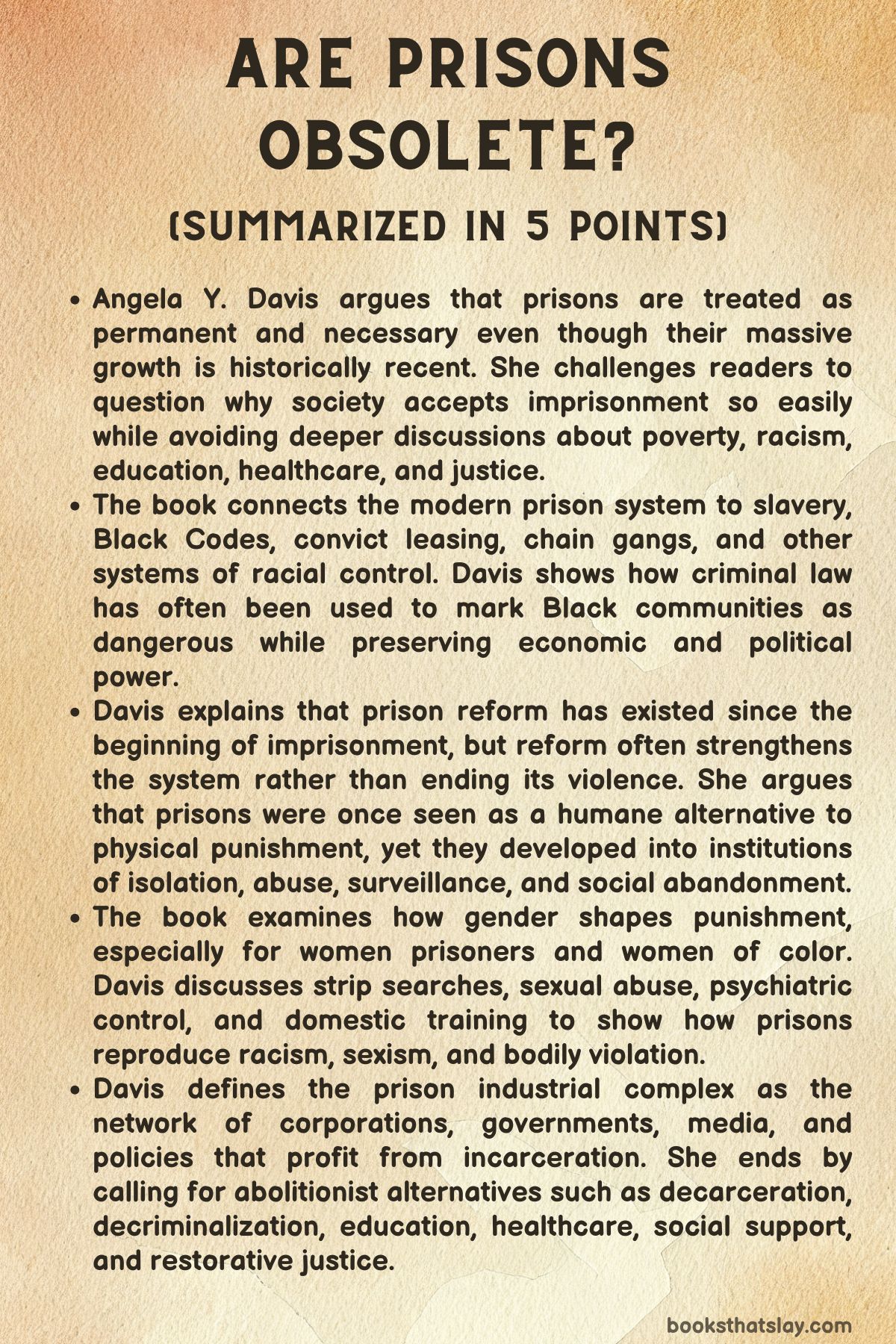
Davis examines how prisons became central to modern punishment, how they carry forward histories of slavery and racism, and how corporations, governments, and media benefit from mass incarceration. The book does not simply criticize prison conditions or call for gentler reforms. Instead, it asks readers to imagine justice beyond cages, punishment, and social abandonment. Davis presents abolition as a practical political project built on education, healthcare, economic justice, decriminalization, and restorative forms of accountability.
Summary
Davis begins Are Prisons Obsolete by asking why society finds it so difficult to imagine a world without prisons. Many people can picture a legal system without the death penalty, but far fewer can picture justice without imprisonment.
Davis argues that prisons have become so familiar that they seem permanent, even though their current scale is historically recent and politically constructed. The prison appears to most people as a normal part of public life, yet it remains hidden from everyday attention.
People assume prisons are for others, not for themselves, so they rarely think carefully about what happens inside them or why so many people are sent there.
Davis points to the massive growth of the United States prison system in the late twentieth century. The number of incarcerated people rose sharply even when crime rates did not justify such expansion.
This growth, she argues, cannot be explained simply as a response to crime. It must be understood through racism, economic inequality, political fear, and corporate profit.
Popular media helps preserve the prison’s legitimacy by presenting incarcerated people as dangerous outsiders. This image allows the public to avoid asking harder questions about poverty, racism, policing, education, housing, and labor.
The prison becomes a convenient way to remove social problems from view.
A central idea in the book is the prison industrial complex. Davis uses this term to describe the network of interests that links prisons, corporations, governments, media, and public policy.
Prisons do not only confine people; they also produce profit and political power. Companies benefit from prison construction, prison labor, surveillance technologies, food services, medical contracts, and the sale of goods to incarcerated people.
Politicians benefit by appearing tough on crime. Media benefits by repeating stories of danger and punishment.
Together, these forces make imprisonment seem useful and unavoidable, even when it fails to solve the problems it claims to address.
Davis then connects the prison system to the history of slavery. She argues that abolitionists who opposed slavery were once treated as unrealistic, much as prison abolitionists are often dismissed today.
Slavery was once viewed by many as a permanent institution, but radical struggle proved otherwise. After slavery formally ended, new systems developed to preserve racial domination.
Lynching, segregation, Jim Crow laws, and racial terror maintained white supremacy in new forms. Davis argues that prisons also belong to this history.
They continue to mark Black communities and other communities of color as criminal, dangerous, and disposable.
The legal loophole in the Thirteenth Amendment is important to Davis’s argument. The amendment abolished slavery except as punishment for crime.
After emancipation, southern states used Black Codes and other laws to criminalize newly freed Black people. Vague offenses allowed authorities to arrest Black people and force them back into labor.
Convict leasing and chain gangs became ways to extract labor under brutal conditions. In some cases, these systems were even more deadly than slavery because employers had little financial interest in keeping prisoners alive.
Through this history, Davis shows that the prison did not simply replace slavery, but helped carry forward its racial and economic logic.
She also explains that the products of prison labor often hide the violence that created them. Roads, buildings, furniture, and industrial development may appear ordinary, but they can be tied to forced labor and suffering.
Davis suggests that modern society often benefits from prison labor without recognizing it, just as many people once benefited from slave labor while ignoring its brutality. This hidden connection helps the prison system survive.
The public sees finished goods, safer streets, or political promises, but not the bodies and communities damaged by incarceration.
Davis next examines the history of imprisonment as a form of reform. The prison was not always the obvious punishment for crime.
In earlier periods, punishment often involved public torture, execution, or corporal violence. Reformers introduced imprisonment as a supposedly humane alternative.
The penitentiary was built around the idea that isolation, discipline, labor, and religious reflection could transform the individual. This idea developed alongside Enlightenment thought, Protestant ideas of self-examination, capitalism’s measurement of time, and new ideas about rights and liberty.
If freedom was understood as a central human right, then taking away freedom could be seen as punishment.
Yet Davis argues that what was once considered reform later became another form of cruelty. Solitary confinement, originally justified as a path to reflection, caused severe psychological harm.
Early critics already recognized this danger, and modern supermax prisons repeat the same violence on a larger and harsher scale. These institutions often abandon any serious claim to rehabilitation.
They isolate, control, and punish. Davis uses this history to show that prison reform can become part of the prison’s survival.
Reforms may soften one practice while leaving the larger system intact, or they may create new forms of punishment under the language of improvement.
Education becomes one of Davis’s key examples of what prison could have offered but often denies. She notes that many incarcerated people have used reading, writing, study, and political education to transform their understanding of themselves and society.
Malcolm X is one example of the power of self-education behind bars. Prison writing and prison literature have also helped expose conditions inside and inspire movements outside.
However, Davis argues that the state has repeatedly restricted education in prisons, especially through policies that cut access to college programs. Denying education keeps incarcerated people isolated from tools that could support growth, critique, and social change.
Gender is another major part of Davis’s analysis. She refuses to treat women’s imprisonment as a side issue simply because women make up a smaller portion of the prison population.
Instead, she argues that gender shapes the entire prison system. Men’s prisons are often associated with violence, discipline, and physical control, while women’s prisons have historically been tied to ideas of morality, domesticity, sexuality, and psychiatric control.
Women who broke the law were often viewed not only as criminals but as failed women. Their punishment was shaped by expectations about obedience, motherhood, purity, and domestic labor.
Davis pays particular attention to Black women and women of color, whose punishment is shaped by both racism and sexism. She discusses invasive searches, sexual abuse, psychiatric drugging, and the long history of treating imprisoned women as morally and sexually deviant.
Practices such as strip searches and cavity searches are presented as routine prison procedures, even though outside prison they would be recognized as sexual violation. Davis argues that sexual abuse by guards is not an accident of the system but part of how power operates behind bars.
Because prison walls hide abuse from public view, the system protects those who commit it.
She also criticizes reforms that seek equality by making women’s prisons more like men’s prisons. In Davis’s view, this is a limited and dangerous form of equality.
If men’s prisons are already violent and repressive, then copying their conditions in women’s prisons does not create justice. It only expands punishment.
True feminist analysis must question why prisons exist at all and how they reproduce gender violence. For Davis, women’s experiences make the case for abolition stronger, not narrower.
The book then returns to the prison industrial complex in more detail. Davis argues that the rise in incarceration is tied to economic shifts, especially deindustrialization and cuts to social welfare.
As stable jobs disappeared and public support systems weakened, many poor people and people of color were left vulnerable. Instead of investing in housing, schools, healthcare, drug treatment, and employment, the state invested in policing and prisons.
This turned social problems into criminal problems. People harmed by poverty and abandonment were punished rather than supported.
Private prisons make this logic especially clear. When companies are paid to house incarcerated people, profit depends on keeping prisons full.
Corporations also profit from selling services and products inside prisons. Davis warns that this creates a direct financial interest in incarceration.
The prison system also becomes global, as the United States exports prison models, security technologies, and supermax designs to other countries. For Davis, this spread risks exporting racialized punishment and harsh confinement across the world.
In the final section, Davis addresses the question most often asked of abolitionists: what should replace prisons? She argues that there should not be one single replacement.
The prison system absorbs many social failures, so abolition must involve many solutions. These include better schools, accessible healthcare, mental health services, drug treatment, housing, employment, and stronger communities.
Davis calls for decarceration, decriminalization, and a shift away from punishment as the main response to harm.
She argues that behaviors such as drug use, sex work, undocumented migration, and survival responses to abuse should not be treated primarily through criminal law. Decriminalization would reduce the number of people sent into prisons and force society to address the real causes of harm.
Davis also asks readers to question the category of “criminal.” Many people break laws, but only some are marked permanently as criminals. Race, class, gender, and power determine who receives that label.
Davis ends by pointing toward restorative and reconciliatory justice. Instead of asking only how to punish, society should ask how to repair harm, understand its causes, and prevent future violence.
She uses the example of Amy Biehl’s murder in South Africa, where Biehl’s parents supported a reconciliation process for the men responsible for her death. Those men later worked with the family’s foundation.
For Davis, this case shows that justice can be built around accountability, repair, and human transformation rather than revenge.
Overall, Are Prisons Obsolete argues that prisons are not natural or inevitable. They are historical institutions created by specific political, racial, and economic forces.
Because they were made, they can also be unmade. Davis’s abolitionism is not a call to ignore harm.
It is a demand to take harm more seriously than prisons do, by building a society that prevents violence, supports human needs, and refuses to treat cages as the answer to social crisis.
Key Figures
Angela Y. Davis
Angela Y. Davis is the central intellectual figure in the book, not as a character in a fictional sense but as the guiding voice shaping its political and moral argument. In Are Prisons Obsolete?, Davis writes as a scholar, activist, former prisoner, and abolitionist, bringing together historical research and lived awareness of state punishment.
Her role is to challenge what most readers assume to be permanent: the prison itself. Davis does not present abolition as a vague ideal or emotional reaction.
She treats it as a serious political project that requires people to question why prisons exist, whom they serve, and what social problems they hide. Her voice is firm, analytical, and urgent, but it is also imaginative.
She asks readers to think beyond punishment and to consider education, healthcare, economic justice, decriminalization, and restorative justice as real alternatives. Davis’s importance in the book comes from her ability to connect history, race, gender, economics, and public policy into one clear argument: prisons are not natural institutions but systems built through power, profit, and social neglect.
Incarcerated People
Incarcerated people are among the most important collective figures in the book because Davis treats them not as a faceless criminal class but as human beings shaped by social forces. The book repeatedly challenges the public habit of imagining prisoners as separate from ordinary society.
Davis argues that this separation allows people to ignore prison conditions and avoid responsibility for the inequality that feeds incarceration. Many prisoners come from communities harmed by racism, poverty, weak schools, lack of healthcare, unemployment, police surveillance, and political abandonment.
Davis shows that prisons often punish people for conditions society helped create. Incarcerated people also appear as laborers whose bodies are made useful to governments and corporations.
They are confined, controlled, and exploited, yet their labor can produce goods and services for the outside world. Davis also presents prisoners as thinkers, writers, students, and political actors, especially when she discusses education, prison literature, and rebellion.
This portrayal resists the idea that prison defines a person’s entire identity.
Black Communities
Black communities function as a major historical and political figure in the book because Davis argues that the prison system cannot be understood apart from anti-Black racism. The book shows how slavery, Black Codes, convict leasing, chain gangs, segregation, and modern incarceration belong to a long history of racial control.
After emancipation, the criminal legal system became a tool for reasserting power over formerly enslaved people. Vague laws allowed Black people to be arrested and forced into labor, creating a bridge between slavery and the prison.
Davis argues that the association between Blackness and criminality did not disappear with older racist systems; it survives through policing, sentencing, media representation, and public fear. Black communities are shown as over-policed and under-protected, targeted by institutions that claim neutrality while producing unequal outcomes.
In Are Prisons Obsolete?, Davis treats the criminalization of Black people as one of the clearest signs that the prison is not simply a response to crime but part of a broader racial order.
Women Prisoners
Women prisoners are crucial figures because Davis uses their experiences to reveal how gender shapes punishment. She rejects the idea that women’s imprisonment is a minor issue just because women are a smaller part of the prison population.
Their treatment exposes forms of control that are often hidden in broader discussions of incarceration. Women in prison have historically been judged not only as lawbreakers but as failed women, failed mothers, sexually deviant people, or mentally unstable subjects.
Davis shows how women’s prisons have been shaped by domestic training, psychiatric control, sexual surveillance, and abuse. The routine use of strip searches and cavity searches reveals how the prison turns bodily violation into procedure.
Women of color, especially Black women, face punishment through both racism and sexism, making their experiences central to Davis’s abolitionist argument. Davis also criticizes reforms that seek equality by making women’s prisons harsher and more like men’s prisons.
For her, that kind of reform only expands punishment rather than challenging its logic.
Assata Shakur
Assata Shakur appears as a powerful figure whose imprisonment exposes the racial and gendered violence of the prison system. Davis uses Shakur’s experience to show how Black women can become targets of state power in ways that combine political repression, misogyny, and racism.
Shakur’s descriptions of invasive searches and cruel treatment reveal the prison not as a neutral institution of justice but as a place where the state exercises intimate control over the body. Her presence in the book also matters because she is not treated as merely a victim.
She stands as a political witness whose writing makes visible what prison authorities often keep hidden. Through Shakur, Davis highlights how imprisoned women, especially politically conscious Black women, are punished for both their alleged crimes and their refusal to submit quietly to state power.
Shakur’s role strengthens the book’s argument that prison practices must be examined not only legally but morally, historically, and politically.
Prison Reformers
Prison reformers appear as complicated figures in the book because Davis recognizes both their historical importance and their limitations. Early reformers opposed public torture, execution, and corporal punishment, and their efforts helped create imprisonment as a supposedly humane alternative.
Figures such as John Howard and Jeremy Bentham represent the belief that confinement could produce reflection, discipline, and moral change. Yet Davis shows that reform can become part of the problem when it preserves the institution it seeks to improve.
The penitentiary itself began as a reform, but it became another system of violence and control. Modern reformers can repeat this pattern when they ask only for better prison conditions without questioning why prisons are used so widely in the first place.
Davis does not dismiss every reform, but she warns that reforms must be judged by whether they reduce the power of prisons or make them stronger. In this sense, reformers serve as a cautionary presence in the book.
Corporations
Corporations are major institutional figures because Davis presents them as active beneficiaries of mass incarceration. They profit from prison construction, private prison management, prison labor, food services, medical services, surveillance equipment, and goods sold to incarcerated people.
In the book, corporations are not distant from punishment; they are deeply involved in making imprisonment economically useful. Davis argues that when profit becomes attached to incarceration, the system gains a financial reason to keep prisons full.
This creates a disturbing relationship between human captivity and business growth. Corporations also benefit from the public’s ignorance.
Many people do not see the labor, contracts, and financial arrangements behind the prison system, so corporate involvement remains hidden behind the language of safety and justice. Davis’s portrayal of corporations makes clear that mass incarceration is not only a legal or political issue.
It is also an economic structure that turns punishment into a market.
The State
The state is one of the most powerful figures in the book because it creates, funds, protects, and legitimizes the prison system. Davis presents the state as an institution that often responds to social problems through punishment rather than care.
Instead of investing deeply in schools, housing, healthcare, employment, and mental health services, the state expands policing, courts, and prisons. This choice is political.
It defines certain populations as dangerous and treats their removal as a solution. The state also helps preserve racial and class inequality by deciding which acts are criminalized and which harms are ignored.
Davis shows that laws are not neutral simply because they are written in official language. They can carry forward older forms of domination, as seen in the connection between slavery, Black Codes, convict leasing, and modern incarceration.
In Are Prisons Obsolete?, the state is not only a background authority but a central force in producing the prison as a normal part of society.
The Media
The media appears as a cultural figure that shapes how the public understands prisons and prisoners. Davis argues that television, film, news, and popular prison imagery often give people the illusion that they know what prison is like.
In reality, these images can distort prison life and turn incarcerated people into symbols of danger. The media helps create emotional distance between the public and prisoners by repeating the idea that prisons contain evil people who deserve removal from society.
This makes it easier for viewers to avoid asking why certain communities are policed more heavily, why prisons keep expanding, or what conditions exist inside them. The media also supports the prison industrial complex by making punishment seem natural and necessary.
Davis’s treatment of the media is important because it shows that prisons survive not only through laws and buildings but also through stories, images, fears, and assumptions.
Abolitionists
Abolitionists are the visionary figures of the book. Davis connects prison abolitionists to earlier movements against slavery, lynching, segregation, and the death penalty.
Like earlier abolitionists, they are often dismissed as unrealistic because they challenge institutions that many people consider permanent. Davis presents abolitionists as people who refuse to accept the prison as the final answer to harm.
Their work is not limited to closing prison buildings. It requires changing the social conditions that make prisons seem necessary: racism, poverty, gender violence, lack of healthcare, poor education, and economic exploitation.
Abolitionists in the book are practical thinkers because they ask what kinds of institutions would actually reduce harm. They push society away from revenge and toward prevention, accountability, repair, and social support.
Davis portrays them as necessary because without abolitionist imagination, reform remains trapped inside the prison’s own logic.
Amy Biehl’s Family
Amy Biehl’s family appears near the end of the book as an example of justice based on reconciliation rather than punishment. After Amy Biehl was killed in South Africa during apartheid-era political conflict, her parents supported a process that allowed the men responsible to seek amnesty through the Truth and Reconciliation Commission.
Their response does not erase the harm of Amy’s death, but it offers a different model of accountability. Davis uses this example to show that justice does not always have to mean permanent exclusion or imprisonment.
The men involved later worked with the Biehl family’s charitable foundation, creating a relationship that would have been impossible under a purely punitive model. Amy Biehl’s family represents the difficult but transformative possibility of asking why violence happens and how repair might be pursued.
Their role helps Davis close the book with a concrete example of the kind of justice abolitionists want society to take seriously.
Themes
Prison Abolition as a Serious Political Imagination
Abolition in Are Prisons Obsolete? is presented as a disciplined way of thinking, not a careless demand to remove prisons overnight without concern for harm.
Davis asks readers to recognize that every institution now seen as permanent was created under specific historical conditions. Slavery, segregation, lynching, and the death penalty were also defended as necessary by many people in their own time.
By placing prisons in this historical frame, Davis makes abolition easier to understand as part of a longer struggle against institutions once considered untouchable. The theme depends on imagination, but not fantasy.
Davis wants readers to imagine practical changes that would reduce dependence on prisons: better education, healthcare, housing, drug treatment, mental health support, and economic security. Her abolitionism also challenges the assumption that punishment creates safety.
Instead, she argues that prisons often hide violence, reproduce inequality, and fail to address why harm occurs. This theme is central because the book’s deepest challenge is not only to criticize prisons but to loosen their hold on the public imagination.
Racism and the Historical Continuity of Punishment
Davis presents the prison system as part of a long racial history rather than a neutral response to crime. The book connects slavery, the Thirteenth Amendment’s punishment clause, Black Codes, convict leasing, chain gangs, segregation, and modern incarceration.
This history shows how racial control can survive by changing its legal form. After slavery ended, southern states criminalized Black life through vague laws and then used imprisonment to force Black people into labor.
The prison therefore became one of the institutions through which white supremacy adapted after emancipation. Davis’s argument is not that modern prisons are identical to slavery, but that they carry forward related structures of racial domination, economic extraction, and social exclusion.
The theme is also cultural. Blackness has repeatedly been associated with criminality in public imagination, policing practices, and media representation.
This racial coding allows unequal punishment to appear normal. Davis insists that prison abolition cannot be separated from antiracist struggle because the prison system is built through racial inequality and continues to protect it.
Profit, Corporations, and the Prison Industrial Complex
The prison industrial complex is one of Davis’s most important concepts because it explains why prisons keep expanding even when they fail to solve social problems. The theme shows how punishment becomes tied to profit.
Corporations benefit from prison construction, private prison contracts, surveillance technology, food services, prison labor, and goods sold to incarcerated people. Governments also benefit politically by appearing tough on crime, while media industries benefit from fear-based images of criminality.
Together, these relationships create a system in which many institutions gain from incarceration. Davis argues that this profit motive changes how society responds to poverty, unemployment, addiction, migration, and mental illness.
Instead of treating these as social issues requiring care and investment, the prison industrial complex turns them into opportunities for punishment and revenue. This theme is especially disturbing because it shows that prisons are not maintained only by fear of crime.
They are also maintained by business interests, political incentives, and public ignorance. The more prisons become economically useful, the harder it becomes to reduce reliance on them.
Gender, Sexual Violence, and the Control of Bodies
Gender shapes imprisonment in ways that expose the prison’s deeper violence. Davis shows that women prisoners have historically been punished not only for breaking laws but for violating social expectations of femininity, motherhood, obedience, and sexual respectability.
Women’s prisons were often designed around domestic training, psychiatric control, and moral correction, while men’s prisons emphasized discipline and physical severity. This difference reveals that punishment is never gender-neutral.
Women, especially Black women and other women of color, experience the prison through both racial and sexual control. Invasive searches, sexual abuse by guards, forced exposure, and psychiatric drugging show how the institution claims authority over the body itself.
Davis also warns against reforms that seek equality by making women’s prisons more like men’s prisons. Such reforms do not produce justice; they only spread harsher punishment.
This theme matters because it expands abolitionist analysis beyond prison population numbers. Women may be a smaller percentage of incarcerated people, but their experiences reveal how deeply prisons depend on humiliation, bodily control, and hidden abuse.