Are You My Mother? Summary and Analysis
Are You My Mother? A Comic Drama is Alison Bechdel’s memoir about her relationship with her mother, Helen, and the emotional questions that remain after the success of Fun Home—though here Bechdel turns her attention away from her father and toward the parent who is still alive, still guarded, and still hard to reach.
The book blends memory, dreams, therapy, literary criticism, and psychoanalysis to examine how a daughter becomes herself while seeking recognition from a distant mother. It is also a book about writing itself: why people turn family pain into art, and what that act costs.
Summary
Are You My Mother? follows Alison Bechdel as she tries to understand her relationship with her mother, Helen, while also trying to write the very book the reader is holding.
The memoir begins with a dream in which Alison traps herself in a basement while moving plywood. Her escape route appears through a window with a spider on it and then through a door that opens onto water.
She jumps in and feels a strange release. This dream becomes an early sign of the book’s main struggle: Alison is searching for a way out of emotional confinement, but the path requires trust, risk, and surrender.
At the same time, Alison is anxious about her mother’s reaction to her earlier memoir, Fun Home, which reveals painful details about her father, Bruce, including his hidden sexuality and his apparent suicide. Alison remembers similar anxiety from earlier moments in life, such as telling her mother she was a lesbian or admitting she had begun menstruating.
Helen agrees that Alison can write the book, but she refuses to help and hopes it will not be too angry. This combination of permission and distance defines much of their relationship.
As Alison works on Are You My Mother?, she becomes convinced that she is avoiding the real subject. She transcribes phone calls with Helen, hoping to capture her voice.
In these calls, Helen talks about ordinary things: books, friends, clothes, news, and family memories. Alison says little, becoming almost like a recorder.
This reverses a childhood pattern, when Alison’s obsessive-compulsive habits led Helen to write down Alison’s diary entries while Alison dictated them. The mother once took over the daughter’s writing; now the daughter records the mother’s speech.
Therapy gives Alison a language for this relationship. She sees two major therapists, Jocelyn during her younger adulthood and Carol later in life.
Through them, she studies her longing for maternal attention and her habit of attaching herself to therapists, writers, and psychoanalytic thinkers. One of the most important figures for her is Donald Winnicott, whose theories about mothers, infants, creativity, and the self guide much of the book.
Alison is so drawn to Winnicott that she jokes she wants him to be her mother. His idea of the “ordinary devoted mother” helps Alison examine photographs of herself as an infant with Helen.
In those photos, Alison seems to mirror her mother’s face, but she also notices the presence of her father behind the camera. Even as a baby, she imagines herself shaped by the tensions in the family.
The memoir moves through Alison’s dreams, memories, and reading. While writing Fun Home, she reads Freud and dreams of spiders, blankets, and warning signs.
Freud leads her to consider slips, injuries, and symptoms as expressions of buried feeling. She remembers childhood rituals in her diary, where she crossed out the word “I” and people’s names to protect herself from danger.
She also recalls entering therapy after losing interest in life. Jocelyn suggests that Alison may be angry at her father for dying, but Alison resists that idea.
Soon, however, her attention turns toward her mother. She wonders whether Fun Home is partly an act of anger against Helen.
Alison also reads Alice Miller’s The Drama of the Gifted Child, which helps her see herself as an emotionally alert child who learned to care for the needs of adults. Miller’s work leads her back to Winnicott, especially his ideas about transitional objects and the Good-Enough Mother.
Alison’s childhood teddy bear, Mr. Beezum, becomes important as a symbol of comfort, separation, and need. She links the bear to stories of Helen’s trouble breastfeeding her, suggesting an early history of unmet need.
Yet Alison does not simply condemn Helen. She tries to understand how imperfect care shapes a child’s mind and creativity.
Helen herself emerges as intelligent, talented, and frustrated. She loved acting and costume design, but marriage and motherhood narrowed her possibilities.
She met Bruce through theater, gave up a fuller artistic life, and became a mother in a household ruled by Bruce’s moods and secrecy. Alison sees her mother’s emotional restraint as partly the result of this marriage.
Helen is capable of sharp criticism, artistic insight, and commanding stage presence, but she struggles to give Alison the approval and warmth Alison wants.
Alison studies Winnicott’s concept of the True Self and False Self, which helps her understand both her parents. The True Self is spontaneous and alive; the False Self develops as a defense when the child’s real impulses are not welcomed.
Alison sees Bruce as someone crushed by his inability to live openly. She also sees Helen as someone who learned performance, control, and distance.
Alison, too, developed compliance and self-editing. As a child, she tried to become more polite and lovable, even calling Helen “mother” and apologizing frequently.
Yet when Helen asked whether Alison loved her, Alison’s answer felt careful rather than free.
The book also explores Alison’s religion, sexuality, and early bodily shame. She remembers the comfort of Catholic ritual and the sadness she often felt in church.
She recalls drawing a picture of a doctor examining a little girl’s genitals and then hiding after Helen discovered it. Around that time, Helen stopped kissing Alison goodnight, though she continued to show tenderness toward Alison’s brothers.
Alison later wonders how much of her self-consciousness came from being gay, but she also believes her sexuality helped reunite her mind and body. Coming out created pain, but it also forced truth into the open.
Alison’s romantic life mirrors her family patterns. Her relationship with Eloise is intense, unstable, and full of betrayal.
Alison wants closeness but fears dependence. She cheats, confesses, feels guilty, and repeats the pattern.
Eloise also betrays her. During these years, Alison’s attachment to Jocelyn grows stronger, and therapy becomes a place where she seeks the reliable mothering she did not receive from Helen.
Jocelyn sometimes crosses professional boundaries by hugging Alison or calling her “adorable,” but these moments matter deeply to Alison because they give her the affirmation she craves.
As Alison becomes a cartoonist, Helen’s reactions remain mixed. She criticizes Alison’s lesbian cartoons as limiting and suggests a pen name.
Later, when Alison sends her writing to Helen, Helen’s responses can be intelligent but cold. A confession of jealousy about Alison’s potential success damages Alison’s desire to continue writing about her father for many years.
Alison connects this to Adrienne Rich, Virginia Woolf, and Anne Bradstreet, considering how women writers struggle against inherited forms, male authority, and family expectations. Helen might have become a critic or artist herself, but her life took another course.
Alison’s writing therefore becomes both an achievement and a source of tension between mother and daughter.
The memoir’s later sections focus on mirroring, performance, and separation. Alison remembers Helen’s obsession with appearance and makeup, including Alison’s efforts to make herself look like “a real child.” She also remembers Helen’s powerful stage performances.
Watching Helen act gives Alison a rare feeling of closeness. Theater becomes one of the few places where Alison can admire her mother without needing anything from her.
When they attend A Little Night Music together, Alison is moved by the play’s mother-daughter themes and by the death of the older female character. She realizes that watching a play about acting with Helen is one of the closest experiences they have shared.
The final movement of Are You My Mother? centers on Winnicott’s idea that a child must be able to “destroy” the mother as an inner object and discover that the real mother survives.
This does not mean literal harm; it means that the child must separate psychologically and stop treating the mother as only an extension of the self. Alison struggles with this.
Jocelyn tells her that her anxiety may come from anger at Helen, but Alison often feels only emptiness. When Alison asks Helen what lesson she learned from her own mother, Helen answers that boys are more important than girls.
The answer shocks Alison but also helps explain Helen’s emotional inheritance.
Alison’s life continues to change. Her relationship with Eloise ends.
Later, she learns that Jocelyn has died of cancer, a loss that comes during another period of personal upheaval. Alison is also dealing with the end of a long relationship with Amy and the pressures of book tours and public exposure.
Helen, meanwhile, offers a quotation about memoir: the writer must serve the story rather than the family or even plain truth. This statement becomes a strange kind of blessing.
Helen may dislike personal writing, but she also understands something about artistic duty.
Near the end, Alison sends Helen a new draft of Are You My Mother?. This time, Helen calls it coherent and recognizes it as a “metabook,” a book about its own making.
Alison feels relief. She believes she has finally managed to separate from the internal version of her mother while still allowing the real Helen to exist.
The book closes not with perfect reconciliation, but with a clearer understanding of distance. Alison remembers a childhood game in which she pretended to be disabled so Helen could fix her.
Looking back, she sees that both mother and daughter carried invisible wounds. Helen’s emotional absence caused pain, but it also created the space in which Alison learned to think, write, and find her own way out.
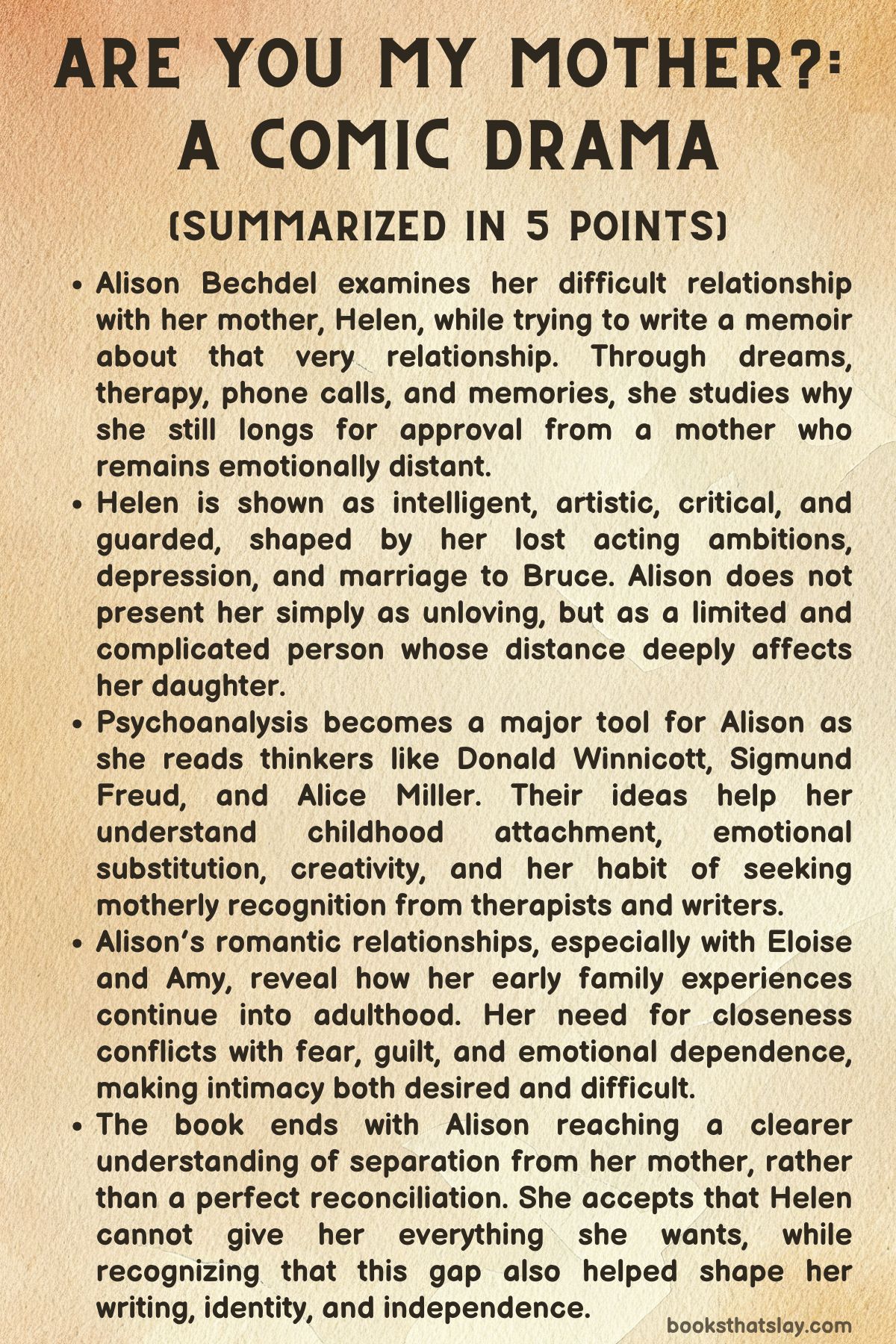
Key Figures
Alison Bechdel
Alison Bechdel is the central figure of the book and the consciousness through which every other figure is examined. She appears not only as a daughter trying to understand her mother, but also as a writer studying the sources of her own creativity, anxiety, shame, and emotional hunger.
Her mind is restless, analytic, and self-questioning. She reads psychoanalysis, records dreams, transcribes phone calls, studies old photographs, and revisits childhood memories as if each might reveal the hidden structure of her life.
In Are You My Mother?, Alison is especially concerned with why she continues to seek approval from a mother who cannot easily provide it. Her need for recognition shapes her writing, her therapy, and her romantic relationships.
At the same time, she is not presented as simply wounded or helpless. She is disciplined, intellectually alive, and capable of turning confusion into art.
Her struggle is to separate from the internal version of Helen she carries inside herself, while still accepting the real Helen as limited, separate, and human.
Helen Bechdel
Helen Bechdel is one of the most complex figures in the book because she is both Alison’s mother and Alison’s subject. She is intelligent, theatrical, sharp, guarded, and emotionally difficult to reach.
Her early life as an actress and costume designer suggests a woman with strong creative gifts, but marriage and motherhood redirect her life into narrower roles. Helen’s relationship with Alison is marked by distance rather than open cruelty.
She can be perceptive about writing and art, but her criticism often feels cold to Alison because it rarely comes with warmth or reassurance. Helen dislikes exposure, especially when family history becomes material for memoir, and she worries about privacy, reputation, and betrayal.
Yet she is not written as a simple antagonist. Her own frustrations, lost ambitions, depression, and marriage to Bruce help explain some of her reserve.
In Are You My Mother?, Helen becomes the figure Alison must stop idealizing, blaming, and needing in the same old way. She is not the mother Alison wanted, but she is also not only the cause of Alison’s pain.
Bruce Bechdel
Bruce Bechdel, Alison’s father, remains a powerful presence even though the book focuses mainly on Alison and Helen. He is connected to secrecy, emotional volatility, artistic control, and unresolved family trauma.
His closeted sexuality and apparent suicide haunt Alison’s understanding of both parents. Bruce’s life affects Helen deeply, and Alison often reads Helen’s distance through the strain of her marriage to him.
He appears as someone who could be romantic, cultured, and intellectually impressive, but also dismissive, angry, and damaging. His inability to live openly becomes important to Alison’s interpretation of Winnicott’s True Self and False Self.
Bruce seems like a man trapped in performance, unable to bring his real desires and social identity into harmony. His presence also complicates Alison’s bond with Helen because the mother-daughter relationship never exists in isolation.
It is shaped by Bruce’s moods, his secrets, his death, and his dominance within the family home.
Jocelyn
Jocelyn is Alison’s earlier therapist and one of the most important maternal substitutes in the book. Alison enters therapy with Jocelyn during a period of depression and soon develops a strong attachment to her.
Jocelyn becomes a figure of emotional attention, someone Alison wants to be seen by, comforted by, and affirmed by. Their relationship is professionally structured, but it also contains moments of boundary-crossing intimacy, such as hugs and personal disclosures.
These moments matter because they give Alison something she has long wanted from Helen: a sense of being recognized as vulnerable and lovable. Jocelyn helps Alison consider anger, especially anger directed toward her mother, even when Alison cannot fully feel or accept it.
Later, Jocelyn’s refusal to hug Alison becomes just as important as the earlier comfort, because it forces Alison to face separation. Jocelyn’s death also becomes a quiet but major loss, showing how deeply Alison had invested in her as a sustaining figure.
Carol
Carol is Alison’s later therapist and serves as a steady witness to Alison’s creative and emotional difficulties while she tries to write the book. Unlike Jocelyn, who belongs to Alison’s younger adulthood, Carol is connected to Alison’s mature self: the established artist, the memoirist, the middle-aged daughter still struggling with the same maternal questions.
Carol helps Alison examine dreams, creative blocks, menopause, anxiety, and the feeling that she is writing around something rather than facing it directly. Her role is less dramatic than Jocelyn’s, but she is crucial because she gives Alison a place to think through the book as it is being made.
Carol often helps Alison notice role reversals, projections, and emotional patterns that Alison might otherwise intellectualize without fully understanding. She is also important because she represents the ongoing nature of self-analysis.
Alison does not arrive at insight all at once; she reaches it through repeated conversation, resistance, revision, and return.
Donald Winnicott
Donald Winnicott is not a character in the ordinary fictional sense, but he is one of the central intellectual figures in Are You My Mother?. Alison treats his psychoanalytic work almost as a guidebook for interpreting her life.
His ideas about the ordinary devoted mother, the Good-Enough Mother, transitional objects, the True Self and False Self, and the child’s need to recognize the mother as separate all shape the book’s emotional structure. Alison is drawn to him not only as a thinker but also as a kind of imagined parent.
She wants his theories to explain what happened between her and Helen, but she also wants the comfort of his attention and understanding. Winnicott’s importance lies in the way his work gives Alison a vocabulary for experiences that otherwise feel private and shapeless.
Through him, motherhood becomes not only a personal relationship but also a psychological process involving dependence, failure, adaptation, anger, and separation.
Virginia Woolf
Virginia Woolf appears as a literary mirror for Alison’s struggle with mothers, art, and memory. Alison connects Woolf’s writing, especially her treatment of maternal absence and family dynamics, to her own attempt to write about Helen.
Woolf becomes a model of how a writer can return to unresolved family feeling through art. Alison is especially interested in Woolf’s relationship to her mother and in how writing can become a way of processing what was never settled in life.
Woolf also represents the burdens placed on women artists, who must create while carrying family expectations, gendered limits, and emotional inheritance. Through Woolf, Alison thinks about how a daughter can transform longing into form.
Woolf’s presence in the book also deepens the connection between private family history and literary tradition. Alison is not only telling her own story; she is placing herself among women who used art to face loss, silence, and maternal power.
Sigmund Freud
Sigmund Freud functions as one of the book’s major interpretive authorities, though Alison’s use of him is often questioning rather than submissive. His writings on dreams, slips, narcissism, and unconscious meaning help Alison interpret accidents, symptoms, and strange repetitions in her life.
Freud gives her a way to read ordinary events as signs of hidden conflict. When Alison injures herself or remembers childhood rituals, Freud’s theories offer possible explanations for behavior that once seemed irrational.
At the same time, his ideas can feel limited, especially around women and sexuality. Alison does not simply accept him as correct; she uses him as one voice in a larger conversation.
Freud’s presence shows Alison’s need to make sense of herself through systems of thought. He also represents the danger of overinterpretation: the possibility that every dream, mistake, or injury can become evidence in a case the mind is building against itself.
Alice Miller
Alice Miller is important because her work helps Alison understand herself as a child who became unusually sensitive to parental emotion. Miller’s idea of the gifted child gives Alison a framework for seeing how children may learn to care for wounded or narcissistic parents in order to receive love.
This speaks directly to Alison’s childhood role in the Bechdel family. She was observant, careful, and emotionally alert, often reading the atmosphere around her rather than freely expressing herself.
Miller’s work helps Alison understand why she attaches so strongly to therapists and creative work: both become substitutes for the responsive mother she wanted. Yet Miller is also part of Alison’s larger pattern of seeking answers in books.
Alison turns to theory because theory seems to promise order. Miller gives Alison language for her pain, but the emotional work still has to happen in her life, her therapy, and her writing.
Adrienne Rich
Adrienne Rich appears as a feminist literary figure whose work helps Alison think about women, writing, anger, and artistic authority. Rich’s criticism of patriarchal literary forms matters to Alison because both she and Helen are women shaped by artistic ambition and social constraint.
Rich’s rejection of Alison’s early story hurts, but it also teaches Alison that personal material must be shaped into something more substantial. This lesson becomes central to Alison’s development as a writer.
Rich also helps Alison understand the difference between writing as confession and writing as art. Her essays on women writers, female inheritance, and creative struggle give Alison a larger context for Helen’s lost ambitions and her own career.
Rich’s presence brings political and literary force into the book, reminding the reader that Alison’s family story is also tied to gender, authorship, and the difficulty women face when turning private experience into public work.
Eloise
Eloise is Alison’s lover during a major period of emotional and artistic formation. Their relationship is passionate but unstable, filled with attraction, jealousy, betrayal, confession, and conflict.
Eloise’s brashness and activism contrast with Alison’s introspection and self-analysis. Through Eloise, Alison’s fear of intimacy becomes visible.
Alison wants love, but she also resists dependence and repeats patterns of guilt and distance. Their open relationship and repeated infidelities expose Alison’s difficulty in sustaining trust.
Eloise is not merely a romantic partner; she is part of the emotional field in which Alison’s unresolved needs surface. The relationship echoes Alison’s larger struggle with attachment: she longs to be held and recognized, but closeness also threatens her independence.
Eloise’s eventual betrayal and the end of the relationship push Alison further into therapy and self-examination. In this way, Eloise helps reveal Alison’s wounds without being reduced to a cause of them.
Amy
Amy is Alison’s later partner and appears in connection with dreams, writing, and emotional transition. She is less fully developed than Helen or Eloise, but her presence marks another stage in Alison’s adult life.
Alison shares dreams with Amy and discusses their possible meanings, showing that Amy participates in Alison’s habit of turning private experience into analysis. The end of Alison’s long relationship with Amy comes at a chaotic time, near the discovery that Jocelyn has died.
This places Amy within the book’s wider pattern of loss, separation, and changing attachments. Amy’s role also shows that Alison’s difficulties with intimacy do not end with youth.
The same questions about dependence, recognition, and emotional survival continue into later adulthood. While Amy is not the main focus, she helps show the ongoing consequences of Alison’s early family life in her adult relationships.
Bob
Bob, Helen’s psychiatrist boyfriend, occupies a smaller but revealing role. His presence shows that Helen has an emotional and intellectual life beyond her role as Alison’s mother.
He also offers an interpretation of Alison’s dream, suggesting that water is favorable for creativity. This moment matters because it links dream analysis, art, and Alison’s writing process.
Bob’s position beside Helen is also significant. He is close to Helen in a way Alison is not, and this subtly reinforces Alison’s sense that her mother is available to others in forms she cannot access as a daughter.
Bob does not dominate the book, but he helps reveal Helen’s separateness. Helen is not only Alison’s mother; she is a woman with relationships, opinions, defenses, and private needs.
For Alison, accepting this separateness is part of the larger movement toward emotional maturity.
Themes
Motherhood, Distance, and the Need for Recognition
Motherhood in Are You My Mother? is examined as a relationship shaped by love, absence, resentment, need, and limitation.
Alison’s bond with Helen is painful because it is not openly hostile, yet it is rarely warm in the way Alison desires. Helen gives criticism, intelligence, and occasional cooperation, but she does not easily give emotional reassurance.
This leaves Alison searching for recognition through writing, therapy, dreams, and psychoanalytic theory. The book shows how a child may continue seeking the mother’s gaze long after childhood has ended.
Alison’s need is not simply childish dependence; it is tied to identity, creativity, and the wish to feel real in another person’s eyes. Helen’s distance also comes from her own history: lost artistic hopes, depression, marriage to Bruce, and inherited beliefs about gender.
This makes the mother-daughter relationship painful but not simple. The book refuses to turn Helen into either a villain or a saint.
Instead, it presents motherhood as a human relationship in which care can exist alongside failure. Alison’s growth depends on accepting that Helen cannot become the perfect mother of her imagination.
Writing as Self-Analysis
Writing is not treated as a clean act of expression; it is shown as a difficult process of exposure, revision, doubt, and emotional risk. Alison writes about her family because she needs to understand them, but writing also threatens the family’s privacy and reopens old wounds.
Helen’s reactions to Alison’s work make this conflict sharper. She can recognize artistic structure, but she also feels betrayed by personal disclosure.
For Alison, memoir becomes a form of self-analysis. She transcribes conversations, records dreams, examines photographs, remembers childhood incidents, and reads psychoanalytic theory in order to understand what she is really trying to say.
The book is therefore not only about Alison’s mother; it is about the making of a book about her mother. This creates a constant tension between life and art.
Alison must decide whether serving the story means disloyalty to the family. The answer is not easy, but the book suggests that writing can transform private confusion into meaning.
It does not repair everything, but it gives shape to what would otherwise remain buried or repeated without understanding.
Therapy, Projection, and Emotional Substitution
Therapy becomes one of the main spaces where Alison tries to understand her need for maternal care. Her relationships with Jocelyn and Carol reveal how old emotional patterns can reappear in new forms.
Alison does not only talk to her therapists; she attaches to them, longs for their approval, and sometimes wants them to mother her. This makes therapy both helpful and complicated.
Jocelyn’s warmth gives Alison comfort she badly needs, but Jocelyn’s later refusal to provide physical reassurance also teaches Alison something necessary about boundaries and separation. Carol, in a different stage of Alison’s life, helps her think through dreams, creative blocks, and the book’s structure.
Through these therapeutic relationships, the book explores projection: Alison places feelings connected to Helen onto other people who seem more available or more understanding. Psychoanalysis gives her language for this process, but language alone does not solve it.
The emotional task is harder. Alison must recognize that no therapist, writer, lover, or theory can replace the mother she wanted.
They can help her see the pattern, but they cannot complete the missing relationship.
Gender, Creativity, and the Inherited Lives of Women
The book repeatedly connects women’s creativity to restriction, inheritance, and self-denial. Helen’s life is central to this theme.
She has talent as an actress and a sharp literary mind, yet her marriage and motherhood limit her artistic path. Her frustration affects how she responds to Alison’s career.
She can admire skill, but she also feels discomfort, jealousy, and fear when Alison turns family life into public art. Alison reads writers such as Virginia Woolf, Adrienne Rich, and Anne Bradstreet to understand this larger history of women creating under pressure.
These literary figures help place Helen and Alison within a tradition of women negotiating ambition, family duty, male authority, and the need for a room of one’s own. The book also shows that Alison’s lesbian identity is part of her creative awakening.
It brings conflict, but it also helps her move toward honesty about the body, desire, and selfhood. Creativity here is not separate from gender; it is shaped by what women are allowed to want, say, and become.
Alison’s art grows from the very restrictions that once made self-expression feel dangerous.