Autobiography Of A Face Summary and Analysis
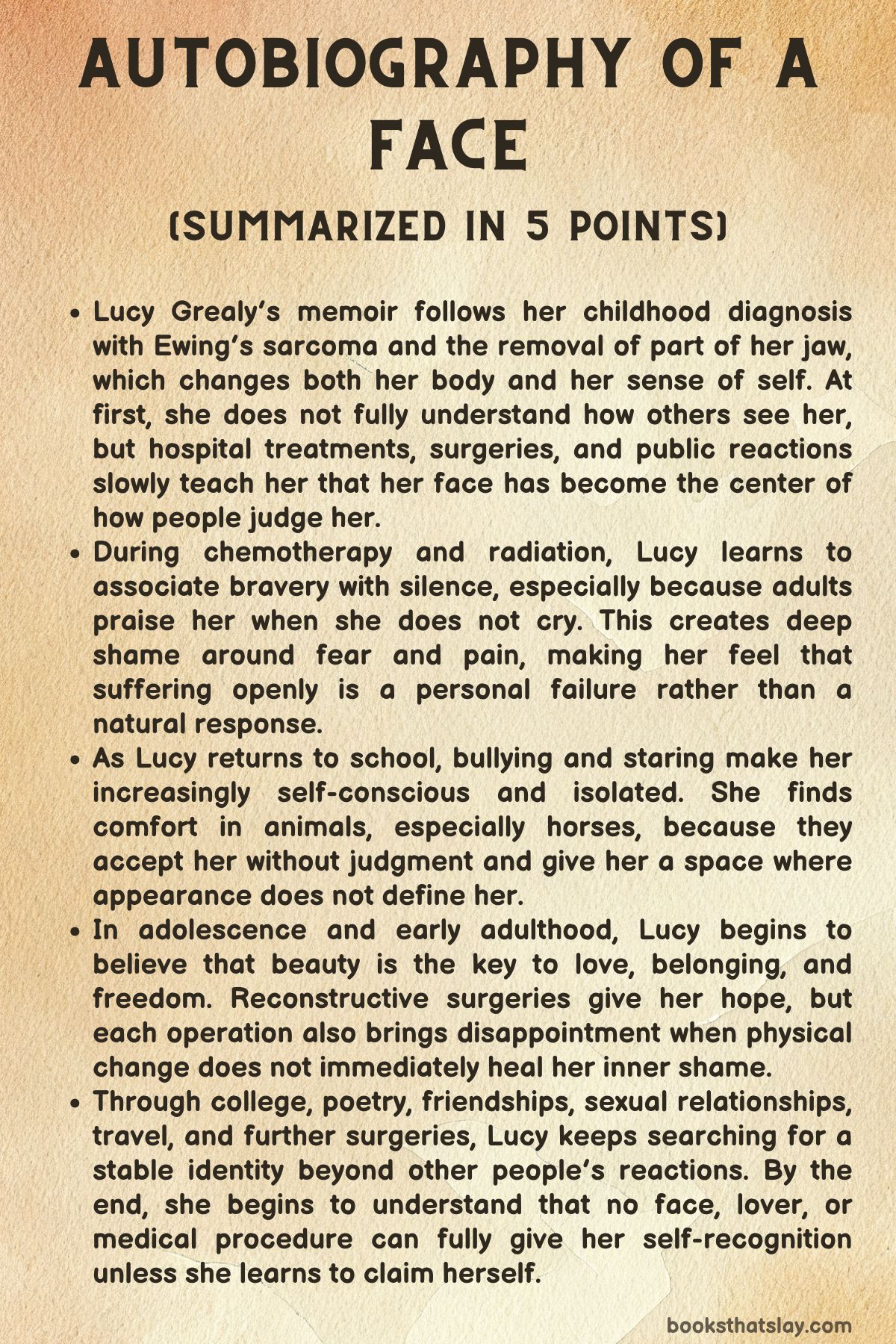
Autobiography Of A Face by Lucy Grealy is a memoir about illness, appearance, shame, desire, and the long search for a stable sense of self. Beginning with childhood cancer and the removal of part of her jaw, Grealy writes about the medical ordeals that shaped her body and the social cruelty that shaped her inner life.
The book is not only about disfigurement; it is about what happens when a person begins to believe that love, beauty, and belonging are all controlled by the face others see. Grealy’s voice is sharp, observant, unsentimental, and painfully honest.
Summary
Autobiography Of A Face begins with Lucy Grealy as a fourteen-year-old girl who has recently completed chemotherapy and takes a job at a riding stable. At this point, she has already survived cancer and the removal of half her jaw, but she is still not fully aware of how strongly other people react to her changed appearance.
When she calls the stable for work, her mother asks whether they know she has been sick. Lucy says yes, but in truth she has not thought to mention either cancer or her face.
This early moment captures one of the central tensions of the book: Lucy’s private sense of herself is often very different from the public identity forced on her by others.
At the stable, Lucy begins to understand how her face sets her apart. Other workers notice her pale, misshapen appearance, and children at pony parties stare, whisper, and laugh.
These reactions train her to become watchful and suspicious. She learns to read every whisper as a possible insult and every laugh as a possible joke about her.
Yet the horses give her a form of comfort that people do not. They do not judge her face or ask her to explain herself.
With them, Lucy feels understood, or at least safely unexamined. The pony parties also expose class differences: the wealthy suburban homes where she brings the horses remind her that her own family is financially strained and emotionally unsettled.
She links much of her mother’s unhappiness to money and secretly feels that her medical expenses are part of the burden.
The narrative then returns to the beginning of Lucy’s illness. As a child, she injures her jaw during a game of dodgeball.
At first, it seems like a minor accident, but that evening she develops a worsening toothache. Her mother reacts with anger at the inconvenience and possible cost, and Lucy interprets that anger as being directed at her personally.
Her father tries to calm the situation with humor, saying she has a cold in her tooth, but the pain does not go away. A doctor suspects a fracture, and an x-ray reveals what appears to be a dental cyst.
Lucy undergoes surgery, and for a time she enjoys the unusual attention that comes with being a patient. She wants to be special, and illness briefly gives her a role that seems dramatic rather than frightening.
When her face swells again months later, she is admitted to the hospital for more surgery. Still, she does not understand the seriousness of what is happening.
The hospital feels like an adventure, and she sees herself as the center of an important story. On the ward, she observes other children and quickly learns the code of behavior that will define her childhood illness: she must be brave, quiet, and good.
A boy who hides under his bed embarrasses her because his fear violates the rule she has accepted. Lucy believes that not crying and not complaining are ways to earn love.
Her family background deepens her sense of difference. Her parents are Irish immigrants, mocked for their accents and marked by financial hardship.
Her brother’s schizophrenia and her mother’s depression add to the feeling that the family is not normal. In the hospital, Lucy’s parents appear unusually composed when speaking to doctors, and she is surprised to see them behaving like the parents she has seen on television.
Yet even as doctors run tests, Lucy does not ask what they are looking for or what the results mean. She does not learn until later that she has Ewing’s sarcoma, a dangerous cancer with very low survival odds.
Lucy’s time in the hospital includes moments of mischief and imagination. She befriends Derek, a boy with asthma, and together they explore areas of the hospital.
One day they find animals used for medical experiments. Expecting something almost playful, they are horrified by the suffering they see.
This scene stays with Lucy as a disturbing vision of helplessness, confinement, and pain. It also mirrors her own situation, though she is not yet ready to understand that connection.
Before one major operation, Lucy’s nurse Mary tries to prepare her for the fact that she will look different afterward. Lucy brushes this aside because she does not understand the scale of the surgery.
The operation removes half of her jaw. Afterward, she has a tracheotomy and difficulty speaking.
She becomes weak and must be fed through a tube. Her mother visits and knits quietly, which Lucy appreciates because her mother does not demand conversation or cheerfulness.
Her father visits too, but his awkwardness makes the visits more painful. At first, swelling hides the full effect of the surgery, and Lucy even feels proud of her scar.
She has always resisted girlish ideas of prettiness, so she does not immediately experience the loss of facial symmetry as a catastrophe.
Chemotherapy and radiation change this. Lucy begins traveling regularly to New York with her mother for treatment.
Radiation seems manageable, but chemotherapy with Dr. Woolf is frightening and humiliating. Dr. Woolf is brusque and insensitive, and the injections make Lucy violently ill.
The worst part is not only the physical suffering but also her mother’s insistence that she must not cry. Lucy understands at some level that her mother is acting from fear and helplessness, but she still feels ashamed every time she breaks down.
Crying becomes a moral failure in her mind. She does not feel deserving of comfort because she has failed to be brave.
At home, Lucy retreats into fantasy. She plays with plastic animals and imagines their lives continuing outside while she is trapped indoors by sickness.
She pretends to be other people in other worlds, but on treatment days she cannot escape herself. Radiation causes weight loss, nausea, pain, and sores in her mouth.
She becomes so desperate to avoid chemotherapy that she tries to make herself sick in other ways, hoping illness will release her from the weekly ordeal. She watches idealized television families and imagines that in such homes everything would be discussed openly.
Her own family avoids emotional truth, so Lucy begins looking elsewhere for certainty, even in religious pamphlets that promise peace.
Chemotherapy also causes her hair to fall out. This loss shakes her more than she expects.
Her mother tells her that she knew it would happen and therefore should not be so upset, but Lucy’s distress increases. Eventually, she shaves her head and begins wearing a small white sailor’s hat, which becomes a protective barrier between herself and the world.
At first, she thinks the taunts from strangers and boys are mostly about baldness. When she visits a wigmaker and later studies herself carefully in the mirror, she realizes the truth of her altered face.
The missing jaw has created a sunken, uneven appearance. Her shock is intensified by shame that everyone else has seen this before she has.
She lies with the cats afterward because they do not care how she looks.
School makes her self-consciousness harsher. Some classmates are respectful, but a group of boys mock her, call her names, and tell her to take off her “monster mask.” Halloween becomes a revelation because, when her face is hidden by a costume, she feels bold and free.
She realizes that without the constant exposure of her face, she can move through the world with confidence. This discovery also convinces her that her face is the central thing wrong with her life.
In junior high, bullying becomes relentless. Boys call her ugly, use her as a joke, and dare each other to pretend romantic interest.
She begins eating in the guidance counselor’s office to avoid them. Her isolation grows, and she feels most at ease with other sick or disfigured children on the hospital ward.
When treatment finally ends, Lucy does not feel simple joy. She worries that if she is no longer a patient, she will no longer be special or loved.
At the same time, she has become emotionally numb. Her mother praises her for being good, but Lucy feels only emptiness.
After the final treatment, she unexpectedly breaks down in front of a hospital cleaner and cries with her whole body. This release suggests the depth of the fear, pain, and anger she has had to suppress.
As Lucy grows older, her hair returns, and she stops wearing the sailor’s hat. The old baldness insults fade, but the cruelty about her face continues.
She undergoes dental and reconstructive procedures, and doctors begin discussing operations that might restore a more normal jawline. Lucy begins to hope that if her face can be fixed, her life can be fixed too.
Beauty becomes, in her imagination, the route to love. Meanwhile, the horses remain her greatest comfort.
A horse named Sure Swinger becomes especially important to her. She spends long hours with him and forms an intense bond that gives her relief from human judgment.
In high school, literature and poetry begin to open another world. Lucy discovers the power of mystery and beauty in language, and she begins to think differently about experience.
But loss continues. Sure Swinger dies from an infection, leaving her devastated.
Soon afterward, her father becomes seriously ill and spends months in the hospital. The family avoids direct conversation, relying on forced optimism.
Lucy visits him only once and later learns that he has died. Her grief is mixed with relief that the waiting is over.
She and her sister laugh hysterically, not because the death is funny, but because they do not know how else to process it.
Reconstructive surgery brings hope and disappointment. After one skin graft, Lucy’s face is swollen and marked by foreign-looking skin.
Doctors say the result looks good, but she feels that their idea of good is far below what she had imagined. She begins to dream of a future beauty, something not yet present but possible.
She tries to stop caring, becomes intellectually pretentious, reads serious books, and becomes interested in Buddhism. She tells herself that her face is an asset because it teaches her to reject desire.
Yet she is still full of desire: for beauty, love, recognition, and romantic attention. Her attempts at spiritual detachment cannot erase her anger or loneliness.
At Sarah Lawrence College, Lucy finds a community where being an outsider can be a form of identity rather than shame. Students cultivate artistic difference, and Lucy feels accepted in ways she had not expected.
She adopts thrift-store clothes and an anti-fashion look, partly to show that she does not care what people think of her face. Poetry becomes central to her life because it allows her to enter the world through language, sensation, and image.
Still, surgeries continue to fail, and one operation leaves her swollen, ill, and deeply ashamed. A friend named Greg takes her to a gay club, where she dances freely because the usual heterosexual judgment feels suspended.
She enters artistic and social circles that give her excitement and distraction.
A successful bone graft briefly lets Lucy like what she sees in the mirror. But she is confused when improved appearance does not bring the freedom she expected.
She still does not feel attractive. She has friendships, but she believes the absence of a lover proves she is unlovable.
In graduate school, she begins a sexual relationship with Jude, an older writer. The relationship is difficult but important because it changes how she experiences her body and sexuality.
Lucy begins dressing provocatively and using her body to distract attention from her face. Male desire gives her temporary validation, but short relationships do not heal her deeper belief that she is not beautiful enough to be loved.
When the bone graft begins to fail, Lucy seeks escape by traveling to Europe. In London, street harassment makes her feel as if she is back in junior high.
Men mock her appearance and turn her into a joke. This pain pushes her toward another major procedure in Scotland.
After long, complex operations, her face begins to look more acceptable, but then the other side of her jaw changes and requires further treatment. When she finally looks better, she feels strangely detached from her reflection.
The face in the mirror does not feel like hers, and she avoids looking at herself for nearly a year.
The memoir ends with Lucy beginning to understand that beauty cannot solve the inner wound created by years of shame. She recognizes that she has allowed other people’s reactions to define her ugliness and has looked for herself only through those reflections.
Her journey back to her face is not a simple triumph but a slow movement toward self-recognition. She must accept that no surgery, lover, or public approval can give her a self unless she is willing to claim one.
By the end, she is ready to look again, not to confirm whether she is beautiful, but to see whether she can finally recognize herself.
Key Figures
Lucy Grealy
Lucy Grealy is the center of the book and its most fully examined consciousness. As a child, she begins with a strong sense of imagination, pride, and separateness.
She wants to be special before she understands the cost of being marked as different. Cancer gives her an identity as a patient, and at first she turns that role into a kind of adventure.
Over time, however, illness, surgery, bullying, and adult silence teach her to connect her face with shame. Her deepest struggle is not only with physical pain but with the meaning she assigns to her appearance.
She comes to believe that ugliness explains rejection, loneliness, and the absence of romantic love. This belief becomes so powerful that even medical improvement cannot immediately free her from it.
Lucy is also intellectually restless. She turns to animals, fantasy, religion, literature, Buddhism, poetry, sexuality, and travel as ways to survive and understand herself.
Her growth lies in realizing that the face is real, but the identity built around other people’s reactions to it is not the whole truth of who she is.
Lucy’s Mother
Lucy’s mother is one of the most difficult and important figures in Autobiography Of A Face. She is practical, anxious, emotionally guarded, and often harsh in ways that deeply wound Lucy.
When Lucy is in pain, her mother frequently responds by asking her not to cry, not because she is indifferent, but because she has no better way to manage fear. Her insistence on bravery teaches Lucy to treat suffering as a private failure.
At the same time, the book does not present her simply as cruel. She is burdened by money problems, depression, immigration, family instability, and the terror of watching her child endure a life-threatening illness.
Her quiet hospital visits, where she knits without forcing conversation, show that she can offer presence even when she cannot offer emotional openness. She often misunderstands Lucy’s needs, yet she remains tied to her daughter’s survival.
Her character shows how love can be real and still be poorly expressed.
Lucy’s Father
Lucy’s father is gentle, awkward, humorous, and emotionally distant. He tries to reduce tension through jokes and puns, as when he says Lucy has a cold in her tooth, but humor also becomes his way of avoiding fear.
During hospital visits, he does not know what to do with Lucy’s suffering and often sits uncomfortably, staring at the IV. His awkwardness makes Lucy aware of his helplessness, and she sometimes feels relief when he leaves the room.
His background as a prisoner of war adds another layer to his silence. His final illness and death reveal how little Lucy feels she truly knows him.
She searches his hospital room for some object or clue that will explain his life but finds nothing adequate. His death brings sorrow, but also relief, because the family’s long uncertainty ends.
He represents a form of love that is present but often unreachable, shaped by trauma and emotional restraint.
Lucy’s Mother and Father as Parents
As a parental pair, Lucy’s mother and father create an atmosphere where ordinary comfort is rare. They are not uncaring parents, but they are unable to give Lucy the open conversation, reassurance, and emotional clarity she imagines in television families.
They rely on silence, optimism, jokes, duty, and endurance. This matters because Lucy’s illness is not only medical; it is also psychological and social.
She needs help making sense of fear, disfigurement, and public cruelty, but her parents rarely provide language for those experiences. Their immigrant background and financial strain add pressure to the family.
They are trying to survive circumstances they do not know how to discuss. As a result, Lucy grows up believing that pain should be hidden, fear should be mastered, and love must be earned by being brave.
Lucy’s Twin Sister
Lucy’s twin sister appears most clearly as a contrast to Lucy’s self-image. Early on, Lucy is praised for not crying, while her sister is imagined as someone who would have cried openly.
This comparison strengthens Lucy’s belief that being brave makes her good. Her twin also appears at the time of their father’s death, when the two sisters laugh hysterically after receiving the news.
That reaction is not emotional shallowness; it shows how unprepared they are to express grief directly. The twin sister’s role is relatively limited, but she helps reveal family patterns.
Through her, the book shows how children in the same home may respond differently to fear, grief, and pressure, and how Lucy defines herself partly through difference from those closest to her.
Lucy’s Brother
Lucy’s brother is mentioned through his schizophrenia, which contributes to the family’s sense of being unusual and troubled. Though he is not developed in detail, his presence matters because Lucy grows up in a household already shaped by mental illness, anxiety, and hidden pain before her cancer becomes central.
His condition adds to the family’s difference from the “normal” families Lucy observes on television and in the neighborhood. He also helps explain the emotional climate surrounding Lucy’s childhood: illness is present, but it is not easily discussed.
His character broadens the book’s view of suffering beyond Lucy’s body, showing that the family contains multiple forms of vulnerability, many of them unnamed or poorly understood.
Derek
Derek is a boy on the hospital ward who has severe asthma. He becomes Lucy’s companion in mischief and gives her a rare experience of shared childhood during illness.
Their friendship allows her to act like a curious, disobedient child rather than only a patient. When they sneak into the area where medical research animals are kept, their adventure turns into a disturbing encounter with suffering.
Derek’s role is important because he belongs to Lucy’s hospital world, a space where illness is normal and where Lucy does not have to explain herself in the same way she does outside. He represents companionship under conditions of fear, and his presence gives Lucy moments of agency inside an institution that otherwise controls her body.
Mary
Mary, Lucy’s favorite nurse, is one of the few adults who attempts to prepare Lucy honestly for what is coming. Before the major surgery that removes part of Lucy’s jaw, Mary asks whether Lucy understands that she will look different afterward.
Lucy dismisses the warning, but Mary’s question matters because it acknowledges a truth that others either soften or avoid. Mary is caring without being falsely cheerful.
She recognizes that the operation will change not just Lucy’s body but also her relationship with the world. Her role is brief but meaningful because she stands for a kind of adult attention Lucy often lacks: direct, compassionate, and aware of the emotional consequences of medical treatment.
Dr. Woolf
Dr. Woolf is the chemotherapy doctor whose manner intensifies Lucy’s fear and shame. He is rude, hurried, and emotionally insensitive, able to divide his attention among multiple conversations while treating a terrified child.
For Lucy, he becomes associated with pain, nausea, dread, and humiliation. The chemotherapy itself is physically brutal, but Dr. Woolf’s lack of tenderness makes the experience worse.
He does not appear to understand, or care enough about, the emotional terror of the child in front of him. His character represents the cold side of medical authority: technically necessary, perhaps even life-saving, but personally damaging.
Through him, the book shows that survival can come through systems that do not always protect the patient’s dignity.
Dr. Woolf’s Nurse and Secretary
Dr. Woolf’s nurse and secretary appear in the background of the chemotherapy scenes, but their presence contributes to Lucy’s sense that her suffering is part of an efficient routine. Dr. Woolf can speak to them, to Lucy, to her mother, and to someone on the phone at the same time.
This busy atmosphere makes Lucy’s terror feel almost invisible. These figures are not individually explored, but they help create the medical environment around her treatment.
Their function in the book is to show how ordinary the machinery of illness can appear to adults working inside it, even while the child receiving treatment experiences it as overwhelming.
Dr. Woolf’s Cleaner
The cleaner in Dr. Woolf’s department appears near the end of Lucy’s treatment and becomes an unexpected witness to one of Lucy’s most powerful emotional releases. After the final chemotherapy session, Lucy speaks to the cleaner and suddenly cries uncontrollably.
This moment is important because the cleaner is not a doctor, parent, or authority figure. The person who happens to be present is someone outside the formal drama of treatment.
Lucy’s breakdown suggests that the body and mind release pain when they can, not necessarily in the presence of the people who are supposed to understand. The cleaner’s role is small, but the scene marks the end of Lucy’s forced bravery and the collapse of the numbness she has carried.
Evan
Evan is Lucy’s friend whose mother died of cancer. His presence connects Lucy’s illness to another family’s experience of loss.
Although Evan himself is not deeply developed, his family history gives his father a clearer understanding of what Lucy may face. Evan’s role helps show how children can be surrounded by death and illness without fully understanding their meaning.
For Lucy, being around Evan’s family introduces a warning from someone who knows more than she does about cancer, treatment, and bodily change. Evan functions as part of the social world that exists just outside Lucy’s innocence.
Evan’s Father
Evan’s father is one of the first adults to understand the seriousness of Lucy’s situation in a way she does not. Because his wife died of cancer, he recognizes what chemotherapy may mean.
When he asks Lucy about it and tries to explain that her hair might be affected, he is attempting to prepare her for a reality that other adults have not fully made clear. Lucy refuses to take in what he says, but his sadness and steadiness register in the scene.
He represents painful knowledge. Unlike Lucy, he knows that cancer treatment is not just another injection and that the body may be changed in visible, frightening ways.
His brief appearance adds emotional weight because he sees the future Lucy cannot yet imagine.
The Boy Under the Hospital Bed
The boy who hides under his hospital bed is important because he reflects a fear that Lucy has been trained to reject. Lucy feels embarrassed for him because his behavior violates her rule that good children do not complain, struggle, show fear, or cry.
His character exposes the emotional code Lucy has absorbed. He is not weak; he is openly terrified.
Lucy’s reaction to him reveals how deeply she has connected bravery with worthiness. In another kind of environment, she might have recognized his fear as natural.
Instead, she sees it as failure because she has learned to judge herself by the same standard.
The Experimental Animals
The animals Lucy and Derek find in the hospital are not human characters, but they carry strong symbolic and emotional force in the book. Lucy expects something like a petting zoo, but instead she sees frightened, suffering creatures used for medical experiments.
Their pain is voiceless and hidden, placed out of sight from the ordinary hospital ward. This encounter disturbs her because it reveals another form of helplessness inside the same institution treating her.
The animals echo Lucy’s own condition: examined, controlled, and subjected to procedures she does not fully understand. They also deepen her later attachment to animals that seem free of human judgment.
The Horses
The horses are central to Lucy’s emotional survival. They offer acceptance without language, pity, or scrutiny.
At the stable and at pony parties, people make Lucy feel watched and judged, but horses allow her to exist without having to explain her face. They become companions, refuge, and a source of identity outside illness.
Lucy’s love for horses also gives her a kind of competence. She can care for them, understand them, and feel needed by them.
In Autobiography Of A Face, the horses are not just background to Lucy’s adolescence; they represent a world where the body matters differently, where touch, attention, and trust are not governed by conventional beauty.
Sure Swinger
Sure Swinger is the horse Lucy receives from a girl at the stable, and he becomes one of the most significant nonhuman presences in the story. Lucy spends long hours with him and describes knowing his being almost as well as her own.
Her attachment to him resembles romance because it is intense, exclusive, and emotionally sustaining. Sure Swinger gives her a relationship untouched by mockery or sexual rejection.
His death from a hoof infection devastates her and fills her with shame, as if she has failed him or failed to protect the one being that gave her comfort. His loss is one of Lucy’s first major experiences of grief outside her own illness, and it teaches her that love can be pure and still end suddenly.
The Second Horse
The second horse, bought after Lucy’s father’s life insurance money arrives, becomes another painful lesson in attachment and loss. Lucy’s mother’s decision to buy the horse suggests a practical attempt to give Lucy something she deeply wants after so much suffering.
Yet the horse soon breaks a leg and must be put down. This second loss reinforces the instability of comfort in Lucy’s life.
Just when she receives something that might restore joy, it is taken away. The death also becomes linked with Lucy’s delayed grief for her father, showing how sorrow for an animal can be clearer and less complicated than sorrow for a parent.
The Cats
The cats appear when Lucy, after truly seeing the altered shape of her face, goes to lie in the sunlight with them. Their importance lies in their indifference to human standards of appearance.
At a moment when Lucy feels exposed, ashamed, and horrified by the thought that everyone else has already seen what she has only just recognized, the cats offer quiet companionship. They do not stare with judgment or ask questions.
Like the horses, they belong to the animal world that Lucy imagines as more accepting than the human one. Their presence gives her a small space of relief from the social meaning of ugliness.
The Stable Workers
The stable workers are among the first people to make Lucy aware that her appearance shocks others. Their reaction matters because Lucy arrives at the stable not fully thinking of herself as someone visibly marked by illness.
Their looks force her to see herself from the outside. They are not necessarily cruel in the way the school bullies are, but their surprise begins Lucy’s education in social perception.
Through them, she learns that even ordinary reactions can wound when a person has not yet understood how others see her body.
The Children at Pony Parties
The children at pony parties sharpen Lucy’s awareness of being watched. Their whispers, laughter, and reactions teach her what she calls the language of paranoia.
She begins to assume that every private exchange is about her face. These children represent the unfiltered social cruelty of childhood, but also the broader public gaze that Lucy will face throughout the book.
At the wealthy homes where the parties take place, their presence also emphasizes class difference. Lucy is not only the girl with the unusual face; she is also the working girl bringing entertainment into homes richer than her own.
Lucy’s School Friends
Lucy’s school friends occupy an uneasy place in her life. Some are curious, respectful, or capable of ordinary companionship, especially because many have known her before and during her illness.
Yet even when they are not cruel, they cannot fully protect her from isolation. Their conversations about boys make Lucy feel excluded from romance before it has even begun for her.
They represent the normal adolescent world Lucy wants to enter but feels barred from. Their presence is painful because they are close enough to show her what ordinary girlhood might look like, but not close enough to erase her belief that her face separates her from love and desirability.
The Boys Who Bully Lucy
The boys who bully Lucy are among the most damaging social forces in the book. They call her ugly, mock her face, knock off her hat, and turn her into the object of jokes about kissing and dating.
Their cruelty teaches Lucy to see herself as public property, someone others feel entitled to judge and humiliate. What makes their behavior especially destructive is that Lucy begins to accept it as natural.
She thinks that because she is ugly, people have the right to make fun of her. These boys do not only hurt her feelings; they help construct the inner voice that later tells her she is unlovable.
The Guidance Counselor
The guidance counselor gives Lucy practical refuge when bullying in the lunchroom becomes unbearable. By allowing her to eat in his office, he protects her from daily humiliation.
However, this solution also confirms her separation from normal school life. Instead of being defended publicly or having the cruelty confronted directly, Lucy is removed from the shared space where she has been targeted.
The counselor’s role is therefore mixed. He is kind and useful, but the arrangement also shows how institutions often manage cruelty by hiding the victim rather than changing the environment that permits harm.
The Vice-Principal
The vice-principal praises Lucy’s bravery at her elementary school graduation, creating a moment of intense embarrassment for her. His public recognition is intended as kindness, but it turns Lucy’s private suffering into a public identity.
By presenting her as brave in front of the whole school, he reinforces the role she has been forced to play: the admirable patient, the courageous child, the one who suffers well. Lucy does not want this kind of attention.
His character shows how praise can still feel exposing when it reduces a person to what has happened to them.
The Doctors and Surgeons
The doctors and surgeons in the book are necessary figures of survival, but they are also connected to disappointment, fear, and the unstable promise of repair. They remove the cancer, oversee treatment, perform grafts, and offer possibilities for reconstruction.
Yet their language often fails to match Lucy’s emotional reality. When they say an operation looks good, Lucy may feel monstrous.
When they propose procedures, she hears not only medical facts but the hope that her life might finally become normal. These medical figures hold power over her body and over her expectations.
They represent the uneasy relationship between healing and harm: they save her life and attempt to rebuild her face, but each procedure also renews her dependence on the idea that she must be fixed.
The Nurses
The nurses often provide the kind of care Lucy craves: attention, gentleness, and the feeling of being special. After operations, she enjoys the aura of concern surrounding her.
This does not mean she enjoys suffering; rather, nursing care gives her a controlled form of love and attention that she can understand. The nurses contrast with harsher medical figures like Dr. Woolf.
They also reveal Lucy’s complicated relationship to illness. Being a patient hurts her, but it also gives her a role in which care is openly given.
The nurses become part of the emotional reward system that makes Lucy fear losing the identity of special patient once treatment ends.
The Wigmaker
The wigmaker helps trigger Lucy’s deeper awareness of how abnormal she appears to others. The visit makes her confront not only hair loss but the larger question of what people see when they look at her.
Until then, she has partly protected herself by thinking the problem is baldness. The wigmaker’s world is built around correcting or concealing visible difference, and Lucy comes away sensing that her appearance may be worse than she has allowed herself to know.
This figure matters because the encounter pushes Lucy toward the mirror scene in which she seriously assesses her face.
The Christian Letter Writers
The Christian groups who send Lucy letters and pamphlets represent a promise of certainty at a time when her life feels full of pain and confusion. Lucy is drawn to the peace, light, and reassurance they seem to offer.
Their role is less about organized religion itself and more about Lucy’s hunger for meaning. She wants an explanation that will make suffering bearable and a language that will tell her she is safe, loved, and spiritually held.
These letter writers show how illness can make a child search for absolute answers, especially when her family cannot provide emotional clarity.
The Television Families
The families Lucy watches on television, such as those in idealized domestic programs, become imagined alternatives to her own household. She pictures them dealing with her illness through open conversation, tenderness, and understanding.
They are not real characters in her life, but they shape her longing. Through them, Lucy measures what her family lacks.
These television families represent the fantasy of normalcy: homes where pain is discussed, parents know what to say, and children are emotionally protected. Their importance lies in how they expose Lucy’s loneliness within her actual family.
The Sarah Lawrence Students
The Sarah Lawrence students give Lucy a new social world in which outsider status has value. Their cultivated coolness, artistic seriousness, thrift-store clothing, and intellectual talk allow Lucy to reframe difference as style rather than pure shame.
For the first time, she finds people who are interested in her ideas and who treat strangeness as a badge of identity. Yet this world also encourages performance.
Lucy’s anti-fashion look is partly a defense, a way of declaring that she already knows she is ugly and therefore cannot be wounded. The students help her feel accepted, but they do not fully heal her private belief that romantic love remains unavailable.
Greg
Greg is Lucy’s friend who takes her to a gay club after a traumatic operation. His act of friendship is important because he gives her a place where she can move, dance, and be distracted from pain.
The gay club feels safer to Lucy than a heterosexual space because she does not experience the same pressure of male judgment. Greg helps open a social world in which Lucy can briefly feel freer in her body.
He is not presented as a savior, but his companionship matters because it interrupts her isolation at a moment when she feels deeply repulsive.
Andy Warhol, Fashion Designers, and Rock Stars
The famous figures Lucy encounters at parties represent the glamorous, artistic world she enters during college and early adulthood. They are less important as individuals than as signs of a social environment that is far removed from hospitals, school cafeterias, and suburban pony parties.
Their presence gives Lucy access to a world where eccentricity, art, style, and fame can rearrange the rules of appearance. Yet this world does not solve her deeper problem.
Even around celebrated outsiders and creative people, she still carries the belief that her face determines her value. These figures show the excitement and limits of social reinvention.
Jude
Jude is Lucy’s first lover, an older writer whose attractiveness and difficult life appeal to her. Their sexual relationship is intense but ultimately damaging and unstable.
Jude matters because he changes Lucy’s relationship with her body. Through him, she begins to experience herself as sexually desirable, or at least sexually visible.
He encourages her to dress more like a woman, and Lucy starts using her body as a way to draw attention away from her face. Yet the relationship does not give her the love or security she wants.
Instead, it feeds her belief that sexuality can prove worth. Jude represents a turning point: Lucy moves from suppressing desire to seeking validation through desire, but she still measures herself through others’ responses.
Lucy’s Later Lovers
Lucy’s later lovers give her temporary proof that she can be wanted, but they do not provide lasting self-acceptance. She begins collecting short-term relationships and enjoys the attention her body receives, yet every ending seems to confirm her fear that she is not beautiful enough.
These lovers matter because they show that sexual attention and love are not the same thing. Lucy had imagined that being desired would cancel out ugliness and prove she was lovable.
Instead, desire becomes another mirror in which she anxiously searches for herself. Her later relationships expose the limits of external validation.
Lucy’s Sister in London
Lucy’s sister in London gives her a place to go after Berlin, when money is running low. This sister’s role is practical but significant because London becomes one of the places where Lucy’s old wounds return with force.
While living there, Lucy faces street harassment that reminds her of junior high school cruelty. Her sister’s home provides shelter, but the city outside revives the public mockery Lucy hoped she might escape through travel.
This part of the story shows that geography alone cannot cure the shame Lucy carries, even though travel briefly promises reinvention.
The Men Who Harass Lucy in London
The drunk men who mock Lucy in London repeat the cruelty of the schoolboys from her adolescence. They call her ugly and turn the idea of asking her out into a joke.
Their behavior is especially painful because Lucy is now an adult who has traveled, studied, written, loved, and survived, yet strangers can still reduce her to her face in seconds. They show how public cruelty follows visible difference across age and place.
Their harassment helps push Lucy toward another medical procedure, because it renews the fantasy that if her face can finally be corrected, her life might become safe.
The Scottish Medical Team
The Scottish medical team performs the long and complex procedures that eventually make Lucy’s face look more acceptable. Their work represents one of the most serious attempts to reconstruct not only her jaw but her hope.
Yet the outcome is emotionally complicated. After the operations, Lucy has to admit that she looks better, but she does not recognize herself.
This medical team therefore stands at the center of one of the book’s sharpest realizations: physical change does not automatically create inner peace. Their success creates a new problem, because Lucy must now form a relationship with a face that is improved but unfamiliar.
The Mirror
The mirror functions almost like a character because it repeatedly shapes Lucy’s relationship with herself. At first, she looks without fully judging.
Later, she studies her face and is horrified by what she has not understood. After surgeries, the mirror becomes a place of hope, disappointment, avoidance, and eventual return.
Lucy expects the mirror to deliver a verdict: ugly or beautiful, lovable or unlovable, fixed or broken. By the end, she begins to understand that the mirror cannot answer all of these questions.
Its role changes from judge to object of confrontation. Looking into it becomes less about beauty and more about recognition.
Themes
Appearance and the Making of Identity
Lucy’s face becomes the place where other people write meanings onto her life. At first, she does not fully understand herself as visibly different.
She is a child who wants to be special, enjoys imaginative play, and thinks of illness almost as an adventure. But after surgery, chemotherapy, hair loss, and public reactions, she begins to see her body through the eyes of others.
The cruelty of boys at school, the stares of adults, the whispers of children, and the awkwardness of strangers teach her to connect her face with shame. The book shows that identity is not formed only from within; it is also shaped by repeated social encounters.
Lucy’s tragedy is that she begins to mistake other people’s reactions for truth. She does not merely think people call her ugly; she begins to believe ugliness is the central fact of her existence.
Even when surgeries improve her appearance, the old identity remains because it has been built over years. Autobiography Of A Face argues that the body matters, but the stories attached to the body can become even more powerful than the body itself.
The Cruel Burden of Bravery
Bravery is treated as a virtue by the adults around Lucy, but for her it becomes a trap. As a child, she learns that not crying makes her good.
Doctors, parents, and teachers praise endurance, and Lucy internalizes the idea that visible fear is failure. During chemotherapy, this becomes especially damaging.
The treatment terrifies her and makes her violently sick, yet her mother urges her not to cry. Lucy comes to believe that suffering is acceptable only when it is silent and controlled.
This pressure does not make her stronger in a simple way; it teaches her to turn pain inward. She becomes ashamed not only of her face but also of her natural human responses to fear.
The public praise she receives for being brave also feels humiliating because it reduces her to a role she never freely chose. The book questions a common cultural habit: praising sick children for courage while ignoring their terror.
Lucy’s experience shows that bravery can be meaningful, but when it is demanded constantly, it can deny a person the right to be comforted.
Desire, Love, and the Search for Proof
Lucy’s longing for love is shaped by the belief that beauty is the condition for being chosen. As she grows older, she watches other girls talk about boys and concludes that romance will not be available to her.
This belief becomes so painful that she tries to transform it into philosophy. She tells herself that desire is shallow, that beauty is not important, and later that Buddhism might free her from wanting.
Yet these attempts fail because her desire does not disappear. She wants to be seen, touched, loved, and wanted.
When reconstructive surgery promises a more normal face, she imagines that beauty might bring love. When she begins sexual relationships, she uses desire as evidence that she has worth.
But each form of proof fails to satisfy her for long. Lovers can desire her body without healing her self-hatred.
Surgeries can alter her face without giving her peace. The theme is powerful because it treats love not as a simple rescue but as something Lucy must learn not to confuse with validation.
Wanting love is not weakness; the danger lies in making another person’s desire the only proof of one’s value.
Silence, Family, and Emotional Isolation
Lucy’s family is marked by silence around suffering. Illness, money problems, mental health, fear, grief, and death are all present, yet they are rarely discussed openly.
Her parents love her, but they often lack the emotional language to help her understand what is happening. Her mother turns fear into control and tells Lucy not to cry.
Her father turns discomfort into jokes and awkward quiet. When he becomes ill, the family relies on forced optimism instead of direct conversation.
After his death, Lucy and her sister laugh hysterically, a reaction that reveals not indifference but emotional confusion. This silence leaves Lucy alone with experiences too large for a child to process.
She looks to television families, religion, animals, poetry, and later lovers for the forms of understanding she does not receive at home. The book does not present the family as loveless; it presents love as blocked by fear, poverty, trauma, and habit.
Emotional isolation becomes one of Lucy’s deepest wounds because she is not only suffering; she is also left to invent meanings for that suffering by herself.