Authority by Jeff VanderMeer Summary, Characters and Themes
Authority by Jeff VanderMeer is the second book in the Southern Reach trilogy and the sequel to Annihilation, set after the disastrous expeditions into the mysterious Area X. The book shifts focus from direct exploration of the strange zone to the damaged government agency trying and failing to understand it. Its main character, John “Control” Rodriguez, arrives as the new director of the Southern Reach, expecting to impose order, gather evidence, and uncover truth.
Instead, he enters an institution full of secrecy, decay, manipulation, and fear. The story is less about solving Area X than about watching certainty collapse under pressure.
Summary
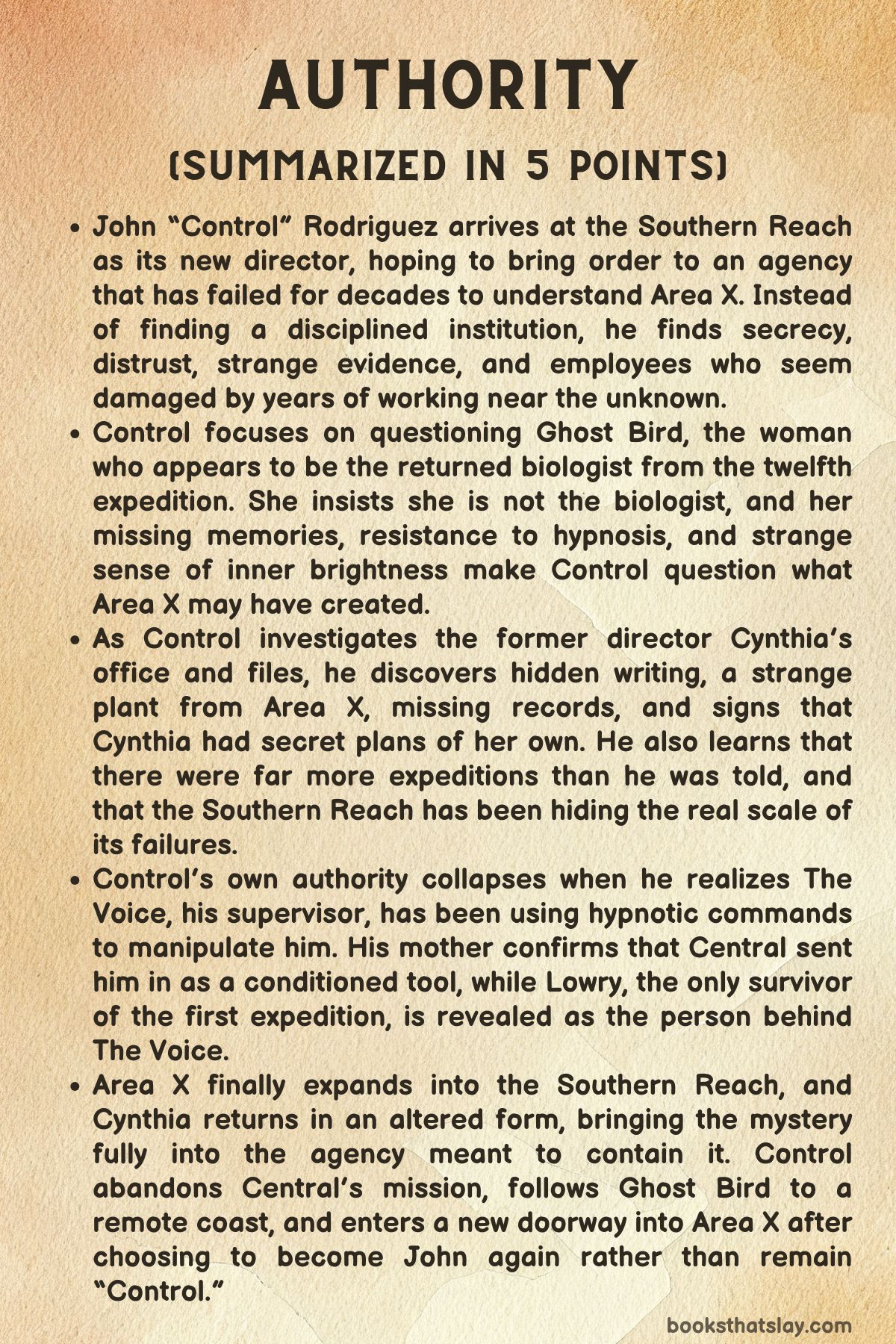
John Rodriguez, known by his professional code name Control, arrives at the Southern Reach as its new director. The facility exists to study and contain Area X, a strange, altered wilderness that has resisted explanation for more than thirty years.
Control comes into the job with pressure from above, especially from his powerful mother, Jackie, who has placed him there after a long series of disappointing assignments. He is aware that this position may be his last real chance to prove himself within the government structure that has shaped most of his adult life.
The Southern Reach is not the efficient intelligence agency Control might have expected. It feels neglected, exhausted, and inward-looking.
The staff have spent years gathering data, running experiments, sending expeditions, and still they have almost nothing solid to show for it. Area X remains unexplained.
People sent inside often do not return, and those who do return come back changed, sick, confused, or unreliable. The agency has become a place where uncertainty is routine and failure has settled into the walls.
On his first day, Control observes the three women who have returned from the twelfth expedition: the biologist, the surveyor, and the anthropologist. Their reappearance is disturbing because they were not found leaving Area X through the official border entrance.
Instead, each appeared in a different location outside the facility. The surveyor was found at her home, the anthropologist at her husband’s medical office, and the biologist near an overgrown lot, staring at a wall.
Control decides to focus on the biologist, who insists on being called Ghost Bird.
His first interviews with Ghost Bird give him little clarity. She is terse, suspicious, and emotionally guarded.
She says she remembers very little of Area X and almost nothing of her life before it. She does not remember her husband clearly and cannot explain important details from the expedition.
She does remember drowning. She also says she is resistant to hypnosis, though she cannot explain how she knows this.
Control is drawn to her because she seems both damaged and unusually self-contained. She frustrates him, but she also becomes the one mystery he most wants to understand.
Control’s relationship with Grace, the assistant director, is tense from the beginning. Grace does not respect him and clearly remains loyal to the previous director, Cynthia, who entered Area X as the psychologist on the twelfth expedition and is presumed dead by most people.
Grace resents Central’s decision to send Control in as a replacement. She keeps information from him, challenges his authority, and treats him like an intruder rather than a leader.
Control tries to manage her, but he quickly realizes that Grace knows far more about the Southern Reach than he does and that the staff are more loyal to her than to him.
Control begins searching the former director’s office and finds evidence that the Southern Reach has been hiding more than it admits. He discovers surveillance devices planted in the office, suggesting that even the director had been watched.
He finds a locked drawer containing a dead mouse and a strange plant from Area X that appears to have survived by feeding on old files. He also uncovers a hidden door.
Behind it is writing on the wall: a long, unsettling line of words connected to Saul Evans, the former lighthouse keeper from the land that became Area X. Similar words have been reported inside the topographical anomaly, which Ghost Bird calls a tower rather than a tunnel.
The more Control investigates, the less stable his position becomes. He speaks regularly to his supervisor, known only as The Voice, who demands reports and criticizes his lack of progress.
The Voice wants useful information, but Control often withholds details, partly out of instinct and partly because he begins to distrust the system he serves. These conversations leave him feeling disoriented.
He senses that The Voice knows more than he admits and may be manipulating him.
The scientific staff offer fragments of understanding but no complete answers. Whitby Allen, a nervous and overextended scientist, gives Control a tour of the science division.
Cheney, the head scientist, discusses experiments involving the border, including one in which hundreds of white rabbits were sent toward Area X in an attempt to overload or test the boundary. The rabbits disappeared, but later Control sees rabbits near the border, showing that past experiments have not behaved as expected.
Cheney also suggests that the border and Area X may not be the same phenomenon, and that Area X may have created an entrance because it wanted people to enter or something to exit.
Control visits the border and sees the shimmering divide between the ordinary world and Area X. The sight affects him deeply. He learns that there have actually been far more expeditions than the official numbering suggests.
The idea that the Southern Reach has hidden the true scale of its attempts adds to his distrust. The agency’s records are selective, incomplete, and possibly shaped by fear or political convenience.
As Control studies the old director’s notes, he begins to see Cynthia as a more deliberate and dangerous figure than the records suggest. She was not merely disorganized or obsessed.
She had her own theories, plans, and methods. She studied the lighthouse intensely, collected odd fragments of evidence, and made private judgments about the people chosen for the twelfth expedition.
She believed the biologist might be especially suited to understanding Area X because she was more attached to the natural world than to human systems. She also used hypnosis as part of expedition preparation, guiding subjects through the border with command phrases.
Control’s interviews with Ghost Bird become more personal. She continues to insist that she is not the biologist.
At first, this sounds like trauma or denial, but as Control learns more about Area X’s possible ability to create copies, he begins to take her statement seriously. Footage from the first expedition shows horrifying evidence of duplication, including a scene in which an expedition leader seems to face an identical version of herself.
The footage disturbs Control and raises the possibility that Area X does not only kill or alter people; it may replace, copy, or recreate them.
Control’s attachment to Ghost Bird becomes a weakness in the eyes of Grace and Central. He speaks with her outside by a pond, where she seems more alive and less confined.
She describes a brightness within herself, something she cannot understand. Control tries to interpret it as life, but she rejects that explanation.
She knows something about her existence is different. Control is increasingly convinced that Ghost Bird is not simply an unreliable witness.
She may be a person created by Area X, carrying fragments of the biologist’s memory while also being separate from her.
The Southern Reach itself grows stranger. Whitby becomes increasingly unsettling.
Control finds him in a janitor’s closet, frightened and disoriented. Later, he discovers a secret attic space filled with disturbing artwork: maps of Area X, monstrous creatures, and images of staff members transformed into animal-like forms.
Whitby appears to have been living or hiding there. When Control finds him lying motionless with his eyes open, then feels Whitby touch his head, the encounter confirms that the scientist is mentally unstable or deeply affected by his long exposure to Area X’s mysteries.
Grace attacks Control publicly by revealing details of a failed undercover mission from his past. In that mission, Control became involved with Rachel, a woman connected to a militia leader.
His mistake exposed her to danger, and she was eventually tortured and killed. Grace uses this story to humiliate him and show that he is not above the damaged people he is trying to command.
The confrontation strips away Control’s authority and leaves him shaken, but it also clarifies that Grace sees him not as a savior of the agency but as another flawed instrument sent by Central.
Control eventually learns that Cynthia made a secret solo trip into Area X before the twelfth expedition. She returned after three weeks, apparently unharmed, but records of what happened during that time are missing.
Grace confirms this after Control tricks her into speaking more openly. Cynthia believed Area X had to be forced to react.
She may have designed the later expeditions not merely to gather information but to provoke a response. Grace still believes Cynthia may not be dead, and her loyalty to the former director remains emotional as well as professional.
Control’s own mind begins to break under pressure. He realizes that The Voice has been using hypnotic commands on him during their calls.
By preparing notes and using an air horn to interrupt his mental drift, he discovers that he has been manipulated since before arriving at the Southern Reach. His mother confirms the truth: Control was conditioned by Central, given commands, and possibly altered memories.
The Voice is revealed to be Lowry, the only survivor of the first expedition, who now works as a powerful figure within Central. Control understands that he has not been an independent investigator but a tool.
This revelation destroys much of his remaining faith in Central and in his mother. Jackie insists that the manipulation was necessary and that Control’s purpose was to stabilize the Southern Reach, understand Ghost Bird, and uncover Cynthia’s plans.
But Control now sees that everyone around Area X has been using someone else: Cynthia used her expedition team, Jackie used Control, Lowry used hypnosis, and Grace used loyalty as a weapon.
The crisis becomes physical when Area X begins expanding. Control sees a door vanish and a wall appear to breathe.
He rushes through the Southern Reach and finds Grace, but then Cynthia appears, changed and dripping with an emerald quality that marks her as no longer fully human. Area X has entered the facility through her or with her.
Grace, seeing Cynthia, gives herself over to what is happening. Control realizes the Southern Reach has been breached and flees.
At his home, Control finds Jackie waiting. She tells him the truth: Area X is spreading, the Southern Reach has been taken, and other sites connected to the returned expedition members may also be forming smaller versions of Area X. There may be no way to stop it.
The government can attempt containment or environmental contamination, but Jackie does not believe any strategy will truly work. She also tells Control that Ghost Bird has escaped Central.
Control makes his own choice. Rather than obey Central or remain part of the failed containment effort, he goes after Ghost Bird.
He leaves his cat Chorry with Jackie and heads north, guessing that Ghost Bird will go to a remote coastal place connected to the biologist’s old life. By the time he finds her among tide pools, he has begun thinking of himself as John again rather than Control.
Ghost Bird points a gun at him, refusing to be taken back. John tells her he understands: she is a replica, but she is also her own person.
Ghost Bird reveals that the brightness inside her has changed and that a new door to Area X has opened in the water nearby. She believes she must return to find out what she is.
She throws away the gun and enters the water. John looks once more at the world he knows, then follows her into Area X. The book ends not with answers, but with a decision: Control stops serving the systems that controlled him and chooses uncertainty beside the one person who may understand what Area X has made.
Characters
Control / John Rodriguez
Control is the central figure of the book and the lens through which the Southern Reach is examined. His code name suggests authority, discipline, and command, but the story steadily exposes the irony behind it.
He arrives believing he has been sent to impose order on a failing agency, yet he is himself being ordered, watched, conditioned, and used. His need for professional recovery shapes much of his early behavior.
He wants to prove that he can succeed where others failed, especially because his mother has made it clear that this assignment may be his final chance. Still, he lacks the certainty that his role demands.
He is observant, intelligent, and trained in intelligence work, but he is also insecure, emotionally bruised, and vulnerable to manipulation.
His relationship with the Southern Reach becomes a slow stripping away of identity. The more he investigates, the less he knows whether his thoughts are his own.
His conversations with The Voice leave him mentally altered, and the revelation that he has been hypnotically controlled turns his professional life into a personal violation. This makes his final rejection of the name Control important.
By choosing to become John again, he steps away from the institutional identity imposed on him. His bond with Ghost Bird also changes him.
At first, she is a subject to interrogate, but she becomes a mirror for his own crisis of identity. Like her, he must ask what remains of a person when memory, command, and purpose have been tampered with.
In Authority, his movement is not toward mastery but toward honest surrender to uncertainty.
Ghost Bird / The Returned Biologist
Ghost Bird is one of the most important and mysterious figures in the book. She appears to be the biologist returned from the twelfth expedition, but she repeatedly insists that she is not that person.
This claim at first seems like trauma, confusion, or resistance, but the larger evidence about Area X suggests she may be a replica with some of the biologist’s memories. Her chosen name, Ghost Bird, captures her strange position between presence and absence.
She is alive, intelligent, and self-aware, yet she carries the shadow of another person’s life.
Her character is defined by resistance. She resists interrogation, institutional control, hypnosis, easy interpretation, and even the identity others assign to her.
She refuses to be reduced to a specimen, a survivor, or a source of data. Her short answers and silence are not simple stubbornness; they are forms of self-protection.
Control wants information from her, but she wants recognition. She needs someone to understand that being made from another person does not make her less real.
Her interest in memory loss, mimicry, and camouflage suggests that she is trying to understand herself through the language of biology and survival. By the end, her return to Area X is not a surrender but a search for origin and meaning.
She chooses the unknown because the human world offers her only captivity and misnaming.
Grace Stevenson
Grace is the assistant director of the Southern Reach and one of Control’s strongest opponents. She is sharp, defensive, and openly hostile to his authority.
Her resistance is rooted partly in professional experience: she has lived with Area X’s failures for years and knows that outsiders often arrive with confidence, only to be defeated by the same mysteries. To her, Control is another Central-appointed figure who does not understand the cost of working so close to the anomaly.
Grace’s loyalty to Cynthia gives her character emotional force. She refuses to accept the former director’s death in any simple way, and her grief often appears as anger.
Her possible romantic attachment to Cynthia deepens her refusal to cooperate with Control, because his arrival is not just an administrative change; it is a replacement of someone she loved or deeply admired. Grace can be cruel, especially when she publicly exposes Control’s past, but her cruelty is also strategic.
She wants to weaken him before he can reshape the agency. By the end, her response to Cynthia’s altered return shows how much she has been waiting for her.
Grace does not flee Area X’s arrival. She welcomes what comes through Cynthia, which makes her both tragic and unsettling.
Cynthia / The Former Director
Cynthia, the previous director of the Southern Reach, dominates the book even when absent. Her office, notes, secret writings, hidden files, and past decisions shape Control’s investigation.
She was officially presumed dead after joining the twelfth expedition as the psychologist, yet her presence lingers everywhere. Unlike Control, who tries to understand the agency by sorting and questioning, Cynthia seems to have accepted that conventional methods would fail.
She moved in secrecy, hid evidence, and designed plans around intuition as much as data.
Her secret solo trip into Area X marks her as bold, reckless, and possibly transformed long before her final expedition. She believed Area X had to be forced into reaction, suggesting a confrontational intelligence that made her willing to risk people and protocol.
Her notes on the expedition members show that she evaluated them not simply as professionals but as instruments in a larger strategy. Her view of the biologist as someone deeply embedded in the natural world reveals that she understood personality as part of the experiment.
Cynthia’s final appearance, altered and carrying Area X into the Southern Reach, changes her from absent mystery to living breach. She is no longer only a failed director; she becomes the sign that the boundary between observer and anomaly has collapsed.
Jackie Severance
Jackie, Control’s mother, is powerful, emotionally distant, and deeply embedded in Central’s culture of manipulation. She sees people through function and mission, including her own son.
Her relationship with Control is defined by control in the ordinary sense: she directs his career, withholds information, and justifies psychological manipulation as necessary. She is not affectionate in any simple way, but neither is she entirely indifferent.
Her care appears through strategy rather than tenderness, which makes her especially difficult for Control to trust.
Jackie’s role exposes the moral rot of Central. She knows that Control has been conditioned, that The Voice is manipulating him, and that the Southern Reach is far more compromised than he has been told.
Yet she continues the operation because she believes the threat of Area X justifies the violation of individual autonomy. Her final conversation with Control is one of the book’s clearest admissions of institutional failure.
She knows Area X is expanding and that containment may be impossible. Still, she thinks in terms of weapons, pressure, and sacrifice.
Her son was her chosen instrument, just as Cynthia used Ghost Bird or the biologist in her own plan. Jackie represents a world that has learned nothing except how to use people more efficiently.
Lowry / The Voice
Lowry is the only survivor of the first expedition and one of the most disturbing hidden powers in the book. Publicly, he carries the status of a survivor, almost a legendary figure within the Southern Reach’s history.
Privately, he operates as The Voice, Control’s unseen supervisor, using hypnosis and psychological pressure to direct him. His survival gives him authority, but it has not made him wise or humane.
Instead, he has become harsh, controlling, and cruel.
As The Voice, Lowry functions like an extension of Area X’s damage inside the human institution. He survived the anomaly, but what returned from that experience is not a healed witness.
His methods suggest paranoia and domination. He does not trust Control to think freely, so he turns him into a conditioned instrument.
Lowry’s position also complicates the idea of survival. To survive Area X is not necessarily to escape it.
Lowry may have physically returned, but his life afterward has been shaped by trauma, fear, and the need to control others before the unknown can control him again.
Whitby Allen
Whitby is one of the clearest examples of what long exposure to the Southern Reach can do to a person. At first, he appears nervous, overworked, and socially awkward.
He is a scientist who seems to serve many roles, someone who knows a great deal but communicates in anxious, fragmented ways. His body and behavior suggest strain: he sweats, looks older than he should, and often seems close to panic.
Yet he is also perceptive. His discussion of terroir gives Control one of the most useful ways to think about Area X, not as separate samples or incidents but as a whole environment with its own total effect.
Whitby’s hidden attic artwork reveals the depth of his breakdown. The monstrous images of staff members and maps of Area X suggest that he has internalized the agency’s fear and turned it into private mythology.
His behavior in the attic is deeply unsettling because it shows a person who has moved beyond ordinary professional stress into something more feral and secretive. Still, Whitby is not simply comic or pathetic.
He is a warning. He has spent too long near the mystery, too long trying to give shape to something that resists human categories.
His mind has not solved Area X; it has been absorbed by the attempt.
Cheney
Cheney, the head scientist, provides a mixture of humor, resignation, and insight. He often jokes about Area X, which can make him seem unserious, but his humor is a coping mechanism.
He has lived with failure long enough to understand that ordinary scientific confidence has limited use here. His comments about Area X needing to cooperate with study are significant.
They suggest that the phenomenon is not a passive object waiting to be measured. It acts, withholds, responds, or refuses.
Cheney is less openly broken than Whitby and less combative than Grace, but he is still marked by the Southern Reach’s culture of long-term defeat. He understands the experiments, the rabbits, the border, and the uncertainty surrounding the door into Area X. He also serves as a witness to institutional absurdity: the agency keeps gathering data while knowing that the data may not mean what it appears to mean.
Cheney’s role is important because he shows how a scientist can remain functional while still accepting that the rules of investigation have been damaged.
Jessica Hsyu
Jessica Hsyu, the lead linguist, represents the struggle to describe Area X in language that does not distort it. Her work is especially important because the anomaly defeats not only scientific testing but also speech, metaphor, and categorization.
She understands that calling Area X by familiar comparisons may be misleading. If there is no proper language for something, then every description risks becoming a false comfort.
Jessica’s explanation of Saul Evans’s words helps connect the Southern Reach’s investigation to the older human history of the landscape. She recognizes the sermonic structure of the writing and traces its diction to Saul’s past as a preacher.
Yet she also emphasizes that the living material of the words matters more than their literal meaning. This shows her ability to move beyond conventional linguistics.
She knows that in this case language is not only symbolic; it may be biological, environmental, or active. Jessica is quieter than Grace or Whitby, but her presence widens the book’s concern with meaning and the failure of human systems to name what they face.
Saul Evans
Saul Evans does not appear directly in the present action, but his words and history are crucial. He was the lighthouse keeper in the area before it became Area X, and he had once been a preacher.
The long sentence associated with him appears in multiple significant places, including the tower inside Area X and the former director’s spaces. This turns Saul into a kind of ghostly origin point for the mystery, a human figure whose language has been taken up by something no longer fully human.
Saul’s importance lies in the transformation of spiritual language into ecological or alien inscription. What may once have been sermon-like speech becomes living writing, repeated in places where it should not be.
His words suggest guilt, seeds, death, worms, darkness, and life, all images that fit Area X’s strange mixture of decay and renewal. Even without direct action in the plot, Saul stands at the border between the old human landscape and the transformed one.
His voice survives, but in a changed form that may no longer belong to him.
The Surveyor
The surveyor is one of the returned members of the twelfth expedition. In the given account, she appears only briefly, but her return is significant.
She is found at her own house rather than at the official border, which suggests that Area X can return people in ways the Southern Reach does not understand. Her existence also contributes to the pattern of returned expedition members creating new zones of instability outside Area X.
Although Control chooses not to focus on her, that choice says something about his methods and limitations. He narrows his attention to Ghost Bird because she seems the most interesting and potentially useful, but the surveyor may carry evidence just as important.
Her removal to Central also shows how quickly individuals become objects of institutional handling. She is not treated primarily as a person who has endured something impossible, but as a returned asset or threat.
Hildi / The Anthropologist
Hildi, the anthropologist, is another returned member of the twelfth expedition. Cynthia’s notes identify her by name, which is unusual because the Southern Reach often reduces expedition members to roles rather than personal identities.
This small detail makes Hildi stand out. Cynthia believed she would be “on board” and would “understand,” suggesting that the anthropologist may have been chosen for more than her professional skills.
She may have been expected to grasp the human, cultural, or symbolic dimensions of Area X in a way others could not.
Hildi’s return at her husband’s medical office adds another strange detail to the pattern of reappearance. Like the surveyor, she is quickly removed from Control’s reach, limiting what he can learn from her.
Her role in the book is partly defined by absence. She is important because others made plans around her, yet Control never fully learns what those plans were.
This makes her an example of how much the Southern Reach’s records conceal even when they seem to document everything.
The Linguist from the Twelfth Expedition
The linguist from the twelfth expedition is remembered mainly through absence and Cynthia’s notes. Ghost Bird cannot clearly remember the linguist, and Cynthia described this person as useful but not essential, possibly even dangerous because they might deflect attention.
That description raises more questions than it answers. A linguist should be valuable in a place where words, hypnosis, naming, and strange inscriptions matter so much.
Yet Cynthia seems to have viewed the linguist as someone whose presence needed to be managed.
The linguist’s importance lies in the way the book treats expertise. The Southern Reach gathers specialists, but specialization does not guarantee understanding.
A linguist may fail where instinct, contamination, or altered perception succeeds. Cynthia’s suspicion suggests that knowledge itself can become a liability if it points attention in the wrong direction.
The linguist becomes another sign that expedition roles were never neutral. Each person was part of someone’s strategy.
Control’s Father
Control’s father appears through memory, but his influence is emotionally important. He was an artist who made large scrap-metal pieces and raised Chorry with Control.
In contrast to Jackie’s cold professionalism, his father represents steadiness, warmth, and a more humane form of creativity. He gave Control a sense of care that was not based on usefulness or rank.
This memory matters because Control’s adult world is dominated by institutions that treat people as instruments.
His father’s art also offers a quiet contrast to the Southern Reach’s failed systems of interpretation. Scrap-metal sculpture turns discarded material into form.
It does not control the world; it reshapes fragments into meaning. Control does not fully inherit that freedom, but the memory of his father remains one of the few parts of his life not defined by Central.
Through him, the book gives Control an emotional background beyond failure and manipulation.
Chorry / El Chorizo
Chorry, Control’s cat, is a small but meaningful presence. He is one of Control’s few sources of stability.
In a life marked by relocation, failed assignments, and strained human relationships, Chorry gives him a domestic anchor. The cat connects him to his father and to a version of life not governed by secrecy, hierarchy, or interrogation.
Chorry’s importance becomes clearest near the end, when Control leaves him with Jackie before going after Ghost Bird. That decision signals that Control understands he may not return.
Leaving the cat behind is a practical act, but also an emotional severing. Chorry belongs to the ordinary world Control is abandoning.
In a book filled with strange animals, altered environments, and unstable identities, Chorry remains simply himself, which makes him quietly powerful.
Rachel
Rachel appears in the account of Control’s failed undercover mission. She was involved with a militia leader and became romantically involved with Control while he was undercover.
Control’s mistake exposed her to danger, and she was later tortured and killed. Though she is not present in the Southern Reach plot, she is central to understanding Control’s guilt.
Rachel represents the human cost of professional failure. For Control, she is not just a past lover or mistake; she is proof that his work can destroy people who do not fully understand the forces around them.
Grace’s decision to reveal this story publicly is cruel because it turns Rachel’s death into a weapon against him. Yet the memory also forces Control to face the fact that he has been compromised before.
His guilt over Rachel makes his later concern for Ghost Bird more complicated. He has already failed one vulnerable woman caught inside a dangerous operation, and he does not want to repeat that failure.
The Militia Leader / Rachel’s Boyfriend
Rachel’s boyfriend, the militia leader, is a minor figure but an important part of Control’s past. He represents the violence and paranoia of the undercover world where Control first failed.
His response to Rachel’s perceived betrayal is brutal, and his killing of her shows the deadly consequences of Control’s compromised mission. He is not developed as a complex figure, but his actions leave a lasting mark on Control.
His role also reflects one of the book’s larger concerns: institutions and extremist groups may seem opposed, but both can consume individuals. Rachel is trapped between a violent militia and a deceptive government operation.
Control’s guilt comes from knowing that his own side did not protect her. The militia leader’s cruelty is direct, while Central’s cruelty is bureaucratic, but both forms of power damage the people caught beneath them.
The Woman in the Diner
The woman in the diner appears briefly when she panics over an ant on her body. Control helps her by removing the ant and placing it safely in the grass.
Though minor, the scene reveals something about Control’s instincts. He is capable of small acts of care, even when surrounded by paranoia and institutional coldness.
He does not crush the ant or ignore the woman; he responds with attention.
The scene also becomes symbolic for Control’s thinking. He wonders whether, in relation to Area X, he is the ant or the frightened woman.
This question captures his uncertain position. Is he the small creature being moved by larger forces, or the person panicking because he cannot understand what touches him?
The diner woman is not important because of her personal history, but because her fear and Control’s response frame his growing awareness of scale, vulnerability, and misperception.
The Expedition Leader from the First Expedition
The expedition leader from the first expedition appears in the disturbing footage Control watches. She is seen facing what appears to be a duplicate of herself, with both versions showing fear and confusion.
This moment is crucial because it gives visual evidence that Area X may create copies of people. The leader’s terror is not only fear of death but fear of identity collapse.
Her brief appearance helps prepare Control to believe Ghost Bird’s claim that she is not the biologist. Before seeing the footage, such a claim could be dismissed as psychological damage.
Afterward, it becomes part of a larger pattern. The expedition leader’s duplication shows that Area X attacks one of the most basic human assumptions: that a person is singular.
Her role is short, but the image of two identical selves facing each other becomes one of the book’s most disturbing ideas.
The Southern Reach Staff
The wider Southern Reach staff function almost like a collective character. They are scientists, guards, administrators, and support workers who have spent years near an impossible border.
Their workplace has trained them into secrecy, resignation, superstition, and defensive routine. Some leave quickly; others stay too long and become strange.
The agency’s high turnover and exhausted culture reveal the psychological cost of studying something that refuses to become knowable.
As a group, the staff also show how institutions normalize failure. The Southern Reach keeps operating, filing reports, holding meetings, preserving samples, and sending expeditions, even though its central mission has never succeeded.
This collective behavior gives Authority much of its atmosphere. The horror does not come only from Area X. It also comes from office life, procedure, hierarchy, and the slow decay of purpose inside a building where everyone knows they are losing.
Themes
The Collapse of Control
Control’s name creates an expectation that the book steadily dismantles. He arrives believing that authority can be restored through investigation, discipline, and command, but nearly every part of his experience proves otherwise.
The Southern Reach does not respond to leadership in any ordinary way. Grace resists him, the staff evade him, records mislead him, and Area X remains beyond institutional reach.
Even his own mind is not secure, since The Voice uses hypnotic commands to shape his behavior. This means the deepest loss of control is not professional but internal.
Control cannot trust his workplace, his superiors, his mother, or even his own reactions. The theme becomes more powerful because the book does not present control as simply difficult; it presents it as a fantasy that institutions maintain to hide their fear.
Central claims to manage the threat, but it relies on secrecy, conditioning, and damaged survivors. The Southern Reach claims to study Area X, but it has been changed by the thing it studies.
By the end, John’s choice to abandon the name Control is not defeat in a simple sense. It is a recognition that honesty may begin only when the illusion of mastery is dropped.
Identity, Replication, and Personhood
Ghost Bird’s insistence that she is not the biologist raises one of the book’s deepest questions: what makes a person real? She may have the biologist’s body, some of her memories, and traces of her habits, but she experiences herself as separate.
The people around her often treat this claim as a problem to solve or a symptom to classify. Control gradually comes to understand that the more ethical response is not to force her back into the biologist’s identity but to accept her as a person in her own right.
The footage of duplication from the first expedition expands this issue beyond Ghost Bird. Area X may produce copies, but the emotional terror comes from what those copies mean.
If a replica feels fear, confusion, desire, and selfhood, then the human category of originality becomes unstable. The book refuses easy answers.
It does not say memory alone makes identity, nor does it say biological continuity is enough. Instead, it presents personhood as something claimed under pressure.
Ghost Bird becomes most herself when she rejects the names imposed on her and chooses her own path back to Area X.
Institutional Secrecy and Moral Compromise
The Southern Reach and Central both operate through secrecy, but their secrecy does not produce safety. It produces confusion, mistrust, and abuse.
Control is sent into the agency without the truth about the number of expeditions, Cynthia’s solo journey, Lowry’s role, or his own conditioning. Grace hides information because she distrusts Central and remains loyal to Cynthia.
Cynthia hid evidence because she believed official methods had failed. Jackie and Lowry manipulate Control because they think the mission justifies psychological violation.
Every faction claims necessity, and each act of concealment creates further damage. Authority shows that institutions facing fear often become more committed to preserving control than discovering truth.
The Southern Reach has files, samples, maps, videos, and protocols, but these materials are compromised by omission and fear. Central has power, but its power depends on turning people into instruments.
The moral compromise is not a side effect of the mission; it becomes the mission’s operating method. By the time Area X expands, the human systems meant to contain it have already been hollowed out by their own habits of deception.
The Failure of Human Language and Knowledge
Area X defeats the categories people bring to it. Scientists gather samples but cannot explain the whole.
Linguists study words but cannot reduce the living writing to ordinary meaning. Administrators organize files, but the files do not create understanding.
The border, the tower, the rabbits, the plant, the returned expedition members, and the altered director all resist stable interpretation. This does not mean the characters are unintelligent.
It means their tools were made for a world that Area X no longer obeys. Jessica’s comments about the lack of proper language are especially important because they show that bad descriptions can become traps.
If people rely on familiar metaphors, they may falsely domesticate what they are seeing. Even the naming of the topographical anomaly shows this problem: tunnel, tower, pit, structure, and anomaly each imply a different reality.
The book’s fear grows from the gap between observation and comprehension. Characters can see things, record them, and classify them, yet still fail to understand what they mean.
Knowledge here is not a clean path to mastery. It is partial, unstable, and sometimes dangerous when mistaken for certainty.