11 Birthdays by Wendy Mass Summary, Characters and Themes
In 11 Birthdays by Wendy Mass, Amanda Ellerby expects her eleventh birthday to be a fresh start, even though she and her once-best friend Leo Fitzpatrick haven’t spoken in a year. Instead, her birthday becomes the same day over and over again.
At first Amanda thinks she’s losing it, but the repeats force her to face what she’s been avoiding: her fight with Leo, the way friendships shift, and how small choices can change the tone of an entire day. With humor, mystery, and a touch of magic tied to their town’s history, the story follows Amanda and Leo as they try to figure out why time is stuck—and how to move forward.
Summary
Amanda Ellerby wakes up excited for her eleventh birthday, but the day already feels slightly off. At home, her dad is sick with a cold, her older sister Kylie is distracted with her own world, and Amanda can’t stop thinking about the one thing she doesn’t want to deal with: Leo Fitzpatrick.
For ten years, Amanda and Leo shared birthday parties because they were born on the same day in the same small town, Willow Falls. They used to be inseparable.
But last year Amanda heard Leo say he only kept doing the joint parties because his mom made him. Humiliated, she ran home, threw away reminders of their friendship, and cut him out of her life.
This year, for the first time, they’re having separate parties—Amanda’s smaller Hollywood-themed party and Leo’s big event everyone at school seems to be talking about.
At school, Amanda’s birthday starts with minor stings that pile up. On the bus, her best friend Stephanie sits with Ruby instead of her, and Amanda feels replaced.
Her locker is decorated, which makes her happy, but she notices a green Tootsie Roll nearby—her favorite—and leaves it behind, unsure if it’s meant for her. In history class, there’s a pop quiz.
Amanda passes, but she sees Leo looking stressed and assumes he failed. At lunch, the twins Emma and Tracy talk excitedly about Leo’s party, and Amanda can’t hide how much it bothers her.
Still, her friends surprise her with a cupcake and sing to her in the cafeteria. Leo notices her and smiles, and for a moment the wall between them doesn’t seem so solid.
After school, Amanda goes to gymnastics tryouts. She wants the team badly, but when it’s her turn to do a back handspring, she freezes.
Stephanie and Ruby make the team, and Amanda leaves feeling embarrassed and defeated. That night, her birthday party is a letdown.
She wears a Dorothy costume she dislikes, fewer friends show up than she hoped, and people start leaving early for Leo’s party. Even Stephanie asks if she can go.
Amanda tries to act like she doesn’t care, but she does. As the night falls apart, her mother drops another blow: she lost her job after mixing up an important work presentation poster with Kylie’s school project.
Amanda goes to bed exhausted, wishing the day would end.
When she wakes up, it’s her birthday again.
At first Amanda thinks it’s a prank or a dream, but details are too exact. The SpongeBob balloon that should be in the closet is back in the middle of her room.
Her dad is sick in the same way. Her backpack is heavy like it was the day before.
At school, the bus ride repeats, her locker is jammed again, the same quiz happens, the same lunch conversations circle back, and the same party waits for her at night. Worse, she has blisters from the Dorothy shoes, and the pain proves she’s not imagining things.
The day resets, but she doesn’t.
Amanda tries to survive the repeats by changing as little as possible, hoping that if she doesn’t disturb anything, the loop will break. When that doesn’t work, she stays home pretending to be sick.
She tells her dad the day is repeating, but he assumes she’s upset about Leo and the birthday drama. While stuck at home, Amanda looks into Kylie’s diary and discovers Kylie’s worries about her appearance and her crush on Dustin.
It’s not Amanda’s proudest moment, and it creates a new tension when Kylie realizes Amanda knows too much.
Amanda also gets an unexpected visit from Mrs. Grayson, an older neighbor who has known the town forever. Mrs. Grayson takes Amanda to the doctor, who confirms she isn’t sick.
On the drive home, Mrs. Grayson talks about Willow Falls history and mentions a feud tied to Amanda’s family. That detail sticks in Amanda’s mind.
After several repeats, Amanda begins noticing patterns and clues. She sees that certain small things are consistent—like a duck-shaped birthmark on the bus driver’s face on some mornings—and that some details change, like who is driving the bus.
She also learns she isn’t the only one trapped. In history class, Leo passes her a note that wishes her happy birthday “for the fourth time” and asks her to meet him.
Outside the cafeteria, Leo confirms he’s been living the same Friday too. He figured it out when Amanda’s behavior changed in a way no one else’s did.
They’re both stuck, and they’re the only ones who can remember it.
Even with the shared problem, Amanda doesn’t immediately drop her anger. Leo apologizes for what he said last year and admits he felt awful about it.
Amanda doesn’t accept the friendship back right away, but their teamwork starts rebuilding what was lost. They meet secretly and compare what they’ve learned: injuries and items kept on their bodies carry over, but everything else resets.
They realize this gives them freedom to experiment and take risks without permanent consequences—at least socially and at school.
They decide to use one repeat day to do something fun and different. Leo brings his savings and “borrows” scooters and helmets.
They have a big breakfast, roam around town, and Amanda feels like herself again for the first time in a long while. Leo surprises her by going to the senior center and reading a poem during an open mic, admitting he treated his best friend badly and that he regrets it.
Amanda is stunned—Leo is not the type she expects to do that, and it affects her more than she wants to admit.
Leo pushes Amanda into another bold moment: a rock band audition. Amanda plays drums alone at home, never in public.
She’s terrified, but she does it. The band leaders, twin brothers named Larry and Laurence, are skeptical until they hear her play.
Amanda performs well, and even though they won’t take a kid into the band, they praise her and give her band T-shirts. The experience sparks a new idea: maybe Amanda doesn’t need gymnastics to define her, and maybe she’s been ignoring something she actually loves.
The fun day ends badly when mall security brings them to their furious parents. Amanda and Leo are grounded, and the consequences hurt emotionally even if the day resets.
Still, the time they spent together matters, and when the next morning finally appears to be Saturday, Amanda feels relief—until she realizes it’s Friday again. The loop is still active.
Determined to solve it, Amanda and Leo investigate causes. They consider the hypnotist at Leo’s party but learn he isn’t powerful enough to create this kind of effect.
Amanda remembers Mrs. Grayson’s mention of an old feud, and they go to the senior center to talk to someone who might know the town’s deeper history. Mr. Whitehead tells them about two families—Ellerby and Fitzpatrick—who once owned neighboring apple farms and tried to sabotage each other for years.
Then, suddenly, they made up and became friends again, but no one understood why. That story matches Amanda and Leo’s situation too closely to ignore.
They visit the historical society and meet Angelina D’Angelo, an elderly woman who seems to be everywhere. She hints that records about the feud are missing and says the earlier feud ended because the two men were told to resolve things before Harvest Day.
The detail that someone “told” them raises Amanda’s suspicion that magic is involved. When the historical society later closes unexpectedly, Amanda and Leo sneak inside and find an old journal belonging to Leo’s ancestor.
In it, they discover something shocking: the earlier Ellerby and Fitzpatrick were also trapped repeating Harvest Day. They escaped by helping people around town, repairing their friendship, and making a toast to it.
Amanda and Leo try copying that solution. Amanda makes a plan to be kinder, more helpful, and more aware of others.
She fixes the poster mix-up so her mom doesn’t lose her job for that reason, helps her dad with his cold, supports other students, and even prepares a periodic table for a crying boy who always forgets an assignment in the hallway. She pushes herself to land a back handspring and makes the gymnastics team, improving her confidence.
She also makes an effort to be decent to Ruby, even when Ruby is rude. Amanda and Leo arrange a public “make-up” so it looks like they’re friends again, and they celebrate together at Leo’s party, ending the night with a toast.
But Amanda wakes up on Friday again.
Angry and desperate, she confronts Angelina—who is driving the bus that morning—and demands answers. Angelina finally admits she caused the original enchantment long ago.
The earlier families escaped, but the magic returned because something tied to the spell was neglected. Angelina explains that on their fifth birthday, Amanda and Leo were each given an apple plant grown from seeds linked to the two families’ old trees.
Caring for the plant matters. Amanda realizes what she did after the fight with Leo last year: she threw her plant out the window in a burst of anger.
After school, Amanda, Leo, and Angelina search under Amanda’s window and find the plant has taken root in the ground. They carefully dig it up and re-pot it, using the picnic basket that came with Amanda’s costume.
With the plant restored and their friendship openly repaired, they decide to stop pretending and choose what they actually want: a shared birthday celebration, the way it used to be, but on their own terms this time.
Amanda also steps into a new version of herself. Instead of chasing gymnastics approval, she goes to marching band auditions and plays drums, feeling proud and energized.
That choice signals she’s no longer stuck in one idea of who she has to be.
That night, Amanda and Leo bring their groups together. Even when things don’t go perfectly—like the twins showing up in costumes that don’t match the other party—they handle it with humor and flexibility.
They focus on the parts that matter: being honest, showing up for each other, and letting the day be joyful instead of controlled by pride or resentment.
When Amanda wakes the next morning, it’s finally Saturday. The loop is over.
She and Leo meet again to open presents together, continuing their tradition. They exchange thoughtful gifts, and even when Leo’s mom teases them about dating someday, Amanda can handle it without spiraling.
Outside, Angelina watches quietly, satisfied that the spell has been set right—this time with a friendship repaired and a small apple plant given the care it needed to keep time moving forward.
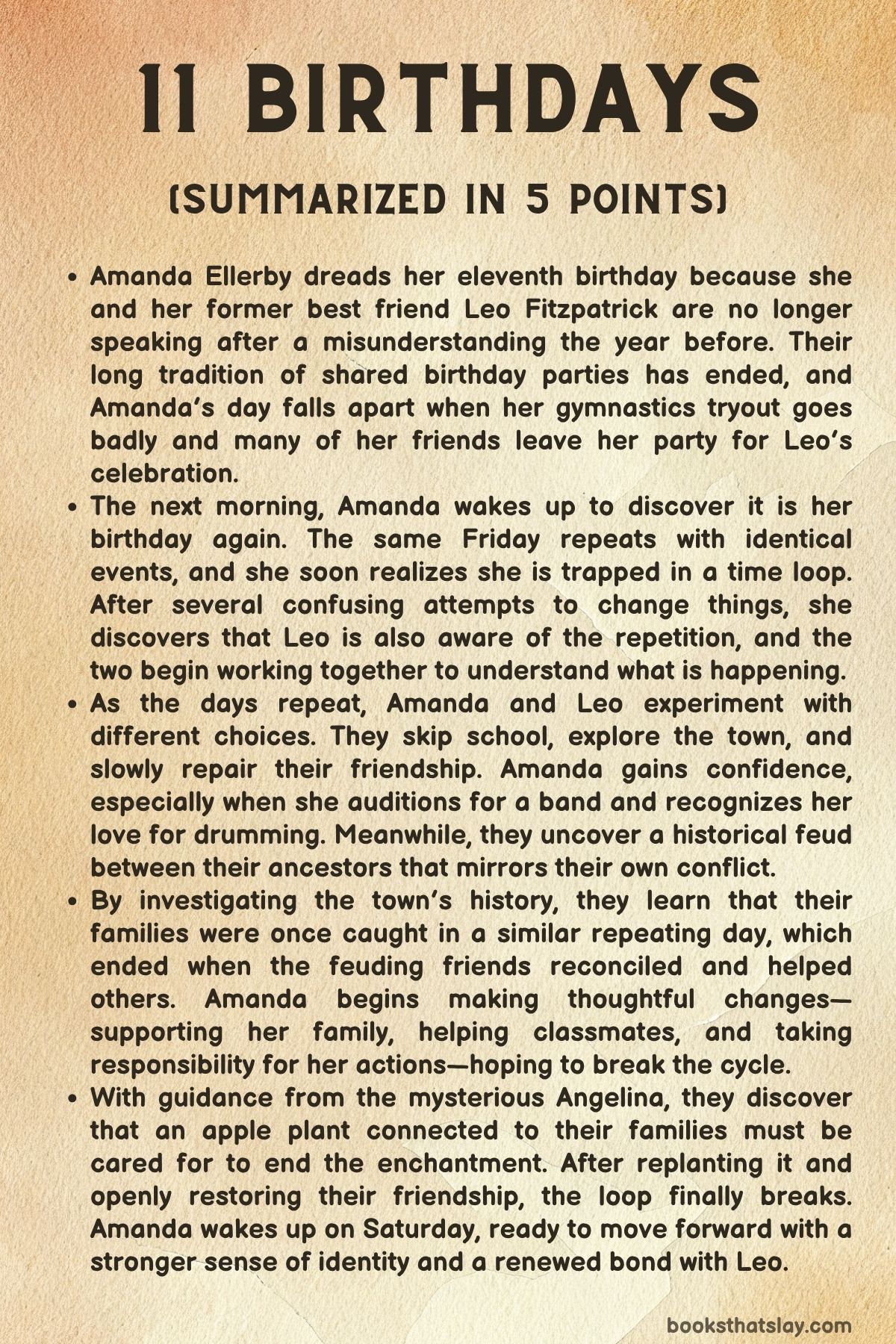
Characters
Amanda Ellerby
Amanda is the emotional and narrative center of 11 Birthdays, and the story unfolds through her perspective. At eleven, she stands at the uneasy threshold between childhood and early adolescence.
She is sensitive, proud, and deeply affected by what others think of her, especially Leo. Her decision to end their friendship after overhearing his comment shows how easily wounded she is, but also how strongly she values loyalty.
Throughout the repeating birthday, Amanda confronts her insecurities: her fear of failure in gymnastics, her jealousy over Stephanie’s shifting attention, and her discomfort with not being the center of Leo’s world anymore. The time loop becomes a mirror, forcing her to examine how she reacts to embarrassment, disappointment, and change.
As the story progresses, Amanda matures in visible ways. She moves from reacting emotionally to thinking deliberately about her choices.
Instead of trying to control how others see her, she begins focusing on how she treats them. Her decision to help classmates, fix her mother’s mistake, support her sister, and treat even Ruby kindly marks a shift from self-absorption to awareness.
She also grows in confidence, especially when she auditions for the band. That moment signals a turning point: she stops chasing what she thinks she should want and instead pursues something that genuinely excites her.
By the time the loop breaks, Amanda is no longer defined by hurt pride. She has learned that forgiveness, responsibility, and authenticity are stronger than stubbornness.
Leo Fitzpatrick
Leo begins the novel as the absent presence in Amanda’s life. Though he and Amanda share a birthday and years of memories, their friendship has fractured because of his careless remark.
At first, Leo appears insensitive and socially comfortable, someone who can easily host a large party and laugh with other friends. However, once the time loop is revealed, a deeper side emerges.
Leo has also been struggling with guilt and regret over what he said. His apology is sincere, and his willingness to admit fault shows emotional maturity that contrasts with Amanda’s initial defensiveness.
Leo’s character is defined by quiet thoughtfulness beneath a casual exterior. His poem at the senior center reveals vulnerability and remorse.
He is also more adventurous than Amanda, suggesting bold plans like skipping school and using their repeated day to explore the town. While Amanda tends to analyze and hesitate, Leo acts.
Yet his impulsiveness is balanced by loyalty; he wants to repair their bond and repeatedly chooses to work alongside Amanda to solve the mystery. His visits to the guidance counselor hint at private pressures, suggesting that he too faces uncertainties beyond the birthday conflict.
By the end of the story, Leo demonstrates growth not through dramatic transformation, but through steady accountability, empathy, and a renewed commitment to friendship.
Angelina D’Angelo
Angelina serves as the mystical force in the story, though she often appears ordinary at first glance. She is an elderly figure who seems to exist on the edges of events, sometimes driving the bus, sometimes appearing at the historical society, and sometimes simply observing.
Her presence connects the past to the present, and she represents the town’s long memory. Unlike the children, who are confused and frustrated by the repeating day, Angelina understands its origins and purpose.
Her role is not malicious but corrective. She originally cast the enchantment generations earlier to force reconciliation between the feuding ancestors of the Ellerby and Fitzpatrick families.
When the modern friendship fractures, the spell resurfaces as a reminder that unresolved conflict disrupts more than just two individuals. Angelina does not immediately offer answers, because the lesson requires effort and insight from Amanda and Leo.
She functions as both guardian and guide, ensuring that the deeper meaning of the spell is understood. Through her, the story suggests that communities are shaped by history, and that healing past and present divisions requires intention and care.
Kylie Ellerby
Kylie, Amanda’s older sister, represents the familiar yet distant world of adolescence. She is preoccupied with her own concerns, particularly her crush on Dustin and her insecurities about her appearance.
From Amanda’s perspective, Kylie can seem self-centered or dismissive, especially when she reacts strongly to Amanda reading her diary. However, Kylie’s character adds depth to the family dynamic.
She is navigating her own fragile stage of growth, dealing with rejection and self-doubt in ways that parallel Amanda’s struggles.
Kylie’s occasional sharpness toward Amanda reflects sibling rivalry rather than cruelty. When she briefly sets Amanda up by letting their mother think Amanda ruined the presentation, it stems from hurt pride over the diary invasion.
Yet Kylie is not vindictive by nature. Over time, Amanda’s increased empathy allows her to understand Kylie’s vulnerability better.
Kylie’s storyline emphasizes that growing up involves private battles that others may not see, and that compassion within families matters just as much as friendship repair.
Stephanie
Stephanie begins as Amanda’s closest friend at school, but their friendship feels strained at the start of the story. When Stephanie sits with Ruby on the bus and later leaves Amanda’s party for Leo’s, Amanda interprets it as betrayal.
In reality, Stephanie is not intentionally abandoning Amanda; she is navigating social shifts and trying to balance multiple friendships. Her willingness to decorate Amanda’s locker and surprise her with a cupcake shows that she cares, even if she sometimes missteps.
Stephanie’s character highlights how friendships evolve during middle school. She is not perfect, but she is not disloyal either.
She feels guilty about unintentionally hurting Amanda and even pretends she decorated the locker because she doesn’t want Amanda to feel overlooked. Stephanie represents the complexity of social dynamics at that age, where small actions can carry heavy emotional weight.
As Amanda grows more secure, her perception of Stephanie becomes less reactive and more understanding.
Mrs. Ellerby
Amanda’s mother is a hardworking adult facing her own challenges. Her job loss introduces a layer of realism into the otherwise magical plot.
She is loving and attentive, organizing Amanda’s birthday party and trying to maintain normalcy despite setbacks. When she mistakenly takes Kylie’s science project instead of her own presentation, it underscores how overwhelmed she is.
Her reaction to Amanda’s supposed misbehavior, such as grounding her, shows that she holds her daughter accountable even when she is stressed.
Mrs. Ellerby’s storyline emphasizes that adults, too, struggle with failure and embarrassment. Amanda’s repeated chances allow her to protect her mother from losing her job for the wrong reason, reinforcing the theme of responsibility.
Through Mrs. Ellerby, the narrative presents parents not as flawless authority figures but as individuals balancing work, family, and personal disappointment.
Mr. Ellerby
Amanda’s father is gentle, humorous, and supportive. His lingering cold during the repeated Fridays becomes a small but steady detail in the loop.
When Amanda tells him the day is repeating, he responds with comfort rather than dismissal, even if he doesn’t fully believe her. He represents emotional steadiness in the household.
Mr. Ellerby’s presence provides warmth and balance. While he is not central to the mystery, his kindness contributes to Amanda’s gradual shift toward empathy.
By choosing to help him during one of the repeats, Amanda demonstrates her growing awareness of how her actions affect others. His character reinforces the importance of family support during times of confusion and growth.
Mrs. Fitzpatrick
Leo’s mother is enthusiastic and deeply invested in her son’s life. She values tradition, especially the shared birthday celebration between Leo and Amanda.
Her disappointment at the fractured friendship is evident, and she reacts strongly when Leo and Amanda go missing during one of their adventurous repeat days. Her protectiveness reflects genuine care.
Mrs. Fitzpatrick also symbolizes continuity. She remembers the families’ shared history and seems quietly pleased when Amanda and Leo reconnect.
Through her reactions, the emotional weight of the friendship becomes clear; it is not just a childhood habit but a bond cherished by both families.
Mrs. Grayson
Mrs. Grayson plays a smaller yet significant role as a keeper of local history. She provides Amanda with early hints about the ancestral feud and acts as a bridge between generations.
Her calm demeanor and familiarity with Willow Falls’ past position her as a subtle guide in Amanda’s journey.
Although she does not reveal the magical truth directly, her comments prompt Amanda to look deeper into her family’s background. Mrs. Grayson’s character underscores the idea that personal conflicts often have roots that stretch beyond immediate circumstances.
Ruby, Emma, Tracy, Dustin and Other Supporting Students
Characters like Ruby, Emma, Tracy, Dustin, and the unnamed boy who forgets his assignment serve to populate Amanda’s social environment. Ruby’s snide comments reflect competitiveness and insecurity common at that age.
Emma and Tracy’s excitement about Leo’s party amplifies Amanda’s feelings of exclusion. Dustin and Alyssa’s quiet drama influences Kylie’s emotional state.
The crying boy in the hallway becomes a symbol of Amanda’s growing empathy when she helps him by preparing a periodic table.
Though these characters do not dominate the narrative, they contribute to the atmosphere of middle school life. Each interaction provides Amanda with an opportunity to react differently, reinforcing the central lesson that change begins with small, intentional choices.
Together, the characters in 11 Birthdays create a layered portrait of friendship, family, and community. Each person, whether central or peripheral, plays a role in shaping Amanda’s understanding of responsibility, forgiveness, and identity.
Themes
Friendship and Reconciliation
At the center of 11 Birthdays lies the fragile nature of childhood friendship and the effort required to repair it. Amanda and Leo’s relationship collapses not because of betrayal in any dramatic sense, but because of a careless remark and wounded pride.
Their estrangement reflects how deeply children at that age feel social embarrassment and how quickly silence can replace years of closeness. The repeating birthday forces both of them to confront what they lost.
Without the distraction of time moving forward, they are left with the same unresolved hurt again and again. This repetition strips away avoidance.
Amanda cannot simply decide to move on, and Leo cannot pretend his apology is unnecessary.
The novel treats reconciliation as an active process rather than a single conversation. Leo apologizes more than once, and Amanda does not accept it immediately.
Trust has to be rebuilt through shared action—investigating the mystery together, supporting each other during humiliating moments, and taking risks side by side. Their restored friendship is not identical to what it once was.
Instead, it becomes more mature, based on honesty rather than obligation. Even their final decision to celebrate their birthday jointly is made openly rather than out of parental pressure.
By tying the enchantment to an old family feud, the story broadens the theme beyond two children. The feud between their ancestors mirrors Amanda and Leo’s argument, suggesting that unresolved conflict can echo across generations.
Reconciliation, therefore, is not just personal; it is communal. The act of repairing friendship becomes a way of correcting history and breaking cycles of division.
Through this theme, the novel presents friendship as both delicate and powerful, capable of harm when neglected and capable of healing when nurtured.
Growth and Self-Discovery
Amanda begins the story with a narrow sense of who she is. She defines herself through external markers: making the gymnastics team, hosting a successful party, being Stephanie’s best friend, and not losing face in front of Leo.
When those markers begin to crumble, she feels unsteady. The repeating day becomes a space where she can experiment with identity without permanent consequence.
Because everything resets, she can try new actions, speak differently, and take emotional risks. What begins as a frustrating trap slowly turns into an opportunity for reflection.
Her journey toward self-discovery is closely tied to failure. She freezes at gymnastics tryouts, and that moment feels devastating.
Yet as the day repeats, the humiliation loses some of its sting. She realizes that her worth is not dependent on a single performance.
This realization opens the door for her to pursue drumming, something she genuinely enjoys but has kept private. The audition scene represents a turning point.
Amanda is no longer chasing validation; she is acting from interest and courage.
Growth also appears in her emotional maturity. At first, Amanda is reactive.
She assumes Stephanie is abandoning her, assumes Leo does not care, and assumes social slights are intentional. As she experiences the same day repeatedly, she begins noticing details beyond herself.
She sees Kylie’s insecurity, her mother’s stress, and even the quiet distress of a classmate who forgets an assignment. By the time the loop ends, Amanda has shifted from self-centered anxiety to broader awareness.
Her growth is not sudden; it is built through repeated chances to choose better responses. The time loop becomes a symbolic representation of adolescence itself, a period where identity is tested and reshaped before settling into something more secure.
Responsibility and the Power of Small Actions
The structure of repetition emphasizes how much impact small actions can have. When the day first repeats, Amanda feels powerless.
No matter what she does, the morning begins the same way. Yet as she pays closer attention, she realizes that while events reset, her behavior still shapes the emotional tone of the day.
She can choose kindness instead of irritation. She can correct mistakes before they escalate.
She can prevent her mother’s job disaster by noticing a simple mix-up. These moments highlight the idea that responsibility often lies in paying attention.
The journal from Leo’s ancestor reinforces this idea. The earlier generation escaped their repeating day by helping others and repairing their bond.
The enchantment is not broken by dramatic heroics but by consistent acts of generosity and accountability. Amanda’s list of helpful deeds—offering support, preparing a study aid for a struggling student, being patient with Ruby—demonstrates that meaningful change often comes from steady, ordinary choices.
The novel suggests that when people focus solely on their own grievances, they remain stuck. When they act with care toward others, time moves forward.
This theme also challenges the notion that children lack agency. Amanda initially feels like a victim of circumstances: of Leo’s comment, of her failed tryout, of her party’s disappointment.
The loop teaches her that while she cannot control everything, she can control her responses. The breaking of the spell coincides with her willingness to take ownership of her behavior and to repair what she damaged, including the neglected apple plant.
Responsibility, in this story, is not presented as punishment but as empowerment. Through conscious action, Amanda regains movement in her life.
The Passage of Time and the Fear of Change
Turning eleven carries symbolic weight in the story. Amanda is leaving behind the simplicity of childhood rituals, including automatic joint birthday parties and uncomplicated friendships.
The repeated Friday reflects her unconscious desire to hold onto what feels familiar while also resisting the changes that growing up demands. Time stopping on her birthday traps her at the exact moment she feels most uncertain about who she is and what her relationships mean.
The enchantment suggests that time cannot move forward when emotional growth is stalled. Amanda’s refusal to forgive Leo and her attachment to pride freeze her development.
The repetition of the day exaggerates what often happens psychologically during adolescence: feeling stuck in the same worries and conflicts. Only when Amanda accepts change—choosing drumming over gymnastics, repairing friendship instead of clinging to resentment, acknowledging her sister’s separate life—does time resume its natural course.
The apple plant symbolizes this connection between growth and time. Plants require care, patience, and consistency.
When Amanda throws hers away in anger, she disrupts something that was meant to grow. Replanting and nurturing it parallels her decision to nurture her friendship and her own identity.
The eventual arrival of Saturday represents not just the end of the loop but the acceptance of change. Instead of fearing what comes next, Amanda steps into it with greater confidence.
Community and Shared History
Willow Falls functions as more than a backdrop; it is a community shaped by shared memory. The feud between the Ellerby and Fitzpatrick families shows how personal disputes can ripple outward, influencing others long after the original conflict has ended.
The historical society, the senior center, and the recurring presence of Angelina all emphasize that the town holds stories that continue to matter.
Amanda and Leo’s journey reveals that they are part of a larger narrative. Their birthday connection is not random but tied to ancestral patterns.
This awareness deepens their understanding of their friendship. It is not just about convenience or habit; it is about a bond that has symbolic meaning within their town’s history.
When they repair their relationship, they are also restoring balance to something older than themselves.
The theme of community also appears in everyday interactions. The crying boy in the hallway, the bus driver, the twins, and even the security guard at the mall all contribute to the sense that individual actions affect a network of people.
Amanda’s choice to help others reflects an understanding that she is not isolated. The enchantment’s resolution depends on cooperation and acknowledgment of shared roots.
Through this theme, the novel presents community as both inheritance and responsibility, reminding readers that relationships are shaped not only by personal emotion but also by collective memory.