13 Little Blue Envelopes Summary, Characters and Themes
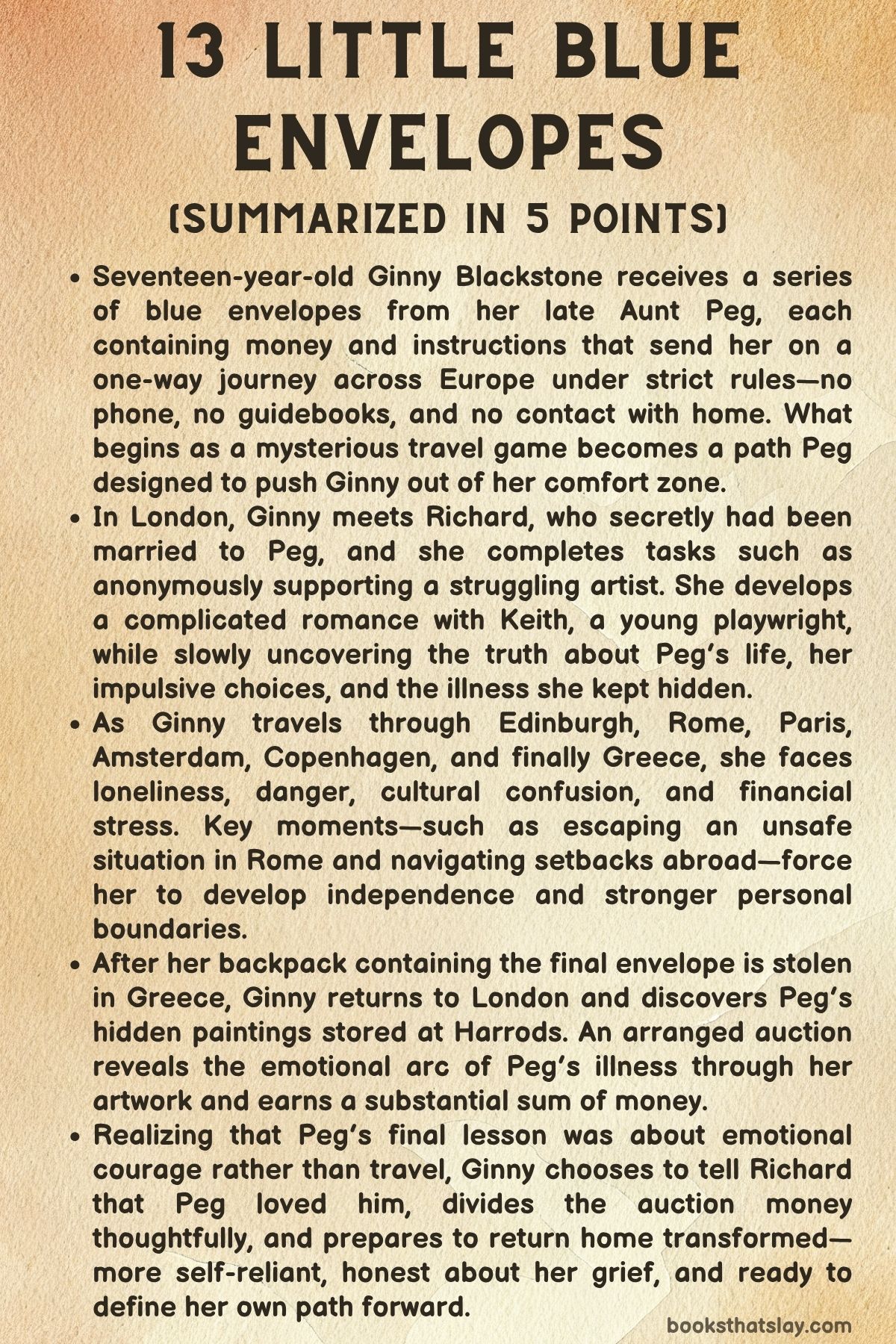
13 Little Blue Envelopes by Maureen Johnson is a contemporary young-adult travel novel about seventeen-year-old Virginia “Ginny” Blackstone, who receives a puzzling set of instructions from her Aunt Peg after Peg’s death. Each small blue envelope sends Ginny to a new European city with strict rules: one backpack, no guidebooks, no phone, and no contacting home.
What begins as a strange scavenger hunt becomes a messy, funny, scary, and unexpectedly freeing trip. As Ginny follows Peg’s trail, she meets strangers who change her days, confronts her own limits, and discovers that her aunt left more than directions—she left a way forward. It’s the 1st book of the Little Blue Envelopes series.
Summary
Ginny Blackstone is seventeen, quiet, and used to a predictable life in New Jersey. Her closest, most unpredictable influence has always been her Aunt Peg, a New York artist who made Ginny feel braver just by being around her.
Two years earlier, Peg vanished without warning. Three months before the story begins, Ginny’s family learned Peg had died of cancer in London.
So when an envelope arrives addressed to Ginny in Peg’s handwriting, it feels impossible.
Inside is cash and a set of instructions: get a passport, buy a backpack, and purchase a one-way ticket to London. Peg frames it as a game they once played when Ginny was a child—“today I live in…”—except now it’s real.
Peg also sets strict rules: Ginny can carry only what fits in her backpack, can’t bring guidebooks or a journal, can’t take her own money, and can’t use a phone, camera, or laptop. She is not supposed to contact anyone back home in the United States while she’s gone.
Peg says she has arranged everything else through the envelopes.
Nervous but compelled, Ginny goes to a Chinese restaurant beneath Peg’s old apartment to pick up another envelope left for her. The restaurant owner assumes Peg is still alive, and Ginny can’t bring herself to correct her.
Then Ginny flies to London with the remaining envelopes packed inside the first package.
On the plane, Ginny learns more about Peg’s choices and the moment Peg decided she needed to leave New York. Peg’s second set of directions sends Ginny from the airport to a specific address in London—54a Pennington Street—where she is to meet Richard Murphy and get the PIN for a debit card.
Ginny arrives jet-lagged and disoriented, struggling with the subway system and the unfamiliar city. At the house, Richard answers the door: polite, tidy, and not what Ginny expected from Peg’s circle.
He shows Ginny the room Peg stayed in, now filled with Peg’s collages and bright, found-object art. Richard works at Harrods and offers to take Ginny along.
Harrods overwhelms Ginny with its scale and luxury. She quickly realizes she is out of her depth and asks for help contacting Richard.
Back at his place, Ginny tries to recover from travel exhaustion, adjusting to small cultural differences that make her feel clumsy. At lunch, she asks Richard the question Peg instructed her to ask, and Richard tells a story about selling pants to the Queen—revealing the password “pants” for the debit card.
Ginny withdraws cash and discovers Peg truly set up an account for her, easing her fear that she’s been sent into the world with nothing.
The next envelope gives Ginny her first big task: withdraw £500 and anonymously support an artist whose work she believes in. Ginny and Richard search for art shows, but everything she sees feels wrong or uninspiring.
Eventually she wanders into a student theater and watches an odd, funny production called Starbucks: The Musical. Ginny becomes fixated on the show and especially on its creator and performer, Keith Dobson, a charismatic young man close to her age.
Trying to fulfill Peg’s assignment, Ginny buys up the remaining tickets for several performances—then realizes she has ruined the audience by making the show “sold out” without filling the seats. She panics, tries to give away the tickets, and ends up with an awkward half-solution that attracts attention from Keith and his friends.
Keith confronts Ginny after a nearly empty performance, confused by her behavior. Ginny, shy and flustered, can’t explain herself properly.
Keith asks her out anyway, and they go to a pub. Ginny orders a beer she doesn’t like, says too little, and gives Keith the wrong impression about her wealth and confidence.
Keith talks a lot to fill the silence, sharing pieces of a troubled past—pranks, trouble at school, and an arrest that forced him to change direction. The evening feels thrilling to Ginny, but her lack of practice with attention makes her impulsive.
When she later tries to hand Keith leftover cash directly, he is startled and offended, and Ginny is humiliated.
Soon after, Peg’s next instructions send Ginny to Edinburgh to meet Peg’s hero, painter Mari Adams. The timing overlaps with Keith’s travel plans, and Ginny thinks she might get a second chance to know him.
She spends a day working up courage, then ends up at Keith’s house where she finds his roommate David upset over a fight with his girlfriend. Ginny comforts David on the sidewalk until Keith arrives, and the three share a meal meant to steady David.
After a chaotic chase when David runs off drunk, Ginny finally asks Keith to come to Scotland. He agrees, kisses her briefly, and they travel by train.
Edinburgh is moody, layered, and dominated by its castle. Mari Adams’s home is just as startling: saturated colors, toys on tables, walls full of women in fantastical paintings.
Mari herself is older, intense, tattooed, and sharply observant. She welcomes Ginny with immediate warmth and odd intimacy, and Keith plays along as “Ginny’s hairdresser.” Mari speaks about art, memory, and the desire to be seen.
Then she abruptly draws on Ginny’s shoulder for a long time, leaving a golden lion there like a private emblem.
On the way back to London, Ginny tells Keith the truth: Peg is dead, and the trip is built from Peg’s letters. Keith reacts harshly, focusing on Peg’s abandonment rather than the romance of the game.
Ginny defends Peg fiercely, insisting Peg made her life bigger. Their argument is interrupted by Keith sharing his own painful history with an ex-girlfriend and an abortion that reshaped his life.
The conversation softens, and Keith’s arm around Ginny feels like a truce. But the peace breaks again at the station when Keith steals a toy from Mari’s home, tosses it away in frustration, and leaves Ginny disgusted.
They part angry.
Peg’s next destination is Rome, with a visit to the ruins of Vesta’s temple. Ginny travels alone, overwhelmed by the heat, crowds, and difficulty of navigating without help.
At the temple, Peg’s letter reveals Peg’s conflicted longing for both freedom and home. Peg sets Ginny a terrifying task: ask a Roman boy out for cake.
Ginny is irritated, partly because the assignment forces her to think about Keith, but she tries. At the Trevi Fountain, a suave young man named Beppe helps her when children attempt to steal from her.
Ginny uses gratitude as an excuse to invite him out. He declines cake but offers coffee and then gelato, speaking with practiced charm.
When Ginny mentions traveling alone, he invites her to meet his sister.
Beppe brings Ginny to a beautiful neighborhood and an apartment full of family photos, but his sister is not there. His answers about her are evasive.
He pours wine, flirts, and kisses Ginny. Ginny doesn’t feel interest so much as pressure to let the moment happen.
When Beppe becomes aggressive and tries to push her to the floor and unbutton her pants, Ginny snaps out of the haze and escapes. Shaken, she returns to Vesta’s statues and leaves a strange offering: the button torn from her pants, a small token of what she refused to lose.
Peg’s next instructions send Ginny to Paris, to stay in Montparnasse and open another envelope at the Louvre. Ginny takes an overnight train, writes letters she cannot send, and arrives to a hostel that locks guests out during the day.
In the bunk room, a group of American girls travels together, and Ginny feels her solitude sharply. At the Louvre, she opens Peg’s letter about a Paris cafe Peg redecorated in exchange for food and a place to sleep, and Ginny is tasked with finding it.
Ginny struggles to locate the cafe in a city full of cafes until hostel staff directs her to a market vendor who supplies local restaurants. She finds Les Petits Chiens and sees Peg’s unmistakable touch: aprons as curtains, walls crowded with photos and painted poodles, furniture splashed in bright colors.
The owner, Paul, praises Peg’s persistence and talent. Ginny can’t bring herself to tell him Peg is dead.
She leaves heavy with loneliness—until Keith suddenly appears at her hostel lobby. He has come to Paris because of a performance opportunity arranged through people who saw his show in London.
Keith and Ginny spend the night roaming Paris, eating crepes, and ending up in a cemetery after Keith hops a fence and Ginny follows. He apologizes for stealing from Mari, and Ginny explains why it hurt.
The topic returns to Peg, and Ginny finally says the word “cancer” out loud to someone who isn’t family. Keith reassures her that he doesn’t like her for money.
They kiss, then are caught by a police officer who simply orders them to leave. Ginny misses hostel curfew and ends up sleeping on benches in a garden with Keith nearby, both of them trying to treat the night as an adventure rather than a problem.
Next, Peg sends Ginny to Amsterdam to find Peg’s friend Charlie and to visit the Rijksmuseum to see Rembrandt’s The Night Watch and speak to a person named Piet. In the rain, Ginny arrives at Charlie’s address only to find Charlie gone.
Her plan collapses. A hostel she tries is filthy, and she flees it, feeling grimy and defeated.
In desperation, she ends up near a small hotel where an American family, the Knapps, notices her situation and insists she stay with them. Their kindness is warm but tightly structured; they travel with schedules and rules, a controlled version of safety.
Ginny joins the Knapps for days of “must-see” sightseeing. At the Rijksmuseum, she tries to linger by The Night Watch but can’t find Piet at first.
Later, she returns alone and learns Piet is a guard in another room. When she asks about the painting, Piet shrugs—he sees it every day, and it has become ordinary to him.
The moment leaves Ginny uneasy, as if the trip has stopped making sense.
During a bike trip to Delft, Ginny grows closer to the Knapps’ teenage daughter, Olivia. Olivia reveals she is gay and that her parents don’t know.
Ginny realizes how easy it is to miss what’s right in front of you when life is organized around checklists and appearances. That night, Mrs. Knapp gives Ginny an itemized bill for her share of expenses.
Ginny pays, but it drains her account dangerously low. She opens Peg’s next letter and learns the truth Peg avoided: Peg knew something was wrong before she left New York.
She had memory slips and fear, and she built a better story to hide the reality. Peg directs Ginny to Copenhagen and instructs her to email someone who will meet her.
In Denmark, a man named Knud picks Ginny up on a motorcycle with a sidecar and takes her onto his ornate houseboat. Knud is a folk artist devoted to old crafts.
He speaks openly about Peg’s death and takes Ginny to see modern windmills near a field, where Peg once came to experience the midnight sun and found hope in the idea of a cleaner future. The quiet trip steadies Ginny, reminding her that Peg left traces in people as much as in places.
Ginny then stays at a clean hostel and meets four Australian travelers—Nigel, Carrie, Emmett, and Bennett—who invite her into their loose, spontaneous rhythm. They nickname her “Pretzels” and pull her into a night of karaoke where Ginny unexpectedly performs and wins, tasting confidence that doesn’t depend on anyone else’s permission.
Peg’s next letter tells Ginny to take a long train journey south, following Peg’s own aimless travel until she reached a ferry and ended up on the Greek island of Corfu. Ginny decides to go, and the Australians choose to come with her.
The journey is exhausting: train after train across Europe, then a dash through Venice to catch a ferry. On the ferry deck, Ginny reads Peg’s twelfth letter and finally understands a central part of Peg’s story: Peg met Richard at Harrods, stayed with him when she needed help, and fell in love with him.
He loved her too. Peg ran away again when emotions became real, then returned once she learned she had cancer.
Richard cared for her through her decline. Peg hints that one envelope remains, the most important one, and that Ginny can open it when she’s ready.
Before Ginny can decide, disaster hits. On Corfu, while Ginny and Carrie swim, someone steals both their backpacks from the beach—along with the envelopes, including the final unopened one.
Ginny still has her passport and debit card, but her money is almost gone. Carrie has lost her passport entirely.
The group scrambles, and Ginny calls Richard for help. He promises to get her a ticket back to London.
Ginny leaves the Australians with an emotional goodbye, feeling guilty that her story brought them into a mess.
Back in London, Richard reveals what he had hidden: he was not just Peg’s friend—he was Peg’s husband. The news makes Peg’s death feel newly real to Ginny, and it also makes Ginny furious that Peg orchestrated a situation that forces Richard to confess this alone on a train platform.
Ginny bolts, running away from the only adult who can explain what Peg chose and why.
She ends up at Keith’s house. Keith isn’t in Scotland after all; a mistake cancelled his Fringe plans.
Ginny collapses into exhaustion and grief, finally articulating what has been haunting her: Peg had been “gone” before, and that was bearable because it left room for return. Now Peg is dead, and Ginny never saw the illness happen.
The truth arrives late and lands hard. Keith comforts her and insists she go back to Richard in the morning.
When Ginny and Keith return to Richard’s house using a spare key, they find Peg’s room unchanged. While talking, Ginny discovers a hidden key behind the poster Peg loved.
She connects it to Richard’s mention of Peg’s Harrods studio and realizes it must open a storage cabinet there. At Harrods, Richard leads them to Peg’s old workspace and unlocks a cabinet containing dozens of Peg’s rolled canvases.
Taped inside is a business card with “call now” written on it.
They call the dealer, Cecil Gage-Rathbone, who has been expecting Ginny. Peg arranged for an auction of the paintings.
Ginny and Richard finally talk honestly: Ginny apologizes for running; Richard apologizes for the blunt reveal. Ginny admits Peg’s death feels more real now that she understands Richard was with Peg at the end.
Richard, despite his own grief, offers steadiness rather than resentment, and Ginny recognizes she has gained an uncle in the middle of losing an aunt.
At the auction, Peg’s paintings are displayed in a progression that mirrors the arc of Peg’s illness—early pieces bright and clear, later ones furious and chaotic, then muddied and wrong, then sharp again in distorted, surreal ways. Seeing them makes Ginny understand Peg was not simply hiding; Peg was unraveling.
The collection sells for £70,000, a number so large Ginny struggles to make it feel real. She wonders what Peg wanted her to do with it, but Keith pushes her toward a different question: what does Ginny want?
Ginny and Keith admit they are “something,” even with the reality that Ginny will soon return to the United States. Meanwhile, the missing last envelope hangs over Ginny like unfinished business.
Ginny decides that the final task was never about a destination. It was about Richard.
Ginny returns to Harrods, thanks the chocolate-counter employee who helped her earlier, and buys her a gift. Then she takes Richard to lunch in the Harrods tearoom and tells him the truth Peg never got to say directly: Peg loved him, and Peg regretted leaving him.
Richard’s reaction—quiet joy and relief—gives Ginny the clearest sense yet that she has completed the journey in the way Peg hoped.
Because the original final envelope was stolen, Ginny writes her own last letter to Peg. In it, she admits anger over Peg’s disappearance and the pain Peg caused, but she also acknowledges what the trip changed: Ginny proved she can move through the world on her own, make decisions under pressure, and come back with a stronger sense of who she is.
She decides to leave half of the money for Richard, then go home, carrying Peg’s influence forward without letting it control her.
Characters
Virginia “Ginny” Blackstone
Ginny is the emotional and structural center of 13 Little Blue Envelopes. At the start, she is shy, self-conscious, and deeply uncertain about her place in the world.
She sees herself as awkward—too tall, too quiet, too hesitant. Peg’s death leaves her suspended between grief and confusion because Peg had always been the person who made her feel interesting and capable.
The envelopes force Ginny into situations where there is no script and no safety net. Over time, the girl who can barely order a drink or speak to a stranger begins navigating foreign cities alone, confronting danger, handling money, making ethical decisions, and choosing whom to trust.
Ginny’s growth is not linear or glamorous. She makes mistakes—buying all of Keith’s tickets, misreading people, trusting Beppe too far, running away from Richard.
Yet these missteps are central to her development. Her encounter with Beppe marks a turning point: for the first time, she clearly asserts her boundaries.
The theft of her backpack in Greece strips away even the illusion of structure, leaving her to act without instructions. By the end, Ginny understands that the final envelope was never about geography but about emotional courage.
She becomes someone who can carry Peg’s influence without being overshadowed by it. Her final act—choosing how to divide the money and telling Richard the truth—signals her transition from follower to decision-maker.
Aunt Peg
Peg is both absent and omnipresent. Though she is dead before the novel begins, her personality animates every setting and every choice.
She is imaginative, impulsive, artistic, and allergic to conventional stability. As a young woman, she ran away before college and shaped her life around art, movement, and unpredictability.
To Ginny, Peg represented possibility—an antidote to suburban routine. Peg’s letters recreate that unpredictability, deliberately pushing Ginny into discomfort so she can discover independence.
Yet Peg is also deeply flawed. She disappears without explanation, even before her illness.
Her decision to leave New York when she begins experiencing symptoms is partly romanticized in her letters, but later revelations show it was also driven by fear. She avoids doctors, avoids confrontation, and avoids fully committing to Richard when love becomes serious.
Peg’s contradictions are central to her character: she longs for freedom yet is fascinated by the idea of home; she craves artistic recognition yet hides her vulnerability; she orchestrates Ginny’s growth but withholds painful truths.
The progression of her paintings mirrors her mental and physical decline, exposing the cost of her silence. In the end, Peg’s final unspoken task—ensuring Richard knows she loved him—reveals that beneath her bravado was genuine attachment and regret.
Peg’s legacy is not just art or money, but the complicated inheritance of courage mixed with avoidance.
Richard Murphy
Richard begins as a quiet, polite figure in London, but gradually emerges as one of the novel’s emotional anchors. At first, he presents himself as Peg’s friend, offering Ginny a stable place to stay.
He works at Harrods, lives modestly, and contrasts sharply with Peg’s chaos. His kindness is understated; he provides practical support without demanding emotional openness from Ginny.
The revelation that Richard was Peg’s husband recontextualizes everything. His restraint is not detachment but grief.
He honored Peg’s wish to keep certain truths private, even when it put him in uncomfortable positions. Richard represents the steadiness Peg both desired and resisted.
Unlike Peg, he confronts responsibility directly. He cared for her through her illness, absorbing the part of her life she concealed from Ginny.
Richard’s role in Ginny’s arc is crucial. He models adulthood that is compassionate without being dramatic.
When Ginny runs from him, he does not retaliate; he leaves space for her to return. At the auction, his quiet pain underscores how love can endure beyond conflict.
By the end, Richard becomes family in a tangible way, giving Ginny a sense of continuity rather than abandonment.
Keith Dobson
Keith functions as both romantic interest and mirror to Ginny’s insecurities. Charismatic, talkative, and creative, he contrasts Ginny’s reserved nature.
His musical is playful and eccentric, reflecting his artistic ambition. At first glance, he appears confident and worldly, but his backstory complicates that image.
His troubled teenage years, arrest, and heartbreak reveal vulnerability beneath his bravado.
Keith’s relationship with Ginny is messy and uneven. He teases her, misinterprets her wealth, and sometimes acts selfishly, as seen when he steals from Mari’s house.
That moment exposes his lingering impulsiveness and moral blind spots. Yet he is capable of apology and growth.
His willingness to travel to Paris for opportunity and to comfort Ginny during her emotional collapse shows genuine care.
Keith challenges Ginny to articulate her feelings. Their arguments about Peg expose differing worldviews: Keith initially sees Peg’s disappearance as abandonment, while Ginny sees it as adventure.
Over time, he learns to respect her loyalty, and she learns to question romanticized narratives. By the end, their relationship is undefined but real, grounded more in mutual recognition than fantasy.
Mari Adams
Mari Adams embodies the artistic life Peg idolized. Eccentric, tattooed, and unapologetically unconventional, Mari lives in a world saturated with color and symbolism.
She speaks bluntly about art’s purpose: to remember and be remembered. Her home is both chaotic and intentional, reflecting a life fully committed to creative expression.
Mari’s significance lies in how she bridges Peg’s mythology and reality. She validates Peg’s talent and ambition while also acknowledging her death without romantic gloss.
Her act of drawing a golden lion on Ginny’s shoulder is symbolic—it marks Ginny with a reminder of strength and identity. Mari sees something in Ginny that Ginny has not yet claimed for herself.
Unlike Peg, Mari does not run from intensity; she leans into it. Her presence forces Ginny and Keith to confront their immaturity.
She serves as a living example of an artist who has survived decades of passion and loss, offering a glimpse of what Peg might have become had illness not intervened.
Beppe
Beppe represents the illusion of charm and the danger of misread signals. Suave, attractive, and seemingly helpful, he initially appears as a romantic possibility in Rome.
His confidence contrasts with Ginny’s awkwardness, making him seem sophisticated and worldly.
However, Beppe’s behavior shifts from flirtation to coercion. His evasiveness about his sister and his escalating physical advances reveal entitlement beneath the charm.
The encounter exposes Ginny’s vulnerability but also catalyzes her assertion of agency. By leaving and returning alone to the temple, Ginny rejects the idea that experience must come at the cost of safety.
Beppe’s role is brief but significant. He underscores the risks of traveling alone and the complexity of navigating desire versus pressure.
Through him, Ginny learns to trust discomfort as a signal rather than ignore it.
Olivia Knapp
Olivia is a quieter parallel to Ginny. Traveling with her highly organized family, she appears reserved and detached.
Her parents’ structured approach to sightseeing contrasts with Ginny’s improvisational journey. Olivia’s revelation that she is gay and has not told her parents adds depth to her silence.
Olivia’s internal conflict mirrors Ginny’s struggle with visibility. Just as Piet sees The Night Watch daily and stops truly seeing it, Olivia lives inside a family that does not fully perceive her.
Her confession to Ginny creates a moment of trust and solidarity between two young women negotiating identity in different ways.
Through Olivia, the novel explores how even in stable environments, personal truth can remain hidden. She expands Ginny’s understanding of how many people carry unseen complexities.
Knud
Knud, the Danish folk artist, represents a quieter, grounded creativity. Living on a carved wooden houseboat and dedicated to ancient crafts, he values preservation and patience.
His art contrasts with Peg’s experimental collage style but shares the same devotion to meaning.
Knud speaks openly about Peg’s illness and death, offering Ginny clarity rather than mystique. His emphasis on windmills as beautiful and useful reframes art as something that can serve a future beyond the self.
In his company, Ginny experiences calm reflection instead of frantic movement.
Knud’s steadiness reinforces a theme that creativity need not reject responsibility. He stands between Peg’s impulsiveness and Richard’s practicality, embodying a balance of imagination and structure.
Carrie, Nigel, Emmett, and Bennett
The Australian friends inject spontaneity and camaraderie into Ginny’s journey. Unlike the Knapps, they travel without rigid plans, adapting easily to change.
Their easy acceptance of Ginny, including the playful nickname “Pretzels,” gives her a sense of belonging that is not tied to romance or family.
Carrie, in particular, forms a closer bond with Ginny. Their shared swim on the beach in Corfu and the subsequent theft create a turning point.
The loss of their backpacks highlights the fragility of adventure. The Australians’ reaction—practical but supportive—shows resilience without melodrama.
Collectively, they represent freedom stripped of illusion. They are not idealized wanderers; they face logistical setbacks and consequences.
Their presence helps Ginny experience companionship that is neither possessive nor prescriptive.
Cecil Gage-Rathbone
Cecil is the art dealer who manages Peg’s posthumous auction. Polished and professional, he views Peg’s paintings as both artistic works and valuable commodities.
His language frames Peg as an emerging figure in the art world, giving her legacy institutional recognition.
Through Cecil, the novel examines the commercialization of art. The auction setting feels sterile compared to Peg’s vibrant studio, yet it provides closure.
Cecil assumes Ginny understands the arrangements, highlighting how Peg orchestrated events even beyond her death.
He is less emotionally central than others, but he completes the transformation of Peg’s private journey into public acknowledgment. The sale forces Ginny to decide how she wants Peg remembered—not just as an artist, but as a person.
Themes
Grief and the Delayed Realization of Loss
Grief in 13 Little Blue Envelopes does not arrive as a single emotional breakdown but as a slow, uneven recognition. Ginny begins her journey technically aware that Peg is dead, yet emotionally she still experiences her aunt as present.
The letters create an illusion of continuity; Peg’s voice guides her across borders, gives instructions, and even anticipates her reactions. This structure postpones the finality of death.
As long as there is another envelope to open, Peg is still speaking. The journey becomes a suspended state in which Ginny can postpone confronting the full weight of loss.
This delayed grief is most evident when Ginny learns that Richard was Peg’s husband and caretaker during her illness. That revelation collapses the protective narrative Peg constructed.
Until that moment, Peg’s absence could still be interpreted as adventure, choice, or mystery. The illness had remained abstract.
When Ginny understands that Peg suffered visibly and privately with someone else, death becomes tangible. Her breakdown is not about new information alone; it is about realizing how much of Peg’s final reality she was shielded from.
The progression of Peg’s paintings reinforces this theme. The shift in color and coherence across the collection makes the illness visible in ways words never did.
Ginny’s acceptance does not erase anger. She feels abandoned not only by Peg’s disappearance years earlier but also by Peg’s refusal to share her vulnerability.
Grief here includes frustration, resentment, and guilt alongside love. By the end, Ginny’s act of telling Richard that Peg loved him becomes a form of closure.
She cannot change the secrecy that shaped Peg’s final months, but she can refuse to let silence define the memory. The novel presents grief as something that matures with understanding, arriving in stages rather than all at once.
Independence and the Formation of Identity
Ginny’s trip across Europe operates as a forced experiment in independence. The strict rules Peg imposes—no phone, no guidebooks, no contact with home—strip away the safety nets that usually buffer a teenager from discomfort.
Ginny must navigate public transportation systems, budget money, choose accommodations, and evaluate strangers without immediate guidance. This isolation is not romanticized.
She feels lonely in hostels, embarrassed in social interactions, and overwhelmed by language barriers. Independence emerges through repetition of small decisions rather than through dramatic heroics.
At the start, Ginny defines herself largely through others. She sees herself as Peg’s niece, as Miriam’s friend, as the awkward girl compared to more confident peers.
Her crush on Keith initially reflects this insecurity; she projects confidence onto him and hopes proximity to him will make her feel more interesting. Over time, however, she begins to recognize that identity cannot be borrowed.
Her refusal to tolerate Beppe’s aggression marks a shift from passive compliance to self-protection. Her confrontation with Keith about stealing from Mari shows that she is willing to challenge someone she admires.
The stolen backpack in Greece symbolizes the removal of external structure. Without the envelopes, the trip is no longer a guided sequence of tasks.
Ginny must decide what to do next without instructions. That moment clarifies that the journey was never only about retracing Peg’s path; it was about Ginny learning to choose.
Her final decisions—how to divide the auction money, how to define her relationship with Keith, how to speak honestly to Richard—are not dictated by Peg. Independence becomes less about physical travel and more about internal authority.
By the end, Ginny’s identity includes Peg’s influence but is no longer dependent on it.
Art as Memory and Self-Expression
Art functions as both a literal and symbolic force throughout 13 Little Blue Envelopes. Peg’s life revolves around creating collage-style works that incorporate found objects and bold color.
Her paintings document not only locations but emotional states, especially as her illness progresses. The visual shift in her work reveals deterioration and resurgence in ways that dialogue cannot.
Art becomes a record of lived experience, preserving moods and moments that might otherwise fade.
Mari Adams articulates this idea directly when she speaks about the desire to remember and be remembered. The reference to paintings that include reflections of the artist suggests that creative work contains both subject and creator.
Peg’s final series, displayed at the auction, captures her psychological arc from clarity to confusion and back to a fractured brightness. For Ginny, seeing the works together provides insight into Peg’s internal world.
The paintings translate silence into color and composition.
Art also shapes Ginny’s development. Peg trained her to feel comfortable in museums and galleries, giving her tools to interpret what she sees.
The assignment to become a mysterious benefactor pushes Ginny to consider the value of supporting creative work. Her choice to back Keith’s production, despite clumsy execution, reflects her belief in nurturing talent.
Even Knud’s devotion to traditional crafts expands the definition of art beyond painting and performance. Through these encounters, art is portrayed as both personal expression and communal exchange.
It holds memory, invites interpretation, and connects strangers across time and geography. The auction scene underscores the tension between artistic meaning and monetary value, forcing Ginny to confront how legacy is measured.
The Tension Between Freedom and Responsibility
Peg embodies a life defined by movement and spontaneity. She runs away before college, shifts cities without warning, and leaves New York abruptly when she senses illness.
Her letters frame these choices as courageous acts of self-determination. However, the narrative gradually reveals the cost of such freedom.
Her disappearance hurts Ginny and her family. Her refusal to confront illness directly delays treatment and isolates her from those who care about her.
The contrast between Peg and Richard highlights this tension. Richard represents steadiness and accountability; he remains, works, and ultimately cares for Peg during her decline.
Ginny’s journey forces her to examine both models. At first, she romanticizes Peg’s mobility and resists Keith’s criticism that Peg abandoned her.
Yet as she travels, she experiences the vulnerability that accompanies unstructured freedom. The filthy hostel in Amsterdam, the theft in Corfu, and the financial strain with the Knapps expose practical realities.
Freedom without preparation can become instability.
The theme is not resolved by condemning Peg’s choices. Instead, the novel suggests that autonomy and responsibility must coexist.
Knud’s windmills symbolize this balance—beautiful yet functional. Ginny’s growth lies in learning that independence does not require rejecting attachment.
She can travel, explore, and fall in love while still honoring commitments. Her decision to give Richard half of the auction proceeds acknowledges his role in Peg’s life and death.
By merging Peg’s adventurous spirit with Richard’s steadiness, Ginny charts a middle path that values both exploration and accountability.
Trust, Vulnerability, and Boundaries
Travel amplifies the question of whom to trust. Ginny encounters a spectrum of strangers: generous hosts, charismatic artists, predatory men, and indifferent officials.
Each interaction tests her judgment. The experience with Beppe marks the most direct threat.
His charm initially disarms her, and her desire to fulfill Peg’s task clouds her instincts. When he pushes beyond her comfort, Ginny’s refusal to comply reclaims control.
That moment reshapes her understanding of vulnerability; openness must be paired with self-protection.
Keith’s arc further complicates trust. His flirtation and humor attract Ginny, but his theft from Mari reveals a capacity for selfishness.
Ginny’s anger is not only about the object taken but about what it represents—a violation of a space tied to Peg. Keith’s apology demonstrates that trust can be repaired, but not without confrontation.
Their relationship matures because Ginny refuses to ignore her discomfort.
Richard represents a different dimension of trust. His withholding of the truth about his marriage to Peg initially feels like betrayal.
However, when Ginny learns the context—that Peg controlled the narrative—she recognizes the complexity. Trust here involves accepting imperfect decisions made under difficult circumstances.
The Australians’ casual inclusion of Ginny also offers a version of trust based on shared experience rather than history. Across these varied connections, the novel portrays trust as dynamic rather than automatic.
Vulnerability is necessary for intimacy, yet boundaries are essential for safety. Ginny’s development lies in balancing these forces rather than swinging between naivety and cynicism.
Home and Belonging
The idea of home shifts constantly throughout the narrative. Peg once admired Vesta, the goddess of hearth and home, despite living a life defined by departure.
This contradiction underscores her internal conflict. She seeks movement but remains drawn to the idea of rootedness.
Ginny inherits this tension. As she moves from London to Rome to Paris and beyond, each new city offers novelty but not permanence.
Encounters with the Knapps and the Australians reveal different models of belonging. The Knapps’ structured travel mirrors suburban stability, yet Olivia’s hidden identity shows that even orderly homes can contain silence.
The Australians’ fluid companionship provides warmth without obligation. Richard’s house, filled with Peg’s art, becomes the most emotionally charged space.
It holds memory, grief, and affection simultaneously.
The final realization that Peg married Richard reframes London as more than a waypoint; it was a shared domestic life Peg chose but did not fully publicize. When Ginny returns there after losing the envelopes, she confronts the physical space where Peg’s final months unfolded.
Home becomes not a static address but a network of relationships and memories.
Ginny’s choice to return to the United States does not signify rejection of adventure. Instead, it signals an understanding that belonging can coexist with mobility.
She can carry the lessons of Europe back to New Jersey without feeling confined. Home, in this sense, becomes internalized—a place defined by honesty, connection, and self-knowledge rather than geography alone.