1776 by David McCullough Summary and Analysis
1776 by David McCullough is a narrative history that recounts one decisive year in the American Revolutionary War. Rather than covering the entire conflict, McCullough concentrates on the dramatic events of 1776, when the fate of the rebellion against Great Britain hung in the balance.
The book presents a close study of leadership, especially George Washington’s growth under pressure, and contrasts the strengths and weaknesses of the American and British forces. Drawing on letters, diaries, and official records, it portrays a year marked by missteps, resilience, hardship, and unexpected victory.
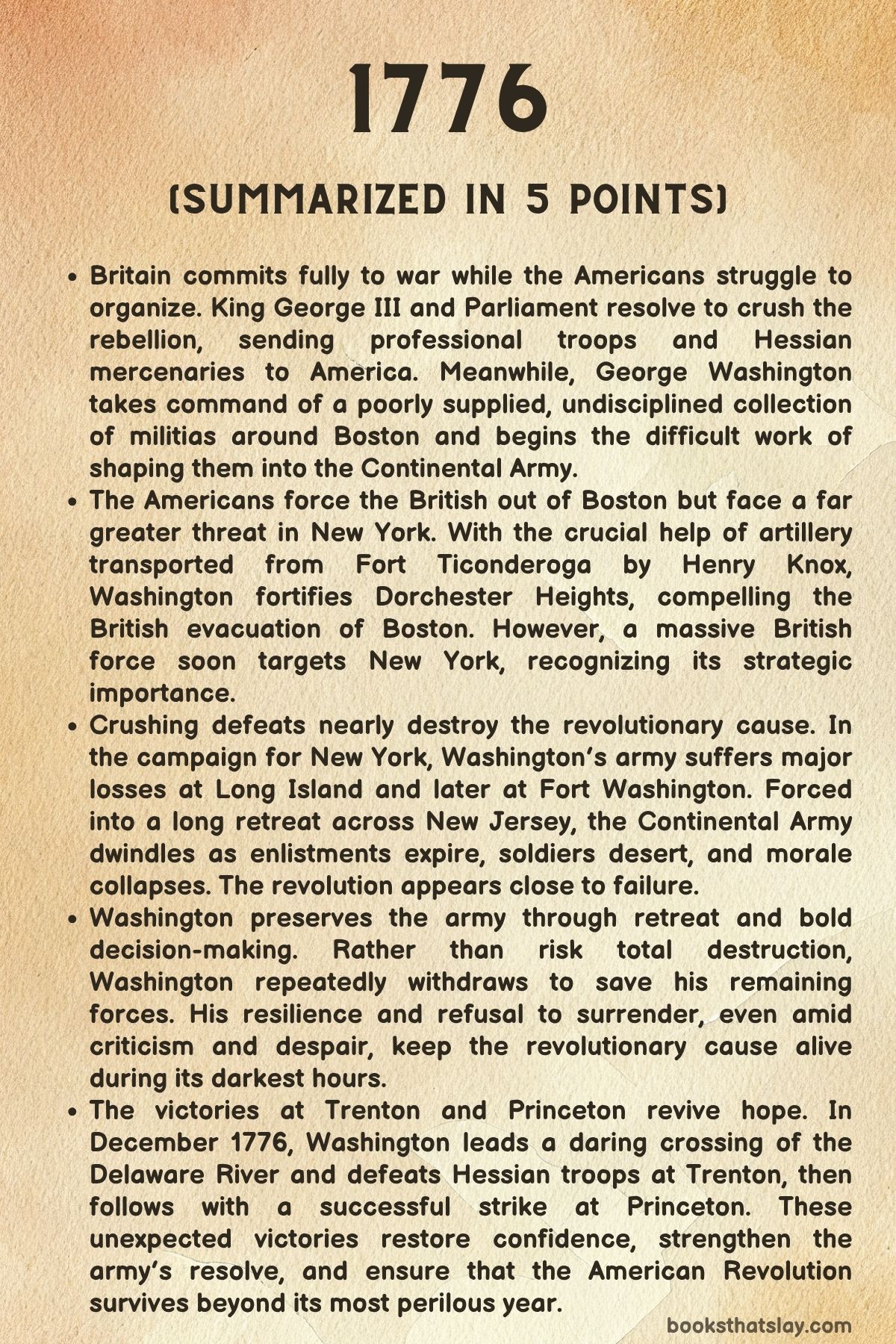
Summary
The story begins in late 1775 in London, where King George III resolves to suppress the rebellion in the American colonies. Though often caricatured by critics, the king is shown as disciplined, principled, and firm in his belief that the empire must be preserved.
Parliament largely supports him, and preparations are made to send more troops across the Atlantic. Foreign mercenaries from German states are hired to strengthen British forces.
Despite some voices urging reconciliation, the British government commits itself to war.
Across the ocean, the American forces gathered around Boston are far from a professional army. When George Washington takes command, he inherits a disorderly collection of militia units with little training, few supplies, and minimal discipline.
Many soldiers come and go as they please. Disease spreads through filthy camps.
Weapons are inconsistent, gunpowder is scarce, and officers are not easily distinguished from enlisted men. Washington, though lacking extensive battlefield experience, imposes structure and order.
He insists on discipline, reorganizes command, and works constantly to shape the volunteers into a unified Continental Army.
Washington’s background shapes his leadership. Raised in Virginia and largely self-educated, he has developed a strong sense of dignity and self-control.
He understands politics as well as warfare, which proves crucial in dealing with the Continental Congress. While determined, he is also aware of his own inexperience and relies heavily on capable subordinates such as Nathanael Greene and Henry Knox.
The British army occupies Boston, confident in its superiority. However, they underestimate the severity of the New England winter and the determination of the rebels.
Henry Knox undertakes a bold mission to transport heavy artillery from Fort Ticonderoga through snow and ice to Boston. The successful arrival of these cannons transforms the strategic situation.
Washington seizes the opportunity and fortifies Dorchester Heights overlooking the city. When British General William Howe realizes his troops are exposed to devastating fire from above, he decides to evacuate Boston.
In March 1776, the British withdraw by sea, taking Loyalists with them. The Americans celebrate their first major success, and Washington’s reputation rises sharply.
Yet the conflict is far from decided. Washington anticipates that New York will be the next target, given its strategic location and harbor.
He moves his army there, but New York proves more divided and less supportive than Boston. Loyalist sympathies are strong.
Discipline remains a problem among the troops, and illness continues to weaken the ranks. Meanwhile, a massive British fleet assembles, carrying tens of thousands of soldiers, including Hessians.
In July 1776, as British forces gather, the Continental Congress declares independence. The Declaration transforms the war from a dispute over rights into a struggle for nationhood.
Washington reads the Declaration to his troops, reinforcing their sense of purpose.
The British soon launch a powerful campaign against New York. In August, they land on Long Island with overwhelming force.
Through a well-executed flanking maneuver, they outmaneuver the Americans at the Battle of Brooklyn. Washington’s army is badly beaten, and many soldiers are killed or captured.
The defeat threatens to end the rebellion. However, in a remarkable nighttime operation, Washington orchestrates a silent evacuation across the East River, saving much of his army.
The British awaken to find their enemy gone.
Fighting continues around New York. American forces retreat again after the British land at Kip’s Bay.
Washington struggles to rally panicked troops. Though a small victory at Harlem Heights restores some confidence, the British gradually force the Americans northward.
Fort Washington falls in November after a determined assault, resulting in heavy American losses and thousands taken prisoner. The defeat is a severe blow to morale.
Washington’s army then begins a long retreat across New Jersey. Conditions are grim.
Soldiers lack proper clothing and shoes, leaving bloody footprints in the snow. Enlistments expire, and many go home.
Supplies run short. The Continental Congress flees Philadelphia, fearing capture.
British commanders offer pardons to those willing to swear loyalty to the crown, and many civilians accept. It appears that the revolution may collapse.
Internal tensions worsen matters. Some officers question Washington’s leadership.
General Charles Lee, ambitious and critical, delays joining Washington and is eventually captured by the British. Washington faces not only external threats but also doubts within his own ranks.
By December 1776, the American army has dwindled dramatically. British and Hessian troops occupy positions along the Delaware River, confident that the rebellion is nearly crushed.
British commanders settle into winter quarters, assuming the campaign season is over.
Washington recognizes that a bold action is necessary to revive the cause. On Christmas night, amid a fierce winter storm, he leads his troops across the icy Delaware River.
The crossing is perilous, and not all planned units make it across. Nevertheless, the main force marches toward Trenton, where Hessian troops are stationed.
In a surprise attack at dawn on December 26, Washington’s men overwhelm the Hessians. Their commander, Colonel Johann Rall, is mortally wounded, and nearly a thousand enemy soldiers are captured.
American casualties are minimal. The victory at Trenton electrifies the colonies and restores faith in the army.
Washington follows up with another daring move. After briefly withdrawing, he recrosses the Delaware and maneuvers around British General Cornwallis.
In early January 1777, American forces strike at Princeton, defeating British troops and capturing more prisoners. These victories force the British to pull back and reconsider their strategy in New Jersey.
By the end of the year, the outlook has changed dramatically from the despair of early December. Washington has demonstrated resilience, courage, and strategic insight.
Though his army remains inexperienced and often poorly supplied, it has survived the worst crisis of the war. The events of 1776 reveal both the fragility and determination of the revolutionary cause.
The year closes not with final victory but with renewed hope. The war will continue for years, but the survival of the Continental Army ensures that independence remains possible.
Washington emerges as a leader shaped by adversity, learning from defeat and relying on audacity when caution would mean ruin. The struggles of 1776 establish the foundation for the eventual success of the American Revolution.
Key People
King George III
In 1776, King George III appears less as a distant villain and more as a determined ruler who believes order and imperial unity must be enforced. He is portrayed as personally disciplined, faithful in his marriage, and more comfortable with routine and duty than court spectacle, yet fully capable of ceremonial grandeur when it serves the crown.
His defining trait in this account is conviction: he reads the colonial resistance as outright defiance that must be answered with strength, not negotiation. Even when dissent exists in Britain, he holds steady, endorsing reinforcements and supporting the use of foreign troops to end the rebellion quickly.
McCullough’s portrayal emphasizes that the king’s resolve is not casual pride but a deeply held sense of responsibility, coupled with a belief that forgiveness can follow once submission is secured.
Lord North
Lord North functions as the political engine of Britain’s wartime policy. He manages the practical demands of turning royal determination into state action, including the ugly necessities of manpower and funding.
In the book’s framing, he is less a battlefield personality and more an administrator of conflict, steering negotiations for Hessian forces and guiding debate through Parliament. His character emerges through his role as a broker between ideology and logistics: he helps maintain the government’s commitment to the war while smoothing over the controversy and cost.
The impression is of a leader who may not be driven by personal ferocity, but who is willing to do what the empire requires to sustain a long military effort.
George Germain
George Germain represents a shift in tone and intent within British leadership. When he replaces Lord Dartmouth as colonial secretary, it signals that Britain is moving away from half-measures and toward a more explicitly military approach.
In 1776, he embodies hard policy—someone selected because the situation is no longer viewed as a political dispute but as an armed rebellion needing decisive suppression. His importance as a character is partly symbolic: his appointment tells both Britain and the colonies that the government’s patience is over and that the conflict will be managed with war-minded priorities rather than conciliatory language.
Colonel Isaac Barré
Colonel Isaac Barré stands out as a principled dissenter within the British political world. A veteran with firsthand knowledge of war, he argues that compromise is the only path to prevent disaster and recognizes the seriousness of colonial resentment before many of his peers do.
His character in 1776 is defined by blunt realism and moral clarity, and his sympathy for the colonists is rooted less in sentimentality than in experience and judgment. By identifying the patriots as “Sons of Liberty,” he gives language to a cause he believes cannot simply be crushed into obedience, making him an early voice warning that force alone will not restore stability.
Samuel Johnson
Samuel Johnson appears briefly but meaningfully as a cultural marker of the era and as someone who, despite his own strong opinions, finds King George III agreeable company. His presence in 1776 helps frame the king’s public image and personal manner: not merely a remote monarch, but a man who can be socially capable and respected by leading intellectual figures.
Johnson’s role is less about direct action and more about reinforcing how the king is perceived among influential circles, which matters in a period when legitimacy and public support shape national will.
General George Washington
Washington is the central figure of 1776, defined by endurance under pressure and a willingness to learn quickly from failure. He begins with major disadvantages: a poorly supplied army, inconsistent enlistments, weak discipline, and limited formal military experience.
Yet his strength lies in self-control, presence, and an intense commitment to order. He constantly works to impose structure on chaos, and his leadership is shown as both political and personal—he must persuade Congress, manage rival generals, and keep ordinary soldiers from dissolving into panic or drift.
His setbacks in New York and the loss of Fort Washington expose the limits of his army and his own judgment, but they also harden his strategic instincts. By the time he crosses the Delaware and strikes at Trenton and Princeton, he has become a commander willing to take calculated risks because survival requires action.
The narrative makes clear that Washington’s greatness here is not flawless genius, but the ability to keep going, adapt, and hold the cause together when it is closest to collapse.
Nathanael Greene
Greene is portrayed as one of the sharpest minds in Washington’s circle—self-taught, pragmatic, and steadily rising through merit rather than background. In 1776, his character is defined by a blend of intelligence and steadiness that Washington comes to rely on.
He sees the strategic landscape clearly, understands the danger of being outflanked, and recognizes the value of decisive choices even when they are unpopular, such as arguing about whether New York should be denied to the British through destruction. His illness at a crucial moment underscores how dependent the American effort is on a small core of capable leaders.
Greene’s arc in the book suggests a commander whose judgment is often strong, but who still operates within the uncertainty and pressure that lead to costly decisions, including the debate over holding Fort Washington.
Henry Knox
Henry Knox represents competence earned through effort and daring rather than pedigree. In 1776, he emerges from relative obscurity into major responsibility because he can deliver results others cannot.
His transport of artillery from Fort Ticonderoga is treated as a turning point—an act of persistence and logistical brilliance that gives Washington the tools to force the British out of Boston. Knox is also portrayed as forward-looking and politically aware, urging independence and developing close working relationships with key commanders such as Greene.
His character blends enthusiasm with practical skill: he is not just an ideas man, but someone who turns strategy into physical capability through organization, grit, and an ability to inspire confidence.
Major General Charles Lee
Charles Lee is depicted as talented, experienced, and corrosive. Unlike many American commanders, he has extensive military background, but his personality cuts against unity.
In 1776, he becomes a source of threat from within because he questions Washington’s leadership and attracts supporters who enjoy the idea of replacing the commander in chief. His arrogance and self-importance are highlighted by his behavior during the retreat, when he remains detached and slow to assist, and by the fact that he is captured while living comfortably and writing complaints.
Lee’s character functions as a warning: professional experience does not automatically translate into loyalty or constructive leadership, and ambition can weaken a cause already under extreme strain.
Major General Artemas Ward
Artemas Ward appears as a contrast figure—steady, respectable, and unremarkable in temperament. In 1776, he represents the dependable but limited leadership that the early American war effort often relied upon: men with local credibility and basic competence, but without the spark or breadth of vision needed for rapidly changing situations.
His role emphasizes Washington’s challenge: he must coordinate with commanders of uneven ability and varying commitment, building an effective command structure from personalities that do not naturally cohere.
John Adams
John Adams is presented as a driving political force behind the transformation of resistance into independence and behind the push for a more serious, long-term army. In 1776, he comes across as blunt, urgent, and intensely focused on what survival requires.
He participates in the attempted peace meeting with Lord Howe, not because he expects surrender, but because buying time matters. He also helps shape the institutional response to Washington’s complaints about short-term militias by supporting incentives and stricter discipline for enlistments.
Adams’s character is grounded in hard practicality: he is less interested in comfort or compromise than in building the structure necessary to outlast Britain.
Benjamin Franklin
Franklin appears as a senior statesman operating on the diplomatic front while the military crisis deepens. His character is defined by strategic patience and long-range thinking.
He participates in the meeting with Lord Howe, again as part of a political calculation, and is shown as someone whose role extends beyond immediate battles to the international dimension, particularly through his mission to France. His presence in the narrative reinforces that the war is fought not only with muskets but also with alliances and international credibility.
Edward Rutledge
Edward Rutledge is portrayed as part of the political leadership navigating both war and diplomacy. He serves as one of the figures willing to sit across from Lord Howe, indicating a readiness to test possibilities while not surrendering principles.
His character role is quieter than Adams or Franklin, but he represents the coalition nature of the revolutionary leadership—men from different colonies and temperaments trying to maintain unity while facing military reverses and internal disagreements.
John Hancock
Hancock functions as an official voice of the new nation. His letter to Washington after the Declaration of Independence signals the formal shift from protest to nation-building and reinforces Washington’s role as the military arm of a political revolution.
Hancock’s character in this narrative is tied to symbolism and authority: he represents the Congress asserting legitimacy, offering Washington not merely instructions but recognition that the war has entered a new phase with higher stakes and less room for half-commitments.
Joseph Reed
Joseph Reed is shown as one of the more troubling figures within Washington’s immediate environment because his loyalty appears mixed with ambition and frustration. He carries Washington’s orders yet also writes privately to Charles Lee in a flattering tone that suggests he is entertaining the idea of changing leadership.
This duality makes him an important character: he illustrates how fear and disappointment can spread through a command structure when defeats pile up. Reed’s actions suggest a man who wants the American cause to win but is tempted by alternative paths to victory, even if that means undermining the commander in chief.
General William Howe
William Howe embodies British confidence and, at times, complacency. He commands a powerful professional force and repeatedly gains battlefield advantages, yet he does not always press them to annihilating conclusions.
His decision to withdraw from Boston reflects a calculation shaped by geography, weather, and risk tolerance, and later his handling of New York shows operational skill paired with a tendency to slow down once key objectives are achieved. Howe’s character emerges as that of a commander who believes time and resources favor Britain, and whose style prioritizes control and steady progress over aggressive pursuit, even when critics argue that greater boldness could have ended the rebellion sooner.
General Thomas Gage
Thomas Gage appears as part of the British leadership framing the early stages of the conflict around Boston. He is associated with debate and uncertainty about how best to subdue the rebellion, reflecting the broader British challenge of fighting far from home in unfamiliar conditions.
His presence highlights that Britain’s leadership is not monolithic; it contains differing judgments about strategy, risk, and the most effective use of power.
Lord Richard Howe
Lord Howe is portrayed as a commander who mixes military authority with a formal offer of reconciliation, but within strict limits set by the crown. He attempts to communicate with Washington and to present the idea of pardon, yet the approach is undermined by the refusal to recognize Washington’s rank and the insistence that the Americans are subjects needing forgiveness rather than a legitimate opposing force.
His character reflects the British belief that political resolution can follow military dominance, but also shows how tone and symbolism can sabotage negotiations before substance is even discussed.
Colonel James Patterson
Colonel James Patterson serves as a direct representative of British pressure during critical moments. He delivers an ultimatum at Fort Washington, giving the American commander only a short window to surrender.
His role is that of an efficient messenger for a larger machine—someone whose presence makes the power imbalance unmistakable. Through Patterson, the narrative shows how Britain combines intimidation with procedure, offering surrender terms while making clear that refusal will bring overwhelming force.
General Henry Clinton
Henry Clinton appears as a sharp and sometimes frustrated strategist within the British command. He proposes operational ideas that others initially resist and later adopt, suggesting that he is perceptive about how to exploit American weaknesses.
At the same time, his disagreements with the Howe brothers show the friction inside British leadership. Clinton’s character comes through as capable, blunt, and constrained by hierarchy, someone who sees opportunities for decisive action but must operate under commanders who prefer a different pace and style.
General Charles Cornwallis
Cornwallis is introduced as disciplined, socially elevated, and professionally serious. He is entrusted with active pursuit of Washington during the retreat through New Jersey, and he appears as a commander who maintains order and expects results.
He is portrayed as personally decent by the standards of his class, attentive to his men, and committed to duty, which makes him a formidable opponent. Yet his campaign also shows the limits of even strong leadership when weather, distance, and assumptions about the enemy’s collapse shape operational choices—especially when pauses allow Washington the space to plan his counterstroke.
General John Sullivan
John Sullivan’s role in 1776 highlights the consequences of uneven leadership depth in the Continental Army. He is placed in major responsibility when Greene falls ill, and the book frames him as a weaker replacement, someone less suited to the complexity of the New York campaign.
His capture during the Battle of Brooklyn underscores both the scale of the defeat and the vulnerability of American command when strong leaders are removed by illness or circumstance.
Major General Israel Putnam
Putnam appears as a morale figure and a symbol of toughness. His reputation as a scarred veteran makes him a hero to ordinary soldiers, representing courage rooted in lived experience rather than polish or theory.
He is part of the leadership holding the line during desperate moments, and his presence helps explain how the American army sustains belief in itself even when training and equipment are poor.
Lord Stirling
Lord Stirling is portrayed as one of the notable American officers operating in the difficult New York and New Jersey campaigns. He is part of Washington’s circle during critical maneuvers and retreats, and he commands troops under exhausting conditions.
His character reads as earnest and active, one of the leaders who remains in the field while enlistments expire and morale cracks, contributing to the army’s ability to keep moving rather than dissolve.
Major General William Alexander (Lord Percy)
Lord Percy appears as a British general observing and judging the war’s turning points, particularly after Washington’s escape from Brooklyn. He represents the British officer class assessing the Americans through the lens of professional warfare.
His reaction to the evacuation captures the British mix of disbelief, criticism, and occasional grudging respect, reinforcing that some British leaders recognize Washington’s competence even when they expect final victory.
Phyllis Wheatley
Phyllis Wheatley appears briefly but powerfully as a representative of the broader colonial world watching the conflict unfold. Her correspondence with Washington signals that the struggle inspires individuals beyond the battlefield and that Washington’s symbolic role reaches into cultural life.
She stands for intellect and aspiration under constraint, and her presence reminds the reader that the revolution’s language of liberty echoes in communities that do not yet fully share in its promises.
Nathan Hale
Nathan Hale is depicted as earnest, brave, and tragically unprepared for the realities of intelligence work. He becomes an emblem of sacrifice, not because he succeeds, but because he accepts risk and pays the highest price.
His capture and execution show British control of occupied New York and the dangers faced by amateurs in a war where professional armies and organized counterintelligence have advantages. Hale’s famous last words, presented as drawn from a popular play, also show how public memory shapes individuals into symbols that can outgrow the messy details of what actually happened.
Molly Corbin
Molly Corbin represents the often-overlooked presence of women near battle and their capacity for courage under fire. She takes up her wounded husband’s place during the fighting at Fort Washington and is grievously injured.
Her story underscores the war’s human cost and shows that the struggle is not confined to formal soldiers. She becomes a figure of resilience—someone who acts not for recognition but because necessity leaves no other choice in the chaos of combat.
Mrs. Mary Murray
Mary Murray occupies an interesting space between legend and history. She is credited in popular memory with delaying British forces by inviting General Howe to tea, supposedly buying time for American troops to withdraw.
The book treats this account with skepticism, presenting her less as a confirmed actor and more as an example of how stories form during wartime to explain narrow escapes and to celebrate civilian ingenuity. Her character, then, is partly a real person and partly a vessel for the kind of folklore that wars generate when communities need hopeful explanations.
Johann Gottlieb Rall
Colonel Johann Gottlieb Rall is portrayed as confident, social, and inattentive to warning signs. He commands the Hessian garrison at Trenton and receives alerts that an attack may be coming, but he dismisses them.
His underestimation of Washington’s capacity for bold action contributes directly to the Hessian defeat. Rall’s character functions as a study in complacency: a professional soldier who treats the situation as secure and pays for that assumption with his life and the collapse of his position.
William Demont
William Demont is a stark example of how fragile the American position can be when loyalty breaks. He defects to the British with valuable information, including letters and details that reveal weaknesses at Fort Washington.
His role highlights that betrayal does not need to be widespread to be devastating; one person with access can shift an entire operation. Demont’s character is not explored as psychologically complex in the book, but his impact is clear: he becomes one of the reasons a vulnerable fort becomes an easy target.
Robert Morris
Robert Morris appears as a practical supporter at a moment when Washington needs resources and confidence as much as soldiers. He is associated with the planning that leads to Washington’s late-December offensive, reflecting the role of civilian leadership in enabling military action.
His character suggests steadiness and a focus on solvable problems—how to finance, supply, and back a risky plan when the cause looks near defeat.
General William Erskine
Erskine is presented as an officer within the British chain of command who helps validate the plan that leads to the American defeat on Long Island. His role shows how British success often comes from methodical planning and the ability to exploit gaps in American preparedness.
He functions less as a personality-driven figure and more as part of the British system that can translate reconnaissance and opportunity into coordinated battlefield advantage.
Nesbit Balfour
Nesbit Balfour appears in the episode of the attempted British communication with Washington, when the British address him improperly and Washington refuses to accept the letter on those terms. Balfour’s role highlights how protocol becomes politics: the refusal to recognize Washington’s rank is not a small insult but a denial of legitimacy.
Balfour thus becomes part of a scene that clarifies Washington’s resolve and the new American insistence on being treated as a formal military and political entity.
Thomas Knowlton
Thomas Knowlton is shown as a capable American officer trusted with initiative at a tense moment. Washington sends him to counterattack during the fighting that becomes Harlem Heights, reflecting Washington’s need for officers who can act decisively without falling into disorder.
Knowlton’s presence in the narrative supports the idea that, despite overall weaknesses, the Continental Army contains leaders whose competence can produce localized success and rebuild confidence after repeated retreats.
Themes
Leadership Under Extreme Pressure
In 1776, leadership is shown not as a matter of brilliance alone, but as endurance under relentless strain. George Washington stands at the center of this examination.
He commands an army that is poorly supplied, inconsistently trained, and often demoralized. His authority is fragile at the beginning, dependent on the goodwill of officers and the support of Congress.
Each defeat—Long Island, the fall of New York, the loss of Fort Washington—threatens not only the military campaign but his personal credibility. What defines leadership here is not unbroken success but the ability to absorb failure without surrendering resolve.
Washington must operate on several levels at once. He must enforce discipline among soldiers who see themselves as temporary volunteers.
He must maintain the confidence of civilian leaders who are prone to panic and retreat. He must manage rivalries among generals who doubt his judgment.
Even in moments of humiliation, such as the rout on Long Island, he retains clarity of purpose. His nighttime evacuation of the army shows a leader who can shift from bold engagement to careful preservation when circumstances demand it.
British leadership is also examined through contrast. General Howe commands a disciplined, professional force and wins major engagements, yet his cautious style and failure to annihilate Washington’s army allow the rebellion to survive.
Leadership, therefore, is not measured only by battlefield success but by strategic vision and the understanding of what truly ends a war. The events of 1776 suggest that the ability to hold an army together and act decisively at the right moment can outweigh superior numbers and resources.
The Fragility of Revolution
The revolutionary cause throughout 1776 appears constantly on the verge of collapse. Early optimism after the British evacuation of Boston gives way to crushing defeats in New York.
Soldiers desert as enlistments expire. Civilians accept British pardons in large numbers.
Congress flees Philadelphia in fear. The narrative underscores how little separated independence from failure.
The Continental Army shrinks to a fraction of its original size, and Washington at times commands only a few thousand effective troops against a vastly superior force.
This fragility is not abstract; it is grounded in practical realities. The army lacks shoes, blankets, gunpowder, and stable pay.
Disease spreads through the ranks. Communication is slow and often inaccurate.
Decisions must be made with incomplete information. A single betrayal, such as the defection that exposes Fort Washington’s weaknesses, can tip the balance.
The revolution is shown as vulnerable to weather, morale, timing, and personality.
Even politically, unity is uncertain. Loyalist sympathies run deep in New York and New Jersey.
The British promise of pardon tempts thousands. Independence is declared not in a moment of strength, but in the shadow of looming invasion.
By portraying how close the rebellion comes to dissolution, the book reframes eventual victory as contingent rather than inevitable. Survival itself becomes an achievement.
The events of late December, when Washington’s daring actions revive hope, feel significant precisely because the alternative—complete disintegration—seems so plausible.
Professional Army Versus Citizen Soldiers
A persistent contrast runs between the British army and the Continental forces. The British are seasoned professionals, drilled and uniformed, supported by naval supremacy and organized logistics.
Their officers often come from wealth and influence, and their troops are accustomed to hierarchy and obedience. They move with discipline, carry standardized weapons, and operate within established military doctrine.
The American army, by contrast, begins as a loose coalition of militias. Soldiers arrive in mismatched clothing, bring their own firearms, and often depart when family needs call them home.
Discipline is uneven. Hygiene is poor.
Many officers lack formal training. The Americans are less an army than a collection of communities under arms.
This disparity shapes nearly every engagement. On open ground, the British hold the advantage.
In organization and coordination, they are superior.
Yet the contrast is not entirely one-sided. The citizen-soldier model carries certain strengths.
Many Americans are accustomed to hardship and possess familiarity with the terrain. Promotions sometimes occur on the basis of merit rather than purchase or influence.
Initiative can emerge from unexpected quarters, as seen in Henry Knox’s rise from bookseller to artillery commander. Over time, Washington’s insistence on a standing army reflects recognition that enthusiasm alone cannot sustain a long war.
The tension between temporary militia service and professional commitment remains unresolved throughout the year. The narrative suggests that independence requires transformation from scattered resistance into a disciplined national force.
Perseverance and Moral Resolve
Material conditions are frequently bleak, yet the book repeatedly returns to the idea that persistence can compensate for weakness. Washington’s army retreats across New Jersey in winter mud, with many men lacking proper shoes.
Enlistments expire at the worst possible moment. Internal criticism threatens unity.
British victories appear decisive. In such circumstances, perseverance becomes a strategic resource.
Washington’s character embodies this theme. He neither collapses into despair nor indulges in unrealistic optimism.
Instead, he chooses calculated risk at critical moments. The crossing of the Delaware is less a reckless gamble than a measured recognition that inaction would lead to ruin.
By attacking at Trenton, he reverses a psychological tide as much as a military one. The victory restores confidence among soldiers and civilians alike.
Moral resolve also appears in smaller acts: soldiers who remain beyond their enlistment, officers who endure criticism, and civilians who continue to support the cause despite danger. Even figures like Nathan Hale, whose mission fails, contribute to a sense that commitment outlasts defeat.
Perseverance does not erase hardship or error, but it sustains momentum long enough for opportunity to arise. The book portrays 1776 as a year in which sheer refusal to give up proves as important as tactical skill.
The Role of Chance and Timing
Events in 1776 often hinge on weather, miscommunication, or delay. Storms obscure movements.
Fog conceals retreats. British pauses allow American regrouping.
Warnings go unheeded. The night evacuation from Brooklyn succeeds partly because of favorable conditions and British inattention.
The Hessian commander at Trenton dismisses intelligence that might have prevented disaster. Timing repeatedly determines whether defeat becomes annihilation or survival.
This emphasis on contingency challenges the notion that historical outcomes follow a clear path. Washington cannot rely solely on planning; he must adapt constantly.
The British, despite overwhelming strength, fail to press advantages at crucial moments. A six-day rest for Cornwallis provides the breathing space Washington needs to organize his counterattack.
Even the decision to settle into winter quarters reflects assumptions that prove costly.
Chance does not replace human agency, but it shapes the field upon which decisions are made. The narrative suggests that success depends on recognizing when opportunity emerges from uncertainty.
Washington’s greatest triumphs occur when he acts decisively within narrow windows created by circumstance. In this way, 1776 becomes a study in how fortune interacts with leadership, rewarding alertness and punishing complacency.
Legitimacy and Recognition
Throughout the book, questions of legitimacy hover over every exchange. When British envoys address Washington without acknowledging his rank, the issue is not mere etiquette but recognition of political authority.
Refusing to accept improperly addressed letters becomes a declaration that the American army stands as an equal opponent, not a rebellious mob seeking pardon.
The Declaration of Independence intensifies this struggle for recognition. By severing ties with Britain, the colonies assert their claim to nationhood.
Yet this claim must be defended in battle and upheld in diplomacy. The British continue to frame the conflict as a rebellion, offering forgiveness rather than negotiation.
The Americans insist they fight for rights inherent to a free people.
Even within the colonies, legitimacy is contested. Loyalists view British authority as lawful.
Congress must persuade soldiers and civilians that sacrifice serves a credible government. Washington’s conduct—his composure, adherence to discipline, and refusal to accept diminished status—reinforces the perception that the Continental Army represents more than temporary resistance.
The theme of legitimacy runs parallel to military action, shaping how each side understands its own cause and the meaning of victory or defeat.
Transformation Through Crisis
By the end, both army and leader have changed. Early in the year, the Continental forces resemble an improvised militia defending local interests.
By winter, Washington advocates for longer enlistments, stricter discipline, and structural reform. Congress begins to grant him broader authority.
The army that emerges from Trenton and Princeton is still fragile, but it has gained experience and cohesion forged in adversity.
Washington himself evolves. Initial caution gives way to strategic boldness.
He learns the cost of divided forces and the danger of underestimating professional opponents. He also learns the importance of preserving his army above all else.
Each setback becomes instruction. The year thus serves as a crucible in which mistakes are painful but instructive.
Crisis compels clarity. Officers who undermine unity are exposed.
Illusions of easy victory vanish. The revolution shifts from hopeful protest to sustained war effort.
This transformation does not guarantee eventual success, but it lays the groundwork for endurance. By surviving the trials of 1776, the American cause moves from improvisation toward something resembling permanence.