1922 by Stephen King Summary, Characters and Themes
1922 by Stephen King is a psychological horror novella set in rural Nebraska during the early 20th century. Written as a confession, the story follows Wilfred “Wilf” James, a farmer who recounts the murder of his wife and the devastating consequences that follow.
King explores guilt, pride, greed, and the unraveling of a mind under pressure. The narrative blends stark realism with elements that may be supernatural—or may be the product of a tormented conscience. At its core, the book examines how one selfish decision can destroy a family, corrupt a son, and hollow out a man from the inside.
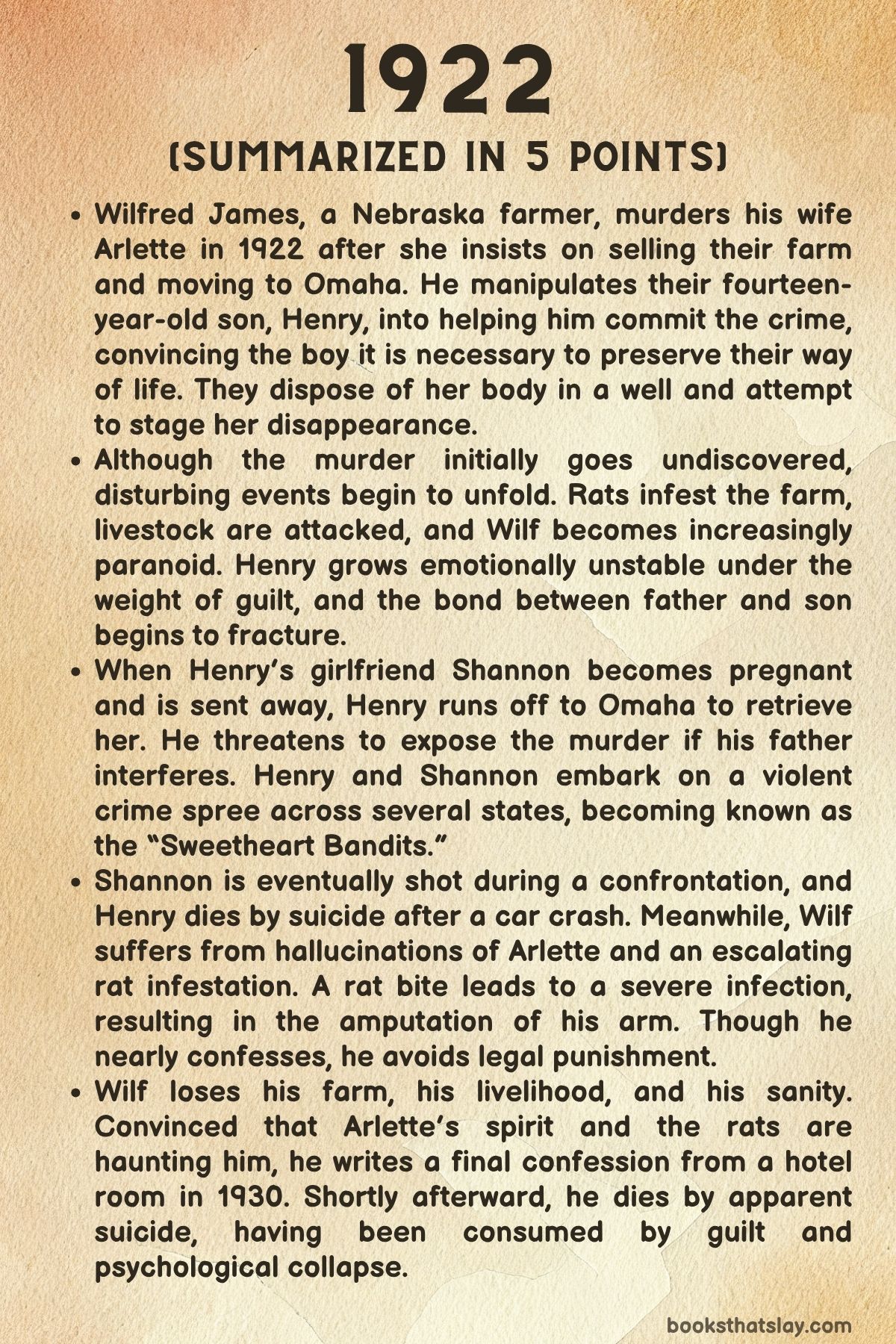
Summary
Wilfred James begins his written confession in 1930 from a hotel room in Omaha. He recounts events from 1922, the year he murdered his wife, Arlette, on their Nebraska farm.
Wilf insists that he is telling the truth and that what happened afterward—no matter how unbelievable—occurred exactly as he describes.
Wilf and Arlette lived with their fourteen-year-old son, Henry, on eighty acres of farmland. When Arlette’s father died, she inherited an additional hundred acres.
Wilf wanted to combine the properties and expand his farm, believing that his identity and happiness were rooted in the land. Arlette, however, wanted to sell everything and move to Omaha to open a dress shop.
She had already contacted a livestock company interested in buying the land. To Wilf, the move represented the destruction of his way of life.
He saw the city as corruption and moral decay. As Arlette remained firm in her plans, Wilf convinced himself that she was betraying him and their son.
After a heated argument in which Arlette slapped Henry for protesting the sale, Wilf decided she had sealed her fate. He carefully manipulated Henry, convincing the boy that killing his mother was the only way to preserve their home and future.
He framed the act as necessary and even righteous, telling Henry that murdered people go to Heaven and that Omaha would be a living Hell for them both.
One June night, Wilf plied Arlette with wine until she passed out. When Henry joined him in the bedroom with a butcher knife and a burlap sack, Wilf hesitated.
Henry, trembling but determined, pushed forward. Wilf ordered him to place the sack over Arlette’s head.
When she woke and struggled, Wilf tried to cut her throat but failed cleanly, instead slashing her face and hands. The attack became chaotic and brutal before he finally managed to kill her.
Henry screamed and fainted. Wilf, shocked by the amount of blood, forced his son to help clean up.
They wrapped Arlette’s body in bedding and dragged her to a well on the property, dumping her inside.
That night, Henry asked if his mother would haunt them. Wilf assured him she would not.
Even as he writes years later, Wilf admits he was wrong.
In the days that followed, they cleaned the house and attempted to construct a believable story that Arlette had left voluntarily. When Henry dropped some of her belongings into the well, he saw her corpse surrounded by rats.
Wilf also saw the body, its face distorted by the wounds and crawling vermin. The image unsettled him deeply, though he tried to remain practical.
When a lawyer representing the livestock company visited, Wilf refused to cooperate. Soon after, he and Henry deliberately caused one of their cows to fall into the well so they would have an excuse to fill it with dirt.
While doing so, Wilf glimpsed Arlette’s face again among the rats before shooting the cow to silence it. They buried the well and attempted to move on.
Sheriff Jones visited but accepted Wilf’s explanation that Arlette had left after a drunken argument. Henry repeated the fabricated story convincingly.
For a time, life appeared to settle. The harvest was good, and suspicion faded.
Shannon, Henry’s girlfriend, began visiting frequently, cooking and spending time with him. Wilf appreciated her presence, though he noticed Henry becoming withdrawn and troubled.
Soon strange disturbances began. Rats attacked livestock.
Wilf discovered one hanging from a cow’s udder, chewing flesh. He sealed a pipe connecting the barn to the buried well, convinced the rats were emerging from Arlette’s grave.
He began to smell decay and feel watched. Whether these events were supernatural or products of guilt is unclear, but Wilf’s fear increased.
In autumn, Henry revealed that Shannon was pregnant. Her father intended to send her to a home for unwed mothers and demanded money from Wilf.
Henry resented his father’s refusal to help him marry Shannon and support the child. During an argument, Henry bitterly remarked that Wilf could not even kill cleanly.
The comment exposed the fracture between them.
Shortly after, Henry ran away to Omaha to retrieve Shannon, leaving a note threatening to reveal the murder if Wilf interfered. Wilf feared exposure but remained tied to his land.
News soon came that Henry had committed robbery. Over time, Henry and Shannon embarked on a crime spree across several states, becoming known as the “Sweetheart Bandits.” Henry escalated from robbery to violence, shooting guards and civilians.
Wilf followed these events through newspapers and later claimed that Arlette herself whispered details to him before they occurred. He described seeing her enter his home, carried by rats, speaking of Henry’s actions with cruel satisfaction.
She told him how Shannon was shot by a diner owner in Nevada and how Henry later died by suicide after a car crash left Shannon dead.
During a winter storm, Wilf was bitten by a rat hidden in Arlette’s old hatbox. Infection spread rapidly through his arm.
Delirious and feverish, he ranted about the murder to Sheriff Jones. However, he phrased his confession ambiguously, and the sheriff dismissed it as illness.
Doctors amputated Wilf’s arm to save his life.
Authorities eventually discovered Arlette’s remains elsewhere, concluding she had been murdered by a stranger while hitchhiking. Wilf was never charged.
Soon after, Shannon and Henry’s bodies were returned home. Henry’s corpse had been partially eaten by rats, a detail that devastated Wilf.
At the funeral, Wilf imagined Arlette sitting beside him, whispering that this was justice.
Wilf’s farm deteriorated. Livestock died.
Buildings collapsed in storms. Attempts to sell the land failed, as neighbors considered it cursed.
Even his remaining cow broke her legs after being frightened, and Wilf shot her. The farm that had motivated murder brought him nothing but ruin.
In the following years, Wilf squandered his money on alcohol and travel, retracing Henry’s path. He worked briefly in a factory and later as a librarian in Omaha.
Yet rats seemed to follow him everywhere—among shelves, in walls, in dark corners. He believed one particular rat, perhaps the same one that bit him and attacked his livestock, pursued him persistently.
By 1930, Wilf’s mental state had collapsed. He felt the presence of Arlette, Henry, and Shannon closing in.
In his hotel room, he sensed rats biting him and heard corpses approaching. He searched for a gun to end his life but failed to find it in time.
His written confession breaks off mid-sentence as he describes being overwhelmed.
A newspaper article later reports that Wilf died by suicide. No gunshot was heard.
The gun in his room was unloaded. The guard who discovered him stated that Wilf had bitten himself repeatedly, even chewing through his own wrists.
The paper on which he had written his confession was shredded into fragments resembling a rat’s nest.
Whether Arlette’s ghost truly returned or whether guilt destroyed Wilf’s sanity remains unresolved. What is certain is that Wilf’s decision to kill his wife in order to preserve his land led instead to the loss of his son, his farm, his livelihood, and finally his mind.
Characters
Wilfred “Wilf” Leland James
Wilf is the narrator and central consciousness of 1922, and everything in the story is filtered through his confession. He presents himself as a practical farmer whose love for the land defines his identity, yet beneath this self-image lies deep pride, insecurity, and resentment.
His need to control his environment—his farm, his son, his future—drives him to murder when he feels that control slipping away. Wilf justifies his actions through twisted logic, convincing himself that killing Arlette is a moral necessity rather than a selfish crime.
This capacity for rationalization reveals his psychological fragility.
Wilf’s manipulation of Henry exposes his moral bankruptcy. He cloaks coercion in paternal concern, shaping Henry’s fears and religious beliefs to secure his cooperation.
Even years later, he expresses greater regret for corrupting his son than for killing his wife, suggesting that he views Henry as an extension of himself. As the narrative progresses, Wilf’s mind deteriorates under the weight of guilt.
Whether the rats and visions are supernatural or hallucinations, they symbolize the rot eating away at him. His physical decay, including the infection that costs him an arm, mirrors his spiritual corruption.
By the end, Wilf is a hollowed man, clinging to denial while being consumed by the consequences of his own choices.
Arlette Christina Winters James
Arlette functions both as victim and as a powerful presence whose influence extends beyond death. In life, she is practical, forward-looking, and unwilling to remain tied to a failing rural existence.
Her desire to sell the farm and pursue independence in Omaha represents modernity and change. To Wilf, this ambition feels like betrayal, but from another perspective, it reflects courage and self-determination.
Arlette’s assertiveness challenges Wilf’s authority, threatening the patriarchal structure he assumes is natural.
After her murder, Arlette becomes an emblem of guilt and reckoning. The imagery associated with her—her slashed face, the rats surrounding her body, her silent or whispering appearances—suggests that she transforms into a force of judgment.
Whether she literally returns or exists only in Wilf’s unraveling mind, her presence exposes the truth he tries to bury. Arlette’s power in death contrasts sharply with her vulnerability in life.
She becomes the voice that recounts Henry’s fate and ensures that Wilf can never escape what he has done. Her character embodies both the cost of silenced autonomy and the inevitability of consequences.
Henry Freeman James
Henry begins as an impressionable adolescent torn between loyalty to his father and affection for his mother. He is deeply influenced by Wilf’s worldview and religious framing of events.
His initial hesitation about murder shows that he possesses a moral compass, but that compass is easily distorted by fear and paternal authority. Henry’s participation in the crime marks the destruction of his innocence.
The traumatic act fractures his stability, leading to emotional withdrawal, erratic behavior, and increasing resentment toward Wilf.
As the story unfolds, Henry’s trajectory mirrors Wilf’s descent but in a more outwardly explosive form. Whereas Wilf internalizes guilt, Henry externalizes it through rebellion and violence.
His love for Shannon becomes a desperate attempt to build meaning after the murder. When Shannon is sent away, Henry’s sense of powerlessness resurfaces, and he turns to crime as a means of reclaiming agency.
The robberies escalate from impulsive acts to increasingly violent offenses, reflecting how easily one moral boundary crossed can lead to others. Henry’s eventual death underscores the generational damage inflicted by Wilf’s decision.
He is both victim and perpetrator, shaped by his father’s influence and destroyed by it.
Shannon Cotterie
Shannon represents innocence entangled in circumstances beyond her control. She is kind and attentive, bringing food to Wilf and Henry and attempting to maintain normalcy after Arlette’s disappearance.
Her relationship with Henry is tender but marked by youthful naivety. When she becomes pregnant, she faces social judgment and confinement in a home for unwed mothers, highlighting the rigid moral standards of the time.
Shannon’s lack of agency in these decisions parallels Arlette’s earlier lack of safety within her marriage.
As Henry’s partner in crime, Shannon evolves from sheltered farm girl to fugitive. Yet she never appears to drive the violence; rather, she follows Henry, motivated by love and dependence.
Her participation suggests how easily devotion can become complicity. Shannon’s death, sudden and senseless, reinforces the tragic cost of choices made by others.
She is caught in the fallout of Wilf’s actions, her life derailed by a crime she had no part in committing. Through Shannon, the narrative emphasizes how far-reaching and indiscriminate the consequences of one selfish act can be.
Sheriff Jones
Sheriff Jones serves as a figure of order and restrained suspicion. He represents the law but also the limitations of institutional authority in a rural setting.
His interactions with Wilf reveal a man who senses something is wrong but lacks definitive proof. He questions, observes, and even advises, yet he ultimately accepts plausible explanations.
His failure to uncover the truth stems less from incompetence and more from the ambiguity surrounding Arlette’s disappearance and Wilf’s calculated restraint.
Jones’s later interactions with Wilf during his illness demonstrate a mixture of compassion and practicality. He interprets Wilf’s near-confession as delirium, inadvertently allowing him to avoid prosecution.
The sheriff’s role underscores how justice in the story operates imperfectly. Legal systems may miss crimes, but moral consequences do not.
Jones becomes a quiet counterpoint to Wilf: stable, grounded, and pragmatic, yet unable to prevent tragedy.
Harlan Cotterie
Harlan, Shannon’s father, embodies material success and rigid morality. As a prosperous farmer with modern conveniences and a stable marriage, he represents everything Wilf envies.
This envy intensifies Wilf’s insecurity and fuels his resentment. Harlan’s response to Shannon’s pregnancy is stern and socially conventional.
He prioritizes reputation and propriety, sending her away rather than allowing her to marry Henry. While his actions are shaped by societal expectations, they inadvertently push Henry further toward desperation.
Harlan’s eventual decline, including the collapse of his marriage and farm, reflects the broader economic hardships of the era. His refusal to purchase Wilf’s land later, believing it cursed, signals recognition of the moral contamination attached to it.
Though not directly involved in the central crime, Harlan plays a significant role in the chain of events leading to Henry and Shannon’s downfall. He stands as both foil and mirror to Wilf: outwardly successful but ultimately powerless to shield his family from ruin.
Andrew Lester
Andrew Lester, the representative of the livestock company, is a minor yet pivotal figure. He symbolizes external pressure and modern commerce intruding upon Wilf’s rural life.
Lester’s persistence and suspicion unsettle Wilf, reinforcing his paranoia. Though he lacks concrete evidence, his accusations touch on the truth, making him a threat in Wilf’s eyes.
Lester’s presence intensifies the tension between secrecy and exposure, reminding Wilf that his crime exists within a wider social framework that cannot be entirely controlled.
Mr. Stoppenhauser
Mr. Stoppenhauser, the banker, reflects financial pragmatism and opportunism. He readily offers loans and mortgages, encouraging Wilf to leverage his property for potential gain.
In doing so, he represents the economic mechanisms that both enable and entrap individuals. His later refusal to purchase Wilf’s land contributes to Wilf’s isolation and frustration.
Stoppenhauser’s role highlights the shifting economic landscape of the 1920s and the vulnerability of farmers caught between ambition and market forces.
Themes
Guilt and Psychological Disintegration
In 1922, guilt does not operate as a passing emotion but as a corrosive force that reshapes perception, memory, and identity. Wilf believes that once Arlette is buried, the problem will be solved.
Instead, the act of murder becomes a living presence that refuses to stay hidden. His confession reveals a mind attempting to defend itself through logic while steadily losing coherence.
The rats, the whispers, the visions of Arlette entering his home—these may be supernatural, but they also function convincingly as manifestations of guilt that has no outlet. Wilf’s body mirrors his mental state: infection spreads from a rat bite, resulting in amputation.
His physical deterioration parallels his moral decay, suggesting that guilt is not abstract but embodied.
What makes this theme especially unsettling is that Wilf continues to justify himself even as he admits wrongdoing. He regrets involving Henry more than he regrets killing Arlette, exposing how self-centered his remorse truly is.
The hallucinations intensify after Henry’s crimes become public, as though guilt multiplies when its consequences spread. By the time Wilf isolates himself in a hotel room, writing his confession, reality and imagination have blurred beyond separation.
His death—apparently self-inflicted through frantic self-mutilation—completes the arc of psychological collapse. The narrative suggests that guilt, when denied rather than confronted, becomes self-consuming.
It eats at the mind much like the rats consume flesh, leaving behind a distorted remnant of what once seemed stable.
Pride, Possession, and Masculine Identity
Wilf’s sense of self is bound to his land, and this attachment reveals how pride can distort moral reasoning. The farm is not merely property; it is his proof of manhood, independence, and permanence.
Arlette’s wish to sell it threatens more than financial security. It challenges his authority and identity.
Instead of negotiating or adapting, Wilf interprets her ambition as betrayal. His pride convinces him that preserving the farm justifies extreme action.
The land becomes symbolic of possession in multiple senses. Wilf believes he owns not only the property but also the right to dictate his family’s future.
His manipulation of Henry demonstrates how deeply this possessiveness runs. Henry is treated less as an autonomous son and more as an extension of Wilf’s will.
Even Arlette’s inheritance becomes something Wilf feels entitled to control. The irony lies in the outcome: the very thing he murders to protect ultimately slips away.
Economic decline, social isolation, and structural damage render the farm worthless. His pride leaves him with neither land nor family.
This theme critiques rigid notions of masculinity rooted in dominance and ownership. Wilf cannot tolerate vulnerability or change, so he chooses violence instead.
His downfall shows how destructive that refusal can be. Pride blinds him to alternatives, isolates him from empathy, and locks him into a path that destroys what he sought to defend.
The Corruption of Innocence
Henry’s transformation embodies the damage that moral compromise inflicts on youth. At fourteen, he stands at a formative stage, still guided by religious ideas and filial loyalty.
Wilf exploits both. By framing murder as necessary and even righteous, he reshapes Henry’s ethical framework.
Once Henry participates in the killing, a boundary is crossed that cannot be restored. The immediate aftermath shows psychological shock: fainting, hysteria, emotional withdrawal.
These reactions signal the collapse of innocence.
As time passes, that collapse evolves into recklessness. Henry’s love for Shannon becomes his emotional anchor, yet it is also tied to desperation.
When Shannon is sent away and Henry feels trapped, he turns to crime. The robberies escalate from theft to violence, demonstrating how quickly moral erosion accelerates once initiated.
Henry’s criminal identity does not arise in isolation; it grows from the precedent set by his father. Wilf rationalized murder; Henry rationalizes robbery and eventually shooting strangers.
The theme underscores generational consequence. Wilf’s decision does not end with Arlette’s death.
It contaminates Henry’s future, shaping his understanding of loyalty and survival. Henry’s tragic end reflects how innocence, once corrupted, leaves individuals vulnerable to self-destruction.
The story portrays youth not as inherently corrupt but as dangerously malleable when guided by flawed authority.
Isolation and Moral Decay
Rural Nebraska provides more than a backdrop; it reinforces the emotional and ethical isolation of the characters. The farm’s physical distance from town parallels Wilf’s growing detachment from communal accountability.
After Arlette’s disappearance, neighbors offer sympathy and assistance, yet Wilf remains internally cut off. His secrecy erects a barrier between himself and others, preventing genuine connection.
As events unfold, isolation deepens. Henry withdraws into silence and later flees entirely.
Shannon is confined to an institution, removed from familiar surroundings. Wilf’s farm deteriorates, livestock die, and storms damage buildings, reflecting his increasing loneliness.
When he eventually moves to Omaha, the urban setting does not relieve this condition. Rats appear in factory corners and library shelves, indicating that isolation is psychological rather than geographical.
Moral decay thrives in this solitude. Without honest communication or confession, Wilf’s guilt festers.
His inability to admit wrongdoing openly isolates him further, creating a cycle in which secrecy feeds paranoia and paranoia feeds further withdrawal. The environment amplifies his mental state, making the physical world feel hostile and contaminated.
Isolation becomes both consequence and catalyst of moral collapse.
Consequences and the Illusion of Control
Wilf commits murder believing he can manage every outcome. He plans the crime, constructs an alibi, manipulates witnesses, and buries evidence.
For a short period, it appears he has succeeded. Yet the unfolding events demonstrate how limited his control truly is.
Henry’s rebellion, Shannon’s pregnancy, the crime spree, and the economic downturn all escape Wilf’s influence.
This theme emphasizes that actions extend beyond intention. Wilf aims to preserve his farm and family; instead, he loses both.
Even when legal punishment does not arrive, consequences manifest through personal ruin. His son’s death, his physical mutilation, and his mental disintegration illustrate that justice need not be delivered by courts to be devastating.
The recurring imagery of rats reinforces the unpredictability of consequences. Wilf attempts to seal the well and block the pipe, believing he has eliminated the source of infestation.
The rats reappear regardless, suggesting that buried wrongdoing resurfaces. The illusion of control dissolves as Wilf realizes he cannot dictate outcomes once he sets events in motion.
His final moments, frantic and powerless, contrast sharply with his earlier confidence. The narrative argues that control gained through violence is temporary and unstable, and that consequences often arrive in forms one cannot anticipate or contain.
Supernatural Ambiguity and the Nature of Reality
The presence of Arlette after death and the persistent rats introduce uncertainty about the boundary between psychological and supernatural phenomena. The narrative never confirms whether Arlette truly returns or whether Wilf’s guilt produces vivid hallucinations.
This ambiguity sustains tension throughout the story.
If Arlette’s appearances are real, then the story presents a form of moral reckoning enforced by forces beyond human law. If they are hallucinations, then the human mind itself becomes the instrument of punishment.
Either interpretation reinforces the inevitability of consequence. The rats operate similarly.
They may simply be vermin drawn to decay, yet their behavior often appears coordinated and purposeful. Wilf perceives them as agents of Arlette’s will, elevating them from pests to symbols of judgment.
This uncertainty shapes the reader’s experience of reality within the narrative. Wilf insists that everything he describes is true, yet his instability undermines his reliability.
The tension between belief and doubt reflects the fragility of perception when guilt dominates consciousness. By refusing to provide definitive answers, the story situates horror in the space between explanation and imagination.
The result is an exploration of how easily reality fractures when the mind is burdened by unresolved wrongdoing.