1Q84 by Haruki Murakami Summary, Characters and Themes
1Q84 by Haruki Murakami, initially published in 3 volumes in Japanese and then eventually translated to English, is a long, strange love story disguised as a thriller about control, belief, and the stories people tell themselves to survive. Set in Tokyo in 1984, it follows Aomame, a fitness instructor with a secret life as an assassin, and Tengo, a math teacher drawn into a risky publishing scheme.
After one small decision, Aomame begins to notice reality has shifted: history feels slightly “off,” and two moons hang in the sky. As a cult, a missing teenage author, and eerie beings called the Little People enter the picture, Aomame and Tengo move toward the same question: what if the world changed so they could find each other again?
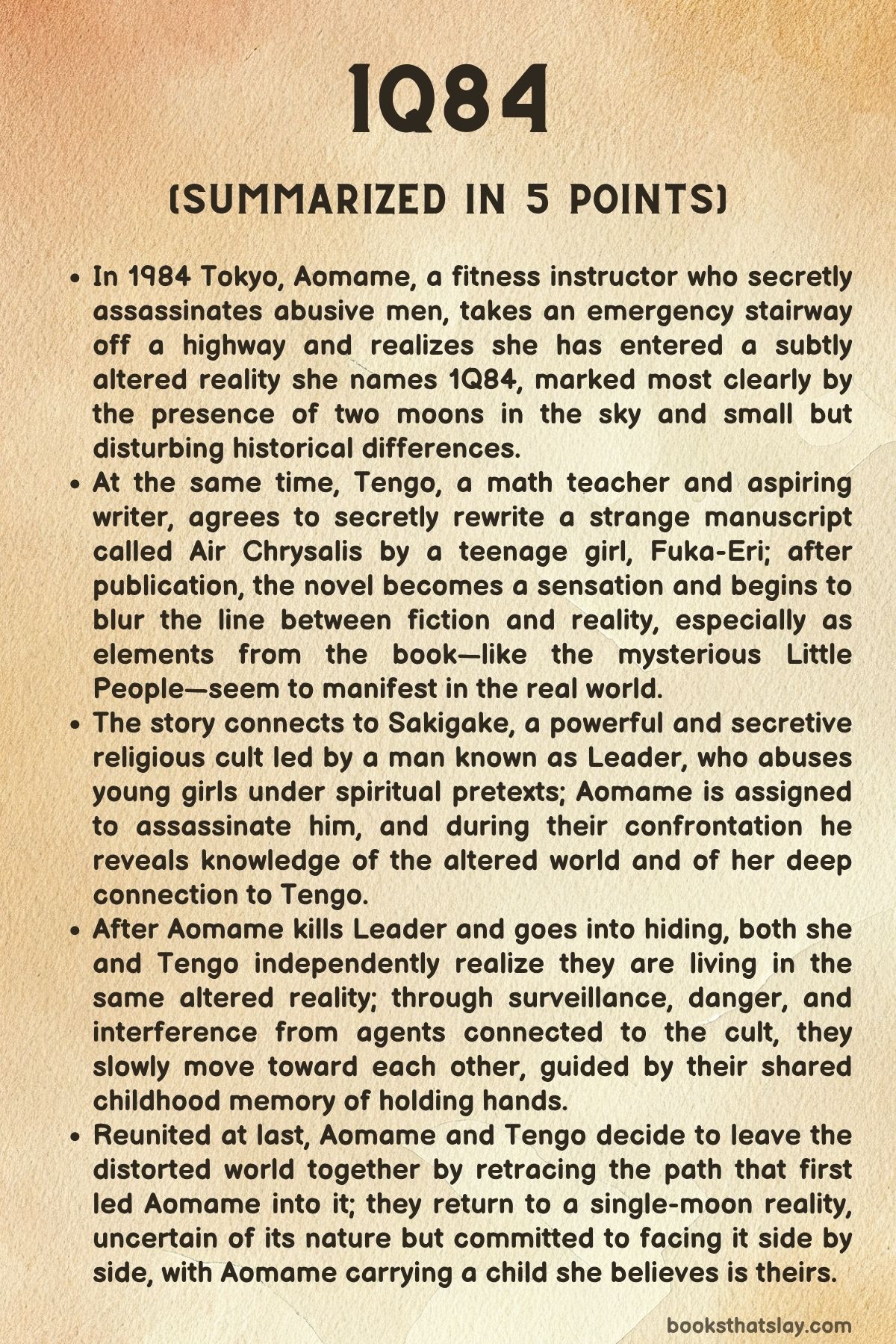
Summary
Aomame is riding in a taxi on the Tokyo expressway, late for an appointment that matters. The driver suggests an unusual shortcut: get out in the traffic jam, climb down an emergency stairway, and reach the streets below.
As classical music plays, he warns her that once you step outside what’s normal, the everyday look of things may change. Aomame takes the stairs anyway, walking in high heels along the road and dropping into the city like someone exiting a sealed room.
She isn’t late for dinner or a date. Aomame is on her way to kill a man.
Publicly, she is a capable, disciplined fitness instructor who knows bodies and posture and the mechanics of pain. Privately, she is an assassin who targets men who harm women, funded by a wealthy elderly woman known as the dowager.
Aomame’s method is precise: a custom needle slips into a point at the back of the neck, leaving no trace and producing a death that looks natural. Her latest target is a well-paid executive who beats his wife brutally.
Aomame gains entry to his hotel room under a small pretense, performs the act with clinical certainty, and leaves without being seen.
Almost immediately, the world begins to feel subtly wrong. Aomame notices a police officer’s uniform that doesn’t match what she remembers and a weapon that seems out of place.
She starts searching newspapers and archives, trying to confirm whether she simply missed recent events. She finds references to an armed incident involving a rural religious group that she believes she would have remembered—yet she doesn’t.
The more she checks, the more she suspects that the problem isn’t her memory but the world itself. She concludes that after walking down that emergency stairway, she stepped into a reality adjacent to the one she knew.
To label it, she calls it 1Q84, using “Q” as a stand-in for a question mark.
While Aomame is testing the edges of this altered reality, Tengo Kawana is living a quieter life that begins to crack open. He teaches math and writes fiction on the side, carrying a disturbing, recurring image from childhood: his mother allowing a strange man intimate access to her body while his father is absent.
The memory returns like a physical attack, leaving him sweating and shaken. Tengo’s present feels stable but emotionally muted—he is having an affair with a married older woman and convincing himself that this is enough.
Then his editor contact, Komatsu, offers him something that is both flattering and ethically rotten. A teenage girl writing under the name Fuka-Eri has submitted a novella called Air Chrysalis to a contest.
The story has a strange power, but the writing is clumsy. Komatsu wants Tengo to rewrite it in secret, keeping the voice simple while repairing the craft, then publish it as Fuka-Eri’s work.
Tengo resists, but the lure of the story—and the money—pulls him in. When he meets Fuka-Eri, she is beautiful, distant, and oddly blank in her speech.
She doesn’t care much about being a writer, yet she insists that the beings in her story, the Little People, are real.
Tengo begins rewriting Air Chrysalis and becomes absorbed by its content. In the story, a girl in a commune is punished by being locked in a shed with a dead goat.
In the night, tiny figures emerge, pull threads from the air, and build an “air chrysalis.” The tale grows stranger: the chrysalis can produce a replica, a double, and the boundary between worlds becomes thin. The more Tengo works, the more he feels he is shaping something that already exists, as if he is translating a hidden record rather than inventing fiction.
Fuka-Eri’s guardian, Professor Ebisuno, meets Tengo and supplies a troubling history. Fuka-Eri’s father once helped lead radical students and later founded a rural commune that evolved into a closed religious organization.
A violent breakaway faction caused a notorious armed incident, and the surviving group reorganized itself, outwardly moderate but increasingly secretive. Fuka-Eri fled the commune at age ten and stopped speaking for years, as if something inside her had been locked away.
Ebisuno’s hope is blunt: by publishing Air Chrysalis, they can draw attention, force the group to react, and uncover what happened to Fuka-Eri’s parents.
The plan works too well. The rewritten novella becomes a sensation, topping lists and attracting media attention.
Then Fuka-Eri disappears. The official story hovers between “missing teenager” and “publicity mystery,” but Tengo suspects something darker.
A cassette recording arrives from Fuka-Eri, telling him she is in a safe place and warning that the Little People may be angry about being described in print. She suggests protection depends on finding something they lack, a clue Tengo cannot yet decode.
Aomame’s life, meanwhile, tightens into danger. The dowager’s operation is more than vengeance; it includes a heavily guarded refuge for abused women.
Aomame visits it and meets a child named Tsubasa, damaged beyond repair by sexual violence. The abuser is the head of a cult called Sakigake, known to his followers simply as Leader.
The dowager has decided Leader must be removed, not only for what he has done but to stop what he will keep doing. Aomame agrees to take the assignment, even though it will force her to vanish afterward, possibly with a new face and identity.
She asks the dowager’s bodyguard, Tamaru, for a gun—not for assassination, but for suicide if capture becomes inevitable.
As preparations move forward, Aomame’s last fragile friendship collapses into tragedy. Ayumi, a young policewoman she has been drinking with and sleeping beside, is found murdered in a hotel room.
Aomame’s grief is violent and immediate, and the timing feels like a message. Soon after, Aomame is led into a hotel suite where she is to perform “therapy” on Leader.
He is physically powerful, but also suffering from strange episodes of stiffness, pain, and prolonged arousal that his group treats as a kind of religious event. He speaks with unnerving calm and suggests he knows exactly why she is there.
When Aomame tries to kill him with her needle, something stops her—her hand freezes as if controlled. Leader demonstrates that he has abilities beyond ordinary human strength.
He claims he is a vessel for the Little People, a Receiver, and that Fuka-Eri served as a Perceiver. He also claims that the world Aomame came from no longer exists for her, and that the two moons are a marker of this changed space.
Most frightening, he knows the name Tengo and the fact that Aomame loves him, though she has never spoken it aloud. Leader offers a bargain: kill him, and the forces around him will leave Tengo alone.
Aomame hates the idea of helping a man like this escape pain, yet the mention of Tengo pins her in place. During a thunderstorm, she makes the choice.
She kills Leader with her silent method, and immediately begins her escape route. No one stops her.
Tamaru relocates her to a small safe apartment in Koenji, close to where Tengo lives, and instructs her to stay hidden while the dowager’s network watches for retaliation from Sakigake.
While Aomame waits, Tengo’s own reality tips into the same altered world. He searches for Aomame using phone books and old school records, finding nothing.
He keeps thinking of the moment in childhood when they held hands, a memory that feels more solid than most of his adult life. Then, one day, standing on a playground slide while searching for a view of the moon, he sees it: two moons in the sky, exactly like the detail Komatsu told him to emphasize in Air Chrysalis.
The unreal detail has crossed into his life. He begins to accept that he, too, is in 1Q84.
Their paths nearly meet. Aomame reads Air Chrysalis in the safe apartment and feels certain it is describing real events tied to Sakigake.
Looking down from her balcony at the playground, she sees someone on the slide staring upward. She recognizes him by instinct before her mind catches up: it is Tengo.
She rushes down, desperate to reach him, but arrives moments too late. He is gone, and the gap between them feels cruelly precise.
Aomame tries to find the stairway that brought her into 1Q84, returning to the expressway location, dressed as she was that day. The emergency stairs are gone.
In despair she puts the gun in her mouth, ready to end it, and then hears a voice call her name—Tengo’s voice—and chooses to live for the possibility of finding him. She returns to the safe apartment and begins a new routine built around waiting, watching, and surviving.
A third thread rises through Ushikawa, a private investigator working for Sakigake. He is unattractive, meticulous, and resentful in ways that sharpen his attention.
He tracks Aomame through her connections and grows suspicious of the dowager’s fortress-like home and her history of “disappearing” abusive men. Eventually he discovers that Aomame attended the same elementary school as Tengo.
He stakes out Tengo’s apartment by renting a room below it and sets a hidden camera to record everyone who enters and leaves. He sees Fuka-Eri, follows her, and is unsettled by the way she looks directly toward the hidden camera as if she can see it.
Tamaru intercepts Ushikawa before he can deliver his findings. He captures him, interrogates him, and kills him to protect Aomame and the dowager.
But Tamaru also realizes that Ushikawa’s work has narrowed the field: Tengo is close, and time is running out. Aomame, in hiding, begins to suspect she is pregnant—despite not having had sex in months.
Tests confirm it. She decides the child is Tengo’s, linked to the night she killed Leader and the strange “purification” event Tengo experienced with Fuka-Eri, which seemed to connect his body to Aomame’s fate across distance.
Tengo, grieving his father’s death and unraveling the story of his own origins, returns to Tokyo determined to find Aomame. Messages move through Tamaru, and a meeting is arranged at the playground after sunset.
Tengo arrives, climbs the slide, and looks up at the moon. Aomame appears beside him, and the world narrows to their hands touching again, as it once did when they were ten.
She tells him they must leave immediately, before the forces circling them can close the exits.
Together, Aomame and Tengo travel to the expressway location where Aomame first entered 1Q84. This time, they approach from below and climb up through the storage yard and stairwell, emerging onto the roadway beneath the billboard.
They wait for the sky to clear enough to confirm what world they are in. At last, the familiar single moon appears.
The marker of 1Q84 is gone. They have crossed out of the question-mark world into a reality that still feels uncertain, but is at least theirs to face together.
They spend the night in a hotel, finally sharing a closeness that is not only memory or longing. Aomame admits she cannot fully name the world they have reached, and Tengo agrees that it may contain dangers and contradictions.
But after everything—cults, doubles, vanishing people, and moons that shouldn’t exist—the important thing is simple: they are no longer alone, and they will protect what they have found.
Characters
Aomame
Aomame stands at the emotional and moral center of 1Q84. Outwardly disciplined and self-contained, she lives by routines of exercise, health, and restraint that reflect her strict religious upbringing.
As a child raised in an apocalyptic sect, she learned early how belief systems can control the body and the mind. Though she rejects the doctrine of her parents, she internalizes its austerity, transforming it into personal rigor.
Her adult life as a fitness instructor is orderly, almost ascetic, yet beneath that surface she carries fierce anger at injustice, especially against men who abuse women.
Her role as an assassin is not motivated by thrill or greed but by a private code of retribution. She sees herself as correcting a moral imbalance that society refuses to address.
Each killing is performed with surgical precision, reinforcing her belief that violence, when directed with clarity, can serve justice. Yet the cost is visible in her isolation.
She keeps emotional distance from lovers and even from her friend Ayumi, as if closeness would expose vulnerability. Her love for Tengo, preserved since childhood, becomes the one constant in her inner life.
It is idealized and almost sacred, untouched by ordinary experience.
When she enters the altered reality she calls 1Q84, her rationality does not collapse. Instead, she adapts.
The appearance of two moons unsettles her, but she responds by observing, naming, and making decisions. Even her confrontation with Leader does not reduce her to fear; she evaluates him morally, not just supernaturally.
Aomame’s pregnancy deepens her transformation. For the first time, her survival instinct is not only about revenge or reunion but about protecting new life.
By the end, she moves from being an instrument of vengeance to someone choosing continuity and connection. Her strength evolves from control to acceptance.
Tengo Kawana
Tengo represents introspection, doubt, and the creative impulse within 1Q84. Unlike Aomame, whose life is defined by action, Tengo’s is shaped by reflection and memory.
His childhood is marked by emotional ambiguity: a father obsessed with routine work and a haunting vision of his mother with another man. This unresolved memory produces a lasting sense of displacement.
He often feels detached from his own life, as if he is observing rather than inhabiting it.
His involvement in rewriting Air Chrysalis marks a turning point. Initially reluctant, he is drawn into the project by artistic instinct.
In reshaping Fuka-Eri’s story, he experiences an awakening of desire—not romantic desire at first, but creative urgency. He becomes aware that storytelling is not merely fabrication but a force capable of altering reality.
The fact that details from the novel appear in his own world blurs the line between author and participant. Tengo slowly accepts that he is not only editing a story but entering it.
Emotionally, Tengo is cautious and reserved. His affair with a married woman reflects his tendency to remain in controlled, limited attachments.
Yet the memory of Aomame disrupts this pattern. As he recalls their shared childhood moment, he begins to see that his emotional life has always revolved around that connection.
In the altered world, he grows more decisive, confronting his father, rejecting Sakigake’s intimidation, and actively searching for Aomame. His journey is less about defeating external enemies and more about claiming agency.
By choosing to leave the “cat town” with Aomame, he affirms that meaning lies not in unraveling every mystery but in committing to shared reality.
Fuka-Eri
Fuka-Eri is one of the most enigmatic figures in 1Q84, functioning both as character and symbol. Her flat speech, minimal vocabulary, and lack of visible emotional fluctuation create an impression of detachment.
She appears almost translucent, as if part of her is missing or displaced. This quality connects directly to the concept of the maza and the dohta introduced in Air Chrysalis.
Fuka-Eri may not be a complete singular self but a being divided or replicated.
Her childhood in the commune that becomes Sakigake positions her as a witness to ideological transformation. She escapes at a young age, yet her silence for years suggests trauma beyond ordinary explanation.
Through her story, she exposes the structure of power within the cult, especially the way Leader becomes a vessel for unseen forces. At the same time, she is not merely a victim.
By allowing Air Chrysalis to be rewritten and published, she participates in a strategy that destabilizes Sakigake’s authority. The book becomes both testimony and counterattack.
Fuka-Eri’s presence in Tengo’s life is intimate but curiously nonsexual. Even when physical acts occur, they feel ritualistic rather than romantic.
She acts as a conduit between worlds, linking Tengo to Aomame and triggering events that culminate in Aomame’s pregnancy. Her statement that she will not become pregnant underscores her separation from ordinary biological consequence.
Once her role as Perceiver is fulfilled and Leader is killed, she withdraws quietly. Her mission appears complete, reinforcing the sense that she exists partly outside conventional human continuity.
Leader (Tamotsu Fukada)
Leader embodies corruption masked as spiritual authority. As the head of Sakigake, he commands devotion through charisma and claims of supernatural mediation.
His physical ailments—paralysis, pain, and compulsive episodes—are reframed by his followers as divine manifestations. This reinterpretation of illness as grace illustrates how ideology can convert vulnerability into power.
Leader is both tyrant and prisoner of the forces he claims to channel.
He justifies sexual abuse as a spiritual necessity, recasting violence as sacred duty. His moral inversion is chilling precisely because he believes, or chooses to believe, that he is maintaining cosmic balance.
He acknowledges the Little People and presents himself as their Receiver, suggesting he is less an originator of evil than its instrument. Whether this is delusion or partial truth remains ambiguous.
Leader’s confrontation with Aomame reveals complexity. He recognizes her significance and speaks of her bond with Tengo as if it were part of a larger design.
His willingness to die suggests exhaustion and perhaps genuine suffering. Yet this does not absolve him.
He remains responsible for systemic harm and personal cruelty. His death marks not a triumphant victory over evil but a shift in equilibrium, as if removing one vessel merely alters the configuration of power rather than eliminating it.
Tamaru
Tamaru is defined by precision and loyalty. As the dowager’s bodyguard, he operates with quiet efficiency and emotional restraint.
His background, hinted to involve marginalized identity and survival through discipline, informs his pragmatic worldview. Tamaru is not driven by ideology but by commitment to protection.
Violence, for him, is a tool deployed when necessary, without moral exhibitionism.
His relationship with Aomame is professional yet tinged with mutual respect. He recognizes her strength and treats her as an equal in operational matters.
When he interrogates and kills Ushikawa, he does so without sadism. The act is functional, designed to eliminate threat and preserve secrecy.
Tamaru’s calm demeanor contrasts sharply with the hysteria of Sakigake’s believers. He represents grounded realism within a narrative crowded with metaphysical speculation.
Despite his composure, Tamaru is not devoid of reflection. His references to philosophy and psychology suggest a private interiority.
He understands the loneliness of people who operate alone. In that sense, he mirrors Aomame, though without her romantic longing.
Tamaru remains anchored in the present, focused on immediate survival rather than cosmic explanation.
The Dowager (Shizue Ogata)
The dowager channels grief into structured retaliation. After losing her daughter to an abusive marriage, she constructs a system to protect other women and punish perpetrators.
Her wealth provides resources, but her motivation is intensely personal. She believes society fails to safeguard the vulnerable, and she compensates by building her own network of refuge and retribution.
Unlike Leader, who twists ideology to justify exploitation, the dowager grounds her mission in empathy. Yet her methods are morally ambiguous.
By sanctioning assassinations, she steps outside legal boundaries, becoming judge and executioner. She does not relish violence, but she accepts it as necessary in extreme cases.
This positions her as a counterforce to Sakigake, operating in shadow yet guided by a code.
Her relationship with Aomame is maternal without sentimentality. She offers guidance, resources, and trust.
In Aomame, she sees both capability and woundedness. Their bond underscores one of the novel’s central tensions: whether violence can ever truly restore balance or merely perpetuate cycles of secrecy.
Ushikawa
Ushikawa is an outsider in every sense. Physically unattractive and socially marginalized, he carries deep resentment and insecurity.
His career trajectory—from lawyer to ethically compromised investigator—reflects ambition frustrated by prejudice. He is intelligent and observant, capable of connecting details others miss.
Unlike the true believers of Sakigake, Ushikawa is not spiritually invested in Leader. His loyalty is pragmatic and tinged with personal gratitude.
His investigation into Aomame and Tengo reveals his persistence and capacity for inference. He correctly identifies their shared past and begins to understand that their connection threatens Sakigake’s structure.
Yet Ushikawa’s loneliness distorts his perspective. His fascination with Fuka-Eri borders on emotional projection.
He is drawn to her opacity, perhaps because he sees in her a reflection of his own isolation. His death at Tamaru’s hands is abrupt and undignified, underscoring that intelligence alone cannot guarantee survival in a world governed by hidden forces.
Even after death, the emergence of the Little People from his body suggests that individuals in this universe are vessels in larger processes.
Komatsu
Komatsu is opportunistic and bold, driven by professional ambition rather than spiritual belief. He orchestrates the ghostwriting scheme for Air Chrysalis with a mixture of cynicism and intuition.
He recognizes literary potential where others see incompetence and is willing to bend ethical rules to capitalize on it.
His kidnapping by Sakigake reveals both his vulnerability and resilience. Faced with threats, he negotiates rather than resists, choosing survival and strategic retreat.
He shuts down publication of the book to prevent escalation, showing that his loyalty to art is secondary to self-preservation.
Komatsu’s role highlights the power of media and narrative. By pushing the book into the public eye, he inadvertently destabilizes a cult and activates metaphysical consequences.
He represents the worldly side of storytelling, where profit and influence intersect with hidden truths.
Ayumi
Ayumi brings warmth and volatility into Aomame’s guarded life. As a police officer with a history of childhood abuse, she embodies both authority and vulnerability.
Her reckless pursuit of casual encounters masks unresolved trauma. She seeks intensity as a substitute for stability.
Her friendship with Aomame offers a glimpse of companionship based on shared understanding of violence. Ayumi senses Aomame’s guardedness and attempts to bridge it, but Aomame keeps part of herself withheld.
Ayumi’s murder shatters that fragile bond and intensifies Aomame’s sense of isolation. It also underscores the pervasiveness of exploitation in this world.
Ayumi’s death is not symbolic but brutally concrete, reminding Aomame that the violence she fights cannot be neatly contained.
Ayumi’s absence lingers as a quiet indictment of systemic failure. She becomes one more casualty of forces that operate both socially and supernaturally, reinforcing Aomame’s determination to act even when the boundaries of reality blur.
Together, these characters form a network of mirrored loneliness and contested belief. Each navigates power, memory, and identity differently, yet all are drawn into the altered gravity of 1Q84, where reality shifts not only through supernatural intrusion but through the stories people choose to inhabit.
Themes
Alternate Reality and the Fragility of Perception
Reality in 1Q84 is not shattered with spectacle but altered by small, almost administrative differences: a changed police uniform, a different firearm, a historical event remembered by others but not by Aomame. The shift from 1984 to 1Q84 is marked by the appearance of two moons, yet even this cosmic sign is visible only to a few.
Murakami constructs an alternate world that feels nearly identical to the original, which makes it more disturbing. The instability lies not in dramatic transformation but in subtle misalignment.
This suggests that reality is less fixed than assumed and may depend on shared belief and attention.
Aomame’s naming of the world as “1Q84” emphasizes uncertainty. The “Q” stands for a question, underscoring that perception is always interpretive.
Tengo later experiences the same rupture, recognizing that details from a fictional manuscript now exist in his lived environment. The boundary between imagined and actual dissolves, raising the possibility that narrative itself shapes existence.
Rather than presenting the alternate reality as a dream or hallucination, the novel treats it as a parallel condition sustained by unseen forces. The Little People, as ambiguous agents, complicate the notion of causality.
The movement between worlds also reflects emotional states. Aomame enters 1Q84 after making a decisive, transgressive choice.
The altered world becomes a space where unresolved desires and latent fears surface. Returning to a single-moon reality does not restore certainty; it simply establishes a different version of normal.
The novel suggests that reality is provisional, maintained by collective agreement, and always vulnerable to revision. Perception is not passive reception but active participation, and small deviations can produce entirely new structures of meaning.
Loneliness and the Search for Connection
Isolation defines the inner lives of the central characters. Aomame’s disciplined exterior masks profound solitude rooted in childhood rejection.
Raised in a strict religious household and cut off from peers, she learned to contain her emotions rather than express them. Tengo, too, grows up feeling detached, burdened by ambiguous memories of his mother and emotionally distant from his father.
Their childhood moment of holding hands becomes a rare instance of mutual recognition. That brief contact echoes across decades, sustaining them in separate lives.
In adulthood, both characters surround themselves with limited or temporary relationships. Aomame engages in casual sexual encounters that never threaten her autonomy.
Tengo maintains an affair that provides comfort without commitment. These arrangements prevent vulnerability but also reinforce emotional distance.
The altered world intensifies their loneliness. Even when surrounded by people, they feel unseen or misunderstood.
The image of the playground slide, where each stares at the moon alone before finally meeting, symbolizes this parallel solitude.
Connection is portrayed as both fragile and transformative. The possibility of reunion motivates Aomame to live when she considers suicide.
Tengo’s creative awakening is tied to his desire to find her. Their love is not built on shared adult experiences but on an emotional memory preserved in its pure form.
This makes their bond feel almost metaphysical, as though it exists beyond circumstance. The novel proposes that genuine connection can anchor individuals in unstable realities.
In a world where institutions fail and perception shifts, human attachment becomes the only stable point of reference.
Power, Control, and Religious Authority
Sakigake represents the danger of concentrated authority cloaked in spiritual language. Leader’s control over his followers is not based solely on coercion but on belief.
He reframes illness as divine grace and sexual abuse as sacred duty. By redefining violence as necessary for cosmic balance, he eliminates moral accountability.
The cult’s structure isolates members from external scrutiny, allowing exploitation to flourish under the guise of enlightenment.
The dowager offers a contrasting form of power. Her wealth and resources enable her to build a refuge for abused women and orchestrate retribution against perpetrators.
Unlike Leader, she does not claim divine sanction. Her authority arises from personal grief and moral conviction.
Yet her methods also bypass legal systems, placing her outside conventional justice. Both Sakigake and the dowager operate in secrecy, revealing how alternative power structures emerge when public institutions fail.
The Little People complicate the question of control. If Leader is merely a vessel, then individual responsibility becomes ambiguous.
However, the novel resists absolving him. His willingness to enact harm remains central.
Power in 1Q84 often depends on narrative dominance. Whoever defines reality—through doctrine, media, or storytelling—shapes the actions of others.
The cult’s need to “hear the voice” reflects dependence on a controlling narrative source. By publishing Air Chrysalis, Tengo disrupts that monopoly, challenging authority through fiction.
Power is shown to be sustained by belief, and belief can be redirected or fractured.
Storytelling and the Creation of Reality
The act of rewriting Air Chrysalis initiates a chain reaction that alters lives and worlds. Tengo does not invent the story from nothing; he refines it, giving structure to Fuka-Eri’s sparse account.
Yet once published, elements of the narrative appear in lived reality. The two moons, the Little People, and the concept of doubles migrate from fiction into experience.
This movement suggests that storytelling is not merely descriptive but generative.
Fuka-Eri’s original manuscript functions as testimony disguised as fantasy. By transforming it into a polished novel, Tengo amplifies its reach.
The book becomes bait, drawing attention to Sakigake and provoking response. Fiction operates as both shield and weapon.
It conceals identities while exposing hidden truths. Komatsu’s commercial ambitions inadvertently unleash consequences beyond publishing success.
The text implies that narratives can destabilize entrenched systems because they reframe perception.
The presence of dohtas and mazas underscores duplication and representation. A dohta is a constructed double, similar to how a written character represents a person.
This parallel reinforces the idea that identity itself may be narrative-based. The unborn child of Aomame and Tengo is described in terms that echo the air chrysalis, blending biological and fictional creation.
Through these layers, 1Q84 examines how stories shape memory, belief, and even physical existence. The boundary between author and character erodes, implying that creators are also shaped by the worlds they imagine.
Violence, Justice, and Moral Ambiguity
Violence permeates the novel in multiple forms, from domestic abuse to cult exploitation to calculated assassination. Aomame’s role as an avenger complicates the reader’s understanding of justice.
Her targets are undeniably cruel, and her method is precise and discreet. She views her actions as necessary correction, especially in cases where legal systems fail victims.
The dowager supports this view, framing each assassination as the last resort.
Yet the moral landscape is not simple. Leader’s crimes are horrific, but his claims of being controlled by the Little People introduce ambiguity.
If supernatural forces influence him, how much agency does he retain? Aomame rejects the idea that he is merely a puppet, insisting on his responsibility.
Even so, she kills him partly to protect Tengo rather than solely to punish him. Motive blends personal love with broader justice.
Ayumi’s murder and the abuse suffered by Tsubasa highlight the vulnerability of victims in a society that often ignores hidden suffering. Violence is not limited to villains; it emerges from ordinary structures of family and community.
The novel resists presenting revenge as complete resolution. Killing Leader does not eliminate the Little People or erase trauma.
Instead, it shifts the balance, suggesting that moral action may mitigate harm without achieving perfect restoration. Justice in the story is partial, imperfect, and bound to individual conscience rather than universal law.
Identity, Doubles, and the Divided Self
The concept of the dohta and maza introduces the possibility that a person can be split into original and replica, perceiver and receiver. This duality reflects internal fragmentation within characters.
Aomame balances disciplined composure with suppressed longing. Tengo navigates between rational mathematician and imaginative writer.
Fuka-Eri herself may exist as more than one entity. Identity is shown as unstable, capable of duplication or loss.
The appearance of two moons reinforces the theme of duality. The sky itself becomes divided, mirroring characters who live between realities.
Ushikawa’s life also contains division: competent professional and socially marginalized outsider. Even Leader embodies dual aspects, spiritual guide and abuser.
These contrasts suggest that individuals contain conflicting forces that cannot be neatly reconciled.
Pregnancy introduces another dimension of doubling. Aomame carries a child conceived through extraordinary circumstances, potentially linking bodies across distance and narrative layers.
The unborn baby symbolizes convergence of separate lives and realities. Identity is not singular or static.
It is shaped by memory, belief, and external influence. The novel questions whether a self can remain intact when reality shifts, or whether survival requires accepting multiplicity within oneself.
Fate, Choice, and Parallel Paths
Events in 1Q84 often appear guided by unseen design. The taxi driver’s warning, the reappearance of childhood memory, and the synchronized sightings of the two moons suggest orchestration.
Leader speaks of roles assigned within this altered world, implying destiny. Yet characters repeatedly exercise choice.
Aomame chooses to descend the stairway. Tengo chooses to rewrite the manuscript.
Aomame ultimately chooses to kill Leader and later to live rather than pull the trigger.
Parallel movement defines their journey. Aomame and Tengo operate separately yet advance toward the same meeting point.
Their lives echo each other without direct coordination. This structure raises the question of whether fate draws them together or whether their longing creates that trajectory.
The narrative resists a single answer. It allows coincidence and intention to coexist.
The final ascent of the stairway together symbolizes shared agency. They do not wait for reality to reset itself; they climb back deliberately.
The return to a single moon does not erase what occurred but marks a new starting point shaped by decisions made under uncertainty. Fate in the book is neither absolute nor illusory.
It exists as possibility, activated or resisted through personal choice.