1929 by Andrew Ross Sorkin Summary and Analysis
1929: Inside the Greatest Crash in Wall Street History–and How It Shattered a Nation by Andrew Ross Sorkin is a narrative history of the Wall Street crash and its long political and social aftershocks. Rather than treating the collapse as a single bad week on the stock ticker, the book follows the bankers, speculators, politicians, and ordinary investors who helped inflate the boom, tried to manage the panic, and then fought over blame when the country’s confidence cracked.
Sorkin tracks how easy credit, celebrity finance, and permissive market practices turned risk into a national pastime—then shows how the crash reshaped power in Washington, the rules of banking, and the public’s relationship with money.
Summary
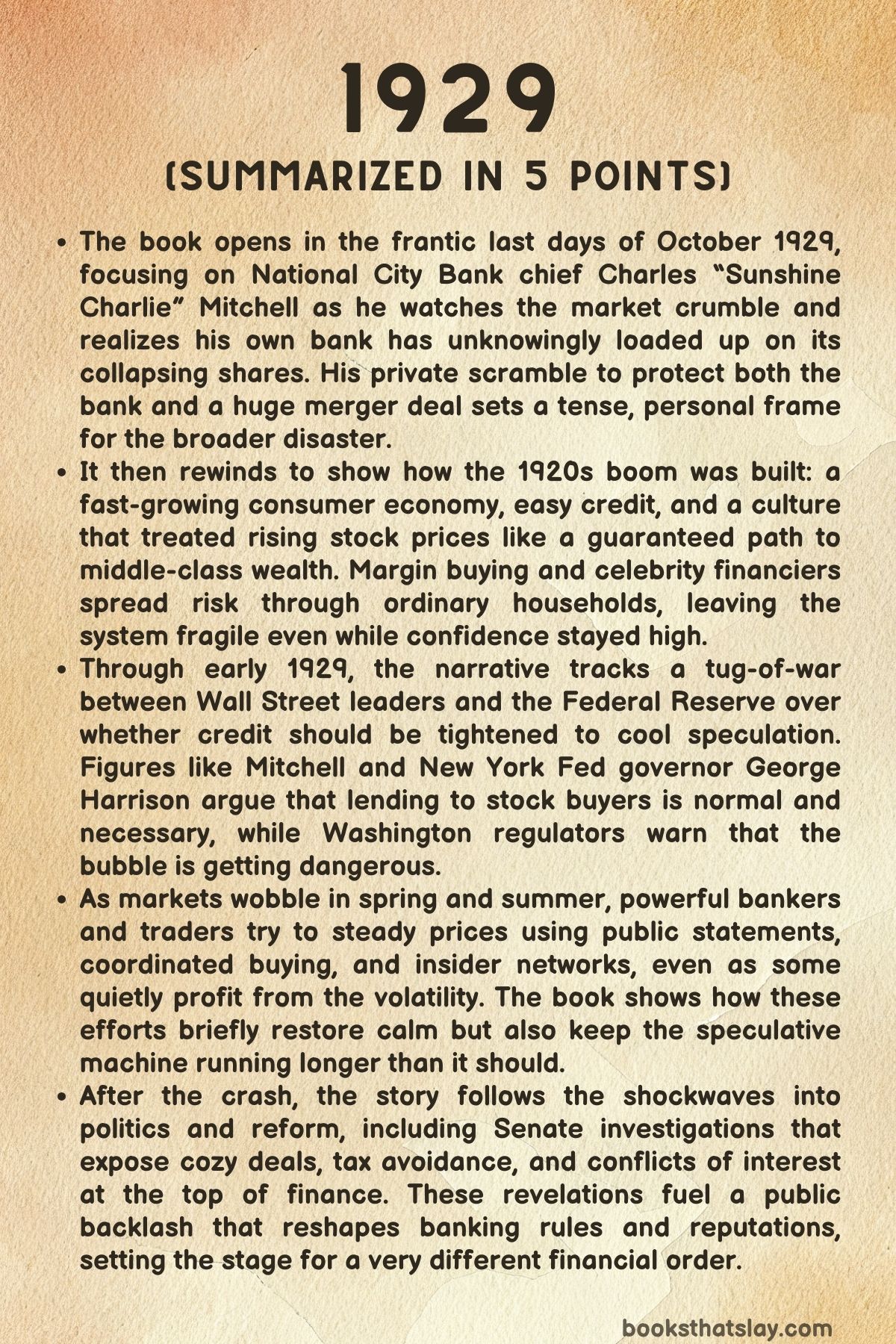
In late October 1929, as panic grips Wall Street, Charles E. Mitchell—chairman of National City Bank—sits in his office facing a problem that could destroy his institution. After the market drops sharply, the bank’s trading unit has bought an enormous block of National City shares to prop up the price.
The purchase is far larger than the bank can afford, yet selling the shares back into the market could trigger rumors of insolvency and invite a run. Mitchell projects calm to outsiders, but privately he realizes that his own decisions—made to protect prestige, a major merger, and the bank’s stock—have boxed him into a corner.
To understand how the country arrived at this moment, the story moves back to the start of 1929, when Wall Street’s influence reaches beyond finance into diplomacy and culture. Thomas W. Lamont, the senior partner who effectively runs J.P. Morgan & Co., boards an ocean liner for Europe as part of an American delegation shaping Germany’s war reparations.
Lamont is comfortable in this role: he is both power broker and public face, a banker who understands reporters and the value of managing perception. Even before leaving New York, his office distributes a coveted opportunity—shares of the speculative Alleghany Corporation offered cheaply to a “preferred list” of influential figures.
The arrangement reveals how access and privilege operate in the market: the right names get first dibs on the best deals, while the public buys later at higher prices.
While overseas, Lamont privately pursues another ambition: a merger that would combine communications giants into something close to a monopoly. The plan’s legal vulnerability under antitrust law does not stop the attempt; it simply pushes the effort further into private channels.
The same mix of confidence, persuasion, and rule-bending that drives speculation at home also shows up in elite dealmaking abroad.
Back in New York, Charles Mitchell is building a different kind of empire—one that depends on bringing the middle class into the securities market. Mitchell has turned National City into a machine for selling stocks and bonds at scale, treating investments as consumer products and using modern marketing to make Wall Street feel accessible.
He is rich, famous, and politically connected, and he sees himself as essential to the nation’s prosperity. When the Federal Reserve tries to discourage speculation by tightening credit, Mitchell attacks the policy openly.
He argues that restricting call money and margin lending will harm the economy. Behind the argument is a practical reality: his bank profits from the surge of customers borrowing to buy stocks.
Speculation has its own stars, and few are bigger than William C. Durant, the flamboyant co-founder of General Motors who now treats the market as a full-time arena. Durant helps organize “pools” that coordinate buying and selling to push prices upward, then unload shares onto latecomers.
These tactics are ethically suspect but still legal, and that legal gray zone allows powerful players to shape prices while ordinary investors assume the market is an honest scoreboard. Mitchell and Durant share a common enemy in Washington: officials who might restrain the credit that keeps the boom alive.
As Herbert Hoover prepares to take office, Mitchell worries he lacks influence with the new administration. He asks Durant to speak to Hoover directly, hoping the president can be pressured into backing away from tighter oversight.
Hoover enters the White House on a wave of optimism. The country has embraced consumer credit, mass advertising, and the idea that prosperity is a permanent condition.
The market’s rise feels like proof of national genius. Yet warnings surface even amid celebration.
Calvin Coolidge, leaving office, is privately gloomy about what lies ahead. Still, public rhetoric remains upbeat, and Hoover is reluctant to appear as an enemy of business.
The market’s psychology is amplified by legendary traders like Jesse Livermore. Livermore has earned fortunes by betting against crowds at exactly the right moment, but the long bull run of the 1920s has tested his patience and made him look out of step.
He watches novice investors and casual tipsters profit wildly, and he reads that as a sign of danger. In late March, he quietly executes a large coordinated short sale and earns millions when prices dip, reinforcing his belief that the market is unstable beneath its confident surface.
Then the instability becomes visible. In late March 1929, a dramatic sell-off hits the exchange.
The ticker cannot keep up with the volume, call money rates soar, and margin calls force leveraged investors to sell. Mitchell remembers 1907 and decides to act as he did then: he uses National City’s resources to support the market and publicly declares that his bank will provide liquidity.
The intervention helps calm trading and makes him a hero to many on Wall Street. But in Washington, critics see something else: a banker using a powerful institution to defend speculation and burnish his own reputation.
Senator Carter Glass, architect of the Federal Reserve system and a fierce opponent of Wall Street dominance, takes special offense. From his hospital bed, Glass condemns Mitchell’s actions as improper and begins a personal campaign to discipline him.
As spring turns into summer, the book shows the boom’s contradictions: private anxiety paired with public cheerleading. Lamont helps finalize the Young Plan for German reparations, but on the way home he grows uneasy about markets back in New York.
Quietly, he urges his family to reduce exposure and hold cash. Publicly, he stays optimistic, aware that pessimism from someone in his position could spark a reaction.
That split—private caution, public confidence—becomes a defining feature of the year.
Other influential figures exploit the moment’s hunger for wealth. John J. Raskob, a businessman with enormous resources and political ambitions, promotes the idea that ordinary Americans should invest regularly and become rich.
He presents stock buying as a disciplined path to security and even character-building, especially when combined with installment-style credit. At the same time, he plans a sharp political campaign against Hoover, hiring an aggressive publicity operator to plant damaging stories while preserving deniability.
Finance, politics, and media feed each other, and the market’s optimism becomes a tool for power struggles far from the trading floor.
By late summer, the mood is both euphoric and fragile. People chase tips from strangers, celebrities dabble in stocks, and confident forecasts become entertainment.
The Dow reaches record highs, and prominent voices argue that prices are justified by modern prosperity. Yet the economy shows hints of strain, and leverage is everywhere.
Margin loans swell to extraordinary levels, meaning a sharp decline would force rapid selling. That risk is widely understood, but the belief that the market will keep rising makes the risk seem manageable.
In early September, a respected economist warns that a crash is coming, and the warning triggers a drop. The decline is quickly labeled and dismissed as a temporary scare.
The market recovers, and boosters treat the episode as proof of resilience. Behind the scenes, however, some insiders lighten their positions, and traders like Livermore prepare for trouble.
As October advances, events accelerate. Churchill arrives in New York on a lecture tour and becomes captivated by the market’s easy confidence, trading on margin despite limited understanding.
His presence highlights how the mania spreads: even famous visitors begin acting like the exchange is a casino that favors everyone. Meanwhile, Lamont and his partner Russell Leffingwell debate what to tell Hoover about the economy.
Leffingwell wants blunt caution; Lamont fears that caution will invite regulation. The result is a message that leans toward optimism, leaving Hoover pulled between warnings and reassurance.
The selling begins in earnest. As prices drop, margin calls hit, and anxiety spreads from the floor of the exchange to the crowds outside.
On Thursday, October 24, the scale of panic is visible in the streets. Lamont watches thousands gather, astonished by the public spectacle of fear.
Blue chips fall rapidly. The exchange considers halting trading, but bankers choose another approach: a pool of money, assembled by the leading institutions, to support key stocks.
Richard Whitney, acting as a commanding presence on the floor, bids aggressively for major shares to signal stability. The gesture slows the collapse for the day, and he becomes a symbol of Wall Street’s attempt to control the narrative and the outcome.
Yet the volume is record-breaking, and the day’s losses erase the year’s gains. The sense of safety is badly damaged.
The weekend brings no relief. Tourists come to stare at Wall Street as if it were a disaster site.
On Monday, October 28, selling returns with greater force. Mitchell, desperate to protect National City’s stock because a major merger depends on it, instructs his trading team to support the price.
The effort fails. By the end of the day, the bank has acquired a massive pile of its own shares—an exposure it cannot carry.
Mitchell understands that the bank cannot legally treat its own stock as collateral in the way it would for other assets, and that unloading the shares could advertise weakness. He goes through social obligations anyway, including a dinner honoring Churchill, because absence itself could breed rumors.
On Tuesday, October 29, the crisis turns historic. Trading reaches an unprecedented level of volume and desperation.
The earlier bankers’ pool has exhausted its resolve, and the market falls in a way that feels uncontrollable. Livermore, positioned on the short side, makes a staggering profit, while countless investors are wiped out.
Rumors, fear, and forced liquidations reinforce each other. Outside the market, the shock begins to register as something larger than a financial correction.
Mitchell’s immediate problem remains his bank. To prevent the stock-support operation from crushing National City, he chooses a dramatic personal gamble: he borrows $12 million and buys the shares from the bank himself, risking his family’s fortune to protect the institution and his own standing.
The decision keeps the bank from immediately collapsing under the weight of its own maneuver, but it also ties Mitchell’s fate even more tightly to a financial system that is coming apart.
After the crash, consequences spread through banking, politics, and public life. The planned merger with Corn Exchange collapses, and Mitchell’s relationships with other bankers sour.
Suicides and bank runs begin to appear, showing that the damage is not limited to paper losses. Raskob confronts the fallout when the head of a bank tied to his political financing takes his own life, and Raskob scrambles to prevent panic that could destroy the institution.
The country’s trust in financial leaders weakens further.
Washington debates what to do. Hoover hears competing advice, including calls for action and arguments for letting the system “liquidate” to cleanse itself.
He takes limited steps to reassure the public but resists large-scale relief, and his cautious approach fails to restore confidence. Over time, unemployment rises, banks fail in waves, and the market’s initial rebound gives way to a long decline.
International pressures compound the crisis, including debt instability and, later, Britain leaving the gold standard, which jolts markets and deepens fear.
As the depression worsens, politics shifts. Democrats gain strength, Hoover loses public confidence, and Roosevelt emerges as the alternative.
Behind the scenes, lawmakers revive investigations into Wall Street practices that had been tolerated during the boom. Ferdinand Pecora, hired to run a Senate inquiry, chooses Mitchell and National City as a focal point because the story has everything: marketing to small investors, insider advantage, executive enrichment, and tax maneuvers that look like the powerful rewriting rules for themselves.
Mitchell’s testimony becomes a public spectacle. Pecora presses him on executive bonuses, on arrangements that reduced tax liability, and on the famous stock sale that let Mitchell claim a large loss while keeping the shares within the family.
The revelations outrage a public already suffering. Mitchell resigns under pressure to protect the bank from a run, but the damage to his reputation is lasting.
He is later arrested and tried for tax evasion, with prosecutors arguing that his transactions were shams designed to escape taxes, while his defense frames the case as political theater and insists the deals were legal.
The trial ends with an acquittal, stunning many who expected a conviction. The verdict does not restore trust.
The public anger remains, and the political momentum for reform strengthens. Meanwhile, Roosevelt takes office amid an escalating bank crisis, refuses to share responsibility with Hoover during the transition, and then moves decisively with a national bank holiday and rapid legislation meant to stabilize the system.
The final phase of the story is the remaking of American finance. Under intense public pressure and with the lessons of the crash still raw, Congress passes banking reforms that separate commercial and investment banking and create deposit insurance.
Carter Glass, despite his complicated motives and private loyalties, becomes central to the legislation that bears his name. The reforms reshape the industry and mark the end of the old assumption that Wall Street can govern itself through private agreements and elite discretion.
Years later, the book closes by tracking what happens to the major figures. Some recover, some fall permanently, and some meet tragic ends.
The larger takeaway is that the crash was not only a market event but a national rupture: a collapse of belief that the people at the top knew what they were doing, followed by a struggle—political, economic, and moral—over how to rebuild guardrails around human ambition.
Key People
Charles E. Mitchell
In 1929, Charles E. Mitchell stands at the center of the drama as both architect and casualty of the era’s speculative excess. As chairman of National City Bank, he represents the transformation of American banking from a conservative, clubby enterprise into a modern sales machine.
Mitchell believes deeply in democratizing finance, pushing stocks and bonds into middle-class homes and normalizing buying on margin. He sees himself as a stabilizer, even a patriot, convinced that supporting the market is synonymous with supporting the nation.
Yet this self-image masks a willingness to bend norms and test legal boundaries, particularly when prestige and profit are at stake.
Mitchell’s character is defined by confidence that borders on hubris. He is bold, media-savvy, and unafraid to challenge the Federal Reserve publicly.
His interventions during moments of market stress are framed as courageous acts, but they also serve his institution’s interests. The fatal flaw in his approach is his belief that he can control outcomes through force of will and liquidity.
When the crash comes, his decision to personally assume enormous financial risk to protect his bank shows both loyalty and ego. Later, during the Pecora hearings and his tax trial, Mitchell appears increasingly defensive and out of touch, unable to grasp how profoundly public trust has shifted.
He is not portrayed as a cartoon villain but as a man shaped by incentives and a culture that rewarded aggressive expansion, only to find himself judged under a new moral standard.
Thomas W. Lamont
Thomas Lamont, the senior partner effectively running J.P. Morgan & Co., embodies the old establishment’s blend of discretion, influence, and global reach. He moves comfortably between Wall Street, Washington, and European capitals, negotiating reparations and advising presidents.
Lamont sees himself as a steward of stability, someone who must project calm even when privately uneasy. His instinct is to preserve confidence at almost any cost, because he believes that confidence itself sustains the financial system.
Lamont’s defining tension lies between private realism and public optimism. He quietly instructs family members to reduce stock exposure while continuing to speak reassuringly in public.
This duality reveals both prudence and calculation. Lamont is also protective of the Morgan firm’s prestige, resistant to reforms that would dismantle its integrated structure.
During the Pecora hearings, his discomfort reflects a generational shift: practices once considered routine and acceptable are now treated as suspect. Lamont is neither reckless nor radical; he is cautious, pragmatic, and deeply invested in preserving the authority of elite bankers.
His tragedy is that the system he mastered becomes politically indefensible.
Herbert Hoover
Herbert Hoover enters the story as a symbol of competence and technocratic optimism. A celebrated engineer and humanitarian, he assumes the presidency convinced that rational management and cooperation between government and business can maintain prosperity.
Hoover’s flaw is not ignorance but temperament. He distrusts dramatic gestures and prefers incremental action, even as conditions deteriorate rapidly.
Hoover’s reluctance to intervene aggressively in the stock market stems from a belief in market correction and a fear of overreach. He is wary of being seen as manipulating prices or interfering in private enterprise.
As the crisis deepens into depression, his measured style appears detached. He struggles to communicate empathy and resolve in a way that restores confidence.
The narrative presents Hoover as highly capable but politically ill-suited to a moment demanding emotional reassurance and bold symbolism. His adherence to orthodoxy—particularly on issues like the gold standard—cements his reputation as a president overtaken by events.
Franklin D. Roosevelt
Franklin Roosevelt emerges later as Hoover’s foil, defined less by technical mastery and more by instinctive understanding of public psychology. He is pragmatic and flexible, willing to let circumstances deteriorate enough to justify sweeping action once in office.
Roosevelt’s refusal to share responsibility during the transition underscores his political shrewdness. He is determined to begin his presidency with a clean slate and maximum authority.
Roosevelt’s leadership style contrasts sharply with Hoover’s. He communicates directly and confidently, framing bold measures like the national bank holiday as decisive protection rather than panic.
Roosevelt is not portrayed as an economic theorist but as a political strategist who grasps that restoring trust requires dramatic action and clear messaging. His support for reforms separating commercial and investment banking signals a new balance of power, shifting authority from Wall Street elites to federal regulators.
Carter Glass
Senator Carter Glass represents both principled reform and personal contradiction. As an architect of the Federal Reserve, he sees himself as guardian of the banking system’s integrity.
He harbors deep suspicion of Wall Street’s dominance and views Mitchell as a symbol of dangerous excess. Glass’s campaign against speculative practices grows from a genuine belief that unchecked finance threatens democratic governance.
Yet Glass is also a complex and flawed figure. He is deeply rooted in Southern politics, openly segregationist, and capable of private alliances that contradict his public stance.
Despite his attacks on Wall Street, he maintains protective instincts toward J.P. Morgan. His authorship of banking reform legislation reflects determination, but his resistance to elements like deposit insurance reveals ideological rigidity.
Glass is driven by pride in his legislative legacy and a sense of ownership over the Federal Reserve. His role in reshaping finance is significant, though shaped as much by rivalry and personality as by abstract principle.
Ferdinand Pecora
Ferdinand Pecora enters as a relatively obscure prosecutor but becomes the embodiment of public accountability. His methodical questioning during Senate hearings exposes practices that had long been hidden behind complexity and privilege.
Pecora’s strength lies in his preparation and clarity. He understands that naming familiar figures and translating technical maneuvers into plain language will capture public attention.
Pecora is less concerned with personal grandstanding than with building a case that illustrates systemic failure. By focusing on executive bonuses, insider stock lists, and tax strategies, he reframes Wall Street behavior as moral misconduct rather than routine business.
His persistence in pressing Mitchell and Morgan partners reveals how vulnerable elite institutions are once transparency is enforced. Pecora’s work fuels legislative momentum and symbolizes a shift toward regulatory oversight.
John J. Raskob
John Raskob is an energetic blend of financier and political operative. He believes fervently in the democratizing promise of stock ownership and promotes installment-style investing as a path to wealth for ordinary Americans.
His optimism about markets coexists with a sharp instinct for political combat. After Hoover’s election, Raskob channels his resources into organizing opposition and shaping narratives through media campaigns.
Raskob’s character reveals the entanglement of finance and politics during the period. He is ambitious, strategic, and sometimes ruthless in pursuit of influence.
Even after the crash, he remains convinced that policy missteps rather than speculative culture caused the collapse. His willingness to leverage wealth for political objectives highlights how economic and electoral battles overlap, especially when financial credibility is on the line.
William C. Durant
William Durant embodies the flamboyant side of speculative capitalism. Once a titan of industry, he reinvents himself as a market operator who thrives on pools and coordinated buying schemes.
Durant is charismatic and persuasive, able to mobilize networks of wealthy allies to influence prices. He views speculation not as manipulation but as an extension of entrepreneurial daring.
Durant’s meetings with Hoover and public speeches attacking the Federal Reserve show his conviction that credit expansion is essential to prosperity. He sees government restraint as the true threat.
Yet Durant’s confidence proves fragile. The crash strips away his fortune and reputation, and his later bankruptcy underscores the volatility of a life built on leverage and bold bets.
He is a cautionary figure, illustrating how quickly triumph can reverse.
Jesse Livermore
In 1929, Jesse Livermore represents the solitary speculator who studies crowd psychology rather than corporate fundamentals. He is introspective, analytical, and willing to bet against prevailing optimism.
Livermore’s success during downturns contrasts with his struggles during prolonged booms. He is sensitive to signals that others ignore, such as the proliferation of novice investors and overheated sentiment.
Livermore’s character is marked by discipline and detachment, but also vulnerability. His immense profits during the crash isolate him socially, attracting resentment and threats.
He understands that markets reward nerve but punish complacency. Ultimately, his repeated cycles of gain and loss, culminating in personal tragedy, underscore the psychological toll of living at the extremes of risk.
Richard Whitney
Richard Whitney, the exchange leader who famously bids up key stocks during the October panic, initially appears as a knightly figure defending order. His theatrical intervention helps slow the collapse temporarily and cements his public image as a stabilizing force.
Whitney symbolizes the belief that coordinated action by insiders can maintain control.
However, his later criminal downfall reveals a darker truth about that culture of insider solidarity. Whitney’s embezzlement and the quiet assistance he receives from powerful friends illustrate an unwritten code among elites.
His trajectory from hero to convict demonstrates how fragile reputations can be when transparency replaces discretion.
Winston Churchill
Winston Churchill appears as an outsider captivated by American prosperity. On a lecture tour to repair his finances, he becomes caught up in speculative enthusiasm, trading on margin despite limited expertise.
Churchill’s fascination with the market reflects the broader international allure of American wealth during the late 1920s.
His presence during the crash offers an observer’s perspective. Even as he witnesses despair and suicide, he retains belief in American resilience.
Churchill functions less as a driver of events and more as a lens through which the cultural mood is visible: ambition, risk-taking, and confidence that can quickly turn to shock.
Andrew Mellon
Treasury Secretary Andrew Mellon represents orthodox fiscal conservatism. He favors limited intervention and views downturns as corrective processes that purge excess.
Mellon’s adherence to the gold standard and reluctance to expand government relief reflect faith in market self-regulation.
Mellon’s perspective, influential during Hoover’s presidency, shapes early responses to the depression. His stance appears increasingly detached as unemployment rises and banks fail.
He stands as a symbol of an older economic doctrine that loses credibility in the face of systemic collapse.
Gordon Rentschler
Gordon Rentschler, president of National City Bank, occupies a middle ground between Mitchell’s boldness and the caution of rivals. He is pragmatic and concerned about the institution’s survival.
During the crisis over the bank’s own stock purchases, Rentschler urges restraint, recognizing the peril of overextension.
Rentschler’s role during the Pecora hearings further exposes internal contradictions. His testimony reveals how executive loans and bonus structures favored insiders.
He appears less flamboyant than Mitchell but nonetheless complicit in practices that prioritized leadership over ordinary employees. His character underscores how systemic incentives shape behavior beyond a single dominant personality.
These figures together form a portrait of ambition, confidence, rivalry, and reform. Each operates according to personal logic and institutional incentives, and together they drive the rise, collapse, and transformation of American finance.
Themes
Speculative Euphoria and Collective Self-Deception
In 1929, speculative euphoria functions not merely as background atmosphere but as a powerful social force that shapes decisions at every level of society. The late 1920s are presented as an age in which credit is abundant, celebrity financiers are admired like movie stars, and stock ownership is recast as a democratic virtue.
The market becomes a national obsession, discussed at dinner parties, in newspaper columns, and over the radio. Buying on margin is normalized, and the risks embedded in leverage are softened by the belief that prices will continue rising indefinitely.
What makes this theme so compelling is the way collective self-deception operates across class lines. Bankers, industrialists, politicians, and ordinary citizens all participate in sustaining the illusion.
Even those who privately suspect that valuations are stretched often continue speaking optimistically in public, fearing that candor could trigger the very collapse they hope to avoid. This gap between private doubt and public reassurance magnifies the bubble.
It becomes easier to ignore warning signs, such as rising margin debt and slowing economic indicators, because confidence itself has been elevated into a civic duty.
The narrative also highlights how new technologies and mass communication accelerate the cycle. Radio broadcasts, ticker tape, and national newspapers spread both optimism and panic at unprecedented speed.
Speculative euphoria thrives in this environment, feeding on rapid feedback and social proof. The crash, when it comes, reveals how fragile that confidence was.
The same collective psychology that lifted prices turns quickly toward fear, showing that markets are not governed solely by rational calculation but by shared emotion.
Power, Privilege, and Insider Advantage
The book presents Wall Street not as a neutral marketplace but as a structured hierarchy where access determines opportunity. Influential figures receive discounted shares on preferred lists, participate in stock pools, and share information unavailable to the broader public.
These practices are often legal, yet they reveal a system tilted toward insiders. The market’s image as a level playing field contrasts sharply with the reality of coordinated buying schemes and quiet agreements among powerful institutions.
Insider advantage extends beyond trading strategies into the realm of governance. Leading bankers maintain close relationships with presidents and senators, shaping policy discussions behind closed doors.
Decisions about interest rates, credit restrictions, and rescue efforts are influenced by personal networks as much as formal authority. This concentration of influence reinforces the perception that finance operates according to its own code, separate from ordinary democratic accountability.
The Pecora hearings expose how privilege functions in practice. Executive bonuses are structured to minimize tax liability, large losses are converted into write-offs, and loans are extended to insiders under favorable terms.
The public reaction to these revelations is fierce because they suggest that while ordinary investors bear the brunt of collapse, elites have tools to cushion their own fall. The theme underscores the tension between capitalism’s promise of open opportunity and its reality of entrenched advantage.
By illuminating these dynamics, the narrative demonstrates how public trust erodes when the rules appear unevenly applied.
The Illusion of Control
Throughout the narrative, influential figures act as though financial instability can be managed through decisive gestures and coordinated interventions. Bankers assemble pools of capital to support key stocks, exchange leaders make conspicuous bids to signal confidence, and executives inject personal funds to stabilize institutions.
These acts are intended to demonstrate authority and reassure observers that the system remains under control.
Yet the scale of the crisis ultimately overwhelms such efforts. The October collapse shows that coordinated buying can delay but not prevent a broader reckoning when leverage is extreme and sentiment turns negative.
The belief in control reflects both professional pride and institutional culture. Leaders of major banks see themselves as guardians of stability, convinced that experience and capital grant them the ability to shape outcomes.
The crash exposes the limits of this mindset.
The illusion of control also appears in political responses. President Hoover resists dramatic intervention, trusting that markets will correct and that confidence can be preserved through moderation.
Later, Roosevelt adopts bold measures that project authority, yet even these steps cannot instantly restore prosperity. The theme suggests that complex systems do not yield easily to individual will.
Financial markets, shaped by millions of decisions and global interconnections, cannot be steered indefinitely by small groups of insiders. Recognition of this limitation becomes central to the push for structural reform.
The Collision Between Public Confidence and Private Doubt
A persistent undercurrent in the narrative is the divergence between what leaders say publicly and what they believe privately. Prominent bankers reassure investors that conditions are sound even as they quietly reduce personal exposure.
Political leaders speak optimistically about the economy to avoid fueling panic, while behind the scenes they express concern about speculation and structural weakness.
This dissonance reflects the fragility of confidence-based systems. Financial markets depend heavily on trust, and public pessimism from influential figures can accelerate decline.
As a result, leaders feel compelled to maintain a positive tone, even if it requires suppressing their own anxieties. Over time, this strategy contributes to a credibility gap.
When the crash occurs, the contrast between earlier reassurances and subsequent devastation deepens public anger.
The theme extends into the aftermath. During investigations, executives attempt to frame controversial actions as standard practice or technical compliance.
Yet the broader public no longer accepts technical explanations as sufficient. The shift in perception demonstrates how confidence, once broken, is difficult to restore.
Trust in institutions depends not only on legality but also on perceived integrity. When private caution is paired with public exuberance, the eventual reckoning damages reputations as much as balance sheets.
Democracy, Reform, and the Rebalancing of Power
The crash catalyzes a political transformation that redefines the relationship between finance and government. Public outrage over insider practices and perceived impunity fuels demand for accountability.
Investigations led by figures such as Ferdinand Pecora translate complex financial maneuvers into accessible narratives, making it clear how incentives favored risk-taking and self-enrichment.
The resulting reforms, particularly the separation of commercial and investment banking and the introduction of deposit insurance, reflect a broader shift toward regulatory oversight. These changes signal that self-regulation by elite institutions is no longer acceptable.
The theme emphasizes how economic crisis reshapes political authority. Wall Street’s dominance gives way to a stronger federal presence, and legislative leaders who had once been marginalized gain prominence.
This rebalancing is not portrayed as simple triumph of virtue over vice. It is shaped by personal rivalries, ideological disagreements, and strategic maneuvering.
Even reformers harbor contradictions, and political actors pursue both principle and advantage. Nevertheless, the outcome marks a decisive redefinition of American capitalism.
The financial system that emerges after 1933 operates under new constraints, reflecting lessons learned through hardship.
Human Nature and Cycles of Excess
At its core, the narrative suggests that the events of 1929 are rooted in enduring aspects of human behavior. Ambition, fear, pride, and the desire for status drive decisions as much as economic fundamentals.
The belief that prosperity can continue indefinitely is not unique to one era; it recurs whenever rising prices create a sense of inevitability.
The personal trajectories of key figures illustrate this cycle. Fortunes are built rapidly through leverage and confidence, then erased when sentiment shifts.
Even experienced operators who have witnessed prior panics convince themselves that conditions are different this time. The recurrence of overconfidence, followed by shock and recrimination, points to structural patterns that transcend specific policies or personalities.
By emphasizing human psychology, the narrative avoids reducing the crash to a technical malfunction. Instead, it portrays a society caught in a feedback loop of optimism and denial.
Reform can alter incentives and impose safeguards, but it cannot eliminate the impulses that generate speculative manias. The enduring lesson lies in humility: recognition that no generation is immune to overreach and that systems require constant vigilance to counteract natural tendencies toward excess.