1984 Summary, characters and Themes
1984 by George Orwell is a dystopian novel set in a totalitarian future where the state exerts absolute control over truth, language, history, and even private thought. Published in 1949, the book presents a bleak vision of a society ruled by an omnipresent Party led by the figurehead Big Brother.
Through the life of Winston Smith, a minor Party official, Orwell examines surveillance, propaganda, censorship, and psychological manipulation. The novel remains influential for its portrayal of authoritarian power and its warning about how fragile objective truth and individual freedom can be when language and memory are controlled by the state. It is one of the most influential dystopian novels of the 20th century.
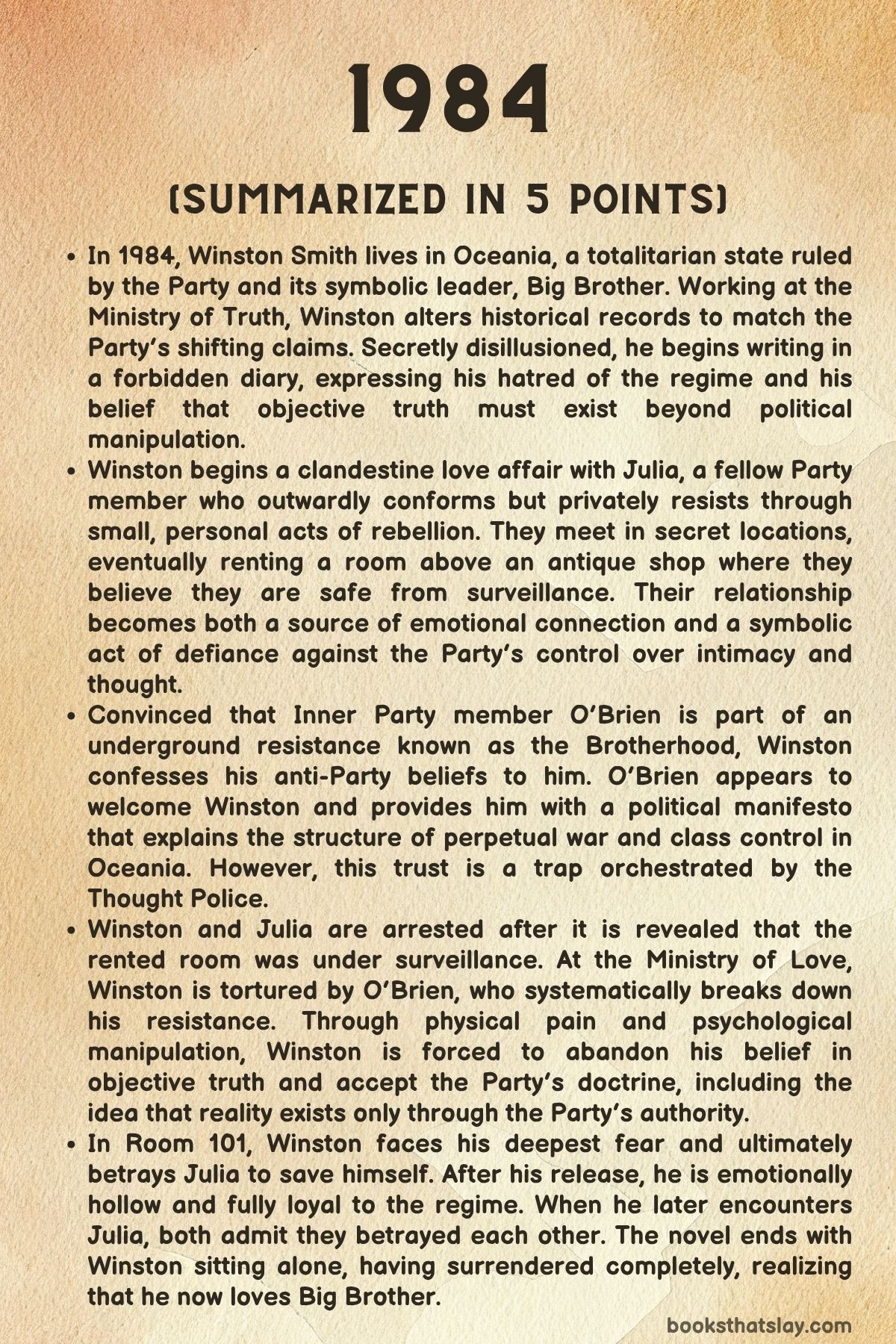
Summary
The story follows Winston Smith, a member of the Outer Party living in Airstrip One, formerly known as Great Britain, now a province of the superstate Oceania. The world is divided into three perpetually warring powers: Oceania, Eurasia, and Eastasia.
In Oceania, the ruling Party maintains control through surveillance, propaganda, and fear. Big Brother’s image is everywhere, accompanied by the slogan “BIG BROTHER IS WATCHING YOU.” Citizens are constantly monitored through telescreens, and the Thought Police punish not only disobedient actions but also unorthodox thoughts.
Winston lives in a dilapidated apartment building and works at the Ministry of Truth. His job is to alter historical records so they align with the Party’s current claims.
If Big Brother predicts something incorrectly, Winston rewrites the past to make it seem accurate. If a Party member falls out of favor, all evidence of that person’s existence is destroyed.
These erased individuals become “unpersons.” Documents are disposed of through memory holes that lead to incinerators. Through this work, Winston becomes acutely aware that the Party controls reality by controlling records.
If all evidence supports a lie, the lie becomes accepted as truth.
Although Winston publicly conforms, he privately resents the Party. He begins a forbidden act by purchasing a diary from a prole shop and writing in it.
Writing personal thoughts is a crime, and Winston knows he risks death. In his diary, he records his hatred for Big Brother and reflects on the falsification of history.
He becomes preoccupied with the idea that objective truth must exist somewhere beyond the Party’s manipulation. He writes that freedom means the ability to assert that two plus two equals four.
Winston interacts with several figures who shape his path. He fears a dark-haired girl, Julia, who works in the Fiction Department, suspecting she might be a spy.
He is also intrigued by O’Brien, a powerful Inner Party member. During a brief exchange, Winston senses that O’Brien might secretly oppose the regime.
Winston imagines that O’Brien is connected to the Brotherhood, a rumored underground resistance led by Emmanuel Goldstein, a supposed enemy of the state.
Winston’s dissatisfaction deepens as he reflects on his childhood. He has fragmented memories of his mother and sister, who disappeared during earlier purges.
He recalls stealing food from them during a time of scarcity and feels lingering guilt. These memories suggest to him that genuine human love once existed, something he believes the Party has largely eradicated.
Life in Oceania is marked by ritualistic displays of loyalty. Citizens participate in the Two Minutes Hate, where they scream at images of Goldstein.
During Hate Week, patriotic fervor intensifies. Even children are trained to spy on their parents.
Winston helps his neighbor Mrs. Parsons with household repairs and observes how her children enthusiastically denounce imagined traitors. Later, Parsons himself is arrested after his daughter reports him for muttering against Big Brother in his sleep.
Winston’s quiet rebellion takes a new turn when Julia slips him a note that reads “I love you.” To his shock, she is not a spy but a fellow dissenter. They arrange secret meetings, first in the countryside and later in a rented room above the shop where Winston bought his diary.
In these meetings, they begin a sexual relationship, which they regard as an act of defiance. The Party discourages sexual pleasure, promoting it only as a duty for procreation.
By seeking intimacy and pleasure, Winston and Julia assert their individuality.
The rented room feels like a sanctuary. It has old furniture and no visible telescreen.
Julia brings real coffee, sugar, and bread obtained through the black market. Winston treasures these signs of a past untouched by Party ideology.
He also purchases a glass paperweight, which he sees as a symbol of fragile beauty from another time.
Winston remains obsessed with larger political questions. He believes the proles, who make up the majority of the population and are subjected to less direct ideological control, might one day rise up.
He tries to discuss organized resistance with Julia, but she is less interested in political theory. For her, rebellion is personal and immediate rather than abstract and collective.
Eventually, O’Brien approaches Winston and invites him to his apartment. There, O’Brien turns off the telescreen, a privilege reserved for Inner Party members.
Convinced that O’Brien is part of the Brotherhood, Winston confesses his hatred of the Party and declares his willingness to commit sabotage. O’Brien appears to accept them into the resistance and promises to send Goldstein’s book.
Winston receives and reads the book, which explains the structure of the three superstates and argues that perpetual war maintains social hierarchy. According to the text, society is divided into High, Middle, and Low classes, and history is a continuous struggle among them.
The Party maintains power by preventing the Middle from overthrowing the High and by keeping the Low in ignorance. Although the book clarifies how the system works, Winston remains uncertain about why the Party seeks power.
Before he can reflect further, the illusion of safety collapses. A hidden telescreen behind a picture in the rented room orders Winston and Julia to stand still.
The shopkeeper, Mr. Charrington, reveals himself as a member of the Thought Police. The lovers are arrested.
The paperweight is smashed, symbolizing the destruction of Winston’s private world.
Winston is taken to the Ministry of Love, where political prisoners are tortured. O’Brien appears, not as an ally but as his interrogator.
O’Brien admits he has monitored Winston for years. Through physical pain and psychological manipulation, O’Brien forces Winston to confront the Party’s philosophy.
The Party, O’Brien explains, seeks power for its own sake. It does not aim for equality or prosperity.
It seeks absolute control over reality and the human mind.
Winston is subjected to intense torture until he begins to accept the Party’s logic. O’Brien demonstrates the concept of doublethink: the ability to hold two contradictory beliefs simultaneously and accept both.
Winston is forced to agree that two plus two can equal five if the Party declares it so. His body deteriorates under abuse, and he becomes dependent on O’Brien for relief from pain.
Despite his intellectual submission, Winston still harbors emotional loyalty to Julia. O’Brien insists that this must be broken.
He sends Winston to Room 101, where prisoners face their worst fears. For Winston, this is a cage of ravenous rats placed near his face.
Overwhelmed with terror, he betrays Julia, begging that the punishment be inflicted on her instead. In that moment, his final attachment is destroyed.
After an unspecified period, Winston is released back into society. He spends his days drinking at the Chestnut Tree Cafe.
He meets Julia once more, and they admit they betrayed each other. Their bond is gone.
Winston feels no love or desire for her.
In the end, Winston sits alone, listening to news of Oceania’s military victories. He reflects on his journey and realizes that he no longer resists.
He has accepted the Party’s version of reality. Tears fill his eyes as he acknowledges his devotion.
He loves Big Brother.
Characters
Winston Smith
Winston Smith is the central figure of 1984, and through him the reader experiences the psychological pressure of totalitarian rule. He is a minor official in the Ministry of Truth, tasked with altering historical records to match the Party’s ever-changing narrative.
This occupation sharpens his awareness of the regime’s manipulation of reality. Unlike most Party members, Winston cannot fully suppress his doubts.
He is intellectually restless, preoccupied with the nature of truth and memory, and deeply disturbed by the idea that objective reality can be erased through collective agreement. His diary becomes a symbol of his fragile individuality, a private attempt to preserve thought in a world that criminalizes independent reasoning.
Emotionally, Winston is nostalgic and burdened by guilt. His fragmented memories of his mother and sister reveal his longing for authentic human connection, something he believes the Party has destroyed.
His affair with Julia is not driven solely by desire but by a craving for intimacy and defiance. He imagines himself part of a larger resistance, projecting his hopes onto O’Brien and the idea of the Brotherhood.
Yet Winston’s rebellion is limited by fear and isolation. He lacks practical courage and is ultimately unable to withstand the Party’s calculated torture.
His final betrayal of Julia in Room 101 marks the collapse of his inner resistance. By the end, he is emptied of dissent and remade into a loyal subject, demonstrating the Party’s power to reshape not only actions but identity itself.
Julia
Julia is Winston’s lover and represents a different kind of rebellion. Outwardly, she appears to be a devoted Party member, participating enthusiastically in public rituals and wearing the symbols of ideological purity.
Beneath this surface, however, she quietly defies the Party’s sexual and moral codes. For Julia, rebellion is practical and personal rather than theoretical.
She does not obsess over political philosophy or historical truth; instead, she seeks pleasure and autonomy in whatever ways are available. Her sexual relationships with Party members are deliberate acts of defiance, expressions of her refusal to let the state control her body.
Julia’s strength lies in her realism. She understands how to navigate the system without drawing attention to herself.
While Winston dreams of revolution and studies Goldstein’s book, Julia focuses on securing small freedoms—food, makeup, private space. She views the Party’s oppression as an intrusion into individual life rather than a grand ideological struggle.
This difference creates tension between her and Winston. After their arrest, Julia’s resilience does not protect her from torture.
Like Winston, she ultimately betrays the person she loves most. When they meet again after their release, her spirit appears diminished.
She has lost the spark of defiance that once defined her, illustrating that the Party’s power extends even to those who resist in quieter ways.
O’Brien
O’Brien is one of the most complex and unsettling figures in 1984. As an Inner Party member, he embodies authority and intellectual sophistication.
From Winston’s perspective, O’Brien initially appears as a possible ally, someone who shares his doubts about the regime. O’Brien’s calculated friendliness and subtle hints encourage Winston’s hope that organized resistance exists.
This illusion of solidarity is essential to the Party’s method of entrapment.
Once Winston is arrested, O’Brien reveals his true role as interrogator and torturer. He is not a sadist in a crude sense; rather, he is a committed ideologue who believes in the Party’s philosophy.
Through long sessions of physical and psychological torment, he explains the regime’s ultimate aim: power for its own sake. O’Brien rejects the idea that the Party seeks equality, justice, or prosperity.
Instead, he asserts that reality exists only through the Party’s will. His calm logic and intellectual clarity make him more terrifying than the anonymous agents of violence.
He dismantles Winston’s beliefs methodically, forcing him to accept contradictions and embrace doublethink. O’Brien represents the perfected Party member, one who understands the system completely and supports it without hesitation.
Big Brother
Big Brother is the symbolic leader of Oceania, though it remains unclear whether he exists as a real individual. His image appears on posters, coins, and telescreens, accompanied by slogans asserting his vigilance and benevolence.
He functions as both a paternal figure and an instrument of intimidation. Citizens are encouraged to love him while simultaneously fearing his omnipresence.
This dual role strengthens the Party’s emotional hold over the population.
The ambiguity surrounding Big Brother enhances his power. Because he may not be a tangible person, he cannot be challenged or overthrown.
He represents the eternal face of the Party, a fixed point in a world where facts constantly shift. By the novel’s conclusion, Winston’s acceptance of Big Brother signifies not merely political submission but emotional surrender.
Loving Big Brother means internalizing the regime’s authority so completely that resistance becomes unthinkable.
Mr. Charrington
Mr. Charrington first appears as a harmless antique shop owner in the prole district. He seems gentle, nostalgic, and fascinated by relics of the past.
His shop provides Winston with his diary and the glass paperweight, objects that symbolize memory and continuity. The room he rents to Winston and Julia appears to be a refuge from surveillance, a rare space untouched by modern intrusion.
This persona is ultimately revealed to be a disguise. Charrington is a member of the Thought Police, and the room is equipped with a hidden telescreen.
His betrayal shatters Winston’s belief in safe spaces and underscores the regime’s pervasive reach. The transformation of Charrington from kindly shopkeeper to stern official reflects the Party’s capacity for deception.
Even nostalgia and apparent innocence can be tools of control.
Syme
Syme works with Winston at the Ministry of Truth and is engaged in compiling the Newspeak dictionary. He is intelligent, articulate, and enthusiastic about reducing language to its most limited form.
Syme understands that shrinking vocabulary will make dissent literally unthinkable. His awareness of the Party’s goals is precise and unclouded.
However, Syme’s clarity is also his weakness. He speaks too openly and sees too deeply into the implications of his work.
Winston senses that Syme’s intelligence makes him vulnerable. Eventually, Syme disappears, becoming an unperson.
His erasure demonstrates that even loyal and capable individuals are expendable if they possess independent thought or excessive insight.
Parsons
Tom Parsons is Winston’s neighbor and coworker, a heavy, conventional Party supporter. He is enthusiastic about community activities, fundraising campaigns, and propaganda events.
Unlike Winston, Parsons never questions official narratives. He accepts announcements about increased rations without hesitation, even when they contradict observable reality.
Parsons’ arrest reveals the extremity of the Party’s reach. His own daughter reports him for muttering subversive words in his sleep.
Even in prison, Parsons expresses gratitude to the Party for correcting him. He represents the ideal obedient citizen, someone whose loyalty is so complete that he welcomes punishment.
His character illustrates how thoroughly indoctrination can reshape moral instincts.
Mrs. Parsons
Mrs. Parsons appears as a weary and anxious woman overwhelmed by her children. She depends on Winston for minor household repairs and seems intimidated by her own family.
Her role highlights the domestic consequences of the Party’s ideology. In her home, authority does not rest with parents but with the state, as her children’s allegiance to Big Brother supersedes familial bonds.
Through Mrs. Parsons, the narrative shows how fear permeates private life. She anticipates her children’s surveillance and appears powerless to resist it.
Her character emphasizes the erosion of traditional family structures under totalitarian rule.
Emmanuel Goldstein
Emmanuel Goldstein is presented as the principal enemy of the Party and the supposed leader of the Brotherhood. His image appears during the Two Minutes Hate, where citizens direct their fury toward him.
Whether Goldstein truly exists as a rebel or is merely a fabrication of the Party remains uncertain.
The book attributed to Goldstein articulates a coherent critique of the regime and explains the mechanics of perpetual war and class control. Yet this text is delivered to Winston by O’Brien, suggesting it may also be a Party construct.
Goldstein functions as a necessary adversary, providing a focus for public hatred and reinforcing the Party’s authority by offering the illusion of opposition.
Katharine
Katharine is Winston’s estranged wife, remembered primarily through his reflections. She is portrayed as an orthodox Party believer who regards sexual activity as a duty to produce children for the state.
Her personality seems shaped entirely by slogans and ideological instruction. She lacks curiosity and emotional depth in Winston’s recollection.
Through Katharine, the narrative shows the success of Party indoctrination in eliminating private desire. Her mechanical adherence to doctrine contrasts sharply with Winston’s inner turmoil.
She embodies conformity without awareness, illustrating how the regime can transform individuals into instruments of its values.
The Prole Woman
The prole woman who hangs laundry beneath the rented room captures Winston’s imagination. He observes her singing while performing mundane tasks and admires her physical vitality.
To him, she represents the enduring human spirit that exists outside the Party’s direct control.
Although she is not politically conscious, her natural strength and capacity for affection symbolize the possibility of a more authentic life. Winston invests her with hope, believing that the future might belong to the proles if they ever awaken to their collective power.
Her presence contrasts with the sterile, controlled existence of Party members.
The Thought Police
The Thought Police operate as an unseen but ever-present force. They monitor citizens, detect ideological deviations, and carry out arrests.
Their power extends beyond actions to intentions and dreams. By criminalizing thought itself, they eliminate the distinction between inner and outer life.
As an institution rather than a single character, the Thought Police embody the ultimate expression of the Party’s control. They ensure that no refuge exists from surveillance, not even within one’s own mind.
Their effectiveness lies in uncertainty; because no one knows when they are being observed, fear becomes constant and self-regulating.
Themes
Totalitarianism and Absolute Power
In 1984, political authority extends beyond governance into the total control of thought, memory, emotion, and identity. The Party does not merely enforce laws or demand obedience; it seeks to dominate the inner life of every citizen.
Through institutions such as the Ministry of Truth, the Ministry of Love, and the Thought Police, the regime eliminates any boundary between public and private existence. Surveillance is constant, and the fear of being watched becomes internalized, turning citizens into their own monitors.
Power is not justified as a means to social welfare or stability. Instead, it exists for its own perpetuation.
O’Brien articulates this clearly when he explains that the Party seeks power purely for its own sake.
The structure of society reinforces this dominance. The Inner Party controls the Outer Party, and both dominate the proles, ensuring that hierarchy remains fixed.
Perpetual war maintains scarcity and prevents citizens from focusing on domestic oppression. Public rituals such as the Two Minutes Hate channel frustration toward manufactured enemies, reinforcing unity through fear and anger.
What makes this system particularly disturbing is its capacity to reshape reality itself. By controlling information and punishing dissenting thoughts, the Party ensures that no alternative worldview can survive.
Totalitarianism in the novel is therefore not limited to political repression; it is a comprehensive assault on individuality, reason, and human dignity.
Manipulation of Truth and Reality
Reality in Oceania is unstable because it is subject to constant revision. Winston’s work at the Ministry of Truth reveals how easily facts can be altered to fit the Party’s needs.
Newspapers are rewritten, speeches are edited, and individuals who fall out of favor are erased from existence. Once documents are destroyed, no evidence remains to contradict the official narrative.
Over time, even memory becomes unreliable, as citizens doubt their own recollections when they conflict with the Party’s version of events.
This systematic falsification creates a society where objective truth loses meaning. If the Party declares that Oceania has always been at war with a particular enemy, then that becomes accepted history, regardless of previous alliances.
The concept of doublethink enables individuals to accept contradictory beliefs simultaneously, allowing them to function within a system built on lies. The terrifying implication is that truth is no longer anchored in evidence or reason but in authority.
Winston’s insistence that two plus two equals four represents a final attempt to defend objective reality. His eventual acceptance that the Party can dictate even mathematical truth illustrates the complete collapse of independent thought.
The manipulation of truth becomes a mechanism for total control, demonstrating how fragile reality can be when language and memory are subordinated to power.
Language as a Tool of Control
Language in Oceania is not simply a means of communication; it is a mechanism of restriction. Newspeak, the official language being developed, is designed to reduce the range of thought by eliminating words that express dissent or complexity.
By narrowing vocabulary, the Party aims to make rebellious ideas literally unthinkable. Syme’s enthusiasm for destroying words reflects the ideological purpose behind linguistic simplification.
If there is no word for freedom in its traditional sense, then conceptualizing freedom becomes increasingly difficult.
The relationship between language and thought is central to the Party’s strategy. Slogans such as “War is Peace” and “Freedom is Slavery” are repeated until they lose their apparent contradiction.
Through repetition, citizens internalize these paradoxes, demonstrating the power of controlled language to reshape perception. The appendix on Newspeak suggests that once the language is fully implemented, dissent will become impossible because there will be no linguistic framework to support it.
In this way, language functions not as an expression of human creativity but as an instrument of confinement. By altering vocabulary and syntax, the Party reduces intellectual freedom and reinforces its ideological dominance.
Surveillance and Loss of Privacy
The constant presence of telescreens, microphones, and informants creates an environment in which privacy does not exist. Citizens are aware that they may be observed at any moment, even within their own homes.
This awareness fosters self-censorship, as individuals regulate their expressions and even their facial movements to avoid suspicion. The fear of committing thoughtcrime extends beyond public behavior into dreams and unconscious reactions.
Children are encouraged to spy on their parents, transforming family relationships into extensions of state surveillance. Parsons’ arrest, initiated by his own daughter, demonstrates how thoroughly suspicion infiltrates domestic life.
The rented room above the shop initially appears to offer refuge, but the hidden telescreen reveals that no space is free from scrutiny. Surveillance in the novel operates not only through technology but also through psychological conditioning.
The possibility of being watched at all times ensures conformity, as individuals internalize the gaze of authority. This erosion of privacy destroys trust, intimacy, and authentic self-expression, leaving citizens isolated and perpetually anxious.
Love, Sexuality, and Rebellion
The Party’s regulation of sexuality reflects its broader desire to eliminate personal loyalty and pleasure. Sexual relationships are permitted only for procreation, and emotional attachment is discouraged.
By suppressing desire, the Party redirects emotional energy toward collective fervor and devotion to Big Brother. Winston and Julia’s relationship challenges this control.
Their intimacy becomes an assertion of individuality, a declaration that private pleasure can exist beyond ideological constraints.
For Winston, love carries political meaning. He views their affair as a symbolic act against the regime.
Julia, though less philosophically inclined, shares the understanding that sexual freedom undermines the Party’s authority. The rented room becomes a temporary sanctuary where they can express vulnerability and desire.
However, the Party ultimately invades even this space, proving that personal rebellion cannot survive under total surveillance. The betrayal in Room 101 reveals the limits of love when confronted with extreme fear.
The destruction of Winston and Julia’s bond demonstrates how totalitarian power seeks not only obedience but emotional allegiance. By forcing individuals to betray those they care about most, the regime ensures that loyalty to the state supersedes all personal attachments.
Psychological Manipulation and Identity
Control in Oceania is achieved not only through physical force but through systematic psychological conditioning. Torture in the Ministry of Love is designed to break down individuality and reconstruct identity according to Party doctrine.
O’Brien’s interrogation of Winston focuses on reshaping perception and belief rather than extracting information. The goal is to eliminate the possibility of inner dissent.
Doublethink becomes the central psychological mechanism that allows this transformation. By training citizens to accept contradictions without question, the Party disrupts logical reasoning.
Winston’s gradual acceptance of impossible statements illustrates how sustained pressure can erode mental resistance. The Party’s insistence that he must love Big Brother demonstrates its ultimate objective: not mere compliance, but genuine emotional conversion.
Identity becomes fluid under such conditions, molded by authority rather than personal conviction. The novel presents a chilling vision of psychological domination, where the self can be dismantled and reconstructed through calculated trauma and ideological indoctrination.
Class Division and Social Hierarchy
Oceania’s rigid class structure reinforces the Party’s dominance. Society is divided into the Inner Party, the Outer Party, and the proles.
Each group experiences different degrees of control and privilege. The Inner Party enjoys comfort and authority, the Outer Party enforces policy while remaining under strict surveillance, and the proles are largely ignored as long as they remain politically inactive.
This hierarchy reflects a cyclical pattern of power, as described in Goldstein’s book. Historically, the Middle class seeks to overthrow the High, often with the support of the Low, only to become the new High.
In Oceania, this cycle has been stabilized through perpetual war and technological control. The proles represent potential change because of their numbers, yet their lack of organization and education prevents effective resistance.
By keeping them distracted with trivial concerns and limited information, the Party ensures their political passivity. Class division thus becomes a strategic tool, preserving inequality while preventing solidarity across social boundaries.
Fear and Betrayal
Fear operates as the ultimate instrument of obedience. The threat of torture, vaporization, and social erasure creates an atmosphere where trust is impossible.
Citizens learn that even their closest relationships may become liabilities. Winston and Julia initially believe that their inner thoughts are beyond the Party’s reach, but Room 101 proves otherwise.
The forced betrayal of loved ones is the regime’s most devastating tactic. When Winston begs that Julia be subjected to his punishment, he severs the last connection that tied him to personal loyalty.
This moment signifies the triumph of fear over affection. After their release, both characters acknowledge their betrayal without anger or passion, indicating that emotional bonds have been permanently damaged.
Fear in the novel is not merely a response to danger; it is a calculated strategy that dismantles solidarity and reinforces isolation. By making betrayal inevitable, the Party ensures that no alternative allegiance can challenge its supremacy.