25 Alive Summary, Characters and Themes
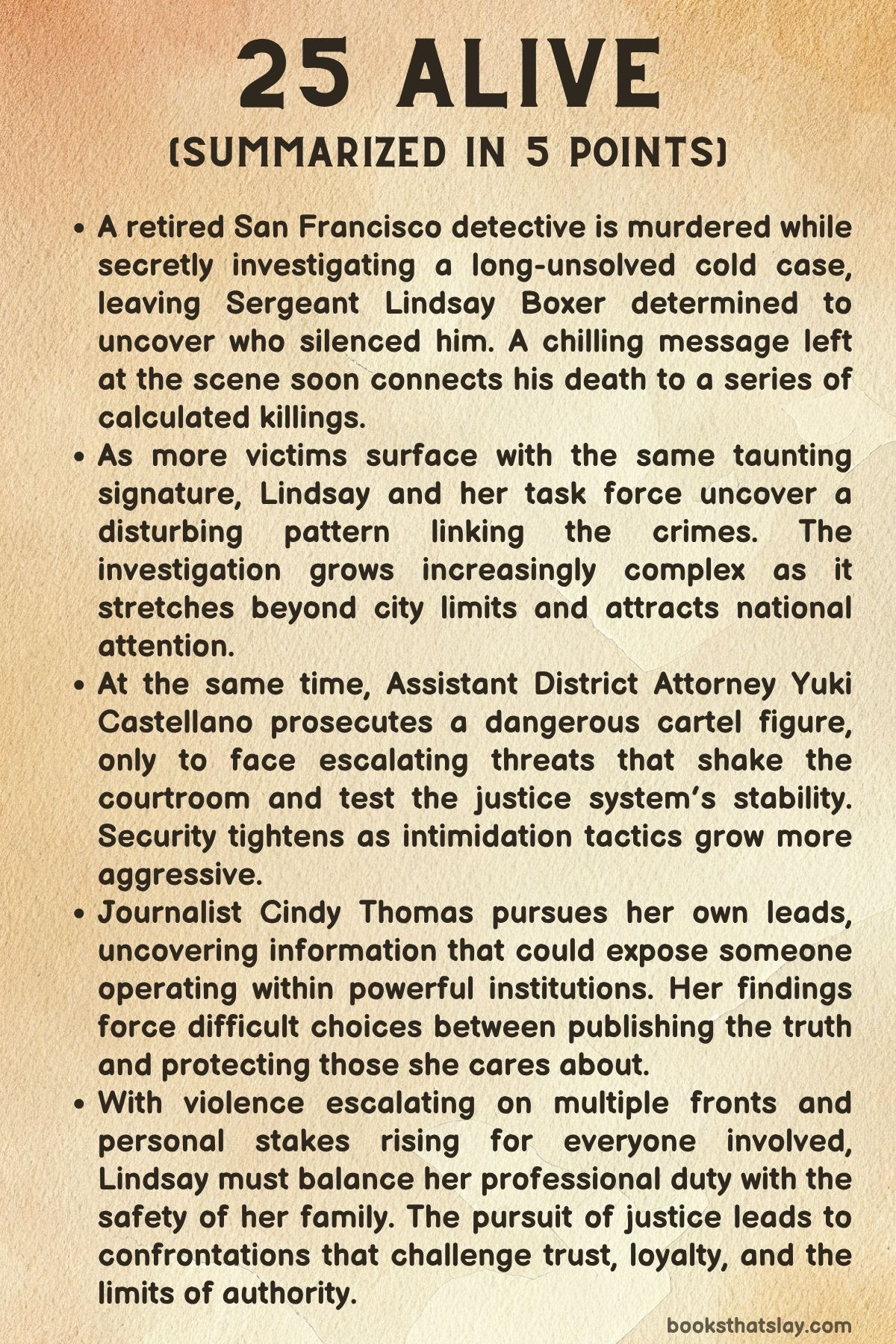
25 Alive by James Patterson is a high-velocity crime thriller and the 25th installment in the Women’s Murder Club series. Set in San Francisco, the novel opens with the shocking murder of retired homicide lieutenant Warren Jacobi, a mentor and friend to Sergeant Lindsay Boxer.
His death launches a relentless investigation that soon reveals a chilling pattern: victims marked with the taunting phrase “I said. You dead.” As Lindsay and her closest allies—medical examiner Claire Washburn, prosecutor Yuki Castellano, and reporter Cindy Thomas—race to stop a calculating killer, personal loyalties, cartel violence, and corruption collide in a story about justice, friendship, and survival.
Summary
The novel begins before dawn in Golden Gate Park. Warren Jacobi, long retired from the San Francisco Police Department, stands near the Lily Pond disguised as a bird-watcher.
He is not there for nature. Still haunted by the unsolved murder of a teenage girl whose body was found in the park years earlier, Jacobi believes he has finally identified the man responsible.
Armed with a camera and quiet determination, he watches his suspect approach. When the man fires a shot at a heron and tosses the gun into the pond, Jacobi prepares to move in.
Instead, he is attacked from behind. Stabbed with a military knife, he dies after glimpsing his killer’s face.
Sergeant Lindsay Boxer is called to the scene. The shock of seeing her former partner’s body is overwhelming.
Jacobi had once guided her through the early years of her career and even stepped in as a father figure at her wedding. Now she studies the crime scene with clinical focus, determined to find who killed him.
A matchbook from a nearby bar lies close to the body. Inside it, written in block letters, is a message: “I SAID.
YOU DEAD.”
As Lindsay begins investigating, a second murder is reported. Frances Robinson, a wealthy romance novelist, is found dead in her condominium near the park.
On her laptop screen are the same words: “I SAID. YOU DEAD.” There are no signs of forced entry or robbery.
The killer appears methodical and controlled. A task force is formed, and Lindsay and her partner, Rich Conklin, take the lead.
Meanwhile, crime reporter Cindy Thomas discovers that an anonymous letter describing Jacobi’s murder—including details not yet released to the public—has been posted on a New York tabloid’s website. The killer is taunting law enforcement.
Cindy realizes that whoever wrote the message wants attention and recognition.
As investigators dig into the victims’ backgrounds, a pattern slowly emerges. Each had recently come into significant money.
Frances Robinson had gained assets through divorce. Jacobi had received a substantial financial settlement shortly before his death.
The possibility that the killer targets people who experience financial windfalls becomes a working theory.
Yuki Castellano, assistant district attorney and Lindsay’s close friend, faces her own battle. She is prosecuting Dario Garza, a suspected serial killer connected to a powerful cartel family.
Her case relies heavily on a frightened eyewitness. During her opening statement, a sudden explosion interrupts the trial.
Although no one is killed, index cards containing the personal information of everyone involved in the case are discovered, each bearing threats. The message is clear: proceed, and you die.
The trial is postponed amid escalating security concerns.
Cindy travels to Nevada after learning about a college student, Sadie Witt, who was murdered with the same signature phrase left behind. Sadie had recently taken ownership of her family home.
The connection strengthens Lindsay’s theory. Three victims, three financial changes, one message.
Jacobi’s funeral brings the Women’s Murder Club together in grief. Lindsay delivers a eulogy that honors his integrity and loyalty.
The loss deepens her resolve.
The case grows more complicated when Judge Martin Orlofsky, who had been presiding over the Garza trial, is found decapitated in his home along with his wife. The brutality signals cartel involvement.
Evidence suggests a professional assassin. The killing appears intended to intimidate the justice system and derail Yuki’s prosecution.
The FBI joins the investigation. Agent James Walsh approaches Lindsay privately with a startling suspicion: the “I said.
You dead.” murders may be connected to FBI Agent Brett Palmer. Walsh explains that Palmer’s second ex-wife died by hanging, with the phrase written on her shoes.
His first wife died in a questionable drowning. In each case, Palmer had an alibi, but the coincidences are troubling.
Walsh believes Palmer may either be the killer or is being framed by someone close to him.
At the same time, Lindsay’s husband, FBI Agent Joe Molinari, is sent to Mexico with his partner Bao Wong to investigate who ordered the judge’s assassination. Their mission quickly turns violent.
They are ambushed by cartel gunmen. Bao is injured, and Joe is detained in Mexico under dubious charges following the shootout.
Lindsay’s fear for Joe intensifies as diplomatic efforts stall.
Back in San Francisco, another victim is discovered with the signature phrase written on her body. Her name is Caroline Ford, and she was pregnant at the time of her death.
Lindsay remembers meeting Brett Palmer at a breakfast arranged by Cindy. During the meeting, Palmer had denied involvement in any murders.
Lindsay discreetly collected his fork from the table, hoping to obtain DNA.
Cindy interviews Palmer’s former in-laws and receives a digital voice recorder Palmer left behind. On the recording, Palmer is heard saying, “I said, ‘You dead,’” followed by his stepbrother Nate Miller congratulating him.
The recording sounds like a confession.
Simultaneously, the Garza trial resumes in a fortified courtroom inside Folsom Prison. Despite intense security, Dario Garza’s father, Tiago Garza, launches a dramatic helicopter assault on the building to rescue his son.
The courtroom roof collapses in the chaos. Gunfire erupts.
When it ends, Dario Garza is dead, and Tiago is captured.
Tiago eventually confesses to orchestrating the murders of Judge Orlofsky and Warren Jacobi. Jacobi had been following him during his independent investigation into the teenage girl’s murder, making him a liability.
Tiago also admits to killing Frances Robinson to muddy the investigation and distract law enforcement.
This confession separates the cartel violence from the “I said. You dead.” killings.
The signature murders remain linked to Brett Palmer.
DNA analysis from the fork Lindsay collected confirms a match with evidence found on Caroline Ford’s body. The scientific proof, combined with the incriminating recording, gives law enforcement enough to move forward.
Lindsay and Walsh arrest Palmer without incident.
As these threads converge, Joe is finally released from custody in Mexico. During a tense phone call with Lindsay, gunshots ring out in the background, but he survives and promises he is on his way home.
By the end of the novel, justice arrives on multiple fronts. Tiago Garza is in custody, his attempt to control the courts crushed.
Brett Palmer faces charges tied to multiple murders. The Women’s Murder Club stands together once again, scarred but intact.
The story closes with Lindsay balancing relief and exhaustion. She has lost a mentor, confronted corruption within federal ranks, and feared for her husband’s life.
Yet the core of her world remains: her friends, her family, and her commitment to the badge. In a city shaken by violence and intimidation, the pursuit of truth endures.
Characters
Lindsay Boxer
Lindsay Boxer stands at the emotional and moral center of 25 Alive. As a seasoned homicide sergeant, she balances sharp investigative instincts with a deep personal vulnerability that becomes increasingly visible throughout the story.
The murder of Warren Jacobi strikes her not just professionally but personally, reopening wounds tied to mentorship, loyalty, and loss. Lindsay’s drive to solve the case is fueled as much by grief as by duty.
At the same time, she is forced to confront her own mental health, acknowledging symptoms of trauma while refusing to abandon the job that defines her identity. Her fear for her husband Joe’s safety in Mexico further exposes her fragility, yet she continues to lead the task force with composure.
Lindsay’s character reflects the tension between strength and emotional cost, showing how deeply justice is intertwined with her sense of self.
Warren Jacobi
Though his presence is brief in life, Warren Jacobi shapes the narrative profoundly through memory and legacy. A retired homicide lieutenant, Jacobi embodies old-school policing marked by tenacity and personal accountability.
His decision to pursue a cold case independently reveals both courage and stubbornness. He is unwilling to let injustice rest, even at the risk of his own safety.
To Lindsay, he represents guidance, stability, and paternal support. His murder functions as both catalyst and moral compass for the investigation.
Even in death, Jacobi’s influence persists through the evidence he collected and the emotional weight he leaves behind. He is portrayed as honorable, relentless, and ultimately sacrificial.
Joe Molinari
Joe Molinari represents steadiness and loyalty under extreme pressure. As an FBI agent and Lindsay’s husband, he operates in a parallel sphere of danger that intersects with the main investigation.
His assignment to Mexico demonstrates his professionalism and willingness to step into volatile situations. Joe’s composure during the ambush and subsequent imprisonment highlights his resilience.
At home, he is attentive and compassionate, especially toward their daughter Julie and their aging dog. His character anchors Lindsay’s personal world, reminding readers that her life extends beyond crime scenes.
Joe’s ordeal abroad underscores the unpredictability of law enforcement life and amplifies the emotional stakes for Lindsay.
Cindy Thomas
Cindy Thomas brings intelligence, initiative, and moral complexity to the narrative. As a crime reporter, she walks the line between journalistic ambition and personal loyalty.
Her discovery of the anonymous online letter and her pursuit of leads across state lines demonstrate her resourcefulness and courage. Cindy’s investigative instincts rival those of the police, and she often uncovers crucial evidence before official channels do.
However, she must constantly decide what to publish and what to withhold to protect lives. Her confrontation with Brett Palmer reveals her fearlessness, but also her vulnerability.
Cindy’s role highlights the power and responsibility of the media in criminal investigations.
Claire Washburn
Claire Washburn provides scientific precision and emotional grounding. As chief medical examiner, she approaches death with clinical clarity, yet she is deeply affected by the murder of Jacobi.
Claire’s composure at crime scenes contrasts with the personal grief she shares with her friends. Her forensic expertise becomes crucial in linking Brett Palmer to the murders through DNA analysis.
Claire represents reason and evidence in a narrative filled with chaos and intimidation. She is both analytical and compassionate, offering Lindsay a steady presence when emotions threaten to overwhelm her.
Yuki Castellano
Yuki Castellano embodies determination within the legal battlefield. As assistant district attorney prosecuting Dario Garza, she faces intimidation, violence, and institutional pressure.
Her commitment to pursuing justice despite cartel threats reflects both courage and professional pride. Yuki’s courtroom presence reveals her strategic mind and belief in the rule of law.
The attack on the judge and the relocation of the trial test her resolve, yet she adapts to heightened security without losing focus. Emotionally, Yuki is closely tied to her friends, allowing herself vulnerability in private while maintaining strength in public.
She represents the legal system’s resilience under siege.
Brett Palmer
Brett Palmer emerges as a calculating and controlled antagonist. As an FBI agent, he operates within the very institution tasked with protecting the public, making his alleged crimes especially disturbing.
Palmer maintains a calm, measured demeanor when confronted, projecting confidence and denial. His history of suspicious spousal deaths reveals a pattern of manipulation and possible narcissism.
The recorded conversation suggesting complicity and the DNA evidence tie him to the killings marked by the phrase “I said. You dead.” Palmer’s character reflects the danger of hidden violence behind authority and respectability.
He is not impulsive but methodical, blending charm with menace.
Tiago Garza
Tiago Garza represents overt brutality and calculated intimidation. As a cartel leader and father of Dario Garza, he operates through fear and spectacle.
His orchestration of Judge Orlofsky’s murder and the dramatic helicopter assault on the prison courtroom illustrate his willingness to challenge institutional power openly. Tiago’s confession regarding Jacobi’s murder clarifies his motive: eliminate threats and confuse investigations.
Despite his ruthlessness, he is driven by loyalty to his son and a warped sense of familial duty. Tiago embodies organized crime’s raw force, contrasting sharply with Palmer’s covert manipulation.
Dario Garza
Dario Garza is volatile, aggressive, and deeply entitled. As the accused serial killer, he shows little restraint in the courtroom, erupting in anger and attempting to intimidate witnesses.
His behavior reflects a personality accustomed to impunity. While much of his violence is described through testimony and prosecution, his reactions reveal arrogance and instability.
Dario functions as both defendant and symbol of cartel influence within American borders. His death during the courtroom assault underscores the destructive cycle of violence surrounding him.
Bao Wong
Bao Wong is defined by competence and quiet resilience. As Joe’s FBI partner, she demonstrates tactical skill during the ambush in Mexico, fighting back decisively despite injury.
Her emotional response to Joe’s imprisonment reveals loyalty and fear, yet she continues to operate professionally. Upon returning to San Francisco, she contributes valuable intelligence linking Tiago Garza to the judge’s murder.
Bao’s character emphasizes teamwork and adaptability under pressure. She is neither reckless nor hesitant, but pragmatic and composed.
Rich Conklin
Rich Conklin, Lindsay’s partner in homicide, provides reliability and grounded support. He approaches cases with logical analysis and steady collaboration.
His marriage to Cindy places him at an intersection between law enforcement and journalism, adding complexity to his loyalties. Rich’s skepticism toward some theories shows his practical mindset, yet he does not hesitate to act when evidence demands it.
He balances professional detachment with personal care for his wife and colleagues, reinforcing the sense of unity within the investigative team.
Julie Boxer
Julie Boxer represents innocence amid violence. As Lindsay and Joe’s young daughter, she anchors the story’s domestic dimension.
Her concern for the family dog and her distress over Joe’s absence highlight the human cost of dangerous professions. Julie’s presence reminds Lindsay of what she is fighting to protect.
Though not involved in the investigation, she provides emotional contrast to the grim realities of homicide work.
Miranda Spencer
Miranda Spencer, Jacobi’s girlfriend, adds depth to his personal life. Her grief at the funeral reveals the quieter, intimate side of the man known professionally as a detective.
Miranda’s disclosure of Jacobi’s financial settlement and private investigation supplies critical leads. She embodies trust and sorrow, showing how violence extends beyond official circles into private relationships.
Themes
Justice Under Siege
Law and order are shown as fragile structures constantly tested by violence, corruption, and fear. In 25 Alive, the institutions meant to uphold justice face direct assault, both literal and psychological.
The murder of Judge Orlofsky and the threats delivered during Dario Garza’s trial reveal how criminal organizations attempt to destabilize the legal system. Courtrooms, traditionally symbols of rational judgment and civic authority, become battlegrounds.
The relocation of the trial to a fortified facility inside a prison underscores the extent to which the justice system must adapt to survive. The presence of armed judges and heightened security measures signals a disturbing reality: justice now requires physical defense.
At the same time, justice is complicated by the involvement of insiders. The suspicion surrounding FBI Agent Brett Palmer suggests that corruption or hidden criminality may exist within the very agencies designed to protect the public.
This blurs the line between protector and predator, raising questions about trust in institutional authority. The investigative process becomes not only about catching criminals but also about safeguarding the credibility of the system itself.
The theme also explores emotional endurance within legal roles. Yuki persists despite threats to her life, while Lindsay continues her investigation even as personal trauma accumulates.
Justice is portrayed not as an abstract principle but as something sustained by individuals who risk their safety and well-being. The novel suggests that justice survives only because people are willing to stand firm in the face of intimidation.
It is not guaranteed by structure alone; it depends on courage, resilience, and moral clarity.
Loyalty and Friendship
The bond among the Women’s Murder Club serves as the emotional foundation of the narrative. Lindsay, Claire, Cindy, and Yuki are connected not only through professional collaboration but through shared history and mutual trust.
The murder of Warren Jacobi reinforces the importance of these bonds. His loss deepens their awareness that their work exposes them to constant danger, yet it also strengthens their solidarity.
They gather in moments of grief, celebrate small victories together, and protect one another when threats escalate.
Friendship is portrayed as a stabilizing force in a world dominated by violence. Lindsay’s vulnerability is visible only among her closest friends, especially when she confronts her diagnosis of trauma or fears for Joe’s safety.
Claire’s clinical precision at crime scenes shifts to emotional support when she comforts Lindsay. Cindy’s decision to withhold certain information from publication reflects loyalty over career ambition.
Yuki, facing courtroom intimidation, finds strength in the knowledge that her friends stand behind her.
Loyalty extends beyond friendship into marriage and partnership. Joe’s commitment to his duty mirrors Lindsay’s, yet their shared understanding of risk binds them.
Rich’s steady support of both Lindsay and Cindy reflects trust built over time. Even antagonistic loyalty appears in Tiago Garza’s violent devotion to his son, demonstrating how loyalty can become destructive when detached from moral boundaries.
Through these relationships, the novel emphasizes that survival in high-risk professions requires emotional networks. Isolation leads to vulnerability, while trust builds resilience.
Loyalty becomes both shield and anchor, sustaining characters when professional pressure intensifies.
Power, Control, and Intimidation
Power in the novel manifests through fear, manipulation, and spectacle. The repeated phrase “I said.
You dead.” is not merely a signature; it is a declaration of dominance. The killer seeks recognition and psychological control over both victims and investigators.
By leaving messages and contacting media outlets, the perpetrator attempts to dictate the narrative and instill fear beyond the crime scene.
Cartel violence represents another form of power exerted through intimidation. The assassination of a judge, the public threats to jurors, and the helicopter assault on a courtroom demonstrate an effort to undermine public confidence.
These acts are not random; they are strategic displays meant to show that organized crime can reach into the heart of the justice system. The spectacle of violence becomes a tool to silence opposition.
Brett Palmer’s suspected crimes illustrate a more subtle version of control. His position as an FBI agent grants him authority and access, which he allegedly uses to evade suspicion.
His calm demeanor and rehearsed denials suggest confidence in his ability to manipulate perception. The contrast between overt brutality and hidden coercion reveals different faces of power.
One relies on explosive force; the other operates quietly behind professional respectability.
The investigation itself becomes a struggle to reclaim control. By gathering evidence, analyzing DNA, and coordinating across agencies, law enforcement works to restore balance.
The theme underscores that power is not inherently tied to violence; it can also emerge from patience, truth, and collective effort. Ultimately, the exposure of both Tiago Garza and Brett Palmer represents the restoration of moral authority over those who attempted to dominate through fear.
The Personal Cost of Duty
Professional dedication carries significant emotional consequences throughout the narrative. Lindsay’s identity is deeply tied to her work, yet the accumulation of trauma begins to surface.
The murder of Jacobi forces her to confront grief layered upon years of exposure to violence. Her therapist’s diagnosis of trauma signals that even the strongest officers are not immune to psychological strain.
Still, she resists stepping away from the job, reflecting the tension between self-preservation and commitment.
Joe’s mission to Mexico illustrates the unpredictability of duty. His arrest and detention leave Lindsay powerless, reversing her usual role as protector.
The uncertainty surrounding his safety intensifies her anxiety, affecting both her professional focus and her role as a mother. Julie’s distress at her father’s absence reveals how the consequences of dangerous work extend into family life.
Even the subplot involving their aging dog highlights the fragility of stability at home.
Yuki faces similar strain in the courtroom, where threats are not abstract but direct and personal. The relocation of the trial to a high-security environment demonstrates that her professional responsibilities place her in tangible danger.
Cindy risks both professional credibility and physical safety in her pursuit of truth, especially when she meets with a potential killer.
The novel portrays duty as a calling that demands sacrifice. It requires emotional endurance, strained relationships, and constant vigilance.
Yet it also offers purpose. Despite the toll, the characters continue forward, suggesting that meaning can coexist with hardship.
The cost is real, but so is the conviction that their work matters.