56 Days Summary, Characters and Themes | Catherine Ryan Howard
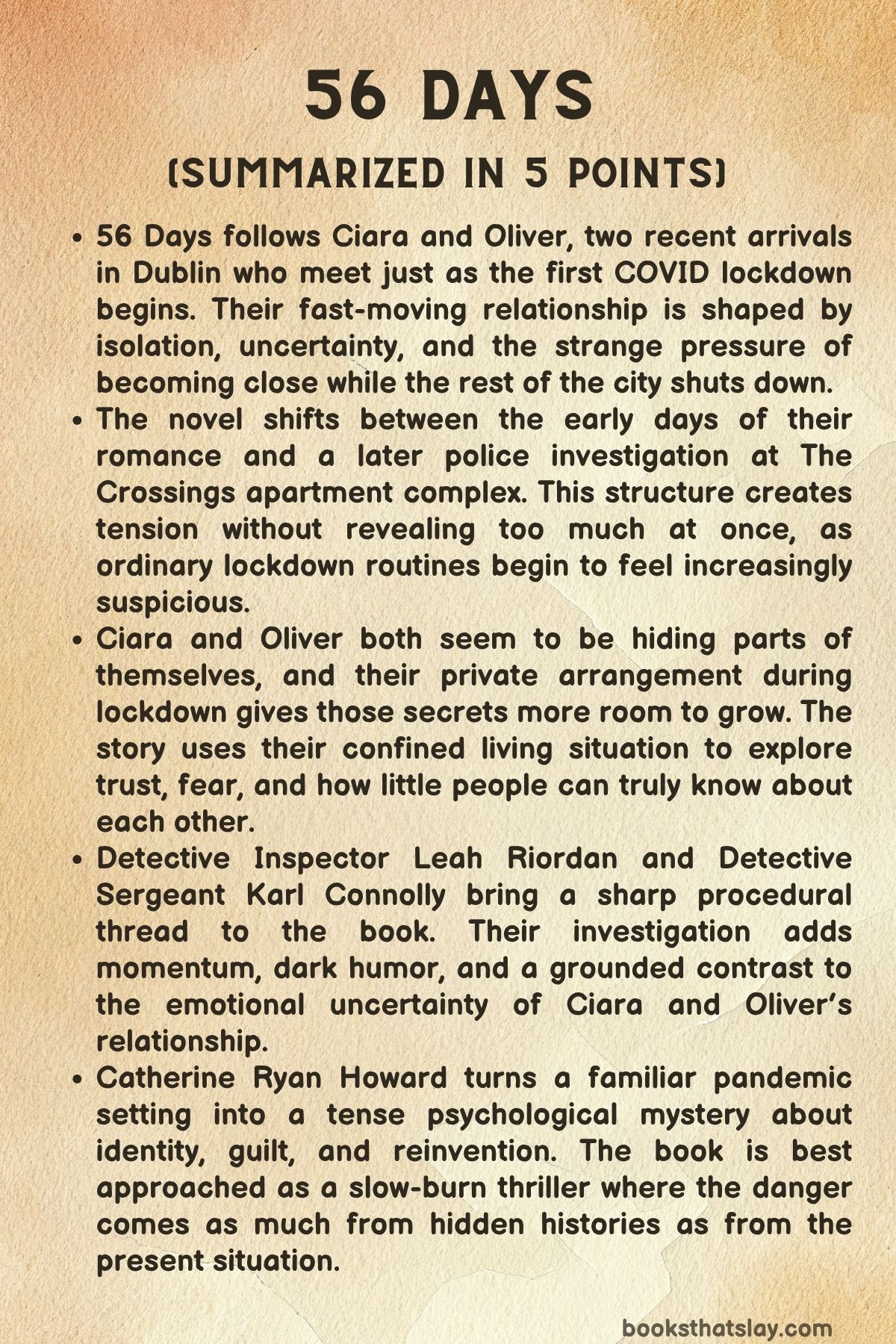
56 Days by Catherine Ryan Howard is a sharp crime thriller built around secrecy, isolation, and the strange intimacy of lockdown. Set in Dublin during the early days of the COVID-19 pandemic, the novel follows Ciara and Oliver, two strangers whose sudden relationship seems romantic at first but is shaped by hidden motives on both sides.
Howard uses the closed world of an apartment complex to create pressure, suspicion, and unease. The book asks how well we can ever know another person, especially when the past has been buried under new names, false stories, and carefully managed lives.
Summary
56 Days begins at The Crossings, a modern apartment complex in Dublin, where residents are woken by a fire alarm at dawn. At first, everyone assumes it is another false alarm, something they have grown used to during lockdown.
But this time, two Gardaí are standing in the courtyard, and an older resident named Gillian Fannin is pointing toward a ground-floor apartment. The residents are curious, but also distant from one another.
Lockdown has made them more aware of each other’s presence while keeping them emotionally separate. Soon, emergency sirens arrive, and it becomes clear that something serious has happened.
The story then moves backward to the day Ciara and Oliver first meet. They are both standing in a Tesco queue during lunch in Dublin.
Oliver lets Ciara go ahead, then notices her tote bag, which shows the space shuttle Enterprise. Ciara is nervous but enthusiastic when she talks about space shuttles, expecting Oliver to think she is strange.
Instead, he seems interested and asks her for coffee. They talk by the canal and appear to connect quickly.
Ciara has recently moved to Dublin for work in tech, while Oliver works as an architectural technologist and has recently come from London. Their shared interest in space gives their first meeting a natural ease, and Oliver invites her to an Apollo documentary.
In the present, Detective Inspector Leah Riordan and Detective Sergeant Karl Connolly are called to The Crossings. A decomposing body has been found in apartment one after Gillian reported a bad smell.
The apartment door was not fully closed, and a paramedic who entered saw the body in the bathroom. Lee and Karl arrive to find a complicated scene: the fire alarm has disturbed the whole building, residents may have seen things, and there are several possible ways in and out of the apartment.
Inside, the smell of decomposition is heavy. The body is found kneeling facedown in the shower, surrounded by broken safety glass, with a head injury and signs of having been dead for some time.
The investigation begins with uncertainty. The apartment appears barely lived in and may be a corporate rental.
Rohypnol is found in the medicine cabinet. The front door is unlocked.
Lee and Karl must work out whether the death was an accident, a suicide, or murder. They learn that the apartment is connected to KB Studios, Oliver’s employer, and begin looking at CCTV, access points, witnesses, and the identity of the dead man.
The earlier timeline follows Ciara and Oliver’s relationship as it develops quickly. Their next date is at The Westbury, an expensive hotel bar where Ciara feels out of place.
They miss their documentary and drink French 75s instead. Oliver is charming but guarded.
He says he likes her, but at the end of the night he sends her home in a taxi instead of inviting her to stay. Ciara is confused, but hopeful.
Oliver’s own perspective reveals that he noticed Ciara before their first conversation. He had seen her repeatedly at Tesco and become suspicious because she seemed to appear whenever he did.
Her space shuttle bag caught his attention, but it also made him uneasy. Oliver is living under a new identity after a dark event in his past, and he fears Ciara could be a journalist or someone trying to expose him.
When he speaks to her, part of him is testing her. He checks her knowledge of space, looks her up online, and even calls her workplace to confirm she is real.
He finds evidence that supports her story, but he cannot fully relax.
As Ireland’s pandemic restrictions increase, Ciara and Oliver’s connection speeds up. Dublin still looks partly normal, but fear is growing.
They meet for drinks, and after the pub closes early, Oliver brings Ciara to apartment one at The Crossings. He says it is a temporary work apartment.
They kiss and sleep together. Ciara sees a long scar on Oliver’s side, and he tells her it came from a drunken fight when he was seventeen.
She accepts his explanation, taking it as a sign of vulnerability.
Soon, strict restrictions make dating difficult. Oliver suggests that Ciara move into his apartment temporarily so they can count as one household during lockdown.
Ciara agrees, even though they barely know each other. At first, the arrangement feels private and exciting.
They choose not to tell anyone. But small details begin to unsettle Ciara.
Oliver is anxious about infection and says he has asthma, yet she does not see inhalers in his medicine cabinet. She notices pills and odd behavior.
During a shopping trip, Oliver hides something in his backpack. Later, Ciara worries he may have tried to enter the bathroom while she was showering.
The hidden items turn out to be decorations for a terrace dinner, but her unease does not disappear.
A fire alarm brings another disturbance. Ciara leaves the apartment and meets a blond woman named Laura, who seems unusually interested in her situation.
Laura reveals that she knows Oliver and calls him “Ollie.” When Oliver sees Ciara speaking with Laura, he retreats, clearly shaken. Laura tells Ciara that if she ever needs help, she is in apartment fourteen.
This encounter deepens Ciara’s doubts.
Oliver has reason to panic. He has received a frightening text from someone named Rich, warning him that there is no safe option and that he should get out.
He fears exposure, especially when he realizes Laura is the same woman he met outside The Westbury earlier. In the present, Lee and Karl discover that Laura Mannix is a journalist.
She admits she has been investigating Oliver because she heard that Oliver St Ledger, once known publicly only as “Boy B” in the Mill River child-murder case, might be living in Dublin under a new name.
Laura had tracked Oliver through KB Studios and rented a nearby apartment to watch him. She sent a blank envelope addressed to Oliver St Ledger to apartment one, using it as bait to confirm his identity.
Oliver sees the name, panics, and hides the envelope from Ciara. He later realizes someone knows who he really is.
At this stage, the story reveals that Ciara has also been lying. Her real name is Ciara Hogan, and she came to Dublin to find Oliver St Ledger.
Years earlier, Oliver and her brother Shane were convicted of murdering a boy named Paul Kelleher. Shane later died by suicide, and Ciara’s mother never recovered from the belief that her son had done something unforgivable.
Ciara wants to know what really happened. She has built a false identity, bought a disposable phone, prepared a cover story, and used Oliver’s childhood interest in space to approach him.
Her relationship with him began as a plan, not an accident.
When Oliver finally tells Ciara about his past, he gives her the version that has protected him for years. He says Shane led the attack on Paul and made the decision to drown him, while Oliver helped.
Ciara is horrified, but also relieved in a painful way. If Oliver can feel guilt and appear decent now, perhaps Shane might also have become a better person.
She begins to believe she loves Oliver and plans to tell him the truth.
But Oliver finds Ciara’s notebook and discovers her cover story. He has taken a sleeping pill and becomes terrified that she is a journalist.
He tries to stay awake, vomits, and turns on the shower. In his panic and drugged state, he slips, breaks the shower glass, injures himself, and collapses.
Ciara reveals that she is Shane’s sister and already knew about Mill River. Oliver then tells the real truth: he was the one who led the attack, beat Paul, and decided to drown him.
Shane had tried to make him admit it, but no one believed Shane. Shane’s life and death were shaped by Oliver’s lie.
Ciara is devastated. Oliver lies injured and barely conscious in the shower.
At first, she turns off the water. Then she understands that if she turns it back on and leaves him facedown, he will drown.
She resets the scene and walks away. Oliver dies.
Lee and Karl later piece together parts of the case, but not all of it. Laura admits she entered the apartment after Oliver was already dead, photographed the body, failed to report it, and set off alarms to try to expose him and his girlfriend.
CCTV supports the idea that Laura did not kill him. The postmortem suggests Oliver drowned after taking Rohypnol and falling in the shower.
The apartment has been wiped clean, and “Ciara” is almost impossible to trace because she used a fake identity and disposable phone.
The official explanation moves toward accidental death pending toxicology. Lee remains uneasy, but there is no proof.
Ciara, meanwhile, has erased her presence and walks on Sandymount Strand, accepting that she caused Oliver’s death while questioning what that makes her. When her sister calls to say their mother is dying, Ciara asks to be put on speaker so she can finally tell her mother the truth about Shane.
Characters
Ciara Hogan
Ciara Hogan is one of the most emotionally complicated characters in 56 Days because she enters the story with a hidden purpose but gradually becomes trapped inside the very intimacy she has manufactured. At first, she appears to be an ordinary young woman beginning a lockdown romance, nervous, hopeful, and eager to be liked.
Beneath that surface, however, she is driven by grief, family trauma, and a need for answers about her brother Shane’s past. Her actions are deceptive from the beginning: she uses a false identity, researches Oliver, prepares a cover story, and deliberately engineers their meeting.
Yet the book does not present her simply as manipulative. Her deception comes from pain, not greed or cruelty, and this makes her morally uneasy rather than straightforwardly villainous.
Ciara’s emotional journey is built around the conflict between truth and attachment. She begins by wanting to expose Oliver, or at least understand him, but as she spends time with him she starts to believe in the version of himself he offers her.
Her growing love for him complicates her original mission and reveals how badly she wants Shane to have been redeemable. If Oliver can feel remorse and become decent, then perhaps her brother was not beyond saving either.
This is what makes Oliver’s final confession devastating for her: he destroys not only her feelings for him, but also the fragile comfort she has built around Shane’s memory. Ciara’s decision to leave Oliver to drown turns her from investigator and grieving sister into someone capable of deliberate death.
However, the book leaves her in a morally gray space, because her act is bound to rage, betrayal, justice, and trauma all at once.
By the end, Ciara is no longer the anxious woman trying to make a romance work. She has become controlled, calculating, and capable of erasing herself from a crime scene.
Her final acceptance that she killed Oliver shows a chilling self-awareness, but her distinction between killing and being a killer reveals that she is still trying to preserve some moral boundary within herself. Ciara is tragic because she wanted truth, but truth did not free her; it transformed her.
In the story, she represents how grief can turn into obsession, how justice can blur into revenge, and how a person can cross a line while still believing she is different from the kind of people she hates.
Oliver Kennedy / Oliver St Ledger
Oliver is one of the most disturbing and layered figures in the book because nearly every version of him is unstable. As Oliver Kennedy, he presents himself as polite, intelligent, charming, cautious, and slightly wounded.
He appears to be a man trying to start over in Dublin, someone made anxious by illness, paperwork, exposure, and the sudden restrictions of lockdown. But as Oliver St Ledger, he carries the hidden identity of “Boy B,” one of the boys involved in the killing of Paul Kelleher.
His entire adult life is structured around concealment. He does not merely hide facts from others; he builds a whole self designed to survive public discovery.
Oliver’s greatest complexity lies in the way he mixes vulnerability with manipulation. He can be tender with Ciara, attentive to her discomfort, and capable of moments that feel genuinely romantic.
At the same time, he constantly measures, tests, and manages her because he fears she may be a journalist or a threat. His paranoia is understandable given his past, but it is also self-protective in a selfish way.
He is less afraid of moral accountability than of exposure. The story repeatedly invites the reader to wonder whether Oliver is a damaged man who deserves a second chance or a dangerous person who has successfully hidden the truth.
His final confession reveals the full horror of his character. The earlier story he tells Ciara allows Shane to carry the main burden of violence, while Oliver casts himself as guilty but secondary.
The truth is much worse: Oliver was the driving force behind Paul’s death, and Shane’s later rage and despair came from not being believed. This revelation recasts Oliver’s remorse as incomplete and possibly dishonest.
He may feel guilt, but he has also allowed another boy, another family, and even Ciara’s mother to live under a lie. In 56 Days, Oliver represents the terrifying possibility that reinvention can become another form of violence when it depends on burying the truth.
Detective Inspector Leah Riordan
Detective Inspector Leah Riordan, often called Lee, is the figure of professional order in a story full of secrecy, panic, and emotional distortion. She enters the book through the discovery of Oliver’s body, and her role is to impose structure on a scene that is physically chaotic and morally uncertain.
Lee is sharp, practical, observant, and experienced enough to understand that the obvious explanation may not be the correct one. She notices the details others might overlook: the unlocked door, the smell, the letterbox, the condition of the apartment, the strange sparseness of the living space, and the significance of the name connected to the Mill River case.
Lee’s strength as a character comes from her combination of discipline and instinct. She does not rush to sensational conclusions, especially when protected identities and old crimes are involved.
At the same time, she is uneasy when the evidence does not fully satisfy her. Her investigation shows how truth in the legal world depends not only on what happened, but on what can be proven.
This makes her a strong contrast to Ciara, who acts from emotional certainty. Lee may suspect that something is wrong, but suspicion alone cannot become justice.
Her relationship with Karl also gives her character a grounded, human quality. She is authoritative without being humorless, and her dry handling of Karl’s embarrassing situation shows her impatience, wit, and familiarity with his flaws.
Lee is not emotionally central in the same way Ciara is, but she is morally central because she represents the limits of official truth. By the end, she understands that the case may not be as accidental as it appears, yet the available evidence points elsewhere.
Through Lee, the book explores the frustrating gap between knowing, suspecting, and proving.
Detective Sergeant Karl Connolly
Karl Connolly brings a different energy to the investigation. He is less polished than Lee and is introduced in a comic, humiliating situation, but that opening should not make him seem useless.
His character adds rough humor and informality to a grim case, creating contrast with the decomposing body and the tense secrecy surrounding the apartment. Karl’s embarrassment, sarcasm, and casual manner make him feel human, but his role in the investigation also shows that he can think practically and contribute meaningfully.
Karl often functions as a sounding board for Lee. Through their conversations, the reader sees different possibilities being tested: accident, murder, journalistic interference, mistaken identity, and the mysterious role of Ciara.
He is willing to consider theories that Lee may not fully accept, including the possibility that Laura could have posed as Ciara. This makes him useful not because he is always right, but because he keeps alternative explanations alive.
His presence also helps reveal Lee’s professionalism, since their dynamic depends on trust, teasing, and a shared understanding of police work.
As a character, Karl represents the ordinary messiness of real people working inside extraordinary cases. He is flawed, sometimes ridiculous, but not incompetent.
His informality makes the investigation feel less sterile and more lived-in. He also helps balance the emotional heaviness of the story, ensuring that the police sections contain personality as well as procedure.
Laura Mannix
Laura Mannix is one of the most ethically questionable characters in the book. She is a journalist who inserts herself into the lives of others under the justification of uncovering a hidden truth.
Her pursuit of Oliver is not baseless; he really is hiding a significant identity, and the public interest in his past is understandable. However, Laura’s methods are invasive, manipulative, and reckless.
She rents an apartment near him, follows him, approaches Ciara, sends bait in the form of the blank envelope, and withholds crucial information after discovering the body. Her actions blur the line between investigation and exploitation.
Laura’s character is driven by ambition, curiosity, and the belief that she has a right to expose what has been hidden. She is alert and socially skilled, able to seem friendly while gathering information.
Her first interaction with Ciara is especially unsettling because she presents herself as helpful while quietly testing how much Ciara knows. Laura understands people well enough to pressure them without openly attacking them.
This makes her dangerous in a different way from Oliver or Ciara: she weaponizes information.
Yet Laura is not simply a villain. She is correct that Oliver’s hidden past matters, and she is also one of the first people to sense that something is wrong.
Her moral failure lies in treating the truth as material to possess rather than as something tied to living people and their suffering. By photographing the body and failing to report it, she reveals that her instincts as a journalist can override basic human responsibility.
Laura’s role in 56 Days shows how the pursuit of truth can become corrupted when it is mixed with career ambition and personal fascination.
Shane Hogan
Shane Hogan is absent from the present action, but his presence shapes the entire story. He is Ciara’s brother and one of the boys convicted in the killing of Paul Kelleher.
For much of the book, Shane exists through other people’s memories, official narratives, and emotional consequences. He is dead before the main events unfold, but the uncertainty around his role is what drives Ciara to find Oliver.
Shane is therefore less a traditional active character and more a haunting force within the novel.
The tragedy of Shane lies in the difference between what people believed about him and what Oliver finally reveals. Shane was blamed as the central aggressor in Oliver’s false version of events, and his later suicide becomes tied to the unbearable weight of not being believed.
Through Shane, the story explores how a false narrative can continue harming people long after the original crime. His life is destroyed not only by his involvement in Paul’s death, but by Oliver’s refusal to tell the truth.
For Ciara, Shane is both a brother and a question. She wants to know whether he was truly monstrous or whether he might have changed.
Her emotional need to redeem him makes her vulnerable to Oliver’s partial confession. When the truth emerges, Shane becomes a symbol of stolen justice.
He was guilty of involvement, but he was also betrayed, scapegoated, and denied the chance to be understood accurately. His character deepens the book’s moral complexity because he is neither innocent nor deserving of the full lie that consumed him.
Paul Kelleher
Paul Kelleher is the victim whose death lies at the center of the old Mill River case. Like Shane, he is not active in the present timeline, but his murder creates the moral foundation of the story.
Paul’s character matters because he represents the original human cost beneath every later deception. The secrecy surrounding Oliver, Ciara’s grief, Laura’s investigation, and Lee’s caution all trace back to what happened to him.
Paul is especially important because the story risks focusing heavily on the lives of those who survived the crime, especially Oliver and the people connected to him. His presence reminds the reader that before there were protected identities, media interest, guilt, reinvention, or revenge, there was a child who was attacked and drowned.
The final revelation about Oliver’s role restores some of the horror of Paul’s death by showing that it was not merely a confused tragedy involving boys swept into violence. It was an act driven by cruelty and choice.
As a character, Paul functions as the moral measure against which everyone else must be judged. Oliver’s hidden life is built on Paul’s death.
Shane’s despair is tied to the lie about Paul’s death. Ciara’s revenge is triggered by the truth of Paul’s death.
Paul may not appear directly, but the book never truly moves away from him. His absence is one of the story’s most powerful forms of presence.
Gillian Fannin
Gillian Fannin is a minor but important character because she helps establish the atmosphere of The Crossings. She is an older owner-occupier who has previously reported neighbors for breaking restrictions, and her watchfulness makes her a believable figure in a lockdown apartment complex where people are physically close but socially distant.
Her report about the smell from apartment one is what brings the Gardaí to the scene, making her a practical trigger for the investigation.
Gillian represents the uneasy surveillance of pandemic living. In ordinary circumstances, her attention to other residents might seem nosy or irritating, but in this story her vigilance uncovers something real.
She also reflects the strange contradiction of The Crossings: everyone is watching, but nobody truly knows anyone. Residents notice alarms, smells, movements, and strangers, yet emotional connection is almost absent.
Gillian’s role shows how isolation can exist even in crowded buildings.
Although she is not deeply developed, Gillian is useful because she grounds the mystery in everyday behavior. She is not a detective, journalist, or conspirator.
She is simply a resident who notices something wrong. In that sense, she represents the ordinary person who accidentally opens the door to hidden horror.
Kenneth Balfe
Kenneth Balfe is significant because his firm, KB Studios, connects Oliver to the apartment where much of the story unfolds. He is not one of the emotional centers of the book, but his position gives Oliver access to a temporary space that makes secrecy possible.
The apartment is sparse, impersonal, and corporate, which suits Oliver’s hidden life. Kenneth’s professional connection to Oliver also becomes important because it provides Laura with a route to finding him.
Kenneth’s character carries the theme of respectable surfaces. Through his company, Oliver appears to have a legitimate, ordinary life.
The firm helps shield him from suspicion, giving him a workplace identity and a reason to be in Dublin. Yet the same professional network that protects him also exposes him, because Alison’s connection to Kenneth allows Laura to gain access.
Kenneth therefore belongs to the social structure that makes reinvention possible, even when he may not fully understand the danger attached to it.
His importance is mostly structural, but that does not make him irrelevant. He represents the ordinary institutions and acquaintances that surround hidden lives.
Oliver does not survive by secrecy alone; he survives because other people, workplaces, apartments, and systems make his new identity look normal.
Alison Balfe
Alison Balfe is a small but crucial character because her leak of Oliver’s identity to Laura sets part of the exposure plot in motion. Her action shows how dangerous private knowledge can become once it passes into the hands of someone determined to use it.
Alison may not be present in the story as forcefully as Ciara or Laura, but her decision has serious consequences. Without her, Laura may not have been able to pursue Oliver so directly.
Alison’s role highlights one of the book’s central concerns: the instability of secrets. Oliver’s life depends on the belief that his past is buried, but all it takes is one person with access to information and another person willing to exploit it.
Alison therefore represents the weak point in Oliver’s constructed life. She does not need to confront him directly to endanger him; disclosure itself becomes powerful enough.
Her character also raises questions about responsibility. Sharing Oliver’s identity may seem justified because of the seriousness of his past, but the result is not clean justice.
It leads to surveillance, manipulation, panic, and eventually a death scene surrounded by uncertainty. Alison’s action shows that exposing the truth is not always the same as controlling what happens afterward.
Siobhán
Siobhán, Ciara’s sister, serves as a voice from Ciara’s real life outside the false identity she has created. Her presence matters because she connects Ciara back to family, history, and emotional truth.
When Ciara speaks to her, she briefly steps out of the performance she is giving Oliver and returns to the unresolved pain that motivated her journey. Siobhán’s comment that people can change habits and beliefs but cannot erase the past captures one of the book’s central ideas.
Siobhán functions as a moral and emotional counterweight. She is not involved in the deception directly, but her conversation with Ciara helps frame the question Ciara is really asking: can someone who did something terrible become someone else?
This question applies to Oliver, Shane, and eventually Ciara herself. Siobhán’s answer is cautious and realistic.
It does not deny change, but it refuses the fantasy of complete erasure.
Her final call about their dying mother brings the story back to the family wound that has never healed. Ciara’s desire to tell her mother the truth about Shane shows that, despite everything she has done, her deepest motive remains tied to family grief.
Siobhán’s role is quiet, but she keeps the emotional stakes rooted in the Hogan family rather than only in the mystery of Oliver’s death.
Ciara and Shane’s Mother
Ciara and Shane’s mother is another largely absent character whose suffering shapes the book’s emotional background. She has never recovered from Shane’s crime and suicide, and her decline shows the long aftermath of public tragedy within a private family.
Her pain is one of the reasons Ciara cannot let the past remain buried. Ciara’s search for Oliver is not only for herself; it is also an attempt to bring some kind of truth back to her mother.
Her character represents parental devastation. She has lost a son physically through suicide and morally through the belief that he committed an unforgivable act.
The later revelation that Shane was not the main force behind Paul’s killing does not make him innocent, but it changes the emotional meaning of his life and death. For his mother, that truth matters deeply because it gives shape to years of grief.
Although she does not drive the plot directly, her presence gives Ciara’s actions greater emotional weight. Ciara’s final wish to tell her the truth suggests that justice, for Ciara, is not only legal or personal.
It is also about restoring a broken family story before it is too late.
Rich
Rich, Oliver’s brother, is a minor character, but his message to Oliver intensifies the atmosphere of danger and paranoia. His warning that there is no safe option and that Oliver should get out shows that Oliver’s hidden life is under pressure even before Ciara fully understands it.
Rich’s existence also reminds the reader that Oliver has a family network connected to his past, even if he lives under a new name.
Rich functions as a signal from the life Oliver is trying to escape. His text suggests knowledge, urgency, and fear.
For Oliver, it is not just a message; it is a threat to the fragile normality he is trying to build with Ciara. The fact that Oliver deletes it and lies about it shows how instinctively he conceals anything that might expose him.
As a character, Rich is not explored deeply, but he helps reveal Oliver’s state of mind. Oliver’s reaction to him shows that the past is not truly past.
It can enter through a phone screen, a name on an envelope, or a person standing outside an apartment building. Rich helps make Oliver’s fear feel active and immediate.
Maura
Maura, Ciara’s nosy neighbor, is a minor figure who helps define Ciara’s life before she fully moves into Oliver’s apartment. Her interruption during Oliver’s visit creates awkwardness, but it also shows how exposed Ciara can feel in her own cramped living space.
Maura’s nosiness contrasts with the anonymity of The Crossings, where people are near each other but emotionally distant.
Maura represents ordinary social intrusion rather than sinister surveillance. Unlike Laura, she is not investigating a secret identity.
She is simply the kind of neighbor who notices and interrupts. Her presence helps show why Oliver’s larger apartment and the privacy of lockdown might seem attractive to Ciara.
Moving in with him feels like escape from discomfort, smallness, and scrutiny.
Even though Maura has a small role, she helps make Ciara’s early vulnerability believable. Ciara is not only pretending; she is also lonely, anxious, and eager for a space where she can feel chosen.
Maura’s brief presence supports that emotional context.
Garda Michael Creedon
Garda Michael Creedon is one of the first officers at The Crossings after Gillian reports the smell. His role is mostly procedural, but he is important because he provides Lee and Karl with the first account of the scene.
He explains how the door was found, who entered, what the paramedic saw, and how the fire alarm was accidentally triggered. Through him, the investigation begins to take shape.
Michael represents the ordinary first-response layer of police work. He is not the one who solves the case, but his observations and mistakes affect how the scene is handled.
The accidental triggering of the fire alarm is especially important because it wakes the residents and turns a private discovery into a public disturbance. This reflects the messy reality of investigations, where the first moments are rarely perfect.
His character also emphasizes Lee’s authority. As she questions him, corrects the situation, and redirects the response, the reader sees the difference between initial confusion and experienced command.
Michael is therefore useful not because he is deeply developed, but because he helps establish the procedural world around the death.
Garda Declan
Garda Declan is another minor police figure connected to the first entry into apartment one. Like Michael, his importance lies in the early handling of the scene.
He briefly enters the apartment, meaning he becomes part of the chain of contamination and witness information that Lee must consider. His role reinforces how difficult it is to preserve a scene when the first responders do not yet know exactly what they are dealing with.
Declan’s character is not psychologically developed, but he contributes to the realism of the investigation. In a story where hidden identities and emotional motives dominate, figures like Declan keep the police work grounded in practical details.
Who entered, what they saw, what they touched, and how they reacted all matter.
He also helps underline the contrast between the ordinary and the horrific. A routine response to a smell becomes a death investigation involving a protected identity, a journalist, and a woman who has vanished.
Declan stands at the edge of that transition.
Themes
Isolation and Suspicion
Lockdown turns ordinary privacy into something more dangerous. In 56 Days, people live close enough to hear alarms, smell decay, and watch one another from balconies, yet they know almost nothing about the person behind the next door.
The apartment complex becomes a place of physical closeness but emotional distance, where neighbors observe without connecting. This atmosphere supports the central relationship, because Ciara and Oliver’s isolation allows them to rush into intimacy without the normal checks of friends, family, routine, or public life.
Their secrecy feels romantic at first, but it also removes outside perspective. Suspicion grows in the quiet spaces: a hidden backpack, a locked past, a strange neighbor, a message sent at dawn, a name on an envelope.
The pandemic setting is not just background; it creates the conditions in which fear can grow unchecked. Everyone is enclosed, everyone is watching, and nobody fully understands what they are seeing.
Identity, Reinvention, and the Past
Oliver’s new name and new life show how difficult it is to escape a past that has never been honestly faced. He has built an adult identity around concealment, trying to become ordinary through work, routine, and distance from London.
Yet his fear of paperwork, hospitals, journalists, neighbors, and chance recognition proves that reinvention based on lies is fragile. Ciara also enters the relationship through a false identity, using prepared stories, a fake name, a disposable phone, and carefully chosen interests to reach him.
The result is that both characters perform versions of themselves while searching for truth from the other. Their romance is therefore unstable from the beginning, because attraction depends on concealment.
The theme becomes sharper when the truth of the old crime changes everything Ciara believed about her brother. The past is not dead history here; it actively shapes names, choices, fear, love, and violence.
Truth, Guilt, and Moral Responsibility
The question of guilt is never limited to whether someone committed a crime. 56 Days examines how truth can be hidden, shifted, softened, and delayed until it destroys people.
Oliver’s first confession seems remorseful, and Ciara is briefly comforted because it allows her to imagine that Shane was not beyond redemption. But his later admission reverses the moral weight of the past: Shane was not the main force behind Paul’s death, and Oliver allowed a false version to stand for years.
This makes guilt both legal and emotional. Oliver’s guilt lies not only in violence but in letting another boy carry blame.
Ciara’s guilt is different but equally troubling. She does not attack Oliver in a direct moment of rage; instead, she chooses not to save him when she understands what will happen.
The novel asks whether omission can become murder, and whether revenge can ever feel like justice without becoming another moral failure.
Love, Manipulation, and Trust
Ciara and Oliver’s relationship develops with the speed and intensity of lockdown, but its emotional foundation is unstable because both enter it with hidden motives. Their early conversations feel tender because they share loneliness, awkwardness, and the hope of being understood.
Yet many of those moments are shaped by testing, performance, and strategy. Oliver questions Ciara because he fears exposure, while Ciara studies Oliver because she wants access to his past.
Trust becomes complicated because their feelings are real even though the circumstances are false. This makes the relationship tragic: each person offers moments of care, comfort, and vulnerability, but neither is fully honest about why they are there.
The closed apartment intensifies this tension until intimacy becomes surveillance. Love does not disappear from the story, but it becomes tangled with fear, control, and self-protection.
By the end, the failure of trust is not sudden; it is the result of every withheld truth.