Score by Kennedy Ryan Summary, Characters and Themes
Score by Kennedy Ryan is a contemporary romance about creativity, second chances, mental health, and the courage required to let another person know every part of you. The novel follows screenwriter Verity Hill and musician Wright “Monk” Bellamy, former college lovers reunited while making a film about an overlooked Black singer.
Their renewed attraction forces them to reconsider a breakup shaped by misunderstanding, untreated bipolar disorder, family trauma, and fear. Through Verity and Monk’s relationship, the book examines how love can survive painful history when honesty, patience, informed support, and personal responsibility replace shame and silence. It’s the 2nd book in the Hollywood Renaissance series.
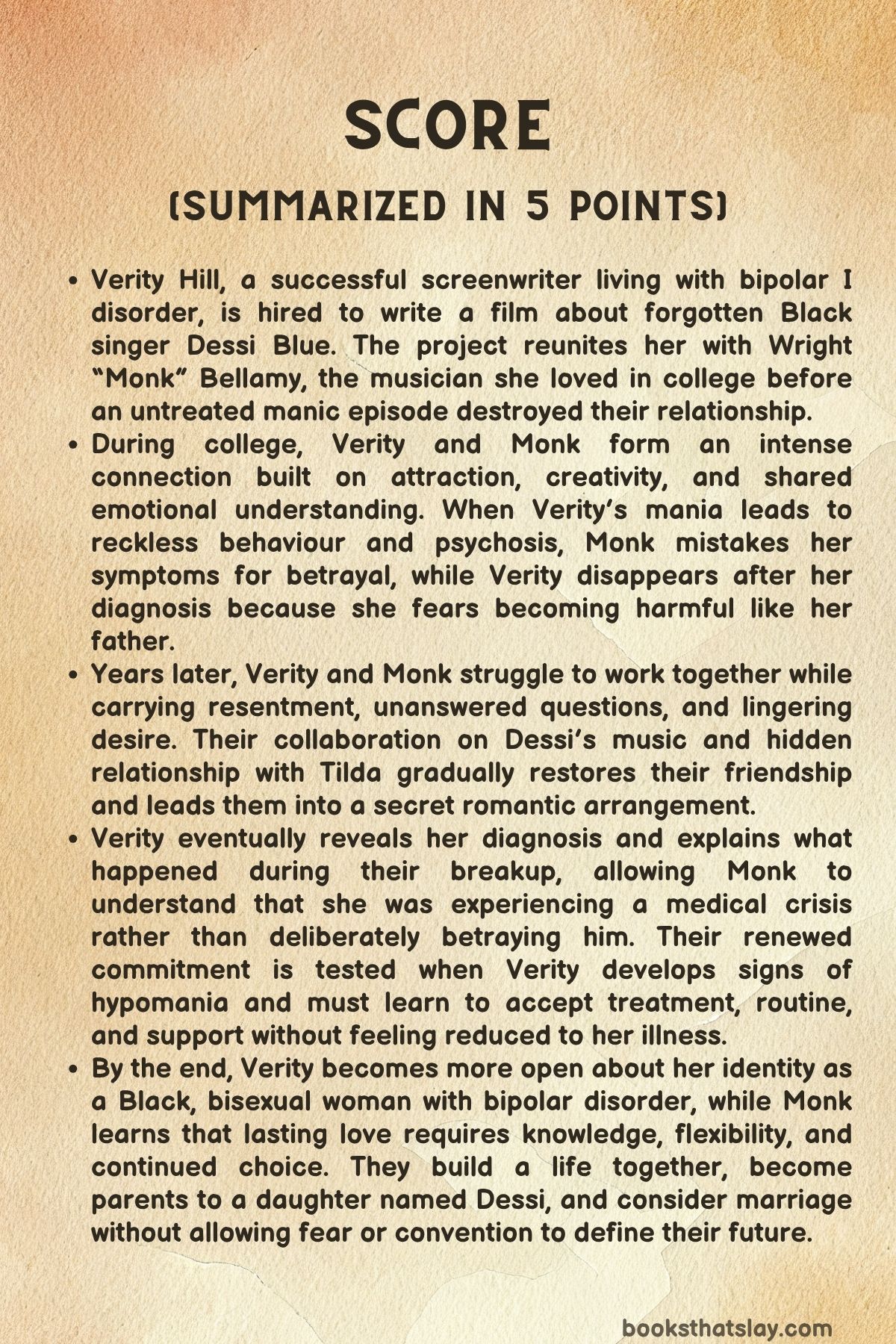
Summary
In present-day Los Angeles, successful screenwriter Verity Hill meets director Canon Holt and producer Evan Bancroft to discuss a prestigious film project. Canon wants to tell the story of Odessa “Dessi Blue” Johnson, a gifted Black singer whose career flourished in Europe after she emerged from the Harlem Renaissance but whose legacy has largely disappeared from public memory.
Verity’s academic background in African American history and her commitment to recovering forgotten Black stories make her ideal for the screenplay. She eagerly accepts until Canon reveals that composer Wright “Monk” Bellamy recommended her, bringing back memories of a passionate college relationship that ended with pain, confusion, and years of silence.
Verity first met Monk at Finley College in 2014 while attending one of his performances with her girlfriend, Petra. Monk’s talent, stage presence, and intense awareness of Verity created an immediate attraction between them, even though Verity and Petra were still involved in an open relationship.
Petra invited Monk to a party, where he and Verity discovered that their connection extended beyond physical desire. They spoke about art, family, sexuality, religion, grief, and the creative purpose that guided both their lives, recognizing in each other an unusual emotional and artistic understanding.
A consensual encounter involving Petra brought Verity and Monk physically close, but Monk quickly realized he could not treat his feelings casually. When Petra and Verity later ended their romantic relationship, Monk and Verity began spending time together and admitted that their attraction frightened them because it felt immediate, serious, and difficult to control.
Verity feared commitment because her parents’ marriage had been unstable and destructive. Monk feared betrayal because his pastor father’s affair had shattered his family, humiliated his mother, and convinced him that exclusivity and loyalty were essential foundations of love.
They agreed to enter a monogamous relationship and soon became deeply attached. Monk began imagining Verity as part of his future, while Verity found in him a sense of safety that challenged her habit of keeping emotional distance from others.
Unknown to Monk, Verity had previously experienced severe depression and had been prescribed antidepressants after leaving another university. Her aunts, Roz and Grace, remained concerned about her sleep, medication, finances, and emotional stability, but Verity believed their vigilance was unnecessary.
Over time, Verity began showing signs of mania. She slept very little, worked obsessively, spoke with unusual speed and confidence, felt intellectually invincible, spent tuition money on an expensive dress, and became increasingly impulsive and sexually uninhibited.
Monk noticed the changes but did not understand what they meant. When Verity interrupted an important studio session and behaved provocatively in front of his colleagues, he stopped her because her actions threatened his professional reputation, but Verity experienced his refusal as rejection and humiliation.
She left the studio and went to a bar, where she drank heavily, danced provocatively, exposed herself, and encouraged attention from several men. Petra recognized that Verity was behaving unlike herself and tried to help, but Verity responded with hostility and refused to leave.
Monk arrived after Petra called him and found Verity in a bathroom stall with a man named Carl, whose hand was beneath her dress. Although Verity had not had sex with Carl, the scene activated Monk’s deepest fears about betrayal, and he ended their relationship before hearing any meaningful explanation.
After the breakup, Verity’s mania developed into psychosis. Fixated on a sculpture called Flame, she became convinced that it represented a real fire threatening Monk and the college, broke into an exhibition building, removed much of her clothing, and attempted to destroy the sculpture’s protective case.
Campus police restrained her until Dr. Garrison recognized that she was experiencing a psychiatric emergency. Verity was hospitalized and diagnosed with bipolar I disorder, and doctors explained that her earlier depression, antidepressant treatment, lack of sleep, impulsivity, hypersexuality, elevated confidence, and psychosis formed part of the same condition.
The diagnosis also forced Verity to revisit the deaths of her parents. As a child, she had watched her father become intoxicated, paranoid, and violent during what was likely an untreated psychiatric episode, accidentally injuring her mother before returning to their burning house and dying in the fire.
Terrified that she might repeat her father’s harm, Verity decided not to contact Monk. She believed that disappearing would protect him from being trapped in a relationship defined by instability, even though leaving without an explanation allowed him to believe she had betrayed and abandoned him.
Years later, Verity and Monk briefly encountered each other in Harlem. Monk demanded answers, but Verity remained unable to reveal her diagnosis, and their conversation ended with anger, regret, and the understanding that neither had stopped caring.
In the present, their professional reunion begins badly. Monk still sees Verity as someone who broke their agreement and vanished, while Verity believes he deserves a life untouched by the risks associated with her condition.
Their shared devotion to Dessi Blue’s story gradually restores their ability to communicate. As Verity uncovers Dessi’s hidden relationship with her roommate Tilda, she and Monk collaborate on scenes, musical choices, and historical details that honour Black artists whose talent, sexuality, and influence were erased or diminished.
Creative partnership brings back their former ease. At a Halloween party, during film screenings, and on the set, they rediscover their intellectual compatibility, humour, attraction, and detailed knowledge of one another.
After kissing for the first time in twelve years, they agree to begin a private, casual, open sexual relationship. Neither truly wants emotional distance, but Monk still fears trusting Verity, while Verity uses the arrangement to avoid revealing the truth about her diagnosis.
Their supposedly casual connection quickly becomes domestic and exclusive. They share meals, spend nights together, discuss family wounds, support each other’s careers, and return to the emotional closeness that once made their relationship feel like home.
Monk begins repairing his relationship with his father, whose betrayal he has allowed to shape his adult ideas about trust. Their conversations about faith, responsibility, forgiveness, and music help Monk understand that acknowledging another person’s failure does not require remaining permanently imprisoned by it.
Conflict returns when Monk sees crew member Chris kissing Verity outside her cottage. He does not know that the kiss was unwanted, and his jealousy leads him to humiliate Verity publicly during a rehearsal by making pointed comments about infidelity.
Verity explains that Chris misread the situation and that she immediately rejected him. Monk admits that he no longer wants an open arrangement and asks for exclusivity, forcing Verity to recognize that they cannot build a future while she continues hiding the central truth of their past.
She finally tells him that she has bipolar I disorder. Verity describes her depression, mania, psychosis, hospitalization, family history, and belief that leaving him was an act of protection rather than indifference.
Monk is devastated to realize that Verity endured a medical crisis while he interpreted her behaviour only as betrayal. Once he understands the illness, the conflicting pieces of her actions begin making sense, and he rejects her belief that loving her would be a burden.
Their reconciliation becomes more secure because it is based on knowledge rather than assumptions. Verity also begins becoming more open about their relationship and considers whether greater honesty about her condition might free her from the fear that exposure will destroy her career.
Their progress is tested when Verity begins experiencing signs of hypomania around Valentine’s Day. She cooks excessively, sleeps very little, works at an intense pace, retrieves a shoe from a swimming pool in the middle of the night, and becomes extraordinarily energetic and creative.
Monk recognizes the symptoms and raises the subject carefully, but Verity initially feels watched and reduced to her diagnosis. Their argument reveals that Monk is not afraid of the illness itself; he is afraid that Verity will refuse to trust him when she needs support.
Verity later accepts that she is moving toward an episode. She also learns that her friend Tessa, who has stopped taking medication because of difficult side effects, has overdosed on sleeping pills and has a history of suicidal behaviour.
The crisis reminds Verity that friendship and partnership require people to remain present during difficult periods. She stays in New York with Tessa and Mel, resumes medication, protects her sleep, returns to therapy, and allows others to help her stabilize.
When Verity meets Monk in New York, she calls him the love of her life but admits that she fears marriage, parenthood, inherited illness, and the possibility of someone feeling trapped beside her. Monk releases his demand for a traditional future and promises to choose her without requiring marriage or children.
They agree to take life day by day while remaining committed and exclusive. Their relationship becomes a shared practice of honesty, flexibility, learning, and continued choice rather than a promise that illness or conflict will never return.
Months later, Verity and Monk are living together openly. Verity becomes more confident about disclosing her diagnosis professionally and begins viewing herself not as damaged, but as a Black, bisexual, bipolar woman entitled to ambition, accommodation, visibility, intimacy, and joy.
The completed film restores Dessi’s full history, including her lasting love for Tilda and her marriage to Cal. Dessi’s story shows that one life can hold more than one genuine love and that identities hidden by prejudice can still be recovered through careful historical storytelling.
Two years later, Monk and Verity are thriving personally and professionally. Their routines protect Verity’s health, Monk has repaired important family relationships, and both have accepted that their version of permanence does not need to resemble anyone else’s.
Verity eventually considers motherhood, and Monk assures her that they will face medical and emotional risks together. Two more years later, they have a daughter named Dessi, and Verity visits her parents’ graves for the first time since their deaths.
At the graveside, Verity forgives her father without denying the harm he caused and forgives herself for the illness and choices that once filled her with shame. She also decides that fear should not automatically take marriage away from her, allowing Monk to prepare the proposal he has patiently avoided forcing upon her.
When Verity asks what he would save in a fire, repeating a question from their youth, Monk holds her and their daughter close. His answer reveals that after years of loss, secrecy, separation, and rebuilding, the life they have created together is the only thing that truly matters.
Characters
The characters in Score are shaped by the conflict between the identities they show the world and the truths they are afraid to reveal. Their relationships demonstrate how artistic ambition, family history, sexuality, illness, race, faith, and public judgment influence the ways people give and receive love.
Verity Hill
Verity is a gifted screenwriter whose work is guided by a desire to restore overlooked Black people to cultural memory. Her intelligence, historical knowledge, curiosity, and creative discipline allow her to transform fragmentary records into emotionally complete lives without reducing those lives to simple symbols.
Within Score, Verity’s most difficult conflict is not merely managing bipolar I disorder but separating the condition from the shame she inherited through her father’s untreated illness. Because she associates psychiatric instability with violence, fire, death, and family destruction, she assumes that anyone who loves her will eventually become a victim.
Her decision to disappear from Monk’s life is therefore both loving and harmful. She believes she is protecting him, but by refusing to explain her condition, she denies him the opportunity to understand what happened or decide what risks he is willing to share.
Verity’s development depends on learning that privacy and secrecy are not always the same. She has the right to control personal medical information, yet emotional intimacy becomes impossible when fear prevents her from giving a committed partner the knowledge needed to understand her behaviour.
Her bisexuality is treated as a permanent part of her identity rather than something altered by the gender of her current partner. Verity refuses the assumption that a relationship with a man erases her attraction to women, and her work on Dessi and Tilda’s romance allows her to defend queer history as part of Black history.
Verity’s creativity also complicates her relationship with treatment. Elevated moods sometimes produce confidence, speed, imagination, and professional breakthroughs, making it difficult for her to separate artistic inspiration from symptoms that may eventually become dangerous.
By the end, she no longer defines stability as the elimination of every risk or unusual feeling. She accepts medication, therapy, sleep, boundaries, professional disclosure, and support while also refusing to describe her differently wired mind only as a defect.
Wright “Monk” Bellamy
Monk is a celebrated musician, composer, producer, and sound engineer whose relationship with music carries spiritual meaning. He experiences artistic creation as his clearest connection to faith, giving his work an emotional seriousness that matches Verity’s devotion to storytelling.
His father’s affair shapes his ideas about commitment long before he meets Verity. Watching his mother lose her marriage, social position, and support from the congregation convinces Monk that betrayal is not a private mistake but an act capable of damaging an entire family and community.
That history explains why he cannot initially interpret Verity’s behaviour with compassion. When he sees Carl touching her, Monk does not recognize illness because the scene reproduces the image that has governed his understanding of disloyalty since adolescence.
Monk’s pain is legitimate, but his interpretation is incomplete. His development requires him to understand that boundaries can remain important without turning past betrayal into a permanent lens through which every confusing situation is judged.
He also struggles with the difference between protection and control after learning about Verity’s diagnosis. His concern about her sleep is reasonable, but Verity’s reaction teaches him that support must preserve her authority over her own body and mind.
Monk’s love becomes mature when he stops believing devotion can solve illness or guarantee a conventional future. He chooses education, flexibility, patience, and presence, accepting that commitment means responding to reality rather than demanding that reality conform to his original expectations.
Canon Holt
Canon is an acclaimed director whose decision to make a film about Dessi Blue reflects his commitment to neglected Black history. He recognizes that recovering such a life requires collaborators who understand not only cinema but also the cultural conditions that caused the artist’s erasure.
His treatment of Verity after learning about her bipolar disorder is especially significant. Rather than withdrawing the opportunity or responding with pity, Canon evaluates her talent, preparation, perspective, and honesty while considering how the production can support her.
Canon also serves as a quiet observer of Verity and Monk’s unresolved history. He sees their hostility, creative compatibility, and attraction before they are willing to admit how strongly their past remains present.
His relationship with Neevah expands his understanding of chronic illness. Watching her struggle with lupus helps him recognize the fear that talented people experience when disclosure may cause others to treat them as liabilities.
Dessi Blue
Dessi is the historical artist at the centre of the film Verity is writing. Although she exists primarily through reconstructed scenes, letters, memories, and research, her life provides a parallel narrative about ambition, identity, love, and historical erasure.
She begins as a talented young Black woman shaped by religious and social restrictions but gradually discovers communities in which queerness, artistic freedom, and self-definition become possible. Her encounter with performers such as Gladys Bentley challenges what she has been taught about women loving women.
Dessi’s relationship with Tilda is genuine, formative, and lasting, even though public prejudice prevents it from receiving open recognition. Her later marriage to Cal is also real, showing that one love does not automatically cancel another.
Her career abroad reflects the unequal treatment of Black artists in the United States. Europe offers opportunities and forms of dignity that her own country frequently withholds, but success also creates distance from the people and places connected to her earlier life.
Tilda Hargrove
Tilda is initially treated by history as Dessi’s roommate, but Verity’s research reveals that she was one of Dessi’s great loves. Her restoration transforms the film because it corrects an erasure created by racism, homophobia, and the tendency to simplify important women’s private lives.
Tilda is more cautious than Dessi because she understands the dangers facing two Black women in a concealed queer relationship. She knows that affection cannot protect them from legal, professional, familial, or social consequences.
Her gift of the ballerina music box becomes a symbol of memory and continued presence. Even when Dessi travels with Cal and builds another life, the music box preserves the emotional truth that Tilda remained part of her inner world.
Cal
Cal is Dessi’s musical partner and eventual husband. He understands the possibilities available to Black performers outside the United States and views Europe as a place where their talent may receive greater respect.
His most important quality is his acceptance of Dessi’s continuing love for Tilda. Instead of treating her past as a threat to their marriage, he recognizes that a meaningful life may contain more than one defining relationship.
Cal’s response rejects possessive ideas about love. He does not need to erase Tilda to confirm his own importance, allowing Dessi’s emotional history to remain complex and complete.
Petra
Petra is Verity’s girlfriend when she first meets Monk. Confident in her polyamorous identity, she recognizes Verity’s attraction before Verity fully admits it and creates the circumstances that allow Verity and Monk to explore their connection.
She is not presented as deceptive or careless. Petra establishes boundaries, values communication, and later ends her relationship with Verity honestly because she wants a form of polyamory that Verity does not share.
Petra also recognizes Verity’s manic behaviour before Monk understands it. Her attempt to remove Verity from the bar shows that their romantic relationship may have ended, but her concern and sense of responsibility remain.
Aunt Roz
Roz helps raise Verity after the deaths of her parents and becomes one of the central sources of stability in her life. Her protectiveness comes from direct knowledge of the family tragedy and an understanding that Verity’s earlier depression was serious.
Her questions about medication, money, sleep, and health sometimes feel intrusive to Verity. However, Roz’s vigilance is rooted in experience rather than a belief that Verity is incapable.
She also represents family continuity. Even when Verity resists being monitored, Roz remains part of the network that makes recovery, education, and long-term stability possible.
Aunt Grace
Grace shares responsibility for raising Verity and supporting her through education, hospitalization, treatment, and adulthood. Like Roz, she balances affection with anxiety, sometimes struggling to know where care ends and excessive supervision begins.
Her presence reinforces the idea that family can be created through sustained responsibility rather than traditional structure. Verity’s survival after losing her parents depends greatly on the home, financial help, and emotional protection her aunts provide.
Grace also participates in family conversations about partnership and children. These discussions pressure Verity at times, but they eventually help her consider whether fear has caused her to reject possibilities she may genuinely desire.
Will Hill
Will is Verity’s father, remembered as loving, creative, troubled, and dangerous. His untreated mental illness, alcohol use, paranoia, jealousy, and refusal of help contribute to the violent night that ends with both parents’ deaths.
His character is important because Verity spends much of her life fearing that diagnosis creates destiny. She believes that sharing aspects of his condition means she may also become destructive, especially toward those she loves.
The novel does not excuse Will’s actions through illness. Instead, it allows Verity to develop compassion for his suffering while maintaining that he remained responsible for seeking treatment and preventing harm.
Bernadette Hill
Bernadette is Verity’s mother, whose death becomes inseparable from Verity’s understanding of romantic love. She tries to calm Will, urges him to seek help, and becomes the victim of his physical instability during their final argument.
For Verity, Bernadette represents the person who loved someone ill and paid an unbearable price. This memory fuels Verity’s fear that Monk will eventually become another partner harmed by devotion.
As Verity heals, she begins to understand that her parents’ marriage is not the only possible model for loving someone with bipolar disorder. Bernadette’s tragedy remains real, but it no longer determines every choice Verity makes.
Dr. Garrison
Dr. Garrison intervenes during Verity’s psychotic crisis at Finley. While campus police respond to Verity primarily as a disruptive or dangerous person, Dr. Garrison recognizes that she requires medical care, dignity, and calm communication.
Covering Verity’s exposed body and preventing criminal charges are acts of practical compassion. The intervention demonstrates how informed authority can change the outcome of a psychiatric emergency.
Without Dr. Garrison, Verity’s illness might have been treated as misconduct alone. The character therefore exposes the importance of recognizing symptoms before punishment intensifies a crisis.
Dr. Simmons
Dr. Simmons helps Verity understand her bipolar I diagnosis during hospitalization. The doctor connects Verity’s depression, antidepressant use, lack of sleep, elevated confidence, impulsive spending, sexual risk-taking, rapid thoughts, and psychosis into a coherent medical explanation.
This explanation offers clarity but also produces terror because Verity immediately connects herself to her father. Dr. Simmons gives her language for what happened, though emotional acceptance will require years of therapy and lived experience.
Dr. Palmer
Dr. Palmer is Verity’s therapist and one of the strongest voices challenging the logic created by trauma. Rather than allowing Verity to use her parents’ marriage as proof that love and bipolar disorder must end disastrously, she distinguishes Verity’s circumstances, treatment, choices, and support system from her father’s.
She also challenges Verity’s habit of making decisions for Monk. By insisting that Monk deserves the right to decide whether he can share Verity’s reality, Dr. Palmer frames disclosure as an issue of trust rather than shame.
Her guidance remains balanced. She does not romanticize illness or commitment, but she refuses the assumption that difficulty makes a stable, loving partnership impossible.
Tessa
Tessa is one of Verity’s closest friends and also lives with bipolar disorder. Her frustration with medication side effects shows why treatment adherence can be emotionally and physically complicated rather than a simple matter of responsibility.
When Tessa stops taking medication, her condition worsens, and she overdoses on sleeping pills after struggling to obtain immediate help. Her crisis reveals the dangerous consequences of isolation, depression, and the belief that one must manage everything alone.
Tessa’s experience also helps Verity recognize her own warning signs. Their friendship becomes a model of mutual support in which neither woman is reduced to a patient and both remain responsible for participating in treatment.
Mel
Mel is the practical and protective member of Verity and Tessa’s friendship group. She cares deeply for Tessa but admits that living near constant instability has exhausted her and caused her to withdraw into a new romantic relationship.
Her honesty prevents the book from presenting support as effortless. Loving someone during a psychiatric crisis can involve fear, resentment, fatigue, and mistakes, even when affection remains strong.
Mel’s decision to return and help Tessa shows that temporary withdrawal does not have to become abandonment. She accepts responsibility for her absence without claiming responsibility for causing Tessa’s illness or overdose.
Neevah
Neevah is the actress chosen to portray Dessi and a talented performer living with lupus. Her kidney failure interrupts production and reveals how easily people with chronic conditions may be judged as unreliable when institutions fail to consider accommodation.
She serves as an important parallel to Verity. Both women fear that disclosure will cause professional decision-makers to see diagnosis before talent, preparation, or ambition.
Neevah’s determination encourages Verity to become more open about bipolar disorder in her own career. Their conversations affirm that illness can alter working conditions without eliminating a person’s right to opportunity.
Monk’s Father
Monk’s father is a pastor whose affair destroys his marriage and damages the trust of his children. His failure is intensified by the congregation’s willingness to forgive him while leaving Monk’s mother socially isolated.
He becomes the source of Monk’s rigid ideas about betrayal, but he is not frozen permanently in the role of villain. Years later, he acknowledges his wrongdoing, speaks honestly with Monk, and asks his son to reconsider the past from an adult perspective.
Their shared music allows communication before full reconciliation is possible. His advice about signs, faith, and openness helps Monk prepare emotionally for Verity’s eventual disclosure.
Monk’s Mother
Monk’s mother is the person most directly harmed by her husband’s affair and by the church community’s response. Her dignity and restraint deeply influence Monk, who remains angry that she carried the consequences while his father retained his position.
She does not demand that Monk preserve anger on her behalf. Her choice not to divide the congregation complicates his belief that remaining unforgiving is the only way to honour her pain.
Her later family life demonstrates that betrayal does not end the possibility of renewal. She eventually shares family space with her former husband without surrendering the new life she has built.
Charlie and Shrieva
Charlie and Shrieva are Monk’s siblings, whose continued relationships with their father and church create conflict within the family. Monk sees their choices as disloyal to their mother, while they regard his distance as another form of family abandonment.
They reveal how the same event can produce different survival strategies. Monk responds through separation and moral certainty, while his siblings remain connected to the structures that wounded their family.
Their eventual participation in a more peaceful family gathering shows that reconciliation does not require everyone to interpret the past identically. It requires boundaries, accountability, and a willingness to share space without denying what happened.
Sheila
Sheila is Verity’s agent and an important professional safeguard. She understands the demands of the entertainment industry and pushes Verity to remain visible even when depression makes public participation exhausting.
During Verity’s hypomanic pitch, Sheila recognizes that the conversation is becoming unmanageable and intervenes without humiliating her. Her response protects both the project and Verity’s professional reputation.
Sheila represents informed workplace support that remains focused on competence. She does not treat Verity as incapable, but she notices when assistance is required and acts decisively.
Chris
Chris is a crew member who develops an attraction to Verity and misinterprets her friendliness as romantic interest. His unwanted kiss creates the misunderstanding that forces Monk and Verity to confront the dishonesty within their supposedly open arrangement.
Verity clearly states that she did not consent, while also recognizing that Chris seriously misread the situation rather than planning to harm her. The scene maintains the importance of boundaries without removing all distinction between different intentions and actions.
Chris functions mainly as a catalyst. His mistake exposes Monk’s jealousy, Verity’s instinctive belief that she is already committed, and the impossibility of continuing their relationship without complete honesty.
Jill
Jill is an assistant director who becomes Verity’s friend on set. Observant and direct, she quickly recognizes the emotional tension between Verity and Monk and encourages Verity to participate more fully in the social life of the production.
Her friendship offers Verity a connection not built around illness or past trauma. Jill knows her primarily as a colleague and creative partner, giving Verity space to inhabit an identity beyond patient, survivor, or romantic partner.
Her delighted reaction after discovering Verity and Monk’s relationship adds warmth to their decision to stop hiding. She represents a community capable of responding to personal truth with uncomplicated acceptance.
Evan Bancroft
Evan is Canon’s producing partner and helps create the professional environment in which the Dessi Blue film is developed. Although less central emotionally, his presence reinforces the collaborative nature of filmmaking.
He is also connected to Arietta, whose early flirtation with Verity briefly relieves the tension before Verity learns that Monk will be involved. Evan’s role remains primarily practical, supporting Canon’s vision and the production’s organisation.
Arietta
Arietta is Evan’s stepsister and openly expresses attraction to Verity during the initial meeting. Her confidence establishes Verity’s bisexuality naturally before the central romantic conflict begins.
Although her role is brief, she helps show that Verity’s attraction to women remains active and acknowledged. This prevents the later relationship with Monk from being presented as a replacement for or correction of her queerness.
Meekah
Meekah is a woman Monk previously dated and someone who quickly recognizes Verity as the person he never fully left behind. Her observations expose the weakness in Monk’s claim that he feels only anger toward his former lover.
She does not become a conventional romantic rival. Instead, she functions as an outside observer who sees that Monk’s resentment remains powerful because his love has never entirely disappeared.
Olivia
Olivia expresses romantic interest in Monk and asks Verity insensitive questions about bisexuality. Her confusion allows Verity to explain that attraction to more than one gender remains valid regardless of the person she is currently dating.
Monk briefly responds to Olivia’s attention after seeing Chris kiss Verity, but he recognizes that using her to inspire jealousy would be unfair. Olivia therefore becomes another figure through whom the couple’s failed open arrangement and unresolved possessiveness are exposed.
Themes
Mental Illness, Identity, and Personal Responsibility
Score treats bipolar disorder as a serious medical condition without presenting it as the complete explanation for Verity’s personality, creativity, sexuality, or choices. Her mania includes exhilaration, reduced sleep, racing thoughts, impulsive spending, hypersexuality, professional confidence, and eventual psychosis, while her depression produces exhaustion, withdrawal, shame, and difficulty completing basic tasks.
The book also rejects the idea that illness removes all responsibility. Verity is not morally condemned for symptoms beyond her control, but long-term stability still requires medication, sleep, therapy, routines, honesty, and early responses to warning signs.
This distinction becomes especially clear through the contrast between Verity and her father. Will may have experienced an undiagnosed psychiatric condition, but his illness does not erase the harm caused by alcohol, violence, refusal of help, and dangerous behaviour.
Verity’s growth depends on accepting that she shares a diagnosis without sharing his destiny. She can acknowledge her differently wired mind as part of her identity while also taking responsibility for managing the risks associated with it.
Tessa’s experience adds complexity by showing why people may stop medication when side effects flatten emotion, desire, or creativity. The consequences remain serious, but the decision is presented as a difficult struggle rather than simple irresponsibility.
Love as Knowledge, Choice, and Continued Support
Verity and Monk’s early relationship is intense, passionate, and sincere, but intensity alone cannot protect it. Their first love fails because neither possesses the knowledge needed to interpret Verity’s behaviour, and Verity later allows shame to replace communication.
Their reunion shows that sustainable love requires more than desire or forgiveness. Monk must learn about bipolar disorder, Verity must reveal the history she has hidden, and both must discuss how support can exist without turning into control.
The novel repeatedly questions whether loving someone means rescuing them. Monk cannot eliminate Verity’s illness, Verity cannot guarantee that Monk will never feel afraid, and neither can promise that future episodes will not challenge their relationship.
What they can promise is honesty, education, boundaries, treatment, flexibility, and presence. Their commitment becomes credible when Monk stops demanding a predetermined future and Verity stops deciding on his behalf that her life is too difficult to share.
The final family they create is therefore not evidence that love has cured Verity. It demonstrates that vulnerability and uncertainty do not cancel the possibility of partnership, parenthood, ambition, stability, or joy.
Historical Erasure and the Recovery of Black Queer Lives
The Dessi Blue film allows the story to examine who receives cultural recognition and who is reduced to a footnote. Dessi’s professional achievements, relationship with Tilda, marriage to Cal, and life in Europe have been simplified because historical institutions often ignored experiences that did not fit acceptable public narratives.
Verity’s writing restores complexity rather than replacing one incomplete version with another. Dessi is allowed to love a woman and a man without either relationship being declared false, secondary, or incompatible with the other.
The references to Gladys Bentley, Hazel Scott, Slim Gaillard, integrated performance spaces, and Black expatriate communities place Dessi within a larger cultural world. These figures represent artists whose talent was affected by racism, homophobia, political suspicion, exploitation, or limited control over their public images.
Recovering Tilda as Dessi’s lover also shows how queer relationships disappear when documents are interpreted through heterosexual assumptions. A woman described as a roommate may have been a central emotional partner whose importance was deliberately concealed or carelessly overlooked.
For Verity, restoring these lives is both historical and personal. As a Black bisexual woman, she understands that visibility creates belonging and that accurate storytelling can return dignity to people denied the ability to describe themselves openly.
Fire, Creativity, Destruction, and Renewal
Fire carries several meanings throughout the novel. It is first associated with the deaths of Verity’s parents, her father’s instability, the destruction of home, and the belief that powerful love eventually consumes everyone near it.
The Flame sculpture becomes a focus for Verity’s trauma before and during her manic episode. What appears to others as art becomes, within her psychosis, an active danger that must be destroyed to save Monk and the campus.
This moment shows how unresolved trauma can transform symbolic fear into perceived reality. Verity is not simply responding to the sculpture itself but to everything fire represents in her memory: helplessness, parental violence, mental illness, guilt, and irreversible loss.
Artistic creativity contains a similar dual quality. Verity and Monk experience writing and music as sources of meaning, spiritual connection, pleasure, and cultural restoration, yet Verity’s periods of elevated creativity can also accompany dangerous reductions in sleep and judgment.
The closing image changes fire from an emblem of destruction into one of informed devotion. Love remains intense, but wisdom, treatment, honesty, experience, and patience give that intensity a form capable of warming rather than consuming.
When Monk answers that Verity and their daughter are what he would save, fire no longer controls their future. It becomes the question through which they measure the home, family, and trust they have consciously built.