90 Miles to Havana Summary, Characters and Themes
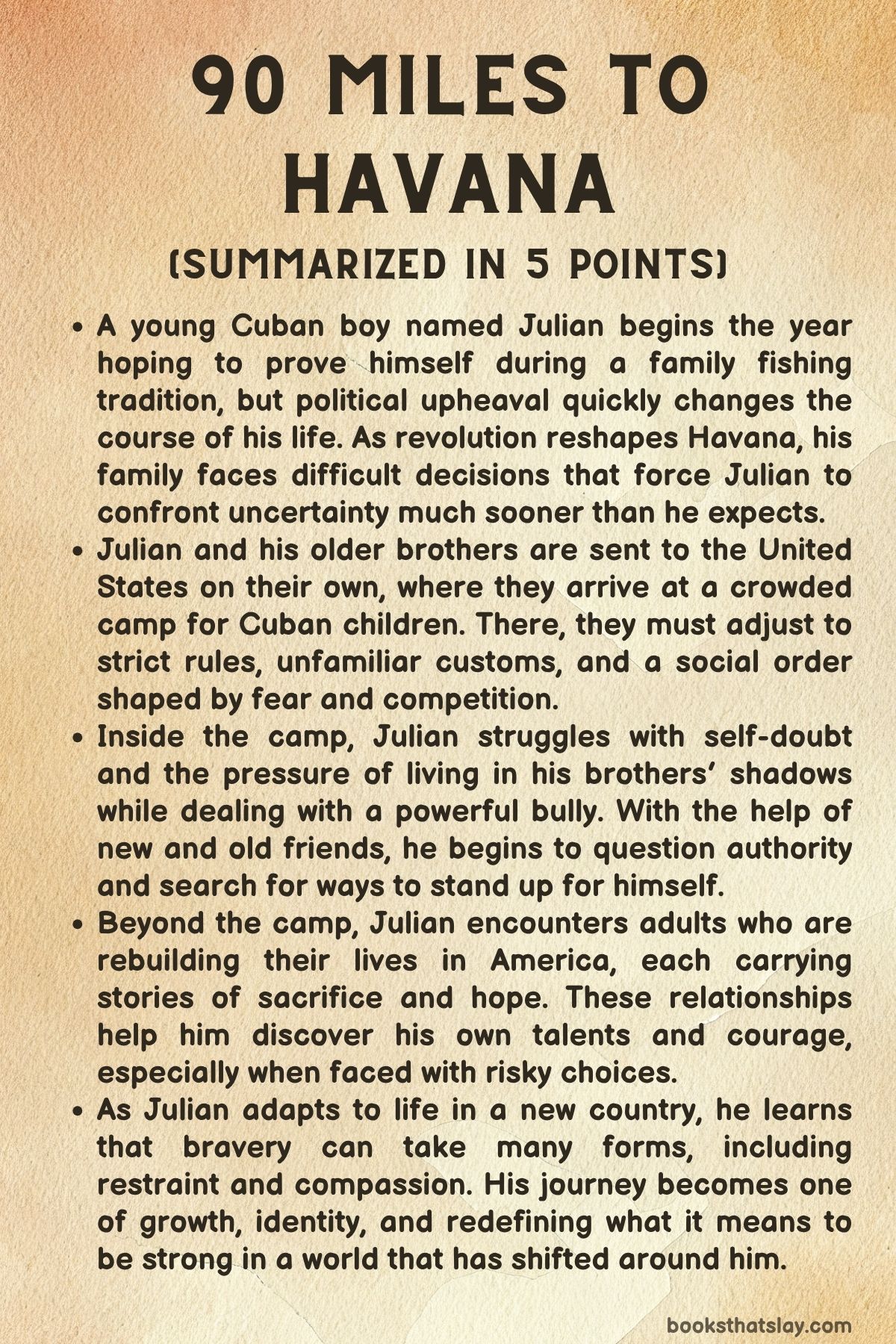
90 Miles to Havana by Enrique Flores-Galbis is a middle-grade historical novel about a Cuban boy, Julian, whose life changes overnight when Fidel Castro comes to power. On New Year’s Eve in Havana, Julian is focused on small hopes—family rituals, pride, proving himself—but the revolution turns those hopes into urgent choices.
When Julian and his older brothers are sent to the United States without their parents, he lands in a crowded camp where kids must survive on their own and bullies set the rules. Julian’s talent for fixing things, his sharp observations, and his growing courage guide him through loss, loyalty, and the hard work of becoming his own person.
Summary
Julian is a young boy growing up in Havana, Cuba, close to the sea and surrounded by family, neighbors, and routines that make life feel steady. On New Year’s Eve, he goes fishing with his father, his two older brothers Gordo and Alquilino, their family friend Bebo, and their neighbor Angelita.
The family believes that catching a big fish brings good luck for the whole year. Julian begs to take his father’s place in the fishing chair and finally gets the chance to prove himself.
He feels a bite and tries to handle it alone, desperate to be the hero for once, but the fish gets away. He is embarrassed and angry at himself, and the failure stays in his head as the night unfolds.
The celebration at the dock is interrupted by gunfire and shouting in the streets. Batista has fled, and people flood Havana celebrating the revolution.
Julian’s parents react with fear and unease, and Julian senses that the world he knows is shifting. The next morning, Julian pushes Bebo to explain what a revolution really is, because Bebo speaks plainly and treats him with respect.
Bebo compares revolution to making an omelet: first there are whole eggs, then everything gets cracked and messy, and afterward a new dish appears that some people will love and others will hate—but nothing returns to what it was.
Changes come quickly. Julian sees lines for food, supplies, and passports, and even lines of parents trying to send their children away.
Angelita’s family, the Garcias, announce they are leaving for Miami. Soldiers and a government inspector show up to control what they can take, and the inspector’s attitude is cruel.
When Angelita is forced to surrender a necklace, she throws it against the wall rather than hand it over politely. After the family leaves, the house is sealed by authorities, and everyone knows that entering it is dangerous.
Julian’s mother realizes her treasured gold swallow pin—an heirloom—was never returned after New Year’s Eve. Julian’s brothers begin sneaking into sealed houses, and Julian begs to join them when they plan to enter the Garcias’ home to search for the pin.
The break-in is tense: the inspector’s son follows them, and the boys barely avoid being caught. Julian and Alquilino race home and stage their room so it looks like they have been asleep.
Gordo returns with the pin, and Julian places it where his mother will find it. The small victory feels like proof that they can still protect something of their old life.
But danger keeps closing in. Gordo’s impulsive anger leads him to hit the inspector’s son with an almond.
Soon the inspector storms into their home, accusing the boys of crimes and threatening punishment. She also spots pork chops Julian’s mother obtained by trading valuables, and she warns that black market food is illegal.
Then she escalates the threat: the boys could be sent to a government “reeducation” school. Julian’s mother knows what that can mean—hard labor and indoctrination—and she decides the only way to keep her sons safe is to send them to the United States without their parents.
The decision happens fast. The boys pack a single suitcase, hide the gold swallow pin in a secret compartment, and head to the airport with forged papers.
Julian is terrified when guards separate him for a search, convinced they will discover the pin and stop everything. After a tense delay, the family gets through.
Julian’s father gives him a box of cigars to sell if needed, and tells him the lost fish was not Julian’s fault. Julian watches Cuba disappear beneath the plane, leaving behind everything familiar, including his parents.
In Miami, the boys are met by a man named Jorge and taken to Camp Kendal, a crowded camp for Cuban children. It is not what Julian expected.
The dorms are packed, the air smells like a hospital, and their assigned sleeping space is a bathroom. A boy from their past—Romeo, who demands to be called Caballo—has become a camp enforcer, protected by a priest who relies on him to keep order.
Caballo humiliates and intimidates newcomers, especially Gordo, and Julian quickly understands that power in the camp belongs to whoever can scare others into submission.
Julian finds comfort when he discovers Angelita and her little brother Pepe are also in the camp. Angelita explains that the camp is not just a waiting place for parents; many kids are sent on to foster care or orphanages.
She warns Julian that Caballo is dangerous and will punish anyone who challenges him. Julian tries to adapt using a trick Bebo taught him: when fear rises, focus on what is outside of you—count, observe, measure—so panic does not take over.
The boys are put to work in the kitchen by a large American cook named Dolores, who speaks in a hard-to-understand accent and believes the boys must learn to work like everyone else. Julian writes letters home but is careful not to reveal how harsh the camp is, because he fears his parents would risk everything to reach them.
Then the director delivers crushing news: Gordo and Alquilino are being sent to an orphanage in Denver, while Julian will go to one in Chicago. The brothers refuse to be separated and claim an uncle will sponsor them, even though it is a lie.
They forge a letter and bribe a boy in the office with stolen cereal so he will type it.
Camp life becomes a constant test of pride and survival. Caballo forces himself into a baseball game, and Gordo is tempted to humiliate him publicly.
Angelita urges caution. Gordo chooses to let Caballo hit a home run, trying to avoid retaliation, but Caballo still lashes out when he hears Julian quietly defend Gordo’s skill.
Caballo grabs Julian and takes his drawing book as a trophy, and a chaotic fight erupts among the children. The director blames Julian’s group and threatens once again that they will be sent away.
Angelita negotiates with Caballo: if Julian gives Caballo the drawing book publicly, Caballo will convince the director to keep the brothers together. Julian hates the bargain because it rewards bullying, but he fears separation even more.
He gives the book up. For a moment, Caballo’s behavior softens, and Julian hopes the deal worked.
Then Caballo posts the weekend pass list: only Gordo and Alquilino are allowed to go into the city. Julian realizes too late that something is wrong.
His brothers leave in a car with suitcases in the back, and they never return. Julian’s fear becomes real: Caballo’s promise was a trap, and Gordo and Alquilino are gone.
Julian’s grief turns into determination. Angelita takes him through a hidden tunnel to work picking tomatoes so he can earn money and understand what struggle looks like beyond camp fences.
There Julian meets Tomas, an inventive man who built a tomato-sorting machine called the Toma-Tron. Tomas reminds Julian of Bebo: resourceful, creative, and unafraid to improvise.
Julian fixes a mechanical problem using a small trick, impressing Tomas. When Caballo catches Julian returning through the tunnel, he extorts money and shoves Julian to the ground, laughing.
Julian feels ashamed of his fear, but the shame also pushes him toward change.
Dolores notices Julian’s pain and tells him Caballo is like a dictator—no one voted him in. She encourages Julian to handle the problem “the democratic way.” Julian and Angelita begin organizing kids to resist Caballo.
At first, they plan pranks, and the laughter helps kids feel brave again. The pranks escalate into a cafeteria rebellion where the children sing and throw food, and Julian recognizes the same wild release he saw in Havana during the revolution.
The director responds by punishing everyone, cutting privileges, and rewarding Caballo and his friends. Another prank dyes Caballo red in the pool, and the backlash is harsher.
Julian and Angelita shift tactics. They start collecting signatures, money, and phone numbers, planning petitions and calls to people with power.
Julian draws pictures to trade for donations. Caballo discovers the petition, smashes Julian’s art supplies, and tells him he will be sent away the next day.
Julian freezes in fear again, then decides he cannot wait for fairness that may never come. He returns to an older idea: direct action.
Julian sabotages Caballo’s bunk so it collapses, then locks Caballo in place with chains and padlocks. As kids laugh, Julian tells Caballo they are even.
Then Julian alters the weekend pass list, adding his name and Angelita’s. They get into the car to Miami before Caballo can stop them.
Julian plans to run to Tomas’s boat and escape the camp system entirely.
In Miami, they reach Tomas, who takes Julian in. Angelita chooses to return to camp, hoping to be placed with Pepe’s foster family.
Julian stays and works with Tomas, helping repair the boat and earning money through odd jobs, selling Tomas-ade, and drawing. Julian learns the city’s rules are different from camp’s, but danger still exists—especially in the form of a cop named Ramirez, who watches for runaway kids.
Julian also meets Lucia, a Cuban girl living unhappily in foster care, who survives by selling woven hats and drawing for tourists. Julian begins to see that “safety” in America can still come with loneliness and suspicion.
Tomas reveals his secret plan: he intends to sail back to Cuba to rescue his parents and others who cannot escape. Julian begs him to include Julian’s parents too, and Tomas agrees, though he warns how risky it is.
Julian tries to contact his parents and instead reaches the same hostile government-linked woman from Havana, who claims Julian’s parents are gone and offers no help. Julian manages to send a coded message through Bebo, hoping it reaches his family.
As the departure date approaches, problems mount. Tomas’s friend Dog steals Tomas’s compass, jeopardizing the trip.
Tomas considers giving up, but Julian offers his mother’s gold swallow pin to pawn for money. Tomas accepts, and they prepare to sail.
Ramirez catches up and claims Julian’s mother is waiting in Connecticut. Julian believes the possibility but still chooses to continue the mission, deciding he can reunite with his family afterward.
On the open water, Julian proves how much he has grown. He keeps the boat running with constant repairs and quick thinking, using what Bebo taught him and his own inventions.
In the dark, Julian guides the boat through a hidden channel and gets them safely to Havana’s dock. People arrive to board, including Tomas’s parents.
A man on the dock hesitates, afraid of being seen helping. When danger approaches, he finally jumps aboard.
Julian also reunites briefly with Bebo, who refuses to leave because he believes in the new Cuba, even if Julian does not. The choice breaks Julian’s heart, but he understands that people can want different futures.
Near Key West, the engine dies completely, but the coast guard finds them because Armando alerted authorities, chasing attention and opportunity. Julian returns to Camp Kendal long enough to collect his belongings and learn what happened: Caballo has been sent to the same Denver orphanage as Gordo and Alquilino, where he is no longer feared.
Julian learns his brothers are now with their mother in Connecticut, and Julian travels there alone, no longer the boy who needed someone else to lead.
In Connecticut, Julian reunites with his mother and brothers, but the reunion is complicated. Julian has changed, and part of him feels guarded, as if he has built a protective shell.
His mother immediately searches for the swallow pin, desperate because Julian’s father is still trapped in Cuba. Julian admits he gave the pin to Tomas for the rescue mission, and his mother is devastated—until the pin arrives later in a package from Tomas.
Relief replaces anger, and the family finally recognizes what Julian did and who he has become.
Julian starts school in America, where he feels out of place and struggles to speak. A bully approaches, and Julian nearly fights, but he stops when he recognizes fear in the bully’s face and chooses a different ending.
With help from a classmate named Darlene, Julian makes a small peace with the bully, Chuck, by offering a handshake. At home, the family celebrates the pin’s return and their new life, even as Julian’s father remains separated from them for now.
Listening to news about astronauts in orbit, Julian feels something open up inside him: the sense that, after everything he has lost and learned, he can still step forward into a new beginning.
Characters
Julian
Julian is the emotional and moral center of 90 Miles to Havana, and the story traces his movement from insecurity to self-awareness. At the beginning, he is desperate to prove himself, especially in comparison to his older brothers.
Losing the big fish on New Year’s Eve becomes a symbol of his self-doubt, and he internalizes blame for events far beyond his control. Throughout his time in Cuba, the camp, and Miami, Julian constantly struggles with fear—fear of failure, fear of bullies, fear of losing his family.
What distinguishes him is not an absence of fear but his growing ability to think through it. He uses observation, logic, and mechanical skill as tools to steady himself.
His talent for fixing things mirrors his deeper desire to repair broken situations—his family’s separation, the injustice at camp, and Tomas’s damaged boat. By the end, Julian learns that strength does not always mean domination; sometimes it means restraint, compromise, or walking away from violence.
His growth is visible not only in his daring rescue at sea but in his quieter choice to offer a handshake to a bully rather than strike him.
Gordo (Eduardo)
Gordo, whose real name is Eduardo, embodies impulse and physical courage. He reacts quickly and emotionally, whether firing an almond at the inspector’s son or confronting Caballo directly.
His anger is often rooted in loyalty; he cannot tolerate unfairness toward his family or humiliation from others. However, his temper repeatedly escalates danger, helping trigger the chain of events that leads to the boys being sent away.
In the camp, Gordo’s instinct is to challenge Caballo openly, which only fuels the rivalry. Yet Gordo is not reckless without thought.
When he allows Caballo to hit a home run during the baseball game, he demonstrates an unexpected maturity, choosing long-term safety over short-term pride. His protective nature remains strong even in Connecticut, where he insists on walking Julian to the bus stop and promises to defend him.
Gordo’s journey suggests that bravery must be tempered by judgment, and that learning restraint is as important as learning to fight.
Alquilino
Alquilino represents strategy and quiet intelligence. Unlike Gordo, he pauses before acting and weighs consequences carefully.
He is often the planner behind the brothers’ schemes, from sneaking into the sealed house to forging the sponsorship letter at camp. His calm demeanor provides balance within the trio, and he frequently mediates between Gordo’s aggression and Julian’s uncertainty.
Alquilino understands systems—how authority works, how paperwork can be manipulated, how power structures function in the camp. His decision to fabricate a letter to delay their separation shows both creativity and desperation.
Although the plan ultimately fails, it highlights his belief that problems can be solved through wit rather than force. Alquilino’s strength lies in analysis and foresight, qualities that complement Julian’s inventiveness and Gordo’s boldness.
Angelita
Angelita is perceptive, pragmatic, and emotionally steady. She has already begun to see the complexities of revolution and exile before Julian fully grasps them.
In Cuba, her act of throwing the necklace against the wall reveals her refusal to submit quietly to humiliation. At camp, she becomes a voice of realism, explaining to Julian that the camp is not a simple waiting room but a transitional space where children are redistributed into unknown futures.
Angelita consistently pushes Julian to think beyond anger. When he wants to confront Caballo directly, she encourages strategy.
When pranks escalate, she advocates for more structured resistance. She understands the psychology of bullies, comparing Caballo to a snake that appears more dangerous than it is.
Her decision to return to camp instead of staying in Miami reflects her sense of responsibility to her brother Pepe. Angelita’s influence on Julian is profound; she helps him see that leadership can be thoughtful rather than explosive.
Caballo (Romeo)
Caballo serves as a representation of authoritarian power within the microcosm of the camp. Once a classmate known as Romeo, he reinvents himself as Caballo to project strength and erase vulnerability.
His authority depends on fear, favoritism, and the support of adults who prefer order over justice. Caballo’s cruelty stems from insecurity; he craves recognition and control in a setting where all children feel displaced.
He manipulates situations, such as separating Julian from his brothers after pretending to help them. His demand for public submission through Julian’s drawing book underscores his obsession with image and dominance.
Yet when transferred to the orphanage in Denver, he loses that constructed authority and hides behind others to avoid being bullied. This shift exposes the fragility of his power.
Caballo illustrates how unchecked authority can mirror larger political systems, and how quickly such authority collapses when the structure supporting it disappears.
Tomas
Tomas is a mentor figure who bridges Julian’s past and future. Like Bebo, he is inventive and mechanically gifted, building machines from scraps and repairing engines through intuition.
Tomas carries both courage and regret; his escape from Cuba was enabled by his father’s secret sacrifice, and he now seeks to repay that act by rescuing others. His plan to sail back to Havana demonstrates both hope and risk.
Tomas treats Julian as a partner rather than a child, trusting him with navigation and mechanical tasks. Their relationship allows Julian to step into responsibility on a larger scale than the camp rebellion.
Tomas’s vulnerability is visible in moments of frustration, especially when money or betrayal threatens the mission. His willingness to accept Julian’s mother’s swallow pin shows how collective survival often requires personal sacrifice.
Through Tomas, Julian learns that heroism involves risk, preparation, and accepting consequences.
Dolores
Dolores is a moral anchor within the camp. As the cook, she occupies a practical role, but she also functions as a quiet advocate for fairness.
Her blunt perspective on equality in America challenges the boys’ assumptions about status and entitlement. When she describes Caballo as a dictator who was never elected, she introduces the concept of democracy as a lived practice rather than a distant ideal.
Dolores does not rescue the children directly; instead, she encourages them to organize, vote, and petition. She supports Julian’s artistic talent, repairing his broken plate and giving him art supplies, which restores not just tools but confidence.
Dolores balances firmness with empathy, representing adult authority that empowers rather than suppresses.
Bebo
Bebo plays an early and symbolic role in shaping Julian’s mindset. He treats Julian with respect, explaining complex ideas like revolution through accessible metaphors.
His mechanical creativity inspires Julian’s later ingenuity. Bebo’s decision to remain in Cuba, believing in the new order, complicates the narrative of escape.
He is not naïve; he understands the risks, yet he chooses to stay because he believes the changes align with his values. This choice challenges Julian to recognize that exile and resistance are not the only possible responses to revolution.
Bebo’s brief reunion with Julian at the dock underscores the bittersweet nature of freedom: one person’s liberation can be another’s commitment to rebuilding.
Julian’s Mother
Julian’s mother is driven by protection and survival. Faced with escalating political danger, she makes the painful decision to send her sons away alone.
Her gold swallow pin symbolizes family history, security, and hope for reunion. When Julian gives the pin to Tomas for the rescue mission, her immediate reaction is anger and despair, revealing how tightly she clings to tangible links with her husband and homeland.
Yet once she understands Julian’s reasoning and receives the returned pin, her pride surfaces. She represents the emotional toll of exile, balancing fear, sacrifice, and resilience.
Julian’s Father (Papi)
Papi is a quieter presence but a significant influence. As an architect, he symbolizes building and stability, designing structures meant to last.
His reluctance to leave Cuba because he is finishing a hospital project shows his sense of duty. At the airport, his reassurance to Julian about the lost fish absolves Julian of misplaced guilt.
Although physically absent for much of the narrative, Papi remains an emotional reference point, representing unfinished work and the hope of eventual reunion.
Ramirez
Ramirez operates as an ambiguous authority figure in Miami. As a police officer tracking runaway Cuban children, he appears threatening and intrusive.
His pursuit of Julian creates tension, reinforcing the idea that escape does not eliminate oversight. Yet his final role in helping coordinate Julian’s return to family complicates his image.
Ramirez is not purely villainous; he is part of a system attempting to manage displaced children, even if his methods feel harsh. His presence highlights the gap between perceived danger and actual intent.
Armando
Armando symbolizes reinvention. Once a respected professional voice in Cuba, he now works at a hotel putting up umbrellas while studying English to rebuild his career.
His decision to alert the media and coast guard about Tomas’s mission blends ambition with assistance. Armando’s story shows that exile often requires starting over from a lower rung, and that pride must be reshaped into persistence.
His involvement ultimately ensures the rescue mission’s safe conclusion.
Lucia
Lucia represents the hidden costs of foster care and displacement. Selling hats and sidewalk drawings to survive, she embodies independence mixed with cynicism.
Her warning about Ramirez reflects her mistrust of authority. Though her time with Julian is brief, she offers him a glimpse of what happens when support systems fail.
Lucia’s resilience underscores that not every child in exile finds safety or belonging quickly.
Together, these characters create a network of contrasting responses to upheaval—anger, strategy, belief, fear, courage, and reinvention. Through them, the story examines how identity forms under pressure and how leadership can emerge in unexpected ways.
Themes
Exile and Displacement
Separation from home defines the emotional landscape of 90 Miles to Havana, shaping not only where the characters live but who they become. The physical distance of ninety miles between Cuba and Florida seems small on a map, yet for Julian and the other children, it represents a vast emotional and cultural rupture.
The decision of parents to send their children away alone under Operation Pedro Pan reflects the unbearable tension between protection and abandonment. Julian’s mother sends her sons to safety, yet that safety requires tearing the family apart.
The camp in Miami, rather than offering immediate comfort, becomes a liminal space where children wait without certainty, unsure whether they will see their parents again or be reassigned to strangers.
Displacement is not limited to geography; it extends to identity. In Cuba, Julian is part of a tightly knit neighborhood and family structure.
In Miami, he is one face among hundreds of children in identical dormitories. His name is mispronounced at school, and he struggles to speak.
The loss of language, routine, and recognition deepens the sense of invisibility. Even adults such as Armando and Alejandro must start over in diminished roles, taking jobs beneath their qualifications while studying to reclaim their professions.
The novel shows that exile demands reinvention, often at the cost of pride.
At the same time, displacement creates unexpected resilience. Julian adapts, learns to navigate new systems, and begins to define himself outside his brothers’ shadows.
Exile becomes both wound and catalyst. The pain of separation fuels Julian’s determination to reunite families, including his own, and gives him a broader understanding of sacrifice.
By the end, exile is no longer only about loss; it is also about growth, memory, and the ability to build belonging in unfamiliar ground.
Power, Authority, and Resistance
Power operates at multiple levels in 90 Miles to Havana, from national politics to playground hierarchies. The revolution in Cuba introduces the concept of authority that claims to represent the people while silencing dissent.
Julian first witnesses this shift in the celebrations and confiscations that follow Batista’s departure. The small woman who inspects homes and insults those who leave embodies how power can shrink into cruelty when given unchecked authority.
This pattern repeats inside the camp. Caballo establishes himself as a ruler not through fairness but through intimidation and the tacit approval of adults who prioritize order over justice.
His authority resembles dictatorship in miniature; he controls privileges, humiliates others publicly, and manipulates fear to secure loyalty. The children initially comply because they believe resistance will lead to harsher punishment.
The camp becomes a compressed version of the political climate the children fled.
Julian’s evolution reflects a shift in how resistance is imagined. At first, retaliation takes the form of pranks and sabotage, mirroring the chaotic rebellion he once saw in Havana.
Food fights and dyed pool water offer emotional release but fail to dismantle the structure enabling Caballo’s dominance. Dolores introduces a different model by encouraging democratic organization: petitions, shared decision-making, and collective action.
The children experiment with voting and drafting rules, learning that power can be redistributed through participation rather than force.
Julian ultimately blends both approaches. His final act of trapping Caballo in the bunk is symbolic, reversing roles and exposing how fragile authoritarian control can be.
Yet even that action leads to a deeper lesson when Julian later refuses to strike a bully in Connecticut. He understands that replacing one tyrant with another does not solve the underlying problem.
The theme of power and resistance explores how authority is constructed and how true change requires both courage and accountability.
Coming of Age and Self-Definition
Julian’s journey from self-doubt to self-definition drives the emotional arc of 90 Miles to Havana. At the beginning, he measures his worth against his older brothers and craves recognition.
The lost fish becomes a metaphor for his fear of inadequacy. He interprets events as personal failures, believing that his mistake somehow caused the unraveling of his world.
Over time, experience challenges this narrow view.
In the camp, Julian confronts fear daily. He learns techniques to steady himself, focusing on practical details rather than panic.
His mechanical curiosity, encouraged first by Bebo and later by Tomas, gives him confidence that is independent of physical strength or social dominance. Fixing engines and machines becomes a metaphor for repairing internal fractures.
Julian begins to see that competence and bravery can take many forms.
The separation from his brothers accelerates his growth. Without Gordo’s protection or Alquilino’s strategic guidance, Julian must act alone.
Organizing resistance against Caballo and choosing whether to sacrifice his drawing book force him to weigh pride against loyalty. The decision to help Tomas rescue others marks a turning point; Julian steps beyond personal survival and accepts responsibility for lives beyond his own.
By the time he arrives in Connecticut, Julian is no longer defined by comparison. When confronted by a new bully, he pauses at the edge of violence and chooses restraint.
This decision reflects maturity that extends beyond physical courage. Julian understands fear from both sides and refuses to perpetuate the cycle.
His coming of age is not marked by a single heroic act at sea but by a series of moral choices that reveal independence, empathy, and a stronger sense of identity.
Sacrifice, Family, and Loyalty
Family loyalty shapes nearly every major decision in 90 Miles to Havana. Julian’s parents sacrifice proximity for protection when they send their sons away.
The gold swallow pin, an heirloom heavy with memory, becomes a symbol of continuity and hope. Its concealment in the suitcase represents the desire to carry home across borders.
When Julian later offers the pin to Tomas to fund the rescue mission, he transforms a personal treasure into a collective lifeline. The act causes tension with his mother, yet it reflects the broader ethic of sacrifice that defines the narrative.
Tomas’s story reinforces this theme. His father secretly prepared his escape boat, choosing his son’s freedom over his own safety.
Tomas in turn risks everything to rescue his parents and others. Even minor characters echo this pattern.
Armando leverages media attention to assist the rescue, balancing ambition with solidarity. Dolores supports the children quietly, risking her position by guiding them toward empowerment.
Sacrifice in the novel is rarely simple or sentimental. It often involves misunderstanding and temporary hurt.
Julian’s mother initially sees the loss of the swallow pin as betrayal rather than bravery. Julian feels guilt for choices that seem to complicate his family’s struggle.
Loyalty requires trust that may not be immediately rewarded.
At its core, the theme emphasizes that family extends beyond blood ties. The children at camp form alliances that resemble sibling bonds.
Tomas becomes a mentor who entrusts Julian with responsibility. Even Bebo’s decision to remain in Cuba reflects loyalty to his beliefs and homeland.
Through these interconnected sacrifices, the story argues that love is measured not by comfort but by the willingness to endure separation, risk, and uncertainty for the sake of others.