96 Miles by J. L. Esplin Summary, Characters and Themes
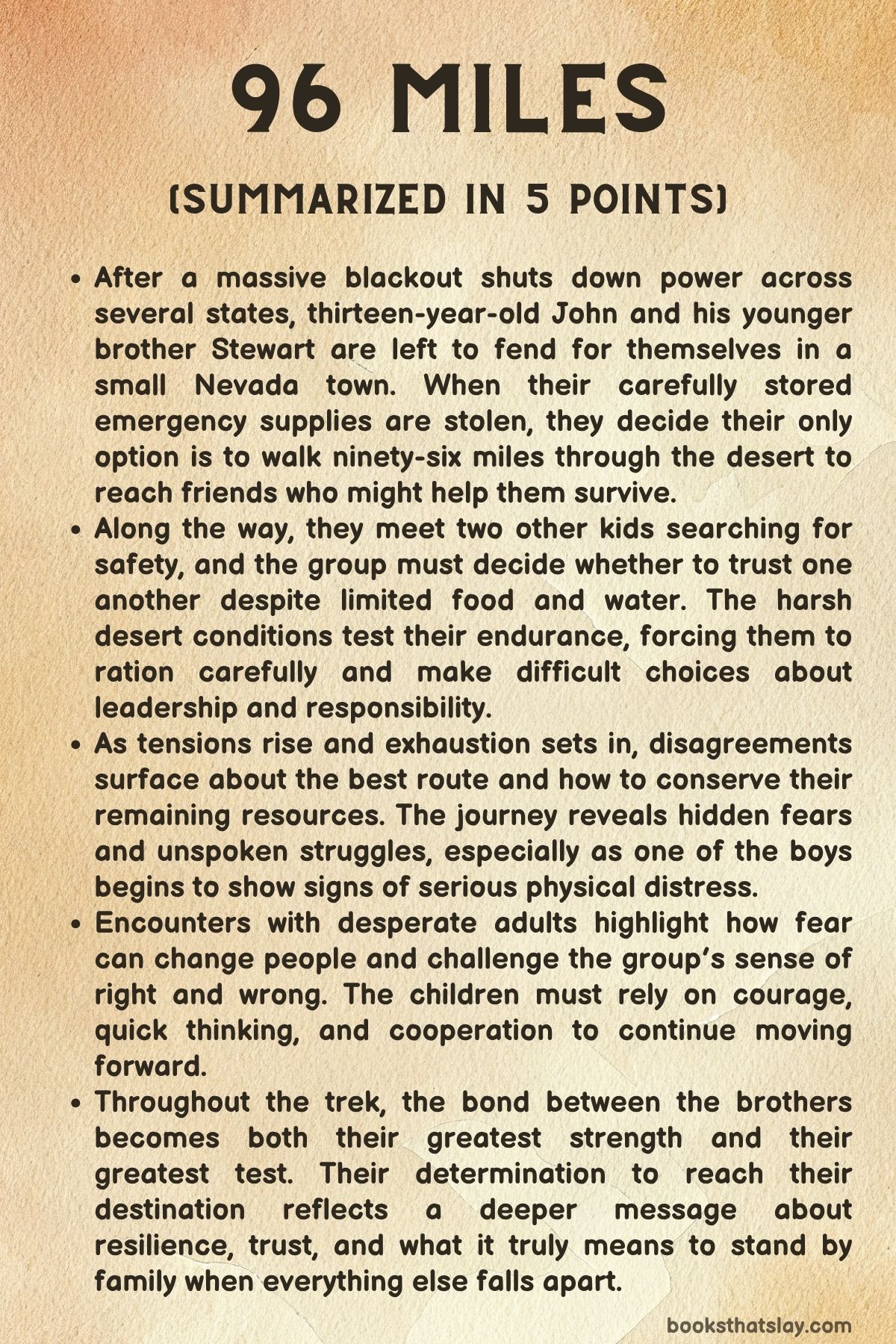
96 Miles by J. L. Esplin is a survival story set in the Nevada desert after a mysterious nationwide blackout brings modern life to a halt. Thirteen-year-old John Lockwood and his younger brother Stewart are left alone when their carefully stored emergency supplies are stolen.
With no power, no communication, and no insulin for Stew’s diabetes, the boys must walk ninety-six miles to reach friends who may have what they need to survive. Along the way, they confront hunger, dehydration, fear, and moral dilemmas that test their character. At its core, the novel explores brotherhood, responsibility, and what it truly means to be “Battle Born.”
Summary
When the power goes out across several western states, thirteen-year-old John Lockwood and his eleven-year-old brother Stewart are staying with neighbors in their small Nevada town. Their father is away on a business trip, and no one knows how far the outage stretches or how long it will last.
At first, the blackout feels strange but manageable. The neighborhood gathers for meetings, shares information, and relies on stored supplies.
John’s father had prepared for emergencies with months of food, water tanks, and a generator to keep vital items running. Confident in their preparation, John believes they can wait out the crisis.
That sense of security vanishes when a man named Clayton Presley and his accomplices rob the boys at gunpoint. They steal the family’s food, water, generator, and, without realizing it at first, Stewart’s insulin supply.
The robbery shatters Stewart’s confidence and leaves John carrying the burden of leadership alone. With their supplies gone and no clear information about when the power will return, John decides they must walk ninety-six miles across the desert to Brighton Ranch, where family friends might offer safety and insulin for Stewart.
Stewart resists the idea. The journey is long, dangerous, and uncertain.
He fears arriving as a burden and would rather stay home than risk dying in the desert. Desperate to convince him, John refuses to eat or drink, offering Stewart his own share.
Eventually, Stewart agrees, and they set out with two small survival packs their father prepared years earlier.
Early in their journey, they encounter siblings Cleverly and Will, who are searching for Jim Lockwood after hearing he had supplies. Cleverly carries herself with determination, though she hides fear and guilt.
Will is younger and struggling with dehydration. John faces a difficult choice: continue with limited provisions or share their already scarce resources.
Stewart reminds him that their father would help others. Despite knowing the risk, John agrees to let Cleverly and Will join them.
The desert is unforgiving. Heat, wind, and thirst take their toll.
The group must ration water carefully, even boiling toilet water collected from an abandoned house to survive. Tension grows between John and Stewart.
Stewart drinks more than his share at one point, forcing John to reconsider their plan and detour toward a reservoir for water. Leadership weighs heavily on John, and he struggles between pride and practicality.
On the road, they encounter a truck driven by a man and a pregnant woman. John quickly realizes the driver is connected to the robbery after spotting his father’s marked gas can in the truck bed.
The man steals one of their canteens and orders them to turn back. John hides his anger, determined to survive rather than escalate the situation.
As Stewart’s health deteriorates, John grows increasingly alarmed. Stewart becomes pale, exhausted, and unsteady.
He vomits after drinking a large amount of water. Cleverly senses that something more serious is happening.
Finally, John admits the truth: Stewart has type 1 diabetes and has been without insulin for two days. The generator that preserved his medication was stolen.
Brighton Ranch has insulin because Jess Brighton, a friend their age, is also diabetic.
The revelation reframes everything. Stewart’s earlier reluctance now makes sense.
He did not want to take insulin from Jess or risk becoming a burden. His exhaustion is not weakness but a medical crisis.
The group presses on, but it becomes clear Stewart cannot continue much farther.
John and Cleverly reach the reservoir at night to refill water, only to discover the robbers’ camp. They see the stolen water tanks and Clayton Presley by the fire.
Anger floods John. He considers revenge but recognizes the danger.
Instead, he and Cleverly slash the robbers’ tires and attempt to hotwire a truck to escape with water. Presley sees John but does not stop him, suggesting a complicated guilt.
After a tense struggle with another man from the group, John and Cleverly manage to drive away, though the truck soon runs out of gas. Fortunately, they find a half-full gas can in the truck bed and continue.
Despite gaining transportation, Stewart’s condition worsens. He drinks excessively and vomits again.
Cleverly confronts John about pushing Stewart too hard. Eventually, Stewart admits his body will not let him keep walking.
Cleverly proposes that she and Will stay with Stewart while John runs alone to Brighton Ranch for insulin.
Leaving his brother behind is the hardest decision John has made. He takes the last of the water and sets off, alternating walking and running.
Pain stabs his chest, blisters form on his heel, and exhaustion overtakes him. He briefly collapses and wakes in the night, realizing he has lost precious time.
Guilt fuels him forward.
When he reaches Brighton Ranch, he is met with hostility. Nate Brighton, Jess’s older brother, points a rifle at him and refuses to share insulin, accusing John of poor preparation.
Nate’s fear has turned into suspicion and selfishness. John sees how crisis can distort judgment.
A physical fight breaks out, and though John is outmatched, he refuses to leave without help. Jess intervenes, understanding immediately what Stewart needs.
She prepares her diabetes supplies and agrees to return with John.
They drive back toward Stewart, unsure what they will find. John fears he has taken too long.
When they reach the truck where Stewart, Cleverly, and Will waited, relief washes over him. Stewart is weak but alive.
Jess checks his blood sugar and administers insulin. Slowly, color begins to return to Stewart’s face.
The immediate danger passes.
The group shares cold drinks and snacks Jess brought. Stewart regains some humor, and the children revive their “Battle Born” club, named after Nevada’s state motto.
The phrase, once tied to a flag hanging in John’s room, now represents resilience and shared strength. John apologizes to Stewart for not listening sooner.
Stewart reassures him, grateful for his brother’s determination.
Before leaving, John leaves a note in the robbers’ truck, signing it from “The Battle Born.” It is not an act of revenge but a statement that they endured.
In the epilogue, their father leaves a voicemail saying he has made it back to Nevada and is on his way home. He trusts his sons are safe because they have each other.
The glowing blue light from the Nevada flag in John’s room lingers in his mind, a reminder of identity and perseverance.
Through hardship and moral challenges, John learns that survival is not only about preparation or toughness. It is about compassion, sacrifice, and understanding the difference between selfishness and courage.
By the end, he recognizes that true strength lies in protecting others without losing oneself.
Characters
John Lockwood
John is the story’s moral and practical center in 96 Miles, a thirteen-year-old forced into adulthood by absence, scarcity, and fear. He is decisive to the point of stubbornness, often choosing the plan that looks most efficient even when it strains relationships, especially with Stewart.
What makes John compelling is how his competence is matched by volatility: he can organize rations, build shelter, track miles, and keep the group moving, yet he also carries anger he doesn’t fully understand until it leaks out as sarcasm or control. The robbery of his home doesn’t just take supplies—it fractures his trust in people and pushes him toward revenge, which he mistakes for justice until he sees how empty that would feel.
Across the journey, John’s growth is less about learning survival skills and more about learning humility: he begins believing leadership means making choices for others, and ends recognizing it also means listening, admitting fear, and accepting help. His decisions—taking Cleverly and Will along, stealing back a truck, running alone for insulin—show a boy who acts first and processes later, but who ultimately chooses responsibility over pride.
Stewart “Stew” Lockwood
Stew is the emotional truth-teller of the story, even when his words come out sharp. At first he looks like the obstacle to John’s plans—complaining, resisting the route, and provoking conflict—but the story gradually reframes his behavior as a mix of exhaustion, fear, and a body that is failing.
Stew is deeply shaped by preparedness culture through his father, yet he carries a quieter moral clarity than John: he pushes John to help Cleverly and Will, and he worries about what it means to arrive at Brighton Ranch needing something that belongs to Jess. His stubbornness is partly dignity; he doesn’t want survival to turn them into people who take without considering the cost to others.
Once his diabetes becomes clear, his earlier mood shifts read differently: he isn’t giving up—he’s enduring a medical crisis while trying not to scare his brother or be treated like a burden. Stew’s arc is painful because it exposes how quickly strength is misread when someone is sick, and how easily a crisis can make even loving people impatient.
By the end, his return of humor and steadier presence doesn’t erase what happened; it underlines how close they were to losing him and how much of the journey was driven by his quiet will to keep going for as long as he could.
Cleverly
Cleverly enters the novel as a guarded stranger with a knife and a story she knows isn’t fully true, but she quickly becomes one of the book’s most stabilizing forces. She is practical, observant, and willing to act, yet she also carries a strong conscience that shapes her choices.
Her decision to leave her grandparents to search for Jim Lockwood is driven by guilt and love—she sees older people sacrificing for neighbors and feels urgency to do something, even if it’s reckless. Cleverly challenges John in ways no one else can: she calls out his pride, questions his assumptions, and refuses to let “being in charge” excuse dishonesty or harshness.
At the same time, she is not positioned as a perfect counterweight; she makes risky choices too, including joining John on the night walk and committing to the theft at the reservoir, but she does those things with clear-eyed awareness of consequences. Her courage is shown not as fearlessness but as the ability to move while afraid, especially when it means protecting Will or pushing back against John’s tunnel vision.
As the story progresses, Cleverly becomes a bridge—between John and empathy, between survival and decency, and between the group’s immediate needs and the kind of people they still want to be afterward.
Will
Will is the youngest and most visibly vulnerable traveler, and his presence forces the older kids to confront what their choices mean. He begins as dehydrated, chapped, and physically struggling, a child whose body shows the desert’s damage quickly.
Yet he is not merely someone to carry; Will adapts, listens, and learns. Small changes—stopping the habit of licking his lips, sharing clothing, taking turns helping—show a kid trying to be useful rather than helpless.
His loyalty to Cleverly is constant and quietly heroic: he gives her his hoodie, stays close when she is scared, and trusts her judgment even when the situation is confusing. Will also brings emotional relief to the group, offering humor and imagination that briefly restores their sense of being kids, not only survivors.
That matters because it counters the hardening effect the crisis has on John and Stew. Will’s arc is subtle but important: he moves from passive endurance to active participation, becoming a small but steady thread of hope that reminds everyone what they’re trying to save.
Jim Lockwood
Jim Lockwood is absent for most of the story, yet his influence shapes nearly every choice John and Stew make. He represents preparation, discipline, and a strict moral code tied to self-reliance and responsibility.
The survival packs, the water tanks, the generator, and the boys’ training all come from him, making him a sort of invisible guide during the journey. But he is not portrayed only as a provider; his absence also creates emotional wounds, particularly in John, who craves approval and struggles with disappointment and anger when his father isn’t there.
Jim’s teachings become something the boys interpret differently: John uses them to justify taking charge and pushing forward, while Stew seems to absorb the values behind them—help others, keep your integrity, and think beyond yourself. The voicemail at the end matters because it reframes Jim not as a distant survivalist stereotype but as a father who trusts his sons and understands that their strongest resource is each other.
In that sense, Jim functions as both the reason they survive and the emotional test they must outgrow: they need what he taught them, but they also need to learn how to apply it with compassion rather than rigidity.
Jess Brighton
Jess is a crucial figure despite limited on-page time, because she embodies competence without cruelty. As someone living with diabetes, she represents the practical reality behind the story’s medical stakes, and her calm handling of insulin becomes a model of control in a world that is spiraling.
Jess is also the moral contrast to paranoia: when John arrives desperate and injured, she listens and understands quickly, choosing action over suspicion. Her presence shows what preparedness can look like when it is paired with empathy—she has supplies, knowledge, and access, but she uses them to save a life rather than hoard control.
Jess’s relationship to Stew also gives emotional weight to the insulin crisis: it’s not a faceless resource but something tied to a person who needs it too. The story positions Jess as a reminder that survival does not require becoming less human, and that competence can be gentle.
Nate Brighton
Nate is the clearest example of how fear can corrupt responsibility into aggression. He is likely acting from the same instinct John carries after the robbery—protect what’s yours before someone takes it—but Nate goes further, turning suspicion into a worldview.
With his father gone, Nate assumes the role of defender and gatekeeper, but he mistakes dominance for protection. His refusal to share insulin and his fixation on judging others as “unprepared” show how preparedness becomes a moral weapon in his hands, something he uses to justify denying help.
Nate’s confrontation with John is not just a physical threat; it is a clash between two versions of survival ethics: one defined by scarcity and entitlement, the other defined by sacrifice and community. Even though Nate is positioned as an antagonist, he is not a cartoon villain; his paranoia suggests someone overwhelmed by isolation and responsibility, spiraling into control because uncertainty feels unbearable.
Nate’s role is to show what John could become if anger and fear were allowed to set the rules.
Clayton Presley
Clayton is the face of the robbery trauma in 96 Miles, a man who uses power and intimidation to strip children of what they need. Yet he is also written with unsettling complexity.
He is capable of violence, but he is not constantly raging; his emptiness, his distance, and his strange stillness by the campfire make him feel like someone hollowed out by his own choices. The most revealing detail is that he recognizes John at the reservoir and does not expose him, which complicates the easy label of “monster.” That moment doesn’t redeem Clayton—he still participated in terrorizing and endangering kids—but it suggests a flicker of conscience or fatigue, a recognition that there are lines even he hesitates to cross.
Clayton’s presence emphasizes a central theme of the story: collapse doesn’t create new morality so much as reveal what people already are, and some people choose harm as their method of coping. Clayton becomes a shadow John has to move past, not by winning a confrontation, but by deciding that revenge will not rebuild what was taken.
Spike
Spike is a more immediate, physical threat than Clayton, representing opportunism without hesitation. He is the one who steals the canteen at gunpoint, tries to intimidate John into turning back, and later attacks John during the truck escape.
Spike’s brutality is direct and practical: he wants resources, and he is willing to hurt a child to get them. Compared to Clayton’s eerie quiet and implied guilt, Spike feels more like a person whose fear expresses itself as aggression and entitlement.
The fact that he travels with a pregnant partner adds a disturbing layer—not as an excuse, but as a reminder that desperation can be used to rationalize cruelty. Spike’s role in the story is to force the kids into morally gray action: they must steal to survive, and they must do it quickly because people like Spike will not negotiate.
Steph
Steph, the pregnant woman traveling with Spike, appears briefly but adds weight to the story’s atmosphere of vulnerability and moral compromise. Her pregnancy highlights how the crisis threatens people who cannot simply “tough it out,” and her presence complicates the reader’s response to the robbers: it becomes clear that some adults are also terrified and trying to protect their own.
Still, Steph is part of the intimidation on the road, and the group’s danger increases because adults with dependents may act with fewer limits. Even without extensive dialogue, she underscores one of the book’s quiet arguments: disaster doesn’t distribute suffering fairly, and fear often pushes people into choices that endanger others.
Mr. and Mrs. Yardley
The Yardleys represent the last stable version of community, the early-world normal that vanishes once scarcity takes over. They feed the boys, share space, and attend meetings, trying to do the responsible adult thing while systems fail around them.
Their toddler and impending newborn make their situation fragile, and their decision to leave for family support is an act of protection rather than abandonment. For John, their household becomes a reference point for what “safe” felt like before the robbery—shared meals, adult guidance, and the sense that someone else is steering the ship.
The Yardleys also highlight how quickly crisis forces families into difficult choices, and how even good people can’t take care of everyone once the limits hit.
Freddy Yardley
Freddy, the Yardleys’ toddler, is a small but meaningful presence because he personifies innocence and helplessness in a world that is becoming dangerous. He doesn’t drive plot, but he raises the emotional stakes: when water runs low and adults are making evacuation decisions, the reader is reminded that children like Freddy cannot understand, prepare, or endure in the way older kids can.
His existence amplifies the tension behind the neighborhood’s choices and makes the collapse feel more personal, not abstract.
Mr. Brighton
Mr. Brighton is mostly off-page, yet his absence is a major catalyst for Nate’s paranoia and the ranch’s growing instability. He represents the missing adult authority that would likely have responded differently to John’s arrival and the insulin request.
His trip to check on family reflects the same impulse Jim Lockwood has—protect your loved ones even when systems are failing—but his long absence creates a vacuum that fear fills. In the story’s structure, Mr. Brighton is a reminder that even prepared households can fracture when leadership disappears, and that the strongest supplies can’t replace steadiness.
Sammie
Sammie, the Brighton family dog, plays a small but vivid role as a signpost of home and a warning system. When John finally reaches the ranch, spotting Sammie is the first hint that he has arrived somewhere real, not just a desperate idea he’s been walking toward.
In a story where so much is uncertain and threatening, the dog functions as a piece of recognizable normal life—something that should mean safety—making the shock of Nate’s hostility hit even harder. Sammie’s presence reinforces how the world can look familiar and still be dangerous.
Themes
Survival and Moral Responsibility
Scarcity strips away comfort and exposes character throughout 96 Miles, forcing young protagonists to confront what survival actually demands. The desert landscape functions as more than a physical challenge; it becomes a testing ground for ethical decisions.
John begins the journey believing survival is primarily about efficiency, preparation, and endurance. His focus is on distance, water rations, speed, and calculated risk.
Yet the moment Cleverly and Will appear, survival becomes complicated by responsibility. Sharing limited supplies reduces their chances of reaching Brighton Ranch, but refusing help would betray the values their father instilled in them.
This tension intensifies when John and Cleverly encounter the robbers’ camp. Faced with stolen water tanks and the men who traumatized them, John must decide whether survival includes revenge.
The temptation to reclaim what was taken blends with anger, but his ultimate actions—stealing water, slashing tires, and leaving without confrontation—reflect a choice to prioritize life over ego. Even later, when Nate refuses insulin, the story contrasts two responses to crisis: one that hoards resources in fear and one that risks vulnerability to save someone else.
Survival here is not presented as simple toughness. It demands cooperation, restraint, and the willingness to act for others.
The desert environment exposes how quickly people justify selfishness when afraid. At the same time, it shows that moral responsibility does not disappear when systems fail.
Instead, it becomes sharper. The children’s decisions suggest that enduring catastrophe without losing one’s humanity is the greater achievement.
Brotherhood and Sacrifice
The relationship between John and Stewart anchors the emotional core of the novel, shaping every decision made along the ninety-six-mile journey. Their bond is not sentimental or consistently gentle; it is strained, argumentative, and full of misunderstandings.
John assumes leadership, believing he must push Stewart forward no matter the cost. Stewart resists, not because he lacks courage, but because he understands consequences differently.
Their arguments over water, direction, and pace reveal deeper anxieties—fear of dying, fear of being a burden, fear of disappointing their father.
When Stewart’s diabetes becomes central to the story, earlier tensions take on new meaning. His exhaustion and mood shifts are no longer signs of weakness but symptoms of a body failing without insulin.
His reluctance to reach Brighton Ranch stems partly from not wanting to take insulin that belongs to Jess. That awareness highlights Stewart’s quiet selflessness.
He thinks beyond his own survival, even when he is the one most at risk.
John’s final decision to leave Stewart and run alone for help is the most significant act of sacrifice. It forces him to confront his greatest fear: losing his brother.
The run is physically punishing, but emotionally it represents trust. John must believe Stewart will hold on and that others will care for him.
Their reunion, marked by apology and reassurance, signals growth in both. Brotherhood here is not simply loyalty; it is learning to listen, to forgive, and to carry responsibility without controlling the other person.
Their shared endurance affirms that family is not just about protection, but about understanding each other’s limits and strengths.
Fear, Paranoia, and the Collapse of Trust
As infrastructure fails, social trust deteriorates alongside electricity and communication. The blackout creates uncertainty, and uncertainty feeds fear.
Neighbors who once gathered peacefully begin evacuating. Information is scarce, rumors spread, and isolation increases.
The robbery at gunpoint marks a turning point, demonstrating how quickly desperation can override community bonds. Clayton Presley and Spike justify stealing from children as necessary for their own survival.
Their actions illustrate how fear narrows empathy.
Nate Brighton’s hostility further explores this theme. Without his father present, he assumes control of the ranch with a rigid, defensive mindset.
He equates preparedness with moral superiority and views outsiders as threats. His refusal to share insulin exposes how paranoia distorts judgment.
Protecting resources becomes more important than protecting life. In contrast, Jess maintains clarity and compassion, showing that fear does not automatically require cruelty.
John himself wrestles with mistrust. After being robbed, he becomes suspicious and guarded.
His instinct is to conceal information, to lie about destinations, and to anticipate betrayal. The desert amplifies this mental strain; empty highways and silent nights mirror emotional isolation.
The flicker of returning power late in the story symbolizes fragile hope that order might return. Yet the narrative suggests that the real danger is not darkness but the mindset that everything is “every person for themselves.” The breakdown of trust becomes as threatening as dehydration.
The story questions whether preparedness without empathy can truly be called strength.
Identity, Preparedness, and the Meaning of “Battle Born”
The Nevada state motto, “Battle Born,” serves as a recurring symbol, shaping the characters’ understanding of identity and resilience. For John, the phrase initially represents pride and toughness.
The flag in his bedroom connects him to his father’s values of discipline and readiness. After the robbery, however, preparedness feels hollow.
Despite stockpiled food and water tanks, they were still vulnerable. The loss forces John to reconsider what being prepared actually means.
As the children adopt “Battle Born” as the name of their club after drinking boiled toilet water, the phrase evolves. It shifts from a state slogan to a declaration of endurance rooted in shared experience.
Being battle born no longer refers to physical strength or emergency kits. It means surviving humiliation, thirst, fear, and doubt without surrendering compassion.
Stewart embodies this redefinition. His illness challenges the idea that willpower alone determines survival.
Preparation can delay crisis, but it cannot eliminate vulnerability.
The adults in the story offer contrasting interpretations of preparedness. Clayton and Spike prepare by stealing.
Nate prepares by hoarding. Jim Lockwood prepares by stockpiling supplies and training his sons.
Yet the boys ultimately discover that identity is not secured by gear or isolation. It is shaped by relationships and moral choices.
The glowing memory of the flag becomes less about state pride and more about connection to family. To be battle born is to rise after failure, to act with integrity under pressure, and to understand that resilience is measured not only by who survives, but by who they remain afterward.