If I Forget Thee, O Earth . . . Summary, Characters and Themes
If I Forget Thee, O Earth . . . is a science fiction short story by Arthur C. Clarke that reflects on exile, memory, and responsibility. Written in the early years of the atomic age, it imagines humanity surviving far from its ruined home after a catastrophic war.
The story follows a young boy who is shown the truth about his world for the first time. Through his eyes, readers encounter both the wonder of space and the sorrow of loss. Clarke combines stark scientific detail with a quiet emotional core, presenting a future shaped by destruction yet sustained by patience and hope.
Summary
The story centers on Marvin, a ten-year-old boy who has spent his entire life inside a sealed Colony. The Colony exists beneath protective domes and enclosed corridors, where air is filtered and controlled, and where life is carefully sustained through engineering and discipline.
Marvin’s world consists of residential levels, power systems, administrative corridors, and farmland chambers where crops grow beneath filtered sunlight. These farms are among his favorite places because they contain living plants and faint natural smells, a rare reminder that life can flourish even in confinement.
One day, Marvin’s father takes him on a journey upward through the Colony. They pass through the familiar internal sectors and continue beyond the Observatory, toward a destination Marvin has never reached before. Gradually, he realizes that they are heading outside.
This is an extraordinary event. Few children are permitted to leave the safety of the Colony’s interior, and the surface environment is hostile and airless. The anticipation builds as they enter a surface vehicle designed for travel across vacuum terrain.
They pass through an airlock chamber, where pressure drains away and the outer door opens. For the first time in his life, Marvin sees the world beyond the protective structures of the Colony.
Though he has seen photographs and televised images, the reality overwhelms him. The sky is black even in daylight, and the sun shines fiercely without atmospheric diffusion. The stars are visible at the same time, sharp and steady.
Marvin remembers a nursery rhyme about twinkling stars and is puzzled; these stars do not twinkle at all. They shine with unwavering clarity in the airless sky.
The vehicle speeds across a barren plain. The Colony quickly disappears below the horizon, emphasizing how small and isolated it is. They pass a mining operation and continue toward the edge of a plateau. The landscape grows harsher and more dramatic.
Mountains rise sharply, and deep shadows stretch across valleys. The terrain is marked by craters and jagged formations. As they descend from the plateau, Marvin feels both fear and excitement. The journey becomes longer than he expected, stretching into hours as they drive through alternating light and shadow.
Along the way, they pass a crashed rocket and a stone cairn topped with a metal cross. This brief image suggests earlier tragedies and the cost of survival. It also hints that others have attempted exploration or escape.
The terrain becomes increasingly rugged until they reach a valley near a towering headland at the end of a mountain range.
As they drive into the valley, something unexpected occurs. Though the sun has dropped behind the hills, the landscape ahead is not dark. Instead, it glows with a cold white radiance.
When they emerge into the open plain, Marvin sees the source of the light.
Hanging low above the horizon is a great silver crescent: Earth.
The sight is overwhelming. From this distance, Earth appears luminous and beautiful. Marvin can see the outlines of continents, the faint haze of atmosphere, and bright clouds swirling above oceans. He notices sunlight glinting off the polar ice.
Even across the vastness of space, the planet seems alive and inviting. For a moment, it looks peaceful and whole. Marvin feels a deep longing for this distant world. He has read about oceans, rain, snow, forests, and sunsets, but he has never experienced them. Everything natural that he has known exists only in limited, artificial form within the Colony.
Yet as his eyes adjust, he sees something else. The darkened portion of Earth’s disk glows faintly with an eerie light. This glow is not natural. It is the lingering radiation from a global nuclear catastrophe.
The planet is not at peace; it is scarred and poisoned. What he sees is the aftermath of total war, the result of forces unleashed by humanity itself. The glow remains visible even from a quarter of a million miles away.
Marvin remembers what he has been taught: Earth was destroyed in an atomic war generations ago. The Colony survived only because it was far from the devastation.
Supply ships once traveled between Earth and the Colony, but after the war began, communication ceased. Radio stations fell silent one by one. The lights of cities faded. Eventually, it became clear that the Colony was alone.
Marvin’s father begins to explain this history in detail. He describes the final days before contact was lost, when the inhabitants of the Colony realized that rescue would never come.
They understood that they were the last surviving fragment of humanity. The responsibility for preserving the species rested entirely with them.
What followed were years of hardship. The Colony struggled to adapt to permanent isolation. Resources were limited. The environment outside was unforgiving. Survival required discipline, sacrifice, and careful planning. Over time, they managed to stabilize their existence.
They built a functioning society in miniature, complete with agriculture, industry, and governance. Yet survival alone was not enough. Without a larger purpose, the Colony risked falling into despair.
This journey, Marvin now understands, is meant to give him that purpose.
His father has brought him here not merely to show him Earth, but to pass on a mission. Earth is not permanently lost.
Though radioactive contamination makes it uninhabitable now, the damage will not last forever. Over centuries, natural processes will cleanse the planet. Winds and rains will gradually wash radioactive materials into the oceans, where they will decay and become harmless.
Life will one day be able to return.
The Colony’s task is to endure until that time. They must preserve knowledge, culture, and human continuity. The ships that once traveled between worlds still exist, waiting for the day when they can make the journey home again. That return will not happen in Marvin’s lifetime. It may not happen in the lifetime of his children. But eventually, his descendants will reclaim Earth.
Standing beneath the silver crescent, Marvin feels both sorrow and awakening. He realizes that he will never walk beside Earth’s rivers or breathe its open air. His generation lives in exile. But exile is not the same as extinction. The dream of return gives meaning to their struggle.
As they prepare to leave, Marvin does not look back at Earth. The sight is too powerful and painful. He carries its image within him instead. He understands that one day he will bring his own son to this same spot. He will repeat the story and pass on the same responsibility. In this way, hope will survive from generation to generation.
The story ends not with action, but with quiet resolve. Humanity’s future depends not on immediate triumph, but on patience measured in centuries. The Colony must remain steadfast, guarding the possibility of renewal. The shining crescent in the sky is both a reminder of catastrophic failure and a symbol of eventual restoration.
Through Marvin’s experience, the story presents a meditation on destruction and responsibility. It suggests that human beings possess both the power to ruin their world and the capacity to rebuild. Survival is not enough; a society must hold onto memory and purpose. The promise of return to Earth becomes a shared inheritance, ensuring that even in exile, humanity retains a direction and a reason to endure.
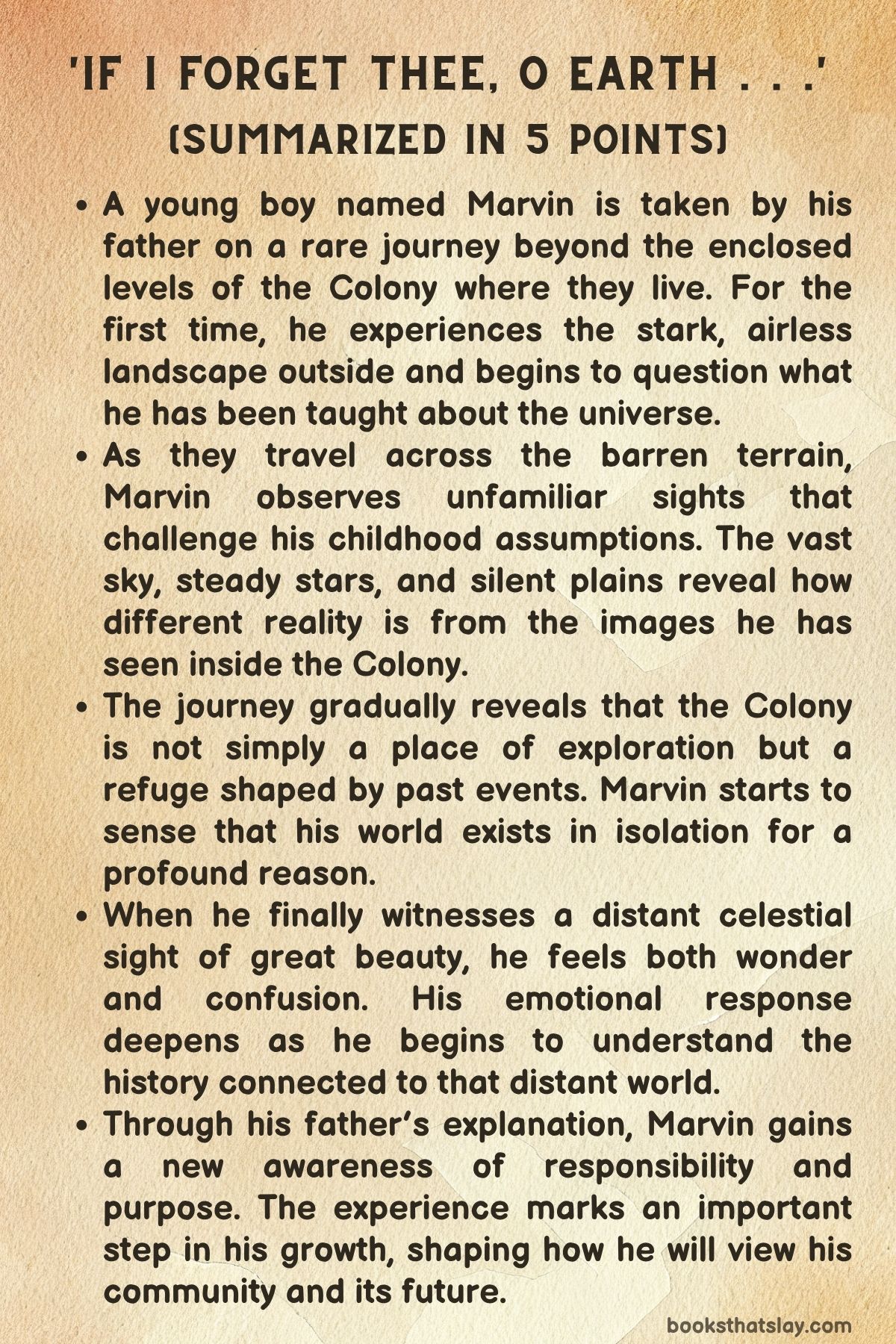
Characters
Marvin
Marvin is the emotional and intellectual center of If I Forget Thee, O Earth . . ..
At ten years old, he represents innocence shaped by confinement. Having grown up entirely within the controlled environment of the Colony, his understanding of the universe is secondhand, derived from books, lessons, and filtered images. His reactions to the outside world reveal both curiosity and naivety. When he sees the stars shining steadily in the black sky, he questions the old nursery rhyme about their “twinkling,” showing a child’s literal logic shaped by scientific surroundings.
At the same time, his wonder at Earth exposes a deeper emotional capacity. He feels a powerful longing for oceans, rain, and natural landscapes he has never experienced. This longing transforms into sorrow when he realizes Earth’s beauty hides radioactive ruin. Over the course of the journey, Marvin moves from simple excitement about leaving the Colony to a profound understanding of exile and responsibility.
By the end, he accepts that his life’s purpose is not personal fulfillment but preservation and eventual restoration. His growth is quiet but decisive: he becomes the next bearer of humanity’s collective hope.
Marvin’s Father
Marvin’s father functions as guide, historian, and moral anchor. He is calm and deliberate, carefully choosing the moment when his son is ready to learn the full truth about their existence.
His decision to take Marvin to see Earth is symbolic initiation. The journey across the harsh lunar terrain suggests determination and perhaps a trace of urgency, as if he feels the weight of time pressing upon him. Unlike Marvin, the father remembers Earth not as myth but as loss. He carries within him the knowledge of humanity’s self-destruction and the despair that followed when communication with Earth ceased.
His explanation of the war and its aftermath is measured rather than emotional, reflecting a generation hardened by survival.
Yet beneath his composure lies deep grief. He understands that neither he nor his son will return to Earth, but he believes firmly in the long-term vision of restoration. He embodies resilience and continuity, ensuring that memory does not fade into apathy. In passing the dream of return to Marvin, he secures the Colony’s psychological survival as much as its physical one.
The Colonists
Though not individualized, the Colonists collectively form a significant character presence in If I Forget Thee, O Earth . . ..
They represent humanity reduced to a fragile remnant, forced to build a sustainable society in isolation. Their existence is defined by discipline, scientific precision, and long-term planning. After the destruction of Earth, they endure years of uncertainty and despair, aware that they are alone in the universe. The silence from Earth’s cities and radio stations marks a turning point in their identity.
No longer a remote outpost, they become the sole custodians of human civilization. Their struggle against the hostile lunar environment reflects determination and adaptability. Yet the narrative suggests that survival requires more than technology; it requires a sustaining purpose. The Colonists’ decision to frame their existence around the eventual return to Earth reveals a collective psychological strategy.
They transform exile into stewardship, teaching each generation that their sacrifices serve a distant but meaningful goal. As a unified character, they embody both the consequences of human folly and the endurance of human aspiration.
The Lost Generation of Earth
Although unseen, the people of Earth before and during the nuclear catastrophe exert a powerful influence over the narrative. They are the silent presence behind the radioactive glow Marvin observes.
This generation represents both the height of human achievement and the depth of human failure. Earth once flourished with diverse ecosystems, vibrant cities, and advanced technology. The supply ships that traveled between Earth and the Colony testify to its capability. Yet it was also the site of catastrophic conflict.
The atomic war that destroyed it reflects shortsightedness and destructive ambition. In this sense, the lost generation serves as a cautionary shadow over the Colony. Their fate reinforces the responsibility placed upon Marvin and his peers. Earth’s former inhabitants are not portrayed with individual traits, but their legacy shapes every aspect of the Colony’s identity. They are both ancestors to be honored and a warning to be remembered.
Their world, now scarred and glowing with residual radiation, stands as a testament to the dual capacity of humanity for creation and annihilation.
Themes
Exile and the Longing for Home
Exile defines the emotional atmosphere, shaping both individual identity and collective consciousness. The Colony exists not as an exploratory outpost filled with optimism, but as a refuge forced into permanence. Its inhabitants live in artificial corridors, under plastic domes, breathing recycled air and cultivating crops beneath filtered sunlight.
Every aspect of their existence reminds them that they are separated from something greater. Marvin’s first glimpse of Earth transforms abstract lessons into immediate emotional reality. Though he has never lived there, he experiences an intense longing for oceans, rain, forests, and open skies. This longing is inherited memory rather than personal experience, suggesting that attachment to home can transcend direct knowledge.
Exile in the story is not merely physical displacement but psychological inheritance.
The Colonists must construct meaning in a place that was never intended to replace Earth. The lunar landscape is stark, silent, and unforgiving, emphasizing their estrangement from natural abundance. When Marvin sees the silver crescent glowing in the sky, he confronts the beauty of what has been lost. Yet the image is complicated by the visible radiation, which reminds him that home is both cherished and damaged.
The pain of exile becomes sharper because return is impossible for his generation. The story presents exile as a condition that requires endurance and imagination. Without the hope of eventual restoration, exile would become despair.
Through Marvin’s awakening, exile transforms from passive suffering into a conscious commitment to preservation, making longing itself a sustaining force.
The Consequences of Human Destruction
The silent glow on the darkened portion of Earth’s disk carries the weight of irreversible human error. The radioactive aftereffects of atomic war are visible even from space, serving as a stark reminder of humanity’s capacity for self-destruction.
In the story, destruction is not described in vivid battlefield scenes but through absence and silence. The radio stations cease transmitting. The lights of cities fade. Supply ships never return. This gradual disappearance intensifies the sense of finality.
Civilization does not collapse in a dramatic instant within the narrative; instead, it vanishes into quiet extinction.
The catastrophe is not framed as an accident of nature but as a deliberate outcome of human choices. This emphasis places moral responsibility at the center of the story. The Colony survives because it was distant, not because it was wiser. Its survival highlights the fragility of advanced societies when confronted with their own technologies.
The presence of a crashed rocket and a grave marker on the lunar surface suggests that even in refuge, human ambition carries risk and loss.
Yet the consequences are not purely punitive. The story implies that destruction carries a lesson. The new generations must understand what occurred so they do not repeat it. The father’s explanation to Marvin ensures that ignorance will not erase accountability. By making the aftermath visible in the sky every night, the narrative transforms Earth into a permanent reminder of both scientific achievement and ethical failure.
The glow of radiation becomes a symbol of memory that cannot be ignored, forcing the Colonists to confront the cost of human aggression while striving toward a more responsible future.
Hope Across Generations
Time in the story stretches far beyond individual lifespans. The return to Earth will not occur for centuries, long after Marvin and his father are gone.
This immense temporal scale shifts the focus from immediate survival to generational continuity.
The Colony’s purpose depends on patience measured in centuries rather than years. Hope is not immediate or emotional; it is structured, deliberate, and institutional. Marvin’s father brings him to see Earth so that the vision will anchor his identity. One day Marvin will bring his own son, repeating the ritual and renewing the promise.
This cyclical act of storytelling becomes essential to the Colony’s endurance. Without a shared long-term goal, survival might lose meaning. The physical challenges of living on the Moon are significant, but the psychological challenge of maintaining morale over generations may be even greater.
The dream of return provides direction. It converts exile into stewardship. The Colonists are not merely refugees; they are guardians of humanity’s future.
The narrative suggests that hope must be cultivated as carefully as crops in the Farmlands. It requires education, memory, and symbolic acts. The journey to view Earth is a rite of passage, ensuring that each generation understands both the tragedy of the past and the promise of the future.
By framing hope as a responsibility rather than a vague emotion, the story presents optimism as an act of discipline. The future depends not on wishful thinking but on sustained commitment passed from parent to child.
Humanity’s Relationship with Science and Nature
Science in the story is both savior and destroyer.
The atomic war that rendered Earth uninhabitable arose from advanced technology used without restraint. At the same time, science enables the Colony to survive in a hostile environment. Air is manufactured, food is grown under artificial domes, and vehicles traverse the airless landscape. The same human intellect that created weapons of annihilation also constructs systems of preservation.
This duality shapes the moral framework of the narrative.
Nature is presented in two contrasting forms. The lunar surface is barren and indifferent, offering no comfort or sustenance. Earth, by contrast, appears vibrant and life-giving, even in ruin.
Marvin’s longing for rain, snow, and oceans reflects a deep human attachment to natural processes. These elements cannot be fully replicated inside the Colony. Artificial life-support systems sustain existence, but they do not replace the richness of a living planet.
The story suggests that science alone is insufficient without ethical guidance. The Colonists rely on technological mastery to endure, yet they must also learn humility. Earth’s destruction demonstrates the danger of scientific power divorced from responsibility.
Meanwhile, the eventual cleansing of radiation by wind and sea highlights nature’s capacity for renewal, though it operates on timescales far beyond human impatience. Humanity’s future depends on aligning scientific capability with respect for natural systems.
By positioning Earth as both victim and hope, the narrative underscores that technological advancement must serve preservation rather than domination.