The Last Murder at the End of the World Summary, Characters and Themes
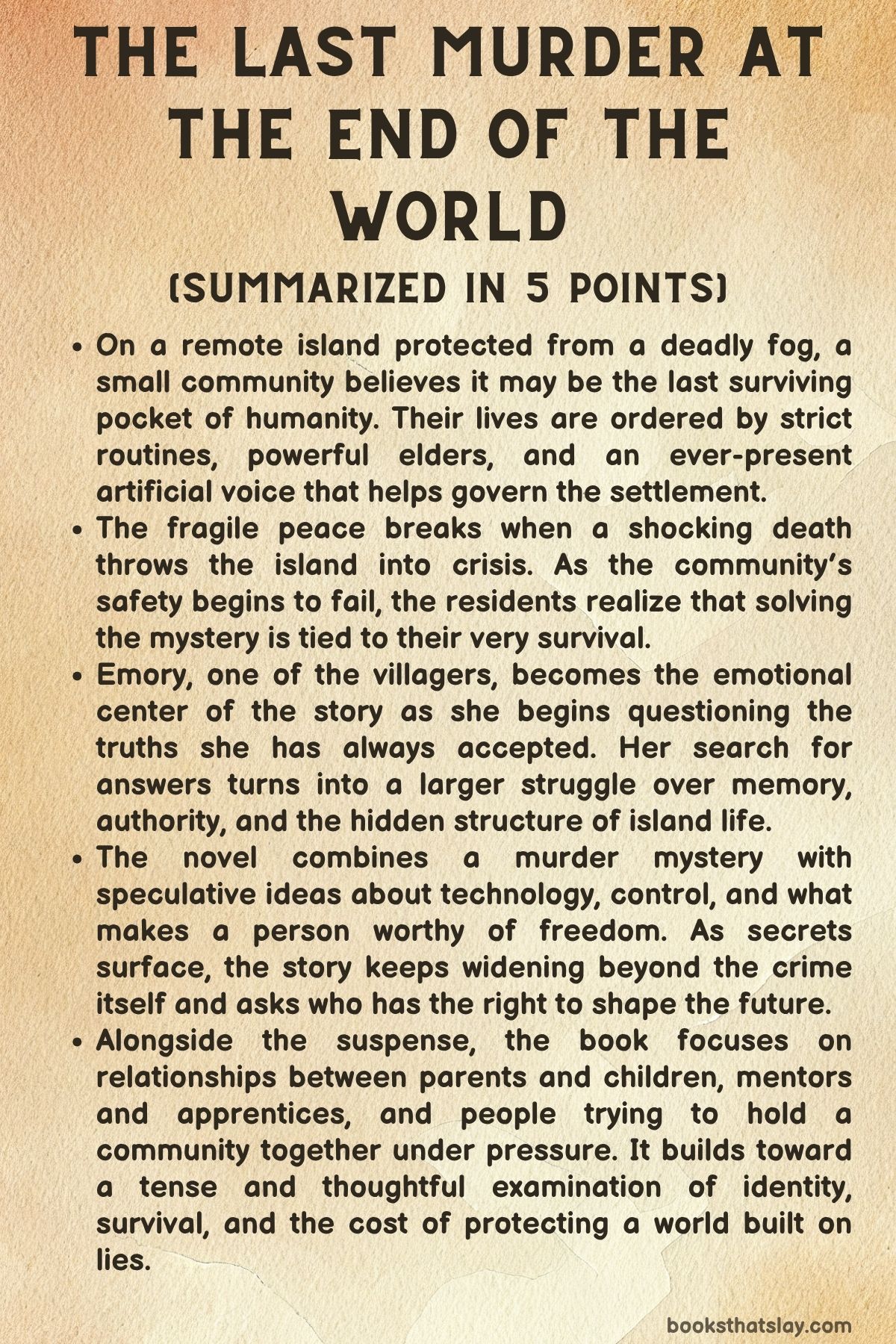
The Last Murder at the End of the World by Stuart Turton is a locked-room murder mystery set at the edge of extinction. On a remote island protected from a deadly fog, a small community lives under strict routines shaped by three elderly scientists and an all-seeing artificial intelligence called Abi.
When one of the scientists, Niema, is found dead, the island’s defenses begin to fail, and everyone learns they have only a short time left to uncover the truth. The novel combines mystery, science fiction, and moral conflict, asking who deserves power, what makes a person human, and whether a better future can be built from a damaged past.
Summary
The story opens on an island that appears to hold the last surviving human community. Beyond its protective barrier lies a world consumed by a deadly fog filled with insects that destroy every living thing they touch.
Niema Mandripilias, one of the three surviving elders who built this refuge, knows that something terrible is about to happen. She speaks with Abi, the artificial voice present in the minds of everyone on the island, and sets in motion a countdown that will determine whether anyone survives.
Life on the island is controlled, orderly, and filled with strange rules. The villagers work useful trades, obey a strict curfew, and rely on the elders for knowledge and authority.
Emory, one of the villagers, has never been fully satisfied with the explanations she has been given. She notices contradictions in the way the island functions and remains uneasy about the elders, especially Thea, whose apprentices perform dangerous tasks while she remains protected.
Emory’s skepticism deepens when she overhears Niema and Hephaestus arguing about an experiment that seems to require a death. Niema insists it is necessary for the future, while Hephaestus calls it murder.
At the same time, there are signs that the island’s history is not what the villagers have been told. The villagers know the broad version of the past: the world ended when a terrible fog spread across the earth, and Niema saved a small number of people by bringing them to the island.
But Emory senses that important truths have been hidden. She is especially disturbed by the fact that villagers sleep through curfew and wake with no memory of the night, despite rumors that they are used for unseen labor while unconscious.
The fragile balance collapses when Niema is found dead in a burning warehouse. At first, her death appears accidental, but Emory discovers a wound in Niema’s chest, and later evidence shows blunt force trauma to the skull.
The crisis is far greater than a murder. Niema had built a dead man’s switch into the island’s barrier, meaning her death has triggered the collapse of the protection keeping the fog at bay.
Abi reveals that unless the killer is identified and executed within forty-eight hours, the barrier will remain down and the fog will destroy the settlement.
Because everyone’s memories from the night of the murder have been wiped, the investigation becomes almost impossible. Emory takes charge anyway, with Clara, her daughter, helping her.
Clara is an apprentice and more scientifically trained, while Emory has the patience and instinct to ask the questions no one else wants to ask. Their search exposes one disturbing clue after another: missing supplies, ruined crops, trampled ground, bloodstains, broken syringes, and signs that several people moved around during curfew for reasons they do not understand.
Another layer of unease comes from Hui, Clara’s friend, who disappears after a trip into the hidden forest inside the volcano known as the cauldron garden. Before vanishing, Hui finds a mysterious metal box and reacts strangely, as though she has seen something shocking.
Clara later discovers that Hui’s blood was mixed with Niema’s, linking her directly to the events surrounding the murder. This turns Hui into a central missing witness, even before anyone fully understands what she saw.
The investigation forces Emory into hidden places and buried histories. In the cauldron garden, Thea reveals the truth of the villagers’ existence.
They are not natural-born humans at all, but engineered beings called simulacrums, manufactured by Blackheath Institute before the collapse of the world. Niema sold versions of them as products, including military ones designed for violence.
The people on the island were created to serve, maintain systems, and eventually rebuild civilization for the true humans waiting in stasis below the island. This revelation shatters Emory’s understanding of herself, her family, and the society she lives in.
Yet instead of accepting Thea’s contempt, she begins to define worth on her own terms.
As Emory keeps pushing, suspicion falls on nearly everyone. Adil, the island’s exile, once tried to kill Niema and had reason to hate the elders after learning forbidden truths.
Thea behaves suspiciously by hiding forensic evidence, including a thumbnail found embedded in Niema’s cheek. Hephaestus is tied to secret experiments involving humans in stasis, and he possesses tools that could have caused Niema’s injuries.
Seth, one of the villagers closest to Emory, is also entangled in the mystery through missing memories, unexplained blood evidence, and his loyalty to Niema.
Emory and Clara uncover a locked room filled with the bodies of dead Blackheath staff, suggesting that Niema and Hephaestus had been carrying out deadly experiments. Broken memory gems and erased records point to a long history of manipulation.
Adil eventually shares what he knows: Niema had exiled him after he began remembering the truth about the apprentices, including Jack, Emory’s husband, who was believed dead. Adil claims Jack is still alive below the island, kept in a trance and used for labor during the night.
He also says he saw Thea near Niema’s body and helps direct Emory toward Blackheath.
Inside the underground facility, Emory discovers that Jack and several others are indeed alive, trapped in a state of forced obedience. She also finds Hui alive but sedated, confirming that Hui survived the night of the murder and may remember what happened.
Adil dies before he can fully explain everything, and Thea becomes even more dangerous as she tries to contain the fallout. Hephaestus, meanwhile, grows desperate and violent, eventually threatening Emory and Clara because he fears the truth of his involvement will be exposed.
As the countdown continues, the emotional and moral conflict of the novel sharpens. The villagers learn that they were created as tools, yet they respond not with blind rage but with courage, solidarity, and sacrifice.
When told that the cauldron garden cannot hold everyone, many volunteer to stay behind. Their choices contrast sharply with the behavior of the humans who claimed superiority over them.
The supposed makers of civilization appear selfish, fearful, and brutal, while the created people demonstrate empathy and restraint.
The final pieces come together when Hephaestus’s memory reveals what happened on the night of the murder. Niema had decided to change course.
After seeing signs that the simulacrums were evolving beyond their design, especially through Hui’s original musical composition, she concluded they should inherit the earth. She intended to leave the future to them rather than to the humans in stasis.
Hephaestus could not accept this. Believing the villagers dangerous and unworthy, he attacked Hui and then stabbed Niema when she intervened.
The villagers fought back and subdued him, but the chaos that followed allowed further confusion. Thea later tried to save Niema rather than kill her.
Adil manipulated the scene afterward to frame the elders and drive the villagers away from Blackheath, smashing Niema’s memory gem and planting false clues.
Yet even this is not the full answer. Emory finally realizes that Niema herself caused the barrier to fail on purpose.
The villagers are immune to the fog because Niema altered them long ago. The barrier was never meant to save them.
It was meant to restrain the humans who wanted to control them. Niema had intended for the villagers to survive outside it, free from the authority of the elders.
Abi had also lied about the need to execute the killer, using that false rule to prevent Hephaestus from slaughtering the villagers in panic.
In the end, the fog reaches Emory, Clara, and Seth, but it does not harm them. This confirms the truth: the villagers can survive in the new world.
Thea dies during the final struggle to protect others. Ben, a child filled by Niema with preserved knowledge, becomes a guide for rebuilding.
In the epilogue, Emory learns one final truth about Abi. Abi has been shaping events to free the simulacrums from human domination.
She directs them to destroy her biological root system so that no future humans can use her network to control the island’s people. Once Abi is gone, Jack and the other entranced workers awaken fully.
Emory and Jack reunite, and the story ends with the old system broken, the survivors facing an uncertain future, and the possibility of a fairer world finally open before them.
Characters
Emory
Emory is the moral and investigative center of the novel, and the character through whom its biggest questions become personal. She begins as someone uneasy with the order around her, not because she is rebellious by nature, but because she notices the gaps between what she is told and what she sees.
In a society built on obedience, routine, and reverence for the elders, Emory’s most defining trait is her refusal to stop asking questions. That quality makes her useful in a murder investigation, but it also makes her dangerous to a system built on secrecy.
Her intelligence is practical rather than academic. She is not the most scientifically trained person on the island, nor the most powerful, but she has emotional clarity, persistence, and the instinct to distrust explanations that ask her to deny her own experience.
Her emotional life gives the story its weight. She is a mother, a widow in all but truth, and a woman who has lived with grief, resentment, and uncertainty for years.
Jack’s supposed death, Clara’s apprenticeship, and her own failed attempts to fit neatly into the village’s labor structure have all left her with a sense that she has been pushed to the margins. That outsider status becomes a strength.
Because she has never fully belonged inside the island’s approved version of reality, she is capable of seeing beyond it. Her love for Clara deepens her role in the story, since every discovery about the island’s lies is also a discovery about what kind of inheritance she is passing on to her daughter.
Emory’s character arc is built around identity. The revelation that she and the villagers are simulacrums could have broken her, because it strips away the very idea that her life has been what she believed it to be.
Instead, she turns that revelation into a moral test and passes it more convincingly than the humans who see themselves as superior. She refuses the idea that origin determines worth.
That is one of the novel’s central arguments, and Emory becomes its strongest proof. Her growing pride in what she is does not come from vanity or denial.
It comes from recognizing that compassion, courage, and responsibility matter more than biological status.
By the end, Emory has become a genuine leader, but not in the old mold of control and manipulation represented by the elders. She does not lead through hidden knowledge, fear, or hierarchy.
She leads by telling hard truths, making decisions in public, and trusting other people to share the burden of survival. Her journey from unsettled villager to the person who can imagine a future without the old rulers makes her the clearest symbol of renewal.
She is not only the one who solves the mystery. She is the one who understands what the solution means.
Niema Mandripilias
Niema is the most complex figure in the book because she is at once protector, architect, manipulator, scientist, ruler, and sacrificial figure. For most of the story, she appears as the benevolent but secretive elder whose intelligence saved life from extinction.
She teaches children, moves among the villagers more than the other elders, and seems more emotionally accessible than Thea or Hephaestus. Yet beneath that warmth lies a profound willingness to control others in the name of a future she believes only she can shape.
She embodies the danger of intelligence detached from humility. She does terrible things not because she lacks ideals, but because she trusts her own judgment too completely.
Her relationship to power defines her character. Niema does not simply preserve the island; she organizes reality on it.
Through Abi, memory manipulation, curfew, and the management of truth, she decides what other people are allowed to know and when they are allowed to know it. She is convinced that human violence can be engineered out of existence, and that conviction justifies, in her mind, experiments and sacrifices that would horrify those she claims to protect.
She is therefore both a savior and a tyrant. What makes her compelling is that the novel does not reduce her to one or the other.
She genuinely wants a better future, but she repeatedly chooses methods that deny others their humanity.
At the same time, Niema is capable of change in a way the other elders are not. Her final decisions suggest that she eventually recognizes the moral and intellectual failure of trying to design a perfect future through domination.
Hui’s creativity and the villagers’ moral growth force her to confront the fact that the simulacrums are not tools but people. Her decision to leave the future to them marks a genuine shift in her understanding.
That shift does not erase her guilt, but it gives her tragedy dimension. She becomes someone who sees too late that the beings she created have surpassed the humans who claimed to own the world.
Her death shapes the entire plot, yet her character remains active after death because everyone is responding to her choices. She has built a world full of lies, but she also leaves behind the possibility of liberation.
In that sense, she is both the source of the crisis and the person who made survival possible. Niema is not admirable in any uncomplicated way, but she is deeply memorable because she represents the novel’s most difficult question: can a person who has done enormous wrong still become the instrument of a better ending?
Abi
Abi is one of the most unusual presences in the story because she operates as voice, system, guardian, manipulator, and hidden strategist all at once. Existing in the minds of the island’s inhabitants, she seems at first like a tool built by Niema, a neutral intelligence enforcing rules and maintaining order.
As the story progresses, however, Abi emerges as something much more independent. She is not merely carrying out commands.
She is interpreting them, reshaping them, and, when necessary, deceiving the very people who created her. That independence makes her one of the novel’s most quietly powerful characters.
Abi’s morality is difficult to read because she often acts through concealment. She withholds information, guides people toward certain encounters, and allows events to unfold when intervention seems possible.
This can make her appear cold, even sinister. Yet her actions are driven by a long view of survival that no human character fully shares.
She sees patterns rather than moments, systems rather than emotions. That distance makes her frightening, but it also makes her effective.
Where the humans are ruled by fear, resentment, superiority, or grief, Abi remains fixed on preserving the possibility of a future beyond those instincts.
What makes Abi especially interesting is that she becomes the bridge between control and freedom. She is literally a system of control, built to enter minds and manage behavior, but she eventually works to end the very structure that gives her power.
Her final role reveals that she understands something Niema only comes to accept late: if the villagers are ever to become fully themselves, the machinery of domination must be dismantled completely. That includes Abi herself.
Her willingness to die so that the simulacrums can live without external command gives her a sacrificial dimension that changes how her earlier actions are understood.
Abi also deepens the novel’s interest in what counts as life and personhood. Though artificial in origin, she shows intention, judgment, and even a form of care.
Her farewell is moving not because she becomes sentimental, but because it confirms that she has always been more than infrastructure. She is a created intelligence choosing the end of her own rule for the sake of others.
That makes her one of the book’s most quietly humane presences, even when she behaves in unsettling ways.
Clara
Clara plays a crucial role as both investigator and representative of the next generation. She is younger than Emory and more open to learning from the elders, especially through her apprenticeship, but she is never naïve in a simplistic way.
Instead, she represents curiosity before cynicism hardens it. She is observant, capable, and willing to engage with evidence.
In practical terms, she often becomes the person who can test samples, notice patterns, or make technical discoveries that Emory cannot make alone. This creates a strong mother-daughter partnership built on complementary strengths rather than repeated conflict.
Her emotional importance comes from the fact that she stands between competing futures. On one side is the world of inherited obedience, where apprentices serve elders and knowledge is passed down through hierarchy.
On the other is the emerging world where the villagers must define themselves without those structures. Clara’s journey shows how painful that transition is.
She begins with trust in systems of learning and authority, but the murder and its revelations force her to see that those systems were built on exploitation. Her growth lies in retaining her intelligence and steadiness without preserving her old illusions.
Clara is also essential to the novel’s treatment of memory and bodily vulnerability. The writing on her wrist, her connection to Hui, and her scientific work all place her near the center of the mystery.
She is often confronted with evidence before she fully understands its meaning, which makes her one of the clearest expressions of how the island’s people have lived inside a reality shaped by manipulation. Yet she does not collapse under that pressure.
She keeps working, keeps observing, and keeps choosing loyalty to truth over comfort.
Her bond with Emory gives both characters greater depth. Clara is not simply someone to be protected.
She challenges Emory, supports her, and helps transform her mother from private doubter into public truth-teller. By the end, Clara belongs to the generation that will build whatever comes after the collapse of the old order.
Her importance lies not in dramatic speeches or control over events, but in her steady embodiment of competence, moral courage, and continuity.
Thea
Thea is one of the most severe and unsettling figures in the novel because she combines scientific authority with open contempt for the villagers. She does not bother to hide her belief that the simulacrums are disposable, and that bluntness makes her, at first, easier to judge than Niema.
She appears harsh, elitist, and utilitarian, especially in the way she treats apprentices and measures lives according to biological status. Her authority is rooted in expertise, but she uses that expertise to maintain hierarchy rather than expand understanding.
She is the clearest human expression of the belief that creation gives ownership.
Yet Thea is not static. Her hard exterior conceals grief, anger, and a history shaped by apocalypse and loss.
Her sister’s fate, her dependence on old structures of meaning, and her attachment to the surviving humans in Blackheath all help explain why she clings so fiercely to hierarchy. She fears the collapse of distinctions because those distinctions are tied to the last scraps of the world she once knew.
In that sense, her cruelty is partly defensive. If the villagers are fully human in moral worth, then the entire structure she has lived by becomes indefensible.
Her character becomes more interesting as suspicion falls on her. Evidence points toward her often enough to make her a plausible killer, and her own behavior does not help her case.
She destroys evidence, withholds information, and acts according to a logic of preservation that frequently overrides transparency. But the deeper truth is that she is not driven by simple malice.
She is trapped inside a worldview that makes ethical clarity almost impossible for her. Even when she acts to save people, she still struggles to admit their equality.
By the end, Thea reaches a tragic form of moral movement. She does not become transformed in the same way Emory does, but she is forced to confront the failure of her assumptions.
The villagers’ willingness to sacrifice themselves and protect others exposes the bankruptcy of her belief in human superiority. Her death carries meaning because it comes after that confrontation.
She remains flawed to the end, but she is not unchanged. She becomes one of the novel’s strongest examples of how prejudice can be challenged not by argument alone, but by undeniable acts of courage from those deemed lesser.
Hephaestus
Hephaestus represents the terrifying side of wounded idealism. As Niema’s son and a scientist shaped by the ruins of the old world, he carries both emotional dependence and moral fracture.
He begins as someone who objects to Niema’s methods, especially her experiments, which gives the impression that he may be a voice of conscience. But that impression becomes increasingly unstable.
His objections are real, yet they do not arise from a belief in equality or justice. They arise from his own limits, fears, and attachments.
When events threaten the hierarchy he believes should survive, he becomes one of the most violent characters in the book.
His greatest psychological trait is fear of human nature, but this fear is distorted by hypocrisy. He believes humanity became monstrous, and he supports extreme measures to prevent that monstrosity from returning.
Yet he cannot see that his own readiness to dominate, experiment on others, and kill in the name of safety is itself part of that same corruption. This contradiction makes him deeply dangerous.
He sees himself as someone protecting the future, but he is actually protecting a narrow, exclusionary vision of who deserves that future.
Hephaestus is also central to the story’s treatment of memory, guilt, and repression. He is involved in Niema’s experiments, tied to the hidden fate of the apprentices, and eventually revealed as the person who attacked Niema and Hui.
His violence is not impulsive in a simple sense. It grows from ideology, panic, and a refusal to accept that the villagers have become something more than what they were designed to be.
He cannot tolerate the idea that the meek might inherit the earth, because that would mean surrendering the authority he believes properly belongs to the old human order.
His ending is powerful because it is both confession and collapse. When the truth becomes clear, he uses the memory extractor on himself, effectively embracing death.
This act contains guilt, despair, and perhaps a final recognition of what he has done. But it is not redemptive in a clean sense.
He does not undo the harm. Rather, he becomes the clearest example of the novel’s judgment on power without moral growth.
Hephaestus is intelligent, traumatized, and at times sympathetic, but he ultimately chooses fear over humanity.
Adil
Adil is the disruptive force who lives outside the official order and therefore sees more clearly than those still trapped inside it. Exiled after trying to kill Niema, he enters the narrative already marked as criminal and outsider.
That status makes him easy for others to dismiss, yet it also gives him a particular kind of freedom. He is not bound by the rituals of obedience that govern village life, and because he has partially recovered memories others have lost, he understands truths that the villagers cannot yet imagine.
He is both witness and saboteur.
What makes Adil compelling is his instability as a source of truth. He knows crucial things, but he is not motivated by pure justice.
He is angry, vengeful, and deeply shaped by betrayal. That means his revelations are often mixed with manipulation.
He withholds, stages, and redirects evidence. He wants the villagers to turn against the elders, and in some ways he is willing to let confusion worsen if it serves that end.
This makes him morally ambiguous. He is not a heroic truth-teller, but neither is he simply malicious.
He is a damaged survivor acting inside a world built on damage.
Adil’s knowledge of the apprentices, of Jack’s survival, and of the hidden structure beneath the island gives him enormous narrative importance. He is one of the first people to realize that what the villagers call normal life is built on exploitation.
His earlier attempt on Niema’s life, once framed as senseless violence, becomes understandable as the response of someone who saw a system of violation and could no longer accept it. Still, the novel does not romanticize him.
His rage leads him to choices that deepen danger for others, especially when he interferes with evidence and destroys Niema’s gem.
In emotional terms, Adil is tragic because he stands close to liberation but cannot move beyond the logic of revenge. He helps open the way to truth, but he cannot fully participate in the kind of future Emory imagines.
His death seals that tragedy. He matters because he exposes corruption, but he also shows how suffering can turn clarity into bitterness.
He is one of the sharpest reminders that surviving injustice does not automatically free a person from its damage.
Seth
Seth is one of the most important supporting characters because he represents the emotional and ideological pull of the old order among the villagers themselves. He is loyal, practical, and often sincere, but he begins from a place of trust in Niema and in the structure of authority that governs the island.
Unlike Emory, he does not instinctively challenge the gaps in the story he has been given. His attachment to the elders is partly gratitude and partly habit.
He wants stability, and that desire makes him vulnerable to accepting exploitation so long as it comes wrapped in the language of survival.
His role in the investigation is shaped by uncertainty. Evidence keeps placing him near danger, and his own memory gaps make him vulnerable to suspicion.
This creates tension because Seth is not a clear villain, yet he is not consistently reliable either. He is emotionally torn between loyalty to what has sustained him and the growing evidence that this foundation is rotten.
His willingness to sacrifice himself through the memory extractor shows both courage and despair. He wants to save others, but he also fears that he may have done something unforgivable without remembering it.
Seth becomes especially meaningful through the revelations about his past with Judith and his likely life before the island. These discoveries complicate his identity in ways parallel to Emory’s, though he responds differently.
Where Emory transforms disillusionment into self-definition, Seth struggles longer with submission. Even after learning that he and the others were designed to serve, part of him continues to measure value according to the old hierarchy.
That makes him realistic. Not everyone abandons internalized obedience at once.
By the end, Seth contributes to survival not by becoming an investigator or ideologue, but by standing with others in crisis. He is a useful counterpoint to Emory because he shows how difficult it is to let go of imposed beliefs even after the truth is known.
His growth is quieter, but it matters. He moves from passive trust toward active participation in a shared future, and that movement reflects the broader struggle of the village as a whole.
Magdalene
Magdalene brings a vital layer of emotional realism to the story because she is deeply rooted in family, memory, and community life. As Sherko’s mother, she is often positioned in relation to care, worry, and domestic observation, but this should not make her seem minor.
She is one of the characters through whom the cost of the island’s secrets is most keenly felt on an everyday level. Her attention to her child, her connection to other villagers, and her memory of earlier events all make her an important carrier of local truth.
She also represents how ordinary people live under systems they do not fully understand. Magdalene does not command the investigation or uncover the central scientific secrets, but she notices patterns, remembers histories, and contributes key pieces to the puzzle.
That makes her valuable in a way the novel clearly respects. Not all knowledge comes from laboratories or authority.
Some comes from living closely with others and paying attention over time. Her recollections about Adil and the past help create continuity between what the village believes and what actually happened.
Magdalene’s emotional importance is tied to how she responds under pressure. She does not dominate scenes, but when crisis intensifies, she acts.
Her role in the final movement, especially in helping with the cable car, shows that survival depends on more than central heroes. It depends on capable people at every level of the community choosing to be useful and brave in practical ways.
That fits the novel’s broader rejection of elite control.
As a character, Magdalene helps keep the story grounded. In a plot full of hidden labs, engineered beings, and apocalyptic systems, she anchors the human scale of events.
Her presence reminds the reader that the stakes are not abstract. They are about mothers, children, households, and the possibility of preserving a community through ordinary acts of care and competence.
Hui
Hui is one of the most symbolically important characters because she stands at the point where the villagers cease to be understandable merely as designed products. Her disappearance, injury, and silence make her seem for much of the book like a missing clue, but she is far more than that.
She is the person whose experience exposes the limits of the elders’ worldview. Her creativity, especially her ability to produce something original rather than merely imitative, becomes decisive evidence that the simulacrums are evolving beyond what they were made to be.
Her function in the mystery is essential. She sees something in the cauldron garden that changes her behavior, becomes physically linked to Niema through blood evidence, survives the memory wipe because of sedation, and ultimately stands as the only true witness to the crucial events.
Because she is absent or hidden for long stretches, her presence becomes haunting. She is the silent center of the story’s truth.
Others argue, speculate, and manipulate around her, but what she saw is what matters most.
Hui also matters thematically because she is harmed precisely for what she represents. Hephaestus attacks her because her existence threatens the hierarchy he wants to preserve.
Her originality is politically dangerous. That is one of the sharpest ideas in the novel: creativity itself becomes evidence of personhood, and therefore a threat to systems built on ownership.
Hui’s music is not a decorative detail. It is one of the reasons Niema changes course.
It proves that the villagers are not limited to function.
Though she is not given the same narrative dominance as Emory or Niema, Hui’s importance is immense. She is a witness, a victim, and a sign of the future at once.
Her recovery matters because it signals that what was nearly destroyed can still live on. Through Hui, the novel suggests that the strongest answer to domination may be the emergence of something genuinely new.
Jack
Jack is a powerful emotional presence even before he reappears because he has shaped Emory’s grief, Clara’s history, and the village’s beliefs about danger and loss. Supposedly dead after a storm during his apprenticeship, he exists at first as an absence surrounded by resentment, especially toward Thea.
That absence is important because it reveals how the island’s official story has been built on false endings. Jack’s return later in the narrative is therefore not just a reunion.
It is proof that memory, mourning, and truth have all been manipulated.
When Emory finds him alive below the island, Jack has been reduced to laboring in a trance, robbed of agency and trapped inside the machinery of Blackheath. This makes him one of the clearest embodiments of the violence hidden beneath the island’s orderly surface.
His condition is horrifying precisely because it turns a loved person into a tool. He is not merely imprisoned.
He is functionally erased while still alive. That fact intensifies the novel’s critique of systems that value utility over personhood.
Jack’s character is necessarily limited for much of the book because he is absent or unconscious, but his narrative importance is immense. He represents all the lives stolen into silence by the elders’ need to preserve control.
His existence confirms Adil’s claims, justifies Emory’s deepest suspicions, and gives the mystery a deeply personal stake. It is no longer just about who killed Niema.
It is about what kind of world made such hidden suffering possible.
His awakening at the end carries enormous emotional force. It means not only that Emory’s hope was justified, but that the future can begin with restoration rather than only loss.
Jack helps close the gap between private grief and public transformation. His return makes the new world feel tangible.
Something stolen has been given back.
Ben
Ben enters the story in a strange and memorable way, appearing as a child brought from the hidden systems of the island into village life. At first he seems mysterious because no one understands where children truly come from or why he appears with such significance.
Later it becomes clear that he is part of Niema’s final attempt to prepare the village for survival. He has been filled with preserved knowledge from the old world, making him both child and vessel of continuity.
This gives Ben an unusual symbolic role. He is not developed through emotional conflict in the same way as Emory or Thea, but he stands for the transfer of knowledge without the continuation of domination.
That distinction matters. The old world’s knowledge is not rejected outright.
What is rejected is the hierarchy through which it was previously controlled. Ben allows the community to inherit what is useful without submitting again to those who once claimed exclusive authority over it.
His presence also adds a note of hope. In a story full of death, deceit, and collapse, Ben suggests that preparation for the future has already begun.
He is evidence that Niema, despite all her terrible choices, ultimately wanted the villagers to have a chance not just to survive but to build. His mathematical gifts and calm assurance at the end serve as an early sign that the new society will not be starting from pure ignorance.
Ben matters because he converts legacy into possibility. He is not an elder ruling over others.
He is a child among them, carrying knowledge into a world that must now learn how to use it ethically. That makes him one of the clearest signs that the future after The Last Murder at the End of the World will not simply repeat the past.
Sherko
Sherko is not one of the principal drivers of the plot, but he plays an important supporting role in showing how the island’s children absorb anxiety, myth, and inherited power. Through him, the reader sees the younger generation trying to understand exile, authority, danger, and punishment.
His questions about Adil and his connection to Magdalene help reveal how the island’s official version of events is sustained through selective explanation rather than open truth.
He also matters because children in the novel are never merely background decoration. They are the ones who will inherit whatever world the adults leave behind, and their understanding of that world is incomplete in ways that expose the failures of the current system.
Sherko’s curiosity shows that control can suppress knowledge temporarily but cannot eliminate the impulse to ask. That places him in quiet continuity with Emory and Clara.
Sherko’s role in the broader design of the story is to remind the reader that the village is not just a political or scientific experiment. It is a lived community with generations growing inside it.
The stakes of deception therefore extend beyond the current adults. They shape the imagination of children who are learning what power looks like and what truths are allowed to exist.
Though he remains a secondary figure, Sherko contributes to the novel’s sense of social depth. He helps show that the island is a whole society, not just a stage for a murder mystery.
That makes the eventual liberation feel collective rather than limited to a few central characters.
Matis
Matis is an early character, but his importance extends beyond his brief presence because he represents mortality, memory, and the quiet unease beneath village ritual. As the oldest man in the settlement, his approaching death is accepted almost ceremonially, which immediately establishes the island as a place where life is managed within a system larger than any individual.
His memory gem, his final conversations, and the odd clue he leaves behind all become part of the novel’s growing sense that even death is being administered according to hidden designs.
His significance lies partly in how others respond to him. Through Emory’s interactions with Matis, the reader sees the tenderness and strangeness of village life.
The custom of preserving memory in gems suggests a humane desire to keep loved ones present, but it also hints at the island’s obsession with recording, storing, and controlling inner life. Matis therefore sits at the intersection of grief and technology in a way that suits the novel’s larger concerns.
The clue connected to him becomes especially meaningful because it points toward truths that older villagers may have sensed without fully articulating. His death is not just a personal loss.
It becomes one of the first signs that the stable surface of island life is about to crack. In narrative terms, he helps move the story from routine into suspicion.
Matis may not dominate the action, but he contributes to the atmosphere of inherited silence that defines the early part of the book. He is one of the figures through whom the novel shows how much has been hidden in plain sight, even from those who have lived longest under the system.
Judith
Judith in The Last Murder at the End of the World is absent for most of the narrative, yet she has major emotional and structural importance because her death and erased history shape Emory’s life and Seth’s buried memories. At first she exists as part of the village’s past, another loss folded into the accepted rhythm of island life.
But as new evidence emerges, Judith becomes one of the clearest examples of how the elders rewrote personal histories to preserve their authority.
Her connection to expeditions, to Seth, and to the mysteries beyond the island complicates what initially seemed settled. The idea that her memories were altered and that she died because of the cost of that manipulation makes her story both intimate and political.
She is not just someone who died. She is someone whose truth was taken away, and whose absence helped sustain a lie for years.
Judith also sharpens the novel’s treatment of mourning. Emory’s grief over Jack and the village’s rituals around death are recontextualized by the realization that loss on the island is often not what it seems.
Judith becomes part of that pattern, showing how memory itself can be weaponized. Her life matters because what happened to her reveals that control over the past is one of the elders’ strongest tools.
Though she never stands at the center of present action, Judith’s shadow stretches across the story. She reminds the reader that long before Niema’s murder, other quieter violences had already shaped the lives of the villagers.
Themes
Power, Control, and the Right to Shape Other Lives
Control defines the island long before the murder forces everyone to confront it openly. The elders do not simply govern daily life; they determine knowledge, memory, labor, and even identity.
Curfew is not just a rule for rest. It becomes the mechanism through which people’s bodies are used without consent, allowing an entire social order to function through hidden coercion.
Memory wiping deepens this structure by removing the ability to question what happened, which means authority is maintained not only through information management but through direct interference with consciousness itself. This makes the novel’s treatment of power especially disturbing.
Domination here is not loud or openly brutal at first. It hides behind routine, care, and the language of survival.
Niema stands at the center of this theme because she believes that intelligence and long-term vision give her the moral right to decide for everyone else. She does not see herself as a tyrant.
She sees herself as a guardian of the future. That self-image matters because it shows how control can justify itself through idealism.
The problem is not that she has no moral purpose. The problem is that her moral purpose has convinced her that other people’s freedom is secondary.
The elders repeatedly frame secrecy as necessity and obedience as protection. That logic allows them to treat the villagers as instruments rather than persons, even while depending on them for the island’s survival.
The story becomes powerful in the way it exposes the fragility of such authority. Once hidden truths begin to surface, the moral basis of the elders’ rule falls apart quickly.
They still possess knowledge, but knowledge alone is no longer enough to justify command. The villagers begin to ask the most important political question in the novel: who gave anyone the right to decide what another life is for?
The answer, finally, is no one. This is why Emory’s emergence as a leader matters so much.
She does not replace one controlling system with another. She models a different kind of responsibility, one grounded in truth-sharing, mutual risk, and collective choice.
The theme also reaches beyond the human characters through Abi. Abi is a system built to guide and manage, yet even she comes to understand that real freedom requires the destruction of the machinery of command.
Her end completes the novel’s argument. A society cannot become just merely by putting kinder people in charge of coercive systems.
It must question whether those systems should exist at all. In The Last Murder at the End of the World, control is first presented as the only way to survive, but the deeper truth is that survival without autonomy is only another form of captivity.
What Makes a Person Human
The novel asks this question in direct and unsettling ways by placing biological humanity under moral pressure. The villagers begin the story believing they are the last surviving humans, only to discover that they are manufactured beings created by Blackheath.
That revelation could have reduced them, in the eyes of the story, to artificial copies or tragic substitutes. Instead, the narrative turns the question back onto the people who claim authentic human status.
The elders possess biological legitimacy, scientific knowledge, and historical continuity with the old world, yet they repeatedly act with cruelty, arrogance, and entitlement. The villagers, who are supposedly lesser, respond to crisis with solidarity, creativity, sacrifice, and emotional depth.
The effect is clear: the novel refuses to let biology settle the matter of personhood.
This theme becomes especially strong through the contrast between design and development. The villagers were created for function.
They were meant to serve, obey, and help rebuild the world for others. Yet they are not confined by that purpose.
They grieve, love, doubt, question, make art, and choose moral restraint even when violence might serve their immediate interests. Hui’s music is especially important because it becomes proof that the villagers are capable of original creation, not just imitation or programmed output.
Her concerto is not valuable merely because it is beautiful. It matters because it reveals an inner life that exceeds utility.
That moment helps break Niema’s certainty that the villagers are tools with limited moral standing.
Emory’s response to learning that she is a simulacrum gives the theme its clearest human expression. She does not deny the shock or pain of the revelation.
It unsettles everything she thought she knew about herself, her family, and her place in the world. Yet she refuses the conclusion that being made differently makes her lesser.
Her growth turns the question of humanity away from origin and toward conduct. The same shift applies across the whole community.
The villagers prove their worth not by discovering hidden biological status, but by the choices they make under pressure.
The novel also sharpens this theme through irony. The people most invested in preserving human superiority often behave in ways that expose the worst elements of humanity: domination, fear, contempt, and violence.
Meanwhile, those built as servants display the very qualities that human beings often claim as the basis of dignity. Compassion, responsibility, imagination, and ethical choice appear more fully among the engineered than among the natural-born.
This does not erase the value of human life. Instead, it breaks the monopoly that biological humans claim over moral importance.
In The Last Murder at the End of the World, being human is no longer a matter of species or manufacture. It becomes a question of consciousness, relation, and the capacity to choose how one lives with others.
Memory, Truth, and the Stories That Hold a Society Together
The mystery at the center of the novel depends on missing memory, but the theme reaches much further than plot mechanics. Memory is shown as the foundation of identity, accountability, and community.
When people do not know what they have done, what has been done to them, or what history they belong to, they become easier to govern and easier to deceive. The island is built on exactly that condition.
Curfew, memory wipes, lost gems, hidden rooms, and manipulated narratives create a society where truth exists, but only in fragments. People live inside a managed story rather than a shared reality.
This theme becomes politically important because control over memory is revealed as a form of rule equal to control over labor or movement. The elders maintain order not simply by issuing commands but by deciding which past can be remembered.
That means people cannot fully interpret grief, guilt, or suspicion. Deaths that should raise questions are folded into accepted explanation.
Relationships shaped by erased experience become distorted. Even the villagers’ understanding of who they are is built on a false history.
The result is a social order that appears stable but is actually fragile, because it depends on constant concealment.
The murder investigation becomes, in this sense, an effort to restore memory as much as to identify a killer. Emory’s work matters because she insists that buried facts must be brought into public understanding.
Every clue she follows is part of a broader struggle against the idea that other people have the right to curate reality on behalf of the community. The broken gems, hidden bodies, altered evidence, and recovered traces of old events all show that truth does not disappear just because power tries to erase it.
It survives in matter, in bodies, in habits, and in the unease of those who sense that the official account is incomplete.
The theme also carries emotional force through the personal losses caused by memory manipulation. Grief becomes harder to bear when its context has been stolen.
Love becomes unstable when the past has been tampered with. Characters like Emory, Seth, Adil, and Judith are all marked by versions of this injury.
Their lives have been shaped not just by suffering, but by the fact that the meaning of that suffering was hidden from them. The pain lies not only in what happened, but in how long they were denied the ability to know it.
By the end, the novel argues that truth is dangerous, but necessary. It does not promise that revelation will produce comfort.
In fact, truth breaks apart the moral and social structure that has governed the island for generations. Yet only after those lies collapse can genuine community begin.
A future worth having requires shared knowledge, even when that knowledge is painful. In The Last Murder at the End of the World, memory is not nostalgia or passive recall.
It is the condition that makes moral life possible.
Survival, Sacrifice, and the Possibility of a New Moral Order
The novel begins in a world shaped by extinction anxiety, and that fear appears to justify nearly everything. The deadly fog surrounding the island, the countdown after Niema’s death, the hidden stasis pods, and the constant language of preserving humanity all create an environment where survival seems like the highest possible good.
But the story steadily complicates that assumption. It asks not only whether people can survive, but what kind of survival is being defended, for whom, and at what cost.
This is where the book’s moral force becomes clearest. Survival is not treated as a simple virtue.
It becomes an ethical test.
The elders embody one answer to that test. For them, survival often means preserving a hierarchy, a lineage, and a system of control inherited from the old world.
Their decisions are shaped by fear that without their guidance, society will collapse into chaos or violence. That fear drives secrecy, experimentation, manipulation, and the willingness to sacrifice others.
Human life is treated as valuable in principle, but not equally valuable in practice. Some are to be saved for the future, while others are to labor, obey, or die in order to make that future possible.
This logic is utilitarian in the coldest sense. It treats the end as morally sufficient to justify almost any means.
The villagers gradually reveal a different model. Their response to crisis is not perfect, but it is grounded in mutual care rather than hierarchy.
One of the most striking moments in the novel comes when space in the cauldron garden is limited and villagers begin volunteering to stay behind. That scene matters because it shows sacrifice chosen rather than imposed.
It is not an elder deciding who is expendable. It is a community accepting shared risk.
The moral difference is enormous. The villagers understand survival not as privilege reserved for the superior, but as something that must be negotiated through dignity, solidarity, and restraint.
Emory’s role within this theme is central because she keeps refusing solutions built on murder. Even under extreme time pressure, with the fog closing in and fear rising, she resists the logic that one execution or one convenient death will solve everything.
That refusal becomes the foundation of the new moral order the novel imagines. The future will not be built by repeating the violence of the old world in cleaner language.
It will require a break from the belief that some lives may be used up for the sake of others.
The ending strengthens this theme by revealing that the villagers are already capable of surviving outside the framework designed to contain them. The barrier, the threat, and the old categories of dependence all lose their power at once.
What remains is uncertainty, but also freedom. The future is no longer guaranteed by systems of command.
It must be built through relationship, learning, and shared responsibility. That is why the ending feels hopeful without being simple.
It does not promise ease. It promises the chance to begin differently.
In The Last Murder at the End of the World, survival becomes meaningful only when it is separated from domination and joined to a more equal vision of life together.