Age of Vice Summary, Characters and Themes
Age of Vice by Deepti Kapoor is a crime novel about power, loyalty, class, caste, and corruption in modern India. Set mainly in Delhi and Uttar Pradesh, it follows Ajay, a poor Dalit boy sold into servitude who becomes the trusted aide of Sunny Wadia, the son of a violent business empire.
Around them are Neda, a journalist drawn into Sunny’s dangerous world, and Gautam Rathore, a privileged aristocrat protected by money and influence. The book exposes how wealth can erase crimes, how the powerless are made disposable, and how personal longing is crushed by systems built on fear.
Summary
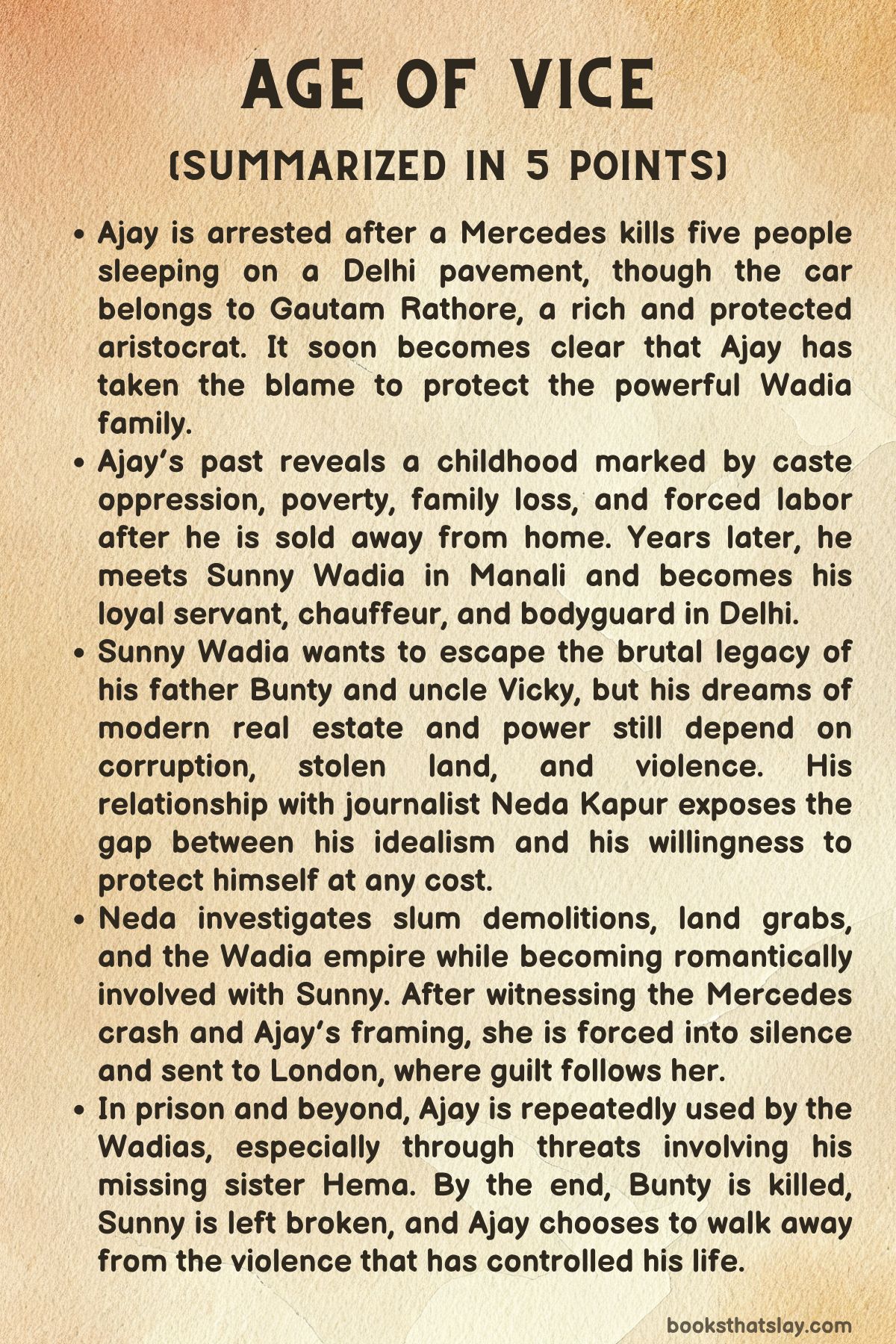
Age of Vice opens with a horrifying crash in New Delhi in 2004. A speeding Mercedes runs over five people sleeping on the pavement, killing them instantly, before slamming into a curb.
Inside the car, police find a drunk young man named Ajay. He is arrested and soon becomes known as the man responsible for the deaths.
Yet the car does not belong to him. It belongs to Gautam Rathore, the reckless son of an old royal-political family.
The Rathores claim Ajay took the car without permission, but inside prison, the other inmates quickly understand the truth: Ajay is taking the blame for someone far richer and more powerful.
Ajay’s past explains how he reached this point. As a child in eastern Uttar Pradesh, he grew up in extreme poverty in a Dalit family forced into degrading work.
His family’s life was destroyed after their goat strayed into the field of a dominant-caste landlord. The village headman beat Ajay’s father so badly that he later died.
To pay for treatment, Ajay’s mother borrowed money from the local moneylender, whose men then abused Ajay’s sister Hema. Soon after, Ajay was sold to a couple in Manali.
He was told that his wages would be sent home, but this was a lie. He spent years as a servant, learning discipline, silence, and survival.
In Manali, Ajay eventually found work at a café popular with tourists. There he met Sunny Wadia, the charismatic son of Bunty Wadia, a liquor baron and real-estate power broker with deep criminal ties.
Sunny noticed Ajay’s intelligence and efficiency and brought him to Delhi as a servant. Ajay became Sunny’s butler, then chauffeur and bodyguard.
He learned how to serve drinks, clean up after parties, manage secrets, and protect Sunny. He was trained in weapons by Eli, an ex-soldier working for the Wadias.
Ajay worshipped Sunny, seeing in him a path to security and purpose.
Sunny began a relationship with Neda Kapur, a young journalist at the Delhi Post. Neda came from educated, old-elite circles but was not rich.
She reported on land grabs, slum demolitions, and the way Delhi’s poor were being pushed aside for development projects. Her editor, Dean Saldanha, was investigating the links between wealth, politics, and real estate.
Neda was drawn to Sunny’s charm and ambition, even though she knew his family’s empire was built on violence and corruption. Their relationship became a secret life for her: by day she reported on injustice, and by night she entered Sunny’s luxurious world.
Sunny wanted to be seen as a visionary, not just his father’s son. He dreamed of building hotels, towers, and new urban spaces.
But his ideals were tangled with the very systems harming the poor. His father Bunty used political alliances to win liquor contracts, transport routes, and land deals.
Bunty’s brother Vicky Wadia controlled parts of eastern Uttar Pradesh through fear. Vicky was both gangster and self-styled holy man, a figure who terrified even those in the family.
Sunny had suffered under Vicky’s influence as a boy, especially after an incident involving abducted girls that left him deeply scarred.
Neda’s reporting brings her closer to the truth. She witnesses the demolition of a slum, where two infants are killed by a bulldozer.
Sunny tries to comfort her, but his father soon intervenes, suspecting that Neda may be gathering information on the Wadias. Neda is later attacked by men connected to the same world she is investigating.
Ajay saves her, beating the attackers and taking her to Sunny. Neda realizes the danger around Sunny is not separate from him; it is part of the power that protects him.
Meanwhile, Ajay tries to reconnect with his family. Sunny uses Wadia networks to locate Ajay’s mother, now living under the name Mary after converting to Christianity.
Ajay returns hoping for love and answers, but Mary rejects him. She blames him for the family’s ruin and tells him she never received money from his employers.
She also reveals that she sold him for cash. Ajay learns that Hema disappeared to Benares.
Shattered, he considers revenge against the Singh brothers who destroyed his family. He kills several of their men, crossing a line that changes him forever.
Vicky stops him from killing the powerful Kuldeep Singh, promising that Ajay can have revenge later and hinting that he knows where Hema is.
The night of the Mercedes crash exposes the full rot of this world. After returning from Goa with Neda, Sunny meets Gautam Rathore, who has backed out of helping him finance a new venture.
Angry, Sunny orders Ajay to chase Gautam’s car. Gautam, high and drunk, loses control and kills the people sleeping on the pavement.
Neda begs Sunny to call an ambulance. Instead, Sunny photographs Gautam at the wheel and decides to use the situation.
Ajay accepts the role of scapegoat. Sunny gives him alcohol and places him in the Mercedes.
When Neda resists, Sunny hits her. She is later forced by Bunty’s associate Chandra to leave India for London, where she discovers she is pregnant and is pressured into terminating the pregnancy.
In prison, Ajay is protected because he is known as a Wadia man, but that protection comes with obligations. He befriends Prem, a young inmate being abused by the violent prisoner Sikander.
Ajay attacks Sikander to protect Prem, but soon receives orders from Vicky to kill Karan Mehta, another inmate connected to a rival gang. Ajay hesitates because Prem loves Karan.
Then Ajay receives a photo of a woman in a brothel, presented as Hema, and understands the threat. To protect the sister he hopes is still alive, Ajay murders Karan.
Prem kills himself. Ajay is left further broken, trapped by the Wadias even in prison.
After the crash, Sunny is rewarded by Bunty for acting ruthlessly. Bunty gives him land for a real-estate project near Delhi and Uttar Pradesh.
Sunny’s project, Shunya Futures, becomes tied to forced land acquisition and a planned megacity. Dinesh Singh, son of the UP chief minister and once aligned with the Wadias, warns Sunny that Bunty has betrayed both families by expanding into stolen medicine routes, hospitals, and land deals that will ruin the poor.
Sunny refuses to listen. Public anger grows as farmers realize their land has been taken for a much larger scheme than they were told.
Sunny is then kidnapped by Sunil Rastogi, a criminal shaped by his own history of violence, loss, and manipulation. Rastogi has been influenced by Vicky, who seems to treat events as destiny.
During the kidnapping, Sunny learns that Bunty hid Neda’s pregnancy and arranged the abortion without his knowledge. This knowledge pushes Sunny deeper into addiction, rage, and despair.
He survives, but he becomes more cruel and unstable.
By 2008, Sunny is marrying Farah Dhillon, a politically useful bride chosen through Bunty’s ambitions. Ajay is temporarily released from prison to attend the wedding.
Bunty offers him a future outside prison if he continues serving the Wadias, then orders him to kill Rastogi. Ajay agrees only because he still wants Hema found and protected.
But when Ajay confronts Rastogi, Rastogi claims the woman in the photo is not Hema and tells him he has been used. Ajay walks away, finally refusing to kill for the Wadias.
At the wedding, Dinesh and Vicky move against the old order. Police arrive and arrest Bunty Wadia and Ram Singh on charges linked to murder, corruption, and kidnapping.
As Bunty is being transported, Rastogi attacks the police vehicle and kills him. Sunny sees his father’s ruined body, while Ajay boards a bus to Manali, trying to leave violence behind.
Age of Vice ends with Bunty dead, Sunny shattered, Ajay escaping toward an uncertain future, and the promise that the story’s conflicts are far from over.
Characters
Ajay
Ajay is the moral and emotional center of Age of Vice, even though he is repeatedly forced into roles designed by others. His life begins under caste oppression, poverty, violence, and abandonment, and these early wounds shape the extreme loyalty and obedience he later shows Sunny Wadia.
Ajay is not naturally cruel; he is disciplined, observant, intelligent, and capable of tenderness. Yet every stage of his life teaches him that survival depends on service.
As a child, he is sold into domestic labor and made to believe that his suffering is helping his family. As a young man, he enters the Wadia household and finds structure, status, and purpose in serving Sunny.
This makes his loyalty understandable, but also tragic. He mistakes usefulness for belonging.
Ajay’s arc is built around the destruction of his inner self. At first, he wants stability and dignity, but the world keeps turning him into a weapon.
He protects Neda, serves Sunny, takes the blame for Gautam, and kills when ordered or cornered. His violence is never simple villainy.
It comes from trauma, coercion, rage, and fear for his sister. The most painful part of Ajay’s character is that he knows when he is being used, yet he often cannot refuse because the people controlling him hold the only things he cares about.
His final refusal to kill Rastogi suggests the first real break in this pattern. By walking away from the Wadia command structure, Ajay begins to reclaim the self that was buried under service, guilt, and fear.
Sunny Wadia
Sunny Wadia is charming, damaged, privileged, and morally weak. He wants to believe he is different from his father and uncle, but he repeatedly benefits from the violence they created.
Sunny dreams of beauty, hotels, towers, wealth, and urban transformation. He imagines himself as a modern builder rather than a gangster’s son.
Yet his dreams depend on stolen land, political corruption, and the erasure of poor people from the city. His tragedy lies in the gap between self-image and action.
He wants to be loved as a visionary, but when faced with fear or pressure, he chooses power.
Sunny’s relationship with Ajay reveals his need for devotion. Ajay gives him loyalty without judgment, and Sunny accepts it as his due.
His relationship with Neda exposes his longing to be seen as good, sensitive, and wounded. Neda briefly allows him to imagine a life outside the Wadia empire, but he is never strong enough to choose that life.
His framing of Ajay after the crash is the clearest sign of his moral collapse. Even in a moment of death and horror, he thinks first of leverage, protection, and advantage.
After learning about Neda’s pregnancy and his father’s role in its termination, Sunny becomes more self-destructive and cruel. He is both victim and perpetrator, but the novel never allows his suffering to excuse his choices.
Neda Kapur
Neda Kapur is a journalist whose intelligence and ethical instincts are gradually compromised by desire, fear, and privilege. She begins as someone who wants to expose injustice.
Her work on slum demolitions, land grabs, and the connection between wealth and poverty places her close to the truth of Delhi’s transformation. She can see how the city’s poor are being pushed out to make room for elite dreams.
Yet her attraction to Sunny pulls her into the very world she is investigating. This contradiction defines her character.
Neda is not naïve in a simple sense. She knows enough to suspect the Wadias, and she recognizes the ugliness behind Sunny’s glamour.
Still, she wants to believe in his wounded idealism. Her class background also matters.
Though she is not as rich as Sunny’s circle, she has cultural access, education, mobility, and protection. These allow her to move between worlds, but they also allow her to escape when things become dangerous.
Her silence after the crash is her central moral failure. She knows Ajay is innocent, knows Gautam was responsible, and knows Sunny helped frame him, but she leaves India and accepts the terms arranged for her.
Her guilt in London shows that she has not forgotten the truth. Neda’s character is powerful because she is neither evil nor heroic.
She is someone who understands injustice but cannot fully sacrifice herself to oppose it.
Bunty Wadia
Bunty Wadia represents power stripped of sentiment. He is practical, brutal, and deeply aware of how modern India can be controlled through politics, business, violence, and respectability.
Unlike Sunny, Bunty does not need to pretend that his empire is clean. He understands that legal contracts, political favors, liquor licenses, transport routes, land acquisition, and criminal intimidation can all serve the same purpose.
His success comes from knowing how to make crime look like development.
As a father, Bunty is emotionally destructive. He wants Sunny to become ruthless, not happy.
When Sunny frames Ajay and uses Gautam’s crime for leverage, Bunty is proud because he sees this as proof that his son has finally learned the family language. Bunty’s love is conditional upon usefulness and hardness.
He also controls Neda’s fate with chilling ease, removing her from India and managing her silence through money and threats. Yet Bunty is not merely a private villain; he is a symbol of a system where business, politics, policing, and media can be bought or bent.
His death does not purify that system. It only shows that even men like him can be replaced, betrayed, or consumed by the violence they helped normalize.
Vicky Wadia
Vicky Wadia is the darkest expression of Wadia power. Where Bunty is corporate, strategic, and polished, Vicky is feudal, mystical, and openly terrifying.
He controls eastern Uttar Pradesh through fear and myth. His appearance, behavior, and reputation make him seem less like a businessman and more like a cult figure.
He presents himself as a godman, but his spirituality is inseparable from domination. He uses prophecy, fate, and ritual language to make violence seem inevitable.
Vicky’s influence over Sunny is especially disturbing. Sunny’s childhood memories of Vicky reveal humiliation, sexual violence, and the crushing of softness.
Vicky sees weakness as something to be punished or remade. His manipulation of Ajay is equally cruel.
He knows Ajay’s longing for Hema and uses it as a leash. By giving Ajay hope, he turns him into an instrument.
Vicky is not chaotic; he is patient and calculating. His alliance with Dinesh and his role in Bunty’s fall show that he understands political timing.
He may seem primitive compared with Bunty’s corporate world, but he is highly strategic. In Age of Vice, Vicky embodies old violence adapting itself to new power.
Gautam Rathore
Gautam Rathore is a portrait of inherited privilege without conscience. He comes from old royal wealth, polished education, and political protection.
Unlike Sunny, who is anxious about proving himself, Gautam behaves as though the world exists for his pleasure. His cruelty toward servants and his role in a young woman’s death show how deeply he has internalized entitlement.
He expects consequences to be managed by others because that is what has always happened.
The Mercedes crash is not an isolated accident in moral terms. It is the result of a life in which Gautam has never had to see poor people as fully human.
The people he kills are socially invisible to him until their deaths become a problem for his own survival. Even then, he is protected.
Chandra arranges his escape, Ajay takes his place, and Gautam is sent away to recover his reputation. Gautam’s function in the story is to expose the obscenity of elite immunity.
His guilt matters less to the system than his family name, his future usefulness, and the leverage that can be extracted from him.
Dinesh Singh
Dinesh Singh is one of the more politically complex characters. As the son of a powerful chief minister, he belongs to the same corrupt world as Sunny and Bunty.
He understands the arrangements between the Wadias and the Singhs, and he has benefited from them. Yet he also recognizes that the old model of corruption is becoming dangerous.
His conflict with his father is partly moral and partly strategic. He sees that exploiting farmers, stealing public resources, and displacing the poor may eventually create political disaster.
Dinesh’s turn toward the farmers’ protest can be read in two ways. On one level, he positions himself as a leader willing to stand with ordinary people against predatory development.
On another level, he is also making a calculated move against his father and Bunty. This duality makes him interesting.
He is not a pure reformer, but he is not empty either. He sees the future more clearly than the older men around him.
His decision to expose Bunty and Ram Singh helps bring down one structure of power, though it does not guarantee justice. Dinesh represents a new kind of political ambition: cleaner in language, sharper in media awareness, but still willing to use betrayal as a tool.
Sunil Rastogi
Sunil Rastogi is a frightening, unstable, and strangely theatrical figure shaped by neglect, police manipulation, family betrayal, and his own appetite for violence. His life begins in lower-middle-class insecurity rather than elite privilege, but he becomes another example of how violence reproduces itself across class lines.
After his brother’s death and his family’s collapse, his rage turns outward, especially against women. He is then used by the police, who encourage his criminal usefulness while pretending to serve justice.
Rastogi’s story shows how the state creates monsters and then denies responsibility for them. He learns that truth is less important than performance.
He invents crimes, manipulates police narratives, joins gangs, changes names, and survives through cunning. His connection to Vicky adds another layer: he begins to see his own actions as part of destiny.
This makes him more dangerous because he treats violence as a sacred assignment. His kidnapping of Sunny is not only about ransom; it is also about delivering pain, story, and revelation.
Rastogi is a mirror held up to the more respectable criminals. He is less polished than the Wadias, but his brutality comes from the same world of impunity, manipulation, and broken institutions.
Eli
Eli is a professional protector, trained, controlled, and emotionally distant. As Sunny’s bodyguard, he watches the collapse of his employer with a mixture of contempt, pity, and duty.
Eli’s role is important because he sees much but says little. He knows Sunny’s weakness, addiction, and recklessness.
He understands that the luxury around Sunny is rotten, yet he remains part of the machinery that keeps Sunny alive and shielded.
Unlike Ajay, Eli does not worship Sunny. His loyalty is more contractual and professional.
This makes him a useful contrast. Ajay’s service is emotional and born from need; Eli’s service is disciplined and detached.
Still, Eli is not free. He is bound by employment, violence, and habit.
His repeated rescues of Sunny after overdoses show the exhaustion of protecting someone who may not want to live responsibly. Eli represents the hired men who keep elite chaos from becoming public scandal.
He is not the architect of the system, but he helps maintain it.
Mary, formerly Rupa
Mary, Ajay’s mother, is one of the most painful figures in the story because she is both victim and source of harm. As Rupa, she suffers poverty, widowhood, caste oppression, debt, sexual violence against her daughter, and the terror of survival without protection.
Her decision to sell Ajay is horrifying, but it occurs in a world where she has almost no power and no safe choices. The tragedy is that her suffering does not make her gentle.
It hardens into resentment.
When Ajay returns, Mary rejects him and blames him for the family’s ruin. Her accusations are cruel, especially because Ajay has spent years believing his labor helped her.
Yet her bitterness also reflects the damage caused by extreme humiliation. She needs someone to blame, and Ajay becomes the target because he is the one who returns.
Her conversion and new name suggest an attempt to escape the past, but the past remains alive in her anger. Mary’s character shows how oppression can fracture family bonds and turn victims against one another.
Hema
Hema is physically absent for much of the story, but her presence drives some of Ajay’s most important choices. As Ajay’s older sister, she is one of the first people he fails to protect, though he is only a child at the time.
The assault against her becomes a permanent wound in his memory. Later, her disappearance gives the Wadias a powerful tool to control him.
They understand that Ajay’s love and guilt can be weaponized.
Hema represents the many women whose suffering is hidden behind the public stories of men, politics, and money. Her fate is uncertain, and that uncertainty is central to her function in the novel.
She becomes a symbol of Ajay’s lost family, lost innocence, and impossible hope. Because he does not know where she is, he remains vulnerable to manipulation.
The photo supposedly showing her in a brothel is enough to make him kill. Hema’s absence is therefore not emptiness; it is a form of pressure that shapes the plot.
Prem
Prem is one of the clearest victims of prison brutality. Young, vulnerable, and trapped, he is abused by Sikander under the false language of protection.
His forced feminization, sexual exploitation, and emotional captivity show how prison reproduces the same hierarchies of power that exist outside. Prem’s suffering also awakens something protective in Ajay.
Ajay sees in Prem another person being used by stronger men, and this recognition pushes him to act.
Prem’s love for Karan gives him a brief sense of dignity and desire outside Sikander’s control. That makes the ending of his arc especially devastating.
When Ajay kills Karan, he destroys the one relationship that had given Prem hope. Prem’s suicide is not only a response to grief; it is the final result of a world that has denied him safety, agency, and tenderness.
Through Prem, the story shows how institutions meant to punish crime can become sites of unchecked violence against the powerless.
Karan Mehta
Karan Mehta matters less for his individual history than for the position he occupies in the prison power struggle. He is connected to a rival criminal network, which makes him a target for Vicky Wadia.
To Prem, however, Karan is not a political object. He is a person capable of affection and escape, at least emotionally.
This difference between how systems see people and how individuals love them is central to his role.
Karan’s death shows how little personal feeling matters in a world governed by gangs, favors, and threats. Ajay does not kill him out of hatred.
He kills him because Hema’s supposed safety is placed against Karan’s life. Karan becomes another body sacrificed to someone else’s strategy.
His murder also marks one of Ajay’s lowest moments, because Ajay knowingly betrays Prem’s trust. Through Karan, the story shows how even love inside prison can be crushed by forces operating far beyond the lovers themselves.
Chandra
Chandra is the quiet fixer who makes elite crimes disappear. He is not as visibly violent as Vicky or as commanding as Bunty, but his calm efficiency is deeply sinister.
He handles Gautam after the crash, manages Neda’s removal from India, arranges silence, and turns horror into logistics. His power lies in procedure.
He knows where to send people, what to say, what threats to imply, and how to make victims feel that compliance is their only option.
Chandra represents the bureaucratic face of corruption. He does not need to shout or attack because he works inside networks that already obey money and influence.
His politeness makes him more chilling. With Neda, he uses her parents as leverage and offers comfort as a form of control.
With Gautam, he converts manslaughter into a debt owed to the Wadias. Chandra shows that great crimes require not only violent men, but also organized, intelligent managers who can clean the scene afterward.
Tinu
Tinu is the household manager who keeps the Wadia world functioning at the domestic and logistical level. He is not one of the central power holders, but he is important because he connects orders to action.
He manages staff, messages, movements, and arrangements. Men like Tinu make elite households operate smoothly even when those households are tied to crime.
His relationship with Ajay is shaped by hierarchy. Tinu helps place Ajay inside the Wadia system, but he also treats him as a resource to be assigned and controlled.
He is part of the machinery that turns people into functions: driver, servant, guard, scapegoat, killer. Tinu may not carry the same moral weight as Bunty or Vicky, but his obedience makes him complicit.
He shows how large systems of power depend on middle figures who rarely question the purpose of the orders they carry out.
Farah Dhillon
Farah Dhillon enters as Sunny’s politically useful bride, but she is not merely a passive match. She comes from a powerful Punjabi family and understands ambition, access, and social performance.
Her marriage to Sunny is arranged as part of Bunty’s plan to shift future influence toward Punjab. In that sense, she represents the continuation of power through marriage, alliance, and regional politics.
Farah also reflects the emotional emptiness of Sunny’s later life. Their wedding is not a union of love but a transaction surrounded by wealth, drugs, spectacle, and political calculation.
Her confidence and appetite for status make her well suited to the world Bunty imagines for Sunny, but Sunny himself is too broken to inhabit that future cleanly. Farah’s presence shows how elite families consolidate influence while masking decay beneath celebration.
Dean Saldanha
Dean Saldanha is the journalist who most clearly understands the scale of Wadia corruption. As Neda’s editor, he pushes her toward stories that reveal how wealth feeds on poverty.
His investigation into Bunty’s liquor monopoly, political bribery, transport networks, and criminal enforcement shows the importance of journalism in exposing hidden power. Yet Dean also learns the limits of truth in a captured system.
His story is marked by professional defeat. His exposé is killed, his computer appears to have been compromised, and he is forced out of his position.
He has the facts, but facts alone cannot overcome owners, advertisers, political pressure, and fear. Dean’s later reporting on the farmers’ protests shows that he does not entirely surrender.
He remains a witness. His character represents the fragile role of the press in a society where the powerful can suppress stories but cannot always erase reality.
Sikander
Sikander is prison power made flesh. He dominates through fear, sexual violence, and psychological control.
His abuse of Prem is one of the clearest examples of how captivity creates private kingdoms for violent men. Sikander offers protection only to create dependency.
He turns vulnerability into property.
His presence also forces Ajay into a confrontation with his own limits. Ajay has tried to remain quiet in prison, but Sikander’s brutality breaks through his numbness.
By attacking Sikander, Ajay acts from moral disgust rather than obedience. Yet the prison world does not become safer afterward.
Sikander’s system of control continues in different forms, and Ajay is soon pulled back into Wadia business. Sikander shows that violence does not belong only to the rich outside prison; it is reproduced wherever power is unchecked.
Ram Singh
Ram Singh is the political partner who helps make the Wadia empire possible. As chief minister, he represents elected authority corrupted into private service.
His relationship with Bunty is transactional: political power gives business access, and business money strengthens political rule. Together, they turn the state into a marketplace for contracts, licenses, land, and protection.
Ram Singh is important because he shows that corruption is not merely a criminal problem. It is governmental.
The violence against slum dwellers, farmers, rivals, and the poor is backed by policy, police silence, and official permissions. His fall alongside Bunty suggests a public reckoning, but it also raises the question of who will inherit the system they built.
Ram Singh is less individually memorable than Bunty or Vicky, but structurally he is essential.
Kuldeep Singh and Rajdeep Singh
Kuldeep Singh and Rajdeep Singh represent local caste power at its most brutal. Kuldeep’s beating of Ajay’s father begins the chain of suffering that defines Ajay’s life.
Rajdeep’s role as moneylender shows how debt becomes a tool of domination. Together, they control land, bodies, labor, and punishment in the village.
Their violence is intimate and local, but it connects to the larger systems controlled by men like the Wadias.
These characters show that oppression does not begin in Delhi’s luxury hotels or political offices. It begins in fields, villages, caste hierarchies, and debt arrangements.
The Singhs can humiliate Ajay’s family because the social order protects them. Later, their connection to larger political-criminal networks reveals that village cruelty and national corruption are not separate worlds.
They are parts of the same chain.
Themes
Power, Protection, and Impunity
Power in Age of Vice operates less like a public title and more like a private climate surrounding the rich. The powerful do not simply commit crimes; they alter the meaning of crimes after they happen.
Gautam kills five people, but Ajay is made into the criminal. Sunny frames a servant and calls it necessity.
Bunty sees the disaster not as a moral catastrophe but as leverage over a royal family. Chandra turns trauma into paperwork, travel arrangements, false alibis, and managed silence.
This is how impunity works in the novel: it is not only the absence of punishment, but the active production of an alternate reality.
Protection is never innocent. To be protected by the Wadias means to be owned by them.
Ajay is protected in prison because he is a Wadia man, but that same protection makes him available for further orders. Gautam is protected after the crash, but he becomes indebted.
Neda is protected through money and relocation, but the protection is really containment. The novel shows that elite power does not need to deny violence.
It absorbs violence, redirects blame, and makes the weak pay for the survival of the strong. The law exists, but it bends around money, caste, political influence, and fear.
Caste, Class, and the Inherited Shape of Suffering
Ajay’s life shows how caste and class decide who is allowed dignity, safety, and a future. His childhood is not just poor; it is structured by inherited humiliation.
His family’s work, their exclusion from village spaces, the denial of proper cremation, the beating of his father, and the assault on Hema all come from a social order that treats them as disposable. Poverty makes them vulnerable, but caste teaches others that this vulnerability is natural.
Ajay is sold because his body has already been devalued by the world around him.
The novel connects this rural caste violence to urban class violence. The pavement dwellers killed by Gautam, the slum residents pushed out of Delhi, the farmers whose land is acquired, and the servants moving silently through elite homes all belong to a broad landscape of dispossession.
The wealthy characters often speak the language of growth, beauty, investment, and modernization, but the cost is carried by people with the least power. Ajay’s rise into the Wadia household does not free him from caste and class.
It only changes the form of his dependency. He wears better clothes, learns weapons, and serves richer men, but his life remains available for sacrifice.
His story shows that mobility without freedom can become another trap.
Development, Land, and the Violence Behind Modernity
The promise of development in the novel is repeatedly tied to removal. Slums must be cleared to beautify Delhi.
Farmers must give up land for highways, megacities, hospitals, and real-estate projects. Poor people are told that displacement is temporary, reasonable, or necessary.
Yet the benefits flow upward, while the costs remain with those who lose homes, work, community, and bargaining power. The language of progress becomes a cover for theft.
Sunny’s dream of building new spaces is central to this theme because he genuinely wants to see himself as a creator. He imagines towers, hotels, and transformed cities, but he refuses to fully confront the machinery that makes his dream possible.
The land does not arrive cleanly. It is acquired through political pressure, misinformation, police force, and broker networks.
Even compensation can become destructive, as seen in the farmers whose sudden cash payment cannot replace land, livelihood, or identity. The novel refuses the idea that corruption is an accidental stain on development.
Instead, it shows development as something often designed through corruption from the start. Roads, luxury projects, and hospitals appear modern, but beneath them are evictions, stolen public resources, and bodies treated as obstacles.
Loyalty, Guilt, and Moral Compromise
Loyalty in the novel is often born from need rather than trust. Ajay is loyal to Sunny because Sunny gives him employment, status, and a form of recognition after years of abandonment.
Neda remains emotionally tied to Sunny because she sees his wounds and mistakes vulnerability for goodness. Sunny seeks loyalty from Ajay, Neda, and later political allies because he cannot stand alone against his father.
Yet loyalty becomes dangerous when it asks people to surrender judgment. Ajay’s loyalty makes him accept blame for a crime he did not commit.
Neda’s attachment helps silence her. Sunny’s desire to please Bunty pushes him into moral ruin.
Guilt follows these characters, but guilt does not always produce courage. Neda knows the truth and suffers from it, yet she cannot bring herself to expose it.
Sunny feels betrayed and wounded, but he turns pain outward rather than accepting responsibility. Ajay feels guilt over Hema, Prem, Karan, and his own violence, but for a long time that guilt keeps him obedient because others know how to use it.
The novel’s moral world is frightening because compromise rarely happens all at once. It happens through fear, love, debt, shame, and the hope that one more wrong act might protect someone.
By the time characters recognize what they have become, the damage is already vast.