Adelaide by Genevieve Wheeler Summary, Characters and Themes
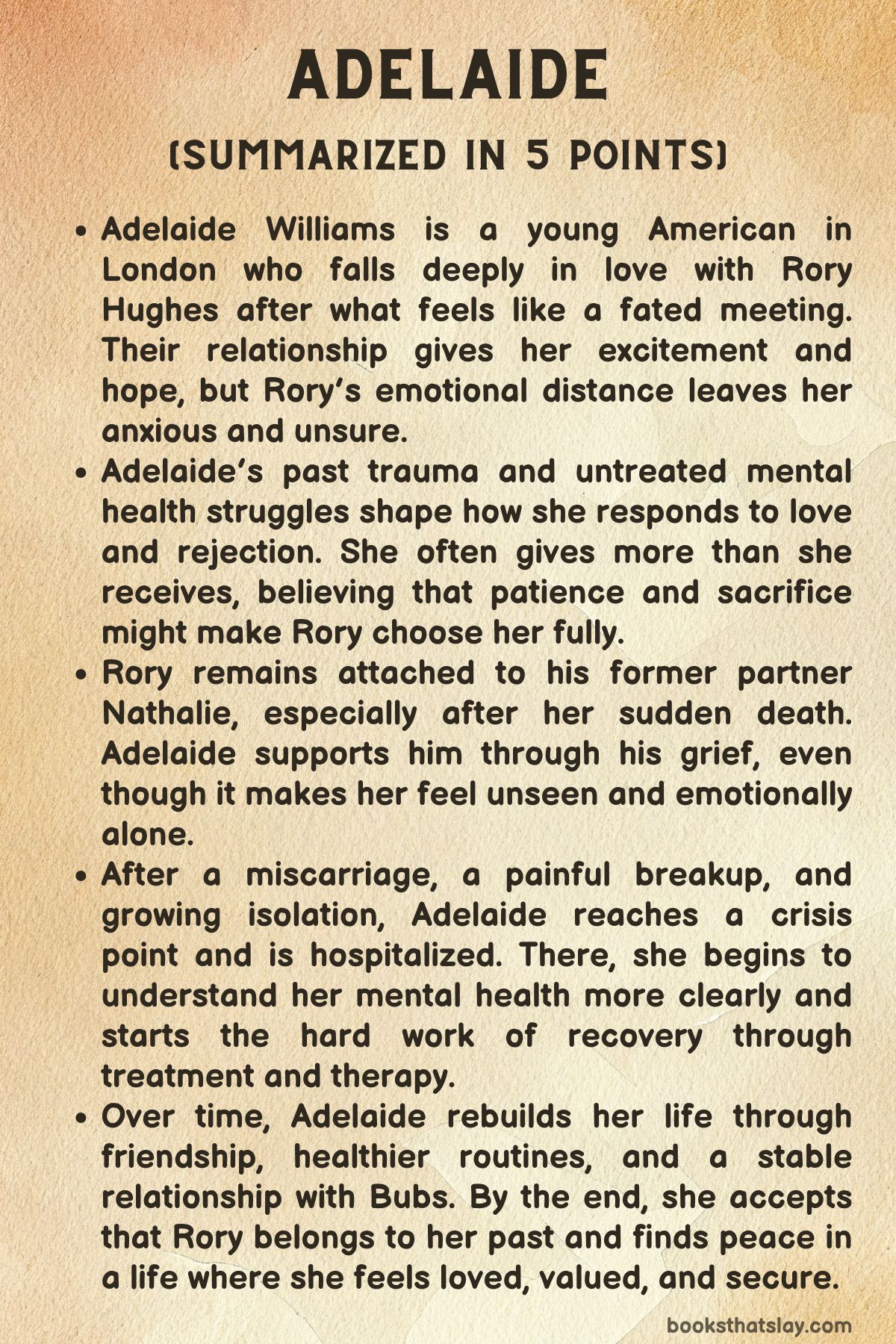
Adelaide by Genevieve Wheeler is a contemporary literary novel about love, mental health, and the complicated ways people search for connection. The story follows Adelaide Williams, a young American living in London who believes she has finally found the person she is meant to be with when she meets Rory Hughes.
As their relationship unfolds, Adelaide becomes deeply attached while struggling with past trauma, insecurity, and an intense need for love. Through shifting timelines, the novel explores her experiences with heartbreak, grief, and identity. Ultimately, the book examines how difficult relationships and painful experiences can shape a person’s understanding of themselves and their path toward healing.
Summary
Adelaide Williams is hospitalized after taking a handful of pills during a moment of despair. She insists that she did not truly want to die, but the emotional weight she was carrying had become unbearable.
A psychologist asks her to explain what led to the event, and Adelaide struggles to articulate the tangled story of her life, her relationships, and the heartbreak that pushed her to that point.
Before the crisis, Adelaide had been living in London with her college friend Madison. They shared a flat in Highgate and had recently befriended Celeste, another graduate student.
Adelaide was finishing a graduate degree in marketing and communications while thinking about her future. One evening she prepares for a date with a man she met online named Rory Hughes.
Madison warns her not to rush into anything, knowing that Adelaide often becomes emotionally involved too quickly.
When Adelaide arrives for the date, she realizes she has seen Rory before. Two years earlier she had boldly approached him near the river and told him that he looked like a Disney prince.
Rory does not remember the encounter, but the coincidence delights Adelaide. Their date goes well, and she feels an instant connection.
Afterward she tells her best friend Eloise that she may have met her soulmate.
Adelaide and Rory continue seeing each other. Their conversations feel easy and exciting, and Adelaide finds herself deeply drawn to him.
She notices that they share many interests, including similar tastes in books and music. After attending a play together, they finally sleep together, and Adelaide experiences a level of emotional intimacy she rarely feels with other partners.
She begins to believe their relationship could become something lasting.
At the same time, Adelaide’s past continues to influence her present. When she was a teenager, she dated a boy named Emory Evans.
Over time Emory became controlling and aggressive. During their relationship he sexually assaulted her multiple times, leaving Adelaide with trauma she never fully addressed or shared with others.
These experiences shape how she responds to intimacy and relationships later in life.
While Adelaide is falling for Rory, his own history unfolds separately. During his years at Cambridge he had a long relationship with a woman named Nathalie Alban.
They loved each other but struggled with Rory’s emotional inconsistency. Sometimes he was affectionate and committed, while at other times he withdrew.
Eventually their relationship ended when Rory admitted he could not sustain the partnership.
Back in the present, Adelaide and Rory continue spending time together around London. She accepts a job with a technology company while continuing to nurture her dream of working with books.
The relationship feels exciting but unstable. Rory often disappears for days without responding to her messages, leaving Adelaide anxious and uncertain about where she stands with him.
Despite these inconsistencies, they share meaningful moments together. During a trip to Mallorca that Adelaide receives through work, they explore the city, talk for hours, and seem deeply connected.
Adelaide becomes increasingly convinced that Rory is the person she wants to build her life with.
However, small signs of imbalance appear. Rory rarely expresses strong emotional commitment, and Adelaide often feels she must prove herself worthy of his love.
When she befriends Nathalie by coincidence without realizing who she is, the situation becomes complicated. Later Rory reveals that Nathalie is his former partner, shocking Adelaide and intensifying her insecurities.
As time passes, Adelaide’s emotional investment grows stronger while Rory remains ambiguous. During birthdays and holidays Adelaide carefully plans thoughtful gestures, hoping he will reciprocate her feelings.
Eventually she confesses that she loves him. Rory responds kindly but does not say the words back, explaining that he does not want marriage or traditional commitments.
Adelaide is hurt but continues the relationship.
A sudden tragedy shifts everything. Nathalie dies in an accident.
Rory is devastated and openly describes her as the love of his life. Adelaide stays with him and supports him through his grief, even though the situation is deeply painful for her.
She struggles with the knowledge that she is comforting him while he mourns another woman.
During this period Adelaide’s physical and emotional health begins to deteriorate. She experiences nausea, crying spells, and exhaustion.
Eventually she discovers that she is pregnant. Unsure how Rory will react, she confides only in Eloise while considering how to tell him.
Before she can share the news, she suffers a miscarriage. The loss devastates her, and she keeps the experience secret from Rory.
The relationship becomes increasingly strained. Adelaide recognizes that Rory is still emotionally tied to Nathalie and unable to fully commit to her.
Eventually she confronts him and suggests that they cannot continue together under these circumstances. They briefly separate but later reconnect.
Meanwhile Adelaide’s friendships begin to shift. Madison plans to move abroad, and the stability of their shared home disappears.
Adelaide feels increasingly alone and dependent on Rory for emotional support. During a night out she discovers that Rory still has an active dating profile.
When she confronts him, he initially denies using it but later admits that he had been browsing other matches.
This revelation breaks Adelaide’s trust. She ends the relationship permanently and prepares to move into her own apartment.
The transition proves overwhelming. Surrounded by reminders of Rory and the life she imagined with him, Adelaide experiences intense panic and despair.
In that vulnerable moment she takes a large number of pills, leading to her hospitalization.
While recovering, Adelaide begins to confront the deeper issues behind her emotional turmoil. Doctors evaluate her mental health and discuss her family history, which includes depression and bipolar disorder.
After listening to Adelaide’s experiences, a psychiatrist suggests that she may also have bipolar disorder. The diagnosis shocks her but begins to explain the extreme highs and lows she has experienced.
Adelaide starts medication and therapy. The process is difficult at first, including physical reactions to the medication, but gradually she begins to feel more stable.
With the help of a therapist named Meg, she starts exploring the patterns that shaped her relationships, particularly her tendency to prioritize others’ needs over her own well-being.
She also rebuilds her daily life. Yoga, new routines, and supportive friendships help her regain emotional balance.
During this period she reconnects with Rory’s friend Brennan Uralla-Burke, known as Bubs. Unlike Rory, Bubs treats Adelaide with consistent care and respect.
Their friendship slowly develops into a romantic relationship.
Adelaide continues to heal over time. She spends holidays with her family, reconnects with Eloise, and adopts a dog named Fitz.
Therapy helps her understand that love should not require constant self-sacrifice. She learns to value her own happiness rather than seeking validation from people who cannot give it.
Years later, Adelaide is living a calm and fulfilling life with Bubs. While walking her dog one day, she briefly sees Rory again.
He does not recognize her and is wearing a wedding ring. The moment brings a mixture of memories and acceptance.
Adelaide realizes that although Rory was once central to her life, he is now only part of her past.
She reflects on how much she has changed since those painful years. Her friendships remain strong even though many of her friends live in different places.
Her relationship with Bubs is stable and loving. Although she cannot predict the future, she feels secure in the present.
Adelaide understands that some questions about the past may never have answers. What matters now is that she has built a life where she feels valued, supported, and at peace.
Characters
Adelaide Williams
Adelaide Williams is the emotional center of Adelaide, and her character is shaped by an intense longing for love, validation, and belonging. She is intelligent, sensitive, and deeply introspective, but she also struggles with insecurity and a powerful tendency to attach her self-worth to romantic relationships.
Living in London while pursuing graduate studies and beginning a career in marketing, Adelaide appears outwardly ambitious and capable. However, beneath that surface she carries unresolved trauma from past abuse, complicated family dynamics, and untreated mental health challenges.
These experiences influence the way she interprets love and connection.
A defining element of Adelaide’s character is her romantic idealism. She believes strongly in fate, timing, and the idea that certain people are meant to find each other.
This belief leads her to interpret small coincidences as signs that her relationship with Rory is destined. While this outlook reveals her hopeful nature, it also makes her vulnerable to disappointment when reality does not match her expectations.
She invests enormous emotional energy into the relationship, often ignoring warning signs and justifying Rory’s inconsistent behavior because she wants the relationship to succeed.
Adelaide’s past plays a significant role in shaping her responses to intimacy. Her abusive relationship with Emory during adolescence leaves lasting psychological effects.
She never fully processes the trauma, and it influences how she perceives affection, aggression, and emotional closeness. As a result, she sometimes tolerates behavior that hurts her because she has internalized the belief that love must involve suffering or sacrifice.
Her silence about the abuse also reinforces a pattern of handling pain privately rather than seeking help.
Another key dimension of Adelaide’s character is her mental health journey. Over the course of the narrative, her emotional instability becomes more visible.
She experiences intense mood shifts, obsessive thoughts about relationships, and episodes of despair. The eventual suggestion that she may have bipolar disorder reframes many of her earlier experiences.
Instead of seeing herself as simply overly emotional or needy, she begins to understand that her brain processes emotions differently. This realization marks a turning point in her self-understanding.
Adelaide’s growth lies in learning to prioritize herself rather than constantly trying to earn love from others. Therapy, medication, and supportive friendships help her develop healthier emotional boundaries.
She begins to recognize that her worth is not determined by whether someone chooses her romantically. By the end of the story, she has become more grounded and self-aware.
Although she still remembers her painful experiences, they no longer define her identity. Her journey ultimately reflects resilience and the possibility of healing after heartbreak and trauma.
Rory Hughes
Rory Hughes represents both Adelaide’s greatest hope and her deepest disappointment. He is charming, intelligent, and culturally engaged, qualities that initially attract Adelaide to him.
Their shared interests in literature, art, and music create a sense of compatibility that convinces Adelaide their connection is extraordinary. Rory’s personality is not overtly cruel or malicious, but his emotional inconsistency and inability to commit create significant harm.
A central aspect of Rory’s character is emotional detachment. He enjoys companionship and intimacy but struggles with sustained commitment.
His relationship with Nathalie reveals a similar pattern: periods of affection followed by withdrawal. This behavior suggests that Rory values independence and emotional distance, even when he cares about someone.
Rather than confronting these tendencies directly, he often avoids difficult conversations or allows situations to continue without clarity.
Rory’s grief over Nathalie further complicates his character. After her death, it becomes clear that he still viewed her as the most important romantic relationship of his life.
His mourning highlights the depth of his feelings for her, but it also exposes the imbalance in his relationship with Adelaide. Adelaide becomes a source of comfort during his grief, yet he never reciprocates her emotional commitment in the same way.
His comparison between Adelaide and Nathalie, even when unspoken, reinforces Adelaide’s sense of inadequacy.
Despite his shortcomings, Rory is not portrayed as entirely heartless. He genuinely appreciates Adelaide’s kindness and sincerity, and he recognizes that she cares deeply for him.
However, appreciation does not translate into love. His inability to match Adelaide’s emotional intensity leads him to treat the relationship casually while she views it as central to her life.
This mismatch becomes the root of their conflict.
Rory’s eventual reflection on their relationship shows a limited level of self-awareness. He admits that he liked being with Adelaide because she made him feel comfortable and understood, yet he also acknowledges that he never intended to fall in love with her.
This honesty reveals a painful truth: the relationship meant far more to Adelaide than it ever did to him. Rory ultimately symbolizes the kind of partner who benefits from someone’s devotion without fully recognizing its emotional cost.
Brennan “Bubs” Uralla-Burke
Brennan Uralla-Burke, often called Bubs, begins as a secondary figure in Rory’s social circle but gradually becomes one of the most important people in Adelaide’s life. At first he appears as a friendly acquaintance who interacts with Adelaide through Rory, yet his role grows as he demonstrates consistent empathy and respect.
Bubs represents a contrast to Rory’s emotional unpredictability.
One of Bubs’s defining qualities is reliability. He shows concern for Adelaide’s well-being even when their connection is casual.
When he encounters her during difficult moments, he responds with patience rather than judgment. His willingness to listen and offer support creates a sense of emotional safety that Adelaide rarely experienced in her romantic life before.
Bubs also demonstrates moral clarity about Rory’s treatment of Adelaide. While he remains Rory’s friend, he does not excuse Rory’s behavior.
Instead, he openly acknowledges that Adelaide deserved better. This honesty helps Adelaide begin to see her situation more objectively.
Bubs becomes someone who validates her feelings rather than dismissing them.
Their eventual romantic relationship develops slowly and naturally, reflecting a healthier emotional dynamic. Unlike Adelaide’s previous relationships, this connection is based on mutual care rather than intense obsession or longing.
Bubs values Adelaide as a person rather than idealizing or comparing her to someone else. This steady affection helps Adelaide rebuild trust in relationships.
Bubs ultimately symbolizes stability and emotional maturity. Through him, Adelaide experiences a form of love that does not demand constant proof or sacrifice.
His presence in her life reinforces the idea that healthy relationships are grounded in respect, consistency, and shared support rather than dramatic emotional highs and lows.
Celeste
Celeste serves as one of Adelaide’s most dependable friends and an important source of emotional support. Living in London alongside Adelaide and Madison, she becomes part of a close-knit social group that helps Adelaide navigate the challenges of adulthood.
Celeste’s personality is grounded, observant, and compassionate.
Throughout Adelaide’s struggles with Rory, Celeste often provides practical advice and emotional reassurance. She encourages Adelaide to maintain perspective when the relationship becomes confusing or painful.
Unlike Adelaide, who frequently interprets events through the lens of romance and destiny, Celeste tends to approach situations more realistically.
Celeste’s loyalty becomes especially evident during Adelaide’s mental health crisis. When Adelaide is hospitalized, Celeste immediately steps in to help her recover and adjust.
Her presence during this vulnerable period demonstrates the strength of their friendship. Rather than offering superficial comfort, she actively supports Adelaide’s efforts to seek treatment and rebuild her life.
Celeste’s role highlights the importance of friendship in the narrative. While romantic relationships often dominate Adelaide’s attention, Celeste represents the enduring connections that sustain her through difficult periods.
Her consistent support reminds Adelaide that she is not alone, even when romantic love fails.
Madison
Madison is Adelaide’s roommate and one of her earliest companions in London. Their friendship provides stability during Adelaide’s transition from university life into adulthood.
Madison’s personality is practical, outspoken, and protective, which often leads her to challenge Adelaide’s romantic decisions.
From the beginning, Madison expresses concern about Adelaide’s tendency to become emotionally invested in men too quickly. She warns Adelaide to approach the relationship with Rory cautiously, recognizing patterns that Adelaide herself overlooks.
Madison’s skepticism reflects her desire to protect her friend from unnecessary heartbreak.
Madison’s decision to move abroad later in the story represents a major turning point for Adelaide. Their shared apartment had been a symbol of friendship and security, and its dissolution forces Adelaide to confront independence.
Although the move initially feels like abandonment, it ultimately pushes Adelaide to develop greater self-reliance.
Madison also plays an important role in confronting Adelaide about her priorities. When Adelaide misses Madison’s farewell gathering because she chooses to spend time with Rory, Madison openly criticizes the decision.
This confrontation highlights the tension between Adelaide’s romantic fixation and her friendships. Madison’s honesty, though painful, encourages Adelaide to reconsider how she values the people in her life.
Eloise
Eloise is Adelaide’s closest friend from childhood and a constant presence despite geographical distance. Their friendship provides emotional continuity throughout Adelaide’s life, serving as a reminder of stability beyond romantic relationships.
Eloise is supportive, protective, and deeply invested in Adelaide’s well-being.
Eloise often acts as Adelaide’s confidante, listening to long conversations about Rory and offering reassurance during moments of doubt. Although she tries to encourage Adelaide, she also expresses concern about whether Rory truly appreciates her.
Her balanced perspective helps Adelaide process her feelings without dismissing them.
Eloise’s own life trajectory contrasts with Adelaide’s experiences. She maintains a long-term relationship with her partner Nico, eventually marrying him.
This stability sometimes intensifies Adelaide’s feelings of inadequacy, as she compares her own complicated romantic life to Eloise’s seemingly secure partnership. Despite these differences, Eloise remains compassionate and supportive.
Eloise’s protective nature becomes especially evident when she confronts Rory after the breakup. She warns him to stay away from Adelaide, demonstrating her fierce loyalty.
Her willingness to defend Adelaide reinforces the strength of their friendship and underscores the importance of having people who advocate for one’s emotional safety.
Nathalie Alban
Nathalie Alban is a pivotal figure whose presence shapes both Rory’s past and Adelaide’s insecurities. She is successful, confident, and intellectually accomplished, working as an editor at a major publication.
Even before Adelaide learns about her connection to Rory, Nathalie’s charisma and achievements leave an impression.
Nathalie’s relationship with Rory represents the benchmark against which Adelaide measures herself. Their long history and Rory’s lingering attachment make Nathalie seem almost mythical in Adelaide’s mind.
Even after Nathalie’s death, her influence remains powerful, affecting how Adelaide interprets Rory’s feelings and her own place in his life.
Nathalie’s accidental death transforms her into a symbol of unfinished love for Rory. Because their relationship ended without complete resolution, Rory idealizes her memory.
This idealization intensifies Adelaide’s self-doubt, as she feels she is competing with someone who can never disappoint him again.
Although Nathalie appears only briefly, her impact on the narrative is profound. She represents the kind of romantic ideal that Adelaide believes she must match in order to be loved.
In reality, Nathalie’s role reveals more about Rory’s emotional limitations than about Adelaide’s worth.
Dr. Grayson
Dr. Grayson is the psychiatrist who evaluates Adelaide after her hospitalization. His role is crucial in helping her understand the psychological patterns that shaped her experiences.
Unlike many people in Adelaide’s life, he approaches her story without judgment or emotional bias.
During their conversations, Dr. Grayson encourages Adelaide to examine her family history and personal experiences in a broader context. His suggestion that she may have bipolar disorder provides a new framework for interpreting her emotional intensity and mood fluctuations.
This perspective helps Adelaide begin to separate her identity from the symptoms she has struggled with.
Dr. Grayson’s calm and analytical approach contrasts with the emotional chaos that characterized Adelaide’s recent life. By offering medical guidance and validation, he helps her take the first steps toward treatment.
His presence marks the beginning of Adelaide’s structured path toward mental health recovery.
Meg
Meg, Adelaide’s therapist, becomes an essential figure in her healing process. Through therapy sessions, Meg helps Adelaide explore the emotional patterns that influenced her relationships and self-perception.
She listens attentively and encourages Adelaide to articulate feelings that she previously avoided confronting.
Meg focuses particularly on Adelaide’s tendency to prioritize other people’s needs above her own. She guides Adelaide toward recognizing how this habit contributed to unhealthy relationships.
Instead of framing Adelaide’s behavior as weakness, Meg helps her understand it as a learned coping mechanism that can be changed.
The therapeutic relationship between Meg and Adelaide gradually builds trust and emotional awareness. Meg’s supportive approach empowers Adelaide to develop healthier boundaries and to value herself independently of romantic validation.
Through these sessions, Adelaide learns that self-respect and self-compassion are necessary foundations for any future relationships.
Meg ultimately represents the structured guidance that helps Adelaide move from emotional chaos toward stability. Her influence reinforces the novel’s emphasis on healing, self-understanding, and the possibility of personal transformation.
Themes
Love, Obsession, and Emotional Imbalance
Romantic love in Adelaide is presented not as a calm source of mutual comfort but as an experience that can become consuming when two people do not carry the same level of feeling, commitment, or clarity. Adelaide does not simply like Rory; she builds a private emotional world around him.
She gives meaning to coincidences, shared interests, and fleeting moments of tenderness until the relationship begins to function as the organizing principle of her life. What makes this theme so powerful is that the novel does not mock her for this intensity.
Instead, it shows how easy it is for longing to grow into fixation when someone offers enough intimacy to create hope but not enough consistency to create security. Adelaide is not irrational in a simplistic sense.
She is responding to real affection, real chemistry, and real companionship. The tragedy is that these things are not enough to sustain the kind of relationship she wants.
The emotional imbalance between Adelaide and Rory becomes the central fact of their connection. She interprets the relationship as deepening while he experiences it as something meaningful but limited.
That gap creates a private anguish that defines much of her life. She waits for messages, replays conversations, searches for signs, and measures her value by the degree of access she has to him.
The novel is especially perceptive in showing how imbalance does not always arrive through obvious cruelty. Rory does not need to openly deceive her at every step for damage to occur.
His distance, evasiveness, and selective availability are enough. He accepts her love without truly returning it, and that dynamic leaves Adelaide doing emotional labor for both of them.
The relationship becomes even more painful after Nathalie’s death, because grief gives Rory a reason to remain emotionally unavailable while Adelaide feels morally obligated to stay and care for him. Love then becomes tied to self-erasure.
Adelaide begins to believe that devotion means endurance, that proving her worth requires patience without limit. This turns romance into a site of humiliation, comparison, and silent bargaining.
She does not only want to be loved; she wants to become the person who is finally chosen. The novel shows how dangerous that desire can become when it is attached to someone incapable of giving what is needed.
What gives this theme depth is that the story does not reduce obsession to weakness. Adelaide’s intensity grows out of hope, loneliness, trauma, and a genuine desire for connection.
The novel understands how intelligent, self-aware people can still remain in painful relationships because desire is rarely governed by logic alone. Love here is not simply beautiful or destructive.
It is something that reveals the difference between being seen, being needed, and being truly loved. That distinction shapes Adelaide’s suffering, and eventually her growth.
Trauma, Memory, and the Repetition of Harm
Past harm remains active in the present, shaping choices, emotional responses, and the kinds of relationships a person is prepared to accept. Adelaide’s history with Emory is central to this theme because it establishes an early pattern in which intimacy becomes linked with fear, silence, and self-blame.
She is assaulted by someone she trusts, yet she does not fully name the violence or share it with others. That silence matters.
The unspoken trauma does not disappear; it becomes part of the structure through which she later understands desire, affection, and power. The novel shows that trauma is not only a memory of something bad that happened.
It is also a way the body and mind continue reacting long after the event is over.
This lingering effect appears in Adelaide’s relationship with Rory. Even though Rory is not Emory, the emotional conditions of her attachment make repetition possible.
She minimizes discomfort, questions her own perceptions, and tolerates instability because she has already been trained by earlier experience to doubt the legitimacy of her pain. When Rory behaves in aggressive or insensitive ways, Adelaide does not always respond with clear boundaries.
Instead, she tries to adapt, explain, absorb, and forgive. That response is not presented as simple passivity.
It is the result of earlier harm that has made self-protection feel uncertain and difficult. The novel handles this with care by showing that trauma often produces repetition not because someone wants suffering, but because the familiar can feel easier to inhabit than the unknown.
Memory also functions as a force that keeps old wounds open. Adelaide repeatedly revisits moments from her past, not in a controlled or reflective way, but in flashes that alter her emotional state.
The story suggests that unprocessed pain does not stay in one time period. It leaks into the present, changes the meaning of current experiences, and intensifies feelings that might otherwise be manageable.
Her reactions to sex, abandonment, and conflict are shaped by more than the immediate situation. They carry accumulated history.
Rory’s attachment to Nathalie introduces another form of repetition. His inability to resolve that relationship even before Nathalie’s death suggests that he, too, is someone caught in emotional cycles he does not fully confront.
After her death, memory becomes a form of idealization. Nathalie is no longer just a past partner; she becomes a permanent emotional reference point.
Adelaide is then placed in the impossible position of competing not only with a real woman from Rory’s past, but with grief and nostalgia. The novel suggests that unresolved memory can make genuine presence almost impossible.
By following these patterns, the story argues that trauma is not a separate subplot from romance or identity. It is built into them.
People carry earlier injuries into new attachments, often without fully understanding how much influence those injuries still hold. Healing therefore requires more than leaving one bad situation.
It requires learning how to recognize repetition, how to trust one’s own pain, and how to stop confusing survival skills with love.
Mental Health, Diagnosis, and the Search for Self-Understanding
Emotional suffering in this story is not treated as a vague atmosphere or a temporary reaction to heartbreak. It is shown as something layered, serious, and connected to both life circumstances and underlying mental health conditions.
Adelaide’s breakdown does not emerge from one bad day. It develops through accumulated stress, romantic disappointment, isolation, trauma, grief, physical loss, and the exhausting effort of appearing functional while internally unraveling.
What makes this theme especially rich is that the novel refuses easy explanations. Adelaide is not simply heartbroken, and she is not simply mentally ill.
She is a person whose experiences and biology meet in ways that intensify each other.
The possibility that she has bipolar disorder becomes a crucial turning point because it gives shape to experiences she has not known how to interpret. Before this, Adelaide understands herself mainly through moral language.
She thinks in terms of being too much, too needy, too emotional, too attached. The diagnosis shifts the framework.
It suggests that some of what she has experienced is not evidence of personal failure but part of a larger psychological reality. That does not erase responsibility, pain, or consequence, but it changes the meaning of her behavior.
She is no longer looking only at a series of bad romantic choices. She is beginning to see a pattern that includes family history, mood instability, and untreated symptoms.
The novel also handles diagnosis with realism by showing that recognition does not produce instant relief. Adelaide is shocked by the suggestion and does not immediately feel transformed by having an explanation.
Medication creates new problems before it helps, and treatment is shown as slow, imperfect work rather than a sudden rescue. This matters because it resists a common narrative in which naming a condition leads immediately to clarity and recovery.
Instead, the story shows that self-understanding can be unsettling. It requires mourning earlier misunderstandings of the self while also building new habits, language, and expectations.
Therapy becomes important not because it offers neat answers but because it gives Adelaide a place to think differently about her life. Her therapist helps her see how often she has measured herself through other people’s needs and reactions.
This expands the theme from diagnosis into identity. Mental health treatment is not only about symptom reduction; it is also about learning how to live without organizing the self around pain, pursuit, and emotional crisis.
Adelaide begins to ask who she is outside longing, outside damage, outside the endless attempt to be enough for someone else.
The theme gains further force through the family context. Adelaide has grown up near mental illness, especially through her sister’s bipolar disorder and her mother’s depression, yet she never imagines that similar struggles could belong to her.
That denial reveals how diagnosis can be shaped by fear, stigma, and comparison. She knows the label, but only as something that belongs to someone else.
When it moves closer, it becomes frightening because it changes how she must think about her own past and future.
In the end, the novel presents mental health not as a side issue but as part of the central drama of becoming a self. To understand her life, Adelaide must understand her mind.
That process is painful, humbling, and incomplete, but it also opens the possibility of living with greater honesty and care.
Friendship, Care, and the Slow Work of Recovery
Recovery is made possible not through romance but through care that is steady, practical, and freely given. One of the most meaningful achievements of the novel is the way it shifts emotional importance away from the unstable romantic bond and toward friendship.
Adelaide spends much of the story treating love as the highest form of validation, but the people who actually sustain her in moments of collapse are her friends. Celeste, Madison, and Eloise do more than comfort her; they create a network of witness and support that keeps her connected to life when she is unable to carry herself alone.
Their presence forms a quiet counterargument to Adelaide’s belief that romantic selection determines worth.
This theme matters because the care offered by friends is very different from the emotional conditions of her relationship with Rory. Friendship does not require Adelaide to perform desirability, patience, mystery, or endless understanding.
Her friends see her at her least composed and do not withdraw. They show up at the hospital, help her settle back into her apartment, listen to her repeated confusion, and continue loving her even when she makes choices they disagree with.
This kind of care is not dramatic. It does not arrive with grand speeches or life-changing declarations.
It is made of calls, meals, warnings, company, and honest conversation. The novel treats those acts as serious emotional labor, not as secondary material surrounding the “real” story.
At the same time, friendship is not idealized into perfection. Madison becomes frustrated with Adelaide when she repeatedly centers Rory over the people who care about her.
That frustration is important because it shows that support is not the same as endless approval. Real care includes confrontation.
Eloise also occupies a complicated role because her stable long-term relationship sometimes intensifies Adelaide’s loneliness, yet she never stops being protective and loyal. These friendships feel convincing because they allow for distance, irritation, and change without losing their core affection.
The theme also extends into the later emergence of Bubs as a healthier romantic partner. What makes that connection possible is not only his kindness but the fact that it grows out of friendship rather than fantasy.
Adelaide’s capacity to receive something steadier seems linked to the work she has done in therapy and to the model of support already offered by her friends. She begins to recognize that love can resemble reliability rather than chaos.
Recovery itself is shown as gradual and uneven. Adelaide does not become well all at once.
She has setbacks, difficult days, and moments when old feelings return. Yet the story insists that healing can still be real even when it is incomplete.
Friendship makes that possible by offering continuity. When romantic love fails, these relationships remain.
They help Adelaide rebuild routines, regain perspective, and imagine a future not defined by one man’s inability to love her properly.
By centering care in this way, the novel argues for a broader understanding of what saves people. It is not always revelation or passion.
Sometimes it is the accumulation of ordinary acts of presence. Sometimes survival depends on the people who answer the phone, sit beside the bed, tell the truth, and stay.