Accomplice to the Villain Summary, Characters and Themes
Accomplice to the Villain by Hannah Nicole Maehrer is a fantasy romance set in a world where dark magic, royal intrigue, and prophecy shape the fate of kingdoms. The story follows Evangelina Sage, who works alongside the feared Villain, Trystan Maverine, in his unusual organization at Massacre Manor.
Despite Trystan’s ominous reputation, Evie discovers a complicated man struggling with prophecy, curses, and responsibility. As political threats grow and a mysterious prophecy begins to unfold, Evie and her allies must uncover hidden truths about magic, loyalty, and identity. Their journey reveals secrets about power and destiny while testing relationships, forcing them to confront who the true villain really is.
Summary
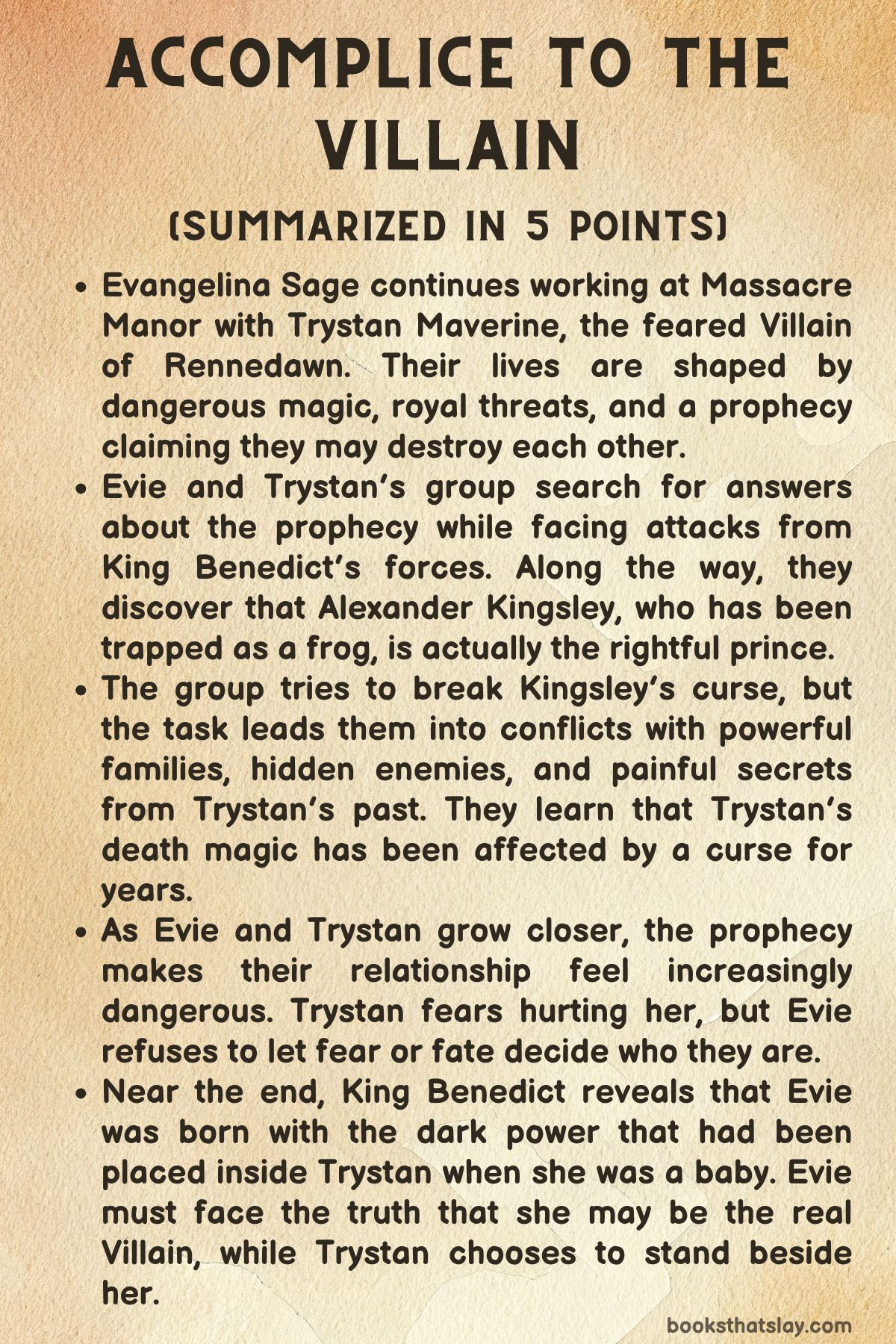
One month after beginning her work with Trystan Maverine at Massacre Manor, Evangelina Sage settles into her role within the Villain’s strange household. The manor functions as the headquarters for Trystan’s group, which includes guards, magical allies, and friends who help him manage threats in the kingdom of Rennedawn.
Evie is adjusting to this unusual life, though tension lingers between her and Trystan. A prophecy has warned that they will be each other’s downfall, and Trystan has been trying to distance himself from her because of it.
Life at the manor has been chaotic. The building was recently attacked, a magical creature called a guvre was kidnapped, and Evie’s mother Nura unexpectedly returned after years of being believed dead.
Nura had been trapped as a star by powerful magic, and her return has created emotional strain within the Sage family. Evie struggles to reconnect with her mother while also trying to keep her younger siblings, Lyssa and Gideon, safe.
The group is focused on solving an ancient prophecy connected to Rennedawn’s future. They possess fragments of a storybook prophecy that suggests the kingdom will fall to dark magic if the events it describes are not fulfilled.
While searching for clues, Evie and a guard named Keeley are attacked by soldiers loyal to King Benedict. Evie is forced to defend herself and kills one of the guards, showing that the threats around them are becoming more dangerous.
Meanwhile, Trystan wrestles with powerful death magic that often slips beyond his control. He also carries the burden of the prophecy about him and Evie, which makes him afraid of what their relationship might cause.
Although he cares deeply for her, he tries to keep emotional distance.
During one of King Benedict’s confrontations with the manor, he offers to reveal the rest of the prophecy in exchange for Nura. The situation grows tense when Nura accidentally unleashes light magic that injures a guard while protecting Lyssa.
This event highlights how unpredictable magic has become for everyone involved.
Another complication arises when an intruder sneaks into the manor disguised as a repairman. Evie discovers the man is Calvin, the son of her former employer whom she killed while escaping abuse.
Calvin fights Evie, but Trystan intervenes. Evie is injured during the struggle, which deepens Trystan’s fear of losing her.
While the group continues to analyze the prophecy, they make an important discovery. Their friend Alexander Kingsley, who has been transformed into a frog for more than a decade, is revealed to be the rightful prince of Rennedawn.
According to the prophecy, restoring Kingsley to his human form is essential for saving the kingdom’s magic.
To reverse the curse, they seek help from a curse expert named Lionel. Lionel confirms that the curse placed on Kingsley must be undone by the enchantress who cast it, using a special wand.
During this meeting, Lionel also reveals something shocking: Trystan himself is cursed. The death magic he carries has been twisted by a dark spell for many years, explaining why he struggles to control it.
As the companions search for the wand needed to break Kingsley’s curse, they encounter numerous dangers. They face magical creatures, royal soldiers, and political enemies.
Eventually they travel to the estate of Lord Edmund Fowler, who possesses the wand. Fowler agrees to give it to Trystan only if he attends a social gathering at his estate.
At the gathering, Fowler creates a cruel game by hiding Kingsley and declaring that whoever finds him will win the chance to spend the night with Evie. Although the announcement embarrasses both Evie and Trystan, they focus on finding their friend.
After rescuing Kingsley, they retrieve the wand but learn that it has been broken. The second half of the wand has been turned into glass slippers and is currently in the possession of Trystan’s mother, Amara.
While these events unfold, other characters pursue their own missions. Gideon and Keeley travel to the Gleaming Palace to rescue the kidnapped guvre.
Along the way, Gideon begins to suspect Keeley of betraying the group because he finds letters addressed to her from someone claiming to be a king. Keeley later explains that the letters come from her unstable father rather than King Benedict, easing some of Gideon’s suspicion.
Back at the manor, Evie’s friend Becky discovers a mysterious memory plant that once played a role in Nura’s past imprisonment. The plant contains fragments of magical energy and becomes another potential clue to the tangled history surrounding Evie’s family.
Meanwhile, Trystan and his companions travel across the sea to seek Amara and retrieve the missing piece of the wand. Along the journey, Evie and Trystan grow closer despite the prophecy hanging over them.
Their affection becomes impossible to ignore, though Trystan remains afraid of what their relationship might cause.
When they finally confront Amara, long-hidden truths emerge. Years earlier, Amara had attempted to have Trystan killed because he possessed dangerous death magic.
To protect him, Clare secretly hired another enchantress to change the spell so that it would transform Trystan instead of killing him. However, the magic went wrong and struck Kingsley instead, turning him into a frog.
The enchantress responsible for the altered spell, Belinda, has since been captured by Kingsley’s royal parents, who believe she murdered their son. The companions realize that Belinda is the only person capable of restoring Kingsley to human form.
The group travels to the southern kingdom where Kingsley’s parents rule. With help from Belinda’s daughter Winnifred, they infiltrate the royal castle to rescue Belinda and break the curse.
Unfortunately, when they present Kingsley to the king and queen, the rulers refuse to believe their story. They transform Belinda into stone before she can reverse the spell.
The situation grows worse when a battle erupts. During the chaos, Trystan’s father Arthur sacrifices himself to protect Evie from a knight’s attack.
Before dying, he apologizes to Trystan for failing him as a father and thanks Evie for loving his son.
After escaping the castle, the group returns to Massacre Manor only to find it overrun by enemies. King Benedict arrives and finally reveals the truth behind the prophecy and the kingdom’s tangled history.
Benedict explains that Evie was born with immense dark power that marked her as a future villain. Her father Griffin wanted to prevent this fate, so he worked with Benedict to transfer Evie’s magic into Trystan when she was an infant.
This act made Trystan appear to be the feared Villain while Evie grew up unaware of her own power.
Now the magic returns to its original owner. As Benedict finishes revealing the truth, Evie feels the death magic flow back into her body.
The power that once defined Trystan now belongs to her.
Although Evie fears that this revelation will destroy Trystan’s life, he refuses to abandon her. He insists that her becoming the true Villain changes nothing about his feelings.
He promises to stand beside her no matter what the prophecy claims.
The story closes with the group mourning Arthur’s death and preparing for the uncertain future ahead. In a surprising moment, Kingsley emerges from the sea in human form, suggesting that the curse may finally be breaking and that the prophecy’s path is still unfolding.
Characters
Evangelina Sage (Evie)
Evangelina Sage is the emotional and moral center of Accomplice to the Villain. She begins the story as an intelligent and capable assistant working for Trystan Maverine, but her role gradually evolves as the truth about her identity emerges.
Evie is practical, observant, and determined to protect the people she loves, especially her younger siblings. Her past shaped her resilience.
Growing up without her mother forced her to take on adult responsibilities early, which explains her strong protective instincts and maturity. Throughout the story she also struggles with complicated feelings toward her returning mother, Nura, and must confront the resentment she carries from years of abandonment.
Evie’s character develops significantly as she faces danger and political conflict. Although she initially sees herself as an ordinary human surrounded by powerful magic users, she repeatedly proves her courage through action.
She defends herself against attackers, confronts threats to the manor, and refuses to abandon difficult missions. Her emotional honesty also defines her personality.
Unlike Trystan, she does not hide her feelings and openly admits that she loves him even when he tries to keep his distance.
The revelation that Evie is the true owner of the powerful death magic dramatically changes how she views herself. Instead of collapsing under the weight of this knowledge, she faces it with the same determination that has guided her throughout the story.
Her journey is about accepting power and identity without losing compassion. Evie’s empathy toward magical creatures, friends, and even enemies shows that the title of villain does not define who she truly is.
Trystan Maverine
Trystan Maverine is known throughout the kingdom as the Villain, a powerful sorcerer feared for his control over death magic. Despite this reputation, he is far more complex than the title suggests.
Trystan runs Massacre Manor as a base for his operations and surrounds himself with loyal allies who help him maintain order and oppose corrupt forces. Beneath his intimidating presence is a man burdened by guilt, responsibility, and fear of harming those he loves.
One of Trystan’s defining traits is his struggle with destiny. A prophecy predicts that his relationship with Evie will destroy them both, which leads him to distance himself from her even though he deeply cares for her.
His internal conflict between love and caution shapes much of his behavior. He often tries to protect Evie by pushing her away, believing that emotional distance will prevent the prophecy from coming true.
Trystan also carries emotional wounds from his family. His mother attempted to have him killed after discovering his dangerous magic, which left him feeling unwanted and mistrustful.
His complicated relationship with his father further deepens his emotional isolation. These experiences explain why he struggles to accept affection or believe that he deserves happiness.
As the truth about Evie’s magic is revealed, Trystan’s identity begins to shift. The power that defined him was never truly his.
Instead of losing purpose, he chooses loyalty and love, standing beside Evie even when she becomes the one associated with villainy. His character represents growth through acceptance and emotional vulnerability.
Alexander Kingsley
Alexander Kingsley is one of the most unusual characters in Accomplice to the Villain because he spends most of the story trapped in the body of a frog. Once the prince of Rennedawn, Kingsley was transformed by a magical accident connected to Trystan’s family.
Although his physical form limits him, his personality remains intelligent, sarcastic, and emotionally perceptive.
Kingsley’s experience highlights themes of patience and endurance. Living for years as a frog has forced him to adapt to a life that constantly reminds him of what he lost.
Despite this, he maintains strong friendships with Trystan and the others at the manor. His presence often provides moments of humor, but his situation also carries deep emotional weight because he longs to reclaim his identity and rightful place.
The prophecy revealing him as the true prince of Rennedawn brings new urgency to his condition. His transformation is no longer just a personal tragedy but a key element in the kingdom’s fate.
Kingsley struggles with moments of fear and frustration as his condition worsens, yet he continues to trust his friends to help him. His eventual return to human form suggests both personal redemption and the restoration of balance within the kingdom.
Nura Sage
Nura Sage is Evie’s mother and one of the most mysterious figures in the story. She was believed to be dead for many years but later returned after being trapped as a magical star.
Her reappearance disrupts the Sage family and forces her daughters to confront unresolved emotional wounds.
Nura carries a sense of guilt for leaving her children behind, even though circumstances prevented her from being present in their lives. She tries to reconnect with Evie and Lyssa, but the process is difficult because they grew up without her guidance.
Evie in particular struggles with resentment because she had to assume a parental role for her siblings.
Despite these tensions, Nura shows deep concern for her family’s safety. She repeatedly attempts to protect her daughters and allies using her light magic.
Her complicated history with other characters, including Becky’s mother, reveals that past alliances and betrayals continue to influence present events.
Nura’s character represents the challenge of rebuilding relationships after long separation. She cannot erase the years she missed, but she continues trying to support her children and make amends for the past.
Gideon Sage
Gideon Sage is Evie’s younger brother and one of the manor’s developing defenders. He is thoughtful, cautious, and strongly protective of his family.
Although he is younger than Evie, Gideon often demonstrates maturity when dealing with threats or emotional conflict.
His storyline includes an evolving partnership with Keeley, a guard who accompanies him on missions. Gideon initially struggles to trust her when he discovers letters that appear suspicious, but he eventually learns about her difficult family background.
This shift from suspicion to understanding reflects Gideon’s growing ability to judge people fairly.
Gideon’s dedication to protecting his family drives many of his actions. When danger threatens the manor or his loved ones, he reacts quickly and courageously.
His loyalty to Evie and Lyssa shows that family remains his primary motivation even while navigating political conflict and magical threats.
Lyssa Sage
Lyssa Sage is Evie’s younger sister and a character who represents curiosity and emotional openness. She often approaches situations with enthusiasm and optimism, which contrasts with Evie’s cautious outlook.
Lyssa’s personality helps bring warmth to the often tense environment of Massacre Manor.
Her relationship with Nura is particularly complicated. Unlike Evie, who carries resentment, Lyssa shows a stronger desire to reconnect with their mother.
She hopes to rebuild their family bond and often tries to encourage reconciliation between Nura and Evie.
Lyssa also contributes to the group’s investigation into the prophecy by discovering important notes and clues. Her intelligence and willingness to explore new ideas make her a valuable member of the manor’s community.
Clare Maverine
Clare Maverine is Trystan’s sister and a skilled fighter with a sharp personality. She is fiercely protective of her brother and remains loyal to him despite the complicated history of their family.
Clare often acts decisively and is willing to challenge others when she believes they are wrong.
Her past relationship with the healer Tatianna adds emotional depth to her character. The two women still care about each other, but their relationship was complicated by disapproval from Trystan and Clare’s mother.
Their ongoing interactions reveal Clare’s struggle between family loyalty and personal happiness.
Clare also carries guilt regarding her role in the magical events that cursed Kingsley. Her attempts to correct past mistakes show that she is driven by responsibility and a desire to protect those she cares about.
Tatianna
Tatianna serves as the healer for the manor’s inhabitants and plays a vital role in maintaining the group’s well being. She is calm, intelligent, and compassionate, providing both medical support and emotional stability to the people around her.
Her relationship with Clare reveals another side of her personality. Although she presents herself as composed and professional, her unresolved feelings for Clare show that she also carries emotional vulnerability.
Their conversations explore themes of forgiveness and second chances.
Tatianna’s perspective often balances the more impulsive actions of others. She reminds the group to consider consequences and care for each other while navigating dangerous missions.
Becky Erring
Rebecka Erring, commonly called Becky, manages the human and magical creature resources at the manor. Her job involves organizing the unusual mixture of people and magical beings working under Trystan’s leadership.
Becky’s cheerful personality and sense of humor make her a central part of the manor’s community.
Her storyline includes the discovery of the memory plant connected to her mother’s past actions. This connection forces Becky to confront family history and the lingering effects of betrayal between previous generations.
Despite this emotional burden, she remains supportive of her friends.
Becky’s romantic feelings for the dragon tamer Blade also add warmth to the story. Their relationship develops slowly, showing Becky’s desire for connection and belonging.
King Benedict
King Benedict is one of the primary antagonistic forces in Accomplice to the Villain. Although he rules the kingdom, his actions reveal a willingness to manipulate others for the sake of controlling fate.
His involvement in transferring Evie’s magic into Trystan demonstrates his willingness to interfere with powerful forces.
Benedict presents himself as a ruler trying to maintain order, but his manipulative decisions create many of the conflicts that drive the story. By hiding the truth about Evie’s magic and shaping events behind the scenes, he influences the destinies of multiple characters.
His final revelations transform the understanding of who the real villain might be. Benedict’s role emphasizes how power and secrecy can reshape lives across generations.
Arthur Maverine
Arthur Maverine is Trystan’s father and a character whose influence becomes most significant near the end of the story. Although his relationship with Trystan has been distant and complicated, Arthur ultimately demonstrates genuine love for his son.
His sacrifice during the battle at the castle marks a turning point for Trystan. Arthur’s final apology acknowledges the emotional damage caused by his earlier absence and mistakes.
By protecting Evie and expressing gratitude for her love toward Trystan, Arthur attempts to repair the bond between father and son before his death.
Arthur’s character represents regret and redemption. Even though he cannot undo the past, his final act shows that he still values his family and wishes to protect their future.
Keeley
Keeley is a member of the Malevolent Guard and one of the manor’s most capable fighters. She is disciplined, brave, and fiercely loyal to Trystan’s cause.
Her dedication to protecting others becomes evident when she risks her life to shield Lyssa from magical harm.
Keeley’s past reveals a difficult upbringing. Her father abandoned her while claiming grand authority, and her mother treated her harshly.
These experiences shaped her independence and determination to build a better life for herself. Joining Trystan’s organization gave her purpose and a sense of belonging.
Her developing relationship with Gideon introduces emotional growth for both characters. Through their conversations, Keeley gradually reveals her vulnerabilities while continuing to prove her strength as a protector.
Themes
Power, Identity, and the Fear of Becoming the Villain
Power and identity are central concerns in Accomplice to the Villain, particularly through the experiences of Evie and Trystan. Throughout the narrative, both characters struggle with the question of whether power defines morality.
Trystan has long carried the label of villain because he possesses dangerous death magic. Others fear him because of this power, and he has spent years believing that he must keep emotional distance from people in order to protect them.
This belief shapes his identity, leading him to think that his magic makes him inherently destructive. His constant attempts to control his emotions and isolate himself reveal how deeply he fears becoming exactly what others expect him to be.
Evie’s journey eventually mirrors and complicates this struggle. For much of the story she believes herself to be an ordinary human who has somehow ended up working among dangerous magical figures.
She defines herself through compassion, responsibility, and loyalty rather than power. However, the revelation that the death magic once attributed to Trystan originally belonged to her forces her to reconsider who she is.
The narrative challenges the assumption that possessing dark power automatically turns someone into a villain. Evie remains empathetic and morally grounded even after learning the truth about her magic.
The theme also highlights how society often assigns identities based on fear rather than understanding. Trystan was treated as a villain simply because of the magic he carried, while Evie was protected from her own power by people who feared what she might become.
Their experiences suggest that identity is not determined by destiny or by the type of magic a person holds. Instead, character is shaped through choices and relationships.
By confronting the truth about their power, both Evie and Trystan begin to reject the labels that have defined them for years.
This theme ultimately suggests that morality is not determined by power but by how individuals choose to use it. The story challenges the idea that dark magic must lead to cruelty and instead argues that compassion and responsibility can exist alongside even the most dangerous abilities.
Love Versus Destiny
The tension between love and destiny drives much of the emotional conflict in Accomplice to the Villain. A prophecy warns that Evie and Trystan will be each other’s downfall, creating a powerful sense of inevitability that shapes their decisions.
Trystan takes the prophecy seriously and believes that distancing himself from Evie is the only way to prevent disaster. His fear of harming her leads him to suppress his feelings, even though his affection for her is obvious.
This internal struggle reveals how strongly he believes in the authority of prophecy and fate.
Evie approaches the situation differently. Rather than accepting the prophecy as unavoidable truth, she questions whether destiny must control their choices.
Her willingness to openly admit her love challenges Trystan’s belief that their relationship is doomed. She refuses to allow a prediction to dictate how she lives her life or how she treats the people she cares about.
This difference in perspective creates tension between them, but it also highlights their contrasting views about control and freedom.
The narrative repeatedly places the characters in situations where they must decide whether to follow the path predicted for them or attempt to change it. Each decision reflects their attitudes toward destiny.
Trystan initially tries to avoid the prophecy by distancing himself emotionally, while Evie believes that love itself is worth the risk. As the story progresses, Trystan gradually begins to question whether avoiding love truly protects anyone.
The revelation about Evie’s magic complicates the prophecy even further. If the magic once believed to belong to Trystan actually originated with Evie, then the entire narrative of villainy and destiny becomes unstable.
The prophecy may have been misunderstood from the beginning. This uncertainty forces the characters to reconsider whether fate is truly fixed or whether human decisions can reshape it.
Through this tension, the story argues that love is powerful precisely because it involves risk. Choosing to care for someone despite the possibility of loss becomes an act of courage rather than weakness.
Destiny may influence events, but the characters demonstrate that personal choices still hold significant power.
Family, Forgiveness, and the Weight of the Past
Family relationships play a major role in shaping the emotional landscape. Many characters carry unresolved pain connected to parents, siblings, and past betrayals.
These relationships influence how they view themselves and how they approach trust. Evie’s relationship with her mother Nura illustrates how complicated forgiveness can be.
Nura’s absence forced Evie to grow up quickly and assume responsibility for her siblings. When Nura returns, Evie cannot easily accept her presence because the years of abandonment created deep emotional scars.
The tension between Evie and Nura reflects the difficulty of rebuilding relationships after long periods of separation. Nura tries to reconnect with her daughters, but she cannot undo the past.
Evie’s anger and resentment demonstrate that forgiveness is not automatic. Instead, it requires confronting painful memories and acknowledging the impact of past choices.
Lyssa, who is younger and less burdened by responsibility, approaches their mother with more openness, showing how different experiences within the same family can shape emotional responses.
Trystan’s relationship with his parents also reveals the weight of family history. His mother attempted to have him killed because of his dangerous magic, leaving him with lasting emotional trauma.
This betrayal explains why he struggles to believe that anyone could truly care about him. His father Arthur’s distant behavior adds another layer of emotional complexity.
Arthur’s final sacrifice represents an attempt to repair the broken relationship between father and son.
Other characters also confront family conflicts. Becky must deal with her mother’s past betrayal involving powerful magic, while Keeley’s difficult upbringing shapes her fierce independence.
These stories emphasize that family can be both a source of strength and a source of pain.
The theme suggests that while the past cannot be erased, individuals can choose how to respond to it. Forgiveness does not mean forgetting the harm that occurred.
Instead, it involves deciding whether the future should remain controlled by old wounds. Many characters struggle with this choice, and their decisions influence how they move forward together.
Loyalty, Friendship, and Found Family
A powerful sense of found family emerges through the relationships among the inhabitants of Massacre Manor. Many of the characters arrive at the manor after experiencing rejection, betrayal, or loss in their original families.
The community they create becomes a space where loyalty and support replace the instability of their past lives. Their bonds show that family is not limited to blood relations but can also form through shared experiences and trust.
Trystan’s leadership plays a significant role in creating this environment. Despite his reputation as a villain, he builds a group of allies who genuinely care for one another.
His organization includes guards, healers, magical experts, and friends who work together not only for political goals but also for mutual protection. The manor becomes a place where unusual individuals find acceptance and purpose.
Evie quickly becomes an important part of this community. Her empathy and ability to connect with others strengthen the group’s relationships.
She forms close friendships with characters like Becky and supports the emotional needs of those around her. Her presence helps transform the manor from a strategic headquarters into a genuine home.
The friendships within the group often provide emotional stability during moments of crisis. When danger threatens the manor or its members, the characters consistently risk their safety to protect one another.
This loyalty demonstrates that their relationships are built on trust rather than obligation.
Even characters who initially struggle with suspicion eventually find belonging within the group. Gideon and Keeley develop mutual respect through shared experiences, while Clare and Tatianna confront their complicated past in order to rebuild their connection.
These relationships show that trust can grow even after conflict or misunderstanding.
The theme highlights how chosen relationships can be just as meaningful as biological family ties. By supporting one another through danger and uncertainty, the characters create a community defined by loyalty and compassion.
Their found family becomes a source of strength that allows them to face the larger challenges threatening their world.