King of Ravens Summary, Characters and Themes
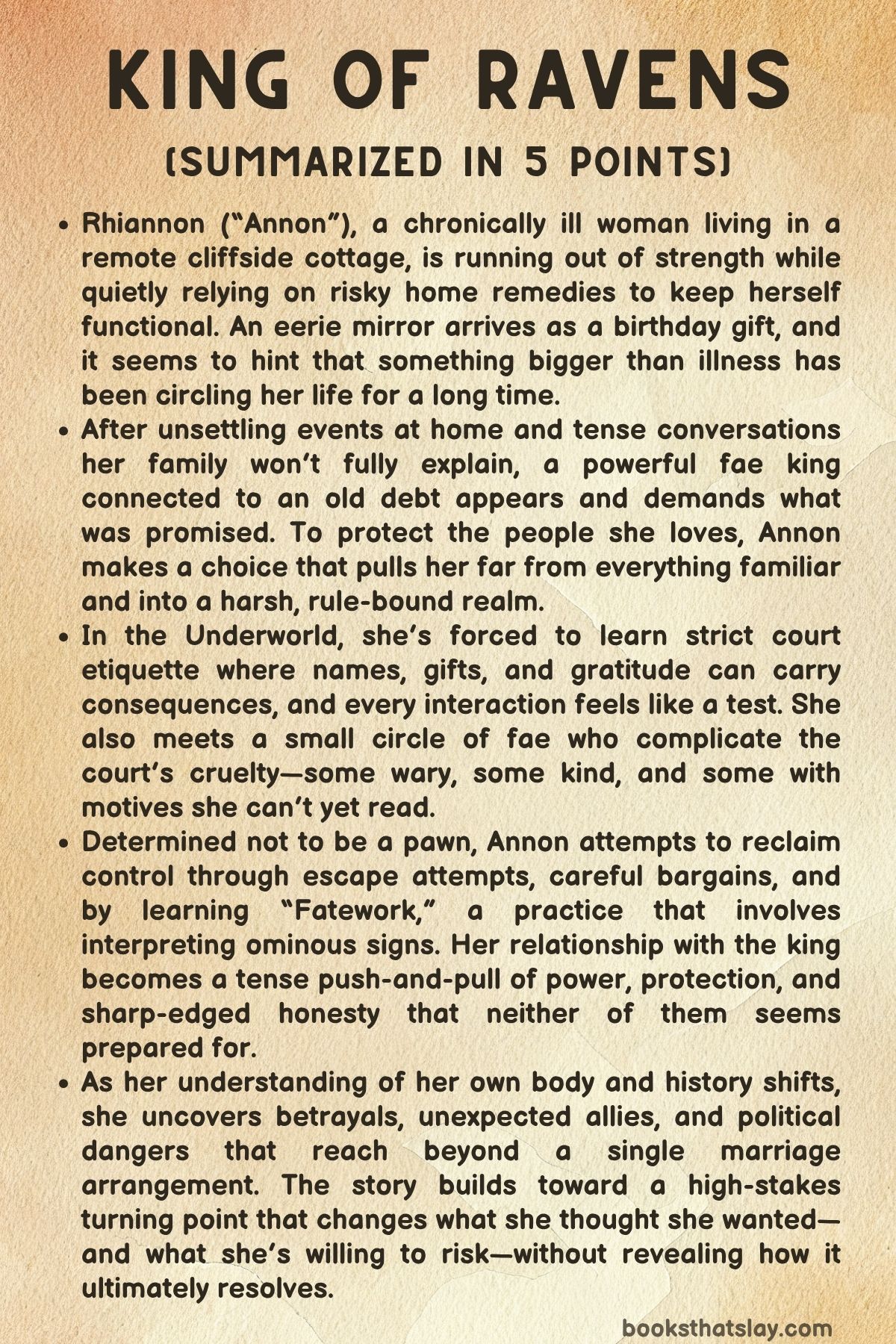
King of Ravens by Clare Sager is a dark, fae-inflected fantasy romance where survival, power, and consent collide. Rhiannon “Annon,” a young woman who believes she’s dying, lives a quiet life in a cliffside cottage—until an old bargain comes due.
Taken into a wintered Underworld by Drystan, a raven-crowned king bound to death, she’s forced into court politics, dangerous rules of fae speech, and a marriage she never wanted. What begins as captivity becomes a harsh education in hidden truths—especially about her own body, her family, and what she might be capable of. It’s the 1st book in the Upon a Broken Throne series.
Summary
On the eve of her thirty-third birthday, Rhiannon—called Annon at home—moves carefully through another fragile day in her family’s seaside village. Chronic illness has shaped her life into measured steps, dizziness, and a constant sense that time is running out.
She relies on medicine and secretly uses powdered belladonna to push her failing body through the worst moments, even though she fears what it’s doing to her long-term. Her brother Lowen tries to brighten her day with a gift he claims he found on the beach: an ornate mirror framed with ravens and moths.
The mirror feels wrong from the start. Its reflection doesn’t quite match the room, and for an instant it shows a bedchamber that cannot exist in their cottage.
Still, Annon can’t help hoping it might be tied to old stories—something that can explain her sickness or offer a way out.
That night brings uneasy dreams: mist, a lake, and a presence she associates with Death, closer than ever. When she wakes, another loss waits for her—her treasured notebook, filled with years of study and desperate experiments to name her condition, has been destroyed.
She finds it burning to ash in the hearth. Her father insists she must accept that there is no cure, while Lowen rages at their parents’ coldness.
Annon forces herself to stay calm, but overhears fragments of her parents’ whispered conversation—talk of her “gift,” and of something being “too late.”
Before dawn, something stranger happens. Annon sees Lowen at the garden wall, moving as if sleepwalking, tearing stones free with bleeding hands.
He mutters, “Let me in,” and pulls at a hidden wire threaded through the wall’s structure. Annon stops him only by cutting the wire with a hatchet.
The moment the wire snaps, thunder cracks and the air changes, as if a boundary has been broken. A storm of ravens drops from the sky and gathers into a tall fae male with gold eyes—beautiful, cold, and unmistakably dangerous.
Inside the cottage, her father scrambles to hang iron charms for protection, even though iron is forbidden and risky to keep. The fae announces that a bargain must be honored.
Under pressure, Annon’s parents confess a secret they’ve carried for decades: during a deadly storm at sea, her father begged for salvation and the Morrigan answered. The price was his firstborn daughter.
To hide her from being claimed, they never truly named her. “Rhiannon” was a cover; “Annon” was meant to keep her unmarked by the power of a true name.
The fae reveals himself as the Morrigan’s son, a king tied to death, and he demands the bargain be fulfilled. Annon must be given to him as his bride.
Her parents refuse—so he raises an army of the dead. Corpses claw up from the earth, battered bones slam into doors and windows, and the roof shudders under their weight.
Watching her family on the edge of slaughter, Annon makes her choice. She offers herself willingly if he spares them.
He agrees with chilling precision, giving her only seconds to step outside. Lowen presses a parcel into her hands, swearing he will come for her if Death takes her.
Annon takes the king’s hand, and the world breaks into feathers and darkness.
She wakes in a snowbound courtyard under a black sun: the Underworld. The king brings her through gray corridors watched by ravens, including a strange white raven that seems to notice her in a different way.
He tells her his name is Drystan, and insists she address him as “Your Majesty.” In his realm, speech has weight and names are power. He warns her against accepting gifts, creating debts, offering thanks, or making careless promises.
She will also be expected to learn Fatework, the skills required of a consort. He leaves her in a vast bedroom that feels both luxurious and hostile, full of carved shadows and unsettling details, and orders her to sleep until “evening.”
Annon clings to the few objects she has left: her tablets, her belladonna, and Lowen’s parcel. Inside is a new notebook and an unfinished sketch of the coast, a reminder of what she’s lost and what she still wants.
She counts her medicine—barely enough for days—and tries to ration it. Soon, a fae woman named Min arrives, direct and careful at once.
Min is the royal sartor, tasked with preparing Annon for court. She helps her bathe, dress, and eat while quietly teaching her how to survive among fae: never apologize, never say thank you, speak around questions, and avoid bargains.
When Annon mentions iron, Min reacts sharply—some words themselves can be dangerous here.
Dressed in jewels and a turquoise gown, Annon is brought into the great hall, where the Underworld court celebrates with music, acrobats, and ornamentation made of bone and teeth. The cruelty beneath the beauty is immediate.
People stare at her as if she’s entertainment, and she hears cutting remarks about a human bride. Drystan appears beside her with unnerving ease, then announces her as his future queen.
When asked what to call her, he says “Rhiannon,” tightening control over her identity in front of everyone. Annon’s weakness nearly betrays her; Drystan orders her to eat and conjures ginger biscuits for her.
When she offers him one in return, he takes it—an unexpectedly intimate beat in a room built for judgment.
Drystan introduces his guard, the Twylth, led by Threnn. Astrid, a fierce second-in-command missing part of an arm, is assigned as Annon’s guard.
Astrid explains she’s a redcap and hints at the violence her kind is known for. After the gathering, Annon demands to go home.
Drystan refuses, dismissing her parents as liars and asserting that she belongs here by law and by bargain.
At sunrise, Annon attempts escape anyway, using a simple deception to get Astrid away from her door. She slips through the fortress, reaches the gates, and believes she’s free—until the Wild Hunt rides out of the snow on skeletal mounts with pale hounds.
They seize her and drag her back. Drystan waits, furious, not just because she disobeyed him, but because she doesn’t understand what waits beyond the walls.
He confines her to her rooms and tightens her guard.
Min discovers Annon’s hidden medicine and confronts her gently. Annon admits she’s chronically ill and needs the tablets to function.
Min promises secrecy, explaining that weakness is despised at court. Her own scar has made her an outsider too, and she chooses to protect Annon rather than mock her.
Drystan later takes Annon beyond the walls on a supernatural horse, hauling her into the saddle when she can’t manage. He shows her the dead moving across the landscape and then reveals something far worse: a monstrous creature formed from a lost soul consumed by a predator of the realm.
He warns that living warmth draws dangers, and loneliness can make a person accept companionship from the wrong thing. He forces Annon to promise she won’t run again.
Trying to regain control, Annon decides to perform the role of bride strategically, hoping to corner Drystan into sending her home. Her plans collide with the Underworld’s deeper machinery: Fatework lessons, public court appearances, and political games that treat her as a prize and a threat at the same time.
During one brutal excursion into a shifting labyrinth with a strange guide known as the Collector, Annon becomes exhausted and disoriented. Drystan intervenes, thinking she has died, and carries her back to Rigor Gard.
He bargains that the day won’t count against her time if she rests, then discovers her medicine and learns the truth of her illness. He keeps her in his own bed under guard, stays close as she sleeps, and begins bringing her books on Underworld plants and healing—help that feels like care even when it’s also control.
When Annon is strong enough, Drystan makes a public show of them as a couple, seating her beside him in front of the court and touching her in ways that signal possession and protection at once. Annon tries to soften political hostility with careful offerings and controlled speech.
On a major night tied to their people’s omens, Drystan shows her Moonfire in the sky and speaks of their marriage as something larger than either of them. Desire and anger spark between them, and when his taunting crosses a line, Annon runs—still refusing to let him decide what her feelings mean.
Back in the labyrinth, she and the Collector face a hunting terror called the Devourer. They escape through broken stairs and crumbling platforms into a higher tier, surviving only because they trust each other at the last second.
The Collector, stitched together from many voices, admits they barely remember any life before the maze. Annon shares Lowen’s coastal sketch with them, and the word “sea” becomes a precious memory they can’t quite claim.
Fatework training continues with Kishel, and Annon begins to see visions—warnings of blood, a horse, and skull-like flowers. She prevents a disaster by stopping Astrid from riding the horse she saw, only to learn the warning still echoes into the world.
Drystan surprises her with a jar of new tablets after having the palace healer analyze her medicine and recreate it. Overwhelmed, Annon thanks him despite the rules, and the moment lands between them like a confession.
Then the truth finally breaks her. Drystan brings her back to the seaside cottage and forces her parents to admit what they did.
Annon—now called Avellan by the revelation of who she truly is—learns she was never sick in the way she believed. Her “medicine” was a poison: aconite and iron given for sixteen years to suppress a magical gift that would draw the Morrigan’s attention.
The pills didn’t protect her; they damaged her heart. The life she thought was fragile by fate was made fragile by her family’s choices.
Avellan returns to the Underworld in shock, her suppressed power flaring with grief and rage. Drystan steadies her with tea and presence, but another betrayal surfaces: he knew the tablets were harming her and replaced them without telling her, choosing safety over her consent.
Avellan confronts him, furious that yet another person decided what to do with her body. Drystan apologizes—rare for him—yet struggles to fully grasp why secrecy, even for protection, is still harm.
Research confirms the worst: the poisoning caused permanent heart damage. There will be no cure, only management.
Avellan withdraws, cared for quietly by Min and Astrid, and begins to accept a brutal reality: she can’t return to the family who hurt her, and she may not survive alone on the surface. She chooses a new path on her own terms.
She proposes marriage to Drystan—this time with conditions. He must never hide something like that again, and he must never make decisions about her body without her consent.
Drystan accepts, visibly relieved, and the court prepares for a political wedding.
The ceremony is fierce and ancient: blood, bone, vows, and ritual binding. But during the rites, a new crisis erupts—Drystan confesses the Consort’s Seal is missing from the vault, and only he or his brother Effan could have taken it.
Challenged to prove herself, Avellan uses scrying and her awakening power to show a vision of her ruined cottage. The court rides there and finds Effan’s corpse hidden away.
Drystan raises the dead body to speak, but its tongue is missing. Effan can only point—at Drystan—and drops a gold coin into his hand before collapsing again.
The court votes Avellan has met the challenge, and the marriage is declared valid, even as the discovery poisons the celebration.
More kings arrive—Drystan’s brothers—mocking the match and circling the newlyweds like sharks. Avellan holds her ground, choosing calm words over fear, and invites them to the feast to prevent immediate violence.
But the night turns cruel in a more intimate way. Drystan, shaken by Effan’s death, becomes distant.
Avellan realizes she loves him anyway and goes to find him, hoping love can be a choice rather than a trap.
Instead, Drystan tells her flatly that he needed a bride, not romance. Pressed, he admits the truth he cannot hide: he tried to make her fall in love so she would stop fighting the marriage and stop trying to escape.
His brothers laugh as Avellan stands stunned by the confession. Then, as the cruelty peaks, Drystan’s own body betrays him.
He pales, clutches his chest, drops his cup, and collapses onto the marble floor—motionless—leaving Avellan in a marriage sealed by blood, surrounded by enemies, and facing a sudden, terrifying question: what happens to a queen of death when the king falls?
Characters
Rhiannon “Annon” “Rhiannon” Avellan
Avellan’s identity is a story of theft, survival, and reclamation, and the shifting names attached to her track every stage of that struggle in King of Ravens. She begins as Rhiannon only on paper, “Annon” in the home that is trying to hide her, and later “Rhiannon” again as a courtly label imposed for political convenience; by the time she is known as Avellan, she is moving toward a self-chosen truth rather than a name used as camouflage.
At first she understands herself through illness and limitation: dizziness, weakness, the constant math of rationing tablets, and the desperate private logic that belladonna is the only way to keep her heart from giving out. That belief shapes her temperament into something restrained and watchful; she practices calm as a shield, swallows grief when her notebook is burned, and measures every reaction because she believes time is the one resource she cannot replace.
Even when she is terrified, she defaults to bargaining with herself and with the world, not because she is naturally submissive, but because she has learned that panic wastes energy and energy is life. The Underworld then forces a second kind of endurance: social survival among predators who treat politeness as a trap and generosity as a hook, where her human instincts could become literal chains.
Her intelligence shows in how quickly she adapts to those rules, how she experiments carefully, and how she turns observation into strategy, choosing when to perform the “future queen” and when to push back. The revelation that she was never sick in the way she thought, that her condition was manufactured to suppress her gift, detonates her internal narrative: the tragedy is not only the poisoning but the way it warped her relationship with her own body, teaching her to distrust sensation and accept harm as treatment.
That betrayal sharpens her into someone who demands agency as a condition of intimacy; when she proposes marriage, it is not a romantic surrender but a contractual reclaiming of control, with consent and transparency as explicit terms. Her arc is powered by a fierce moral core that keeps colliding with fae pragmatism: she can accept darkness in the world, even in Drystan, but she cannot accept being managed like an object.
By the end of the summary, her composure in front of hostile kings shows that she is no longer merely surviving; she is learning to rule, even as love complicates the clean lines of her decisions.
Drystan
Drystan functions as both captor and caretaker, and the tension between those roles is the engine of his character. He arrives as an embodiment of cold inevitability: a king who can become a storm of ravens, who speaks in bargains, and who uses terror as leverage without apology.
His power is theatrical and absolute, but what makes him unsettling is how controlled he is with it; he doesn’t rage like a monster, he calculates like a sovereign, and that makes the brutality feel like policy rather than impulse. The bargain frames him as the instrument of his mother’s will, yet he is never just a messenger; he manipulates the mirror, influences Lowen, and methodically dismantles the iron protections, revealing an ease with coercion that is deeply fae and deeply personal.
At the same time, his behavior repeatedly complicates the simple villain shape: he prevents days from counting against the bargain when Avellan is unwell, brings her books, cancels appearances by hiding away, and later replaces her tablets with harmless copies. Those acts are care, but they are also control, and his tragedy is that he seems to believe the two are naturally the same thing.
He cannot easily grasp why doing the “right” thing without consent is still a violation, because his world treats authority as moral justification; his apology is therefore meaningful not because it fixes everything, but because it signals the beginning of a new framework he has never needed before. Drystan’s emotional life reads as repressed and coded: he toys with her at court, not simply to humiliate her, but to keep distance by turning intimacy into performance; he is quick to anger at her escape attempt, yet the anger is tied to genuine fear of what the Outside will do to a living human.
The moments where his mask slips are violent and revealing, such as when he kills Threnn with shocking ferocity, suggesting that loyalty and possession are intertwined for him, and threats to what is “his” trigger something almost primal. His confession that he intentionally tried to make Avellan fall in love is the clearest expression of his moral ambiguity: it is honest, strategic, and cruel, and it forces the reader to ask whether his tenderness was ever freely given or always weaponized.
Yet even that confession is constrained by his inability to lie, implying that whatever else he is, he is trapped by certain rules as much as he enforces them. His collapse at the end lands like an inversion of his earlier dominance: the king of death made suddenly fragile, hinting that the cost of manipulation, grief, and whatever binds the Underworld may finally be exacting payment from him.
The Morrigan
The Morrigan is less a present character in scenes and more a gravitational force shaping every choice, and that distance is part of her power. She appears through consequences rather than conversations: storms answered, bargains sealed, ravens as omen and weapon, a son who executes her will, and a system of law that treats human lives as tradable currency.
As a mother, she is terrifying precisely because her maternal role does not soften her; her “price” is a firstborn daughter, which frames children as assets and love as irrelevant next to fate and claim. Her mythic aura is reinforced by how others react to her name, the way the bargain seems unbreakable, and the implication that Avellan’s suppressed gift would have drawn her attention anyway.
She represents the Underworld’s moral logic at its most distilled: power speaks, and the world rearranges itself to comply. Even when she is offstage, her presence defines the stakes for Drystan and Avellan, because their bond begins not in choice but in a contract she authored.
The title “King of Death” tied to her lineage suggests she is not merely a queen figure but a primordial authority, and the story treats her as someone whose reach extends into dreams, borders, and bodies.
Annem
Annem is written as a mother whose love expresses itself through fear, and whose fear becomes harm. Early on she reads as anxious and caregiving, hovering over Annon’s medicine and trying to keep her functioning, yet that concern is steeped in secrecy and complicity.
When the truth later emerges, Annem becomes one of the sharpest portraits of parental betrayal: she participates in long-term poisoning as an act of protection, choosing a controlled suffering she can manage over a danger she cannot control. Her motivation is not sadism but desperation, yet the effect is still an erosion of Avellan’s autonomy and reality, because Annem helps craft a false identity where sickness becomes the explanation for everything.
The later confession shows that Annem has been carrying guilt and rationalization for years, but guilt is not repair; what devastates Avellan is that Annem’s love did not prevent her from repeatedly choosing the system over her child’s consent. Annem therefore embodies a central theme of the book: love without respect can become a cage, and protection can be a form of violence when it is rooted in ownership.
Avellan’s Father
Avellan’s father is the origin point of the central bargain, and his character is defined by the kind of cowardice that wears the mask of necessity. In the first crisis, he bargains with The Morrigan to survive a storm, and that single act reveals his hierarchy of values: his life is worth any cost that can be pushed onto someone smaller, even his future child.
Later, when Avellan’s notebook is burned and when he insists there is no cure, he positions himself as the voice of grim realism, but that “realism” reads as control, a way to extinguish her hope so she will not threaten the secret. His protective behavior is inseparable from possession; he hides her through namelessness, surrounds the cottage with iron, and then accepts years of poisoning as the price of keeping what is “his” out of fae hands.
When Drystan forces the truth out of him at the cliffside cottage, the father becomes almost pitiable in his helplessness, yet the narrative does not let helplessness equal innocence. He is the clearest example of how a bargain made in panic can become a lifelong moral debt, and how a parent can turn a child into collateral to pay it.
Lowen
Lowen is the story’s emotional anchor to the human world and the most uncomplicated source of devotion to Avellan, which makes his manipulation particularly tragic. He is affectionate, energetic, and protective in a way that contrasts with their parents’ secretive control; he brings gifts, runs errands, challenges the parents, and physically helps Avellan when her body fails her.
His round mirror gift is both tender and catastrophic, because it becomes the opening Drystan exploits, and Lowen’s innocence becomes a weapon turned against the family. The scene where he sleepwalks at the garden wall, tearing at the hidden wire until his hands shred, reframes him as a victim of forces he cannot perceive, and his confusion afterward underscores how little agency humans have against fae interference.
Yet even under that power imbalance, Lowen’s promise to come after her if Death takes her shows the shape of his loyalty: he refuses to accept the narrative that she is already lost. When Drystan later sends word that Lowen is safe and rebuilding a life, it positions Lowen as someone who survives grief by moving forward rather than being consumed by it, and that resilience keeps him from becoming only a symbol of what Avellan left behind.
Min
Min is a quiet strategist whose compassion is sharpened by experience, making her one of the most practically important allies Avellan gains in King of Ravens. She enters as a royal sartor, ostensibly tasked with appearance, but her real function is translation: she teaches Avellan the court’s language of traps, where gratitude is debt and apologies imply obligation.
Her tact in the bath scene and her refusal to stare at Avellan’s body signal a respect that is rare in the Underworld’s culture of spectacle. Min’s own scar and social exclusion give her empathy without naïveté; she understands cruelty as a system, not a series of individual bad acts, and that understanding lets her navigate danger while still choosing kindness.
By hiding belladonna for Avellan and keeping secrets about her medicine, Min risks herself, which shows that her loyalty is not merely professional. She also becomes a model of what survival can look like in this court: not rebellion for its own sake, but careful protection, choosing when to yield and when to quietly bend rules.
When Avellan withdraws after learning the truth about her poisoning, Min’s steady companionship reads as a form of care that does not demand performance, making her a counterpoint to Drystan’s more possessive style of protection.
Astrid “Asti”
Astrid embodies the Underworld’s blunt violence and its capacity for loyalty, and she complicates both by attaching them to Avellan. As a redcap and second in command, she carries the court’s threat in her body, including the missing part of her arm and the blood dyed hair that signals what she is.
Her early pledge as Avellan’s guard can be read as duty, but over time it gains warmth: she participates in protecting Avellan during her collapse, takes turns watching her so she is not alone, and responds seriously when Avellan warns her about the scrying vision of the copper red horse. Astrid’s willingness to lock the stall and warn others suggests she respects Avellan’s instincts even when they seem irrational, which is a meaningful shift in a culture that dismisses human fragility.
She also represents the boundary between fear and trust: Avellan is right to be frightened of what Astrid is capable of, but Astrid’s presence becomes one of the first ways Avellan experiences safety in the fortress that is not conditional on pleasing the king.
Threnn
Threnn is the clearest internal antagonist within Drystan’s court, and his hostility exposes the political logic beneath the marriage. As leader of the Twylth, he should embody protection, yet he frames Avellan as a threat and a stain, accusing her of weakness, mortality, and unfitness, and implying that killing her would serve the king.
What makes Threnn compelling is that he likely believes he is correct; in a realm that values strength and purity of power, removing an inconvenient human bride could look like loyalty. His attempted murder of Avellan on the tower is less a personal vendetta than a political corrective, a way to restore the court’s preferred order.
Drystan’s response, killing him violently and then commanding the corpse, demonstrates that Threnn misread the king’s priorities, but it also reveals the price of court power struggles: death is a tool, bodies are instruments, and even justice is performed through horror. Threnn’s role therefore clarifies the danger Avellan faces is not only from outside monsters, but from insiders who see her existence as provocation.
Effan
Effan begins as charm and possibility, the kind of courtier whose lightness makes the Underworld seem less suffocating, and then he becomes a corpse that rearranges the entire political landscape. His early introduction is brief but notable, because it positions him as socially adept and potentially sympathetic, especially in contrast to colder nobles.
The later revelation of his death in Avellan’s ruined cottage turns him into a symbol of hidden rot: someone with access, importance, and ties to Drystan who is removed offstage, suggesting betrayal, conspiracy, or a struggle among the kings. His inability to speak because his tongue is gone is narratively brutal because it makes truth physically inaccessible; even in death, the system of power controls testimony.
When the dead Effan points at Drystan and drops a gold coin into his hand, the gesture reads as accusation and message at once, implying either culpability, framing, or a debt being paid in the only language remaining to him. Effan’s character, therefore, becomes less about who he was and more about what his death reveals: that the marriage is happening in the middle of a larger conflict Drystan has not contained.
Phaedra
Phaedra is a political predator who uses tradition as a blade, and her antagonism is sharpened by her intelligence rather than simple cruelty. From her first challenge in the hall, she questions Avellan’s place and tries to control the narrative by demanding what the human should be called, signaling that she understands names as power.
She operates through social pressure and public moments, making sure dissent is witnessed and therefore consequential. Her gifting of the shell necklace is layered because it looks like generosity but functions as leverage; when Avellan gives it away to Lord Mastelle as a peace offering, she turns Phaedra’s weapon into diplomacy, and Phaedra’s anger reveals that she expected the gift to bind Avellan, not empower her.
Invoking the ancient Right of Challenge during the wedding is Phaedra at her most dangerous: she escalates in a way that forces the court to judge Avellan’s legitimacy under ritual authority, attempting to humiliate or disqualify her without needing open violence. Yet Avellan’s surprising choice to select Phaedra as an attendant creates a forced détente, suggesting Phaedra is the kind of enemy worth binding close, either because she is too powerful to ignore or because she can be managed through inclusion.
Phaedra thus represents the court’s social warfare: she may not be swinging swords, but she can still draw blood.
Lord Mastelle
Lord Mastelle serves as a portrait of aristocratic resistance that can be negotiated, making him a useful contrast to more absolute threats. He is hostile toward Avellan and inclined to see her as an insult to the court’s standards, yet his antagonism has a transactional quality: he can be appeased by a symbol, a gesture that restores his sense of respect or advantage.
When Avellan offers him the shell necklace as a peace offering, she reads him correctly as someone who values status and artifacts, and his acceptance ends his hostility. That moment is important because it shows Avellan learning courtcraft: not only surviving cruelty, but redirecting it, building small alliances by understanding what different nobles need to feel satisfied.
Mastelle’s role also highlights Avellan’s growth into queenship, because she chooses a pragmatic compromise rather than clinging to personal pride.
Lord and Lady Song
Lord and Lady Song appear as embodiments of the court’s polished cruelty, mirroring Min’s role but without her empathy. Their coolness toward Avellan suggests they are aligned with tradition and perhaps with the faction that resents a human queen, and their presence reinforces how isolated Avellan is when Min disappears in the great hall.
They are not given the overt villainy of Threnn or the active scheming of Phaedra, but their demeanor functions as atmosphere: the subtle, constant social chill that tells Avellan she is being assessed, not welcomed. In a story where etiquette can create binding obligations, characters like the Songs represent the danger of civility used as a weapon, making every conversation feel like stepping onto thin ice.
Kishel
Kishel is a mediator between power and interpretation, and his presence legitimizes Avellan’s gradual transformation from pawn to participant. As the one who trains her in Fatework and uses moonwater and ink for scrying, he occupies a space that is part tutor, part priest, part political functionary.
His approach to her inability to conjure visions, focusing instead on interpreting portents, suggests he values insight over raw magical display, which helps Avellan find competence even before her power fully emerges. During the wedding challenge, Kishel’s defense of Avellan’s “pass” shows him as someone willing to argue against a hostile narrative, not purely out of kindness but out of respect for process and evidence.
He therefore acts as a stabilizing figure in a court built on predation, using ritual and interpretation to keep disputes from collapsing into immediate violence.
The Collector
The Collector is one of the most haunting figures in the story, because they are a person made from absence, a being defined by what has been taken away. They guide Avellan through the labyrinth, yet they do not have a coherent personal history; instead, they hold fragments, voices, and half memories like relics.
That fractured identity makes them both unsettling and deeply sympathetic, and their connection to Avellan grows through shared vulnerability rather than politics. They are brave in action, dragging her from the Devourer’s shrieks and physically throwing her to safety across a gap, but their bravery is underscored by fear, especially after nightmares return.
The glimpses of remembered life, like dreams of a pregnant belly, trees, a cottage, horses, and the sea, suggest the Collector may be a composite of stolen dead or a soul broken by the Underworld’s tiers, making them a living testament to what this realm does to people. Their delight in the word “sea” and in Lowen’s coastal sketch shows how small human details become acts of resistance against erasure.
In saving Avellan from the Devourer, the Collector becomes more than a guide; they become proof that even in a system built on consuming souls, connection can still form, fragile but real.
The Apothic
The Apothic functions as a scientific and political hinge point, because their analysis of Avellan’s tablets is what transforms “incurable illness” into “deliberate poisoning.” They are not characterized through personality as much as through role: a maker and analyzer of substances whose work carries enormous moral weight in a realm where medicine can be weapon. By recreating the tablets with harmless herbs, the Apothic becomes complicit in Drystan’s choice to protect Avellan without consent, highlighting how knowledge can serve care and control simultaneously.
When Drystan names the Apothic as an attendant for the wedding, it suggests the Apothic’s importance is public enough to provoke noble resentment, making them not only a healer figure but a political statement. Their presence underscores one of the book’s central tensions: bodies are battlegrounds, and whoever controls the treatment controls the person.
The Wild Hunt
The Wild Hunt is not a single character but an institutional horror, a moving border of violence that enforces the Underworld’s containment. When they seize Avellan during her escape, they demonstrate that the world beyond the fortress is not freedom but a different cage, one built of skeletal mounts, white hounds, and ritualized pursuit.
Their existence supports Drystan’s claim that he is not only imprisoning her but also shielding her from predatory forces that would hunt a living warmth across dead land. As a symbol, the Hunt represents how the Underworld punishes human impulses like flight and hope, turning escape into spectacle and fear into law.
The Devourer
The Devourer is the story’s purest externalized terror, a creature that turns the labyrinth’s dread into teeth and momentum. Its stag-like shape twisted into something wrong, its white eyes and black shifting fur, and the way it pursues with relentless surefootedness make it feel like a manifestation of the Underworld’s appetite.
What matters most about the Devourer is the psychological role it plays: it validates Drystan’s warnings, escalates the danger of the labyrinth work, and forces Avellan and the Collector into a bond forged by survival. The Devourer is also tied to the creeping black bloom and slime that seems to consume matter, suggesting the Underworld has ecosystems of hunger, not just politics of death.
It exists to remind the reader that in this realm, it is not only courts and kings that can destroy you; the land itself has predators.
Drystan’s Brothers
The arrival of Drystan’s five brothers shifts the conflict from personal to dynastic, revealing that Avellan’s marriage is a threat to power structures far larger than her relationship with Drystan. They enter mocking and circling, behaving like rulers accustomed to taking what they want, and their immediate choice to humiliate Avellan shows they view her as a weakness in Drystan’s position.
Avellan’s ability to remain composed and invite them into the feast is a pivotal display of political instinct, because she refuses to let them define her as prey. Their presence also reframes Drystan’s earlier urgency to secure a bride; if kings can arrive uninvited and openly challenge him, then legitimacy and alliances matter, and Avellan is not only a person to him but a stabilizing piece on a violent board.
The brothers’ later mockery during Drystan’s confession pushes the emotional conflict into public cruelty, turning private manipulation into a court entertainment, and their role as witnesses makes the betrayal feel sharper and more dangerous.
Annem and Avellan’s Family as a Unit
While Annem and the father have distinct roles, together the parents function as a single mechanism of concealment, and their unity in secrecy is what destroys Avellan’s sense of home. They construct an entire life around hiding a gift, choosing surveillance, medicine, and iron boundaries over honesty.
The home they maintain is outwardly tender and inwardly coercive, and the tragedy is that their choices do not even succeed in preventing the bargain; they only ensure that when the fae arrive, Avellan is already weakened, already conditioned to comply with “treatment,” and already trained to doubt her own perceptions. As a unit, they embody the human side of the book’s theme that bargains do not stay contained to one moment; they spread through families, rewrite identities, and turn love into a ledger of costs.
Themes
Bodily autonomy under coercion and “care” that crosses the line
From the opening moments of King of Ravens, the body is treated like a battlefield where survival, secrecy, and power all compete. Annon believes she is choosing belladonna as a desperate stabilizer, measuring out doses because she wants another hour of steadiness, another day with her family.
That feeling of agency is brutally complicated by later revelations: the tablets she trusts are not simply medicine but a method of control designed to suppress her magic and keep her hidden. The theme is not just that she is harmed, but that the harm is framed as protection, and that framing is what makes the violation so devastating.
Her parents justify years of poisoning as a lesser evil, turning love into a permission slip to override consent. The story keeps pressing on a hard question: when fear is involved, how easily does “I did it for you” become “I did it to you”?
The Underworld repeats the same conflict in a different register. Drystan takes charge of her safety and her body with the authority of a king and the cold confidence of someone used to being obeyed.
He restricts her movement, compels promises, and dictates rules of speech that reshape what she can even express. Then he replaces her pills without telling her, certain his intent is enough.
His action is safer than the original poison, but the theme insists that safety does not erase the breach. Consent is not a technicality here; it is the difference between care and possession.
Avellan’s later conditions for marriage push the theme into a moral contract: if a relationship is going to survive, it must stop treating her body as a problem to be managed and start treating it as a self that must be consulted. The lasting heart damage cements the point in physical terms: once autonomy is violated, the consequences are not theoretical, and apology cannot rewind the cost.
Names, language rules, and the politics of identity
The book builds a world where language is not decoration but leverage. Annon’s half-name is not a quirky family habit; it is an engineered erasure, a strategy meant to keep her unlocatable and less claimable.
Being denied a true name becomes a form of disappearance while she is still alive, a way for others to decide who she is allowed to be. When Drystan publicly calls her “Rhiannon,” it lands as both coronation and confiscation.
He isn’t merely introducing her; he is assigning a label that serves court optics and his claim. The effect is chilling because it exposes identity as something that can be overwritten by whoever holds the room.
That pressure intensifies through the Underworld’s etiquette: no thank-yous, no apologies, indirect answers, careful avoidance of debt. These rules are presented as survival tactics, but they also shape behavior into submission.
If gratitude creates obligation, then politeness becomes a trap; if apology implies debt, then remorse becomes dangerous; if direct speech is risky, then truth becomes something you can be punished for stating plainly. Avellan is forced to learn a new version of herself that fits inside these constraints.
Even when she tries to resist, her resistance must speak the local dialect of power.
The theme also runs through the bargain itself. Her father’s words at sea become a chain on her future, proving that language can bind people who were never present for the conversation.
The bargain treats Avellan’s life as transferable property because a man made a promise while terrified. The tragedy is not only that the bargain exists, but that everyone around her treats the bargain’s language as more legitimate than her refusal.
By the time she proposes marriage on her own terms, her strongest act of self-definition is verbal: she states conditions, draws boundaries, and forces a new agreement whose words protect her instead of erasing her. The story keeps returning to the idea that identity is negotiated, and the most dangerous negotiations happen when one party is not allowed to speak freely.
Home as a constructed lie and the search for a place that is truly safe
The cottage by the sea reads like sanctuary at first: herbs, family routines, familiar weather, a brother who brings gifts because he wants her to smile. But the story steadily redefines that home as a controlled enclosure built to contain risk rather than nurture a person.
Iron charms on doors, illegal protections, secrecy about her naming, the burning of her notebook, the refusal to talk about her “gift” — each detail pushes home away from comfort and toward containment. The home is not merely threatened by the fae; it has already been shaped by fear long before Drystan arrives.
That is why the moment of confession hits so hard: Avellan is not losing a safe place; she is discovering it was never safe in the way she needed it to be. Her grief becomes complicated because the betrayal sits beside real affection and real memories.
She can love her brother and still recognize that the structure around her was harming her.
The Underworld, meanwhile, functions as the obvious opposite: cold stone, black sun, rules that punish human instincts, court cruelty that treats her as entertainment. Yet over time, it also becomes the first place where parts of her are seen clearly.
Min’s tactful care, Asti’s watchfulness, the Apothic’s work to replicate the tablets, even Drystan’s grim insistence on preventing a deadly escape — these are not pure kindness, but they form a network of attention that the surface never offered without manipulation. The story refuses to let “home” mean “where you started.” It turns home into an ethical concept: where your body is not sabotaged, where your boundaries are respected, where support is not conditional on silence.
The labyrinth episodes sharpen the theme because they create a third space: neither cottage nor court, but a hostile corridor-world where survival depends on partnership, observation, and stamina. With the Collector, Avellan experiences companionship without ownership.
Their shared fear of the Devourer and the physical work of climbing broken stairs produces trust that is earned, not demanded. When she later chooses marriage, she is not choosing romance as an escape hatch; she is choosing a place to stand when the surface has collapsed as an option.
The book treats belonging as something built from honest terms, not inherited geography. The tragedy is that her “home” is taken from her, but the deeper wound is realizing it was taken from her long before she ever stepped into the Underworld.
Love, manipulation, and the cost of strategic intimacy
The relationship between Avellan and Drystan is charged because it keeps switching meanings depending on who is looking and what they want. On the surface, he arrives as an extractor: a king enforcing a bargain with threats and undead violence, making it clear that refusal has consequences.
In court, he performs possession, naming her, presenting her, placing her on display. Yet in private moments, he performs tenderness: feeding her, letting days “not count,” bringing books, adjusting her comfort in front of others, staying close when he believes she might die.
Those scenes create emotional evidence that intimacy is forming, and Avellan responds like a person starved for steadiness would respond: she begins to trust what is repeated. The theme here is not simply “love versus hate,” but the dangerous overlap between genuine attachment and calculated influence.
Drystan’s power makes every kind act ambiguous because the story has already shown how “protection” can be a cover for control. His refusal to let her escape can be read as cruelty, care, or both.
His decision to replace her tablets without consent repeats the same paternal logic her parents used, making it impossible for Avellan to relax into gratitude. Even when he apologizes, the apology does not erase the structure: he still has the authority to decide what she is allowed to do, where she is allowed to go, and how the court sees her.
Against that, Avellan’s growing feelings become a risk, because love can become another leash if it is exploited.
That risk becomes explicit at the wedding aftermath. When Drystan admits he tried to make her fall in love so she would stop trying to escape, the book forces the reader to re-evaluate earlier tenderness without pretending it was all fake.
Strategic intimacy does not require total deception; it can operate through selected truths, timed softness, and the careful withholding of motive. The theme insists that affection is not automatically pure simply because it feels real.
If the goal is compliance, intimacy becomes a tactic, and the person who fell for it is left questioning their own perception. Avellan’s insistence on conditions before marriage shows her attempt to convert closeness into an agreement with safeguards, but the later confession shows how fragile that attempt is when one partner views emotional dependence as a tool.
The final collapse of Drystan adds a brutal twist: even the architect of the strategy has a vulnerable body, and power does not prevent consequences. The story frames love as something that can be true and still be used, and it asks what kind of repair is possible when a bond began as enforcement and continued through persuasion.