A Tongue So Sweet and Deadly Summary, Characters and Themes
A Tongue So Sweet and Deadly by Sophia St Germain is a fantasy novel built around secrecy, coercion, political danger, and divided loyalties. At its center is Lessia, a half-Fae woman who has made a life for herself in Ellow while carrying the weight of an old blood oath that still binds her to a cruel king.
The story combines court politics, hidden magic, survival trials, and a slow, complicated romance, while keeping its focus on what it costs to protect vulnerable people in a world shaped by fear and prejudice. It is a story about duty, guilt, power, and the impossible choices people make when every path demands a sacrifice.
Summary
Lessia lives in Asker, where she has built a rough but meaningful life among friends who have become her family. One evening, although exhausted, she forces herself to appear in a crowded tavern because staying hidden too long would attract the attention of King Rioner’s agents.
After a drunken soldier insults and shoves her, she finally uses her forbidden half-Fae magic to compel him into buying drinks for her and her friends and to remember who controls that neighborhood. The small moment of victory ends immediately when Merrick, the king’s terrifying silver-haired Fae guard, appears.
He questions her absence, mocks the life she has created in Ellow, and delivers the news she has feared for years: King Rioner has come to collect the debt she owes under a blood oath.
The threat leaves Lessia shaken. She cannot fully explain the danger to her friends because the oath itself limits what she can say, but those closest to her understand enough to know the king is involved.
Returning home, she moves through the warehouse she shares with Amalise, Ardow, and others, then passes into its hidden inner refuge, where rescued half-Fae children are kept safe. There she meets a traumatized new boy who cannot even remember his own name.
She comforts him, helps him choose the name Ledger, and listens as he mourns a friend who died stealing food. The encounter reveals the purpose of her life: she has devoted herself to saving abandoned and abused half-Fae children, partly out of compassion and partly because of guilt tied to a terrible loss from her past.
The next day, Lessia tries to continue with ordinary business. She pays taxes, negotiates terms for her taverns, and attempts to preserve stability during Ellow’s tense election season.
But that night the blood oath asserts itself. The magical silver serpent tattoo on her arm comes alive and physically drags her through the freezing streets and out to the cliffs, where King Rioner and Merrick wait.
Rioner reminds her that she once spent years in his dungeon and makes clear that he still owns her through the oath. He orders her to enter Ellow’s regent election, not because he expects her to win, but because he wants her inside the process.
Strange events in Vastala, missing people, vanished ships, and troubling rumors have convinced him that Ellow or Regent Loche may be involved. Lessia must get close to Loche and the other candidates and learn the truth.
If she succeeds, Rioner promises to free her permanently. When she shows resistance, Merrick beats her brutally and leaves her half-dead as a warning.
She is later found and taken home, where Ardow and Amalise care for her. Though she cannot reveal everything, she tells them enough to prepare them for the danger ahead.
Knowing she may not survive, she signs over her property and responsibilities to them. Even bruised and exhausted, she resolves to obey the king for now, uncover what is really happening, and secure her freedom after five years of bondage.
At the public nomination for regent, the square fills with tension. Frayson, Guardian of the Law, opens the twentieth election by reminding everyone that Ellow created this political system after a destructive war caused by royal greed.
Loche, the current regent, nominates himself and receives loud support from the public. Other candidates include Craven Bernedir, an arrogant noble, and Stellia Silversvard, a respected naval captain.
Before Lessia can proceed, Merrick appears and forcibly replaces Ardow as her escort, using magic and threats to ensure compliance. Lessia steps forward and nominates herself, immediately provoking fury because she is half-Fae.
The crowd shouts for her removal, but Frayson rules that the law permits her nomination, allowing her to remain in the race. Loche watches her closely, already suspicious.
The candidates are brought to the castle, where the election rules are explained. Over the coming weeks they must prove themselves through debates and harsh trials designed to recreate the suffering Ellow once endured in war.
There will be pain, hunger, and hardship, though supposedly not death. Lessia quickly sees that politics here is bound to performance, endurance, and public judgment.
She is also forced into uncomfortable proximity with Merrick, whose presence constantly reminds her that she is not acting freely. When she returns briefly to the warehouse, Ardow and Amalise warn her that the trials are even worse than they sound.
Still, the children and her hidden household strengthen her determination to survive.
Danger rises almost at once. On the cliffs, hostile townsmen confront her, and she secretly uses magic to drive them away.
Loche notices enough to become more curious about her. Later, at dinner, Craven insults her, Stellia offers her warmth, and Loche continues to alternate between hostility and scrutiny.
Then Frayson announces the first trial: the candidates must spend two weeks in an isolated cabin in the dangerous woods with no food or assistance. Before the trial even begins, violence disrupts the election when Lessia discovers two of Stellia’s guards attacking Craven.
Though she helps stop the assault, Stellia is blamed and removed from the election. On the journey into Blackwoods, Venko Alkhal, a shipping magnate who has secretly helped transport rescued children, reveals that he knows Lessia’s hidden work.
Merrick privately gives her a jeweled Fae dagger for protection and warns her that none of the men around her will keep her safe.
Elsewhere in the election, Lessia faces public debate and humiliation. When she speaks, insisting she has contributed to Ellow and means no harm, the crowd rejects her, calling her slurs and refusing to hear her out.
Crushed by the reaction, she retreats, but Merrick unexpectedly pushes her to continue. He understands better than most how dangerous her position is, yet he does not expose her.
That night, at a feast filled with music and dancing, Loche asks her to dance. What begins as surprise turns into intense attraction.
During the dance he reads her reactions with unsettling accuracy, and for a moment she forgets the crowd, the politics, and the danger around them. Then he abruptly hardens and warns her away, leaving her confused and unsettled.
Lessia later spends time studying Ellow’s history in the library, trying to better understand the land she has claimed she wants to serve. She learns about the old divisions between peoples, the lies that triggered war, and the destruction that followed.
Loche joins her there, and their conversations begin to shift. He admits he does not believe the rumors that paint her as a manipulative creature.
Instead, he senses compassion, restraint, and a self she keeps carefully hidden. Their growing intimacy is interrupted by fresh violence when three armed men bearing Stellia’s symbol attack Lessia and Zaddock on a staircase.
Zaddock fights them, and Lessia finally uses magic openly enough to save his life by compelling one attacker to surrender his sword. Before they can question the surviving assailant, he dies from poison, leaving behind more questions than answers.
Lessia is shaken not only by the attack but by the strange moment when one of the men hesitates after seeing that she is part-Fae.
As the pressure intensifies, so does the connection between Lessia and Loche. After a warm evening among Loche’s people, in which she is accepted rather than feared, he takes her to a secret magical chamber called the Lune, an icy hidden place glowing with moonlit flowers.
There they finally surrender to their desire and sleep together. For Lessia, the happiness of the moment is overshadowed by the truth she still cannot tell him: she is in Ellow under orders from the very king who threatens them all.
The next morning everything changes. Loche becomes distant and reveals that the spy network has been uncovered and Venko is among the conspirators.
He also tells her the final votes are near and that she must face her last ordeal immediately. Back at the castle, Merrick warns her to stay calm, but she is led into the dungeons and confronted with a nightmare.
Amalise is being restrained, Ardow is imprisoned beside an unconscious Venko, and Frayson announces that Ardow has been exposed as a traitor involved in a larger conspiracy. Lessia is devastated.
Worse still, she learns that Loche had suspected someone close to her and said nothing.
Her final trial is then revealed. Since she herself has been cleared of complicity, she must choose between two punishments: Ardow will be executed, or Amalise will be banished from Ellow forever.
Allowed a brief private conversation with Ardow, she learns that he has been committed to a wider cause for oppressed people and no longer believes the current system can truly change enough to protect them. He is furious that she trusts Loche; she is furious that he hid so much from her.
Yet despite her anger, she cannot choose his death. When the others return, she announces that Amalise will be banished.
Shattered by the decision, Lessia returns home and begins making urgent plans. She orders that the children be taken to safety, to a refuge connected to Geyia and Steiner.
She tells Amalise and Kalia to prepare horses and flee when the coming vote distracts the city. She promises that she and Amalise will somehow free Ardow later, though she has no clear path to doing so.
Then she goes to Loche. He apologizes for not warning her earlier and admits he suspected the betrayal reached someone close to her.
He agrees to help protect the children and reveals that in his own trial he had been forced to choose between banishing her or Zaddock, and he chose to spare her. Even so, Ardow remains imprisoned, the conspiracy is only partly understood, and Lessia is still trapped between the man she is beginning to love and the king who still holds her life through blood magic.
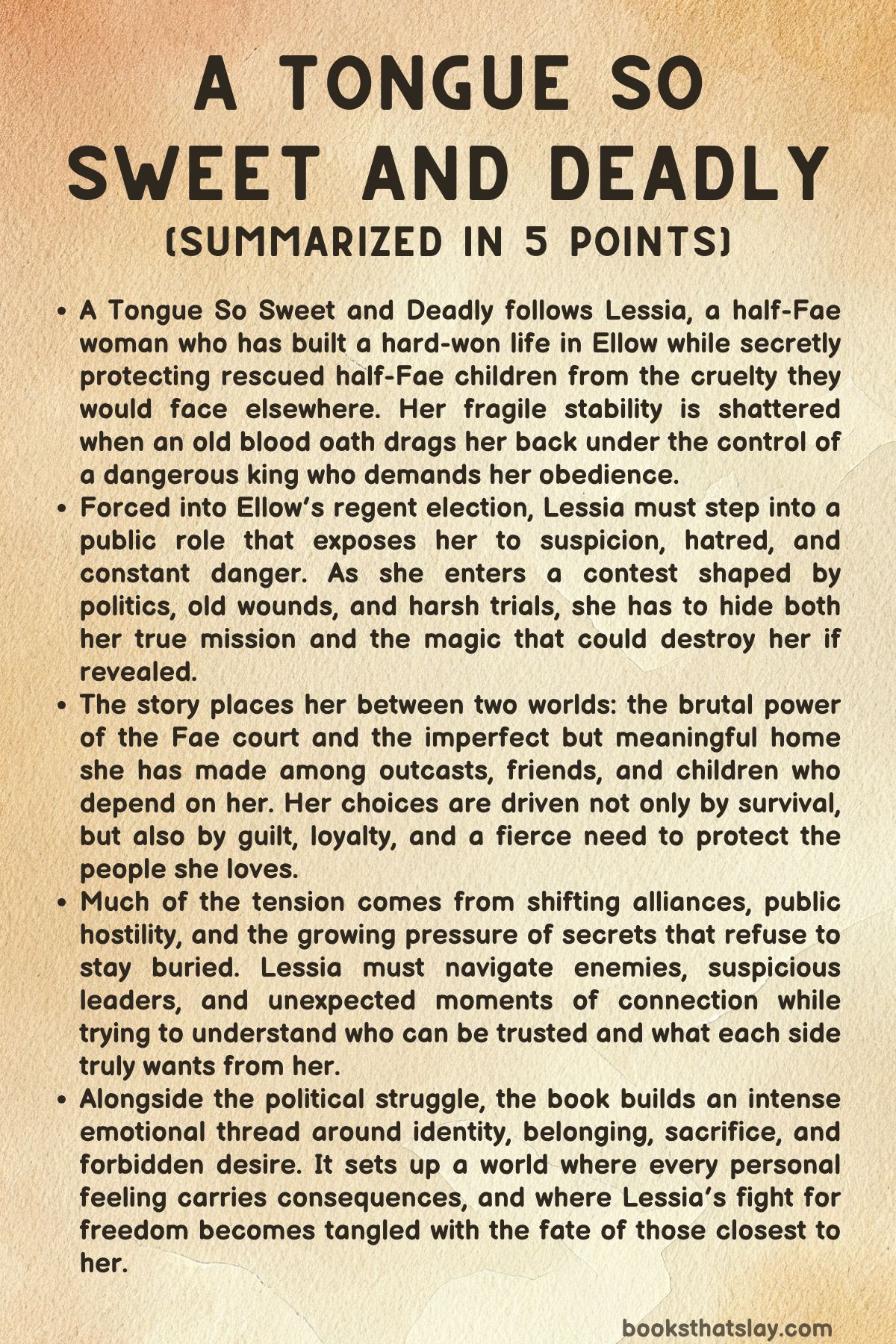
Characters
Lessia (Elessia)
Lessia stands at the center of the story as a character shaped by fear, guilt, endurance, and fierce love. She begins as someone living under constant pressure, never fully free even in the life she has built for herself.
Her outward image is that of a capable tavern owner and a sharp survivor who knows how to manage dangerous men, tense situations, and the hostility of a city that does not entirely trust her. Yet beneath that toughness is a woman carrying years of trauma.
The blood oath binding her to King Rioner means her life is never fully her own, and that lack of control defines much of her inner conflict. Even when she appears strong, there is always a shadow of dread behind her actions because she knows that punishment can arrive at any moment.
What makes her especially compelling is the tension between the person she has been forced to become and the person she wants to be. She has power, including magic that can influence minds, but she is deeply wary of using it because of past regret.
That restraint is important. It shows that she is not simply trying to survive; she is trying to remain morally intact.
Her secret refuge for half-Fae children reveals the truest part of her character. She is driven by guilt over a past loss, but that guilt has turned into action rather than self-pity.
She has built a hidden life around protection, rescue, and responsibility. Even when she is exhausted, injured, frightened, or humiliated, she continues to place the safety of others above her own comfort.
Her political journey adds another layer to her character. She enters the election under coercion, but once inside it, she begins to confront larger questions about power, justice, and belonging.
She is not naturally drawn to public leadership in the way some ambitious figures are, yet she gradually shows that she possesses qualities many rulers lack: empathy, sacrifice, and the ability to understand suffering from the inside. Her attraction to Loche complicates her further, because it places personal longing against secrecy and duty.
She wants closeness, but her life has trained her to conceal, protect, and endure in silence. In the hardest moments, especially when forced to choose between people she loves, her character is defined by impossible compromise rather than clean heroism.
That is what gives her depth. She is not idealized; she is bruised, burdened, and often uncertain, but still determined to keep moving.
Merrick
Merrick is introduced as a figure of menace, and for much of the story he carries the atmosphere of a predator always standing just behind Lessia’s shoulder. He represents the reach of King Rioner’s power and the terror of the blood oath more vividly than the king himself at first.
His silver-haired appearance and Fae nature make him seem almost inhuman in Lessia’s eyes, and that emotional effect matters because he is not just an enemy in a practical sense. He is the embodiment of the fear she has never escaped.
When he appears, he strips away her illusion of control. His ability to threaten, coerce, and physically overpower her makes him a constant reminder that violence is never far away.
At the same time, Merrick is not written as a simple brute. He is brutal, but he is also observant, controlled, and unexpectedly complex.
He does terrible things, including carrying out the king’s cruelty, yet he is not entirely without nuance. He understands more about Lessia than most people do, and although he pushes her relentlessly, he also seems to recognize her endurance and intelligence.
There are moments when he encourages rather than destroys, and that contradiction makes him more interesting. He can beat her as a warning and later urge her not to give up.
He can threaten her while also giving her tools to survive. That does not erase his violence, but it suggests that he operates according to a harsh logic that is larger than simple sadism.
His relationship with Lessia is therefore deeply unsettling because it contains both domination and a strange form of recognition. He sees what she feels, especially in relation to Loche, and he often acts as though nothing in her is hidden from him.
That creates a psychological pressure far beyond physical danger. He becomes one of the few characters who fully understands how trapped she is, because he is part of the mechanism trapping her.
Even so, he is not emotionally transparent. It remains unclear how much of his behavior comes from loyalty, how much from personal belief, and how much from his own entanglement in systems of power.
This ambiguity gives him weight as an antagonist. He is frightening not only because he can hurt people, but because he moves through the story with a calm certainty that makes him difficult to predict or dismiss.
Loche Lejonskold
Loche begins as a suspicious and sharp-edged political figure, a man already carrying authority before he fully steps into the emotional center of the story. He is popular with commoners and hated by nobles, which immediately marks him as someone disruptive within Ellow’s power structure.
That public reputation matters because it frames him as a leader defined by conflict rather than comfort. He is not universally admired, and his position appears to have been earned through struggle.
When Lessia first encounters him in the election setting, he watches her closely, questions her motives, and often treats her with a mixture of curiosity, hostility, and attraction. This unstable combination makes him difficult to read.
He is not openly welcoming, yet he is never indifferent.
A key part of his character is that he lives behind his own guarded exterior. He is clever, cutting, and often provocative, especially in public settings where political performance matters.
He mocks opponents, unsettles people with pointed remarks, and uses emotional distance as a kind of shield. Yet the story repeatedly reveals that this outer hardness conceals someone far more vulnerable and emotionally burdened.
He has endured his own trials, carries private sorrow, and seems to understand loss in a way that gives depth to his leadership. His connection with Lessia becomes meaningful because he gradually sees through the identity she performs.
He senses that the seductive, dangerous reputation attached to her does not match the caring person beneath it. That insight suggests a man who is perceptive not only politically but personally.
His romance with Lessia is compelling because it never feels detached from power. Their attraction grows in an atmosphere of secrecy, surveillance, danger, and divided loyalties.
He wants her, but he also suspects her. He offers tenderness, then withdraws into doubt.
He creates moments of emotional safety, then reminds her that he is still a ruler navigating threats and conspiracies. This inconsistency is not merely romantic tension; it reflects the central fracture in his character.
He is a man trying to balance feeling and duty, trust and caution, compassion and statecraft. Even his acts of mercy are shaped by political responsibility.
By the time he reveals the pain of his own final trial and the difficult choice he made, he emerges as someone who is not cold by nature but forced into coldness by leadership. His character gains strength from that tension.
He is neither savior nor enemy, but a man whose sincerity is always filtered through the burdens of rule.
Ardow
Ardow initially appears as one of Lessia’s most loyal and comforting companions, someone who offers steadiness when her life is unraveling. He is part of the chosen family she has built in Ellow, and his presence is tied to emotional safety, practical support, and shared history.
He understands her moods, comforts her after frightening encounters, and helps maintain the hidden life they have created together. His role in the household suggests patience and reliability, and his knowledge of politics makes him useful in a way that goes beyond friendship.
He is not only emotionally close to Lessia; he is also someone she trusts with responsibility. That trust becomes especially significant when she transfers property and duties to him in preparation for possible death.
What gives Ardow real complexity, however, is the revelation that his loyalty has never been as simple as it seemed. For much of the story, he appears to represent home, safety, and continuity, but later it becomes clear that he has been keeping enormous secrets.
His involvement in a wider political cause transforms him from supportive companion into a morally ambiguous figure. He does not see himself as a traitor in the narrow sense.
From his perspective, he is acting on behalf of oppressed people and pursuing change that existing systems will never willingly allow. This makes him more than a plot twist.
He becomes a character driven by ideology, resentment, and a deeper distrust of reform than Lessia is willing to accept.
His confrontation with Lessia is powerful because it exposes the painful gap between personal loyalty and political conviction. He clearly cares for her, but he is also frustrated by what he sees as her faith in a system that cannot truly save people like them.
His anger over her feelings for Loche reveals jealousy, fear, and disappointment all at once. He does not simply disagree with her choices; he feels betrayed by what those choices symbolize.
At the same time, Lessia feels betrayed by his secrecy. Their conflict hurts because neither is entirely false.
Ardow is not reduced to villainy, even after his exposure. He remains someone shaped by injustice, committed to a cause, and willing to risk everything for it.
That makes him tragic. He is one of the clearest examples in the story of how oppression can fracture trust even among people who genuinely love one another.
Amalise
Amalise is one of the emotional pillars of Lessia’s world. She does not dominate scenes through political power or dramatic mystery, but her importance is profound because she represents care, honesty, and shared burden.
She is one of the few people close enough to see how guilt is eating Lessia alive, and she refuses to let silence disguise that damage. When she confronts Lessia about clinging to past loss, her role becomes clear: she is not only a friend who offers comfort, but someone willing to challenge destructive patterns.
This makes her presence essential. She is not passive support.
She is emotionally intelligent enough to recognize when love requires tenderness and when it requires confrontation.
Her connection to the hidden household also shows her strength. She helps care for the children, shares responsibility for the refuge, and appears deeply woven into the daily labor that keeps their secret family alive.
That matters because it grounds her character in action rather than sentiment. She is part of the practical machinery of survival.
When Lessia faces the election, Amalise’s pain is immediate and personal. She struggles with choices like Ardow being selected as escort, and her hurt in those moments shows that she is not endlessly self-sacrificing in a flat or unrealistic way.
She feels excluded, worried, and emotionally raw, which makes her believable.
Her later role in the final crisis reveals even more. When Lessia is forced to choose between Ardow’s death and Amalise’s banishment, Amalise becomes the measure of what home means.
She is not just a friend to be protected; she is part of the life Lessia has built from ruin. Choosing banishment is devastating precisely because Amalise symbolizes belonging, continuity, and ordinary human closeness in a story full of manipulation and violence.
Even when pushed toward exile, she remains part of the emergency plans to protect the children, which reinforces her courage and reliability. Amalise’s character may not be wrapped in mystery, but she is emotionally indispensable.
She brings warmth, directness, and moral clarity into a world where many others are operating behind masks.
King Rioner
King Rioner functions as a major force of domination in the story, and his power is most disturbing because it is so deeply personal. He is not merely a distant ruler issuing commands.
He has direct control over Lessia through the blood oath, and his authority is tied to her history of imprisonment, fear, and bodily violation. This makes him more terrifying than a conventional political antagonist.
He reaches into her present through trauma, turning the past into an instrument of continued control. Even when he is physically absent, his influence shapes her choices and emotional state.
He does not need constant page time to feel powerful because the consequences of his rule are always visible in Lessia’s reactions.
What stands out in his characterization is the mixture of strategic intelligence and cruelty. He is not content simply to punish or possess.
He sets Lessia into motion as part of a larger political game involving spies, missing figures, and the possibility of a deeper conspiracy. That means he operates on multiple levels at once: personal tyrant, calculating monarch, and manipulator of unstable alliances.
His promise to free her if she succeeds is especially revealing. He understands exactly how to weaponize hope.
Freedom becomes another tool of control, dangled in front of someone who has been denied it for years.
He also represents the hypocrisy of power. He commands obedience through violence while framing his demands in terms of necessity and intelligence-gathering.
He expects loyalty from someone he has brutalized, which exposes a worldview in which other people exist as instruments. Yet he is not portrayed as reckless.
His suspicions about larger disturbances in the political landscape suggest that he is alert, suspicious, and capable of reading danger. That makes him harder to dismiss as a simple monster.
His evil is organized, political, and patient. He stands for a form of rule built on fear, ownership, and the destruction of individual freedom, which is why his presence weighs so heavily over Lessia’s every attempt at building a life of her own.
Zaddock
Zaddock first appears as one of Regent Loche’s masked officials, and at a glance he seems likely to remain a functional political aide. Instead, he gradually develops into a more substantial supporting figure whose importance lies in his watchfulness, competence, and uncertain loyalties.
He questions Lessia sharply, studies her motives, and does not allow her presence in the election to pass without scrutiny. This makes him an extension of institutional caution.
Where Loche can be provocative and emotionally inconsistent, Zaddock often feels more controlled and methodical. He is one of the people most clearly trying to assess risk at all times.
His character becomes more vivid during moments of danger. When attacked on the stairs, he fights decisively and protects Lessia without hesitation, showing that he is not merely a bureaucratic observer but someone capable in direct conflict.
That competence adds weight to his political role. He is a man who can survive close violence while still functioning within a larger system of governance and security.
This dual capability makes him an important stabilizing presence around Loche, especially in an environment filled with plots and hidden agendas.
Zaddock is also significant because he acts as a mirror for Lessia’s uncertainty about the castle and its people. He is suspicious of her, yet not needlessly cruel.
He escorts, questions, observes, and intervenes, often without revealing much of his own interior life. That reserved quality makes him difficult to fully decode, but it also suits his narrative function.
He belongs to a world where information is dangerous and trust is conditional. Even when his emotional depth remains less visible than that of other major characters, he contributes to the atmosphere of tension and careful political calculation.
He helps define the castle as a place where every look, escort, and conversation may carry meaning beyond the obvious.
Frayson
Frayson, the Guardian of the Law, represents institutional order and the weight of Ellow’s legal and political traditions. His role is especially important because he stands at the intersection between public legitimacy and private suffering.
He oversees elections, explains trials, calms crowds, and serves as a voice of procedure in situations that could easily descend into chaos. When the crowd reacts violently to Lessia’s nomination, Frayson’s declaration that the law allows her participation marks him as a figure committed, at least outwardly, to the system rather than to popular prejudice.
That moment gives him authority not simply as an administrator but as someone capable of holding the line against public hysteria.
Yet his position is not uncomplicated. He also presides over a brutal political culture in which candidates must endure suffering, and later he becomes the formal voice delivering one of the cruelest choices Lessia faces.
This means he is tied to a system that claims justice while inflicting controlled pain. He does not appear overtly malicious, but he is deeply embedded in a structure that normalizes hardship as proof of worthiness.
His calmness during such events can read as dignity or coldness depending on the moment, and that ambiguity gives him force as a character.
Frayson is therefore valuable not because he is emotionally expressive, but because he personifies the law as both shield and burden. He protects Lessia’s right to stand as a candidate, but he also enforces the mechanisms that torment her.
He is not driven by obvious prejudice or personal hatred. Instead, he seems committed to process, tradition, and the abstract idea that rulers must be tested through suffering.
That makes him less personally dramatic than characters like Merrick or Loche, but no less important. He embodies the uncomfortable truth that systems can uphold fairness in one moment and cruelty in the next without seeing themselves as contradictory.
Stellia Silversvard
Stellia enters the story as a respected naval captain and one of the election candidates, and she quickly brings a different kind of energy into the tense, suspicious atmosphere around Lessia. She is warm, witty, socially confident, and more open than most of the other political figures.
Her ease around people creates contrast with both Loche’s cutting reserve and Craven’s arrogance. This makes her feel immediately more approachable.
Her interactions suggest a woman comfortable with power but not imprisoned by stiffness. She can joke, flirt, and move through public spaces without losing authority, which gives her a distinct presence.
Her importance also lies in what she reveals about the fragility of reputation. Even though she appears respected, she is swiftly blamed and eliminated after the attack involving her guards.
Whether or not she is truly responsible, the speed of her fall shows how unstable political standing can be. This gives her character a tragic edge.
She is not developed through long introspection, yet her treatment in the narrative exposes how quickly systems of judgment can turn. Her downfall also heightens the sense that the election is riddled with manipulation and that innocence offers little protection.
Stellia’s brief warmth toward Lessia matters because it shows that acceptance is possible in spaces otherwise marked by hostility. She becomes one of the few candidates who offers companionship instead of suspicion.
That role may be limited, but it is meaningful. She represents a possible social ease and solidarity that the story repeatedly threatens to destroy.
Even after her exit from the competition, her presence lingers because her apparent disgrace leaves unanswered questions about guilt, framing, and political convenience.
Venko Alkhal
Venko occupies an especially interesting position because he bridges Lessia’s secret world and the wider political conspiracy surrounding the election. As a shipping magnate who has secretly helped transport rescued children, he is tied to the hidden acts of mercy and resistance that sustain Lessia’s mission.
That alone makes him important, because it shows that her efforts are not isolated. There are others operating in the margins, using wealth, networks, and influence to move vulnerable people to safety.
In this sense, Venko initially appears as an ally embedded in a more dangerous and powerful sphere than the warehouse household.
What complicates him is the revelation that he knows more than Lessia expected and is involved in a larger web of conspiracies. His exposure as connected to treason destabilizes any simple sense of him as helper or villain.
He becomes another example of how aid, resistance, and political subversion overlap in morally unstable ways. A person can participate in rescue and still be entangled in schemes that threaten wider violence.
This ambiguity makes Venko significant even if his emotional life is less fully explored than that of the core cast.
His role also sharpens the story’s central question about methods. How far should people go to oppose unjust systems?
When does covert resistance become something more destructive? Venko’s actions sit near that boundary.
He broadens the political landscape by showing that the struggle around Lessia is not confined to courts, elections, and personal loyalties. There are hidden networks at work, and he is one of the clearest signs that behind every public event lies a deeper structure of secret alliances.
Ledger
Ledger is one of the most emotionally resonant supporting characters despite his limited power within the plot. As a newly rescued child, traumatized, starving, and barely responsive, he represents the human cost of the world Lessia is fighting against.
His introduction is devastating because he arrives with almost nothing left, not even a stable sense of identity. When he cannot remember his name and Lessia helps him choose one, the moment becomes about more than comfort.
It is about restoration of self. Ledger’s character is defined by fragility, grief, and the first painful steps toward safety.
He is important because he reveals the best side of Lessia. Around him, her protectiveness, patience, and restraint become especially clear.
She wants to erase his pain but refuses, knowing the moral damage of using power to overwrite suffering. Through Ledger, the story shows that healing cannot simply be forced, even by magic.
His tears over his dead friend and his damaged silence make him one of the clearest symbols of why the hidden refuge matters. He is not treated as background scenery for Lessia’s heroism; he is a reminder that survival leaves wounds that do not vanish when danger ends.
Later, when he appears in the household dynamic and in small conflicts such as fighting with Harver, Ledger becomes more than a symbol of trauma. He starts to feel like a child reclaiming ordinary life.
That shift is important because it shows movement from survival into personhood. His character may remain secondary, but he gives emotional stakes to nearly every difficult decision Lessia makes.
Kalia
Kalia serves as part of the hidden family Lessia has built, and though she receives less attention than some others, her presence helps define the household as a living community rather than a symbolic refuge. She appears during moments of farewell, worry, and emergency planning, which positions her within the emotional fabric of the home.
She is one of the people Lessia fears leaving behind and one of those she tries to protect when the political crisis worsens. That alone gives her significance, because it shows she is among the lives that give Lessia’s struggle personal meaning.
Kalia also becomes important in the final movement of the summary, when escape plans are being made and the children’s safety takes priority. In those moments, she is part of the future Lessia is trying desperately to preserve.
The promise Lessia makes to her about coming back later carries emotional weight because it reveals how children in this world live under uncertainty even in supposed shelter. Kalia helps keep the stakes grounded.
The political intrigue matters, but it matters most because people like her will bear the consequences.
Harver
Harver, like Kalia, helps fill out the reality of the refuge and the chosen family at the story’s center. He appears as one of the children whose presence transforms Lessia’s hidden household into a genuine home with conflict, routine, and emotional ties.
When Lessia settles a fight involving Ledger and Harver, the scene does more than show childish friction. It shows that the refuge is not a frozen image of suffering.
It is a place where life continues in all its messy, ordinary forms. Harver contributes to that sense of everyday reality.
His character functions as a reminder that rescue is not a single event but an ongoing process. Children who have survived abandonment and danger do not simply become peaceful and healed overnight.
They remain children, with tempers, fears, and needs. Harver’s role may be small, but it adds texture to the world Lessia is fighting to protect.
Geyia
Geyia appears most memorably in the section where Lessia spends time among Loche’s people and discovers a rare environment of acceptance. Through Geyia, the story offers a contrast to the suspicion and prejudice that have followed Lessia elsewhere.
Their conversation allows Lessia to recognize her own earlier misjudgment, which means Geyia also functions as a corrective presence. She expands Lessia’s understanding rather than merely welcoming her.
That is important because it makes acceptance active and intelligent, not just pleasant.
Geyia later becomes part of the refuge plan for the children, which confirms that she is more than a social acquaintance. She is someone trusted enough to help protect vulnerable lives.
This gives her quiet moral significance. She belongs to a pocket of community that offers the possibility of solidarity across difference, and that makes her one of the more hopeful supporting figures in the story.
Steiner
Steiner helps create one of the story’s strongest images of warmth and belonging. His call to dinner interrupts an intimate moment, but what follows is not embarrassment or rejection.
Instead, he is part of the communal generosity that briefly allows Lessia to feel at ease. His presence, like Geyia’s, helps define Loche’s circle as a place where care can exist openly.
That matters because it offers a counterweight to the harshness of the castle and the cruelty of the wider political world.
Later, as part of the planned refuge for the children, Steiner’s role gains practical importance. He is not simply background hospitality.
He becomes connected to safety, shelter, and the possibility of continuity when Lessia’s own home is under threat. His character may not be explored deeply, but he helps embody the idea that survival sometimes depends on communities willing to receive the vulnerable without fear.
Craven Bernedir
Craven represents entitlement, exploitation, and the uglier face of elite power. As a wealthy noble and election candidate, he stands in sharp contrast to Loche’s popular support and Lessia’s hard-earned resilience.
His behavior is marked by complaint, arrogance, and insult, making him one of the clearest embodiments of class contempt within the summary. He does not simply oppose others politically; he carries himself with the assumption that status should shield him from discomfort and give him the right to belittle those beneath him.
This makes him useful as a character because he concentrates social tensions into an identifiable figure. Through him, the election becomes not only a contest of personalities but a clash between different visions of rule.
His treatment of Lessia exposes prejudice, and his general attitude toward hardship reveals a man ill-suited to the ideals the trials supposedly demand. Even when he is not the most emotionally layered character, he plays an effective role as a representative of selfish privilege and decaying nobility.
Themes
Identity as a Burden and a Weapon
Lessia’s half-Fae identity shapes nearly every part of her life, but the story refuses to treat that identity as a simple source of either strength or suffering. Instead, it shows how something central to the self can become both a wound and a tool, depending on who is looking at it and what they want from it.
In public, her heritage marks her as suspect. The crowd at the nomination does not judge her by her actions, her work, or her care for others; it judges her by what she is.
Their outrage makes clear that prejudice in Ellow is not subtle or private. It is loud, communal, and politically powerful.
Her presence alone is enough to cause panic, which means she enters every space already carrying other people’s fear and hatred before she even speaks.
At the same time, that same identity gives her access to forms of power that others do not have. She can compel, protect, conceal, and survive in ways tied directly to her Fae blood.
But the story does not frame this power as freeing. Her magic is entangled with shame, secrecy, and danger.
She uses it when cornered, yet she also fears what it can make her become. This creates a strong inner tension: the very thing that helps her endure is also the thing that isolates her from the society around her.
Even in private relationships, she cannot fully relax into herself because revelation carries consequences.
What makes this theme especially strong is that identity here is never abstract. It affects law, romance, politics, safety, and self-worth all at once.
Lessia is forced to think constantly about which version of herself can be seen, which must stay hidden, and which might be used against her. The result is a portrait of a person living in fragments, trying to hold together a self that the world keeps trying to split apart.
Her struggle is not just to be accepted, but to remain morally intact while living inside labels that others have already decided define her.
Love, Loyalty, and the Cost of Divided Allegiance
The story builds enormous emotional force from the fact that Lessia is never pulled in only one direction. She is always divided between people, promises, and obligations that cannot peacefully coexist.
Her loyalty to the children she protects is sincere and unwavering. Her bond with Amalise and Ardow is rooted in shared survival, trust, and chosen family.
Yet she is also bound by force to King Rioner through the blood oath, which means her body and choices can be claimed against her will. As the plot develops, her growing attachment to Loche deepens this conflict even further.
What could have become a simple romantic thread instead becomes one more painful fracture in an already unstable life.
This theme matters because the story shows that loyalty is not always noble in a clean or easy sense. Sometimes loyalty means lying to people you care about because telling the truth would destroy them.
Sometimes it means standing beside someone even after learning they have hidden terrible things. Sometimes it means choosing the person you can save, not the person you most want to save.
Lessia’s emotional world is shaped by these impossible choices. She cannot be fully honest with Ardow and Amalise because of the oath.
She cannot be honest with Loche because the truth would expose her mission and likely end whatever trust is forming between them. In every direction, affection is poisoned by secrecy.
Ardow’s betrayal gives this theme even more weight because it shows that divided allegiance is not hers alone. He, too, has been serving a cause larger than friendship.
His choices force Lessia to confront a painful reality: people can love each other deeply and still betray one another for reasons they believe are just. That recognition makes the emotional landscape of the story much more mature and tragic.
Love does not erase ideology, fear, or duty. Instead, those forces cut through love and test whether it can survive.
By the time Lessia must choose between Ardow’s execution and Amalise’s banishment, loyalty has become almost unbearable. The story makes clear that devotion is not measured by purity but by endurance under pressure.
She continues to care, even when every bond around her is strained by hidden motives, political violence, and moral compromise. That gives the theme its lasting power.
Power, Control, and the Violence Behind Political Order
Political authority in this story is never presented as neutral administration. It is intimate, physical, and often cruel.
From the beginning, power is shown not through speeches alone but through bodies being controlled, watched, beaten, judged, and threatened. King Rioner’s authority over Lessia is the clearest example.
His rule reaches into her life through the blood oath, which strips away distance and turns power into something almost biological. He does not merely command her in a formal sense; he can summon her body, force her presence, and punish defiance with direct violence.
This sets the tone for the wider political world, where institutions and personal domination constantly overlap.
Ellow may appear more lawful and civilized than Vastala, but the election process shows that its political system is also built on suffering. Candidates are tested through hunger, hardship, humiliation, and emotional devastation.
The official justification is that rulers must understand what the people endured in war, yet the trials also reveal a belief that leadership must be forged through pain. This idea gives the political order a grim edge.
Public legitimacy is tied not only to competence but to one’s ability to survive cruelty. Even when the system claims fairness, it still relies on spectacle, punishment, and the stripping away of comfort.
The story also examines how power protects itself by shaping narratives. Stellia is blamed and eliminated before the truth can be properly established.
Public opinion turns quickly against Lessia because prejudice is politically useful. Ardow is exposed at a moment that serves the structure of the trial.
Again and again, the people with institutional authority decide what events mean before others can speak for themselves. This does not mean every leader is equally corrupt, but it does show that systems of order are vulnerable to manipulation and built on unequal control over information.
Loche complicates this theme in an interesting way because he is neither a simple tyrant nor a pure reformer. He challenges nobles, earns public support, and appears to want change, yet he still operates inside a system that inflicts brutal tests and withholds mercy.
His relationship with Lessia is shaped by this contradiction. He may care for her, but he is also part of a structure that investigates, judges, and corners her.
That tension prevents politics from becoming a distant backdrop. Instead, the story argues that power enters the most personal parts of life.
It governs desire, friendship, survival, and truth itself.
Guilt, Survival, and the Search for Redemption
A deep current of guilt runs through Lessia’s actions, and it gives the story much of its emotional seriousness. She does not protect children simply because she is kind.
She does it because she is trying to answer for something in her past that still lives inside her like an open wound. The rescued children, the hidden refuge, and the care she gives Ledger all suggest that her present life has been built as a response to an earlier failure or loss she cannot forgive.
This makes her compassion feel active and costly rather than sentimental. She is not helping others from a place of peace.
She is helping from a place of damage.
What makes this theme compelling is that guilt is never shown as purely noble. It drives her toward meaningful acts of protection, but it also threatens to consume her.
Amalise sees this clearly and tries to warn her not to let that burden define her completely. Lessia, however, seems to believe that suffering is the price of continuing to deserve a place in the world.
She keeps moving, caring, and sacrificing, but she rarely grants herself softness. In that sense, survival in the story is not just about escaping enemies or enduring physical trials.
It is also about surviving one’s own memory and self-judgment.
Redemption is therefore presented not as a grand moment of absolution but as a difficult, unfinished practice. Every child she shelters, every danger she faces for others, and every hard choice she makes becomes part of that process.
Yet the story also suggests that good deeds do not erase pain in any simple way. Her past still shapes how she uses magic, how she handles grief, and how she responds to vulnerability in others.
Even moments of happiness, especially with Loche, are shadowed by the knowledge that she is still carrying secrets and still acting under coercion. Joy does not cancel guilt; it exists beside it.
The final sections deepen this theme by forcing her into choices that no morally serious person could make without being scarred. Choosing Amalise’s banishment to save Ardow does not feel like victory.
It feels like another wound added to an already heavy conscience. That is precisely why the theme works so well.
Redemption here is not clean, and survival is not heroic in a polished sense. It is painful, morally messy, and full of consequences that remain long after the decision is made.
The story suggests that a person may continue doing what is right while still feeling broken by what they could not prevent, and that truth gives the narrative much of its emotional depth.