Wretched by Emily McIntire Summary, Characters and Themes
Wretched by Emily McIntire (Never After #3) is a dark contemporary romance that reimagines The Wonderful Wizard of Oz through a gritty, morally ambiguous lens. It follows Evelina “Evie” Westerly, the ruthless “wicked” anti-heroine of an Irish-American crime family, and Nicholas Woodsworth, the undercover DEA agent sent to dismantle her empire.
The story blends intense family grief, betrayal, revenge, criminal intrigue, and a volatile enemies-to-lovers romance laced with deception, steamy encounters, and moral grayness. It is dual POV, standalone within the Never After series, and emphasizes that “a woman can be great…and terrible too.”
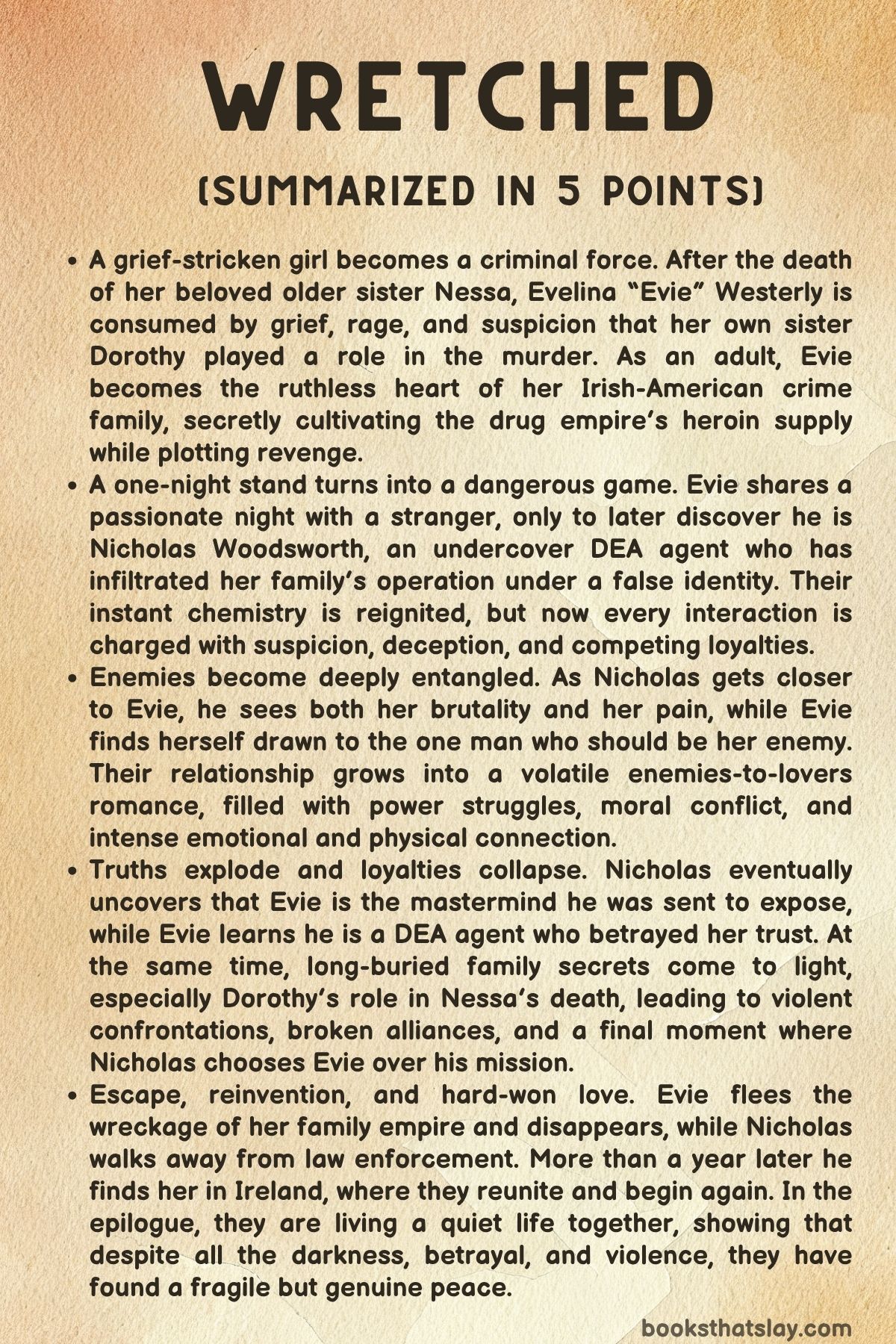
Summary
The novel opens at the Memorial Mass for Vanessa “Nessa” Westerly in Kinland, Illinois. Seventeen-year-old Evelina (Evie) sits with her middle sister Dorothy and their father Farrell, recently released from an eight-year prison sentence for drug trafficking.
Nessa, the eldest sister and ten years older than Evie, had raised both younger girls after Farrell went to prison and their mother abandoned the family. Dorothy, fueled by long-standing jealousy, usurps Evie’s spot at the podium to deliver the eulogy—wearing Nessa’s shoes in a pointed act of disrespect.
In private, Evie seethes with complex anger: grief over losing the sister who was her protector and stabilizer, resentment toward Nessa for dying, and a cold certainty that Dorothy is responsible for Nessa’s murder. This loss ignites a darkness in Evie that will define her path.
Now in her mid-twenties, Evelina Westerly has fully embraced her role as the brains, brawn, and botanist of the Westerly criminal empire. She is her father Farrell’s ruthless secret weapon.
By day (and often night), she tends a massive secret underground greenhouse hidden beneath a cottage on the family estate. There, she cultivates poppies and manufactures “Flying Monkey,” the family’s signature high-potency heroin that has made them powerful in the drug trade.
Evie divides her time between perfecting her product, methodically seeking revenge for Nessa’s death, and eliminating threats with cold efficiency—guns, violence, or whatever the situation demands. She has no time or interest in love or softness; she is the villain of her own story, shaped by loss into someone impulsive, intelligent, and deeply scarred.
Evie allows herself one impulsive night of release: a scorching one-night stand with a gorgeous stranger at a Chicago nightclub. No names, no strings—just raw physical connection that leaves her sated and ready to return to her criminal life.
Enter Nicholas Woodsworth, a dedicated DEA agent. His own family was devastated by the drug trade, fueling a personal vendetta to destroy operations like the Westerlys’.
Assigned by his supervisor Agent Galen, Nicholas goes undercover as a jewel thief named Brayden (or similar alias in interactions) to infiltrate the Westerly organization and identify their mysterious supplier. He has no idea the “new lackey” role will collide with his recent hookup.
When Brayden shows up at the Westerly estate as the latest hired help, both Evie and Nicholas are stunned to recognize each other. The attraction that sparked that night reignites instantly, but now it’s poisoned by secrets and opposing worlds.
Nicholas is disgusted by what Evie represents—everything he has sworn to eradicate—yet he cannot deny the pull. Evie, believing he lied about his name during their encounter, views him with suspicion mixed with lingering desire.
Their interactions crackle with tension: sharp banter, power plays, and undeniable chemistry that blurs the lines between hate and lust.
As Nicholas embeds himself deeper into the family operations, he witnesses the Westerlys’ ruthless world firsthand. Farrell is a domineering crime boss whose love for his daughters is overshadowed by his need for control and power.
Dorothy remains a jealous, manipulative presence, still harboring resentment and now showing interest in learning Evie’s “product” methods—hinting at her ongoing scheming.
Evie continues her dual life: managing the greenhouse with scientific precision while advancing her revenge plot against those responsible for Nessa’s death (Dorothy’s involvement becomes a key revelation that fuels her fury). She is unapologetically violent when needed, putting “a gun to the head of anyone in her way.” Nicholas’s mission grows complicated as he falls for the very woman he was sent to bring down.
The more time they spend together—working side by side, clashing over morals, and giving in to explosive physical encounters—the more he sees the darkness in her heart mirroring his own. They are alike in their brokenness: both shaped by profound loss, both capable of terrible things in pursuit of what they believe is right (or necessary).
Hatred slowly twists into something deeper and more dangerous. Their relationship is volatile—enemies with benefits who push each other’s buttons, expose vulnerabilities, and challenge each other’s worldviews.
Nicholas grapples with his duty versus his growing feelings, while Evie begins to question her isolated, vengeful existence even as she refuses to soften. The romance is intense, explicit, and emotionally raw, with Oz-inspired motifs (yellow brick road hints in paths of deception, shoes as symbols of envy and loss, the “Tin Man” lacking a heart, etc.) woven throughout.
The plot escalates when Nicholas uncovers the truth: Evelina is the mastermind supplier he was tasked to find. The revelation hits hard, forcing him to confront how deeply entangled he has become.
Meanwhile, Evie learns Nicholas’s true identity as a DEA agent, shattering any fragile trust. The betrayal cuts deep—she feels used, exposed, and furious that the man who made her feel alive was there to destroy her and her family.
Family fractures widen. Dorothy’s role in Nessa’s death comes fully to light, igniting Evie’s long-planned revenge.
Tensions with Farrell peak as power dynamics and loyalty are tested. External threats, including rival agents or internal betrayals (such as involving characters like Agent Baum or others closing in), create chaos.
Violent confrontations erupt, including a critical scene where Nicholas must choose sides in a life-or-death moment—ultimately shooting a threat to protect Evie, uncuffing her, confessing his love, and urging her to run while he stages the scene to cover her escape.
Evie flees through the underground tunnels of her greenhouse world, leaving the crumbling empire behind. Nicholas resigns from the DEA, his mission (and heart) irrevocably altered.
After the dust settles, Evie goes into hiding. More than a year later, a private investigator helps Nicholas track her to Doolin, a small coastal village in Ireland.
He finds her walking the cliffs, her signature dyed hair returned to natural brown, quietly writing in a notebook—finally allowing herself space to breathe and create beyond crime and revenge.
Their reunion is poignant: Nicholas approaches with the same opening line from their first night, and Evie offers her first genuine, unguarded smile. They acknowledge the pain, lies, and darkness they brought into each other’s lives, but also the redemption and connection that emerged from it.
An extended epilogue set five years later shows them living peacefully in a cottage in a Northern Irish forest. They are unofficially married.
Nicholas has left law enforcement behind and runs a furniture business called “Tin Roof” (a nod to his “Tin Man” archetype). Evelina tends her own garden and writes poetry, having learned to live for herself rather than for family legacy, revenge, or survival.
Their love, forged in fire and moral ambiguity, offers a hard-won, imperfect happy ending—proof that even the “wretched” can find peace and that love can redeem without erasing the past
Characters
Evelina “Evie” Westerly
Evie is the emotional and moral center of the story because nearly every conflict passes through her grief, anger, intelligence, and need for control. As a child, she loses the one person who made life feel stable, and that loss hardens into an identity built on self-protection.
What makes her compelling is that she does not pretend to be innocent. She understands her own cruelty, acts with clear intention, and often treats violence as a practical tool rather than a tragic last resort.
That honesty gives her a frightening kind of clarity. She is not a heroine pretending to be dark; she is a genuinely dangerous woman who still retains emotional depth.
Her work in the underground greenhouse reveals how she thinks. She is patient, technical, and exact, which contrasts with her impulsive emotional life.
She can build, cultivate, and perfect, yet she can also destroy without hesitation. That split makes her more than a standard crime-family anti-heroine.
She represents someone whose tenderness has been redirected into obsession. The same focus that could have made her a scientist, artist, or caretaker instead becomes the foundation of a criminal empire.
Her relationship with love is equally shaped by loss. She avoids softness because softness once meant dependence, and dependence led to pain.
Nicholas unsettles her because he reaches the parts of her that revenge cannot satisfy. Even when she begins to feel genuine attachment, she never becomes simplified or morally cleansed.
Her growth lies not in becoming good, but in finally wanting a life that is not ruled by death, family inheritance, and punishment. That makes her ending convincing: she does not become innocent, but she becomes freer.
Nicholas Woodsworth
Nicholas functions as both romantic lead and moral counterforce, yet the story carefully prevents him from becoming a clean symbol of justice. He enters the plot with institutional authority and a personal mission, believing he can separate duty from emotion.
His hatred of the drug world is rooted in family pain, so his investigation is not neutral service but private vengeance given legal form. That matters because it places him closer to Evie than he initially understands.
Both are driven by grief, both justify extreme actions through personal wounds, and both believe their cause gives them permission to cross lines.
His undercover role exposes the instability of his identity. As he moves deeper into the Westerly orbit, he is forced to perform intimacy, loyalty, and criminal usefulness, and eventually those performances stop feeling entirely false.
His attraction to Evie is not simply sexual temptation. He recognizes in her a version of himself stripped of social approval.
She acts on impulses he represses. She is honest about the darkness he hides behind his badge.
That recognition turns his mission into a crisis of self-knowledge.
What makes Nicholas effective is that his arc is not about rescuing Evie from herself. He is changed by her as much as she is changed by him.
His final choices expose the limits of law when law collides with love, moral ambiguity, and lived human complexity. By resigning from the institution that defined him, he does not prove that love erases wrongdoing.
He proves that his previous certainty about justice was incomplete. He ends as a man who has lost the comfort of clear categories and chosen a life built on responsibility rather than righteousness.
Dorothy Westerly
Dorothy is one of the most psychologically revealing figures because her cruelty is rooted in emotional starvation, envy, and the need to matter in a family structured by comparison. From the opening funeral scene, her behavior shows that grief for her is inseparable from competition.
Wearing Nessa’s shoes and stealing Evie’s place at the podium are not random acts of disrespect. They reveal a personality that experiences love as something scarce, something won by possession, display, and humiliation of rivals.
She cannot simply mourn; she must also perform and dominate.
Her role in the family suggests a woman who has long felt secondary, especially beside Nessa’s caretaking goodness and Evie’s force of will. That inferiority turns poisonous.
Rather than building an independent self, she defines herself through resentment. She wants what belongs to others because ownership seems like proof of worth.
This makes her more tragic than purely monstrous, though she is still capable of horrifying betrayal. Her actions imply that she has internalized the family’s brutal logic: power is the only protection against being ignored or discarded.
Dorothy also serves as a dark mirror to Evie. Both sisters are shaped by abandonment and instability, but they respond differently.
Evie turns pain into discipline and retaliation, while Dorothy turns it into pettiness, sabotage, and spite. That contrast sharpens the story’s moral complexity.
Evie may be violent, but Dorothy often feels spiritually emptier because her actions spring less from purpose than from corrosive envy. She embodies the ugliness that grows when grief is left to rot inside rivalry.
Farrell Westerly
Farrell represents inherited corruption, not only in the criminal sense but in the emotional architecture of the family. His presence shapes the story long before he fully acts, because his choices have already determined the daughters’ lives.
His imprisonment, criminal legacy, and failure to protect or nurture his children create the conditions in which Nessa becomes a surrogate parent, Evie becomes a weapon, and Dorothy becomes emotionally warped by neglect. He is a father whose authority rests on fear and utility rather than trust, and that makes him central to the damage everyone carries.
What makes Farrell especially important is that he is not presented as a simple caricature of patriarchal evil. He likely believes, at least in part, that he is preserving the family.
But his version of preservation is possession. He values loyalty while creating the very wounds that make loyalty impossible.
He wants obedience from daughters whose lives were shaped by his absence and by the violent economy he built. In that sense, he is the architect of the family tragedy: a man who mistakes control for love and empire for legacy.
His relationship with Evie is particularly revealing. He depends on her capability, intelligence, and brutality, which gives her a kind of status, but that status is still granted within his system.
She is powerful because she serves the structure he made. This means that even her strength is entangled with paternal exploitation.
Farrell stands for the world she eventually has to leave behind if she is ever to become a self-directed person instead of an extension of family violence.
Vanessa “Nessa” Westerly
Nessa’s power in Wretched comes from absence. Though she is dead before the main action fully unfolds, she remains the emotional standard against which the surviving family measures itself.
She was the caretaker, the stabilizer, and the person who absorbed responsibilities that should never have belonged to her. Because she effectively raised her younger sisters after abandonment and imprisonment shattered the household, she becomes associated with safety, sacrifice, and maternal devotion.
Her death is therefore not just a loss of a sister; it is the collapse of the family’s last humane center.
At the same time, Nessa is not remembered in a simple saintly way, especially by Evie. Evie’s grief includes anger at being left behind, which makes the loss feel more real.
Nessa is loved, but she is also resented for dying, because her death forces others to confront what she had been protecting them from. That complexity deepens her role.
She is not merely a symbol of goodness but a reminder that even the strongest caretaker cannot hold a broken family together forever.
Nessa also drives the revenge structure of the plot. She becomes the wound around which Evie organizes her life, and that gives her an afterlife inside the story’s violence.
Her memory shapes choices, loyalties, and acts of punishment. In this way, she represents both what was best in the family and the pain that pushes the survivors toward their worst selves.
Agent Galen
Agent Galen represents the institutional face of Nicholas’s mission. He is important not because he has the same emotional depth as the central pair, but because he embodies law stripped of personal intimacy.
Through him, the investigation appears procedural, strategic, and justified by the language of enforcement. That distance matters because it highlights how alone Nicholas becomes once his feelings for Evie begin to compromise the clear logic of the operation.
Galen stands for the version of duty Nicholas is expected to serve: disciplined, impersonal, and outcome-oriented.
His presence also helps expose a core tension in the story. Institutions often claim moral clarity, yet the people carrying out those missions are never free from bias, trauma, or personal motive.
Nicholas may technically work under legitimate authority, but his reasons for taking down the Westerlys are emotionally charged. Galen therefore functions as a measuring stick.
The more Nicholas drifts from Galen’s expectations, the more obvious it becomes that the investigation is no longer just about law but about love, identification, and moral conflict.
Even without dominating the page, Galen is useful as a structural character because he reminds the reader that Nicholas’s betrayal of Evie is not an isolated romantic deception. It is connected to a larger system that sees her as a target, a case, and a criminal asset to be exposed.
That impersonal framing intensifies the personal damage once the truth is revealed.
Agent Baum
Agent Baum operates as an external pressure point, a figure associated with escalation, exposure, and the closing net around the Westerly world. Characters like him matter because they convert emotional and relational tension into immediate danger.
While Nicholas’s conflict grows increasingly internal, Baum represents the harder edge of law enforcement, the part that does not hesitate once the operation reaches its endgame. His presence raises the stakes by showing that there are forces in motion larger than Nicholas’s feelings and larger than Evie’s revenge.
He also sharpens the story’s question about what justice looks like in practice. Through Baum, enforcement becomes less abstract and more threatening.
The collapse of secrecy, the risk of arrest, and the possibility of violent confrontation all gather around figures like him. This makes him more than a secondary antagonist.
He is part of the mechanism that forces choice. Without that pressure, Nicholas could continue living in contradiction; with it, he must decide where he stands.
Baum’s narrative function is therefore catalytic. He helps turn hidden truths into irreversible action.
In a story defined by divided loyalties, he represents the moment when ambiguity can no longer remain private and everyone must live with what they have chosen.
Themes
Grief as Identity
Grief is not treated as a passing emotional state but as a force that shapes personality, desire, and moral vision. Nessa’s death leaves behind more than sadness; it creates a vacuum in which each surviving family member becomes a harsher version of what they already were.
Evie’s grief becomes discipline, vengeance, and emotional self-erasure. Dorothy’s grief becomes jealousy and spite.
The loss does not unite the family because there was no healthy foundation for unity to begin with. Instead, it exposes fractures that were already present and turns mourning into a contest over memory, legitimacy, and blame.
What gives this theme weight is that grief does not make the characters nobler. It makes them more dangerous, more possessive, and less willing to trust.
Love is remembered through injury rather than comfort. Even years later, the dead continue to rule the living because no one has truly processed what happened.
In Wretched, healing only begins when grief stops being used as permission for destruction. The story suggests that loss can explain a person’s darkness, but it cannot forever excuse a life built around it.
Love Without Moral Purity
The central romance refuses the idea that love belongs only to good people making clean choices. The bond between Evie and Nicholas develops through lies, surveillance, lust, mutual recognition, and betrayal.
That makes the relationship uncomfortable by design. They are not opposites in a simple sense; they are reflections of each other’s private damage.
Both are driven by pain, both believe their mission gives them moral license, and both are forced to confront the fact that attraction can arise alongside disgust and distrust.
What makes this theme effective is that love does not erase consequence. Their connection does not magically fix the violence surrounding them, nor does it transform either person into a conventional romantic ideal.
Instead, love functions as exposure. Nicholas sees the limits of his righteousness.
Evie sees the cost of living as if tenderness is weakness. Their relationship matters because it creates the possibility of change without pretending that change is purity.
The ending feels earned precisely because peace comes after ruin, confession, and compromised choices. Love here is not innocence restored; it is two damaged people deciding not to remain trapped inside the identities pain built for them.
Family as Inheritance and Imprisonment
Family in this story is both origin and cage. The Westerly name offers belonging, power, and purpose, but it also demands loyalty to violence, secrecy, and emotional distortion.
Farrell’s empire is not just a criminal structure; it is a system of inheritance that assigns roles to his daughters and teaches them that usefulness matters more than safety. Nessa becomes caretaker, Evie becomes weapon, and Dorothy becomes a vessel for unresolved resentment.
Each daughter is shaped by what the family needs, not by what she might have become freely.
This theme gains force because the damage is generational. The children do not simply make bad choices in a vacuum; they are responding to absence, abandonment, and a father whose authority is rooted in control.
At the same time, the story never suggests that inheritance removes responsibility. The characters still choose, betray, and harm.
The family explains them, but it does not fully absolve them. The eventual break from that world matters because leaving is not only physical escape.
It is the rejection of a script that says blood must determine destiny. Freedom begins when legacy loses its claim to define identity.
Womanhood Beyond Niceness
One of the story’s strongest ideas is that female power does not need to arrive in a morally acceptable form to be taken seriously. Evie is intelligent, sexually confident, violent, strategic, and emotionally difficult.
She is not softened to make her easier to admire. Her rage is not framed as a temporary flaw waiting to be corrected by romance.
Instead, the narrative allows her to be formidable and frightening at once. This gives the character unusual force because she is not reduced to victim, temptress, or redeemed criminal.
She remains fully capable of harm even when she becomes emotionally vulnerable.
This theme also appears through contrast. Dorothy reveals how womanhood can be shaped by envy and emotional deprivation, while Nessa shows the burden of idealized caretaking.
Together, these women represent different responses to a world that limits female value to service, beauty, or emotional labor. The story resists that limitation by showing women who are protective, destructive, needy, brilliant, cruel, and loving in unequal measure.
The result is a portrait of womanhood that refuses comfort. Greatness is shown as something that can coexist with damage, and tenderness is treated as meaningful only when it is chosen freely rather than demanded as proof of goodness.