Her Cold Justice Summary, Characters and Themes
Her Cold Justice by Robert Dugoni is a modern Seattle legal thriller that puts the justice system under a harsh light. It opens with an old trauma: a child survives her parents’ execution in a Little Saigon jewelry shop.
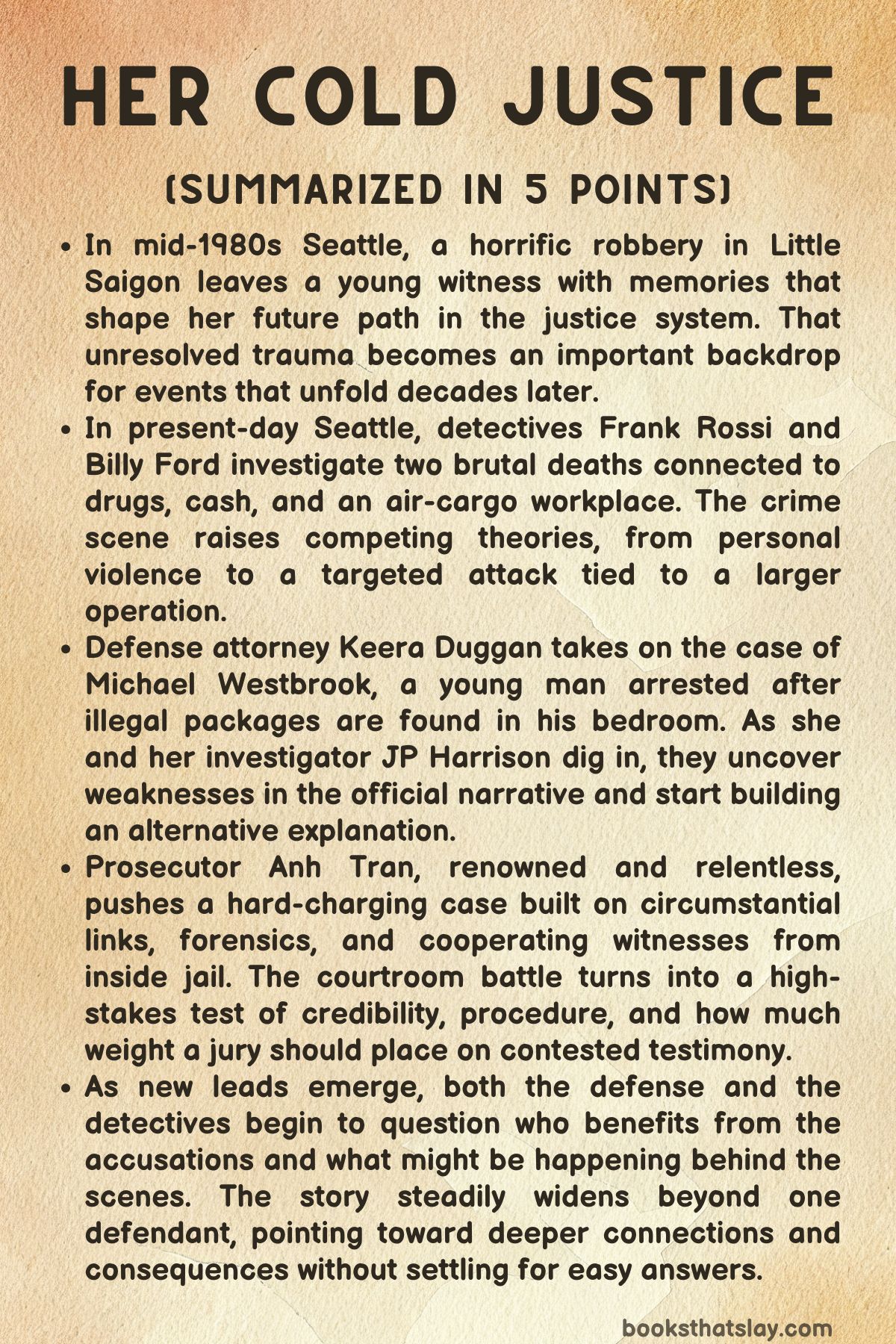
Decades later, another brutal double homicide ignites a case that looks simple on the surface—drugs, cash, and a convenient suspect—but quickly turns into something far more unsettling. Defense attorney Keera Duggan takes on a client everyone expects her to lose, and the story follows her fight against rushed conclusions, courtroom games, and the way power can bend a narrative until it feels like truth. It’s the 3rd book in the Keera Duggan series.
Summary
In July 1985, Seattle homicide detective Jack Thompson and his new partner respond to a robbery at Tran Jewelry Market in Little Saigon during a suffocating heat wave. Inside the shop they find the owners—husband and wife—bound and shot in the back room.
The space is clearly also their home, with food left out and schoolwork unfinished, as if life stopped mid-moment. When Thompson looks under a bed, he discovers their young daughter hiding there in a school uniform, staring in terror toward her parents’ bodies.
The image stays with him, and it becomes the emotional origin point for everything that follows.
Years later, on December 4 in Seattle, homicide detective Frank Rossi arrives late to a fresh crime scene in South Seattle, rolling up in his loud 1969 Pontiac GTO. Two people are dead.
John Lockett has been shot in a detached garage while working on a vintage car. His girlfriend, Melissa Scott, has been beaten to death in the bedroom.
The house holds a messy clue trail: opened Blue Horizon Air Cargo packages with drugs, powder, pills, and cash spilling out. The setup suggests narcotics trafficking, but the brutality in the bedroom feels personal.
A neighbor, Alex Cortez, says he came by around 8:00 a.m. as planned to work with Lockett on a classic car and found the body.
Investigators begin testing theories: murder-suicide, rival hit, or something tied to the drugs.
Two weeks later, criminal defense attorney Keera Duggan returns from a short trip to Italy and drops back into her Seattle routine at Duggan & Associates with her sister, Ella. Their private investigator, JP Harrison—a former homicide detective—asks Keera for a personal favor.
His nephew, Michael Westbrook, has been arrested and is sitting in federal detention, accused of participating in a fentanyl-smuggling operation connected to Blue Horizon Air Cargo, where Michael works. JP explains the most damaging fact: after the murders, police searched Michael’s home and found two sealed Blue Horizon packages sitting in his bedroom.
One contained fentanyl. The other contained nearly $16,000 in cash.
Prosecutors are hinting that state murder charges are coming, which blocks bail and raises the stakes from “drug mule” to “killer.”
Keera meets Michael and his mother, Tina Westbrook. Tina insists her son is a hardworking community college student and not the kind of person who would commit violence.
Michael is scared and confused. He says his car wouldn’t start, so he took an Uber to work.
After their shift ended around 4:30 a.m., Lockett gave him a ride home. Michael claims Lockett asked him to hold the packages, describing them as hidden birthday gifts for Melissa.
Michael says he didn’t open them and didn’t know what they contained. When detectives arrived with a warrant, photographed the packages in plain view, then obtained a second warrant to open them, the discovery of drugs and cash made him panic.
He tried to run and was subdued, which only hardened police suspicion.
Keera tries to get information from the detectives, but Rossi is distant and irritated, cutting her off and pushing her toward his partner, Detective Billy Ford. Behind that tension is a personal sting: Rossi has feelings for Keera and resents being kept out of her life decisions.
Keera, however, stays locked on the case. She and JP refuse to wait passively for prosecutors to define the story.
They return to the neighborhoods tied to both Michael and the victims, hoping to find witnesses, timelines, or anything that challenges the assumption that the obvious suspect is the right suspect.
They measure distances and routes, anticipating what the State will argue. The walk from Tina’s home to Lockett’s house is about 2.2 miles—close enough for the prosecution to suggest Michael could have returned to commit the murders.
Keera doubts it, especially given Michael’s asthma and the practical problem of moving through a neighborhood after a shooting and a beating without anyone seeing blood or panic. Keera begins shaping a defense that emphasizes missing proof: no murder weapon, no clear motive beyond speculation, and no direct evidence that Michael handled drugs for Lockett.
As Keera and JP collect background, they focus on the prosecutor who is clearly driving the case: Anh Tran. Tran is respected and feared, known for intensity and for never backing down once she chooses a target.
JP explains that Tran’s career rose during her time connected to the ROPE team, a repeat-offender narcotics unit with a reputation for aggressive stops and searches. The unit later became controversial amid accusations of racial profiling and improper search tactics.
Tran’s past matters because this case is already tinged with assumptions about who looks guilty.
A flashback shows Tran in 2010, pressing for a search warrant on thin probable cause during a ROPE operation in Little Saigon. The scene reveals her willingness to push the margins of procedure to secure results.
Another flashback goes back even further to 1986, when seven-year-old Anh Tran testifies in court about her parents’ murders. The case against the suspect, Andrae Ollson, is weak.
Under pressure and after therapy that shaped her memories, Anh identifies the man—then falters under cross-examination and points to someone else in a lineup. The accused walks.
The childhood failure becomes a wound that never closes, and it helps explain the kind of adult Tran becomes: someone who cannot tolerate an unsolved ending.
In the present, Keera finally gets a meeting with Tran, and Tran lays out the State’s narrative with blunt certainty. She claims Michael helped distribute drugs for Lockett, engineered his car trouble to get a ride, then killed Lockett and Melissa, leaving drugs and cash to make the scene look like a rival narcotics hit.
Tran says the case is going to a grand jury for indictment on first-degree murder and robbery, and she won’t discuss leniency. Keera leaves understanding she’s not just fighting facts—she’s fighting a prosecutor who has decided what “justice” looks like, regardless of gaps.
As the case moves into court, Keera attacks the investigation through Detective Ford’s testimony. She highlights what law enforcement cannot prove: no one saw anyone enter or exit the garage, no one reported a suspicious vehicle, and no one heard a gunshot despite it being close range.
The absence of a shell casing suggests either a revolver or a shooter careful enough to collect evidence—either way, it doesn’t point uniquely to Michael. Keera forces Ford to admit there’s no digital trail showing Michael and Lockett coordinated drug distribution, no burner phone found, no messages, no emails, and no records of Michael buying a gun.
She emphasizes the most glaring mismatch: the crime scenes had blood, yet investigators found no blood-spattered clothes, boots, or cleanup trace tied to Michael.
Then the State unveils what Ford hinted was coming. Forensic testimony begins with partial uncertainty: unidentified fingerprints exist but can’t be timed, a bullet is too deformed for meaningful ballistic matching, and the time of death spans several hours.
But the medical examiner testifies that he collected seminal fluid from Melissa and from the bedsheets. That detail hangs in the air long before the DNA report arrives.
Late at night, Keera receives the DNA analysis, and it hits like a hammer. A lab analyst testifies that hair found in the garage matches Michael.
Worse, hair from the bedroom and semen from the bedsheets also match Michael, with astronomical odds against error. The evidence places him not only near the victims but in the bed, leaving biological material behind.
The courtroom logic becomes dangerously simple: drugs and cash in his room, his DNA in the bedroom, and two people dead.
Keera confronts Michael in jail, and he finally admits the secret he was hiding. He had been having a sexual relationship with Melissa for weeks.
It started after he helped her with yard work and escalated when Lockett wasn’t around. He says the semen evidence could be from a sexual act a day or two earlier, not from the morning of the murders.
But he can’t prove timing, and the admission gives Tran a new emotional motive to sell: jealousy, rage, humiliation, and violence.
Tran then leans into jailhouse informants. One inmate, Laurence Holmes, claims Michael confessed in detail: he shot Lockett, beat Melissa with a tire iron, bought the gun on Craigslist, disposed of evidence on garbage day, and even masturbated afterward.
Michael explodes in court, flipping furniture and lunging toward Holmes before being restrained. The outburst hurts the defense in front of the jury, but Keera keeps fighting.
She cross-examines Holmes and exposes his incentives and credibility problems. A second inmate, Glenn Ellis, also claims a confession but contradicts Holmes about where it happened and changes key details.
The informants look practiced but inconsistent.
Behind the scenes, Rossi and Ford begin to doubt what they’re part of. Rossi compares “witness letters” connected to the jailhouse informants and notices identical typos and misspellings across multiple cases, suggesting one author.
He looks back at older prosecutions tied to Tran and finds a disturbing pattern: convictions built heavily on supposed jail confessions. The possibility forms that someone inside the jail system is manufacturing statements—feeding facts to inmates, then delivering those statements to prosecutors as “confessions.”
Keera’s team obtains visitor logs from the federal detention center. A name stands out: Sam Vo, visiting a prisoner who can move between units—George Frazier.
The timing suggests Vo was involved before Michael even arrived in custody, as if the story was being prepared in advance. The defense realizes they have a leak too.
Their staff member Maggie mentioned strategy details to her new boyfriend, who claimed to be “Sam Chen.” When confronted with Vo’s mug shot, Maggie recognizes him. She has been unknowingly feeding information to someone connected to the informant pipeline.
Keera shares the new developments with Rossi. Rossi and Ford rush to interview Glenn Ellis in the hospital after Ellis is stabbed inside the facility.
Under pressure and with promises of protection, immunity, and transfer, Ellis tells the truth. George Frazier coached him, told him Westbrook was guilty before Westbrook even arrived, supplied graphic “facts” about the crime, and pushed him to extract a confession that never came.
Ellis admits Michael never confessed. He explains he testified under threat and later tried to insert discrepancies on the stand to create reasonable doubt because he couldn’t live with helping convict an innocent man.
With Ellis’s statement, the informant structure collapses.
The investigation swings toward the larger narcotics operation. JP learns from a DEA contact that Lockett had been on their radar as a smuggler using Blue Horizon.
The DEA believed he wasn’t the top figure—just a working link. Keera and JP connect that to a familiar name: Tommy Phan, an informant from older cases with deep ties to Southeast Asian smuggling networks.
Rossi and Ford learn Tran herself negotiated deals with Phan in the past. The same ecosystem of informants and narcotics cases appears to be circling this trial.
As pressure builds, authorities arrest Sam Vo and bring in Tommy Phan. Without the informants, the State’s murder theory loses its spine.
Tran tries to position herself as unaware that the testimony was manufactured, but the damage is done. Keera demands not only dismissal but full exoneration for Michael.
In court the next morning, Tran does not appear. Another prosecutor dismisses all charges against Michael Westbrook with prejudice and fully exonerates him.
Michael is released, reunited with his mother, and walks out free after processing. Judge Patel privately acknowledges the court’s earlier assumptions and warns Keera that her growing reputation will bring new temptations and new scrutiny.
In the aftermath, Michael’s family throws a welcome-home party. Keera shows up with homemade cookies and publicly states Michael’s innocence.
Quietly, the larger machine keeps moving: Vo and Phan are arrested, and federal authorities believe Vo, acting on Phan’s orders, killed Lockett and Melissa—likely because Lockett skimmed from the organization or became a liability. The Department of Justice begins reviewing Tran’s past convictions, and Tran leaves Washington while cooperating elsewhere.
Michael gives Keera a personalized challenge coin and talks about changing his life, even considering law as a future. The story ends with the sense that the case is closed for Michael but not for the system—and with a hint that Keera and Rossi’s personal connection is still unfinished.
Characters
Keera Duggan
Keera Duggan is the story’s moral and strategic center, a criminal defense attorney who refuses to let the system’s momentum substitute for proof. In Her Cold Justice, her defining trait is controlled intensity: she moves fast, works methodically, and treats every gap in the State’s case as a thread worth pulling, not merely an argument to perform in court.
Keera’s intelligence shows in how she builds parallel tracks—legal pressure in the courtroom and investigative pressure outside it—while staying grounded in a single objective: protecting a client from an accusation that “feels” convenient. Her character is also shaped by professionalism under emotional provocation; Rossi’s personal irritation and Tran’s blunt intimidation don’t derail her, and she consistently chooses disciplined advocacy over ego.
When the DNA evidence destabilizes her defense narrative, Keera adapts rather than collapses: she confronts Michael, updates her theory, and recalibrates toward impeaching the State’s witness pipeline, which highlights her resilience and realism. By the end, Keera’s victory is not just winning dismissal—it is forcing the justice system to re-engage with its burden of proof, while she herself absorbs the lesson that reputation and scrutiny will now follow her as closely as her skill.
JP Harrison
JP Harrison operates as Keera’s streetwise counterweight: an ex-homicide detective turned private investigator who brings instinct, contacts, and procedural memory to a case that is being hurried toward a narrative. His loyalty is personal—Michael is family—but it never becomes sloppy; he understands that family loyalty without rigor just creates new blind spots.
JP’s value lies in how he thinks like law enforcement while working against a prosecution: he anticipates what detectives will argue, what prosecutors will exploit, and what evidence will be framed as “common sense.” He also carries a quiet guilt that professionals sometimes feel when they’ve seen the system misfire before; that experience makes him skeptical of informants, shortcuts, and institutional confidence. JP’s character deepens when the case reveals the hidden machinery behind jailhouse testimony, because he becomes less of an “assistant investigator” and more of a driver of the meta-investigation—who is shaping statements, who benefits, and who is coordinating inside custody.
He is pragmatic, sometimes blunt, but his pragmatism is ultimately ethical: he doesn’t want a clever win, he wants the truth to be structurally unavoidable.
Michael Westbrook
Michael Westbrook is the case’s emotional pressure point: young, vulnerable to optics, and trapped by circumstantial evidence that creates an easy storyline. He is written as someone whose ordinary decisions—accepting a ride, holding packages, socializing in a neighbor’s garage—become retroactively sinister once the murders occur.
Michael’s panic during the search and his attempt to run are crucial character notes because they show how fear can mimic guilt in the eyes of investigators, and how quickly a person can lose control when authority interprets everything in the worst light. His secrecy about his relationship with Melissa is not just a plot twist; it reveals a core immaturity and a need for approval that makes him susceptible to manipulation and shame.
Yet the story ultimately frames him as a person more reckless than predatory: his biggest “crime” is hiding a humiliating truth, not committing violence. Michael’s courtroom outburst underscores how the legal process can become psychologically unbearable when you’re being publicly rewritten as a monster, and his later recommitment to changing his life suggests a character arc built on trauma-driven clarity: he has seen how easily identity can be assigned by accusation, and he wants to build a life less exposed to that kind of narrative trap.
Anh Tran
Anh Tran is the most complex figure in Her Cold Justice because she embodies the collision of personal trauma with institutional power. As a child witness to her parents’ execution-style murders, she grows into a prosecutor whose identity is fused with the idea of certainty—certainty that the guilty should not escape, and certainty that she can recognize guilt faster than others.
Her reputation for speed, aggressiveness, and warrant-driven action reflects a personality that treats hesitation as a moral risk, which is an understandable adaptation for someone shaped by a childhood where helplessness was absolute. But that same adaptation curdles into something dangerous: she begins to treat outcomes as justice rather than a possibility that must be proven, and she leans on informants and coercive structures that can be guided toward a desired result.
Tran’s earlier ROPE era shows her comfort with operating close to the edge, and her later choices suggest a prosecutor who confuses “winning” with correcting the universe’s original injustice against her family. What makes her especially unsettling is that she is not portrayed as cartoonishly evil; she seems capable of believing her own rationalizations, which is precisely why she is effective and frightening.
By the end, her partial cooperation and refusal to fully confess reads like a final character tell: she can retreat, but she cannot surrender the self-image that she was acting for justice, even when her methods undermine it.
Frank Rossi
Frank Rossi functions as a character caught between swagger and conscience, and the story uses him to show how a detective can be both competent and complicit without intending harm. His loud, customized car and his sharp-edged demeanor signal a man who performs confidence, but the story steadily reveals a more thoughtful investigator underneath—someone who notices patterns, rechecks assumptions, and ultimately becomes pivotal to exposing the manufactured informant pipeline.
Rossi’s personal feelings toward Keera—especially his annoyance that she left for Italy without telling him—introduce an important flaw: he is susceptible to ego and interpersonal resentment, which can tint professional interactions. Yet Rossi is also capable of self-correction; once the case’s deeper shape becomes visible, he pivots from defensive posture to problem-solving, and he uses investigative comparison and document analysis to connect dots others overlook.
His character arc is less about becoming “good” and more about choosing accountability over departmental inertia, which is a meaningful shift in a system that often rewards staying quiet. By the end, Rossi reads like a man who wants justice to be real, not merely achieved, and whose interest in Keera hints at a future relationship built as much on mutual respect as on attraction.
Billy Ford
Billy Ford is the quiet ethical thermometer inside the investigative team, and he often appears as the one who can admit uncertainty without losing authority. Unlike characters who cling to the case theory as identity, Ford repeatedly acknowledges what the evidence does not show—no weapon, no blood-spattered clothing, no clean motive, and no direct proof beyond the packages and the contaminated reliability of jailhouse testimony.
His willingness to voice discomfort about racial bias and rush-to-indict dynamics makes him a rare kind of procedural character: he remains inside the system while still naming its distortions. Ford’s testimony under Keera’s cross-examination reveals a professional who can be pressed into conceding flaws because he does not build his ego on being “right” at all costs.
Later, his role in securing Ellis’s immunity and extracting the full truth shows his pragmatic courage: he doesn’t just privately doubt, he acts in a way that threatens the case’s scaffolding. Ford’s character suggests that integrity in law enforcement is not dramatic heroism but a series of choices to privilege truth over pride, even when the institution would prefer certainty.
Chuck Pan
Sergeant Chuck Pan appears as a stabilizing supervisory presence, a practical leader who keeps the investigation organized and moving. Pan’s character function is to represent the managerial layer of policing—briefings, coordination, and maintaining operational order while detectives chase leads.
He is not depicted as the moral engine of the story, but his presence matters because he reflects the reality that cases are not solved by lone geniuses; they move through chains of responsibility. Pan’s relative neutrality also highlights the contrast between detectives wrestling with doubt and prosecutors pushing for a clean narrative, underscoring how the system can proceed smoothly even when the truth is not smooth.
Ella Duggan
Ella Duggan serves as Keera’s internal anchor and organizational partner at Duggan & Associates. She is a steadying force who helps translate Keera’s drive into structured action, ensuring that strategy meetings, logistics, and team coordination remain tight as pressure escalates.
Ella’s significance grows when the defense team realizes information has leaked through Maggie; the response is not chaos but controlled triage, and Ella’s presence reinforces that this firm runs on competence, not just Keera’s brilliance. She is portrayed as loyal without being blind, practical without being cynical, and crucial in making the defense effort feel like a disciplined operation rather than a solo crusade.
Patsy Duggan
Patsy Duggan represents wisdom earned through experience, and he provides both emotional support and tactical clarity. He understands what younger lawyers sometimes learn the hard way: that prosecutors leaning heavily on informants can signal weakness, but also danger, because the case may be supported by hidden machinery rather than open evidence.
Patsy’s approach is calm, paternal, and penetrating—he asks questions that force the room to slow down and see structure instead of noise. His private conversation with Maggie is one of his most revealing moments; he is firm without cruelty, protective without melodrama, and immediately oriented toward safety and containment.
Patsy’s character suggests a form of strength that is less about confrontation and more about keeping people steady while the storm tries to make them reckless.
Tina Westbrook
Tina Westbrook is written as a mother standing at the edge of power, trying to keep her son from being swallowed by a machine she cannot control. She is persistent, practical, and emotionally raw without being reduced to a stereotype of grief.
Her insistence that Michael is a good boy is not naive idealism; it is a parent’s lived knowledge colliding with the state’s presumptions. Tina’s role in providing medical context—Michael’s lifelong asthma—shows how families understand details that matter in real life but are often dismissed as “excuses” in legal narratives.
Her welcome-home party in the epilogue emphasizes her need for restoration and community after prolonged fear, and it frames the human cost of wrongful prosecution: even with exoneration, the emotional residue remains.
Alex Cortez
Alex Cortez begins as the helpful neighbor who discovers the crime and calls 911, but the narrative makes him more than a neutral witness by showing how ordinary people translate shock into suspicion. His involvement with vintage cars and the garage hangouts places him inside Lockett’s social orbit, giving him proximity without true knowledge.
Cortez’s speculation about Michael—his willingness to infer guilt from familiarity and from the fentanyl found later—illustrates a broader theme: how quickly communities accept the simplest explanation when violence enters their street. Yet he is not portrayed as malicious; he becomes more cooperative when he understands JP’s connection, which suggests he is more responsive to relationships than to abstract “justice.” Cortez embodies the messy middle ground between witness and rumor engine, and the story uses him to show how narratives harden long before court ever begins.
Theresa
Theresa, Cortez’s partner, operates as a reinforcing voice for neighborhood perception. She contributes the kind of observational testimony that feels persuasive—seeing Michael around, remembering yard work, linking presence to presumed involvement—without offering actual proof of violence.
Her confidence in drawing conclusions highlights how social inference can be mistaken for evidence, especially when people try to make sense of brutality by assigning it to the most available suspect. Theresa’s character matters because she demonstrates how “common sense” can become an informal prosecution long before the formal one.
John Lockett
John Lockett is portrayed largely through aftermath, but he is the gravitational body around which everyone else’s motives and risks orbit. He is a working-class man with a mechanical hobby and a social garage culture, which initially makes him feel ordinary, even likable, but the discovery of drugs and cash reframes him as a conduit in a larger smuggling operation.
Lockett’s character is defined by double life: an airfreight employee who may have been skimming product or money, hiding packages, and managing secrets that ultimately get him killed. The way he uses Michael as a temporary holder of contraband suggests either carelessness or calculated insulation, and the story leans toward the idea that he made himself useful as a fall guy buffer.
In death, Lockett becomes a symbol of what happens when low- to mid-level operators try to play both sides: they are expendable to the organization above them and convenient as a narrative anchor for the system below.
Melissa Scott
Melissa Scott is the story’s most tragic figure because her limited on-page agency is replaced by the brutality done to her and the meanings others impose afterward. Her death is staged with rage and exposure—naked on bloodstained sheets, beaten repeatedly—which turns her body into both evidence and message.
The revelation of her secret sexual relationship with Michael complicates her character: she is not only a victim in the prosecution’s narrative but also a person making risky choices within an unstable relationship dynamic. The story never fully maps her interior life, but it strongly suggests she lived amid drugs, secrecy, and volatility, and that she became a target either because of proximity to Lockett’s trafficking or because her relationship web made her useful to someone’s framing strategy.
Melissa functions as the emotional accelerant for the case—her death invites moral certainty and anger—and that is precisely why the story uses her to critique how outrage can become a substitute for proof.
Arthur Litchfield
Dr. Arthur Litchfield, the medical examiner, represents the cold neutrality of forensic process. He provides timelines, injury descriptions, and the crucial detail that seminal evidence was collected and submitted for DNA testing.
His testimony shows the boundary between science and narrative: he can describe what bodies reveal, but he cannot reliably date when DNA was deposited, and he cannot declare motive. Litchfield’s role is important because it demonstrates how forensic testimony can be both stabilizing and ambiguous—precise in mechanics, uncertain in story—and how attorneys then fight to control what jurors believe those mechanics “mean.”
Dr. Emily Carter
Dr. Emily Carter, the DNA analyst, functions as the story’s most disruptive technical voice. She delivers evidence that collapses the defense’s early comfort: hair and semen on the bedsheets matching Michael with overwhelming statistical certainty.
Carter’s character is professional rather than personal; she is not shown as biased or emotional, which makes her impact more severe because it feels purely factual. Yet the story also uses her testimony to expose a legal paradox: jurors often treat DNA as time-stamped truth, even when the science cannot say when it was left.
Carter’s presence forces Keera into a more sophisticated defense that distinguishes “contact” from “crime,” and she embodies how modern evidence can be both accurate and still misleading when interpreted without context.
Judge Patel
Judge Patel represents the court’s balancing act between order and fairness. His decisions reveal the tension judges face when spectacle threatens procedure, such as denying a mistrial after Michael’s outburst while still attempting to preserve trial integrity.
Later, Patel’s private apology and warning to Keera reflect a judge capable of humility and realism—he acknowledges the gravitational pull of assumptions and the professional temptations that follow success. Patel’s character reinforces the theme that even well-meaning arbiters operate inside a system that can misread people, and that correcting those misreads often requires uncommon clarity.
Laurence Holmes
Laurence Holmes embodies the predatory ecology of jailhouse informants. He is not merely a witness but a manufactured narrative delivery mechanism, offering graphic, conveniently complete details that align with what prosecutors want a jury to hear.
His credibility is structurally compromised by incentives and history, and the story uses Keera’s cross-examination to show how informant testimony often relies on performance rather than verifiable fact. Holmes’s function is to demonstrate how a prosecution can build the feeling of certainty without building actual proof, turning the courtroom into a theater where jurors may confuse detail with truth.
Glenn Ellis
Glenn Ellis begins as another informant voice but becomes one of the story’s moral turning points. He is trapped between institutional leverage and prison retaliation, pressured to support a confession that never occurred.
His later decision to introduce discrepancies is a small act of conscience inside a brutal environment, suggesting a person who is ethically awake but practically cornered. When he finally speaks under immunity, Ellis reveals how confessions can be engineered through social manipulation rather than obtained through truth.
His character illustrates that “witnesses” in custody can be both perpetrators of injustice and victims of coercion, sometimes in the same breath.
George Frazier
George Frazier is the organizing shadow behind the informant scheme, a prisoner with access and influence who can move between units and broker stories. He represents the jailhouse middle-management of corruption: not necessarily the ultimate mastermind, but the operational coordinator who knows how to trade information, fear, and incentives for outcomes.
His threats against Ellis demonstrate how coercion in custody is not abstract—it is immediate, bodily, and enforced by the social economy of prison. Frazier’s role shows how easily “confessions” can be industrialized when one person controls the flow of rumor, pressure, and opportunity inside detention.
Sam Vo
Sam Vo is the bridge between the outside world and the custody-based manipulation network. He is revealed as the person using proximity, charm, and deception to gather intelligence and influence events, including visiting Frazier and exploiting Maggie as a source.
Vo’s character is defined by instrumental relationships: people are not companions to him, they are access points. His eventual arrest positions him as a hands-on operator—someone who can act on orders, not just relay them—and the epilogue’s implication that he killed Lockett and Scott on Phan’s orders cements him as a violent extension of the trafficking organization’s discipline.
Tommy Phan
Tommy Phan is the long-thread antagonist, a figure who connects past and present through informant culture and organized trafficking. He is portrayed as someone who understands the justice system as a tool, not a threat: he cooperates when it benefits him, testifies when it buys him leverage, and remains entangled with prosecutors who may underestimate how much power he actually holds.
The flashbacks involving his deals and the later suspicion that he sits atop a Southeast Asian smuggling organization position him as the kind of criminal who survives by being useful—to law enforcement, to prosecutors, and to his own network. Phan’s most chilling trait is indirectness: he does not need to be on scene to shape outcomes; he can order, influence, and contaminate systems until they produce what he wants.
Jack Thompson
Jack Thompson is a living archive of unresolved trauma and unresolved casework. He appears as a retired homicide detective carrying the lingering weight of the Tran parents’ murders and the ethical discomfort of putting a child witness on the stand to compensate for thin evidence.
Thompson’s confession of doubt about the old informant story gives the present-day investigators a crucial perspective: patterns repeat, and “confessions” can be currency rather than truth. His character underscores a central theme of the story: the past is not past in the justice system; it becomes precedent, habit, and sometimes a template for misconduct.
Kyle Mitchell
Kyle Mitchell appears mainly in the opening flashback as Jack Thompson’s new partner, and his role is to reflect the innocence of early career policing entering a scene of extreme brutality. Kyle’s presence emphasizes how cases imprint themselves on detectives, especially when the victims’ humanity is visible in small domestic details like schoolwork and half-eaten fruit.
Though he does not drive the main plot, Mitchell functions as part of the story’s emotional framing: the justice system is not only about evidence and argument, it is also about what investigators carry forward from the worst rooms they ever enter.
Andrae Ollson
Andrae Ollson is a haunting example of how the legal system’s “answer” can remain disputed even after a verdict. He is arrested for the Tran Jewelry Market murders despite thin evidence, is challenged effectively in court, and later is tied to another case through a jailhouse confession narrative.
Ollson’s character is less about who he truly was and more about what his story represents: once a case is built on weak physical evidence, the system becomes vulnerable to performance—child testimony shaped by trauma, informant testimony shaped by incentives, and prosecutorial certainty shaped by need. His death in prison does not resolve the moral question; it freezes uncertainty into history, which then poisons the present.
Tuãn Le
Tuãn Le is the defense attorney who confronts Anh Tran during the ROPE flashback, and he represents the institutional counterforce that questions probable cause, affidavit truthfulness, and the ethics of aggressive policing tactics. His willingness to call out the warrant as unreliable highlights a theme the story returns to repeatedly: legality and legitimacy are not identical, and a judge’s signature does not automatically make a search morally clean.
Le’s character also functions as an early mirror to Keera—someone who insists that the State’s power must be challenged precisely when it feels most confident.
Alexander “Kuz” Kuznetsov
Kuz is the DEA agent who expands the case’s horizon beyond a local double homicide into a broader smuggling architecture. He is pragmatic and quietly frustrated, aware that Lockett’s death may have cut off a longer investigation into higher-level leadership.
Kuz’s character is important because he frames Lockett as a mid-level player and makes the “skimming and retaliation” theory feel structurally plausible. He also reflects how different arms of law enforcement can have competing priorities—local closure versus federal reach—and how those priorities can indirectly shape what narratives get pushed.
Daniel Butcher
Daniel Butcher serves as a corrective institutional presence when the case collapses. His appearance in court to dismiss charges instead of Tran signals a shift from personal crusade to institutional damage control.
He represents the office’s need to restore credibility once the informant structure is exposed, and his role underscores that systems often prefer quiet repair over loud accountability. Butcher is not depicted as heroic; he is functional, procedural, and necessary—the person who closes the door that should never have been opened.
Isabel Martinez
Isabel Martinez, as Glenn Ellis’s public defender, represents the legal safeguard that becomes essential when a vulnerable witness is about to tell the truth against powerful interests. Her presence signals that Ellis’s cooperation is not merely an emotional confession but a legally structured act with consequences.
She functions as a reminder that the justice system can protect people when it chooses to, and that protection often determines whether truth is even survivable for the person speaking it.
Warden Bill Erickson
Warden Bill Erickson embodies the carceral institution’s priorities: control, security, and liability management. He is suspicious of unusual requests, alert to timing, and acutely aware of how fast prison violence can become a scandal.
Yet he is also pragmatic enough to cooperate when presented with a credible threat and a credible theory. His decision to provide logs and request reciprocal information portrays him as a gatekeeper who understands that prisons are not sealed worlds; they are nodes in a wider network of influence, and he is trying to manage that reality.
Maggie
Maggie is a cautionary character about vulnerability, social engineering, and how easily legal strategy can leak through ordinary human needs. She is not malicious; she is lonely, flattered, and unaware that intimacy can be used as an extraction tool.
Her mistake becomes consequential because it confirms that the defense is not only fighting evidence in court, but also information warfare outside it. Maggie’s arc is painful precisely because it is believable: she wants connection, she gets manipulation, and she pays with guilt and fear.
The story treats her with a measure of compassion by showing the firm’s response as protective rather than punitive, and by placing her recovery in the epilogue as a quiet form of restoration after being used.
Jada Davis
Jada Davis represents the edge of Michael’s past and the social residue that prosecutors often exploit. She arrives as a neighbor with history, admits Michael sold small amounts of weed in high school, and then tries to withdraw—worried about what she is getting involved in and focused on her own nursing test.
Her character illustrates a key dynamic in cases like this: peripheral witnesses often fear being pulled into a legal machine, so they offer partial truths and then retreat. Jada is not there to solve the case; she is there to show how a person’s adolescence can be weaponized to imply a criminal identity, even when it has little to do with the crime charged.
Jerry Garcia
Jerry Garcia is a minor presence, mentioned as another neighbor who visited during a Seahawks playoff game, but his inclusion reflects how investigations expand through social circles. He functions as an example of how police and defense teams map a victim’s orbit, looking for anyone who might carry a hidden grievance, a hidden debt, or a hidden connection.
Even as a small name, he contributes to the atmosphere of community-level familiarity where casual visits become points on a timeline.
Themes
Justice under pressure and the cost of certainty
A constant force in Her Cold Justice is the way the system rewards confidence even when evidence is thin, and how that confidence can harden into something dangerous. The Lockett and Scott murders begin with ambiguity that should naturally slow everyone down: no clear weapon recovery, no obvious eyewitnesses, and a scene that supports multiple explanations.
Yet the case accelerates toward a single suspect because the narrative is convenient and emotionally satisfying. A young man has fentanyl and cash in his room, he had access to the victim, and investigators can build a story that sounds like motive.
That story becomes more “real” with repetition. Once prosecutors speak it aloud and detectives work inside it, the absence of hard proof starts getting treated as proof of sophistication instead of a warning sign.
The logic turns circular: no gun means he disposed of it; no bloody clothes means he destroyed them; no casing means he was careful. Each gap becomes a reason to trust the accusation rather than a reason to doubt it.
The theme becomes sharper when the courtroom reveals how fragile that confidence really is. Cross-examination forces the system to show its seams: assumptions presented as conclusions, speculation presented as insight, and investigative steps that stop when they no longer support the preferred theory.
The “surprise” forensic evidence against Michael shifts the emotional temperature again, because DNA and biology carry a sense of finality. The problem is not that science is unreliable; it is that people often treat scientific facts as if they automatically answer the central question.
Presence is not the same as guilt, timing cannot be assumed, and context matters. The book’s tension comes from watching legal actors decide what they want the evidence to mean, then arranging the case around that meaning.
The eventual collapse of the prosecution’s narrative highlights the cost of certainty. Once informant testimony and back-channel manipulation are exposed, the case flips fast, showing how little of the original confidence was anchored to proof.
Michael’s exoneration does not erase what happened to him, and it does not restore the two victims’ lives. What remains is a portrait of a justice system that can move with impressive speed when it feels sure, and with troubling reluctance when it needs to admit error.
Trauma shaping identity and decision-making
The story gives trauma a long shadow, especially through Anh Tran’s life, without treating it as a simple explanation or a neat excuse. A childhood memory of violence is not only a personal wound; it becomes a professional fuel source.
Tran’s origin as a witness to her parents’ execution-style murders creates a lifelong relationship with powerlessness and with the desire to control outcomes. The adult version of that child is a prosecutor who does not merely want convictions but seems to need them to mean something larger: that the world is not random, that killers do not simply walk away, that a courtroom can provide the closure that failed her as a child.
That need makes her formidable because she works harder than most people, pushes faster than most people, and refuses to accept ambiguity as the final answer.
The theme gains complexity when the book shows how memory and certainty can be manipulated. The early courtroom moment where young Anh’s identification wavers under pressure is a reminder that trauma can distort perception and that adults can shape a child’s recall, sometimes unintentionally, sometimes with an agenda.
The adult Tran later operates in a world where narratives are built with words, affidavits, and controlled framing. Her insistence on precision and certainty can look like strength, yet it also creates a vulnerability: when a person’s inner stability depends on a particular outcome, doubt feels like a threat rather than a tool.
That emotional structure makes her more likely to treat procedural shortcuts as justified, and more likely to see challenges as personal attacks.
This theme also appears in Keera’s experience, though it functions differently. Keera is confronted by sudden, destabilizing information—DNA that seems devastating, hidden relationships, and witnesses claiming confessions.
Her stress response is not to force certainty but to expand the search for truth, even when the truth may complicate her defense strategy. She is shaken, embarrassed, and pressured, but she continues to ask what is real, what can be proven, and what cannot.
The contrast between Keera and Tran shows two different ways trauma or fear can shape professional behavior: one turns uncertainty into an enemy to defeat, the other turns uncertainty into a reason to investigate deeper.
By the end, trauma is not presented as something that stays in the past. It shapes careers, tactics, and ethics.
It can create empathy, but it can also create rigidity. It can drive excellence, but it can also drive overreach.
The book’s emotional realism comes from treating trauma as a force that changes how people interpret the same facts, and how they decide what “justice” should look like.
Power, credibility, and the manufacture of truth
“Truth” is shown as something the system often treats like a product of authority rather than a product of verification. The same set of facts looks different depending on who says them and how they are packaged.
A prosecutor’s theory carries institutional weight; an accused person’s explanation is treated as self-serving by default. Jailhouse informants, despite well-known incentives, can enter the courtroom wrapped in the language of confession, remorse, and insider knowledge, and that framing can become more persuasive than physical reality.
The book makes this unsettling by showing how easily credibility can be constructed through repetition, paperwork, and alignment. When multiple informants tell similar stories, listeners assume corroboration, even if the similarity is actually a warning sign of coordination.
The mechanics of this theme become vivid through the letter patterns, the shared typos, the visitor logs, and the network connecting inmates, intermediaries, and outside operators. The narrative demonstrates that a manufactured story does not need to be perfect; it only needs to be plausible enough to survive long enough to be heard by the right people.
Once that happens, the system’s incentives do the rest. Detectives want closure and promotion, prosecutors want convictions and public safety outcomes, and institutions want the appearance of competence.
Even well-meaning actors can become carriers of a false story because believing it feels like doing their job. The falsehood gains legitimacy not by being true but by being useful.
This theme also addresses how power can quietly pressure outcomes without leaving fingerprints. The fear inside a detention facility—threats, reputational violence, the circulation of “snitch” labels—becomes a weapon that can shape testimony.
People do not need to be beaten to comply; they only need to believe their safety depends on cooperation. When Ellis later admits he never received a confession but testified as if he did, it shows how coercion can produce “evidence” that looks clean in a transcript.
The legal record becomes a stage where the most damaging forces happen off-camera, yet their effects are presented as voluntary choices.
The theme does not argue that every official is corrupt or that every conviction is suspect. Instead, it shows a structural weakness: credibility is often granted based on role rather than on reliability, and the system is slow to admit when that credibility has been abused.
When the case finally collapses and charges are dismissed with prejudice, the speed of reversal is almost as disturbing as the speed of accusation. It suggests that the supposed solidity of the truth was never solid; it was authority wearing the costume of certainty.
Moral courage, loyalty, and the risk of doing the right thing
Personal loyalty is not presented as sentimental; it is presented as a form of work that requires stamina, judgment, and a willingness to be unpopular. Keera takes the case as a favor rooted in trust, but her commitment quickly becomes something larger than helping a friend’s family.
She chooses to challenge a powerful prosecutor, resist pressure to accept the easiest narrative, and keep investigating even when the case turns against her. Her loyalty is tested repeatedly because loyalty can become blindness if it turns into denial.
The book makes her loyalty meaningful by placing it beside moments when she has to confront uncomfortable truths about her own client. When Michael’s secret relationship with Melissa is revealed, Keera does not abandon him, but she also does not pretend the revelation is harmless.
She adjusts strategy, demands honesty, and keeps the defense grounded in what can be proven.
Moral courage also shows up in places where it is less expected. Billy Ford’s willingness to acknowledge the weaknesses in the case and to worry aloud about bias stands out because it carries professional risk.
In a culture that often rewards unity and punishes dissent, raising doubts can be framed as disloyalty. Ford’s arc shows how integrity in policing is not only about catching the guilty; it is also about resisting the comfort of a clean story when the evidence does not support it.
Rossi’s gradual shift toward deeper scrutiny reflects a similar tension: he is not portrayed as instantly heroic, but as someone who has to overcome ego, habits, and institutional momentum to ask harder questions.
This theme reaches a peak in the prison-related revelations. Ellis’s decision to introduce discrepancies on the stand, despite fear and exposure, is a small act of courage that signals a conscience still operating under threat.
Later, his choice to tell the full story once protection is offered becomes the turning point that saves an innocent person, yet it also highlights the tragedy that truth required so much danger to emerge. The visitor-log investigation and the recognition of a leak inside the defense circle shows that loyalty has boundaries too.
Maggie’s mistake is not treated as evil, but it is treated as consequential, and the response is protective rather than purely punitive. People make errors, but the ethical response is to reduce harm and prevent exploitation.
By the conclusion, doing the right thing is not rewarded with a clean victory. Michael is freed, but the victims remain dead, reputations are damaged, and institutional review comes with uncertainty.
The theme’s power lies in its realism: moral courage does not guarantee a satisfying ending, but without it, the ending would have been a wrongful conviction that looked “successful” on paper.