Happily Never After by Lynn Painter Summary, Characters and Themes
Happily Never After by Lynn Painter is a contemporary romantic comedy built around a deliciously chaotic idea: what if two strangers made a side career out of stopping weddings that should never happen?
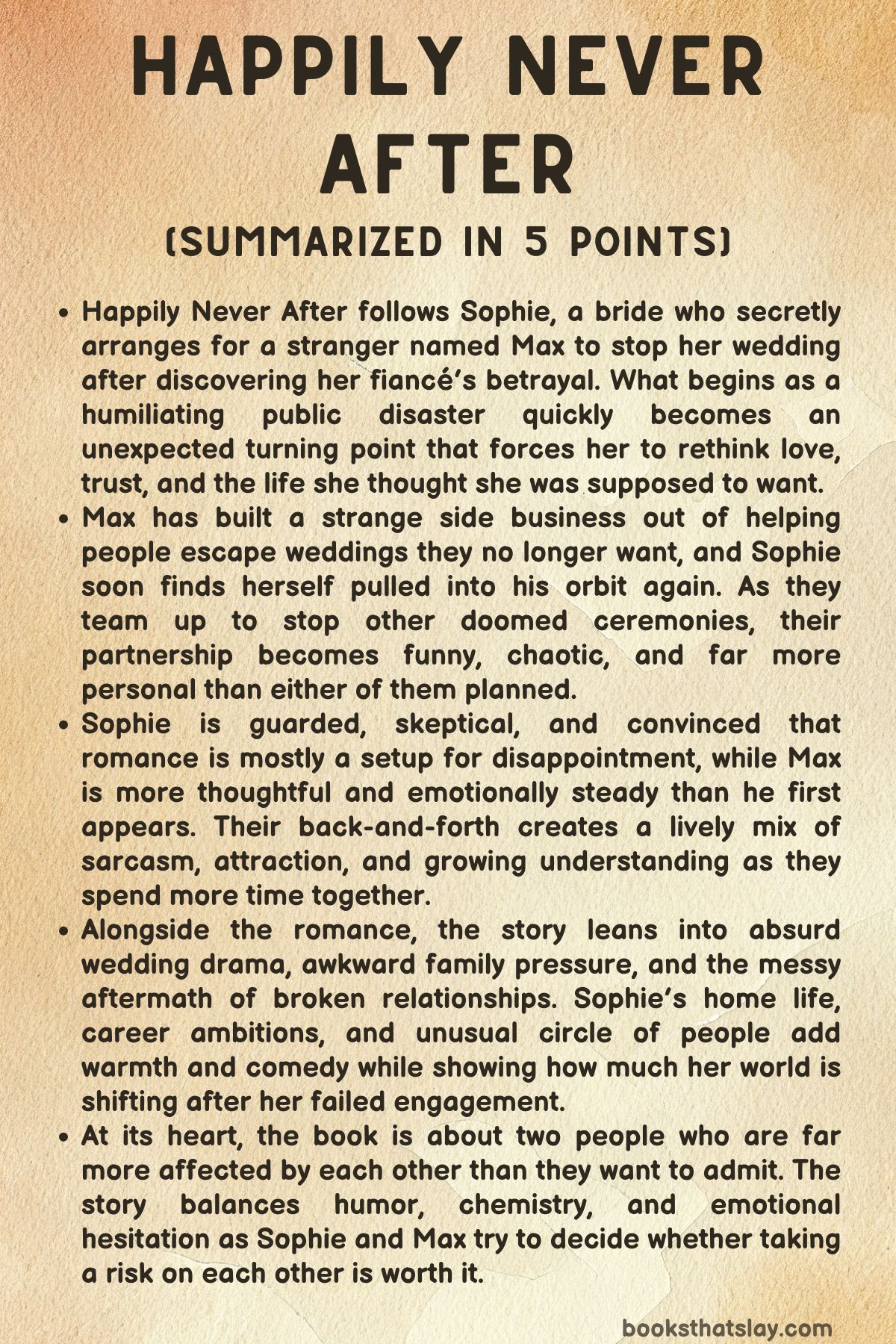
Beneath the sharp humor and public disasters, the story follows two people who are badly burned by trust, both of them skeptical about love for different reasons. Sophie begins the book convinced romance is mostly a bad bargain, while Max has found a strange purpose in rescuing people from terrible marriages before they begin. What starts as a messy alliance slowly becomes something much riskier, more intimate, and far harder to control.
Summary
The story opens on Sophie’s wedding day, with her standing at the altar in a state of near panic. Outwardly, she looks like a bride going through the motions, but inside she is consumed by dread.
She is furious with her groom, Stuart, and terrified that the desperate plan she set in motion will fail. Rather than simply calling off the wedding herself, Sophie has arranged for a stranger to interrupt the ceremony at the exact moment objections are invited.
Her reason is not cowardice alone. Stuart’s father has professional power over Sophie’s own father, and she feels trapped by family pressure, social expectations, and the practical damage that could follow if she openly backs out.
So she waits, sick with anxiety, hoping the man she hired will actually appear.
When the officiant asks if anyone objects, the stranger rises. Tall, composed, and impossible to ignore, he announces that the marriage should not go forward because Stuart has been cheating.
He names one woman, Becca, and refers to another affair from the past. Stuart immediately tries to deny everything, but the scene spins out of control.
Sophie demands his phone, forcing the situation into the open, and instead of calming matters, Stuart explodes. He charges at the man and punches him in front of everyone.
The chapel erupts into chaos, and the wedding collapses in a way that leaves no doubt that Stuart is the guilty party. Sophie is humiliated in public, but she is also saved from marrying a man she no longer trusts.
Later, in the honeymoon suite, Sophie processes the wreckage with her best friend Asha. They drink tequila, pick through the emotional fallout, and talk bluntly about what just happened.
Sophie is still hurt by Stuart’s betrayal, but she also feels enormous relief. The interruption has given her a way out that she did not believe she could create on her own.
Asha, impressed by the man they hired, jokingly treats him like a professional hero and dubs him “The Objector.”
That man, Max, soon arrives to collect his payment. He expects tears and drama, but instead he finds a strange celebration.
Sophie has shed her elegant bridal look and turned into a half-feral, half-exhausted woman in casual clothes, tossing Twinkies from the balcony at Stuart’s car below. Max is amused and caught off guard by the odd energy in the room.
What should have been a quick transaction turns into a long night together after Asha insists he stay for drinks. The three of them shift from tequila to whiskey, order pizza, and spend the evening in a haze of relief and absurdity.
After Asha passes out, Max and Sophie are left alone. Their conversation becomes unexpectedly personal.
Sophie reveals that infidelity has shaped her entire understanding of relationships. Every serious commitment in her life has ended in cheating, and she no longer believes in romantic destiny.
To her, long-term relationships are not proof of true love but of effort, luck, and practical compatibility. Max does not fully agree, though he admits that love can be dangerous and often painful.
In return, he explains how he first became “The Objector.” He once helped a coworker named Hannah, who had discovered her fiancé was cheating but felt too manipulated and cornered to stop the wedding herself. After Max objected for her, word spread, and he gradually became the person others quietly approached when they needed an escape from a wedding they felt unable to stop.
Sophie is fascinated by this strange unofficial mission and jokes that she should become “The Objectress.” At the time, it feels like drunken banter more than a real possibility. But four months later, Max unexpectedly reaches out and asks her to meet for coffee.
By then Sophie’s life has changed a great deal. She still lives in the expensive apartment she once shared with Stuart, but only because she has taken on two elderly roommates, Rose and Larry, whose constant bickering turns the place into a daily comedy of irritation.
When Sophie sees Max again, she has transformed her appearance and regained some control over her life, but she is still cautious and guarded.
At Starbucks, Max proposes a job. A man named TJ is about to marry a woman named Callie, who has been cheating on him for years.
TJ cannot easily break things off because of the influence and pressure surrounding Callie’s family. Max wants Sophie to be the one who objects.
At first Sophie resists, but after hearing more, and after learning there is money involved, she agrees to help as long as Max stays beside her through it.
Their preparation for the wedding becomes the start of a true partnership. Max picks Sophie up, survives a hilariously hostile encounter with Rose and Larry, and coaches Sophie through her nerves.
At the chapel, she nearly loses her courage. But once she sees Callie exchange a telling look with the man she has been seeing behind TJ’s back, Sophie’s fear hardens into resolve.
When the moment comes, she stands and publicly announces the affair. Callie lies, lashes out, and tries to turn the crowd against Sophie, but Sophie keeps pressing, demanding proof and forcing the truth into the open.
The ceremony falls apart. On the way out, Callie attacks Sophie, and Sophie shocks everyone by handling the fight herself, locking the bride into a headlock until she is forced to stop.
Once outside, Sophie and Max escape in a rush of adrenaline and laughter.
The job changes something for Sophie. For the first time since her own wedding disaster, she feels not just rescued but useful.
Later, TJ thanks them sincerely and explains that Callie’s affair was exposed beyond repair when Ronnie, the other man, confessed in front of everyone. Sophie is deeply affected by TJ’s relief because it mirrors her own.
During the drive home, she and Max share a warm, intimate conversation that ends with a selfie and an almost-kiss charged with obvious attraction.
From there, their connection grows through jokes, calls, lunches, and quiet time together. Max’s family notices Sophie almost immediately, especially his father, who is charmed by her.
Sophie also begins entering Max’s professional world, showing interest in the construction projects that matter to him. A visit to one of his sites leaves Max unexpectedly moved because she seems to fit so naturally into a part of his life few people truly understand.
Another wedding job takes them to Detroit, where both the bride and groom privately want out but cannot admit it themselves. On the trip, Sophie and Max’s attraction becomes impossible to ignore.
After drinks, Sophie boldly tells Max she wants to kiss him, and they end up in a stairwell, kissing with all the tension they have been suppressing. Max stops things from going further because she is drunk, even though he wants her badly.
The restraint only makes the desire between them sharper.
The next day they complete the job, and afterward their emotional and physical restraint finally collapses. Back at the hotel, sober and fully aware, Sophie goes to Max’s room and tells him plainly what she wants.
They sleep together, and the experience is intense enough to unsettle them both. It is not casual, no matter how much either of them may wish it could be.
In the aftermath, Sophie suggests a friends-with-benefits arrangement, but Max refuses. He knows his feelings are already growing too deep for that to work.
They attempt to pull back, but distance only makes the problem clearer. Max admits that he could fall for her.
Sophie, who has built her whole emotional life around preparing for betrayal, is frightened by how much that confession matters to her. Their brief separation is made worse by outside complications, including Max’s lingering connection to his ex, Lilibeth, and the ways his parents begin attaching hope to Sophie’s presence in his life.
Eventually, tension explodes into a painful argument when Sophie learns Max warned Lilibeth about one of their sabotage jobs. To Sophie, it feels like proof that Max still prioritizes someone else over her.
During the fight, Max finally says what he has been trying not to admit: he is crazy about her. Sophie panics and pushes him away.
The turning point comes after Larry fakes a major health crisis and lands everyone at the hospital. In the middle of the chaos, he confronts Sophie about the way she is running from Max.
Larry forces her to consider whether avoiding love really protects her, or whether it only guarantees loneliness. His words stay with her even after the truth comes out that his supposed medical emergency was mostly dramatic exaggeration following an anxiety attack.
At last Sophie goes to Max and tries to explain herself with a carefully prepared speech. Max stops her and asks for honesty instead of performance.
What follows is the most vulnerable conversation of the book. Sophie admits she is jealous, scared, and overwhelmed by how much he matters to her.
Max answers with the same openness. They stop fighting what is obvious between them and choose each other fully.
A year later, they are the ones getting married. Their ceremony takes place on the rooftop of their building, surrounded by the people who helped shape their story.
Rose and Larry jokingly object, turning the moment into a loving echo of the disasters that first brought Sophie and Max together. Sophie has achieved her career goals, Max has advanced professionally, and both have built a life far better than the one either expected.
After the ceremony, Sophie surprises Max by transforming the unfinished honeymoon suite of one of his major restoration projects into a private wedding-night retreat. Moved by her thoughtfulness and by everything they have overcome, they finally speak their love without hesitation and step into marriage with complete certainty that this time, there is nothing to stop.
Characters
Sophie
Sophie is the emotional center of Happily Never After, and her arc is built around fear, self-protection, and the slow rebuilding of trust. At the beginning, she is not simply a woman escaping a bad wedding; she is someone who has already decided that love is unreliable and that emotional safety comes only from expecting disappointment before it arrives.
Her decision to hire someone to object at her wedding reveals both her desperation and her inability to confront pain directly. She is clever, practical, and capable of planning her own rescue, but she is also deeply wounded, which makes her approach to life defensive and indirect.
She would rather engineer an escape than risk open vulnerability.
What makes her compelling is the contrast between her cynicism and her capacity for warmth. She insists that love is not real in the romantic sense, yet she forms attachments easily through loyalty, humor, and care.
Her affection for Asha, her patience with the chaos of Rose and Larry, and her growing concern for the people whose weddings she helps disrupt all show that she is not emotionally cold at all. She is, instead, someone who feels very deeply and therefore tries to control the conditions under which she can be hurt.
That tension defines much of her behavior.
Sophie is also written as capable and sharp in ways that go beyond romance. She is funny under pressure, quick on her feet, professionally ambitious, and physically competent, as shown by the way she handles Callie’s attack.
She is not waiting to be saved. Even when Max helps change her life, she remains an active force in every major turn of the story.
Her eventual growth does not come from becoming softer in a simple way, but from becoming more honest with herself. She learns that strength is not the same thing as emotional distance.
By the end, her willingness to admit fear, jealousy, desire, and love marks her real transformation. She does not abandon caution because she becomes naïve; she changes because she finally understands that avoiding attachment has been its own kind of prison.
Max
Max first appears as a charming outsider with a strange side occupation, but he quickly proves to be much more emotionally layered than his confident surface suggests. His role as “The Objector” immediately frames him as someone who places himself in messy, high-stakes situations to protect people who feel trapped.
That already says a great deal about him. He is not reckless for fun; he is motivated by empathy, moral instinct, and a willingness to take public heat on behalf of others.
He steps into humiliation and conflict so someone else does not have to. That gives him an unusual kind of quiet heroism.
At the same time, Max is not idealized into a flawless rescuer. He has his own limits, confusions, and contradictions.
He is emotionally perceptive enough to see through Sophie’s defenses, yet he also avoids naming his own feelings until they become impossible to contain. He knows how dangerous emotional entanglement can be, and because of that, he is actually more cautious than he first appears.
His refusal to sleep with Sophie when she is drunk is a defining moment because it shows restraint, respect, and seriousness. He is attracted to her, but he does not want a blurred, convenient version of intimacy.
He wants something real, even before he fully admits that to himself.
One of his strongest traits is the way he makes room for other people. He listens.
He coaxes rather than pressures. He often lets Sophie arrive at difficult truths in her own time.
Even when he is frustrated, he is rarely manipulative. His honesty about potentially falling for her is one of the most vulnerable and mature moments in the story, because he says it not to trap her but to prevent both of them from pretending.
That emotional directness separates him from the men who hurt Sophie in the past.
Max’s family situation also adds depth to his character. His parents’ expectations create pressure he does not fully know how to manage, and that pressure makes him feel cornered in ways that mirror Sophie’s own resistance to romantic commitment.
He is not simply the stable one helping the damaged one. He has his own anxieties about adulthood, marriage, and being absorbed into other people’s plans.
What makes him such a strong romantic lead is that he combines steadiness with vulnerability. He is protective without being possessive, sincere without becoming sentimental, and patient without losing emotional intensity.
Stuart
Stuart serves as the clearest example of the kind of relationship Sophie has learned to expect and distrust. He is not especially complex compared with the central pair, but he is effective as a character because he represents a polished, socially acceptable form of selfishness.
On the surface, he is successful, respectable, and suitable. He seems like the kind of man who fits into a stable life plan, which is exactly why Sophie nearly goes through with marrying him despite already sensing that something is wrong.
His importance lies in the fact that he embodies rational compromise rather than passionate love. Sophie does not choose him because she is swept away; she chooses him because he appears to make sense.
That is why his betrayal cuts in a specific way. It is not just about cheating.
It is about exposing the failure of Sophie’s attempt to build a life through logic and managed expectations. She thinks that if she does not ask for too much emotionally, maybe she can still create something workable.
Stuart proves that even that bargain is unsafe. His explosive reaction during the wedding, especially when he turns violent instead of honest, strips away any illusion of decency.
In that moment, the carefully maintained image collapses, and what remains is entitlement, cowardice, and rage at being exposed.
He also continues to matter after the wedding because his shadow lingers in Sophie’s emotional life and professional world. Her struggle not to react to his pompous work email shows that getting free of him is not just about ending a romance; it is about reclaiming her dignity and focus.
Stuart is the kind of person who drains energy even after he is gone, because people like him make others organize themselves around avoiding conflict. Sophie’s eventual ability to stop centering him is one sign of her growth.
As a character, Stuart is less about inner complexity and more about narrative function, but that function is important. He is the final proof that a life built on resignation is still dangerous.
His presence clarifies why Sophie becomes the person she is at the start, and his absence helps reveal who she can become once she stops defining herself through disappointment.
Asha
Asha brings momentum, humor, and emotional grounding to the opening part of the story. She is the kind of friend who does not merely comfort Sophie in theory; she actively joins her in surviving disaster.
In the aftermath of the ruined wedding, Asha helps transform humiliation into relief and absurd celebration. Her drunken enthusiasm, her approval of “The Objector,” and her willingness to treat catastrophe as liberation all help reset the tone of the story.
Without her, the opening could remain too heavy. She helps establish that Sophie’s broken wedding is also a beginning.
Beyond comic energy, Asha serves an important role in showing how Sophie is seen by those who love her. She validates Sophie’s anger and relief instead of pressuring her into graceful sadness.
That matters because it gives Sophie emotional permission to treat the wedding collapse as a rescue rather than a personal failure. Asha is supportive in a way that is practical, irreverent, and fiercely loyal.
She does not ask Sophie to be noble about betrayal; she meets her exactly where she is.
She also helps create the environment in which Sophie and Max first connect. By inviting him to stay, turning the evening into a strange celebration, and then passing out at exactly the right moment, she becomes an accidental architect of their intimacy.
Yet she never feels like a mere plot device. Her presence suggests Sophie already has meaningful relationships in her life, which is important because it prevents the romance from feeling like the only source of emotional rescue.
Asha’s role may be smaller than others, but she represents friendship at its most useful: the kind that can witness public disaster, pour a drink, make a joke, and still understand the seriousness underneath. She is part of the reason Sophie is able to move forward at all.
Rose
Rose is one of the story’s most vivid supporting characters because she combines comic eccentricity with genuine protectiveness. At first, she appears almost purely as a chaotic force: suspicious, loud, theatrical, and delightfully intrusive.
Her sharp tongue and immediate distrust of Max make her memorable, but that behavior is not random. Rose acts like someone who has decided that guarding Sophie is one of her responsibilities, whether anyone asked for it or not.
Her nosiness is really a form of loyalty.
She also expands the emotional world of the story by turning Sophie’s apartment into a place of noisy, improvised family rather than lonely recovery. After the broken engagement, Sophie could easily have been written as isolated and glamorous in her expensive apartment, but Rose helps replace that image with something messier and warmer.
The apartment becomes full of bickering, disruption, inconvenience, and affection. Through Rose, the story shows that healing does not always happen in elegant solitude; sometimes it happens in crowded domestic absurdity.
What makes Rose especially effective is that she is funny without being disposable. Her behavior creates many of the novel’s most entertaining scenes, but she also contributes to the deeper theme that love and companionship can take many forms.
She is not part of the central romance, yet she helps rebuild Sophie’s sense of home. Even her comic objection at the final wedding fits this role perfectly.
It turns her from a suspicious gatekeeper into a celebratory witness, someone whose teasing protest confirms just how far everyone has come.
Rose matters because she shows that care is not always polished or gentle. Sometimes it is loud, meddling, inconvenient, and absolutely sincere.
Larry
Larry begins as part of the comic roommate arrangement, but he gradually becomes one of the story’s most unexpectedly meaningful supporting figures. Like Rose, he brings humor and chaos into Sophie’s life, yet his role deepens when he becomes one of the people most willing to challenge her self-deception.
His bickering, dramatic tendencies, and outrageous behavior make him entertaining, but underneath that theatrical surface is someone who sees more than Sophie realizes.
His most important contribution comes in the hospital scene. What initially appears to be a medical crisis becomes, in effect, an emotional intervention.
Larry cuts through Sophie’s defenses with unusual bluntness. He does not let her hide behind general claims about being careful or realistic.
Instead, he forces her to confront the actual question underneath all her fear: if Max is kind, if she wants him, if he cares for her, then what exactly is she protecting by refusing him? In that scene, Larry becomes a truth-teller.
He frames emotional risk not as foolishness but as part of being alive.
That makes him more than comic relief. He is part of the story’s moral argument.
He suggests that heartbreak is painful, but emotional avoidance is its own kind of loss. Because he is flamboyant and dramatic, that wisdom lands with more surprise and therefore more force.
He is not positioned as a solemn mentor, which makes his insight feel more organic and human.
Larry also helps redefine family within the narrative. Sophie may not have chosen him under ordinary circumstances, but he becomes part of the structure supporting her through transition.
By the end, his playful objection at the wedding shows how fully he belongs inside her future. He stands for the idea that found family is sometimes built out of accidents, financial need, irritation, and unexpected devotion.
TJ
TJ is important because he allows Sophie to see her own experience from the outside. He is kind, trapped, and unable to call off his wedding despite clearly being wronged, which mirrors Sophie’s earlier position in a different form.
His role in the plot is relatively brief, but his emotional impact is large because his situation transforms wedding interference from a personal one-time escape into something that feels genuinely meaningful. Helping him lets Sophie understand that what Max does is not just spectacle; it is rescue.
TJ is drawn with enough sincerity that he never feels like a joke, even though the wedding scene around him is chaotic. His gratitude afterward gives moral clarity to the entire scheme.
Without him, the objections could begin to seem like stylish meddling. With him, they become acts that restore agency to people who have been cornered by pressure, family, and fear.
His relief after the truth comes out matters because it confirms that public disruption can sometimes be the only path to freedom.
He is also useful as a contrast point for Sophie. Seeing TJ’s freedom allows her to admit how deeply she needed the same thing at her own wedding.
That recognition helps move her from detached cynicism toward empathy, and from there toward a more hopeful involvement in life. TJ does not remain central for long, but he leaves a lasting mark because he confirms that the work Sophie and Max do can change lives.
Callie
In Happily Never After, Callie represents a more aggressive and shameless version of romantic dishonesty than Stuart. Where Stuart tries to preserve appearances until exposure forces collapse, Callie responds with immediate denial, insult, and physical aggression.
She is important not because she is deeply explored, but because she turns the second wedding sabotage into a direct test of Sophie’s nerve. Sophie is terrified before speaking up, and Callie’s open hostility proves that the danger is real.
This is not just a theatrical interruption; it has personal and bodily consequences.
Callie also embodies entitlement. She assumes she can control the narrative, dismiss accusations, and continue performing innocence even when the truth is plainly cracking underneath her.
Her attack on Sophie reveals a character who cannot tolerate loss of control. In that sense, she is less about romantic complexity and more about power.
She is used to dominating the situation, and Sophie’s refusal to back down becomes all the more satisfying because it is a confrontation not only with infidelity but with arrogance.
As a supporting antagonist, Callie helps sharpen Sophie’s growth. By facing someone like her and not collapsing, Sophie gains confidence in her own strength.
The headlock scene is funny, but it also matters symbolically. Sophie is no longer the bride quietly waiting for someone else to save her.
She can now step into conflict and hold her ground.
Themes
Betrayal as the force that reshapes identity
Sophie’s life is organized around betrayal long before the story begins, and that history shapes nearly every decision she makes. Stuart’s cheating is painful on its own, but the deeper wound is that his betrayal confirms a pattern she already expects from intimate relationships.
Because of that, she does not react like someone whose worldview has just been shattered. Instead, she reacts like someone whose worst assumptions have once again been proven right.
This gives the story an interesting emotional foundation. The problem is not simply that she trusted the wrong man.
The problem is that she has reached a point where she no longer believes trust itself is wise. Her broken wedding therefore becomes more than a public humiliation.
It becomes proof, in her mind, that closeness always leads to deception, and commitment only creates new opportunities for pain.
That emotional stance affects how she presents herself afterward. She changes her appearance, restructures her life, and throws herself into work and practical goals.
These outward changes suggest recovery, but they also function as armor. She is trying to become someone less vulnerable, someone harder to disappoint.
Her early conversations with Max reveal this clearly. She treats love as a myth and prefers the idea of relationships as logical arrangements rather than emotional surrender.
That belief is not abstract philosophy. It is a survival system built from repeated hurt.
The story keeps returning to the way past betrayal lingers, not as memory alone, but as a framework through which Sophie interprets every new possibility.
What makes this theme effective is that betrayal is not treated as a single event that must be “gotten over.” It becomes an active force in the present. It explains Sophie’s caution, her defensiveness, her jealousy, and even her resistance when Max offers something genuine.
Her fear of being destroyed by love is not exaggerated in her own mind; it feels earned by experience. The emotional movement of the novel depends on whether she can stop treating old damage as a permanent map for the future.
In that sense, betrayal is not just backstory. It is the pressure that shapes her identity until she finally begins to imagine a self no longer defined by what others have done to her.
Public performance versus private truth
Weddings in this story are not only romantic ceremonies. They are stages where people perform identities, loyalties, and expectations for an audience.
Again and again, the plot shows that what appears polished and celebratory on the surface often conceals dishonesty, coercion, fear, or emotional confusion underneath. Sophie’s wedding opens with all the visual markers of joy and commitment, yet she is inwardly panicked and desperate for interruption.
The ceremony is designed to display certainty, but the truth beneath it is dread. That contrast establishes one of the book’s strongest ideas: social rituals can become powerful masks, forcing people to act out happiness even when their private reality says the opposite.
Max’s work as “The Objector” exists inside that tension. He literally enters these polished public scenes to expose truths that have been hidden for the sake of reputation, family pressure, money, or appearances.
Each disrupted wedding becomes a confrontation between image and reality. People are often not marrying because they are sure of each other, but because the machinery surrounding the event has become too large to stop.
Families are watching. Jobs are at stake.
Powerful relatives are involved. The ceremony starts to matter more than the people standing in it.
That is why the objections feel dramatic but also strangely necessary. They break through scripted behavior and force private truth into public view.
This theme also appears in subtler ways outside the chapel. Sophie prepares herself carefully in professional spaces.
Max manages his feelings with restraint and humor rather than open confession. Sophie even arrives at a key emotional turning point with a prepared speech written on her phone, as though she can better control vulnerability by rehearsing it.
The novel keeps showing characters trying to manage reality through performance, yet the most meaningful moments happen when that performance collapses. Laughter in the truck after a chaotic escape, an almost-kiss after a simple ride home, frightened honesty in an apartment lobby, and an emotional confrontation in a hospital all matter because they are unscripted.
The larger point is not that ceremonies or social roles are fake by nature. It is that they become dangerous when they demand silence from the people inside them.
The story is deeply interested in the cost of pretending, especially when that pretending is rewarded by approval or convenience. Truth is messy here.
It causes embarrassment, scandal, and conflict. But the novel repeatedly suggests that mess is healthier than a polished lie.
Only when characters stop performing for others do they begin to act in ways that are emotionally honest for themselves.
Healing through unexpected forms of community
Although the romance drives the central emotional arc, the story also argues that healing rarely happens in isolation. Sophie does not recover simply because time passes or because a new man enters her life.
She recovers because she is surrounded, often in strange and imperfect ways, by people who interrupt her loneliness and force her back into connection. Asha is there in the immediate aftermath of the failed wedding, turning disaster into something survivable through humor, alcohol, companionship, and fierce loyalty.
Rose and Larry later bring chaos into Sophie’s domestic life, but they also keep her from disappearing into numb routine. Their constant presence creates a household that is ridiculous, invasive, and deeply alive.
Even when they are difficult, they make detachment harder.
This matters because Sophie’s instinct after betrayal is not only to avoid romance but to avoid emotional dependence of any kind. She wants structure, control, and professional progress.
Yet the people around her keep drawing her back into a world where feelings cannot be managed so neatly. Rose and Larry, in particular, become far more than comic side characters.
They act as witnesses to Sophie’s transformation and, at key moments, as emotional challengers who refuse to let her hide behind cynicism. Larry’s confrontation in the hospital is especially important because it reframes risk.
He does not promise that love will be safe. He simply argues that closing oneself off is another kind of suffering.
That pushes Sophie toward a more honest reckoning with what she actually wants.
Max is part of this healing community too, but not as a lone savior. He helps Sophie because he sees her clearly and gives her space to change at her own pace.
Still, the novel avoids the idea that romantic love alone fixes old pain. Sophie also heals by participating in helping others.
Once she joins Max in objecting at weddings, she stops being only the person who was rescued and becomes someone who can rescue others. That shift is essential.
It gives her a sense of agency and purpose that her own broken engagement had stripped away. Helping TJ, for example, allows her to feel that her own humiliation can be transformed into empathy and action.
The theme becomes even richer because this community is not tidy or idealized. It includes drunk friends, argumentative roommates, overinvolved parents, anxious exes, and chaotic clients.
Yet from that mess comes something stabilizing. The novel suggests that recovery is often built through ordinary, untidy bonds rather than grand moments of revelation.
Healing happens in shared meals, FaceTime calls, awkward family encounters, car rides, and conversations that start as jokes and end in truth. By surrounding Sophie with people who keep reaching for her, the story presents community as the bridge between heartbreak and the willingness to begin again.
Love as a choice to accept risk rather than avoid it
One of the clearest emotional arguments in the novel is that love is not valuable because it guarantees safety. It is valuable because people choose it despite the absence of guarantees.
Sophie begins the story convinced that love is either fictional or, at best, unstable. She trusts strategy more than emotion.
In her view, compatibility and effort may sustain a workable partnership, but the grand idea of love is too unreliable to build a life around. This belief gives her a sense of control.
If she dismisses love, then she also protects herself from expecting too much from it. What the story gradually challenges is not just her opinion about romance, but her assumption that self-protection is the same thing as strength.
Max becomes crucial here because he does not represent a fantasy free from complications. He is cautious, emotionally affected, and frightened by the seriousness of his own feelings.
He does not sweep Sophie into certainty. Instead, their relationship grows through hesitation, boundaries, missteps, attraction, withdrawal, honesty, and renewed effort.
That progression matters because it turns love into an act of choice rather than a magical certainty. Max refuses to sleep with Sophie when she is drunk, admits when his feelings are becoming too serious, and tries to step back when he thinks continuing physically could deepen the emotional stakes.
Those decisions show that love is not simply desire. It involves responsibility, restraint, and the courage to name what one feels.
Sophie’s struggle is more dramatic because she understands that accepting Max means accepting vulnerability. She is not choosing between loneliness and a guaranteed happy ending.
She is choosing between emotional control and the possibility of being hurt again. That is why her eventual honesty carries so much weight.
When she admits that her feelings terrify her because they could destroy her, she finally states the real issue. Love is frightening not because it is weak, but because it has the power to matter deeply.
The story treats that fear seriously rather than mocking it. Then it moves beyond fear by suggesting that a meaningful life cannot be built entirely around avoiding pain.
The ending completes this theme by returning to marriage, the very institution that once symbolized entrapment and humiliation for Sophie. This time, however, marriage is not something she is pushed into by pressure, appearances, or resignation.
It is entered freely, with knowledge, mutual devotion, and emotional honesty. The comic objection during the ceremony reinforces how much has changed.
What once represented catastrophe now becomes part of shared joy. The final message is not that love is easy or destiny is flawless.
It is that love becomes real when two people stop treating fear as a final authority. The risk remains, but so does the choice to move forward anyway.