Goldfinch by Raven Kennedy Summary, Characters and Themes
Goldfinch is the sixth and final installment in Raven Kennedy’s The Plated Prisoner series. It follows characters who have already been broken by power, betrayal, and loss, and asks what remains when kingdoms collapse and old truths are stripped away.
At its center is the bond between Auren and Slade, but the story also gives weight to loyalty, recovery, found family, and the cost of choosing hope when the world keeps offering ruin. It is a story of reunion after suffering, of people fighting their way back to one another, and of love that changes not only hearts, but entire futures.
Summary
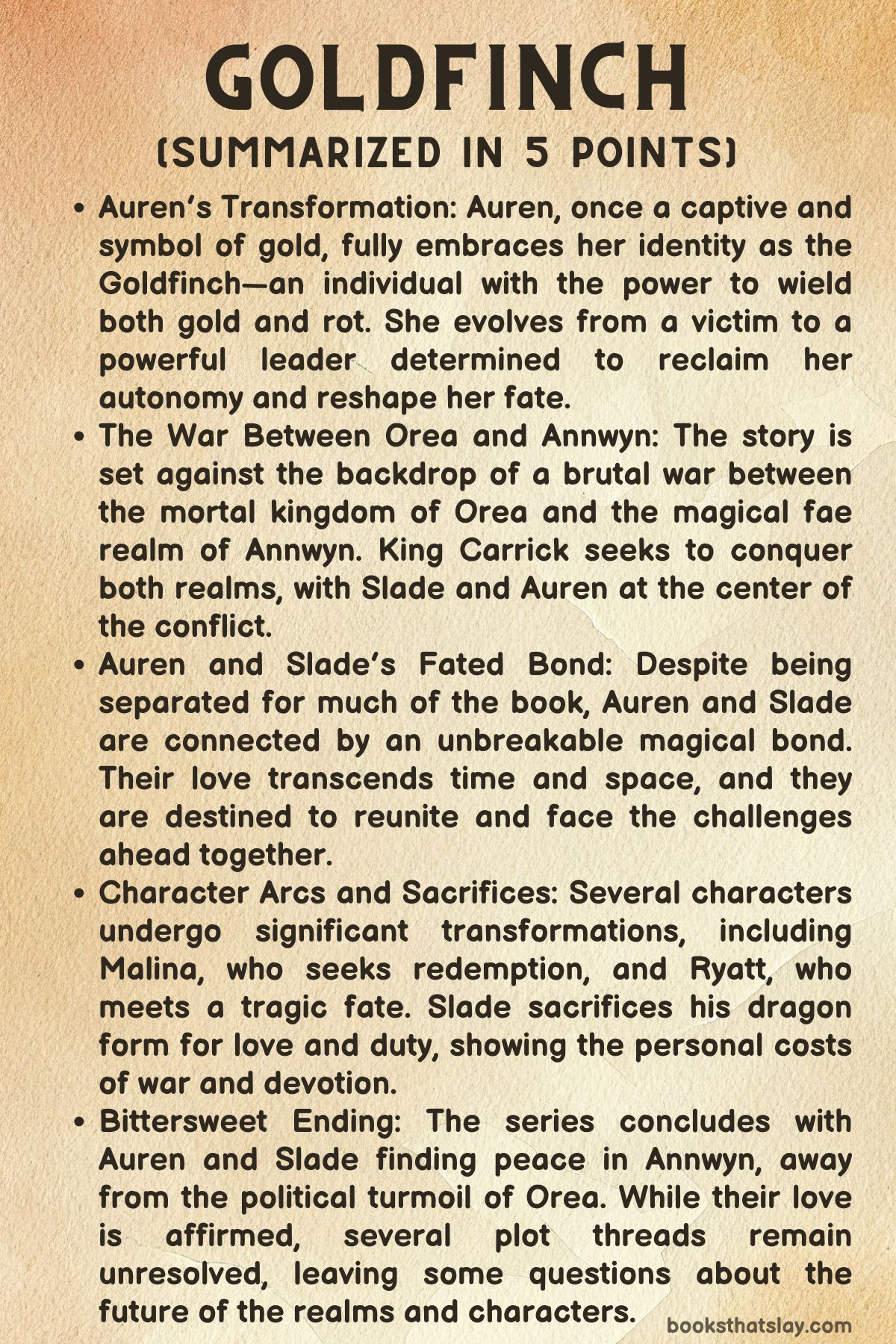
The story opens with Slade preparing to leave Brackhill as war looms over Orea. The castle courtyard is crowded with soldiers, weapons, supplies, and armored timberwings, all part of the force being assembled to respond to the shocking news that the long-destroyed bridge to Lemuria has somehow been rebuilt.
For Slade, the bridge means more than military danger. It means there may finally be a route back to Auren.
Though Ryatt continues organizing the army, Slade cannot bear the delay. He chooses to fly ahead alone on Argo, driven by urgency, love, and dread.
He gives instructions, refuses Lu’s offer to accompany him, shares a brief exchange with Wynn, and leaves Ryatt with the burden of leading the larger force. His immediate goal is to reach Ranhold, warn the Fifth Kingdom, and continue toward the bridge.
During the flight, Slade’s physical condition worsens. His damaged heart, already compromised, begins failing in a violent way.
As dawn nears, agony tears through him, poison spreads in black veins, and his chest swells with grotesque pressure. He loses control in the sky and nearly falls to his death.
Argo tries to save him, and though the effort is desperate and clumsy, the timberwing manages to catch him and drop him into a bog instead of letting him crash outright. Even on the ground, Slade is barely alive.
He drags himself through the mud, sees the terrible state of his chest, and understands that he is very close to death. Still, his mind remains fixed on Auren.
Even as his body begins to fail, he keeps trying to rise, refusing to die before reaching her.
At the edge of death, something extraordinary happens. Slade feels Auren’s presence reach him as if it has crossed every barrier between them.
Her warmth and power move through him, burning away poison and rot. In that moment, an ancient mate bond forms between them.
He understands that they are tied together at the level of soul and magic, and the bond changes him completely. The dead layers over his heart peel away to reveal something golden beneath, and then his body transforms further with scales, spikes, fangs, and sharpened features.
Dark smoke edged with gold erupts from him and takes the shape of a dragon, a creature believed lost to history. The dragon mirrors his new nature before vanishing.
Overcome by the bond and the transformation, Slade collapses unconscious, still carrying Auren’s fire inside him.
At the same time, Auren is trapped in a shattered state of mind. She has been brutalized by the aftermath of Carrick’s violence and is barely able to understand what is happening around her.
People are killed in front of her, others are tortured, and Carrick intends to use her not simply as an enemy but as a symbol. Rather than killing her immediately, he is persuaded to keep her alive as a public humiliation for the rebellion.
She is placed in a cell and repeatedly subjected to mental manipulation by a woman named Una, who tries to rewrite Auren’s memory and identity. Una pushes the idea that Auren is a traitor who surrendered and now belongs to Carrick’s cause.
Auren is weak, confused, and full of blank spaces, yet some core part of her resists. Even when much of her memory is stripped away, she clings to one truth: her name is Auren Turley.
That truth becomes an anchor. By the end of her ordeal, she is still damaged and disoriented, but she has not been erased.
Back in Orea, Rissa is recovering from the stabbing that nearly killed her. Osrik visits her and what begins in their usual sharp manner quickly becomes deeply serious.
He admits that while she was unconscious, he realized he loved her and could not bear the thought of losing her without saying so. Rissa resists him at first, shaped by years of pain and by a life in which intimacy has often meant exploitation rather than care.
She insists that men disappoint women and that love has never protected her. Osrik does not argue in grand speeches.
He simply tells her he will not fail her. His honesty unsettles her because it offers something she has never trusted herself to want.
Eventually she admits that her desires have changed. The future she once imagined for herself no longer fits.
She accepts what is growing between them and tells him she wants him.
Their intimacy becomes one of the emotional turning points of the story. Rissa and Osrik move toward each other with both tenderness and heat, but what matters most is that the encounter forces Rissa to confront how deeply old habits have shaped her.
She begins by slipping into familiar patterns, offering performance instead of honesty, and trying to please him in ways that erase her own needs. Osrik stops that immediately.
He makes it clear that with him, she does not need to act or pretend, and that he wants her desire to be real rather than practiced. Even when she fakes pleasure out of habit, he notices and refuses to let her hide behind that lie.
The intensity between them becomes not just physical but personal. Rissa is forced to claim her own pleasure honestly, and by the end of their encounter she realizes that for the first time, intimacy has not been work, survival, or obligation.
When Osrik asks if what they have is a mistake, she tells him it is the best mistake she ever made.
Their bond deepens further when talk of marriage sparks an argument. Rissa rejects the institution because she sees it as another structure that gives men control over women.
Osrik surprises her by not defending it. Instead, he offers a private version of commitment on her terms, one without legal ownership or social confinement.
That answer matters because it shows he is listening to her rather than trying to fit her into a role. Their affection remains fierce, playful, and sincere, and it gives Rissa a new understanding of what love can be when it is built on respect.
Meanwhile, Ryatt faces the growing disaster in Orea. Now burdened with command, he struggles to hold the kingdom together while waiting for word from Slade.
Supplies arrive, but fear is spreading through the ranks in the form of rumors, including suspicions that powerful figures in their own kingdom may secretly be fae. Ryatt knows panic could do as much damage as the enemy, so he suppresses the rumors and focuses on preparation.
Then the message comes, and it is worse than expected. Slade never made it to Ranhold, the Fifth Kingdom has already fallen, and the fae are moving quickly.
Lu is trying to slow enemy forces with only a handful of Elites, while others race for ports in hopes of stopping further spread. Ryatt realizes they no longer have time for a full military campaign.
Instead, he orders nearby settlements evacuated into Brackhill, prepares the kingdom for siege, and decides to fly out with Osrik and a small force to reinforce the border. He accepts that survival may depend on how long they can delay the enemy.
In Annwyn, Auren and Slade are finally reunited. Their bond pulls them together with overwhelming force, but their time together is not only about desire.
It is also about safety, relief, and truth. Auren rests beside him, watches him sleep, and feels for the first time in a long while that she is safe.
Once they are able, they tell each other everything that happened while they were apart. Slade listens to the full account of what she endured, and Auren receives the comfort of finally being fully seen and believed.
Before they reenter the city, he shows her that he has kept a frayed piece of her ribbon with him all along, proof that she remained with him in even the bleakest moments.
Their return to Lydia changes everything politically. The rebels have taken the city after Carrick fled, and the people greet Auren with joy.
She and Slade are brought to Wick, who has helped lead the resistance. Tension flares because Slade blames him for failing to protect Auren, but a more painful truth soon emerges.
Wick reveals that he is part of the Turley bloodline and therefore family to Auren. He also confesses that on the night Bryol fell, he abandoned her in the chaos.
He was a frightened child driven by jealousy, fear, and panic, and he has carried the guilt ever since. The revelation devastates Auren, yet she chooses not to reject him.
She recognizes that both of them have already lost too much and accepts him as family despite the wound his confession opens.
Elsewhere, Emonie endures her own ordeal. Forced by Carrick to impersonate Auren through glamour, she is sick with shame and fear that others will see her as a traitor.
Carrick drags her through a fairy ring into the deadlands near the ruined Orean bridge, where his army is preparing for war. When she dares to challenge his cruelty, he punishes her publicly and plans to have her returned, displayed, and burned as an example.
Before he can carry out those orders, a dying soldier arrives from the bridge and reports that Carrick’s men were slaughtered by a single male. The report unsettles Carrick badly, and Emonie sees that he is no longer secure in his own power.
Eventually, Ryatt, Lu, Osrik, Digby, Rissa, and the others discover Emonie in the snow after Auren’s failed effort to investigate the fog and find a route back to Annwyn. Emonie proves she knows Auren by using glamour to mimic her appearance, and she reveals the existence of a fairy ring that may be their only path across worlds.
The group takes the risk, forces Friano to activate the ring, and is thrown violently into Annwyn. Friano tries to kill Emonie on arrival, and Ryatt kills him to stop the attack, only to realize too late that the dead twin may have been their only way home.
Even so, Emonie guides them toward Lydia. There they find signs that Slade and Auren have recently been there, and finally the long separation ends.
Slade and Ryatt meet in shock and relief, the others reunite with Auren, Digby breaks down in her arms, and joy is cut with sorrow when Slade learns Judd is dead.
The story closes not in perfect happiness but in hard-won peace. The group mourns Judd, accepts Emonie, rebuilds damaged bonds, and begins shaping a future out of survival.
Ryatt is reunited with his mother. Bryol begins to heal.
Two months later, life has changed. Auren and Slade are no longer fighting just to survive each day; they are learning how to live.
In a quiet moment by the water, Slade gives Auren a recreated book tied to their bond and reveals that his dragon has returned in shadow form touched with gold. It is a final sign that after war, grief, and separation, something miraculous has survived.
Love, home, and hope remain.
Characters
Slade
Slade emerges as a man driven by love, duty, and a refusal to surrender even when his body is failing. At the beginning, his urgency is impossible to miss.
He is not content to wait for armies, plans, or proper timing, because the possibility of reaching Auren overrides every strategic instinct. That impatience says a great deal about him.
He is still a leader who thinks about kingdoms, borders, and warnings, but beneath that public role is a man whose private devotion shapes every decision he makes. His determination to fly ahead alone shows both courage and recklessness, qualities that seem inseparable in him.
His physical collapse deepens his character rather than reducing him to a victim. Even when poisoned, falling, and close to death, his mind remains fixed on reaching Auren.
That makes him more than a powerful male hero; it shows that endurance is central to who he is. He does not survive because the road is easy or because rescue comes early.
He survives because he keeps pushing long after reason would tell him to stop. The transformation he undergoes through the päyur bond also reflects something essential in him.
What was divided, rotting, and damaged becomes fused into a more complete self. In that sense, his change is not only magical but personal.
It suggests that his bond with Auren does not erase his nature; it restores it.
At the same time, Slade is not presented as flawless. His instinct to blame Wick for failing Auren reveals how protective and angry he can be.
His feelings are intense, and that intensity can harden into judgment. Yet that same fierceness is also what makes his love feel convincing.
He holds onto a frayed ribbon, listens to Auren’s pain with guilt and pride, and meets reunion not with distance but with complete emotional presence. He is powerful, dangerous, and almost mythic by the end, especially with the return of the dragon, but what anchors him is his capacity for attachment.
He becomes compelling because his strength is always tied to what and whom he loves.
Auren
Auren’s character is defined by survival, identity, and a hard-won inner steadiness. Even when her mind is fractured and outside forces are trying to rewrite her, she does not fully disappear.
Her imprisonment is not only physical; it is psychological. Una’s manipulation attempts to strip away memory, truth, and selfhood, which makes Auren’s resistance especially meaningful.
She cannot hold onto every fact, every event, or every relationship in clear detail, but she clings to the core truth of who she is. Her insistence that she is Auren Turley becomes an act of rebellion.
It is a declaration that identity is not something others get to define for her.
What makes her especially strong is that her resistance is not loud or theatrical. It survives in fragments, in instinct, in the refusal to let the darkness consume her.
This gives her resilience a quiet force. She is brutalized by circumstance, used as a symbol, isolated, and made vulnerable, yet she still finds a center within herself.
Later, when she reunites with Slade, her character expands beyond endurance into emotional openness. She allows herself peace, tells the full truth of what she suffered, and chooses connection rather than isolation.
That ability to remain soft enough to love after so much violation says as much about her strength as any act of magical power.
Auren is also important as a moral force in the story. She accepts Wick after his confession, not because his betrayal did not matter, but because she understands fear, loss, and the damage done by one terrible choice.
That response shows emotional maturity and generosity without making her passive. She is capable of judgment, but she does not let pain make her cruel.
Her transformation, including her wings and the growing power tied to gold and magic, suggests that she is changing outwardly as well as inwardly. Yet the most striking thing about her is that the change never separates her from her humanity.
She remains someone shaped by grief, loyalty, tenderness, and the decision to keep living as herself.
Rissa
Rissa is one of the most layered characters because her emotional arc is rooted in lived pain rather than abstract fear. Her past has taught her to distrust men, intimacy, and the entire structure of romantic promises.
That distrust does not come from stubbornness alone; it comes from exploitation, disappointment, and a lifetime of learning that her body could be used while her needs were ignored. Because of that, even moments of care are difficult for her to accept.
She expects guilt instead of love, performance instead of honesty, and possession instead of partnership. Her guardedness is therefore not a weakness but a defense built from experience.
What makes her development powerful is that she does not suddenly become unafraid. She remains wary even while moving closer to Osrik.
She questions his feelings, challenges his views, rejects marriage as a social cage, and refuses to surrender her perspective simply because she is being desired. That keeps her from becoming a passive romantic figure.
She is not swept along by the relationship; she actively negotiates its terms. Her resistance to marriage is especially revealing, because it shows that she thinks not only about personal feeling but about power.
She understands how social structures can trap women, and she refuses to dress up inequality as romance.
Her intimate scenes also reveal something deeply important about her character: she has learned to survive by performing. That habit is so embedded that she fakes pleasure almost automatically, trying to manage a man’s expectations before she can be disappointed or blamed.
When Osrik interrupts that pattern, the moment becomes about more than desire. It becomes about whether Rissa can believe that her real pleasure matters.
By the end, her realization that intimacy can be genuine, wanted, and free from obligation marks a major shift in how she sees herself. She is still sharp, skeptical, and strong-willed, but she is beginning to imagine a life in which she is not merely enduring experience.
In Goldfinch, she stands out as a woman reclaiming agency over both her body and her future.
Osrik
Osrik is written as a rough-edged man whose emotional honesty gives him depth. On the surface, he fits the image of someone blunt, physically imposing, and not especially polished with words.
Yet beneath that exterior is remarkable clarity. He does not hide behind ambiguity when it matters.
He tells Rissa directly that he loves her, that nearly losing her changed him, and that he wants something real with her. That kind of plain speech becomes one of his strongest traits.
He is not eloquent in a delicate way, but he is sincere, and the sincerity matters more.
One of the most notable things about Osrik is how he handles Rissa’s fear. He does not dismiss it, mock it, or try to argue her out of it through empty reassurance.
When she rejects marriage, he adapts immediately and offers another vision of commitment. That flexibility reveals respect.
He wants her, but he also wants her trust, and he understands those are not the same thing. His willingness to shape the relationship around what she can accept, rather than demanding she submit to his idea of commitment, makes him more than a dominant romantic figure.
It shows emotional intelligence beneath the bluntness.
His behavior during intimacy is also central to his characterization. He refuses false performance and insists that Rissa not reduce herself to pleasing him out of habit.
That makes him unusually attentive to the difference between sex and real connection. Even when he reacts strongly to her faking pleasure, the emotional logic is not cruelty for its own sake.
He wants honesty, mutual experience, and her full presence. He is forceful, yes, but also deeply invested in her reality rather than his ego.
This combination of protectiveness, possessiveness, tenderness, and blunt devotion makes him compelling. He feels like a man who may not be refined, but who is trying very seriously to love in a way that heals rather than harms.
Ryatt
Ryatt is shaped by responsibility, pressure, and the burden of command. Unlike Slade, whose decisions are often driven by personal urgency, Ryatt has to think in terms of logistics, morale, supply lines, defense, and survival.
His role reveals a different kind of strength. He does not have the luxury of acting only on feeling, because an entire kingdom may depend on what he decides next.
That makes him a practical character, but not a cold one. His anxiety over missing news, dangerous rumors, and collapsing fronts shows how heavily the role weighs on him.
He is also a character whose instincts are protective but not always perfectly controlled. He suppresses rumors because he understands how fear can rot an army from the inside.
He rapidly changes strategy from marching to siege preparation when the facts demand it. These are the choices of someone who can adapt under pressure.
But he is also impulsive in crucial moments, especially where Emonie and the fairy ring are concerned. Killing Friano may save one life, but it may also trap them all.
That decision captures one of Ryatt’s core tensions: he is brave and decisive, but sometimes immediate instinct outruns long-term consequence.
His emotional life is equally important. His reunion with Slade carries the force of brotherhood, shock, and relief, while his reunion with his mother reveals a more vulnerable side.
These moments prevent him from becoming only a military figure. He is grieving Judd, fearing collapse, trying to protect Fourth, and still carrying personal bonds that matter deeply to him.
Even his distrust of Emonie makes sense within that emotional context. He is a man under strain, trying to separate allies from threats while the world keeps shifting beneath him.
That tension makes him believable. He is competent and brave, but he is never untouched by the cost of leadership.
Emonie
Emonie is one of the most tragic and morally complex figures. Much of her role centers on coercion, shame, and the desperate need to prove that forced actions do not equal chosen loyalty.
She is made to impersonate Auren through glamour and becomes part of a public humiliation she never wanted. The pain of that is not just fear of punishment; it is the fear of being seen as false by the people whose trust she values most.
That emotional conflict makes her character especially sympathetic. She is not only trying to survive enemies, but also trying to survive the possibility of being misunderstood by allies.
Her strength lies in the fact that humiliation does not erase her judgment. Even after being dragged, threatened, and physically overpowered by Carrick, she still speaks against cruelty and still sees the broader truth that violence breeds resistance.
That willingness to speak in dangerous moments suggests courage that is quieter but no less real than battlefield heroics. She hardens herself when she must, deciding that survival is necessary so she can later prove where she stands.
That resolve keeps her from being reduced to a victim.
Emonie also functions as a bridge character. She connects worlds, carries knowledge others do not have, and becomes the key to the fairy ring that may lead back to Annwyn.
At the same time, she remains vulnerable to suspicion because of how she looks, where she has been, and what magic she carries. Her use of glamour to mimic Auren is a brilliant character moment because it is both proof and wound.
The same magic that was used to make her complicit becomes the tool she uses to testify to her loyalty. Even after being forgiven by Auren, she remains under Ryatt’s wary eye, which keeps her situation morally unsettled.
She is a character marked by damage, but also by endurance and a clear desire to do right despite everything done to her.
Wick
Wick is defined by guilt, secrecy, and the difficult possibility of forgiveness. For much of the story, he occupies a position of authority within the rebellion, but his hidden truth changes how he must be seen.
Learning that he is Wickum Almon Turley and a member of Auren’s family recasts him not just as an ally, but as someone bound to her by blood and by an old failure. His confession that he abandoned her as a child is devastating because it is not presented as a noble mistake or an unavoidable tragedy.
He admits jealousy, fear, and panic. That honesty makes the confession harsher, but also more human.
What makes Wick compelling is that he has clearly been living under the weight of that moment for years. His guilt has not turned into open self-pity.
Instead, it seems to have shaped his choices, his secrecy, and perhaps even his involvement in resistance. He is someone who kept moving forward while carrying a private knowledge that could destroy how others see him.
That creates tension between the role he plays publicly and the shame he lives with privately.
His scene with Auren matters because it tests whether guilt can coexist with belonging. He does not demand forgiveness.
He confesses and accepts the pain it causes. That posture suggests growth, because he is finally willing to expose the ugliest truth about himself rather than hiding behind usefulness or leadership.
In Goldfinch, Wick stands as a portrait of someone who did fail in a defining moment, but who has not stopped trying to become better than that failure.
King Carrick
Carrick is presented as a ruler whose power is rooted in cruelty, image, and fear. He does not simply want enemies destroyed; he wants them humiliated, displayed, and turned into warnings.
His treatment of Auren and Emonie shows that domination matters to him as much as victory. He is interested in symbolic violence, in using bodies and public performance to assert control over rebellion.
That makes him feel politically calculating as well as personally vicious.
At the same time, Carrick is not written as entirely invulnerable. His reaction to the dying soldier from the bridge is one of the most revealing moments in his characterization.
The report that a single male destroyed his troops unsettles him visibly. His fear does not humanize him in a redemptive sense, but it does expose a crack in his authority.
He can terrorize others, yet he is still capable of being shaken when faced with a force he cannot easily master. That makes him more believable than a villain who is only ever confident.
Carrick’s character also reveals a deeper moral emptiness. He sees cities as places to burn, populations as targets to exterminate, and loyalty as something to enforce through punishment.
Even when Emonie warns him that brutality will create more enemies, he cannot imagine another path because violence is central to how he governs. He is therefore not just a personal antagonist but a figure of corrupted power.
He embodies rule through fear, and the story places him in direct contrast with characters who build loyalty through love, trust, or chosen bonds.
Lu
Lu plays a smaller role in page space, but she comes across as capable, disciplined, and essential in moments of crisis. Early on, her offer to accompany Slade shows both loyalty and readiness.
She is not ornamental support; she is someone prepared to act, fight, and share risk. When Slade orders her to rest and lead later, it reinforces that she is trusted with real responsibility.
Her presence in military planning suggests competence that others rely on.
Later, her importance becomes even clearer when she is the one to send devastating news to Ryatt. She is active at the front edge of disaster, moving with only a few Elites and trying to delay enemy forces where she can.
This places her among the people who continue functioning under impossible circumstances. She is not dramatized as emotional in those moments, which actually makes her seem stronger.
She conveys hard truths and keeps moving.
Lu also serves as a grounding force for Ryatt after the fairy ring disaster. When panic and blame threaten to consume the group, she forces attention back to the practical task at hand.
That suggests clarity under pressure and a refusal to let fear waste what little time they have. Though she is not as emotionally foregrounded as some others, she reads as one of those indispensable characters whose steadiness helps keep everyone else from splintering.
Argo
Argo is more than a mount or magical beast; he is characterized with loyalty, instinct, and emotional presence. His relationship with Slade feels deeply personal.
He does not simply carry him from place to place. He senses danger, tries to save him during the fall, and remains significant enough that Wynn extracts a promise regarding his safety.
These details make Argo feel like a being with bonds rather than equipment.
His actions during Slade’s collapse are especially important. He catches Slade in his talons when death seems certain and gets him to the ground, however roughly.
That intervention gives Argo a heroic role in his own right. He is brave, responsive, and fiercely attached.
Even his panicked reaction in the fog later helps reinforce that he is sensitive to magic and threat in ways humans may not fully understand.
Argo’s continued presence during the fairy ring journey and reunion sections also keeps him tied to the emotional life of the group. He is part of the network of loyalty surrounding Slade and Auren.
In a story full of war, betrayal, and uncertainty, Argo represents a more instinctive kind of devotion, one based not on politics or explanation but on trust.
Una
Una is a disturbing figure because her power works through invasion rather than open force. She repeatedly enters Auren’s mind, shaping memory and belief, trying to make falsehood feel like truth.
That gives her a different kind of menace from soldiers or kings. She threatens the self from the inside.
Her role makes the violence against Auren more intimate and more terrifying because it targets identity rather than only the body.
She seems to embody obedience to a larger authoritarian order, but the summary also suggests personal coldness in the persistence of her methods. She does not simply carry out instructions once.
She works Auren over repeatedly, pressing false narratives into her again and again. That relentlessness makes her an instrument of psychological control.
She stands for the idea that domination is most effective when victims can be made to participate in their own erasure.
Although she is not one of the most developed characters in terms of backstory, her function in the narrative is sharp and memorable. She is the face of systematic manipulation, and through her, the story shows that the battle for freedom is also a battle over memory, identity, and language.
Wynn
Wynn appears briefly, but her presence carries emotional weight. She is associated with healing and innocence, and her concern for Argo reveals a gentle conscience amid preparations for war.
In a narrative filled with armies, poison, and collapsing kingdoms, her brief exchange with Slade reminds the reader that not all strength is martial. Care itself matters.
Her role also helps illuminate Slade. The fact that he pauses for a meaningful promise to a child before leaving shows the softer part of him, and Wynn is the one who draws that out.
She is therefore a small but important emotional touchstone, representing the lives that war is supposed to protect.
Judd
Judd’s role in the book is shaped largely through absence, which makes him poignant as a character. He is mentioned as someone who should have been part of the later movement and reunion but is instead mourned as lost.
That loss is felt sharply by the group, especially when the joy of reunion is cut by the news of his death. A character does not need long page time to matter; sometimes significance is measured by the emptiness left behind.
Judd appears to have been one of the trusted inner circle, someone woven into the emotional and strategic life of the others. The fact that the companions honor him with both grief and celebration suggests he was not merely useful, but loved.
His absence helps define the cost of everything the survivors have endured.
Friano
Friano is presented as dangerous, unstable, and tied to strange magic that others do not fully understand. He is initially associated with violence against Emonie, which immediately marks him as a threat.
Later, he becomes the key to activating the fairy ring, making him both necessary and hated. That tension gives him an unusual role.
He is valuable not because anyone trusts him, but because circumstances force others to use what he knows.
His attempt to attack Emonie again upon arrival in Annwyn confirms that his violence is not situational. It appears deeply rooted in who he is or in the corrupt forces surrounding him.
Ryatt killing him is understandable on instinct, which in turn makes Friano narratively effective: he is threatening enough to justify immediate action, yet important enough that his death creates serious consequences. He is a character through whom the story shows how survival decisions can close doors as quickly as they open them.
Themes
Love as Restoration Rather Than Rescue
What gives the central relationship its force is not simply longing or reunion, but the way love becomes a means of restoration for two people who have both been altered by pain. Slade’s journey begins in a state of urgency that is physical, emotional, and spiritual all at once.
He is not moving toward battle for glory, duty alone, or revenge. He is moving toward Auren because she has become the one fixed point in a world coming apart.
Even while his body is failing and his heart is literally rotting inside him, his thoughts remain centered on reaching her. That focus shows how love is tied to survival, but the story does not reduce that bond to dependency.
Instead, it presents their connection as something that gives each of them back to themselves.
This becomes especially clear in the moment when Auren’s essence reaches Slade across worlds and the päyur bond takes hold. The change is not framed as a soft emotional comfort.
It is transformative, almost violent in its intensity, burning away poison, exposing hidden strength, and calling forth a truer self that had been buried beneath damage and division. Love here is not decorative.
It is active, cleansing, and identity-making. Slade does not merely feel better because he is loved; he is remade by a connection that strips away corruption and reveals what was always latent within him.
The same pattern appears in Auren’s recovery. After imprisonment, manipulation, and mental assault, she exists in a fractured state, with pieces of memory torn away and replaced by false narratives.
Her eventual reunion with Slade gives her relief, but the deeper significance lies in how that reunion offers safety without erasing her own strength. She is not saved into passivity.
She is given the space to speak, to remember, and to be witnessed fully. When Slade listens to what happened to her, the scene matters because it turns love into recognition.
He does not rewrite her suffering or simplify it. He receives it.
The story therefore treats love not as fantasy fulfillment, but as a force that restores dignity, steadies identity, and creates the conditions for healing. It is not about one person completing another in a shallow sense.
It is about two people becoming more whole because their bond allows truth, trust, and endurance to survive what violence tried to destroy.
Identity Under Siege
Nearly every major thread in the story is shaped by a struggle over identity: who has the right to define a person, what remains when memory is damaged, and how selfhood survives coercion. Auren’s captivity provides the clearest expression of this theme.
Her mind has been fractured, her perceptions are unstable, and Una works methodically to insert false beliefs into her consciousness. The goal is not only political control but internal conquest.
If Auren can be made to accept a false version of herself, then her captors do not merely imprison her body; they colonize her inner life. That is why her insistence on her own name becomes so important.
“I am Auren Turley” functions as more than memory. It is resistance in its most concentrated form.
That struggle over identity appears elsewhere in ways that expand the theme beyond mental manipulation. Emonie is forced to impersonate Auren through glamour, turning identity into performance under threat.
Her shame afterward comes not only from what she was made to do, but from the fear that others will believe the false image over the truth of her loyalty. The pain lies in being seen incorrectly and judged through a role forced upon her.
In this way, the story shows how power can weaponize appearance and public narrative, making identity something vulnerable to theft and distortion.
Slade’s transformation also belongs to this theme, though from another angle. His rotting heart, his divided nature, and the dragon that emerges all suggest that he has never been fully legible even to himself.
The bond with Auren does not create a false self; it reveals a more integrated one. His scales, fangs, smoke, and dragon-form imagery represent a truth coming to the surface.
This is why the transformation feels meaningful rather than arbitrary. It answers a question about what he is, but also about what he has been prevented from fully becoming.
Rissa’s story adds a social and gendered dimension. Her past has taught her to perform a version of femininity shaped by exploitation, service, and male expectation.
Even in intimacy, she initially defaults to what has been demanded of her before. Osrik’s refusal to accept performance forces a confrontation between habit and authentic desire.
For perhaps the first time, she is asked not who men need her to be, but what she herself wants.
Taken together, these arcs suggest that identity is never presented as simple or static. It is pressured by trauma, politics, class, violence, memory, and desire.
Yet the story insists that the self can endure even under distortion. Sometimes that endurance looks like holding onto a name.
Sometimes it looks like rejecting a role. Sometimes it looks like becoming what fear once forced into hiding.
Power, Control, and the Refusal to Submit
Power in this narrative is never abstract. It appears through armies, kings, invasions, imprisonment, punishment, rumor, bodily threat, and even emotional expectation.
What makes the theme compelling is that control is shown operating at both grand and intimate levels. Carrick’s rule offers the broadest example.
He uses public cruelty, symbolic humiliation, and terror as tools of domination. He wants bodies subdued, cities burned, enemies displayed, and rebellion broken not only physically but psychologically.
His treatment of Auren and Emonie reveals a ruler who understands that fear becomes most effective when it is theatrical. He wants people to witness what happens to those who resist, turning punishment into political language.
But the story does not stop with tyrannical kings. It also examines how control can seep into personal relationships, habits, and assumptions.
Rissa’s resistance to marriage is one of the most direct articulations of this. She rejects the institution because she understands it as a structure historically tilted toward male authority.
Her refusal is not cynical for the sake of being cynical. It comes from lived knowledge of how women are cornered, used, and then told to accept that arrangement as normal.
Her anger gives the theme a grounded social edge. She recognizes that domination often disguises itself as respectability.
What strengthens this theme is the repeated presence of characters who refuse submission in different forms. Auren resists even when memory is unstable.
Emonie speaks against Carrick even while surrounded by enemies and already condemned. Ryatt suppresses dangerous rumors because he understands that fear can fracture a kingdom from within before any external invasion finishes the job.
Slade’s entire early journey is built on the refusal to yield to bodily collapse. Even when death seems unavoidable, he keeps moving in spirit if not in strength.
Yet the story also avoids suggesting that resistance is clean or easy. Ryatt’s choices are shaped by desperation.
Osrik’s method of confronting Rissa’s false performance is rough, controlling, and charged with complicated implications. The border between protection and dominance is not always neat, which gives the theme its tension.
Characters are constantly forced to ask what kind of power they are using and to what end.
In the end, the narrative values not the possession of power, but the ethical use of it. The contrast is clear: Carrick uses power to erase personhood, while the protagonists struggle, however imperfectly, to defend it.
Control seeks obedience, silence, and fear. The refusal to submit seeks truth, agency, and the right to remain fully human in the face of force.
Healing Through Chosen Belonging
Running beneath the war, magic, and political upheaval is a quieter but deeply important concern with belonging. The story returns again and again to the idea that healing is made possible not only by survival, but by being claimed, accepted, and given a place within a living community.
This theme matters because many of the characters carry histories of abandonment, exile, guilt, or emotional isolation. Their wounds are not only physical.
They are relational.
Rissa’s movement toward Osrik shows this with particular clarity. Her past has taught her that closeness comes with transaction, disappointment, or loss of power.
What she finds with him is not simply sexual fulfillment, but a form of belonging that does not require performance. He wants truth from her, not a service.
He wants a bond shaped by mutual choice, not social ownership. Even their discussion of marriage turns toward a private reimagining of commitment rather than submission to an institution she distrusts.
That shift matters because it allows Rissa to imagine attachment without erasure. She can belong without being possessed.
Auren’s story is likewise shaped by chosen belonging. Her reunion with Slade gives her emotional shelter, but the theme expands further when she is welcomed by the people rallying around her in Lydia and when she chooses to accept Wick as family despite his devastating confession.
That acceptance does not dismiss the harm of what he did as a child. Instead, it recognizes that family can sometimes be rebuilt through mercy, honesty, and shared grief.
Belonging here is not naive. It is something forged through painful truth.
The reunions in Annwyn carry the same weight. Ryatt’s reunion with Slade, Digby’s emotional response to seeing Auren alive, and the group’s decision to remain together and honor Judd through both mourning and celebration all show belonging as collective repair.
These moments matter because they counter everything the forces of war and tyranny have been trying to do. Invasion scatters people.
Trauma isolates them. Shame convinces them they no longer deserve a place.
Community answers by gathering them back in.
Even the closing vision of rebuilding Bryol and making new lives speaks to this theme. The goal is not merely to defeat enemies.
It is to create a world where people can live, love, remember the dead, and imagine a future that is more than aftermath. Home is not treated as a static location.
It becomes something made through loyalty, forgiveness, memory, and shared labor.
That is why the ending carries emotional weight. After so much fracture, the story argues that healing does not happen in solitude.
It happens when people choose one another again and again, until safety starts to feel possible and hope begins to look like a place they can actually stay.