Forged In Blood by Sadie Kincaid Summary, Characters and Themes
Forged In Blood by Sadie Kincaid is a dark paranormal romance built around hidden supernatural societies, ancient prophecy, and a young woman whose past has been shaped by secrets she never understood. The story blends vampires, wolves, witches, and forbidden power within a university setting that looks ordinary on the surface but is ruled by dangerous beings beneath it.
At the center is Ophelia Hart, an outsider who arrives at college carrying trauma, loneliness, and a buried force that others recognize before she does. What begins as fear and survival slowly grows into a story about identity, power, fate, and belonging.
Summary
The story begins far in the past with the legend of the Lost Prophecies of Fiere, six sacred scrolls rescued from the burning Library of Alexandria by knights of the demonic Order of Azezal. Though history says the Order fell soon after, the truth is different.
Its members survived, scattered, and hid the scrolls because the prophecies carried dangerous knowledge that could threaten nonhuman beings across the world.
In the prologue, Grand Healer Nazeel Danraath, Kameen, and Insignius arrive in a forest consumed by fire. They have been called there by Jadon, Kameen’s dying brother.
Jadon lies mortally wounded beside his human mate, and the bodies of their attackers burn around them. He reveals that the destruction came from his unborn daughter, whose power erupted from inside her mother’s womb.
He explains that enemies came for the child because she is special and may be tied to prophecy. Jadon begs them to protect her.
His mate dies, and Kameen burns her body. From the charred remains, a living baby emerges.
Nazeel immediately senses extraordinary ancient power within her. The group argues over what to do.
Kameen decides the child cannot be raised openly within their Order and should instead be hidden among humans. To keep her safe, they agree her powers must be bound, even though Nazeel is disturbed by the harshness of that choice.
Nineteen years later, Ophelia Hart arrives at Montridge University. She is shy, socially awkward, and marked by a lonely childhood shaped by foster care, rejection, and instability.
At the university fair, she tries to find where she belongs but feels out of place almost immediately. She is dismissed by some groups and warned away from the commanding men of Ruby Dragon Society.
When she notices them, she is struck by how intimidating and attractive they are, though she wants nothing to do with them.
Soon afterward, while walking back from the library at night, Ophelia hears a girl screaming and discovers a horrifying scene. Axl Thorne has his mouth on another student’s neck while Xavier Adams and Malachi Young stand nearby.
She realizes they are vampires. When she tries to intervene, Xavier and Malachi overpower her and take her at supernatural speed to a strange house near the society buildings.
They drag her into a basement that is clearly used for imprisonment and torture. There they threaten, humiliate, and terrify her.
Even in her fear, Ophelia is unsettled by how strangely her own body reacts and by the fact that she does not feel fear in a normal way.
Before the situation goes further, Professor Alexandros Drakos arrives and orders them to release her. Though he treats her with cold cruelty and warns that no one would believe her if she spoke, he makes it clear that she is not to be bitten.
Afterward, he investigates her past and finds details that confirm his suspicions. She survived a devastating fire in high school without injury, and her history contains too many oddities.
He becomes convinced she possesses magical power that was bound when she was young. He orders Axl, Xavier, and Malachi to watch her closely, keep others from feeding on her, and isolate her if needed.
The three vampires are puzzled by the command. No one has ever forbidden them from biting someone before, which convinces them Ophelia is important.
Though they agree to obey, they still enjoy tormenting her. Ophelia tries to learn more about the girl she saw attacked, only to be mocked and slapped when the girl denies anything happened.
Later, Malachi speaks to Ophelia with surprising gentleness. He confirms details about vampires, including how their saliva heals bites and their blood can heal larger wounds.
He also reveals pieces of the hidden world around Montridge, including the existence of supernatural societies divided among vampires, wolves, and witches.
Axl then begins showing a disturbing obsession with her. He appears in her dorm room, mocks her history, references the fire in her past, and warns her to stay quiet.
Though he claims she disgusts him, his behavior suggests something far more intense. Meanwhile, Alexandros asks his old werewolf friend Osiris Brackenwolf, dean of admissions, to investigate who really arranged Ophelia’s presence at Montridge, because her official background does not add up.
As Ophelia spends more time around the vampires, especially Malachi, she becomes increasingly curious about the supernatural world. Malachi answers some of her questions, confirming that Professor Drakos is also a vampire and that he is the sire of Malachi, Axl, and Xavier.
He tells her about his age and the existence of wolves and witches, and she begins to see how deeply the university is shaped by hidden power.
At a football game, Xavier and Axl corner Ophelia in the stands. They frighten away a friendly student who tries to sit with her, then trap her beside them and make degrading comments about the cheerleaders.
Ophelia is disgusted by their cruelty, yet also disturbed by the confusing attraction and physical tension they stir in her. When they speak casually about preying on the girls, she finally understands how dangerous they truly are and quietly breaks down in front of them.
Later, devastated by rejection and emotional pain caused by Xavier, Axl, and Malachi, Ophelia leaves her dorm during a storm and goes to the library. There she finds unexpected comfort in Cadence, who sits with her, shares cookies, and helps her laugh for the first time in a while.
Cadence hints that her own society, Silver Vale, is tied to special ability, which leaves Ophelia confused. Their conversation ends when news breaks that five students have died in what authorities are calling a car crash.
Ophelia is horrified, sensing there is more to the story.
At the same time, Malachi rushes to Alexandros because Axl has become gravely ill. Alexandros explains that Ophelia is not human but an elementai, an ancient and powerful magical being.
The first taste of an elementai’s blood is poisonous to vampires, creating sickness and an overwhelming need for a second bite that will cure the illness and create a permanent bond. Axl now needs Ophelia’s blood to survive.
Alexandros forces Ophelia to visit Axl. She finds him weakened and almost monstrous from sickness.
When Axl bites her, the experience overwhelms her with pleasure rather than pain. Their emotional and physical connection intensifies rapidly, and he apologizes for his earlier cruelty.
They become lovers, and the bond between them locks into place. Axl immediately realizes with dread that Xavier and Malachi will feel it too and will want the same bond.
Alexandros soon notices that Ophelia’s emotions may affect the natural world around her. Her sadness seems to bring days of rain, while her pleasure appears to shake the earth.
Xavier, maddened by jealousy and desire, eventually bites her as well and forms his own bond. Not long after, Malachi apologizes for his part in hurting her, and his bond forms too after an explosive encounter in the library.
The next morning, Ophelia discovers she can hear Axl, Xavier, and Malachi in her mind, and they can hear her. Alexandros confirms that the bond is permanent and unusually strong.
Ophelia is furious because none of this was truly her choice, but the connection also gives her a sense of belonging she has never known before.
During the annual Hunt, Ophelia is somehow drawn into the forest despite promising to stay away. Two pledges capture her and decide to use her as bait, planning to mutilate her so they can survive the chase.
Alexandros arrives just in time, kills them, and rescues her. He believes some outside magical force compelled her into danger by using her fear for the bonded vampires.
Afterward, everyone is shaken, and the need to protect her becomes even stronger.
As concern grows, Alexandros urges the others to attend classes with her and watch her more closely. He also reveals that the strange tremors around campus may be linked directly to her.
Eventually, in a hidden faculty library, he tells Ophelia the truth: she is not simply a witch but an elementai, perhaps the last of her kind. Soon after, Cadence tells her a darker version of history, saying vampires exterminated the elementai.
The revelation devastates her.
Sensing her distress, Alexandros drags her away and confronts her in private. The intensity between them finally breaks open, and he bites her too.
Through the bond, he shares memories of betrayal, suffering, and the destruction tied to her people. The shock of that truth awakens her buried powers.
Fire erupts around them, but with Alexandros guiding her, she manages to gain some control. Their connection deepens, and she emerges changed, with her true nature finally rising to the surface.
In the end, it is revealed that Nazeel had bound her power long ago and quietly influenced events so that Ophelia and Alexandros would come together, believing their union could restore balance to the world.
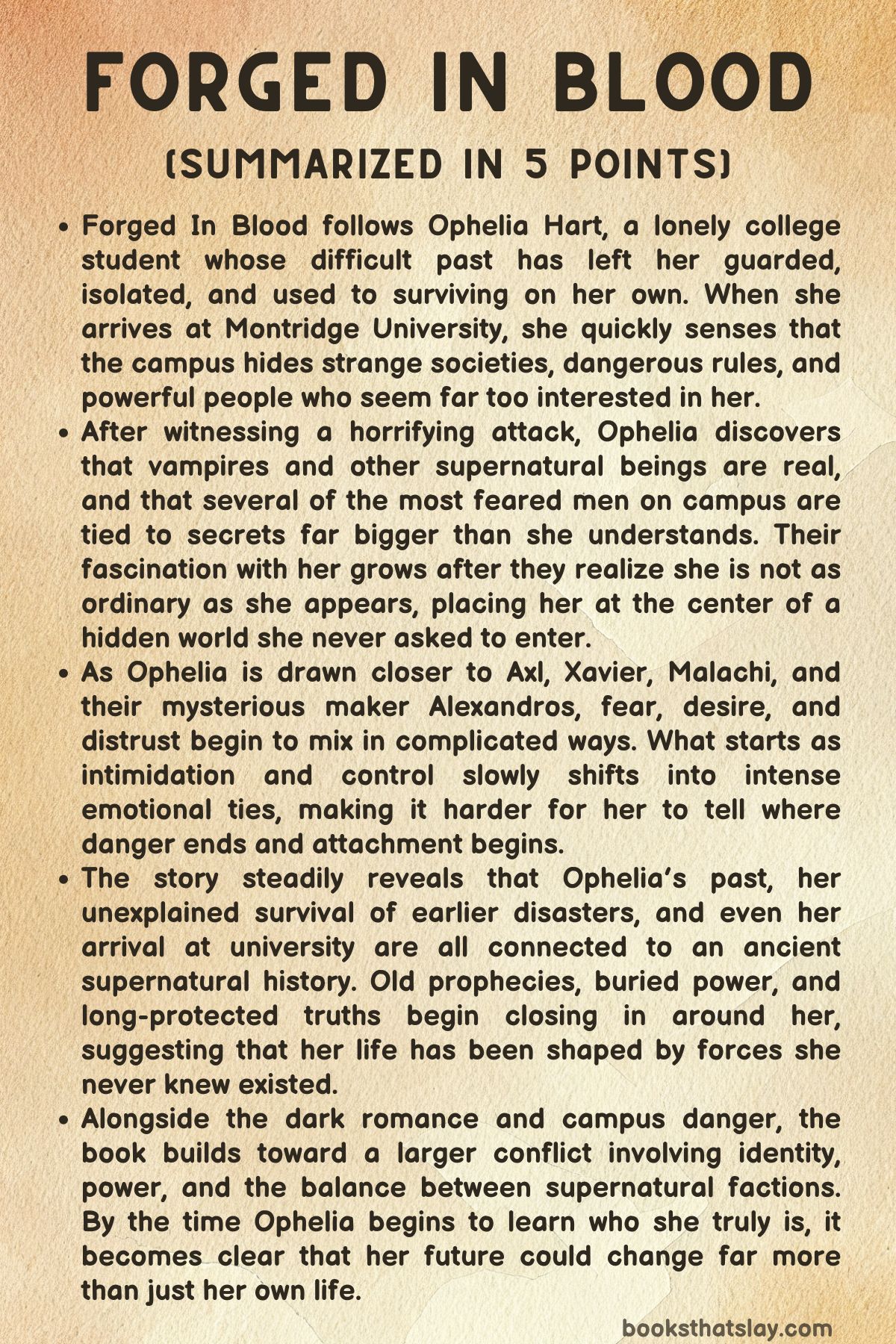
Characters
Ophelia Hart
Ophelia stands at the emotional and narrative center of the story. She begins as a lonely, awkward young woman shaped by foster care, abandonment, and repeated rejection.
Her early insecurity is not presented as weakness alone; it is also a survival mechanism built over years of being overlooked, blamed, and emotionally unprotected. She arrives at university wanting something ordinary: a place to belong, a future she can build through study, and a life defined by helping others.
Her desire to become a social worker says a great deal about her inner character. Even after suffering neglect and cruelty, she has not become cynical.
She still wants to protect vulnerable people, especially children, which shows that compassion remains one of her deepest instincts.
What makes Ophelia especially compelling is the contrast between how she sees herself and what she actually is. She thinks of herself as unwanted, socially misplaced, and powerless, yet almost every major revelation in the story proves the opposite.
She is central to prophecy, carries ancient elemental power, and becomes the focus of intense supernatural attention. Even before she understands any of that, there are signs that she is not ordinary.
She does not react to fear the way others expect. She resists intimidation with surprising force.
Her emotions have unusual weight, later shown to affect the natural world itself. This creates a layered character arc in which self-discovery is not just emotional but cosmic.
Her relationships also reveal her complexity. She is frightened by the vampires, disgusted by their cruelty, and yet drawn into bonds with them that blur desire, anger, resentment, and longing.
These contradictions do not make her inconsistent; they show how deeply conflicted she is as someone who has spent her life craving safety and connection, only to find both wrapped inside danger. Her journey is not simply about gaining power.
It is about learning that her pain, her rage, her desire, and her need for belonging are all tied to a buried identity that can no longer remain hidden.
Professor Alexandros Drakos
Alexandros is one of the most complicated figures in the story because he exists at the intersection of authority, secrecy, control, and buried feeling. He first appears as a savior who stops Ophelia from being harmed, but that rescue is immediately tainted by cruelty.
He protects her, yet humiliates her. He intervenes, yet refuses to explain himself.
This duality defines him for much of the narrative. He is never simply protective or simply ruthless.
He is both at once, which makes him unpredictable and dangerous.
His role in the story is that of gatekeeper to hidden truth. Long before Ophelia understands what she is, Alexandros begins piecing it together.
He notices the inconsistencies in her background, recognizes the signs of bound magic, and senses that her existence carries enormous consequences. Unlike the younger vampires, he has the distance of age, knowledge, and history.
He knows more than he says, and much of the tension around him comes from his deliberate withholding of information. He believes secrecy is necessary, but that secrecy repeatedly harms Ophelia by denying her agency.
This makes him morally difficult to trust, even when his actions are meant to preserve her life.
At the same time, he is far from emotionally detached. He is affected by her scent, her presence, and the force of what she represents.
His interest is not merely academic or strategic. It is personal, instinctive, and increasingly consuming.
When he finally shares truth with her through blood and memory, his character shifts from manipulator to participant. He is no longer only managing her fate; he becomes bound up in it.
His memories of suffering and the destruction tied to her people give him tragic depth, suggesting that his severity has been shaped by loss, guilt, and a long relationship with violence. He embodies the burden of history: someone who has lived long enough to understand how dangerous power can be, but not long enough to escape being changed by it.
Axl Thorne
In Forged in Blood, Axl is introduced as openly monstrous, and his early role is to embody threat in its rawest form. He attacks without shame, intimidates without restraint, and seems to enjoy Ophelia’s fear and helplessness.
His first major interactions with her are invasive and cruel. He enters her private space, mocks her past, and treats knowledge of her trauma as a weapon.
He wants control, and he expresses desire through domination. At this stage, he appears to be the least redeemable of the three brothers because he is the most unapologetically vicious.
Yet Axl’s character becomes far more layered once his bond with Ophelia begins. His illness after tasting her blood reveals something unexpected: beneath the arrogance and violence is a being capable of need so extreme that it strips him of power.
This matters because Axl is someone who has relied on force and intimidation as his identity. When he becomes weak, feverish, and dependent on Ophelia for survival, the emotional balance shifts.
He is no longer just predator. He becomes vulnerable, desperate, and honest in ways he was never willing to be before.
His later tenderness does not erase his earlier behavior, but it does deepen him. Once bonded, he apologizes, expresses genuine feeling, and reveals that obsession and disgust were never cleanly separated in him.
He is a character driven by intensity. He does not do anything halfway, whether that is hatred, jealousy, lust, or devotion.
This makes him volatile, but it also makes him emotionally transparent once the walls come down. His attachment to Ophelia quickly becomes possessive and protective, showing that the same force that made him terrifying can also turn into fierce loyalty.
He represents the danger of desire when it is stripped of restraint, but also the strange sincerity that can emerge when someone built for violence is forced into emotional dependence.
Xavier Adams
Xavier shares Axl’s predatory nature, but his personality is filtered through a sharper sense of performance, cruelty, and restless hunger. He enjoys intimidation and often uses mockery, sexual provocation, and public pressure to destabilize Ophelia.
At the football game, for example, his presence is not only threatening but humiliating. He wants to dominate the emotional space around her, to make sure she feels watched, cornered, and unable to escape.
He is the kind of character who weaponizes confidence and spectacle.
What distinguishes Xavier from Axl is the way jealousy shapes him. Once Axl forms the first true bond with Ophelia, Xavier’s reaction is immediate and consuming.
He does not simply want what his brother has. He feels excluded from something he now understands at a visceral level.
This gives his character a strong undertone of possessive desperation. He is emotionally driven, but unlike Axl’s rough directness, Xavier’s desire often carries a sharper edge of competition.
He is deeply affected by hierarchy among the brothers and by access to Ophelia’s attention, body, and loyalty.
After bonding with her, Xavier becomes more emotionally exposed. His connection is not only physical but existential, and he quickly realizes that belonging to her is both ecstatic and binding.
This is important because Xavier initially behaves as though he answers only to appetite and amusement. The bond forces him to recognize attachment as something heavier than attraction.
He cannot remain detached or merely playful. His instincts toward control are still present, but they are now fused with real need, protectiveness, and emotional vulnerability.
He becomes one of the clearest examples of how the supernatural bond transforms cruelty into dependence without fully removing the darker parts of personality. He is still dangerous, still sharp-tongued, still capable of intimidation, but he is no longer emotionally untouchable.
Malachi Young
Malachi is the most measured and emotionally readable of the three younger vampires, which is why he often feels like the bridge between Ophelia and the hidden world around her. From the beginning, he is different in tone.
He still participates in threatening situations and is far from innocent, but he is less impulsively cruel than Axl and less performatively aggressive than Xavier. His conversations with Ophelia are marked by curiosity, teasing, and moments of genuine softness.
He answers her questions, explains parts of the supernatural system, and gives her information rather than only fear. Because of this, he becomes the first figure through whom hidden knowledge starts to feel approachable.
His age and long life give him an air of quiet detachment, but there is also weariness in him. He has seen greed, human weakness, and the long patterns of immortality, which makes him more reflective than his brothers.
Yet he is not presented as morally superior. He hurts Ophelia too, and his later apology matters precisely because it acknowledges that his restraint was never enough to keep him from becoming part of her suffering.
He is gentler, but still complicit.
What makes Malachi especially important is the emotional balance he brings to the group dynamic. His bond with Ophelia comes later, after time has passed and after she has already been changed by the others.
That delay gives his relationship with her a different texture. It feels less like immediate conquest and more like a gradual surrender to what has been building all along.
When he finally bonds with her, the event feels like the completion of an emotional pattern rather than a sudden reversal. Malachi represents intimacy through understanding, though that intimacy still exists within a world shaped by coercion and supernatural hunger.
He is the most conversationally open of the three, and that makes him essential to Ophelia’s gradual acceptance of connection, even as he remains part of the danger surrounding her.
Cadence
Cadence serves as one of the few sources of ordinary kindness in Ophelia’s life, though even she is linked to larger hidden systems. Her importance lies not in dramatic supernatural action but in emotional contrast.
At a moment when Ophelia is heartbroken, isolated, and overwhelmed, Cadence offers simple human comfort: cookies, conversation, humor, and companionship. That gesture matters because it reminds both Ophelia and the reader that care does not always arrive through intensity or destiny.
Sometimes it arrives quietly, through someone choosing to sit beside another person and make them feel less alone.
Cadence is socially fluent in ways Ophelia is not. She moves through the university world with familiarity and ease, and her connection to Silver Vale suggests she belongs to networks of privilege and inherited power.
Yet she does not use that status to exclude Ophelia. Instead, she brings her in.
This makes her an important counterpoint to the early social rejection Ophelia experiences. Cadence sees Ophelia’s vulnerability and responds with warmth rather than judgment.
At the same time, Cadence is not merely a cheerful side character. She also becomes a conduit for painful truth.
Through her, Ophelia learns a darker version of history about the extermination of the elementai by vampires. That revelation deepens Cadence’s role because she is not just emotional support; she is also part of the process by which Ophelia’s identity is uncovered.
Her presence shows that friendship in this world can still be meaningful, but it cannot remain untouched by ancient conflict and buried violence. She adds emotional texture and helps ground the story in something beyond obsession and supernatural possession.
Nazeel Danraath
Nazeel is one of the key figures in shaping the entire story, even though much of his importance lies in the background and the epilogue. From the beginning, he is framed as someone with spiritual authority and deep awareness.
He immediately senses the extraordinary power carried by the infant Ophelia and understands that her existence is tied to prophecy and ancient consequence. Unlike others in the prologue, he responds not only with caution but with moral unease.
He objects to the cruelty of binding the child’s powers, which shows that he is capable of recognizing the human cost of supposedly necessary action.
His later role gives him even greater significance. He is revealed to be the one who bound Ophelia’s abilities and quietly set her path toward Alexandros.
This transforms him from observer into architect. He is not simply preserving a child from danger; he is arranging fate on a grand scale.
That makes him morally ambiguous. His actions may be meant to restore balance, but they also involve taking choices away from Ophelia before she is even old enough to know herself.
In that sense, he reflects one of the story’s central tensions: whether power can ever be guided without becoming coercive.
Nazeel’s character carries the weight of ancient planning. He believes in patterns larger than individual desire, and this belief allows him to justify painful decisions.
He is not portrayed as cruel for cruelty’s sake. Rather, he is someone who sees too much and therefore acts with a kind of cold long-range purpose.
His influence lingers over the entire narrative because Ophelia’s confusion, hidden identity, and eventual awakening all trace back to his intervention. He stands as a reminder that destiny in this world is never neutral; it is shaped by people willing to make severe choices in the name of a future they believe must happen.
Kameen
Kameen is defined by hard practicality and emotional resistance. In the prologue, he is the one most determined not to take responsibility for the child born from fire.
Even though the baby is his dying brother’s daughter, he refuses the idea of raising her within the Order and immediately thinks in terms of concealment, survival, and necessary harshness. This gives him a stern and unsentimental presence.
He is not moved by wonder in the same way Nazeel is. He is moved by risk.
His choices reveal someone shaped by danger and probably by long experience of loss. He believes interference will only make the child more vulnerable, and his solution is to hide her among humans and bind her powers.
That decision may feel cold, but it is driven by a survival logic rather than indifference. Kameen seems like the kind of character who expresses care through severe action rather than tenderness.
He does not comfort. He does not nurture.
He acts in ways he thinks will keep catastrophe at bay.
The fact that Jadon is his brother adds emotional tension to his behavior. His refusal to fully embrace the child can be read as fear, grief, or even self-protection against what the prophecy might demand.
He is a character who does not allow himself softness because softness would make the situation harder to manage. Though he is not present in the later university storyline, his decision at the beginning helps define the life Ophelia ends up living.
He represents the harsh side of guardianship: protection stripped of warmth, sacrifice without emotional expression.
Insignius
Insignius has less direct page presence in the book than some others, but he plays an important symbolic and practical role in the prologue. He is there at the moment of Ophelia’s impossible birth and is part of the small circle forced to decide what to do with a child who already feels larger than ordinary life.
His first significant act is physical and immediate: he wraps the baby in his cloak. This gesture may seem simple, but it carries strong meaning.
Amid fire, death, argument, and prophecy, he responds with shelter. That makes him one of the first figures to treat the infant as something more than a problem to be solved.
He functions as a quieter counterpart to stronger personalities like Nazeel and Kameen. While they argue about power, destiny, and danger, Insignius appears more grounded in the practical act of care.
Characters like this are often essential because they stabilize moments of crisis without dominating them. His presence suggests loyalty, discipline, and readiness to act when needed.
Even with limited direct development, Insignius contributes to the tone of the opening events. He helps create the sense that Ophelia’s survival depended not on one person alone, but on a small network of powerful beings reacting in different ways to the same impossible event.
He may not be emotionally foregrounded, but he helps anchor the scene in solemnity and responsibility.
Jadon
Jadon’s role is brief but deeply consequential. As Ophelia’s father, he appears at the edge of death, surrounded by destruction, trying to ensure that his daughter survives even if he cannot.
His final moments are marked by urgency, fear, and paternal devotion. He understands that the unborn child is special, that enemies came for her because of what she may become, and that protecting her will require immediate and painful decisions.
In this sense, he functions as the first person to name the stakes of her existence.
What makes Jadon effective as a character is the emotional force of his situation. He is dying beside his mate, in the aftermath of violence, yet his focus is entirely on the child.
He does not ask for revenge or rescue for himself. He asks for protection for her.
That establishes him as someone whose love is expressed through final trust in others. He cannot raise his daughter, but he can still shape her fate by forcing those around him to confront responsibility.
His presence also helps frame Ophelia’s origins in tragedy rather than mystery alone. She is not simply a prophetic child appearing out of myth.
She is the daughter of parents who were hunted and destroyed because of what she represented. Jadon’s death gives her story an inherited sorrow that echoes through everything that follows.
He is the first casualty of the prophecy’s reach, and his final plea gives emotional weight to the decision to hide her.
Osiris Brackenwolf
Osiris provides an important perspective because he stands slightly outside the central vampire-elementai dynamic while still being deeply embedded in the supernatural world. As dean of admissions and a werewolf, he occupies a position that combines institutional power with older, more personal loyalty.
His relationship with Alexandros is full of history, mutual understanding, and hints of unresolved attraction, which immediately gives him more depth than a simple ally figure.
He is practical, overworked, and somewhat irritable when first encountered, yet he quickly proves dependable. When Alexandros asks him to investigate Ophelia’s background, Osiris agrees without demanding full explanation.
That willingness suggests trust, but also intelligence. He knows enough to recognize when something serious is unfolding, even if he does not yet know all the details.
He is the kind of character whose value lies in steadiness. In a story full of passion, concealment, and supernatural obsession, Osiris brings a calmer form of competence.
At the same time, he is not emotionally empty. His exchanges with Alexandros reveal familiarity that goes beyond friendship, and that undertone adds richness to his character.
He understands how to read what Alexandros is not saying, which suggests emotional insight as well as long experience. Though he is not central to Ophelia’s emotional arc in the same way the bonded vampires are, he helps widen the social and political world of the story.
He reminds the reader that the hidden community is not limited to one house or one species, and that old relationships carry their own tensions and loyalties.
Meg
Meg appears early in the plot of Forget in Blood, but her brief role helps establish the university’s social atmosphere and the coded hierarchy of its supernatural societies. At the activity fair, she is one of the glamorous girls at the Silver Vale table who questions Ophelia and warns her away from the men of Ruby Dragon Society.
Even in a short scene, Meg helps show how appearance, status, and hidden knowledge operate on campus. She belongs to a world Ophelia does not yet understand, and her interaction with Ophelia carries both social judgment and protective warning.
Her significance lies less in personal development and more in function. Through her, the story shows how outsiders are assessed and how power is communicated indirectly.
She recognizes danger around the Ruby Dragon commanders, which means she understands more about the supernatural order than Ophelia does. Yet instead of explaining openly, she speaks in the coded, selective way of someone accustomed to insider systems.
Meg therefore contributes to the atmosphere of exclusion and mystery that surrounds Ophelia’s arrival. She is part of the social machinery that makes the campus feel both alluring and hostile.
Even a small interaction with her reinforces that Ophelia is entering a place where beauty, power, and threat are tightly linked.
Jake
Jake has a minor but effective role as a messenger of crisis. When he interrupts Ophelia and Cadence to reveal that five students have died in what authorities are calling a car crash, he becomes the voice of official explanation colliding with hidden truth.
His character matters less as an individual and more as a representative of ordinary public understanding. He believes, or at least repeats, the human version of events, while Ophelia knows that the real story is darker and more violent.
Because of this, Jake helps emphasize the split between surface reality and supernatural reality. He moves through the same campus, hears the same news, and yet occupies a completely different level of awareness.
His brief appearance sharpens Ophelia’s isolation, because it reminds her that truth cannot be spoken plainly without risk. Others will accept the public narrative, while she must carry knowledge that cannot safely be shared.
Jensen
Jensen serves as one of the clearest examples of human cruelty in the story’s later action. During the Hunt, when he and Malone discover Ophelia in the woods, they do not simply restrain her or panic.
They immediately begin treating her as an object to be used. Their plan to use her blood and body parts as bait is not only violent but dehumanizing.
Jensen therefore embodies the brutal logic of survival when stripped of empathy. He reveals that monstrosity in this world does not belong to vampires alone.
His role is short, but it is memorable because it intensifies the danger around Ophelia at a moment when she is already vulnerable and isolated. He turns the Hunt from a frightening event into an immediate personal nightmare.
Through him, the story shows how quickly ritualized violence can produce moral collapse in those desperate to survive.
Malone
Malone works alongside Jensen and reinforces the same terrifying dynamic. Where Jensen helps drive the plan, Malone’s participation confirms that this cruelty is shared rather than accidental.
Together they create one of the starkest moments of bodily danger in the story. Their willingness to mutilate Ophelia for tactical advantage reveals how little value human life can hold within the culture surrounding the Hunt.
Malone’s importance lies in collective menace rather than individual distinction. He helps create a scene where Ophelia is reduced to prey in the most literal way, which in turn heightens the significance of Alexandros’s intervention.
By presenting danger from human pledges as well as supernatural predators, the story broadens its sense of threat and refuses simple moral categories.
Themes
Power as Both Burden and Awakening
Ophelia’s journey is shaped by a form of power that exists inside her long before she understands it, and that hidden strength becomes one of the novel’s central concerns. At first, her life is defined by confusion, exclusion, and the sense that disaster follows her without explanation.
The fire in her past, her survival without injury, and her strange emotional reactions all suggest that something within her has been active for years, even while she remains cut off from the truth. That separation matters because the story does not treat power as something glamorous or simple.
Instead, it presents it as a force that isolates her, frightens others, and leaves her vulnerable to manipulation by people who know more than she does. Her abilities are not immediately a source of confidence.
They are first experienced as mystery, shame, and danger.
As the story develops, that buried strength starts moving from the background into the center of her life. Her blood alters the vampires who taste it, her emotions seem to influence the natural world, and the revelation that she is an elementai transforms everything she thought she knew about herself.
What makes this theme compelling is that her power is tied closely to feeling. Rain, tremors, fire, and inner unrest are not separate from her emotional life; they grow out of it.
This creates a vision of power that is deeply personal rather than merely destructive. Her awakening becomes inseparable from her pain, desire, fear, and grief.
The more she feels, the more the world around her responds.
At the same time, the novel asks whether awakening is liberating when it happens under pressure and surveillance. Ophelia does not gain knowledge in a safe, supportive way.
She is cornered into discovering who she is while being watched, desired, and controlled. Even so, the movement of the story pushes her toward a clearer understanding of her own significance.
By the end, power is no longer only something others fear or want from her. It becomes the basis of a new self-awareness.
In Forged In Blood, strength is not presented as clean triumph. It arrives through pain, confusion, and confrontation, making identity itself feel like something forged through fire rather than gently uncovered.
Control, Consent, and the Struggle for Agency
A major tension in the story comes from the repeated denial of Ophelia’s ability to choose for herself. From the moment she enters Montridge, she is pushed into systems and relationships that operate according to hidden rules she does not understand.
The supernatural world around her is organized by hierarchy, secrecy, and coercion, and she becomes trapped within it before she is ever given the truth. The vampires watch her, isolate her, threaten her, and make decisions about her body and future without her informed agreement.
This creates a strong thematic focus on agency, especially because the novel continually shows how power structures justify control in the name of protection, necessity, or destiny.
The most disturbing part of this theme is that domination is often wrapped in intimacy. Ophelia is not only physically restrained or ordered around; she is also emotionally entangled with the very people who restrict her freedom.
The bond she forms with Axl, Xavier, and Malachi brings comfort, pleasure, and belonging, yet it also removes the possibility of full consent because those connections are formed under conditions she did not choose. She repeatedly learns life-changing truths only after irreversible events have already taken place.
That pattern gives the theme its force. The story is not simply showing a heroine entering a supernatural romance; it is examining what it means to be absorbed into a world where desire and control are dangerously close to each other.
Alexandros plays a crucial role in deepening this issue. He understands more than anyone else, but he withholds information, directs others around her, and treats her fate as something to be managed.
Even when he appears protective, his protection comes with dominance. The novel therefore creates a morally complicated world in which nearly every powerful figure believes they have the right to decide what Ophelia needs.
Her emotional responses do not erase that imbalance. Instead, they make it harder to separate genuine attachment from imposed dependence.
What gives this theme depth is that agency is not absent from Ophelia forever. She resists, questions, argues, and slowly begins to claim knowledge of herself.
Still, that process remains difficult because her awakening happens inside structures built to contain her. The story keeps returning to a painful question: can belonging ever feel fully safe when it begins with force?
That question lingers underneath the romance, the supernatural revelations, and the family-like bonds, giving the narrative much of its emotional tension.
Belonging, Loneliness, and the Cost of Being Chosen
Ophelia begins the story as someone defined by abandonment. Foster care, rejection, humiliation, and social awkwardness have taught her to expect exclusion rather than acceptance.
She arrives at university already convinced that she does not fit anywhere, and her early experiences only reinforce that belief. She is dismissed by student groups, mocked by others, and pushed to the margins of campus life.
This background makes belonging one of the most emotionally important themes in the novel. The story understands that loneliness is not just about being alone in a room.
It is about being shaped by years of not being wanted, not being protected, and not being seen as worth keeping.
That is why even small moments of kindness matter so much. Cadence’s companionship in the library, casual conversation, and willingness to sit beside Ophelia without judgment create a kind of relief that stands out sharply against the cruelty surrounding her.
Malachi’s gentler curiosity also matters because it gives her a brief sense that connection might be possible without humiliation. These moments prepare the ground for the far more intense belonging that arrives through the blood bonds.
Once Ophelia is linked to Axl, Xavier, and Malachi, she experiences something she has never truly had before: a feeling of being central to others rather than disposable. Their attention is overwhelming, possessive, and often troubling, but it also gives her a sense of home she has been denied her entire life.
The complexity of this theme comes from the fact that being chosen has a cost. Ophelia does not simply step into a loving found family.
She becomes part of a network of attachment that is consuming, permanent, and tied to supernatural need. The same connection that offers comfort also limits her freedom.
The same people who protect her are the ones who frightened and hurt her. As a result, belonging is never uncomplicated.
The novel suggests that people who have been starved of care may cling even to imperfect forms of love because the hunger to matter runs so deep.
This tension makes the theme more than a simple emotional reward. The story asks what happens when someone who has always been unwanted suddenly becomes indispensable.
That shift can feel healing, but it can also be dangerous, because being needed is not the same as being respected. Ophelia’s emotional arc rests on that distinction.
Her longing for home is real, and so is the comfort she finds, yet the narrative refuses to let belonging become innocent. It remains tangled with power, dependence, fear, and desire, which gives her search for connection its ache and its force.
History, Prophecy, and the Weight of Inherited Violence
The novel frames Ophelia’s personal story within a much older struggle shaped by prophecy, hidden history, and the destruction of entire peoples. From the opening account of the Lost Prophecies of Fiere, the narrative makes clear that the present cannot be understood without the buried past.
Sacred scrolls, ancient orders, suppressed truths, and long memory all create the sense that current events are part of a conflict that began centuries earlier. This gives the novel a strong theme of inheritance.
Characters are not acting in a vacuum. They are living inside the consequences of decisions, betrayals, and fears that existed long before they were born.
Ophelia’s importance is therefore never only personal. She becomes significant because she may fulfill or disrupt a prophecy, because her people were nearly erased, and because her existence threatens the balance of a supernatural order built on violence and secrecy.
The revelation that the elementai were exterminated adds moral weight to everything around her. It changes her from an unusual girl with mysterious powers into a living reminder of historical atrocity.
Her body and abilities carry the memory of a people who were nearly wiped out, which makes her awakening more than an individual coming-of-age. It becomes a return of something the world tried to destroy.
This theme also gives Alexandros greater complexity. Through him, the story shows that history is not abstract.
It lives in memory, guilt, pain, and unresolved grief. When Ophelia experiences truth through his memories, the past stops being legend and becomes visceral.
The novel suggests that hidden history is never truly buried. It waits inside survivors, institutions, and bloodlines, shaping behavior even when no one speaks of it openly.
Prophecy functions in a similar way. It is not just prediction; it is a force that changes how people behave in the present.
Because characters believe in what Ophelia may represent, they make choices that trap, protect, and transform her.
What emerges from this theme is a world in which destiny is inseparable from old violence. The future is being fought over because the past was never healed.
Ophelia’s existence threatens to reopen wounds that others would rather leave sealed, while also carrying the possibility of restoration. That tension gives the story much of its mythic force.
In Forged In Blood, prophecy is not decorative lore. It is a way of showing how power preserves itself, how truth gets buried, and how one life can become the point where memory, injustice, and hope finally collide.