Five Brothers by Penelope Douglas Summary, Characters and Themes
Five Brothers by Penelope Douglas is a dark, emotionally charged romance built around class tension, family loyalty, trauma, and desire. It follows Krisjen, a young woman trapped between the polished cruelty of her wealthy world and the fierce, chaotic honesty of Sanoa Bay, where the Jaeger brothers rule by instinct, labor, and loyalty to one another.
What begins as reckless attraction and dangerous curiosity grows into something far more complicated as Krisjen becomes entangled with the brothers’ lives, especially Macon, the oldest and most burdened among them. The story mixes raw intimacy, family conflict, and power struggles into a romance shaped by survival and belonging.
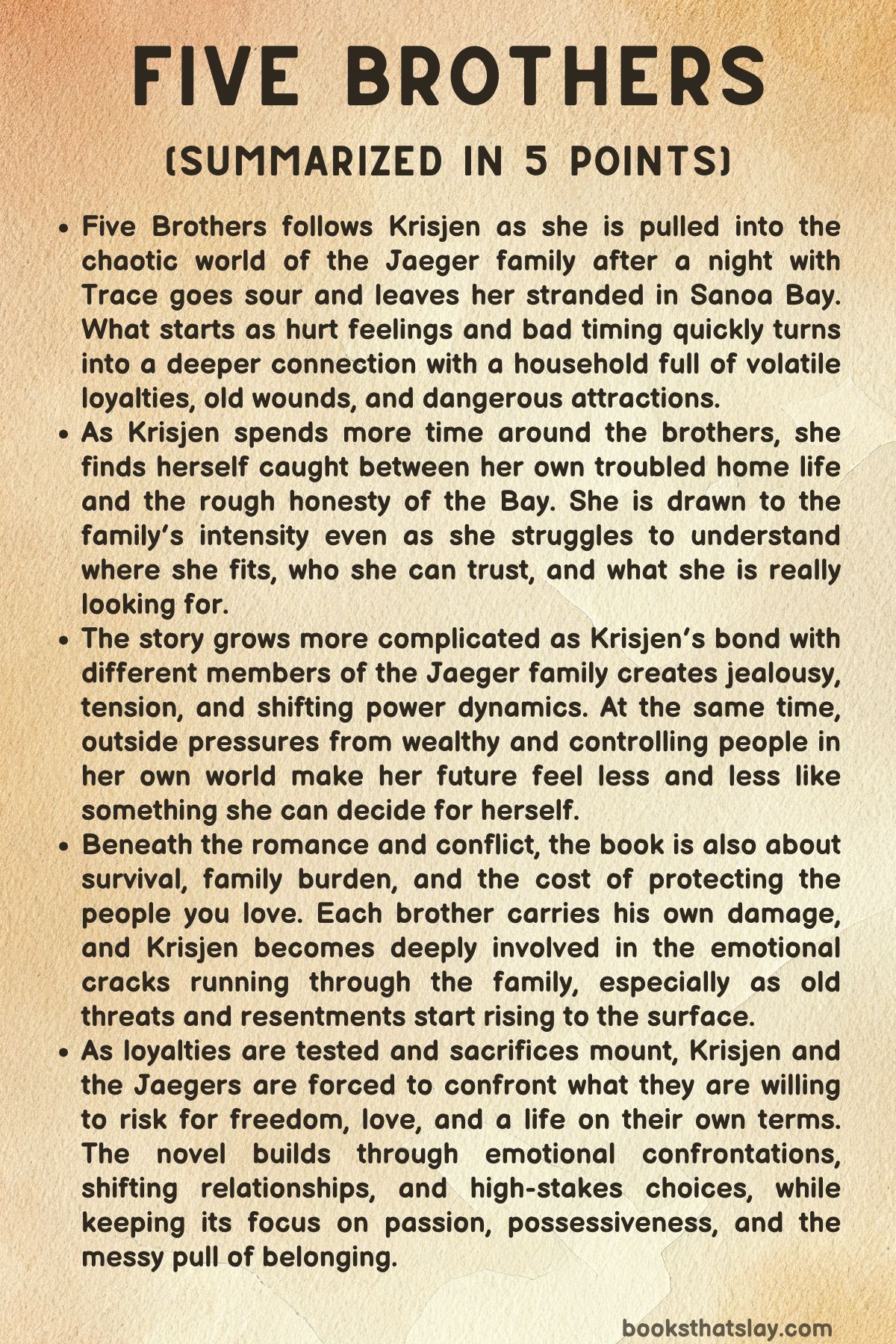
Summary
Krisjen begins the story walking alone at night, thinking about the ways women are taught to stay afraid, stay dependent, and make themselves smaller. She is picked up by Trace Jaeger, and the two slip into a familiar game built on danger, control, and sexual tension.
What first seems playful turns painful when Krisjen realizes Trace has recently been with someone else. The discovery breaks the illusion she had allowed herself to live in.
She understands that whatever existed between them did not mean to him what it had started to mean to her. Hurt and humiliated, she lets him drive her back toward the Jaeger home so she can get her car.
At the Jaeger house, she is pulled into the family’s loud and unruly world. The place is overflowing with brothers, girlfriends, arguments, jokes, and constant motion, and Krisjen feels both drawn to it and sharply aware of being an outsider.
She sees the different energies of the brothers, including Iron, Army, Dallas, and the powerful but distant Macon. Trace tries to resume their flirtation, but Krisjen is already emotionally done with him.
When another girl shows up, any remaining illusion is destroyed, and she leaves the situation angry and insulted.
Outside, she discovers that two of her tires have been slashed, leaving her stranded for the night. With nowhere else to go and no one she is willing to call, she goes back inside and sleeps on the couch.
In the quiet darkness, she becomes overwhelmed by loneliness, frustration, and desire. While there, she realizes someone is watching her.
Instead of immediately fleeing, she begins talking, confessing things she has kept buried: her disappointment over Trace, her lack of control over her life, her inability to go to college, and her mother’s efforts to push her toward an older, wealthy man named Jerome Watson. The stranger comforts her, then kisses her, and the encounter turns intensely physical.
He has sex with her in the dark but leaves before she can clearly identify him, telling her not to tell Trace.
The next morning, Krisjen wakes confused and fixated on discovering which brother was with her. At breakfast, she studies their voices, movements, and even the bracelets they wear, trying to match them to the anonymous man from the night before.
Iron stands out when he reveals he fixed her tires and then offers to help with her car without asking for anything in return. He is unexpectedly tender with her, and her suspicion shifts toward him.
He also speaks to her honestly about his coming prison sentence and his worries about Trace. When he gives her a ride home on his motorcycle, Krisjen briefly feels free.
That feeling disappears as soon as she gets home. Her mother is already working to force her into a future built on marriage, status, and security rather than choice.
Krisjen learns that Jerome Watson is still part of that plan, and the conversation with her mother makes clear how little agency she is expected to have. In defiance, she grabs her younger sister Paisleigh and leaves in her father’s old car, heading back toward the Bay, the one place that has begun to feel more honest than her own home.
Meanwhile, Iron returns home and faces Macon, who is stressed, angry, and carrying the weight of the entire family. Iron wants to stay behind and help Krisjen with her car, but Macon forces him to go to work instead.
Their argument exposes old resentment and Iron’s fear that prison will not change who he is. The brothers head out, and along the way tension rises when they spot Milo Price, a man with a disturbing history involving both Krisjen and the Jaeger family.
Krisjen arrives nearby with her little sister, and Milo’s crude remarks about her and about the hypocrisy of her wealthy world push Iron into a violent confrontation.
Iron then turns his anger on Krisjen, telling her to stay away from the Bay and accusing her of treating the place like a temporary thrill. Krisjen fires back, refusing to let him pretend the men of the Bay are morally superior.
But when he presses her about Milo, the fight breaks open into something more vulnerable. Krisjen confesses the extent of the damage done to her, the helplessness she felt, and the way the institutions around her failed to protect her.
She admits that the Bay appeals to her because it is blunt, visible, and honest about pain instead of hiding it under money and manners. Iron is shaken by her honesty.
He apologizes, holds her as she cries, and tells her she is not to blame for what happened to her.
That fragile understanding is cut short when Macon appears and work pulls everyone away. Before leaving, Iron slashes the tire on Krisjen’s father’s Mercedes so she cannot simply drive off.
Furious, Krisjen is pushed by circumstance into spending the day working at Mariette’s restaurant while her own car remains in Macon’s garage. What begins as punishment becomes unexpectedly meaningful.
She likes the work, enjoys being useful, and finds satisfaction in a role that depends on effort rather than image. The restaurant gives her a glimpse of a life where she can contribute and belong on her own terms.
As she continues spending time with the Jaegers, Krisjen remains preoccupied with the question of which brother was with her that first night, but her emotional attention slowly shifts toward Macon. He is severe, exhausted, and always on edge, yet she starts noticing the cost of the life he carries.
Later, while everyone is gathered together, Army receives a collect call from Iron, who is now in prison. Iron jokes and asks after the family, but Macon refuses to take the phone.
Army explodes in fury. He attacks Macon, and the fight between them becomes violent and destructive, exposing years of pain and resentment.
In the middle of that chaos, Army recklessly drags Krisjen into the conflict, using her in an attempt to provoke emotion from Macon. She rejects that manipulation, but later, after police haul both her and Army away, their anger and humiliation turn into a heated sexual encounter in the back of the police car.
The next morning, Krisjen wakes in Army’s room and then encounters Macon in the kitchen. Their conversation is harsh, but beneath the insults she sees how deeply damaged and emotionally frayed he is.
Looking at old family photos and the traces of loss in the house, she begins to understand the depth of suffering that shaped him.
From there, the relationship between Krisjen and Macon grows heavier and more intimate. She makes choices designed to protect him, even when those choices cost her dearly.
At one point she sacrifices her own security and future to buy him and the Bay time against outside forces led by Garrett Ames and Jerome Watson. Macon, devastated by what she has done for him, refuses to accept it.
He fights back in his own way, arranging a deal that restores her house, protects the Bay for several more years, and brings Krisjen and her siblings under his protection. Though furious that he has taken control in return, she is also overwhelmed by the fact that he acted because he could not bear losing her.
Their bond is sealed through repeated confrontations where desire and love are tangled with fear, pride, and power. Macon struggles most of all because loving Krisjen means admitting he wants something for himself and risks destroying it.
Eventually he stops running from that truth. After he and his brothers track down Milo and nearly go too far in avenging the harm he caused, Krisjen becomes the reason Macon pulls back from total destruction.
That moment clarifies what she means to him. At last, he tells her openly that he loves her.
By the end, they choose each other fully. Macon agrees to seek help for his mental health, and Krisjen becomes part of the home he once thought he had to carry alone.
In the epilogue, years later, their life together is still noisy, crowded, and full of danger, but it is also stable, loving, and shared. The house is alive with children, siblings, and daily chaos, and the future that once seemed impossible has become real.
Krisjen is no longer trapped in the life others planned for her, and Macon is no longer facing his burdens alone.
Characters
Krisjen
In Five Brothers, Krisjen is written as someone constantly balancing vulnerability, anger, pride, and hunger for control. From the beginning, she resists the role the world expects her to play.
She thinks deeply about how women are taught to become smaller, quieter, and easier to manage, and that awareness shapes almost every decision she makes. She does not move through life as a passive victim, even when she is trapped in situations designed to break her down.
Instead, she fights for whatever power she can claim, whether that means turning a dangerous sexual game back on Trace with a knife, refusing to let humiliation silence her, or taking her younger sister and driving away rather than accepting her mother’s plans for her future. What makes her compelling is that her strength is never clean or simple.
It is messy, reactive, and sometimes bound up with pain.
Her emotional life is equally complex. She wants tenderness, safety, and real devotion, but she has learned not to trust those things when they appear.
That is why she is so shaken by Trace’s casual carelessness and so drawn to the raw honesty she finds in Sanoa Bay. She sees a kind of truth there, even in its violence and disorder, because at least people do not pretend.
Her attraction to the brothers, and eventually to Macon most deeply, comes from that recognition. She is looking for something solid in a world that keeps treating her as an object to be traded, controlled, or used.
At the same time, she can be reckless, confrontational, and emotionally impulsive. She does not merely endure conflict; she often moves toward it, almost as if intensity itself reassures her that she is still alive.
One of the strongest parts of her characterization is her instinct toward care. Even while she is dealing with humiliation, fear, sexual confusion, and family pressure, she stays aware of her younger siblings.
She is more of a protector than either of her parents, and that responsibility forces her to mature faster than she should have had to. Her choices are not only about romance or desire.
They are also about survival, family, and finding a place where she can build a life that is not dictated by wealth, appearances, or male entitlement. By the end, she becomes the emotional force that pushes Macon toward love, truth, and healing.
She is not simply the woman who enters the brothers’ world; she changes its emotional structure by demanding honesty from the people inside it.
Macon Jaeger
Macon is the emotional center of the family even when he tries to behave as if he has no emotions left. He comes across first as an absent force, then as an overworked, intimidating presence, and eventually as a man held together by duty, grief, fear, and sheer willpower.
He has spent so long carrying the family, the businesses, and the Bay that control has become his language. He does not express care softly.
He manages people, orders them, withholds, and sacrifices himself in practical ways while often failing to provide the emotional reassurance others need from him. This makes him frustrating, but it also makes him tragic.
He is not cold because he feels nothing. He is cold because feeling everything would break the system he has built around himself.
His relationship with his siblings shows the cost of that role. Iron’s prison sentence, Liv’s absence, Army’s resentment, and the threat of everyone drifting away reveal how much Macon’s identity depends on keeping the family physically and economically intact.
The problem is that he has mistaken endurance for love’s only valid form. He works, organizes, repairs, protects, and absorbs pressure, yet he rarely says what he feels.
That failure damages the people closest to him. Army attacks him because silence has become unbearable.
Iron is wounded by Macon’s harshness because he wants his brother’s fear to sound like care, not condemnation. Even Krisjen, who understands him more deeply than most, suffers because he cannot tell her clearly that she matters before she nearly destroys herself for his future.
What makes Macon such a powerful character is the contrast between his public force and private fragility. Krisjen notices the signs of neglect in his body and habits before he openly admits anything, and when he finally speaks honestly, he reveals a man who fears that all his sacrifices may have meant nothing.
He is haunted not just by responsibility, but by the possibility that he has failed everyone anyway. His love for Krisjen terrifies him because it threatens the rigid system that has allowed him to function.
Loving her means wanting something for himself, and wanting something exposes him to loss. His eventual transformation is meaningful because it is not about becoming softer in a simplistic way.
It is about accepting that love requires speech, vulnerability, and change. By the end, he is still dangerous, intense, and controlling in many ways, but he is also willing to admit love, accept help, and imagine a future larger than duty alone.
Iron Jaeger
Iron is one of the most layered figures in the story because he combines physical danger, rough humor, emotional intelligence, and deep self-doubt. He is introduced through mystery and bodily intensity, which immediately gives him a charged presence, but as the story develops, he becomes far more than a threatening or seductive figure.
He is a man living in the shadow of an approaching prison sentence, trying to act casual about it while quietly wrestling with what it says about his past and what it may mean for his future. He jokes, teases, and performs toughness, but he is one of the first brothers to show Krisjen real gentleness.
Fixing her tires, checking her car, and giving her a ride home are practical actions, yet they carry emotional weight because they reveal a person who notices vulnerability and responds to it even when he does not fully know how to talk about it.
His internal conflict is especially striking. He claims he is not afraid of prison itself, but he admits that the real fear is that prison may not change him.
That thought exposes the insecurity beneath his swagger. He is not simply a reckless man facing consequences.
He is someone who suspects he may be fundamentally stuck, and that fear haunts him more than confinement. His tension with Macon deepens this portrait.
Macon sees his irresponsibility; Iron wants to be seen as more than his failures. Their arguments are sharp because both are speaking from love, but neither can say that clearly.
Iron is desperate not to be treated as disposable or immature, and Macon is desperate not to lose another piece of the family.
His connection with Krisjen matters because she brings out both his attraction and his empathy. He initially judges her as another privileged girl using the Bay for excitement, but once she speaks honestly about her pain, his perspective shifts.
He is capable of listening, apologizing, and changing his view, which marks him as more emotionally open than his harder image suggests. Even so, he remains impulsive, violent, and territorial.
His attack on Milo shows how quickly his protective instincts become destructive. He represents a version of masculinity that is dangerous yet not emotionally empty, wounded yet still capable of tenderness.
He is not the final romantic center of the story, but he remains crucial because he reveals how desire, shame, loyalty, and fear circulate through the entire family.
Army Jaeger
Army is one of the most emotionally volatile characters in Five Brothers, and his volatility comes from a painful combination of insecurity, neglect, and a desperate need to matter. On the surface, he may seem less imposing than some of his brothers, but his emotional instability makes him unpredictable in a different way.
He carries a deep wound related to abandonment, rejection, and the belief that other people see him as unnecessary. When Iron calls from prison and Macon refuses to take the phone, Army’s rage spills out in a way that is about far more than that single moment.
The fight becomes an outlet for years of feeling unseen, undervalued, and emotionally dismissed. His violence is ugly, but it comes from a place of ache rather than simple cruelty.
What makes Army especially complicated is the way his need for recognition spills into sexuality, family conflict, and self-definition all at once. His provocative behavior with Krisjen during the confrontation with Macon is disturbing because he uses her body as part of an emotional strategy to force a reaction.
That moment reveals how badly his need to disrupt Macon’s emotional numbness has twisted his judgment. Yet the story also allows him real vulnerability.
In the police car, stripped of performance and family posturing, he speaks openly about feeling worthless, about people stepping over him, and about the pain tied to Dex’s mother leaving. These confessions make clear that beneath his recklessness is someone begging to be chosen.
Army’s later confrontation with Macon is one of his strongest moments because he finally speaks from dignity instead of provocation. He claims his place in the house, in the Bay, and in the family’s shared history.
He recognizes Macon’s sacrifices, but he also refuses to let that erase his own value. This is important because Army’s arc is not just about desire or chaos.
It is about a man trying to define his worth in a family where usefulness is often measured through labor, sacrifice, and control. He longs for belonging in the deepest sense: not just to be tolerated, but to be needed.
That longing drives both his worst and best actions. He is reckless, wounded, and often dangerous, but he is also painfully human in the way he asks, again and again, whether anyone will truly choose him.
Trace Jaeger
Trace functions as Krisjen’s early romantic disappointment and as an important contrast to the deeper emotional bonds that develop later. He is playful, sexual, provocative, and immature, and his relationship with Krisjen begins in a space of performance rather than stability.
Their role-play, banter, and physical chemistry suggest excitement, but the empty condom box instantly exposes the limits of what he offers. He is not malicious in the way some other men in the story are, but he is careless.
He assumes that charm, jokes, and easy affection can smooth over emotional hurt, which reveals how lightly he treats intimacy. Krisjen’s humiliation after discovering he has likely been with someone else is significant because it shows that Trace has been participating in something emotionally real for her without recognizing the depth of that reality.
At the same time, Trace is not written as purely shallow. He does show concern, tries to reassure her, and later behaves with a casual warmth that suggests he is not intentionally trying to destroy her.
Iron even describes him as someone who still needs care and stability, which reframes him as one of the more fragile brothers beneath the flirtation and bravado. He seems like a product of the Jaeger world’s chaos: attractive, reckless, emotionally underdeveloped, and used to living in the moment.
He can create intimacy, but he cannot yet sustain accountability.
His importance also lies in what he does not become. In another kind of story, he might have remained the central love interest because of his chemistry with Krisjen.
Here, however, he becomes the doorway into a much larger emotional landscape. Through him, Krisjen enters the Bay and the Jaeger household, but he quickly proves unable to hold her deeper attention because he lacks emotional depth, steadiness, and seriousness.
He is therefore essential not because he grows the most, but because he shows the difference between being exciting and being trustworthy. His character highlights how easily desire can be mistaken for connection when someone is hungry to be chosen.
Dallas Jaeger
Dallas occupies a quieter but still meaningful place among the brothers. He does not dominate the story in the same way as Macon, Iron, or Army, but his presence helps flesh out the family dynamic and the emotional texture of the household.
He often appears as an observer within chaos, someone who understands more than he says and who participates in the family’s rough energy without always escalating it. In a household where loudness, violence, and confrontation are common forms of communication, Dallas helps create the sense that not every sibling processes emotion in exactly the same way.
His restraint makes him feel steadier than some of the others, even if he is still fully part of the Bay’s unruly culture.
His reactions during major confrontations are especially revealing. When Army and Macon fight, Dallas does not immediately intervene, because like Trace, he seems to believe something necessary is finally being expressed.
That choice suggests emotional awareness. He recognizes that the family’s silence has become toxic, and that the violence, however destructive, is exposing truths that have been buried too long.
This does not make him passive so much as realistic about the emotional rules that govern his household. He understands that some conflicts cannot be prevented by politeness.
Dallas also contributes to the sense that the brothers, despite their flaws, form a deeply interdependent unit. Even when individual members are distant or destructive, the family operates with a kind of lived-in loyalty, and Dallas is part of that connective tissue.
He may not receive the deepest individual focus, but he helps anchor scenes, supports the group dynamic, and reinforces the idea that every brother has been shaped by the same difficult environment while developing a different emotional style within it.
Aracely
Aracely is possessive, territorial, shrewd, and impossible to dismiss as a simple jealous ex. At first glance, she appears to fill the role of the disruptive woman who lashes out at Krisjen, especially when she slashes the tires.
But her characterization suggests something more layered. She understands the men around her, especially Iron, well enough to manipulate situations for emotional effect.
Slashing the tires is not only an act of sabotage against Krisjen; it is also a calculated move designed to engineer closeness between Krisjen and Iron. That choice reveals both her possessiveness and her intelligence.
She is not acting blindly. She is reading dynamics, intervening in them, and trying to shape outcomes according to her own emotional logic.
Her continued presence in the Jaeger world despite the end of her relationship with Iron shows how entangled personal history is in this setting. She is not fully outside the family orbit, which makes her a reminder that relationships in this world are rarely cleanly finished.
She needles, observes, and repositions herself through familiarity. At the restaurant, she also begins reorganizing business matters when Krisjen is absent, which shows competence and ambition in addition to jealousy.
She is not merely hovering around the men; she is capable of taking charge.
Aracely’s function in the story is partly to expose the territorial nature of love and survival in the Bay. She comes from the same rough environment and understands that access, loyalty, and usefulness are forms of power.
She is emotionally sharp enough to sense weakness and press on it. Even when she behaves cruelly, she feels believable because her actions come out of history, attachment, and the refusal to let herself become irrelevant.
She adds a layer of female rivalry to the story, but she also reflects the same larger theme visible in many characters: in a hard world, people cling fiercely to the places and relationships that make them feel significant.
Clay
Clay serves as one of the more grounded and emotionally reliable figures around Krisjen. She is important not because she dominates scenes, but because she offers a contrasting model of womanhood and support.
In a story full of coercion, volatility, and men who struggle to say what they feel, Clay represents steadier emotional presence. Krisjen trusts her enough to confess one of her most intimate and confusing experiences: sleeping with one of the brothers in the dark without knowing which one.
Clay listens, interprets, and responds without melodrama, which marks her as someone Krisjen sees as safe.
Her role also helps widen the emotional world beyond romance and conflict. She demonstrates that female connection in this setting is possible even amid chaos.
Krisjen is often isolated, misunderstood, or objectified, so characters like Clay matter because they offer recognition without control. Clay’s guesses, reactions, and later support around Macon and the Bay make her a quiet but stabilizing force in the narrative.
Though she is not given the same depth of interiority as the central figures, Clay helps the story breathe. She is part of the social structure that makes the Bay feel lived in rather than reduced only to danger and desire.
Her presence suggests that community, however flawed, is still possible there.
Liv
Liv is physically less present in much of the action, but her absence is emotionally powerful. She represents a kind of loss that hangs over the family, especially over Macon and the brothers’ sense of stability.
When Trace explains that Macon’s anger is really fear, he includes Liv’s departure as one of the reasons the family structure feels as though it is cracking. That detail immediately establishes her importance.
She is not just another relative; she is part of the emotional architecture holding the household together.
Her past connection to Milo also links her to one of the story’s darker histories, reinforcing the sense that violence against women has shaped the family’s emotional world in enduring ways. Even when she is not the main focus, she remains tied to questions of protection, guilt, and memory.
Characters respond to threats partly through what they have already seen happen to her.
Liv helps show that the family’s pain did not begin with Krisjen’s arrival. The brothers are already carrying old damage, old failures, and old grief.
That history matters because it explains why they react with such ferocity to danger and why Macon in particular is terrified of losing more people. Liv’s significance lies in that emotional residue.
She is part of the reason the family feels haunted by what it has survived.
Paisleigh
Paisleigh is important as more than just a younger sibling to be protected. She represents the innocence and dependency that sharpen Krisjen’s choices.
Whenever Paisleigh appears, the story’s emotional stakes become clearer. Krisjen is not only trying to save herself from a bad future; she is also trying to protect someone younger from being shaped by the same poisonous system.
Taking Paisleigh with her when she flees home shows how instinctive Krisjen’s caregiving has become. She is already functioning like a guardian.
Paisleigh also reveals how unnatural Krisjen’s family structure is. Instead of being free to think only about youth, romance, or escape, Krisjen is burdened with practical and emotional responsibility for children.
That weight gives her character more urgency and maturity. Paisleigh, in that sense, is part of the moral center of the story.
She makes clear that the consequences of adult selfishness fall hardest on the young.
Though she is not psychologically developed in the same way as the major adult characters, her presence is emotionally crucial. She symbolizes what is worth protecting and why Krisjen refuses to surrender to the future others have arranged for her.
Mars
Mars, like Paisleigh, expands Krisjen’s motivation beyond desire and personal freedom. Even when he appears more at the edge of the narrative, he matters because he is part of the sibling group Krisjen feels responsible for.
When the children go missing or become bargaining points within larger conflicts, the story shows how easily young lives can be destabilized by adult power struggles. Mars represents the vulnerability at the center of Krisjen’s world.
His role also strengthens the emotional significance of Macon’s later choices. When legal authority over the siblings becomes part of the resolution, the story is not simply resolving a romance; it is restructuring a family.
Mars helps make that visible. The future being built is not just about two people staying together.
It is about creating a safer home for children who need one.
Milo Price
Milo is one of the clearest antagonistic figures in Five Brothers, but he is effective because he embodies more than personal malice. He represents exploitation, cruelty, and the hidden abuses protected by power and silence.
His presence immediately changes the emotional temperature of scenes because he is tied to past violations involving both Krisjen and Liv. He taunts, provokes, and speaks with the confidence of someone used to getting away with harming others.
That confidence makes him especially disturbing. He is not merely violent; he is socially protected violence.
What makes Milo important is the way he exposes class and gender hypocrisy. He knows the ugly truths of Krisjen’s wealthy world and weaponizes them.
He talks crudely about women from St. Carmen not just to insult, but to reveal how normalized exploitation has become in elite circles. His character therefore connects private trauma to broader social corruption.
He is not an isolated monster. He is the product and beneficiary of a system that values status over justice.
The brothers’ hatred of him, especially Macon’s and Iron’s, is intense because Milo symbolizes the harm they could not prevent. Their urge to destroy him is not only revenge; it is rage at a whole pattern of abuse.
When Macon nearly kills him, the moment carries moral tension because Milo seems to deserve destruction, yet acting on that desire would cost Macon everything. Milo’s role as antagonist works because he is personally vile and structurally significant at the same time.
Jerome Watson
Jerome functions less as a fully rounded emotional figure and more as a chilling symbol of the future being forced onto Krisjen. He is the older, wealth-based solution her mother wants to impose, a man associated with security, arrangement, and ownership rather than love or mutual desire.
His significance lies in what he represents: a polished form of imprisonment. Unlike the open chaos of the Bay, Jerome belongs to a world that hides domination beneath status, religion, and financial comfort.
The threat he poses is effective precisely because it is socially respectable. He does not need to be wildly expressive or physically present in every scene to feel oppressive.
Krisjen’s dread is enough to define him. He stands for a life where her body, future, and choices would be absorbed into someone else’s plan while everyone around her pretends that the arrangement is sensible and proper.
Jerome also helps clarify why Krisjen is drawn toward men and places that seem rougher but more honest. Faced with a choice between respectable captivity and dangerous truth, she is naturally pulled toward the latter.
His character sharpens the class critique at the center of the story by showing that wealth and propriety can be just as predatory as open violence.
Garrett Ames
Garrett Ames represents institutional and economic power. He is part of the machinery that can reshape land, pressure communities, and threaten the Bay from above.
Unlike Milo, whose danger is personal and openly ugly, Garrett’s power operates through deals, timing, leverage, and official channels. That makes him a different kind of threat.
He does not need to throw punches to destabilize lives. He can do it through contracts, inspections, development pressure, and strategic alliances.
His importance grows as the conflict over the Bay and Krisjen’s home becomes more intense. Deals involving Garrett are never just business.
They affect where people will live, who gets to stay, and what can be preserved. He therefore embodies the larger external pressure on Macon’s world.
The Bay is not only endangered by internal dysfunction; it is also vulnerable to outsiders who see it as land, value, and opportunity.
Garrett’s presence expands the story beyond romance and family drama into territory involving class conflict and the future of a community. He helps show that love and survival here are tied to economics, property, and power structures larger than any single relationship.
Mariette
Mariette matters as both a person and a stabilizing force within the Bay. Her restaurant becomes one of the few places where Krisjen experiences usefulness, rhythm, and belonging.
Through that environment, Mariette represents labor, community, and female authority of a different kind than Krisjen has known at home. The work is demanding, but it gives Krisjen something her old life often denied her: competence that feels real.
Even when Mariette is not foregrounded in every emotional conflict, her space becomes essential to the story’s social world. It is where family, tension, gossip, work, and temporary refuge intersect.
That makes her important because she anchors the Bay in everyday life rather than only in danger or sexuality.
She also contributes to the sense that this community, however rough, sustains itself through people who keep things running. In that way, she stands as a quiet counterpoint to the more destructive forces around her.
Krisjen’s Mother
Krisjen’s mother is one of the story’s most painful figures because her cruelty is wrapped in the language of practicality, religion, and protection. She is not portrayed as nurturing or emotionally available.
Instead, she treats Krisjen’s future as a problem to be solved through marriage and social positioning. Her logic is rooted in security, but it strips Krisjen of personhood.
She is willing to push her daughter toward Jerome because she views status and financial stability as more important than autonomy, desire, or emotional truth.
What makes her especially effective as a character is that she represents internalized systems of control. She does not need to physically dominate Krisjen when she can enforce submission through expectations, pressure, and the claim that this is simply how the world works.
Her influence helps explain why Krisjen is so reactive to ownership, shame, and manipulation. She has been taught at home that her body and future are negotiable assets.
Through her, the story shows how women can become agents of the same oppressive structures that harm them. She is not powerful in the way Garrett or Jerome are, but within the domestic sphere she becomes a powerful enforcer of class, gender, and social obedience.
Her role deepens Krisjen’s struggle by making clear that escape is not just from men, but from an entire value system embedded in family life.
Themes
Power, Vulnerability, and the Fight to Reclaim Control
From the opening scene, control is never presented as a simple matter of physical strength. Krisjen begins by thinking about how women are taught to shrink themselves, to stay agreeable, and to depend on protection that often never truly comes.
That idea shapes nearly every important turn in the story. Even when she enters situations that look dangerous, she keeps trying to seize authority over them, whether through role-play with Trace, through sharp language, through sexual choices, or through the risky bargains she makes later.
What matters is not that she is never vulnerable, because she is vulnerable again and again, but that she refuses to remain passive inside that vulnerability.
The story keeps testing how much control a person can really have when family systems, money, gender expectations, and violence all press in from different sides. Krisjen lives in a world where powerful men make decisions about women’s bodies, futures, and safety, often under the cover of respectability.
Her mother tries to sell marriage as security, but that security is really another form of ownership. Officials, wealthy families, police officers, and men like Jerome and Milo all represent institutions that claim order while leaving women exposed.
Krisjen understands that reality, which is why her decisions can look reckless from the outside. In her mind, choosing danger for herself is still better than quietly submitting to a life arranged by others.
The Jaeger brothers complicate this theme because they are both protective and threatening. Their world gives Krisjen a sense of honesty that her own social circle lacks, yet it is also shaped by male dominance, territoriality, and force.
She is drawn to that honesty because at least nothing is hidden there. Bruises are visible.
Rage is visible. Need is visible.
That does not make the Bay safe, but it makes it legible. The contrast matters.
The novel suggests that power becomes most destructive when it hides behind manners, status, and claims of decency. Open danger is frightening, but disguised control may be worse because it asks its victims to participate in their own confinement.
By the end, reclaiming control does not mean independence in a pure or solitary form. It means choosing where to place trust, naming pain without shame, and refusing the version of life others prepared for her.
Krisjen’s struggle is not about becoming invulnerable. It is about insisting that her life cannot be traded, managed, or decided without her.
Family as Shelter, Burden, and Inescapable Inheritance
Family in this story is never calm, tidy, or uncomplicated. It is loud, invasive, exhausting, and often damaging, yet it is also the deepest source of loyalty and meaning the characters have.
The Jaeger household is introduced through chaos, noise, and physical disorder, and that first impression becomes a blueprint for how family functions throughout the novel. People fight, taunt, interfere, and overstep constantly, but they are still bound to one another with a force stronger than comfort.
Love in this world is rarely soft. It shows up as labor, protection, anger, sacrifice, and possession.
The brothers are shaped by a shared past of hardship, and that history has left each of them carrying damage in a different form. Macon carries responsibility like armor, turning himself into the structure that keeps everyone else standing.
Army hides pain behind recklessness and humor until his feelings of abandonment spill out in destructive ways. Iron faces prison with a mix of fatalism and fear, while Trace still seems emotionally unfinished, needing more care than he admits.
None of them knows how to love cleanly, because survival taught them that affection and hardship arrive together. Their family bond is real, but it has been built in conditions that made tenderness feel secondary to endurance.
Krisjen’s own family highlights the darker side of inheritance. In her home, obligation does not feel like belonging.
She is more responsible than her parents, protective of her siblings, and painfully aware that the adults around her are willing to use her as an asset. That makes the Bay attractive not because it is peaceful, but because its dysfunction at least contains devotion.
Her attachment to her younger siblings strengthens this theme further. She is not simply trying to escape for herself.
She is trying to interrupt a pattern before it hardens around the next generation. Her decisions gain emotional weight because they are always tied to the question of what kind of life children will inherit from the adults who claim to love them.
Macon embodies the harshest version of family duty. He has spent years holding together land, business, siblings, memory, and grief, and the burden has hollowed him out.
Yet he cannot release it, because doing so would feel like abandoning the dead as well as the living. The family structure depends on him, but it is also consuming him.
That tension gives the novel much of its emotional force. Family is shown as something that can save people from loneliness while also trapping them inside roles they never freely chose.
What makes this theme powerful is that the story never treats family as purely sacred or purely toxic. It is both refuge and wound.
It gives the characters their strongest loyalties and their deepest injuries. They remain bound not because those ties are easy, but because shared history has made separation almost impossible.
Desire, Shame, and the Need to Be Truly Seen
Sex in this story is not presented as decoration or simple romance. It is one of the main ways the characters express hunger, fear, anger, comfort, and identity.
Desire often arrives tangled up with shame, especially for Krisjen, who has learned that wanting can expose her to judgment, humiliation, or loss of control. Her early encounter with Trace captures that instability well.
What begins as a familiar game becomes painful the moment she realizes she mattered less to him than she hoped. The emotional injury does not come only from jealousy.
It comes from the fear that her body was available while her heart remained unseen.
That pattern repeats in different forms with several men. Krisjen keeps moving toward intensity because intensity feels honest.
It strips away politeness and reveals what people want. At the same time, those encounters leave her asking whether she is desired as a person or only as a temporary release, a thrill, a symbol, or a battleground for male rivalry.
The uncertainty over the anonymous encounter in the dark turns that question into an obsession. She studies gestures, voices, and reactions because she wants more than physical memory.
She wants recognition. She wants the person who touched her to also claim her reality.
Army’s storyline pushes the link between sex and emotional exposure into uncomfortable territory. His intimacy with Krisjen grows out of humiliation, rage, and a desperate need to feel significant.
For him, sex becomes a way to force acknowledgment, to insist that he cannot be dismissed. That does not make the encounter simple or healthy, but it does reveal how badly he wants to be chosen rather than tolerated.
In a different register, Macon resists verbal confession for much of the story even when his behavior makes his attachment obvious. His silence becomes another kind of shame: the shame of needing someone so deeply that it threatens the identity he has built around endurance and control.
The story repeatedly argues that desire alone is not enough. Physical hunger can expose truth, but it can also conceal it when people use the body to avoid saying what they feel.
That is why the emotional climax depends not only on possession or passion, but on speech. Krisjen does not merely want to be wanted.
She wants love named plainly. She wants the person before her to admit what she means.
The need to be seen is stronger than the need to be touched.
This theme also challenges the double standards surrounding female desire. Krisjen is judged by systems that want her attractive, useful, and exchangeable, but never fully self-directed.
Her sexual choices become powerful because they reject that hypocrisy. She does not accept a version of morality built to control women while excusing men.
Still, the story is careful to show that freedom without emotional truth can become another kind of loneliness. Real intimacy requires not just access to the body, but courage in the soul.
Class, Social Masks, and the Violence Hidden Inside Respectability
One of the sharpest tensions in the novel lies between St. Carmen and Sanoa Bay, not just as places, but as opposing moral cultures. On the surface, Krisjen comes from the more polished world, the one associated with wealth, status, proper presentation, and institutional authority.
The Bay, by contrast, appears rough, messy, sexual, and openly confrontational. Yet the novel steadily reverses the easy assumptions that might come with those categories.
The refined world is full of coercion, concealment, and transactional cruelty, while the Bay, for all its danger, often feels more emotionally truthful.
Krisjen’s growing attachment to the Bay is rooted in this contrast. She is not simply rebelling against privilege for excitement.
She is responding to the fact that the respectable world around her has failed her in intimate and structural ways. It protects reputations, not people.
Men with money and influence can circle vulnerable women while maintaining a polished image. Families can speak of duty and morality while treating daughters as bargaining chips.
Authority figures can look away from obvious harm if acknowledging it would upset the social order. Respectability becomes a mask that allows violence to continue without calling itself violence.
Milo’s taunts and Iron’s early accusations both bring out the class hostility running underneath the romance. Women from Krisjen’s world are imagined as tourists in the Bay, using its men and its danger for temporary excitement before returning to safer, wealthier lives.
That accusation hurts because part of it reflects a real social divide. The Bay has been looked down on, desired, used, and denied dignity all at once.
Iron’s anger comes from knowing how often poor or rough communities are treated as disposable until their land, labor, or bodies become useful. His resentment is not only personal jealousy.
It is also class memory speaking.
At the same time, the novel refuses to idealize poverty or toughness. The Bay contains misogyny, volatility, and brutality of its own.
What distinguishes it is not innocence, but openness. Its ugliness is visible.
Its people do not pretend that power is gentle. That gives Krisjen a strange sense of relief, because she has spent her life surrounded by people who hide domination behind smiles, churches, business deals, and family plans.
In that sense, class is not only about money. It is about which kinds of violence are considered normal, and which are considered shameful enough to hide.
The land deals and property struggles deepen this theme by linking romance to economics. Love is never fully separate from ownership, territory, and future survival.
Houses, roads, businesses, and inheritance all shape what becomes possible between people. Krisjen’s sacrifice and Macon’s response show how class power operates through contracts as much as through threats.
Personal lives are constantly being negotiated in the shadow of wealth and land value.
By the end, the story suggests that true belonging requires stripping away the social masks that make domination look respectable. What matters is not appearing civilized, but living honestly.
The novel keeps asking which world is actually more dangerous: the one that looks wild, or the one that looks proper while quietly consuming the people inside it.