Cross Your Heart and Hope He Dies Summary, Characters and Themes
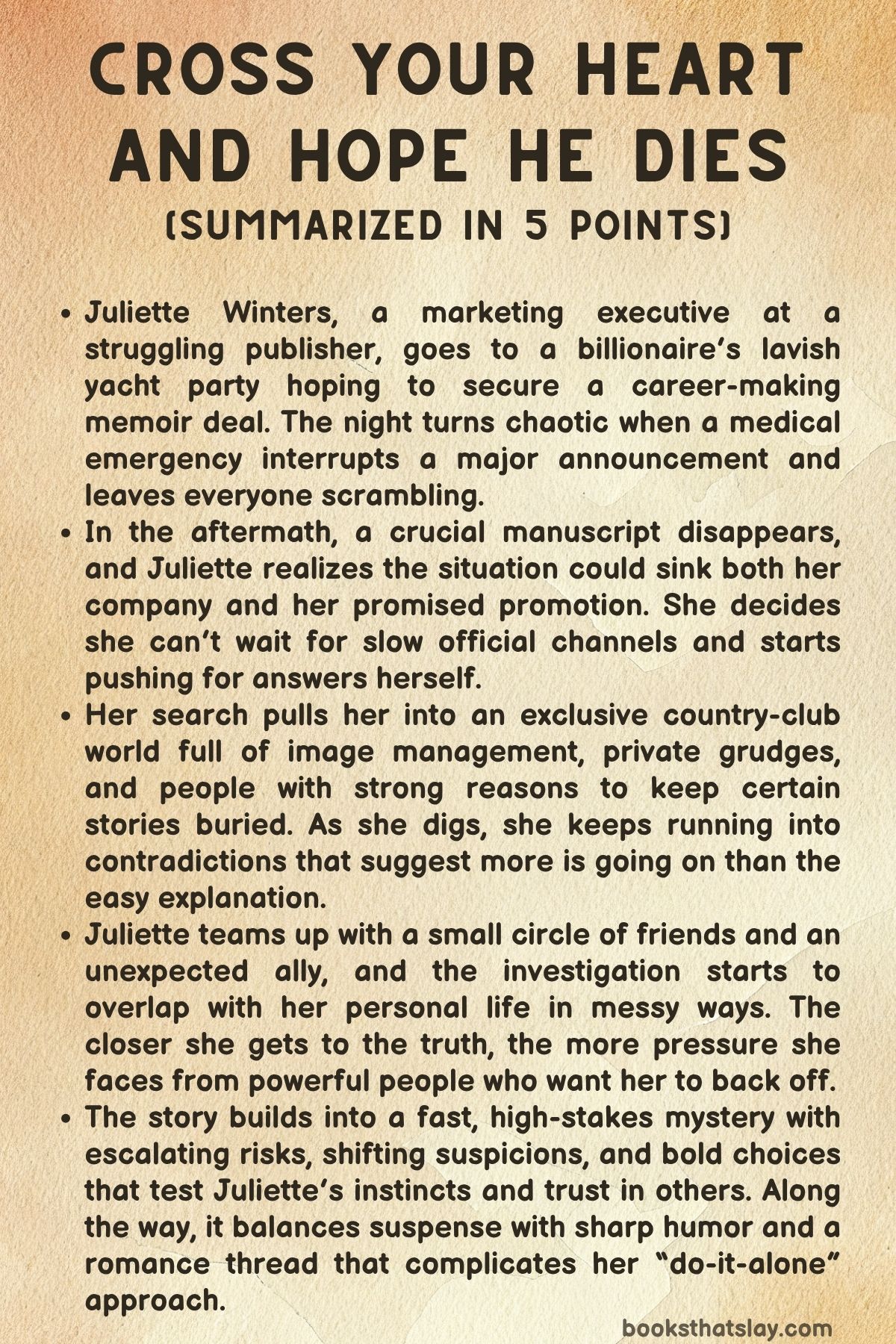
Cross Your Heart and Hope He Dies by Jenny Elder Moke is a fast, contemporary mystery that mixes publishing-world pressure with high-society scandal and a sharp, funny edge. Juliette Winters is a marketing executive who’s betting her career—and her company’s survival—on landing a billionaire’s explosive memoir.
When the billionaire dies mid-party and the manuscript vanishes, Juliette refuses to accept the official story. She starts digging, even as suspicion swirls around her and a second death raises the stakes. Along the way, she leans on unlikely allies, faces the ways she’s learned to survive alone, and fights to rewrite how her story ends.
Summary
Juliette Winters steps onto a luxury yacht in Elliott Bay for Warren Ellingham’s seventieth birthday celebration, trying to ignore her seasickness and focus on what matters: the deal. Warren is a billionaire power broker, and his rumored memoir is the acquisition Juliette believes will rescue her struggling publisher, Simon Says.
She’s spent months courting him, and she needs this night to end with a public announcement that ties her name to the book—and to the promotion she’s been promised. Her assistant, Veeta, urges her to ease off and let the party run itself, but Juliette is determined to be in Warren’s orbit when the moment hits.
The yacht is a floating stage set for the wealthy and competitive, managed by June Piedmont, a polished club socialite who treats information like currency. June corners Juliette almost immediately, fishing for details about Warren’s “secret” announcement and offering favors in exchange for even a peek at the manuscript.
Juliette dodges and slips away, scanning the guests and trying to get to Warren before someone else plants their flag beside him.
In an employees-only corridor near the private suites, Juliette overhears Warren in a heated argument with Chipper Floyd, a former golf star. Chipper threatens lawsuits if Warren “goes public,” and Warren responds with icy confidence, quoting legal references and making it clear he’s ready to ruin Chipper socially and professionally.
When the door opens, Warren flips from ruthless to charming in an instant, drawing Juliette inside and dismissing Chipper as a nuisance. Chipper leaves furious, and Juliette clocks his rage as the kind that doesn’t cool quickly.
Alone, Warren complains about people speculating he’s ready to retire. He waves around a gossip blind item, irritated that everyone thinks they can predict his next move.
Juliette reframes the gossip as free publicity, then locks in on what she came for: the pages stacked on his desk. The manuscript.
Her pulse spikes. She reaches for it, but Warren refuses to hand it over yet.
He insists he still has edits to make and will deliver it after he makes his big announcement. He locks the pages away in a safe—alongside visible stacks of cash—then leads her back to the party, promising to stir things up.
They run into Clayton Westminster, Warren’s immaculate executive assistant, who’s juggling party logistics and technical problems with the sound system. Clayton speaks in efficient lists and constant updates, the person who makes sure Warren’s world stays upright.
Warren introduces him as indispensable, and Juliette notes how much access Clayton has to everything.
The party gathers for Warren’s announcement, but the moment is already wobbling. Warren’s son, Bradley Ellingham, is drunk and grabs the microphone for an introduction that turns into a rambling public jab at his father, including a bitter reference to Warren’s many ex-wives.
Bradley’s wife, Brigitte, tries to contain the mess and keep the event moving. Meanwhile, the microphone keeps cutting out.
The audio problems become their own spectacle, with Clayton and the band scrambling to patch things together.
Finally, Warren gets the microphone. The sound fails again.
He crouches near the amplifier to reconnect a loose cord as the yacht’s lights flare. Then, in front of everyone, Warren stiffens, clutches his chest, and collapses.
Panic takes over. Clayton starts CPR and demands a defibrillator, but the on-board device announces a low battery and won’t deliver a shock.
The helipad has been turned into a dance floor, blocking any chance of a medical helicopter landing. The yacht races back to shore, but Warren remains still.
As Juliette watches, she notices black streaks on Warren’s hand where he held the microphone—evidence that something electrical happened.
With Warren dead and the announcement destroyed, Juliette’s mind snaps to the safe. The manuscript is her company’s lifeline, and it’s now locked in a room no one is supposed to enter.
She pushes into the restricted hallway and catches a waiter in uniform sprinting out of Warren’s suite with a duffel bag. Juliette storms into the room and finds it trashed.
The safe is open. It’s empty.
The manuscript is gone.
Two weeks later, gossip coverage frames the story as both tragedy and spectacle: Warren’s sudden death, his argument with Chipper, Bradley’s humiliating speech, and the missing memoir. Police claim they’re investigating, but Juliette hears little.
Her company’s future hangs in the balance, and her own professional reputation starts to sour as people treat her like the fool who bet everything on a dead man’s secret book.
Juliette attends Warren’s funeral at his estate, Pacific Pines, where even mourning looks like performance. The service route winds through an extravagantly decorated terrace built around a mini-golf course, as if grief needs a themed activity.
Juliette runs into June Piedmont, who insists Warren died naturally and bristles at the idea of an investigation. June dismisses the stolen manuscript as something that should have died with Warren, and she hints the memoir held secrets that could destroy people—secrets some club members would rather bury forever.
Juliette finally gets time with Detective Marks, who confirms unsettling details: the microphone model has a known defect that can cause burns, the defibrillator had no charge despite signs it had been used, and an autopsy was ordered. Still, Marks keeps leaning toward “natural causes,” treating Juliette’s suspicions as wishful drama.
Juliette follows him and watches him deliver the autopsy report to Bradley. Inside Bradley’s room, the encounter turns grotesque when he mistakes Juliette for someone he hired for sex.
When Juliette identifies herself, Bradley shifts into entitlement and hostility, mocking her, denying responsibility, and threatening to bury her with lawyers. In the chaos, Juliette snaps a photo of the autopsy report and gets thrown out.
Back at the office, Juliette brings the photo to Kate Valentine, a bestselling author with a sharper-than-silk presence. Kate suggests they consult Charlie Hawkins, a heart surgeon.
Charlie is reluctant, citing ethics and privacy, but he bends for Kate. He explains Warren had digitalis in his system—a medication used for certain heart conditions—and that a high dose can cause dangerous symptoms.
More important, an electrical shock could trigger cardiac arrest in someone affected by digitalis, even if the dose alone wouldn’t kill. Juliette’s suspicion hardens into a theory: someone may have dosed Warren, then relied on the microphone malfunction to finish the job, and made sure the defibrillator wouldn’t save him.
Juliette tries to map everything alone, but her friends refuse to let her spiral in isolation. Kate, Veeta, and Kennedy show up with a rolling whiteboard and supplies, turning her apartment into a chaotic command center.
They list suspects and motives: Bradley, who inherited control; June and her husband Robert, who have club power and secrets; Chipper, who argued with Warren; and Clayton, who had access to logistics, pills, and restricted spaces. The club, Pacific Pines, emerges as the hub where everyone overlaps.
Juliette pushes Charlie to get her inside the club, leveraging a recruiting event tied to the Surgical Society. At the event, she meets Katarina—Charlie’s ex—who now works at Pacific Pines and is dating Rajiv, a surgeon who needles Charlie publicly.
Juliette pretends she and Charlie are dating and impulsively accepts a tennis challenge, despite not knowing how to play. It’s partly strategy, partly spite, and partly her refusal to back down once someone tries to make her small.
Then the situation explodes again: a gossip column reports Bradley Ellingham has been murdered at Pacific Pines, and Juliette is suddenly a prime suspect. Police question her for hours, seize her bloodstained clothes, and imply revenge.
Shaken and furious, she returns home determined to solve everything—Warren’s death, the missing memoir, and Bradley’s murder—because no one else seems interested in protecting her.
Her friends rally around her again, and Charlie checks her head injury. The connection between Juliette and Charlie deepens, complicated by Juliette’s habit of pushing people away before they can leave her.
Just as things begin to soften, Detective Marks calls her back to the station: they’ve recovered key evidence, including Juliette’s missing duffel bag and a rare whiskey bottle.
That whiskey becomes the thread that finally tightens. June and Robert Piedmont are dragged in, and the evidence corners them: the bottle matches what Warren drank the night he died, and the same bottle appears connected to the scene of Bradley’s murder.
Under pressure—and with their finances exposed—Robert confesses that he and June dosed Warren’s whiskey with digitalis because they were desperate. Warren had ordered an audit, and they feared losing everything.
Their plan was to scare him, not kill him, but their panic and carelessness turned lethal.
Yet Juliette notices what the Piedmonts don’t say. They admit to the poisoning, but they don’t account for the electrical burn or the defibrillator failure.
Juliette starts to suspect Warren’s death had more than one hand on it—and that someone else exploited the chaos.
Juliette shifts her focus to Clayton Westminster. A recovered manuscript confirms Chipper stole it, but that doesn’t explain the larger pattern.
A detail clicks: the microphone incident makes more sense as a timed power surge than as a random malfunction. Brigitte reveals the yacht’s cockpit uses individualized access codes and logs.
If someone triggered a surge deliberately, they would need Warren’s schedule and technical timing—exactly the kind of knowledge Clayton would have.
Juliette and Brigitte track down security footage from the day Bradley died. Many hallway cameras are mysteriously disabled, but a motion-sensor camera near a service entrance catches Clayton sneaking back into the club shortly before the murder.
Juliette goes further, sneaking onto the police-surveilled yacht to find cockpit access logs. It almost gets her killed: she’s spotted, runs, and slips into the water.
Veeta and Kate haul her out, furious that she tried to do it alone again.
Before they can regroup, Clayton appears with a gun. He claims innocence, but his story frays fast.
Juliette points to the footage, and she connects another detail: resin found under Bradley’s fingernails, consistent with high-end art restoration—work Clayton would handle while managing Warren’s art collection. Clayton panics and escalates.
He smashes their phones, forces them into a tender boat, ties them up, and rigs the engine to race full throttle into a fatal crash, intending to frame their deaths as a doomed escape.
In the chaos, Veeta frees them with a rope cutter. Juliette tears out a tangled bundle of spliced wires, killing the power and stopping the boat.
Stranded in the dark, she finally admits the core truth driving her: she doesn’t trust anyone with her life because her parents—famous psychologists—used her childhood as material, publishing her vulnerabilities and leaving her exposed. Self-reliance became her armor, even when it cuts the people who want to stand beside her.
The Coast Guard arrives after a chaotic flare-gun mishap, and Detective Marks gets the full picture. Dock and boat cameras captured Clayton’s threats and sabotage.
Police catch him at a private airfield as he tries to flee. With Clayton arrested, the remaining pieces fall into place: the poison, the engineered electrical incident, the cover-ups, and the desperate attempts to erase anyone who got close to the truth.
At the docks, Juliette finds Charlie waiting. She apologizes for the cruel things she said when she tried to end things before they could matter.
Charlie admits he froze around her because he liked her too much and didn’t know how to be brave with it. They choose each other anyway.
In the aftermath, Warren’s memoir becomes worthless as a clean publishing victory, and Juliette thinks she’s lost everything. Then the irony lands: the scandal that nearly destroyed Simon Says becomes its rescue.
Public obsession turns the case into a media storm, and Juliette writes a true-crime account that attracts attention and investment. The company secures major funding, Juliette rises into leadership as COO, and she builds a future that isn’t rooted in fear.
This time, she doesn’t just survive the story—she gets to steer it.
Characters
Juliette Winters
Juliette is the engine of the story—ambitious, stubbornly self-reliant, and so fixated on professional survival that she initially treats Warren’s birthday party as a career battlefield rather than a social event. Her drive comes from a place that’s both practical and bruised: she works at a struggling publisher and believes Warren’s memoir will save the company and finally earn her the promotion she’s been promised, so she clings to control even when everyone around her suggests she step back.
As the mystery deepens, Juliette’s strengths become liabilities—her refusal to wait for police, her impulse to push past locked doors, and her habit of forcing solutions alone repeatedly put her at risk and make her look guilty. Underneath that hardness is an origin story of betrayal and public humiliation: her psychologist parents turned her childhood into material for their work, then published something that a rival used against her, shaping Juliette into someone who equates dependence with danger.
Her arc is learning that competence doesn’t have to mean isolation; she becomes a leader not by muscling through alone, but by finally letting Veeta, Kate, and Charlie stand beside her, and by turning the chaos into a new kind of professional power when she authors the true-crime book that revives Simon Says.
Warren Ellingham
Warren is a charismatic tyrant with gravity—so wealthy and connected that his mere attention makes people orbit him, bargain with him, or fear him. Even in limited on-page time, he’s defined by dominance and performance: he enjoys “rattling cages,” collects art as status and legacy, and treats relationships like transactions, whether that’s with Juliette as a publisher or with club insiders who depend on his approval.
He is also a walking trigger for other people’s panic; his threat to audit finances becomes existential to the Piedmonts, and his rumored memoir becomes a weapon powerful enough to motivate theft and murder. Warren’s death is narratively crucial because it exposes the rot beneath elite polish: the yacht’s luxury is paired with negligent safety (a dead defibrillator, a repurposed helipad), and his collapse becomes a public spectacle that instantly turns alliances into blame games.
Even after he’s gone, Warren’s “presence” persists as leverage—the missing manuscript, the autopsy report, the club politics, and the inheritance chain all revolve around what Warren controlled and what people feared he might reveal.
Veeta
Veeta begins as the practical counterweight to Juliette’s intensity—an assistant who sees the storm coming (sometimes literally, given Juliette’s seasickness) and tries to stop her from taking unnecessary hits. What makes Veeta more than a supportive side character is her emotional authority: she’s the one who names Juliette’s pattern of isolation, forces her to promise she’ll ask for help, and then backs that boundary up with action by tracking Juliette when she disappears.
Veeta’s loyalty is not passive; it’s protective, confrontational, and brave, culminating in her presence on the dock when Clayton escalates to violence. She also functions as part of the story’s “found family,” representing the kind of steady, non-exploitative care Juliette never got at home, which is why Veeta’s insistence on shared burden becomes a turning point rather than background encouragement.
Kate Valentine
Kate is the friend who combines warmth with strategic ruthlessness—she can show up with a hug, but she can also engineer an “emergency” to force Juliette into a double date because she recognizes that Juliette’s emotional avoidance is becoming self-sabotage. As a bestselling author, Kate also symbolizes a different kind of literary power than Juliette’s corporate ladder-climbing: she understands narrative, public appetite, and how stories can reshape disaster into opportunity.
That talent becomes central when the case goes viral and Juliette eventually writes her own true-crime book with Kate’s support. Kate’s loyalty has bite; she doesn’t just comfort Juliette, she holds her accountable—especially after Juliette lashes out at Charlie.
By mixing empathy with pressure, Kate becomes a catalyst for Juliette’s growth, pushing her toward connection and away from the “I’ll fix it alone” mindset that nearly gets her killed.
Charlie Hawkins
Charlie is introduced as a skilled heart surgeon with a cautious ethical compass, and his first role is practical: interpreting medical evidence and bridging the gap between “police say natural causes” and “the science suggests murder is plausible.” He’s emotionally complicated in a way that mirrors Juliette’s issues from the other side—where Juliette over-controls to avoid vulnerability, Charlie over-controls to meet expectations, decompressing through bread-baking and quietly managing family pressure. His vulnerability shows in the way he’s rattled by Pacific Pines politics and by Katarina’s presence, and his attraction to Juliette becomes frightening to him precisely because it’s not casual.
The romance dynamic isn’t decorative; it’s structural, because Charlie repeatedly chooses care over convenience—checking Juliette’s head injury instead of pursuing sex, driving her to the precinct, and later showing up at the docks to reconcile after she’s traumatized. Charlie’s arc is about stepping out of being “good” for other people and choosing a life that includes mess, desire, and risk on his own terms, which makes the final relationship feel like mutual growth rather than a simple happy ending.
Clayton Westminster
Clayton is the most dangerous type of antagonist in this story: polished, competent, and socially invisible in the way powerful assistants often are. He starts as Warren’s indispensable right-hand man—organized, calm in crisis, and positioned close enough to manage logistics that other people stop noticing how much access he truly has.
That access becomes his weapon: he’s tied to pills, schedules, the party’s technical chaos, and later to the art world through restoration materials that connect to forensic evidence under Brad’s fingernails. The reveal that Clayton is the child of Pacific Pines members (Phillip and Charlotte) reframes him as someone with roots in the club’s ecosystem, able to move through its systems with familiarity and entitlement.
His attempted escape and the staged “accident” plan on the tender show his core psychology: he believes he can manage outcomes like operations—control the narrative, remove witnesses, and slip through jurisdictional cracks. Clayton is ultimately undone by the same thing that empowered him: the logistical footprint he can’t fully erase, including camera evidence and the specialized resin that betrays his proximity to violence.
June Piedmont
June presents as a country-club social queen—charming, intrusive, and always trading in gossip as currency. Her obsession with Warren’s “secret announcement” and her willingness to barter favors for manuscript access establish her as someone who treats information like ownership, which makes her later defensiveness about the investigation feel less like grief and more like protection.
June’s key trait is control disguised as hospitality: she curates people, polices staff, limits who can be questioned, and reframes the yacht as an unfortunate inconvenience rather than a potential crime scene. When the confession arrives, June’s social mask falls away and her motives sharpen into survival; she and Robert aren’t just snobs, they’re desperate administrators who abused club funds and panicked when Warren threatened an audit.
The tragedy in June is that her worldview makes murder feel like an extension of management—an escalation of “handling a problem”—which fits the story’s theme of wealthy spaces using polish to hide predation.
Robert Piedmont
Robert is June’s counterpart, and where she dominates socially, he carries the pressure of financial collapse and institutional exposure. He reads as the weaker link not because he’s less culpable, but because he cracks when confronted with evidence—suggesting a man who has been living under mounting anxiety and can’t sustain the performance once the truth is pinned down.
His confession gives the Piedmonts dimension: they didn’t start as cartoon villains twirling mustaches, but as people who made increasingly reckless choices—raising dues, misusing funds, hiding debt—until the lie became too big to survive an audit. Robert embodies the story’s critique of elite institutions: the club’s prestige isn’t built on integrity, but on the ability to bury mistakes until burying them requires something unforgivable.
Bradley “Brad” Ellingham
Brad is volatility with inherited privilege—drunk, sloppy, entitled, and furious that the world doesn’t automatically adore him. His disastrous microphone speech publicly humiliates Warren and exposes the family’s ugliness, while also foreshadowing Brad’s broader pattern: he’s reckless with power and careless with consequences, whether that’s hiring equipment, altering the helipad, or treating people as objects.
His sexual harassment of Juliette is a direct expression of entitlement—he assumes purchase and access, then pivots instantly into weaponizing authority when challenged. Brad’s later murder functions as narrative whiplash: even though he’s repellent, his death turns him into a tool within larger schemes, and it becomes the mechanism by which Juliette is framed and threatened.
Brad matters because he shows how easily social systems excuse monstrous behavior until the moment those systems need a scapegoat—then the same environment that protected him can turn his body into evidence.
Brigitte Ellingham
Brigitte is a composed, strategic survivor in a world of tantrums and egos. She initially appears as the spouse trying to control Brad’s embarrassing public spiral, but as the plot unfolds she becomes someone with real influence—an investor, a decision-maker, and a person who understands how to move within elite systems without being devoured by them.
Brigitte’s conversations with Juliette are quietly pivotal because she challenges Juliette’s self-protective myth that closeness equals compromise, offering a sharper, more adult logic: liking yourself doesn’t mean everyone will, and assuming rejection in advance is its own form of control. Her involvement in the business aftermath—especially her investment role connected to Troy—makes her part of the new power structure after Warren and Brad are gone, which positions her as neither saint nor villain but as a realist who adapts faster than everyone else.
Kennedy Hempstead
Kennedy operates as both friend and social connector—wealthy enough to navigate spaces like Pacific Pines, but close enough to Juliette to show up with supplies and solidarity rather than judgment. She helps form the “team” that Juliette resists at first, and her presence underscores how Juliette’s life now includes people who choose her even when she’s messy.
The mention of a previous murder investigation at Kennedy’s wedding also suggests Kennedy is part of a broader pattern of high-society chaos intersecting with Juliette’s orbit, reinforcing the theme that privilege doesn’t prevent violence; it just changes how scandal circulates. Kennedy’s role is less about solving clues and more about stabilizing Juliette’s world so Juliette can keep moving.
Detective Marks
Detective Marks is the institutional face of skepticism: cautious, procedural, and initially dismissive of Juliette’s suspicions. He’s not portrayed as purely incompetent; he acknowledges technical details (like the microphone’s burn risk and the defibrillator’s lack of charge) but resists drawing conclusions that leap ahead of evidence.
His dynamic with Brad shows the vulnerability of law enforcement inside wealth-heavy ecosystems—Brad intimidates him, and Marks is forced to navigate power games that complicate “just follow the facts.” When Marks finally confronts the Piedmonts with layered evidence, he becomes the mechanism of truth rather than obstruction, suggesting that his earlier restraint wasn’t laziness but a slow-building case. He also serves as a mirror to Juliette: where she acts on instinct and urgency, he acts on admissible proof, and the story’s resolution requires both approaches to collide.
Chipper Floyd
Chipper is introduced as a furious man with a threatened reputation, and that initial argument with Warren plants him as an obvious suspect—exactly the kind of red-herring energy mysteries love. His actual wrongdoing is greed rather than murder: he steals the manuscript during the yacht chaos, exploiting the moment when everyone’s attention is on Warren’s collapse.
That theft matters because it demonstrates how tragedy becomes opportunity in predatory circles; even if Chipper didn’t kill Warren, he’s still willing to profit from death. His claim that the yacht locks disengaged during a power glitch becomes a crucial clue, because it nudges Juliette toward the realization that a timed power surge could explain multiple “failures” at once.
Chipper’s function, then, is twofold: he’s the shiny distraction that wastes time, and he’s the accidental truth-teller whose self-serving excuse helps reveal the real method.
Troy Pham
Troy sits at the intersection of service labor, business ambition, and elite gatekeeping. As a chef with a club deal, he represents the kind of talent the wealthy want to consume while still controlling access, and his conflict with Brad suggests friction between entitlement and professional dignity.
The later reveal that the trendy restaurant is Troy’s reframes him as someone who can pivot away from the club’s ecosystem when circumstances change—especially after Brad’s death collapses old agreements. His new investor relationship with Brigitte ties him into the post-Ellingham power reshuffle, showing how quickly alliances realign after scandal.
Troy’s presence adds texture to the world: while the club members treat the setting as theirs by birthright, Troy treats it as a business environment that can be left behind.
Rajiv Nazeem
Rajiv is a foil for Charlie—flashier, smugger, and comfortable using social and professional dominance to needle people. He’s tied to Pacific Pines events and to “Kat,” making him a personal antagonist as well as a symbol of the club’s status games infiltrating medicine.
Rajiv’s role isn’t about the central murders, but about pressure: he’s part of what makes Charlie feel small and managed, which helps explain why Charlie is susceptible to being pulled around by Katarina and by external expectations. By existing mostly as provocation, Rajiv sharpens the stakes of Charlie choosing his own life instead of performing one.
Katarina
Katarina is control wrapped in charm—publicly smiling while privately cutting, especially toward Charlie. As the ladies’ tennis pro at Pacific Pines and Charlie’s ex, she blends romantic leverage with institutional leverage, turning Charlie’s presence at the club into something she can direct and exploit.
Her hostility toward Juliette is performative and territorial, and the tennis invitation functions like a social trap meant to humiliate. Katarina matters because she embodies a softer form of coercion than the story’s outright violence: she doesn’t need a weapon to dominate; she uses proximity, reputation, and obligation.
When Charlie later “shuts her down,” it signals a non-murderous but still meaningful victory—choosing boundaries over being managed.
Jake
Jake appears primarily as part of Kate’s life and as a stabilizing presence in the social circle that keeps Juliette from spiraling completely alone. His role in the plot is less investigative and more atmospheric: he’s evidence that Kate has a grounded partnership, which contrasts with Juliette’s fear that intimacy inevitably becomes entrapment or ridicule.
By helping normalize connection—shared meals, group plans, ordinary kindness—Jake supports the story’s emotional arc even without driving the mystery.
Juniper Kensington
Juniper is a small but sharp social detail: the person who posts a “be kind” comment that reads as pity, triggering Juliette’s anger and shame. Even with minimal page time, Juniper represents the way public compassion can feel like humiliation when you’re already being gossiped about, and how social media turns crisis into a performance stage.
Her presence reinforces one of Juliette’s deepest wounds: being observed, labeled, and reduced to a narrative written by other people.
Phillip and Charlotte
Phillip and Charlotte appear indirectly through the recovered manuscript photo that identifies them as Pacific Pines members and, crucially, as Clayton’s parents. Their significance is structural rather than emotional: they establish Clayton’s hidden lineage and explain how he could belong to the club’s world even if he presents as “staff-adjacent” rather than “member-adjacent.” In a story obsessed with access—who gets through doors, who has codes, who is allowed in restricted hallways—Phillip and Charlotte function as the quiet explanation for Clayton’s long game.
Juliette’s Parents
Juliette’s parents, both psychologists, operate as the psychological origin of her central flaw and central strength. By exploiting her childhood “prodigy” identity and then publishing material that exposed her teen life, they taught Juliette that intimacy can be transactional and that authority figures can monetize your vulnerability.
This betrayal doesn’t just add backstory; it actively shapes Juliette’s adult behavior—her obsession with controlling outcomes, her reflex to do everything alone, and her impulse to flee and reinvent herself when shame threatens to swallow her. Their influence is the invisible antagonist inside Juliette’s head, and her eventual acceptance of help is, in a quiet way, her rebellion against the version of “psychology” they practiced on her.
Themes
Ambition, Professional Identity, and the Cost of Chasing a Win
Juliette steps onto the yacht in Cross Your Heart and Hope He Dies with a single, high-stakes objective: secure Warren Ellingham’s memoir and attach her name to the acquisition so firmly that her employer and the industry can’t ignore what she accomplished. That focus is not portrayed as simple vanity; it’s survival logic in a workplace that feels brittle, rumor-driven, and ready to collapse.
Her insistence on being physically present for the announcement, even while violently seasick, shows how she equates career progress with visibility and proximity to power. When the manuscript disappears and Warren dies, the loss is not only a professional disaster but a personal unraveling, because her plan was also her proof that she can outwork instability and outmaneuver doubt.
The story repeatedly pressures Juliette to confront the difference between competence and control. She is competent—prepared, strategic, and relentless—yet the events around her expose how limited control actually is when wealth and legacy structures dictate access.
Police ignore her theories, Brad treats her like disposable entertainment, and club leaders treat the truth as a nuisance. Her professional instincts still keep firing: she reads rooms, tracks motives, and treats information like currency.
But the closer she gets to saving the publisher, the more she is forced to accept that “saving” something can require changing what it is. By the end, the company’s rescue comes from a true-crime book fueled by the scandal itself, not from the prestige memoir Juliette fought for.
That shift matters thematically: ambition doesn’t disappear, but it transforms. Success is no longer about winning a seat at someone else’s table; it becomes about building a platform from what she can verify, write, and stand behind.
The novel makes the uncomfortable point that career advancement can demand moral flexibility and emotional sacrifice, then asks what it looks like to keep striving without letting the chase define your worth.
Wealth, Privilege, and the Systems That Protect the Powerful
The luxury yacht, the curated guest list, the exclusive country club, and the casual dehumanization of staff establish a social world where money functions as a shield. In Cross Your Heart and Hope He Dies, the people with status treat institutions—security, police relationships, club governance—as tools they can steer.
Brad can intimidate a detective, distort the narrative around his father’s death, and weaponize security against Juliette with minimal consequence. June Piedmont can push for background checks that conveniently punish workers while the club’s elite present themselves as respectable victims of “chaos.” Even the party logistics—like turning the helipad into a dance floor—underline how spectacle and comfort outrank safety when the hosts expect rules to bend around them.
The novel also shows privilege as a kind of social permission. Warren’s looming memoir is feared not just for its content but for its ability to reassign shame and consequence.
People worry about exposure more than wrongdoing; reputations are treated as assets. The Piedmonts’ financial misconduct illustrates how wealth-centric spaces can normalize fraud when it’s framed as maintaining appearances or protecting “the club.” Their panic over an audit suggests that accountability is an exception in these circles, not an expectation.
At the same time, the story doesn’t pretend wealth is automatically competence. The rich characters frequently fail in basic human ways—impulse, cruelty, denial, incompetence—and the system cushions them anyway.
Juliette’s position highlights a different kind of proximity to wealth: she is near power but not protected by it. She can enter the estate only when Clayton grants access; she can be thrown out of Pacific Pines; she can be painted as a suspect by gossip and authorities.
The theme sharpens as the investigation progresses: truth becomes a threat to the powerful because truth can redistribute control. That is why the manuscript matters, why the club’s image matters, and why scapegoating is so effective.
The narrative critiques a world where money doesn’t just buy luxury—it buys the right to shape events, outsource blame, and delay justice until it becomes negotiable.
Secrets, Reputation Management, and Who Gets to Control the Story
Information is treated like contraband throughout the book—desired, hoarded, stolen, and traded. Warren’s memoir is the clearest symbol of that, but the novel expands the idea far beyond a single manuscript.
June’s immediate hunger for details, the blind items, and the publishing rumors show a culture where perception can outrun reality and still cause real damage. Juliette is a marketing executive; she lives inside narrative strategy.
She spins gossip as “publicity,” calculates what an announcement will do to investors, and thinks in terms of headlines and momentum. The book uses her skill set to examine a moral tension: shaping a story can be professional expertise, but it can also slide into manipulation if the goal becomes winning rather than telling the truth.
The murder plot turns this tension into a practical problem. People commit crimes not only to gain money but to prevent disclosure.
The Piedmonts dose Warren because an audit threatens their hidden financial ruin; Clayton orchestrates events because his access, identity, and ambitions sit inside secrets he cannot afford to have revealed on someone else’s terms. Even the police process is influenced by image control—Brad’s refusal to cooperate about an autopsy, the club’s desire to shut down scrutiny, and the public’s appetite for scandal rather than accuracy.
Juliette experiences the violence of reputational storytelling firsthand when her reunion group mocks her and circulates an unflattering photo. That humiliation is not trivial; it demonstrates how quickly a person can be reduced to an image that others consume for entertainment.
The climax resolves the theme in an ironic, pointed way: the original “truth product” (Warren’s memoir) becomes worthless, while Juliette’s true-crime book becomes valuable precisely because it aligns public interest with verified events. The novel isn’t claiming that true-crime is automatically pure; it’s highlighting that the market rewards stories, and the ethical question is how those stories are built.
Juliette’s ending suggests a new kind of authorship—one where she stops chasing someone else’s controlled narrative and instead becomes accountable for her own, including what she chooses to reveal and why.
Trust, Friendship, and Learning to Accept Help
Juliette’s default mode is isolation disguised as strength. She keeps insisting she can fix everything herself: recover the manuscript, solve Warren’s death, clear her name in Brad’s murder, and rescue the publisher.
That self-reliance is initially framed as admirable drive, but the story steadily exposes it as an emotional defense that leaves her vulnerable in practical ways. She runs investigations without backup, takes unnecessary risks, and withholds information from the people most willing to protect her.
The novel uses her friendships to challenge the fantasy that independence equals safety.
Kate, Veeta, and Kennedy repeatedly refuse to let Juliette disappear into her own plan. They show up with food, supplies, and structure; they create a shared “working space” for the investigation; they confront her secrecy; they track her phone when she goes dark; they physically pull her out of the water when her lone-wolf approach finally collapses into danger.
Their care is not sentimental decoration—it is the functional difference between Juliette being overwhelmed and Juliette surviving long enough to uncover the truth. Veeta’s insistence that Juliette promise to ask for help is a turning point because it names the pattern: Juliette doesn’t merely prefer solitude, she clings to it even when it harms her.
The theme becomes sharper when Juliette’s mistakes injure relationships. Her cruelty toward Charlie is not just romantic drama; it’s the same defensive reflex she uses everywhere—preempt rejection by controlling the exit, control the exit by making the other person the problem.
The friends, especially Kate, call her out because they can see that self-protection has become self-sabotage. By the end, when Juliette finally tells the full story of her parents and the social betrayal that shaped her, the disclosure functions like a new kind of evidence: it explains her behavior and also loosens its grip.
Trust is portrayed as a practice rather than a feeling—showing up, sharing information, accepting support, and letting people witness your fear without turning it into a performance of competence. The novel argues that found-family loyalty can be stronger than elite social bonds, precisely because it is not based on status, image, or transactional leverage.
Trauma, Self-Reliance, and Rewriting the Self
Juliette’s backstory reframes nearly every choice she makes in Cross Your Heart and Hope He Dies. Her psychologist parents didn’t merely pressure her; they commodified her, built a public narrative around her childhood, and published material that left her exposed to ridicule.
The betrayal is intimate and systematic: the people tasked with protecting her used her as content. That experience explains why she distrusts institutions, resists vulnerability, and treats personal exposure as an existential threat.
It also explains why she changes her name and rebuilds her life around the idea that if she needs nothing, no one can take anything from her.
The novel presents self-reliance as both a tool and a wound. It helps her navigate high-pressure environments and outthink people who underestimate her.
But it also traps her into repeating the same harm pattern she suffered: turning a human life into a project. When she tries to “solve” everything alone, she reduces herself to a function—fixer, achiever, closer—because being a person with needs feels unsafe.
That is why her career obsession is emotionally charged; winning at work becomes a substitute for being secure in herself.
Her romantic arc with Charlie mirrors this theme without overpowering it. Charlie is “safe” on paper—ethical, careful, conflict-avoidant—and that carefulness triggers Juliette’s contempt because it resembles the controlled environments she associates with judgment.
She wants him to be “bad” not for thrills, but because she equates emotional freedom with risk-taking; she’s terrified that calm affection is just another setup for exposure and humiliation. Their reconciliation only works when she stops performing toughness and speaks plainly about what she did and why.
By the conclusion, Juliette’s transformation is not that she becomes softer in a simplistic way. It’s that she becomes more honest about the origin of her hardness and learns that control is not the same as safety.
Writing the true-crime book is thematically significant: she takes authorship back. After being turned into a story by her parents, she chooses to tell a story on her own terms, with consent, purpose, and accountability.
That shift—moving from being used to using her voice—signals a repaired relationship with identity itself.