Fall With Me by Becka Mack Summary, Characters and Themes
Fall With Me by Becka Mack is a contemporary hockey romance built around bad timing, sharp banter, emotional baggage, and the slow discovery that being loved well can change the way a person sees themselves. It begins with a reckless vacation hookup setup and turns into a story about healing, found family, trust, and choosing a better future after heartbreak.
At its center are two people who both carry old wounds: Lennon, who has just been abandoned by her fiancé, and Jaxon, who hides his loneliness behind jokes, sex, and chaos. Their connection starts messily, but it grows into something steady, intimate, and life-changing. It’s the 4th book in the Playing for Keeps series.
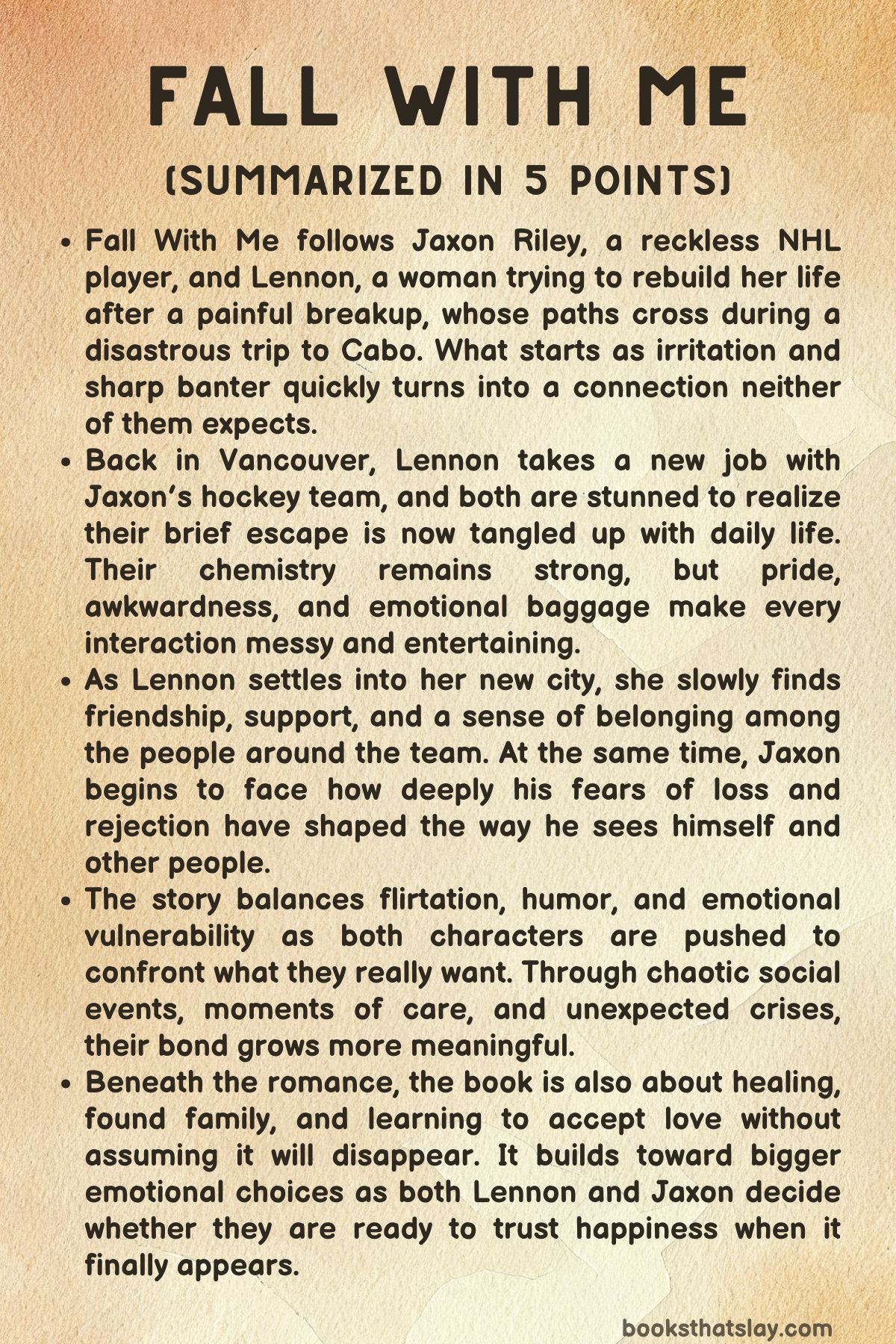
Summary
The story begins when Jaxon Riley, a professional hockey player known for being careless and unserious, invites a woman named Brielle to join him on a spontaneous trip to Cabo. The arrangement is shallow from the start.
He barely knows her, forgets her name, and treats the trip more like a reckless distraction than anything meaningful. Brielle, meanwhile, is excited by the luxury, the attention, and the idea of being seen with a famous athlete.
She talks constantly about bikinis, shopping, social media, and the public image of their vacation. Jaxon quickly realizes he cannot stand being around her and begins regretting the entire decision almost as soon as they arrive.
The tension between them grows until it explodes into a loud argument on the deck of their villa. Brielle is furious that Jaxon is dismissive and rude, while Jaxon is openly irritated by her constant demands for approval and attention.
Their fight becomes so loud that the woman staying in the neighboring villa finally yells at them to shut up because they are ruining her honeymoon. That woman is Lennon, and her angry interruption reveals a painful truth: she is in Cabo alone because the man she was supposed to marry abandoned her before the honeymoon could become what it was meant to be.
Brielle notices Jaxon paying attention to Lennon and becomes even angrier. She accuses him of disrespecting her and caring more about the woman next door than the person he brought on the trip.
Jaxon does almost nothing to stop her when she decides to leave early. Once she is gone, he feels relieved rather than upset.
With the chaos removed, his attention shifts more fully to Lennon, the sharp-tongued stranger next door who is trying to survive a honeymoon by herself.
Lennon spends her days dealing with humiliation, loneliness, and the growing realization that she cannot go back to the life she had planned with her ex-fiancé, Ryne. During a phone call with her brother Devin, she admits she is considering a major change.
She has been offered a job in Vancouver as a photographer and social media manager for a hockey team, and Devin encourages her to stop building her life around people who have already hurt her. He pushes her to choose herself for once.
Later, Lennon goes alone to the resort bar, where Jaxon joins her. Their first real conversation is full of irritation, sarcasm, and instant chemistry.
When the bartender mistakes them for honeymooners, Jaxon plays along and calls Lennon his wife. She resists him, but she also goes along with the joke just enough to keep the exchange moving.
They begin drinking together and playing Never Have I Ever, and beneath the insults and teasing, they begin revealing more honest parts of themselves. Lennon indirectly admits that her engagement is over.
Jaxon makes it clear that his history is built on casual sex rather than real relationships. As the night continues, the attraction between them becomes impossible to ignore.
When the bar closes, Jaxon walks Lennon back to her villa. Outside the door, the emotional and sexual tension finally breaks.
He challenges her to admit she is not going back to Ryne and asks why she is still wearing her engagement ring. Lennon confesses that the ring makes her feel as though someone still chose her, even if that feeling is false.
Jaxon tells her to get rid of it. Once she throws it away, he kisses her.
Inside the villa, they spend the night together in an intense encounter that is not just about desire, but also about reclaiming something Lennon feels she was denied. By morning, however, she is gone.
She leaves before Jaxon wakes, taking her belongings and leaving behind only a mocking note.
Back in Vancouver, Jaxon returns to his ordinary life with his teammates and his cat, Mittens, assuming the night in Cabo is over and done with. That changes during a team meeting when the coach announces that the club has hired a new photographer and social media manager.
To Jaxon’s shock, it is Lennon. She is just as horrified to see him and immediately rushes out of the room.
Their one-night escape is suddenly part of daily life.
As Lennon starts working with the Vipers, she finds herself surrounded by a loud, affectionate social circle made up of players and the women close to the team. At the arena, she meets Cara, Olivia, Rosie, and Jennie, who quickly welcome her and just as quickly make it clear they know about her history with Jaxon.
Lennon is embarrassed, especially when they tease her about his jersey number and try to get details, but their warmth also gives her something she has been missing: the beginning of real friendship and belonging. That feeling deepens when they invite her out after the game and offer to help assemble her furniture.
Jaxon, meanwhile, reacts badly to Lennon becoming part of his world. He insists he does not care, but he is jealous, defensive, and unable to stop thinking about her.
His teammates notice immediately and mock him for it. At the bar after the game, he tries to provoke Lennon by flirting with another woman, but she remains unimpressed.
When he attempts to turn their conversation back into sexual banter and even floats the idea of friendship, Lennon shuts him down and leaves him frustrated.
Lennon’s next days are a mix of progress and chaos. She receives manipulative messages from Ryne, who alternates between pleading and insulting her, trying to undermine her decision to move.
She deletes the messages, but they still shake her. Then Cara adds her to a chaotic group chat with the other women, and for the first time since moving, Lennon feels genuinely happy.
That happiness is interrupted when a leak in her apartment bursts through the bathroom ceiling, making her already difficult day even worse.
At a later community event, Jaxon keeps watching Lennon while pretending not to care. She tricks him into posing outside the women’s bathroom and photographs his humiliation, which delights everyone around them.
But the mood changes when Lennon accidentally eats something made with almond flour and goes into anaphylactic shock. Jaxon reacts instantly.
He finds her EpiPen, lays her down, gives her the injection, and stays with her until the ambulance arrives. The emergency deeply rattles him, and it becomes clear that his protectiveness toward Lennon runs far deeper than simple attraction.
The story then moves through a series of group events that strengthen the bonds between the characters. At Ireland’s first birthday party, chaos erupts because Carter secretly brings ponies despite Olivia explicitly forbidding them.
The adults are forced into ridiculous Toy Story costumes, the room fills with children, and the absurd celebration turns unexpectedly emotional when Carter dances with his daughter and everyone ends up crying. In the middle of all the noise and comedy, Jaxon and Lennon continue circling each other, flirting and resisting what is clearly becoming real.
Later, when Lennon begins looking at apartments, Jaxon reacts by tearing apart every listing. Pressed to explain himself, he finally reveals the truth.
As a child, he lost his best friend Bryce to an allergic reaction after a bee sting. Bryce had forgotten his EpiPen, and Jaxon has blamed himself ever since for not saving him in time.
Lennon’s medical emergency reopened that wound. His fear is not really about her apartment choices.
It is about the possibility of losing her. This confession breaks him open, and for the first time, the people around him see how much pain he has carried for years.
From that point forward, Lennon begins to notice how carefully Jaxon loves her even when he cannot yet say it plainly. He quietly adjusts his home around her allergies and routines, brings her favorite things, and takes care of her in small, steady ways.
On her birthday, he gives her a telescope, showing that he pays attention to the details that matter to her. Lennon realizes that what he offers is the exact opposite of what Ryne gave her.
It is thoughtful, observant, and real.
Jaxon, however, still fears abandonment. In an emotional conversation with his teammates, he finally admits that he expects people to leave him.
He speaks about Bryce’s death, about other losses, and about the belief that he has never been enough for anyone to stay. His teammates answer with honesty and affection, reminding him that he is already loved and already part of a family.
Their support helps him begin to imagine a different future.
That emotional shift leads to the story’s central misunderstanding. When Jaxon comes home and sees Lennon moving furniture, he assumes she is leaving him.
Panicked, he begs her to stay and finally says everything he has been too afraid to say. He tells her he loves her and admits that he pushed her away because he believed she would eventually realize he was not worth choosing.
Lennon stops him with the truth: she loves him too, and she was never leaving. Her apartment is ready again, but she has already decided not to go back.
The furniture is being donated to a shelter. She was planning to stay with him all along.
Their relationship settles into something open and secure. Jaxon later takes Lennon to see a house he has chosen for their future, complete with a library and a glass observatory where she can watch the stars.
The house represents the life he finally dares to want.
The final major conflict comes on the day of game seven of the Stanley Cup Final, when Ryne shows up and publicly proposes to Lennon again. She firmly rejects him and makes it clear that Jaxon is the man she chooses.
Soon after, Jaxon is reunited with Bryce’s parents, who explain that their grief caused them to disappear from his life even though they never stopped caring. Their apology gives him long-awaited peace.
When Jaxon steps onto the ice for the championship game, he is no longer driven by fear of loss. He is surrounded by love, friendship, forgiveness, and hope.
In overtime, he scores the winning goal that brings Vancouver the Stanley Cup. Afterward, Lennon runs onto the ice, crying and taking photos, and Jaxon holds her while looking around at the people who love him.
In that moment, he fully understands that the things he once thought he would never have are finally his: family, home, healing, and lasting love.
Characters
Jaxon Riley
In Fall With Me, Jaxon begins as someone who hides almost everything real about himself behind sarcasm, recklessness, and sexual confidence. At first, he looks like a man who refuses seriousness on principle.
He invites Brielle on a careless trip, barely pays attention to her as a person, and treats the whole situation like another disposable experience. That early version of him seems shallow, but the summary steadily shows that this surface behavior is actually a defense mechanism.
He expects relationships to disappoint him, so he keeps them unserious. He acts like someone who wants freedom, but in truth he is someone who has learned to expect loss and is trying to stay one step ahead of it.
What makes Jaxon compelling is the contrast between how he presents himself and how he actually loves. He talks like a man who only offers sex, but his instincts are deeply protective, attentive, and domestic.
This appears most clearly in the way he responds to Lennon’s allergic reaction. There is no hesitation, no performance, and no self-protective distance.
He takes control because caring for her is immediate and natural to him. The same quality appears later in quieter ways through the small routines of care he creates around her life.
He notices preferences, remembers needs, and changes his environment to make her safe and comfortable. These actions reveal that his emotional language is not grand speech at first, but service, vigilance, and consistency.
His deepest conflict is not whether he can love, but whether he believes he is worth staying for. The death of Bryce shapes his entire emotional world.
He carries guilt, abandonment, and the fear that he fails the people he loves when they need him most. Because of that, Lennon’s possible departure becomes bigger than a relationship problem; it awakens every old wound he has never fully healed.
His panic, jealousy, and sabotage of her apartment search all come from that buried terror. By the end, his arc is about accepting that he is not doomed to be left behind.
He learns to say what he wants, to believe what others feel for him, and to imagine a future without expecting it to collapse. That growth turns him from a man surviving through emotional distance into one who can finally receive love without distrusting it.
Lennon
Lennon enters the story in a state of humiliation, loneliness, and emotional dislocation. She is physically present in Cabo, but psychologically she is stranded between the life she thought she was going to have and the one she now has to invent for herself.
Being alone on her honeymoon after the collapse of her engagement immediately defines her as someone dealing with rejection, but the summary does not keep her in a passive role. Even in pain, she is sharp, observant, and capable of fighting back.
Her first interaction with Jaxon is not soft or vulnerable. She yells at him, insults him, and meets his energy head-on.
That matters because it establishes that her healing will not come through meekness. She does not need to be rescued into having a personality; she already has one.
Lennon’s emotional struggle centers on self-worth. The engagement ring becomes a powerful symbol of that condition.
She knows the relationship with Ryne is broken, yet she keeps wearing the ring because it lets her feel chosen by someone, even if that choice has already collapsed. This detail reveals how deeply abandonment has affected her.
She is not simply mourning a man; she is mourning the validation attached to being wanted. Her movement toward Jaxon is therefore not only romantic.
It is part of a larger process in which she slowly stops accepting the lie that love must come with dismissal, manipulation, or conditional approval.
Her growth is tied closely to belonging. Vancouver is important not just as a new city but as a place where she builds a life from scratch.
Her friendship with the women around the team matters because it gives her a social world that is warm, chaotic, and reciprocal. She begins the story feeling like an outsider listening to other people’s intimacy from nearby.
She ends it embedded inside a chosen family. Professionally, she is capable and creative, and that competence gives her a sense of identity outside romance.
Emotionally, she becomes stronger through laughter, friendship, and the realization that she no longer has to chase people who diminish her. By the end, she is not merely loved by Jaxon; she is someone who clearly knows the difference between being wanted for convenience and being cherished with steadiness.
That clarity makes her final choices feel earned.
Brielle
Brielle serves an important role even though her time in the story is brief. She represents the kind of connection Jaxon has been living on before the real emotional center of the story begins.
Her excitement about status, shopping, social visibility, and being linked to a famous athlete suggests that she is drawn to fantasy and external signs of importance. She wants the trip to mean glamour, attention, and public recognition.
Jaxon, meanwhile, is already emotionally absent before the vacation properly starts. Their mismatch is immediate and intense because neither is actually offering the other what they want.
She wants performance and validation; he wants distraction without responsibility.
It would be easy to reduce Brielle to comic annoyance, but the book gives enough to suggest that she also exposes truth. Her complaints are not invented.
Jaxon is rude, inattentive, and plainly irritated by her. She recognizes that she is unwanted, and her anger grows from that humiliation.
She may be shallow in some ways, but she is not wrong about how badly he is treating her. In that sense, Brielle is useful as an early mirror.
She reveals the emotional laziness Jaxon has normalized in his casual life and shows the damage done when he refuses genuine regard for another person.
Her exit from the trip also helps define the difference between superficial chemistry and meaningful connection. With Brielle, Jaxon feels trapped, impatient, and vaguely disgusted with himself.
After she leaves, his relief is obvious. That reaction is not just about her personality; it is evidence that he is exhausted by the kind of empty encounters he has been choosing.
Brielle therefore helps establish the emotional dead end from which the story moves forward. She is not built as a deeply layered central figure, but she is a necessary contrast that clarifies what Jaxon has been mistaking for freedom.
Garrett
Garrett is one of the clearest examples of quiet loyalty in Fall With Me. He is not the loudest personality in the group, but he repeatedly appears at crucial emotional moments, especially where Jaxon is concerned.
His care is expressed through steadiness rather than spectacle. Bringing Jaxon his favorite coffee may seem small, but it reveals a pattern: Garrett notices, remembers, and acts.
He does not need attention for his kindness. That makes him one of the emotional anchors in Jaxon’s life, even when Jaxon is too defensive or withdrawn to fully recognize it.
His most important function is as someone who refuses to let Jaxon isolate himself without challenge. The confrontation outside Rogers Arena is significant because Garrett does not indulge self-destructive withdrawal under the excuse of giving space.
He acknowledges Jaxon’s need for room, but he also insists that disappearing affects people who love him. That balance makes Garrett emotionally mature.
He neither smothers nor abandons. He speaks with the authority of someone who has already proven his love through action, and because of that, his words carry weight.
Garrett also helps define the meaning of family in the story. The team is more than a workplace, and Garrett embodies that truth in a grounded way.
He participates in the group’s chaos, but beneath the humor he represents dependability. He helps make it possible for Jaxon to finally admit his fear of loss and his desire for love.
In many romances, friends exist only to tease or entertain, but Garrett does more than that. He actively helps create the emotional conditions in which the hero can change.
Carter Beckett
Carter is the great theatrical force of the book. He brings absurdity, exaggeration, and spectacle into nearly every scene he touches.
Whether he is secretly bringing ponies to a birthday party, staging a grand entrance with smoke and music, or behaving as though ordinary events are major productions, he fills the social world with chaos. On the surface, he is comic relief, and he certainly functions that way.
He keeps scenes lively, ridiculous, and emotionally oversized.
At the same time, Carter is not only a clown. He has a genuine emotional largeness that gives his ridiculousness unexpected depth.
His love for Olivia and Ireland is excessive in form but sincere in feeling. The absurd pony entrance becomes touching because it comes from real devotion to his daughter.
His ability to make people laugh exists alongside a capacity to make them cry. That combination suggests a man who fully commits to emotion rather than rationing it.
He is embarrassing, loud, and often impossible, but he is also wholehearted.
Carter matters in Jaxon’s arc because he helps create an environment where vulnerability is normalized beneath the jokes. The team’s warmth is not polished or restrained; it is noisy, affectionate, and intrusive.
Carter represents that emotional culture at its most extreme. He teases, dramatizes, and overwhelms, but he also belongs to the group that holds Jaxon together when he starts to fall apart.
His presence keeps the story from becoming emotionally narrow. He reminds the reader that love can be messy, comic, and excessive without being any less real.
Cara
Cara comes across as socially fearless and emotionally perceptive. She is one of the first women to help pull Lennon into the group, and she does it with the kind of teasing confidence that turns embarrassment into belonging.
Rather than letting Lennon remain awkward and peripheral, Cara makes her part of the social rhythm almost immediately. That instinct matters because Lennon is still fragile when she arrives in Vancouver.
Cara helps dissolve that isolation through humor, directness, and collective energy.
She also functions as someone who sees through Jaxon quickly. When he feels threatened by Lennon’s growing closeness with the group, Cara does not let him hide behind false indifference.
She reassures him when reassurance is needed, but she is equally capable of exposing nonsense. Later, when she gathers the men and forces them to watch the footage of their bouncy-house disaster, she shows another side of herself: strategic, authoritative, and entirely unafraid to take control of a room.
She knows how to use chaos for correction.
What defines Cara most is her ability to hold a group together without softening her personality. She is not maternal in a quiet or gentle sense.
Her version of care is outspoken, playful, and forceful. She creates community by making people participate in it.
That makes her important to the emotional architecture of the story. She is one of the women who transform Vancouver from a lonely new city into a place of chosen attachment for Lennon.
Olivia
Olivia appears as someone whose life is full, loud, and deeply rooted in family. Her scenes often involve comic frustration with Carter, especially around Ireland’s birthday party, but that frustration is part of a dynamic built on intimacy and familiarity.
She knows exactly how impossible he is, and the conflict between them has the rhythm of a relationship where love is assumed even when patience is exhausted. Her irritation is never a sign of emotional distance.
It is the language of someone managing a man who turns everything into theater.
As part of the women’s circle, Olivia helps represent the stability and inclusiveness Lennon has been craving. The group’s joking and bickering feels familial because women like Olivia make that environment possible.
She is not presented through long private introspection, but the social texture around her says a great deal. She belongs to a network of love that is practical, chaotic, and dependable.
That network becomes essential for Lennon.
Olivia also reinforces one of the story’s larger ideas: adulthood here is not neat, restrained, or emotionally minimalist. It is noisy, communal, and full of overlapping relationships.
Through her, motherhood and partnership are shown as exhausting but affectionate, ridiculous but meaningful. She helps give the world its feeling of lived-in emotional abundance.
Rosie
Rosie is gentle but not passive, and her emotional intelligence stands out strongly. Her relationship with Lily and her news about passing foster parent training immediately frame her as someone whose love expands outward into responsibility.
She is not only caring in a vague sense; she is actively building a home for a child who needs one. That detail gives her character moral weight.
She represents care as commitment rather than sentiment.
Her conversation with Jaxon at Ireland’s party is one of her most revealing moments. She congratulates, confides, and then gently turns the topic toward Lennon and his feelings.
She does not attack him or mock him into honesty. Instead, she creates a space where truth can surface.
That suggests someone who understands people well and knows that emotional resistance cannot always be broken by pressure. Rosie’s care has tact.
She helps balance the louder personalities in the group. In a social world full of teasing and spectacle, Rosie brings softness, thoughtfulness, and steadier forms of affection.
That does not make her less important. In many ways, she gives the group its emotional depth.
Her future as a foster parent is also symbolically meaningful because the story is deeply concerned with home, safety, and chosen family. Rosie embodies those values in action.
Jennie
Jennie is part of the women’s group that welcomes Lennon into belonging, and her role is tied to collective energy, humor, and emotional immediacy. Even when she is not singled out for long analysis in the plot, her presence matters because she contributes to the sense that this friend group is real, layered, and alive.
She is one of the people whose delight, teasing, and participation help dissolve Lennon’s loneliness.
Her crying during Carter’s dance with Ireland also shows that she is emotionally open. In this world, emotion spreads quickly through groups, and Jennie participates in that shared feeling without embarrassment.
That willingness to be moved is part of what makes the circle feel safe. People are not guarding themselves from one another.
They are reacting, laughing, crying, and intervening with full force.
Jennie may not receive a major independent arc in the book, but she is important as part of the social fabric. She is one of the women who make tenderness feel communal rather than private, and that quality helps reshape Lennon’s life.
Devin
Devin is one of the earliest voices urging Lennon toward self-respect and forward movement. His role is relatively brief, but it is crucial.
When Lennon is emotionally stranded, Devin does not encourage nostalgia or indecision. He pushes her to think about what is best for her rather than what feels familiar.
His support is loving, but it is not indulgent. He wants her to stop allowing other people to control her future.
That conversation helps establish Lennon’s move to Vancouver as an act of agency instead of mere escape. Devin’s belief in her gives structure to a moment when she could easily retreat to the old life that hurt her.
He represents family support that is practical and future-facing. He does not solve her problems, but he helps redirect her attention from loss to possibility.
His importance lies in timing. Before Lennon has new friends, before she has new routines, Devin is one of the people reminding her that starting over is not failure.
That makes him part of the emotional bridge between collapse and renewal.
Ryne
Ryne is less a romantic rival than a concentrated symbol of emotional manipulation and entitlement. His absence at the honeymoon already tells the reader a great deal about him, but the later messages deepen that picture.
He alternates between pleading and contempt, affection and insult, trying to destabilize Lennon emotionally so she remains available to his control. He is not simply inconsiderate; he is someone who wants access without accountability.
What makes Ryne effective as an antagonist is that he embodies the kind of love Lennon must reject in order to grow. He treats her choices as offenses against him.
He mocks her move, attacks her vulnerability, and assumes he still has the right to define her future. His reappearance before game seven shows the full extent of his delusion.
Publicly proposing again is not a noble gesture. It is an attempt to overwrite Lennon’s reality with his own fantasy of possession.
Ryne matters because he clarifies the emotional difference between being chosen and being cherished. Lennon once clung to the ring because it made her feel wanted.
By the end, she can reject Ryne publicly and without doubt because she understands that his version of wanting her was always self-centered. He is the past refusing to accept its own irrelevance.
Bryce
Bryce is absent in the present timeline, yet he is one of the most powerful characters in the story because his death defines Jaxon’s emotional architecture. As a childhood best friend who died from an allergic reaction, Bryce becomes the center of Jaxon’s survivor’s guilt.
The tragedy is not treated as a past event Jaxon has neatly processed. It remains an open wound, shaping how he understands responsibility, failure, and attachment.
Bryce’s importance lies in what he represents inside Jaxon’s psyche. He is the first major proof, in Jaxon’s mind, that love leads to irreversible loss and that being needed may end in catastrophe.
That belief then spreads into later fears of abandonment and unworthiness. Jaxon does not merely mourn Bryce; he builds his whole defensive identity around the idea that he was too late and not enough.
The reunion with Bryce’s parents near the end adds another layer. It suggests that the grief surrounding Bryce damaged multiple lives, not just Jaxon’s, and that healing requires the past to be spoken aloud rather than endlessly carried in silence.
Bryce’s presence in the story is therefore deeply structural. He is the ghost around which much of Jaxon’s fear has been organized.
Mittens
Mittens may be a cat, but the cat is important enough to function almost like emotional shorthand for Jaxon’s inner life. Early on, while he is supposedly on a glamorous trip, he is thinking about Mittens.
That detail is funny, but it also reveals something serious: Jaxon’s true attachments are domestic, quiet, and safe. Even before he can admit he wants intimacy, the book shows him already oriented toward home.
Mittens also helps soften Jaxon without making him sentimental. A man who otherwise presents himself as unserious and sexually casual is repeatedly linked to affectionate care for his cat.
That contrast humanizes him. Later, when Lennon’s growing bond with Jaxon includes Mittens, the cat becomes part of the shared home they are unconsciously building together.
In that sense, Mittens symbolizes the life Jaxon actually wants long before he can say so aloud. The cat is part of the emotional truth beneath the performance.
Adam
Adam is not centered heavily, but he contributes to the sense of a larger, interconnected community. His closeness with Rosie and Lily shows him as part of a nurturing unit rather than just a background friend.
The image of Lily running straight into Adam and Rosie’s arms conveys trust, safety, and continuity. Adam is therefore linked to stability and care.
He also participates in the group’s comic life, including the ridiculous costume assignments and shared party chaos. That matters because the friend network is not divided into people who are only funny and people who are only serious.
Adam belongs to both dimensions of the story’s world. He can be part of absurdity while also standing inside scenes of tenderness and responsibility.
Though less individually developed than Jaxon or Lennon, Adam helps reinforce the story’s communal values. He is one more example of adulthood shaped by chosen attachment rather than emotional distance.
Emmett
Emmett contributes to the comic energy of the group, especially through the absurdity of the birthday-party costume sequence. His willingness to exist inside this ridiculous shared world adds to the sense that the characters are not merely connected by circumstance but by ongoing participation in one another’s nonsense.
That kind of social intimacy matters more than any single joke.
He also appears in emotional group scenes, including the collective crying during Carter’s dance with Ireland. Like others in the circle, Emmett helps normalize openness.
Men in this story are allowed to be ridiculous, affectionate, embarrassed, and moved. Emmett supports that atmosphere simply by being part of it.
His character may not receive a major independent conflict in the book, but he strengthens the sense of a vibrant social ecosystem around the central romance.
Serena
Serena appears briefly, but her presence matters as part of Lennon’s personal support system. Telling Devin and Serena that she has made friends is a meaningful moment because it shows Lennon recognizing her own life changing in real time.
Serena belongs to the small group of people with whom Lennon shares emotional milestones. Even a brief mention can therefore indicate trust and continuity.
She helps show that Lennon is not entirely isolated from family or history. Vancouver is a new beginning, but Lennon’s identity is still connected to people who know her beyond this romance.
That grounding helps her growth feel broader than a love story alone.
Lily
Lily represents the theme of care being made concrete. Her immediate movement toward Adam and Rosie shows that children in this world are not ornamental additions but living measures of trust.
Her bond with them gives emotional substance to Rosie’s hope of fostering. Lily is a reminder that love in the story repeatedly expresses itself through protection, reliability, and chosen responsibility.
Though she is not centrally developed, she helps deepen the moral atmosphere of the book. She makes the adults’ aspirations matter in a visible way.
Ireland
Ireland is the child around whom one of the story’s most memorable communal scenes unfolds. Her birthday party becomes comic catastrophe and emotional spectacle at once, and she serves as the focal point for both.
The absurdity of ponies, costumes, and dramatic entrances exists because adults are trying, in wildly excessive ways, to celebrate her.
At the same time, Carter’s dance with Ireland becomes one of the most emotionally disarming moments in the book. Through Ireland, the story shows how parenthood can bring out sincerity beneath performance.
She is not heavily characterized through dialogue or introspection, but she matters because she draws out tenderness from nearly everyone around her.
Gran and Bryce’s Parents
These older figures arrive late, but their appearance carries enormous emotional significance for Jaxon. His gran’s presence at game seven represents steadfast familial love making itself physically present at a crucial moment.
Bryce’s parents, meanwhile, bring long-delayed healing. Their reunion with Jaxon allows grief that has remained frozen for sixteen years to finally move.
They acknowledge absence, explain their silence, and give him something he has needed for years: confirmation that he was not abandoned because he was blameworthy.
Together, these figures help complete Jaxon’s transformation. They connect his present happiness to the wounds of his past and show that reconciliation is possible even after years of pain.
Their arrival turns the final victory into more than a sports triumph. It becomes emotional restoration.
Connor
In Fall With Me, Connor appears only briefly, but even that short appearance adds to the lively, affectionate chaos of the friend group. His excitement at Cara’s “sexy Woody” costume shows the easy flirtation and playful energy that define the social world around the main couple.
He may not carry major emotional weight, but he contributes to the sense that this circle is full of ongoing relationships, shared jokes, and lived familiarity.
His presence is small, yet it supports one of the story’s strengths: even minor characters help the world feel socially crowded and emotionally active rather than existing only to frame the central romance.
Themes
Abandonment and the Fear of Being Left Behind
Nearly every major emotional movement in the story is shaped by the fear that love is temporary and that closeness will eventually end in loss. Jaxon’s behavior makes the clearest case for this.
On the surface, he looks unserious, cocky, and overly comfortable with casual relationships, but that attitude is really a shield. He has trained himself to expect disappointment before anyone else can cause it.
His history teaches him to connect pain with attachment, so he tries to stay in control by keeping things shallow. Even when he is deeply drawn to Lennon, he keeps trying to reduce what exists between them to sex, banter, or irritation because admitting that she matters would mean admitting she has the power to hurt him.
His panic whenever he senses distance from her shows that his greatest struggle is not romance itself but the belief that love always comes with an ending he cannot survive.
Lennon carries a different version of the same wound. She arrives in Cabo after being abandoned at the point when she should have been entering a permanent partnership.
The humiliation of being left alone on her honeymoon affects far more than her pride. It damages her sense of worth.
Her decision to keep wearing the engagement ring is not really about loyalty to Ryne but about clinging to the idea that she was once chosen. That small detail becomes one of the most revealing signs of her emotional state.
She is not mourning only a relationship; she is mourning the image of herself that the relationship seemed to confirm. Because of that, moving to a new city is not just a career step.
It is an attempt to rebuild an identity that is no longer tied to rejection.
What makes this theme powerful is that the story does not treat abandonment as a single event. It shows how it becomes a mindset.
Jaxon expects people to leave, so he pushes first. Lennon has been made to feel disposable, so she becomes wary of trusting what feels good.
Their relationship develops in the space between those instincts. The emotional payoff comes when both of them stop treating loss as fate.
Love becomes possible only when they stop measuring the future by what other people have done to them.
Care as a Daily Practice Rather Than a Grand Gesture
The romance gains its emotional force by arguing that real love is not built on dramatic declarations alone but on repeated, practical acts of care. Physical attraction sparks the connection between Jaxon and Lennon, and their chemistry is obvious from the start, but the story steadily shifts the meaning of intimacy away from desire alone.
What matters most is not that they want each other. What matters is the way that care starts appearing in ordinary habits, choices, and observations.
Jaxon notices what Lennon likes, what she needs, what makes her feel safe, and what might harm her. He changes his surroundings for her, brings her favorite things, and pays attention in ways that her former relationship never taught her to expect.
Those choices are not flashy, which is exactly why they matter. They show a kind of love grounded in attention.
This is also why the emergency at the community event carries so much thematic weight. When Lennon goes into anaphylactic shock, Jaxon responds instantly and decisively.
On one level, it is a suspenseful moment. On a deeper level, it reveals the shape of his love before he has fully named it.
His reaction is protective, informed, and urgent because he is already deeply invested in her well-being. The moment also links present care to past trauma.
He could not save Bryce, and that loss has shaped his sense of himself for years. Helping Lennon does not erase that wound, but it shows that love can move him toward action instead of paralysis.
It is one of the clearest points where caring for someone becomes both a gift to another person and a step toward healing himself.
Lennon’s response to these acts is equally important. She recognizes that the tenderness Jaxon offers is not performative.
She has known a relationship built on manipulation, selfishness, and emotional instability, so being cared for in steady, quiet ways changes her understanding of what partnership can look like. The story keeps returning to the idea that devotion is revealed in details.
A telescope, a safe home, favorite snacks, allergy awareness, emotional presence, and simple consistency all matter because they create a life in which love is lived rather than merely spoken. That idea gives the romance its strongest emotional foundation.
Chosen Family as the Place Where Healing Becomes Possible
In Fall With Me, belonging does not come only from romance in this story. It comes from being drawn into a community that makes room for weakness, chaos, humor, and honesty.
The friend group surrounding Jaxon and Lennon is more than comic relief or side-character energy. It functions as an alternative family structure, one built not by blood but by loyalty, affection, and mutual care.
This matters deeply for both leads because each of them enters the story in emotional isolation. Lennon arrives in Vancouver with professional uncertainty, social loneliness, and the aftereffects of betrayal.
Jaxon, despite being surrounded by teammates, still feels emotionally separate from the people around him. The gradual inclusion of both characters into a loud, affectionate circle gives them something larger than a love story.
It gives them a home.
The women welcoming Lennon is especially important. Their teasing is immediate and intrusive, but it is also warm, open, and disarming.
They do not let her stay on the edges. They fold her into their chat, their outings, their furniture assembly, and their routines.
For someone who has just uprooted her life, this kind of acceptance changes everything. She begins to feel not simply wanted but included.
That sense of connection helps loosen the hold Ryne’s cruelty still has on her. His messages try to convince her she is alone and unsupported, but the reality around her starts proving otherwise.
Friendship becomes a direct counter to emotional abuse because it offers evidence that she is valued without condition.
For Jaxon, chosen family becomes transformative when he finally stops performing invulnerability. His emotional breakdown with the team is one of the clearest moments where the theme comes fully into view.
These men, who joke constantly and communicate through chaos and mockery, respond to his fear with seriousness and love. They tell him he matters.
They remind him of what he has contributed to their lives. They refuse the version of himself he has been carrying, the one that says he is temporary, secondary, or unworthy.
Their support does not solve everything at once, but it gives him a new frame for understanding himself. He is not just tolerated.
He is claimed.
The same pattern appears across the wider group, from birthday-party absurdity to quiet emotional rescue. The house, the gatherings, the children, the partners, the shared crises, and the ridiculous traditions all point toward one truth: healing becomes more possible when people are held by a community.
The story insists that love is strengthened by friendship and that being known by many people can make it easier to accept being loved by one person.
Self-Worth and the Decision to Accept Love
Underneath the romance, the friendships, and the comedy sits a deeper question: what happens when two people who do not fully believe they deserve love are asked to receive it anyway? Much of the emotional tension comes from the distance between what Jaxon and Lennon feel and what they think they are allowed to have.
Both have internalized damaging ideas about their value. Lennon’s failed engagement leaves her with the fear that she was not enough to be chosen properly, respected properly, or kept.
Jaxon carries a heavier and older burden, one tied to grief, guilt, rejection, and the repeated impression that he is the kind of person people enjoy for a while but do not stay for. Because of that, the central love story is not only about finding the right person.
It is about becoming able to believe that being loved is not a mistake.
This theme is visible in many of their conflicts. Jaxon’s push-and-pull behavior is driven by desire, but even more by disbelief.
He assumes Lennon will eventually recognize some deficiency in him and leave, so he tries to stay ahead of that imagined moment. He would rather sabotage closeness than wait for rejection to arrive naturally.
Lennon, meanwhile, has to learn that tenderness does not always hide manipulation. She has been trained by past hurt to question whether affection is reliable.
Accepting Jaxon’s care therefore requires her to revise her sense of what she deserves from another person. She must stop treating disappointment as the most realistic outcome.
The emotional climax works because it resolves this theme at the level of identity, not just plot. When Jaxon says he deserves friends, family, home, Lennon, and love, the statement matters because it is new to him.
It marks a movement from survival to self-acceptance. He is no longer speaking from panic alone.
He is claiming a future. Lennon’s response completes that movement by confirming not only that she loves him, but that his love already meets needs she has carried for years.
Her choice to stay is meaningful precisely because he had convinced himself staying was impossible.
The final victories in the story feel satisfying because they grow out of this inner shift. Public rejection of Ryne, emotional reconciliation with Bryce’s parents, the imagined future of the house, and the championship win all land with force because Jaxon is finally able to stand inside joy without expecting it to vanish.
The story argues that love becomes real when people stop treating themselves as unworthy of it. That is the change that allows everything else to follow.