Faebound by Saara El-Arifi Summary, Characters and Themes
Faebound is an epic fantasy built on exile, war, prophecy, and divided loyalties. Saara El-Arifi begins with a mythic account of how gods created humans, fae, and elves, then moves into a story driven by sisters whose bond is tested by duty, guilt, and survival.
The novel combines battlefield conflict with court intrigue, ancient magic, romance, and political betrayal. At its center are people trying to decide whether they belong to the nations that shaped them, the families that hurt them, or the futures they want to build for themselves. It is a story about crossing boundaries, both literal and emotional, and learning what those crossings cost. It’s the first book of the Faebound trilogy.
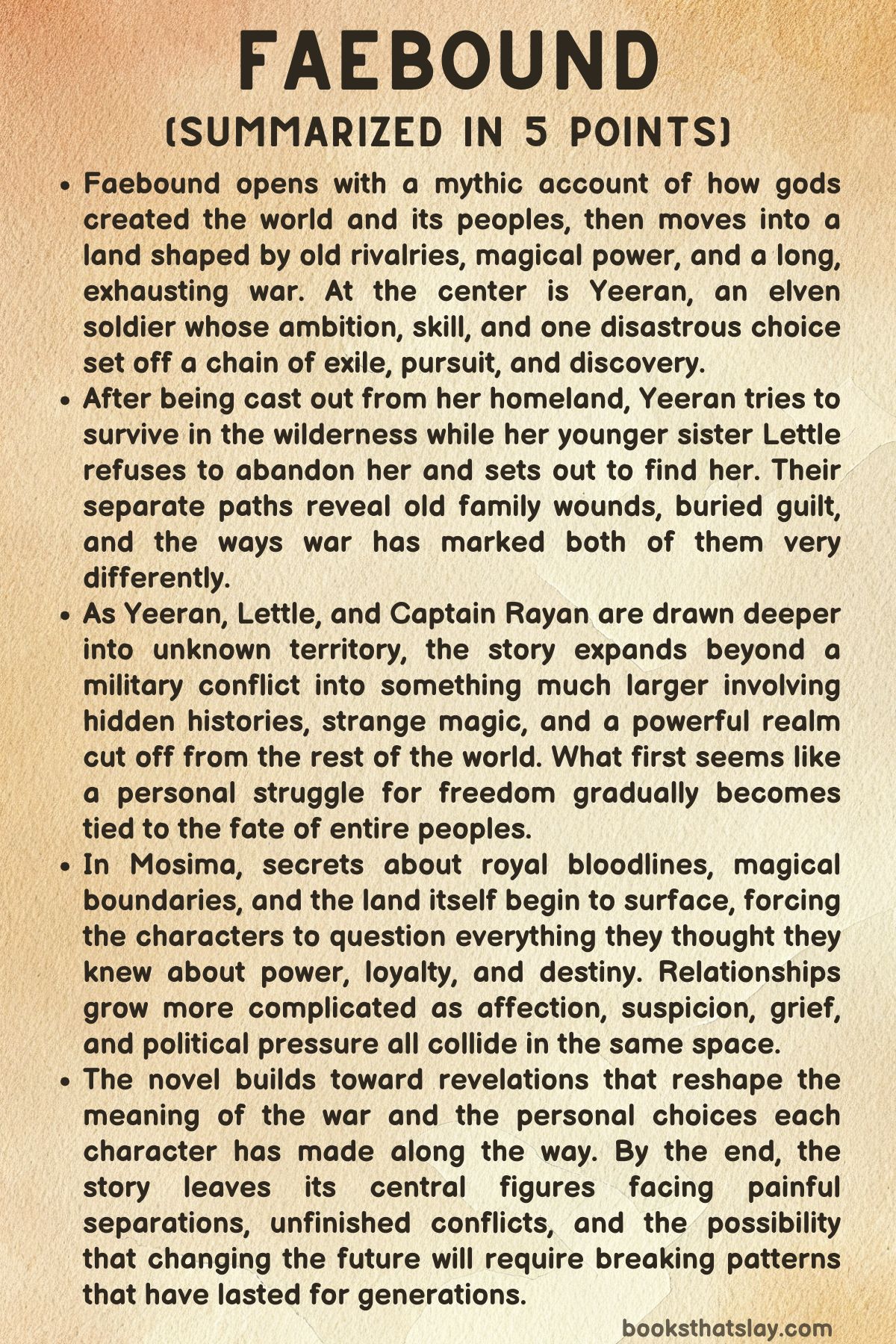
Summary
The story opens with the creation of the world. Three gods bring existence into being in different forms.
Asase grows from a grain of wheat into the earth itself, forming mountains, forests, valleys, and canyons. Ewia arrives as a two-headed bat and creates both light and darkness, establishing the cycle of day and night.
Bosome shapes the waters and becomes the moon. Each god then creates a people: humans from the earth, fae from wing-skin, and elves from water, with traits borrowed from the other races.
Although the gods want peace, they grant their children free will, and conflict begins almost immediately.
The main story follows Yeeran, an elf soldier who has spent her life inside the Forever War. On the eve of her promotion to colonel in the Waning Army, she is with her lover Salawa, who is also the chieftain of their people.
Salawa gives her a powerful drum made from the hide of an elderly obeah, a magical beast whose skin holds enormous energy. Yeeran tests it at once and is amazed by the force it releases.
As morning approaches, she reflects on the war, which is being fought over fraedia, a precious crystal capable of warming homes and helping crops grow. The value of fraedia has kept the conflict alive for generations, even as countless lives are spent.
The next day Yeeran goes to take command of her regiment. Along the way she sees child soldiers in training and is disturbed by the sight of a starved girl named Hana.
When Yeeran gives her money for food, Hana reveals that she herself had been sold to the army for even less. The exchange stirs painful memories of Yeeran’s own poor childhood.
At the front Yeeran receives orders to conduct only a routine sweep of the western bank and avoid the enemy’s main line. Before she leaves, her younger sister Lettle secretly visits her and shares a divination reading, warning that Yeeran’s glory lies to the east.
Yeeran leads her troops out expecting nothing more than patrol duty, but when the western bank proves empty, she is tempted by Lettle’s prophecy and the encouragement of Captain Rayan. She turns eastward, stretching her orders.
Soon the regiment discovers the missing scouts dead in the field, along with signs of magical fur dragged through the dirt like a signal. Yeeran realizes too late that they have walked into a trap.
Crescent soldiers rise from hiding in overwhelming numbers.
The battle quickly turns disastrous. Yeeran’s archers fire, but their arrows strike an invisible magical shield and fail to do damage.
She has never seen such protection before. Forced to retreat, she stays behind to cover her soldiers’ escape and uses her new drum to blast the ground and slow the enemy advance.
Even so, the regiment is shattered, and Rayan finally pulls her away on his camel. The cost is devastating: hundreds die because Yeeran disobeyed orders.
Back in Gural, Yeeran is judged for the defeat. In front of Salawa, she admits what she did.
Salawa is torn between private love and public responsibility, but because Yeeran is admired by the people, she does not execute her. Instead she exiles her permanently from the Elven Lands.
Lettle protests outside the palace, but Salawa suppresses the unrest with drumfire. When Lettle wakes in the infirmary and learns Yeeran has already been sent away, she decides to follow her sister.
Yeeran is abandoned at the edge of a forest with only basic supplies and her drum. Scarred with the marks of dismissal and stripped of rank, she begins trying to survive alone.
That night she encounters a huge obeah elder and immediately sees possibility in it. If she can kill such a rare creature and bring back its hide, perhaps she can bargain for her freedom and regain what she lost.
Lettle follows the wagon tracks leading out of Gural and realizes someone is trailing her. Using the hunting skills learned from her father, she prepares an ambush and discovers the follower is Captain Rayan.
He insists on helping because he feels responsible for Yeeran’s exile. Lettle distrusts him but accepts his company when she notices he has food, tools, and camping supplies.
As they travel, she reflects on her hatred of soldiers and the damage war has done to her family. Rayan grows sick from a concussion, and Lettle gathers snowmallow flowers to ease his pain, a task that reminds her of her father’s illness and death.
While Rayan rests, Lettle goes hunting but kills an obeah cub instead of a rabbit. She uses its entrails for divination, hoping for news of Yeeran, but the prophecy is obscure, speaking of a hidden waxing moon, a broken partnership, and two people destined to die by poison.
It gives her no direct answer. Back at camp Rayan, now stronger, finally shares more of himself.
He was born in Crescent, and his mother Reema was a diviner murdered by the tyrant Akomido after giving him a prophecy. Rayan joined the Waning Army out of a desire for revenge.
At the same time, Yeeran survives in the wilderness by relying on everything her father taught her about tracking, bushcraft, and endurance. She nearly dies of thirst while following the great obeah, but eventually finds a hidden lagoon where she drinks, bathes, and recovers.
Meanwhile Lettle and Rayan push through Crescent territory under harsh restrictions and mutual tension. In an inn they are forced to share a room, and their guarded conversations draw them closer.
Eventually Lettle and Rayan find Yeeran in the forest and reunite with her. The joy is mixed with anger.
Yeeran is shocked they came and insists they should go home while she continues her hunt. Lettle refuses, and the sisters argue over years of pain, especially Yeeran’s choice to join the army and leave Lettle behind.
Before the quarrel can go further, the great obeah appears. Yeeran uses drumfire to bring it down at last.
Their triumph is cut short by the arrival of a mysterious golden woman and other riders mounted on living obeah. Their magic is unlike anything Yeeran and Rayan can fight.
The woman reveals herself as fae and places Yeeran under arrest for killing the prince of Mosima when she slew the obeah. Lettle is captured as well, and the dead beast is burned before Yeeran’s eyes, destroying her hope of reclaiming her old life.
The three are marched into the Wasted Marshes and taken prisoner behind invisible magical barriers.
In Mosima, the hidden land of the fae, Yeeran learns that the Tree of Souls is bound directly to the ruling Jani dynasty. Two monarchs must always reign, and the land itself depends on that magical bond.
She also learns of a spreading blight that has been damaging Mosima for decades whenever members of the royal bloodline live beyond its borders. Nerad, one of the rulers, brings her to the grave of the prince who died because of the obeah hunt and reveals his own tangled feelings toward the dead man, who had once raised him.
Yeeran grieves sincerely, though Nerad tells her the death was not truly her fault.
Lettle, meanwhile, becomes increasingly involved in the magical life of Mosima. Seer Sahar helps her understand that elves can read the Fates without killing obeah, and she discovers that by entering a heedless state she can actually see magic around her.
She follows these new perceptions through the city, studies the strange boundary around Mosima, and gains access to the Book Orchard, a library hidden in an old tunnel. She persuades Golan to teach her the fae language after Sahar refuses.
Back at their quarters, Lettle shares what she learns with Yeeran and Rayan, while Yeeran reports on the Tree of Souls and the monarchy’s link to the survival of the realm.
After the funeral of the queens, events accelerate toward a new coronation. Yeeran trains with her drum and grows stronger.
Furi, another heir and someone with whom Yeeran shares powerful feelings, teaches her new forms of magic. At the coronation beneath the Tree of Souls, everyone expects Furi and Nerad to be bound as rulers.
Instead the magic rejects Nerad and reaches unexpectedly toward Rayan, choosing him as king. In private, they discover that Rayan is the son of Reema and likely Najma, a hidden member of the royal line.
His life outside Mosima explains the blight. Though Furi accepts him, Nerad reacts badly and storms out.
Rayan and Lettle draw closer and confess their love, though Lettle keeps secret the darker side of the prophecy linking them. Yeeran, desperate to leave and warn her people, confronts Furi.
Their anger and longing turn them into lovers, and afterward Furi finally gives Yeeran the word that can open Mosima’s boundary: Aiftarri. Yet Furi asks Yeeran to stay, and Yeeran cannot promise that.
Lettle soon uncovers a hidden war room and overhears Nerad and Golan arguing. She learns that they poisoned the queens and that Nerad knew of Rayan’s bloodline all along.
When she is discovered, Nerad attacks her with magic and nearly kills her. Yeeran rushes in, hears Lettle accuse Nerad of murdering the queens, and chases him with Furi.
They trap him near the boundary, and in the struggle he dies after his obeah falls from the cliff. Furi and Yeeran decide the public will be told he jumped.
The revelations do not end there. Yeeran learns the fae have secretly allied with the Crescent tribe in the Forever War and are already sending troops to reclaim ancestral land beneath the Bleeding Field.
She is devastated to realize that the strange battlefield magic that destroyed her regiment had been fae magic. Back at the palace, Rayan and the others also uncover Komi’s true identity: he is actually the tyrant Akomido.
Enraged over his mother’s death, Rayan uses his power as king to trap him in stone and kill him.
As Lettle recovers in the infirmary, Yeeran prepares to leave Mosima and warn Salawa that war is about to widen. The sisters have one last bitter argument, and Lettle confesses that she slowly poisoned their father with snowmallow flower, believing she was easing his suffering.
Yeeran forgives her, but the wound between them remains raw. At the boundary, Rayan promises to recall the fae forces and rule differently.
Speaking the word Furi gave him, he opens the barrier and frees Yeeran. She departs, carrying love, grief, and urgent knowledge back toward her homeland, while Rayan later reads a letter from his father hinting that the curse binding Mosima may yet be broken.
Characters
Yeeran
Yeeran stands at the center of the story as a character shaped by violence, discipline, guilt, and longing. She begins as someone who has built her identity around military achievement.
Promotion, command, and battlefield success are not just professional goals for her; they are the structure through which she has learned to survive a brutal world. Her excitement over the drum made from an obeah’s hide reveals both her skill and her moral compromise.
She understands power immediately and instinctively reaches for it, which shows how deeply war has trained her mind. At the same time, her reaction to Hana and her memories of childhood poverty show that she has not become emotionally numb.
She can still recognize exploitation when it appears before her, especially when it reflects her own past.
Her tragedy is that she is both capable and flawed in ways that make disaster almost inevitable. She is proud, decisive, and willing to trust instinct over instruction, which makes her an effective commander but also leads directly to catastrophe when she chooses to ride east.
That choice is not made from simple arrogance. It comes from a mixture of faith in Lettle’s warning, confidence in her own judgment, and a deep hunger to prove herself worthy of her new rank.
Once the ambush begins, the same qualities that doomed her also make her admirable. She stays behind to protect her soldiers, refuses to collapse under pressure, and fights even when she realizes she cannot win.
Her exile strips away her rank, status, and homeland, forcing her to exist without the identity she had relied on.
What makes Yeeran compelling is how exile exposes the emotional costs she has been avoiding for years. Her relationship with Lettle is full of unspoken damage caused by absence, hierarchy, and the assumption that protection is the same as love.
Her connection to Furi opens another side of her, one that longs for tenderness, stability, and a life beyond war, yet she is never able to surrender fully to that possibility because duty keeps pulling her back toward the homeland she feels responsible for. Even in Mosima, where she discovers new forms of power and intimacy, she continues thinking in terms of return, strategy, and conflict.
By the end, she becomes a figure torn between worlds, loves, and identities. She is brave and deeply feeling, but also trapped by the habits of sacrifice and combat that made her who she is.
Lettle
Lettle is one of the richest characters in the story because she combines vulnerability, sharp intelligence, suppressed anger, and unexpected moral complexity. At first she appears to occupy a quieter role than her sister, positioned outside formal military power and associated instead with divination, intuition, and domestic memory.
But this impression quickly deepens into something far more forceful. She is not passive or secondary.
The moment Yeeran is exiled, Lettle acts. She protests publicly, then sets out into dangerous territory to find her sister, showing a courage that is less celebrated than martial heroism but equally real.
Her strength is grounded not in command but in persistence, observation, and the refusal to accept the losses others expect her to endure.
A great deal of her character is shaped by abandonment and resentment. Yeeran joined the army and left her behind, and that wound has clearly defined how Lettle understands love.
She has been treated as someone to protect, someone to leave out, someone too young or too fragile to stand in the center of events. Her anger at Yeeran therefore feels earned and layered.
It is not the anger of simple misunderstanding but of years spent living in the shadow of another person’s choices. This is why her voice matters so much in the sisters’ arguments.
She speaks for the emotional damage that duty can hide. Where Yeeran justifies herself through necessity, Lettle remembers what that necessity cost the people left behind.
Her growth in Mosima is especially important because it allows her power to take visible form. Her magesight, her developing relationship to divination, and her determination to learn despite repeated refusals all show that she is moving from inherited practice into self-directed mastery.
She becomes someone who can interpret hidden structures, whether magical, political, or emotional. She notices lies, follows threads others miss, and gradually emerges as the person most capable of uncovering the truth beneath appearances.
Yet the story also refuses to idealize her. Her confession about slowly poisoning her father with snowmallow flower transforms her from wounded younger sister into someone carrying terrible guilt.
That revelation changes how everything before it is understood. Lettle is loving, perceptive, and brave, but also burdened by secrecy and self-reproach.
That combination makes her feel startlingly human.
Rayan
Rayan first appears as a loyal captain and battlefield survivor, but his role expands until he becomes one of the most consequential figures in the entire narrative. What makes his character effective is the slow movement from apparent simplicity to hidden depth.
Early on, he seems defined by devotion to Yeeran and a sense of responsibility for the disaster that led to her exile. His decision to follow Lettle into danger suggests guilt, but it also reveals constancy.
He is not someone who abandons people easily. His willingness to endure discomfort, suspicion, and pain in order to help search for Yeeran makes him seem dependable long before the full truth of his identity emerges.
As the story progresses, Rayan becomes a bridge between worlds. His history in Crescent, the murder of his mother, and his decision to defect are all rooted in trauma, but they also show that he is someone who has repeatedly remade himself in response to injustice.
He is not driven by abstract ideals alone. Revenge, grief, and displacement are central to his choices.
This gives his compassion a rougher edge. He can comfort Lettle, cook for her, and remain patient with her defensiveness, but beneath that steadiness is a person shaped by loss and rage.
That hidden intensity becomes even more meaningful once he is chosen by the Tree of Souls.
His coronation transforms him from companion into symbol, yet the story keeps him emotionally grounded. He does not receive power with triumph.
He receives it with confusion, strain, and the knowledge that the role will trap him in Mosima. This gives his kingship a tragic dimension.
He is the answer to the blight and the missing branch of the bloodline, but his emergence also closes off the possibility of an ordinary future with Lettle. His power over the palace and land marks him as extraordinary, yet his most striking moments remain personal: admitting fear, accepting love, forgiving Yeeran for killing his father, and confronting Komi with the fury of a son who has finally reached the man responsible for his mother’s death.
By the end, he feels like a man forced into destiny rather than one who desired it, which makes his resolve to change how he rules especially meaningful.
Furi
Furi is a deeply divided character in Faebound whose strength lies in the tension between public role and private feeling. She is introduced through intimacy, as Yeeran’s lover and the giver of the powerful drum, which immediately positions her as someone associated with desire, trust, and celebration.
Later revelations make that opening more complicated, because Furi is never only a lover. She is also a ruler, an heir, and a participant in systems of power that repeatedly demand emotional sacrifice.
Her decision to exile Yeeran rather than execute her is a perfect example of this split. It is both merciful and ruthless.
She protects Yeeran’s life but still sends her away forever, showing that love does not free her from obligation.
As a ruler in Mosima, Furi carries the burden of continuity. She is bound to prophecy, monarchy, and the survival of the land itself.
That responsibility makes her seem emotionally distant at key moments, especially when Yeeran longs for reassurance and receives restraint instead. But that distance is not emptiness.
It is discipline shaped by a life in which personal desire can destabilize an entire realm. Her relationship with Yeeran therefore becomes painful not because feeling is absent, but because feeling is constantly constrained by what must be done.
Even when they become lovers again, the reunion carries the tension of incompatible futures. Furi wants Yeeran to stay, to become consort, to choose a shared life in Mosima.
But she also knows Yeeran belongs to another homeland and another conflict.
What makes Furi especially compelling is that she is neither innocent nor villainous in political matters. She has been involved in the fae military alliance and in actions that place Yeeran’s people at risk.
This means she embodies the painful fact that intimacy does not erase political opposition. Yeeran may love her, but Furi is still implicated in forces that could destroy what Yeeran is trying to protect.
That contradiction gives Furi a tragic gravity. She is loving, commanding, and capable of tenderness, yet she is also someone whose choices are inseparable from the machinery of state.
Her silence at the farewell is one of her defining moments because it captures everything unresolved within her: grief, love, regret, pride, and an inability to offer the simple promise Yeeran wants.
Nerad
Nerad is one of the most layered and unsettling characters because he moves from mysterious royal figure to emotionally wounded insider to architect of betrayal. Early on, he appears as someone with knowledge Yeeran lacks.
He explains the Tree of Souls, the magical logic of monarchy, and the blight that threatens Mosima, giving him the role of interpreter between outsider and realm. He does not come across as purely hostile.
In fact, some of his scenes with Yeeran are marked by melancholy and complexity, especially when he brings her to the grave of the prince whose death she caused. There, he presents himself as someone capable of ambivalence, mourning, and nuance.
He does not reduce the dead prince to a simple victim, and he does not reduce Yeeran to a murderer. This makes him feel emotionally intelligent and unusually self-aware.
That surface complexity becomes darker once his deeper motives are revealed. Nerad is driven by resentment, confinement, and a desperate desire for freedom from the structures of Mosima.
He does not simply crave power for its own sake. He wants escape from a magical and dynastic order that determines lives before they are chosen.
This helps explain why he becomes willing to poison the queens and manipulate the succession. His actions are monstrous, but they emerge from a recognizable source: a refusal to remain trapped inside inherited duty.
That does not excuse him, yet it makes him more than a stock traitor. He is someone whose suffering has curdled into rationalized cruelty.
His final arc shows how intelligence and grievance can become destructive when severed from responsibility to others. He treats lives as pieces in a larger game, justifying murder and alliance through the language of necessity and release.
Even his knowledge of Rayan’s bloodline becomes something he hoards and weaponizes. In this sense, Nerad serves as a dark mirror to several other characters.
Like Yeeran, he resists confinement. Like Lettle, he sees beneath appearances.
Like Rayan, he is shaped by inheritance. But where they struggle toward love, truth, or repair, he turns toward manipulation and death.
His end at the boundary feels fitting because he has spent so much of the story trying to break or evade the limits that define Mosima, only to be destroyed in the very space where those limits hold their greatest force.
Salawa
Salawa plays a smaller role in terms of page presence, but her significance is substantial because she reveals the collision between affection, authority, and public obligation. As Yeeran’s lover and chieftain, she embodies the impossibility of separating the personal from the political.
Her earliest scenes with Yeeran show warmth, intimacy, and familiarity. She is close enough to give a ceremonial gift with emotional meaning, and their relationship appears grounded in trust.
That makes her later judgment far more painful. When Yeeran returns in disgrace after the failed mission, Salawa is forced to stand not only as lover but as ruler before her people.
Her refusal to execute Yeeran is often the most remembered part of her role, but what matters is how that choice exposes her entire character. She does not abandon duty for love, nor does she abandon love for duty completely.
Instead, she chooses a middle path that preserves Yeeran’s life while permanently severing their shared world. It is an act of calculation as much as feeling.
She knows Yeeran is too beloved to be killed without consequence, which means even mercy is entangled with politics. This makes Salawa a pragmatic leader, someone who understands perception, stability, and power.
Yet the decision is still emotionally costly, suggesting that leadership for her is a practice of cutting away personal desire in order to preserve collective order.
Salawa’s importance also lies in what she represents to Yeeran: the life left behind. She is tied to home, rank, and the version of Yeeran that existed before exile broke everything open.
Because of that, she functions almost like a measure of irreversible change. Once Yeeran is exiled, Salawa becomes part of a lost identity rather than an active future.
Even with limited direct presence, she remains emotionally powerful because she shows how institutions can inhabit intimate relationships, turning love into judgment and shared history into sentence.
Golan
Golan is a fascinating supporting character in Faebound because he initially appears to be a source of knowledge, culture, and even quiet generosity, but later becomes entangled in conspiracy and moral compromise. His connection to books, language, and instruction gives him an intellectual presence that contrasts with the more overtly martial figures around him.
For Lettle especially, he becomes important as a gateway to understanding Mosima. His willingness to guide her into the Book Orchard and teach her the fae language places him in the role of mentor, or at least potential mentor, someone associated with access rather than exclusion.
This makes the later revelation of his involvement in the poisoning especially effective. Golan is not framed as an obvious villain from the beginning.
Instead, he is shown as uneasy, strained, and carrying private conflict. These earlier signs gain meaning in retrospect.
He is a character split between his outward role and his hidden actions, and that split creates moral instability around him. He participates in a deadly scheme, yet he does not seem to possess the same cold certainty as Nerad.
There is a sense that he is compromised, pulled into something larger, perhaps by loyalty, fear, or conviction, but not untouched by conscience.
That ambiguity keeps Golan from becoming a flat accomplice. He represents the unsettling truth that knowledge and refinement do not guarantee moral clarity.
Someone can preserve books, teach language, and still take part in treachery. His character enriches the political texture of the story because he shows how betrayal often comes not only from obvious enemies but from cultivated, trusted insiders whose motives remain difficult to untangle.
Komi / Akomido
Komi is constructed around concealment, and that makes his eventual unmasking one of the most powerful character turns in the book. For much of the story he exists at the edge of events in a way that does not immediately demand suspicion.
He moves through courtly and social space with enough ease to avoid direct scrutiny, which allows the revelation of his true identity as Akomido, the Two-Bladed Tyrant, to land with tremendous force. Once that truth is known, his entire presence is reinterpreted.
He is no longer a secondary figure within the palace but a hidden continuation of an older regime of brutality.
What defines him most is his persistence. He survives political change, imprisonment, and the apparent end of his old power by adapting into a new role.
That makes him especially dangerous. He is not merely violent; he is strategic, patient, and capable of embedding himself in the systems of others.
The revelation that he was responsible for Reema’s death intensifies this menace by tying broad tyranny to intimate loss. He is not just a historical monster but the direct source of one of Rayan’s deepest wounds.
His death matters because it is more than punishment. When Rayan entombs him in stone, the act becomes the completion of a long emotional arc.
Komi’s character therefore serves a clear narrative purpose: he embodies unresolved violence from the past, the kind that keeps shaping the present until it is directly confronted. He is less psychologically layered than some of the others, but that relative solidity works in his favor.
He stands as the hard center of cruelty around which so many injuries have formed.
Sahar
Sahar is a quieter but important character because he represents knowledge that resists easy access. As a seer and apothecary, he stands at the intersection of magic, healing, and interpretation.
He is not simply a wise elder who gives answers on demand. Instead, he withholds, tests, and frustrates.
This makes him feel more believable and more interesting. When Lettle comes to him seeking understanding, he does not offer comfort through simple instruction.
He challenges her, pushes her toward inner perception, and forces her to discover that magical sight is something she must enter rather than receive.
His role also broadens the spiritual and intellectual world of the story. Through him, Lettle begins to understand the relationship between fae magic, elven divination, and the possibility of practicing without violence toward obeah.
That matters because it opens an ethical as well as magical shift. Sahar becomes associated with another way of knowing, one less tied to blood and killing than the practices Lettle has inherited.
Yet he remains resistant, even disappearing rather than becoming the teacher she wants. This refusal gives him integrity.
He does not exist for the convenience of the heroine’s development.
Later, his welcome toward Rayan as grandson adds another dimension. He is part of the hidden continuity of bloodline and memory that the younger characters are only beginning to understand.
In that sense, Sahar serves as a keeper of truths too large or too painful to explain all at once. He is measured, difficult, and deeply rooted in the older currents of the world.
Pila
Pila may not dominate the political storyline of Faebound, but the emotional and symbolic importance of this character is considerable. As Yeeran’s companion during exile and training, Pila functions as a source of steadiness in a life repeatedly shattered by war and separation.
The bond between them is marked by trust rather than drama. Pila witnesses Yeeran’s vulnerability, ambition, grief, and determination, often without judgment.
That constancy matters because Yeeran spends much of the story surrounded by strained loyalties, political conflicts, and broken relationships. Pila offers a form of connection that is reliable when many human ties are unstable.
Pila also helps reveal Yeeran’s softer, more faithful side. Yeeran’s promise that they will stay together no matter what happens shows the depth of care she can feel when hierarchy and public expectation fall away.
In scenes of training and movement, Pila is tied to continuity, survival, and companionship. This relationship underscores that Yeeran’s capacity for attachment is not limited to romance or family.
She can love with devotion, and that love is often expressed through action and presence rather than speech.
In narrative terms, Pila also acts as a silent counterweight to the human world’s betrayals. While rulers lie, alliances shift, and prophecies threaten, Pila remains bound to immediacy and trust.
That does not make the character simple. It makes the bond meaningful.
The presence of such loyalty in Yeeran’s life highlights what she is fighting to protect in herself.
Hana
Hana appears only briefly, yet her role is memorable because she crystallizes the cruelty of the system Yeeran serves. As a child soldier who has been sold into the army for less than a single coin, she is not developed as fully as the central characters, but she does not need extensive page time to matter.
Her existence is an indictment. Through her, the story strips away any glamorous illusions that military honor might still carry.
She is a living sign of how poverty, war, and exploitation combine to consume the vulnerable.
Her interaction with Yeeran is especially important because it punctures Yeeran’s forward-driving confidence. Yeeran tries to help in a small, immediate way by giving her money for food, but Hana’s response reveals the scale of the injustice.
The gesture cannot repair what has already been done. This makes Hana less a passive victim than a figure of harsh truth.
She forces Yeeran to remember where she came from and what kind of machinery she has risen within.
Though minor in terms of plot, Hana leaves a moral imprint on the story. She represents the countless unnamed lives that underpin the ambitions and disasters of the powerful.
Her brief presence helps ensure that the larger conflicts never become abstract.
Themes
War as an Inherited System
War in this story is not treated as a single conflict with a clear beginning and end. It functions as a structure that shapes identity, ambition, childhood, and even love long before any character makes a personal choice about it.
Yeeran has grown up inside the logic of the Forever War, and for much of the narrative she understands herself through military achievement, discipline, and usefulness. Her promotion is a mark of honor, but the scenes surrounding it show how hollow that honor really is.
The army depends on child soldiers, hunger, fear, and the recycling of poverty into service. When Yeeran sees Hana, she is forced to confront the fact that the machine she serves feeds on the vulnerable and calls it duty.
That moment matters because it reveals that the violence of war is not confined to the battlefield. It begins much earlier, in the systems that decide whose body can be spent.
The same theme deepens once Yeeran is exiled and separated from rank. Away from the army, she starts to see how thoroughly war has governed her imagination.
Even her first instinct in freedom is to hunt power, regain status, and return with the means to win. Her thinking has been trained by conflict so completely that survival, love, and belonging are all filtered through military purpose.
Lettle, by contrast, resists soldiering from the start, yet she cannot escape the damage war has done to her family either. Their father’s teachings help both sisters survive, but the sisters inherit a world where tenderness is always under pressure from political violence.
What makes this theme especially strong is that war is shown as self-renewing. Old tyrants cast long shadows, secret alliances continue under the surface, and every attempt to secure safety produces new betrayal.
By the end, even Mosima, which first appears distant from the elven conflict, is tied to the same cycle through history, territory, and revenge. The story suggests that war survives not only because rulers choose it, but because societies organize themselves around memory, scarcity, pride, and the promise that violence can restore what has been lost.
Family, Love, and the Burden of Divided Loyalty
The emotional core of the novel rests on the conflict between private attachment and public obligation. Nearly every major relationship is tested by competing loyalties, and the pain of the story comes from the fact that love does not erase responsibility.
Yeeran and Lettle love one another deeply, yet they carry years of resentment. Yeeran believes she has acted out of necessity, while Lettle experiences many of those same choices as abandonment.
Their reunion is moving because it is built not on easy reconciliation but on accumulated hurt. The bond between them survives exile, distance, and anger, but it is never simple.
The narrative refuses to idealize sisterhood; instead it shows family as a place where protection and injury can exist side by side.
This same tension appears in Yeeran’s relationship with Salawa and later with Furi. Salawa’s decision to exile Yeeran rather than kill her is shaped by both affection and political calculation.
Furi’s connection with Yeeran grows into something intimate, but it is constantly obstructed by the demands of monarchy, grief, and statecraft. Neither woman can love freely because both are bound to larger responsibilities.
Their closeness is genuine, yet it is repeatedly interrupted by what each owes to a people, a throne, or a homeland. Love becomes painful not because it is weak, but because it exists inside structures that require sacrifice.
Lettle and Rayan carry a related tension. Their affection develops through shared hardship, disclosure, and mutual care, yet prophecy hangs over them, giving love an atmosphere of danger.
Lettle wants closeness while fearing what closeness may cost. Rayan, once revealed as central to Mosima’s future, can no longer imagine a personal life detached from political destiny.
Their relationship therefore becomes a test case for whether intimacy can survive when the future has already been mapped by bloodline and magic.
Across all these pairings, the story argues that loyalty is never singular. Characters are pulled between sibling and lover, homeland and partner, grief and duty.
The tragedy is not that they fail to love, but that love alone cannot solve the demands placed upon them. Affection keeps people human, yet it also exposes how painful human choice becomes when every bond leads toward a different obligation.
Fate, Prophecy, and the Struggle for Agency
Prophecy runs through the narrative not as decorative fantasy material but as a force that shapes action, fear, and interpretation. Characters live in a world where signs matter, readings influence decisions, and destiny appears to speak through visions, symbols, and magical selection.
Yet the novel does not present fate as fixed in a simple or comforting way. Instead, prophecy creates uncertainty.
Lettle’s warning that Yeeran’s glory lies to the east helps set disaster in motion, and later prophecies speak in images that are difficult to understand until events are already unfolding. This makes foresight feel less like power and more like a burden.
To know that meaning exists without fully grasping it is its own form of torment.
Lettle’s arc is especially important to this theme because she moves from dependence on inherited forms of divination toward a more expansive understanding of vision. At first, her gift seems bound to blood, ritual, and sacrifice.
Over time she begins to perceive magic directly, learning that sight can be trained and that knowledge need not come through the old violent methods alone. This development matters because it shifts prophecy from passive reception to active interpretation.
She is no longer merely waiting for the future to reveal itself. She is trying to read, question, and intervene.
At the same time, the Tree of Souls offers a harsher model of destiny. Its selection of rulers appears beyond argument, and the revelation that Rayan is chosen despite everyone’s assumptions shows how little control people have over the deeper laws governing Mosima.
Bloodline, absence, and return all carry consequences no one can easily escape. The blight itself becomes evidence that fate is not abstract; it is written into the land.
Even so, the story resists surrendering entirely to determinism. Characters make consequential choices within the pressure of prophecy.
Yeeran can still decide whether to return home. Lettle can still choose whether to trust, reveal, or conceal.
Rayan can still decide what kind of ruler he will become. The theme therefore rests on a tension between pattern and will.
Destiny may frame the path, but character is revealed by how people respond once they realize the path exists. In Faebound, prophecy is not a replacement for agency.
It is the condition under which agency becomes most difficult and most meaningful.
Power, Legitimacy, and the Cost of Rule
Power in the story is never merely personal strength. It is tied to land, lineage, magic, secrecy, and the stories a society tells about who has the right to command.
The monarchy of Mosima first seems like a distant institution, but the revelation of the Tree of Souls transforms it into something much more unsettling. Rule is not symbolic.
It is biological, magical, and ecological at once. The royal line is fused with the survival of the realm, which means governance cannot be separated from the health of the world itself.
This gives the throne an aura of necessity, yet it also makes the system deeply fragile. If survival depends on a single bloodline, then politics becomes hostage to inheritance.
The narrative keeps testing whether legitimacy comes from tradition, morality, or magical selection. Nerad appears groomed for authority, but the Tree rejects him.
Rayan, who has lived outside the center of power and carries pain from exile and revenge, is chosen instead. That choice disrupts every assumption about belonging.
It suggests that legitimacy may exist beyond public expectation, yet it does not guarantee wisdom or stability. Being chosen is not the same as being prepared.
Rule becomes a burden placed on someone who must rapidly learn what power means and how it can harm.
This theme also examines the corruption produced by confinement. Nerad’s crimes do not emerge from simple wickedness; they grow from frustration, ambition, and the suffocating conditions of a system that binds lives to land and duty.
His betrayal exposes what can happen when political structures deny freedom while claiming sacred necessity. Komi represents another face of power: tyranny hidden beneath performance, manipulation, and long-term infiltration.
Together these figures show that authority becomes dangerous when it is protected by secrecy and insulated from accountability.
Against them stands the possibility of ethical rule, though the novel treats that possibility cautiously. Rayan’s connection to the palace and land hints at restorative leadership, but it also raises new risks, since such power can reshape the world itself.
The question is not simply who rules. It is whether any system built on bloodline, sacrifice, and enclosure can avoid reproducing violence.
Faebound keeps that question open, which is why its politics feel alive rather than settled.