Wicked Appetite Summary, Characters and Themes
Wicked Appetite by Janet Evanovich is a fast, comic paranormal mystery set around Salem, Massachusetts. This first book of the Lizzy & Diesel series follows Lizzy Tucker, a talented pastry chef whose ordinary life changes when she learns she has a strange gift: she can sense magical objects.
Her world soon fills with ancient stones tied to the seven deadly sins, dangerous rivals, bad spells, a troublemaking monkey, and a mysterious man named Diesel. The story mixes treasure-hunt adventure, supernatural mischief, romantic tension, and Evanovich’s trademark humor, turning Lizzy’s quiet bakery life into a wild chase for the Gluttony Stone.
Summary
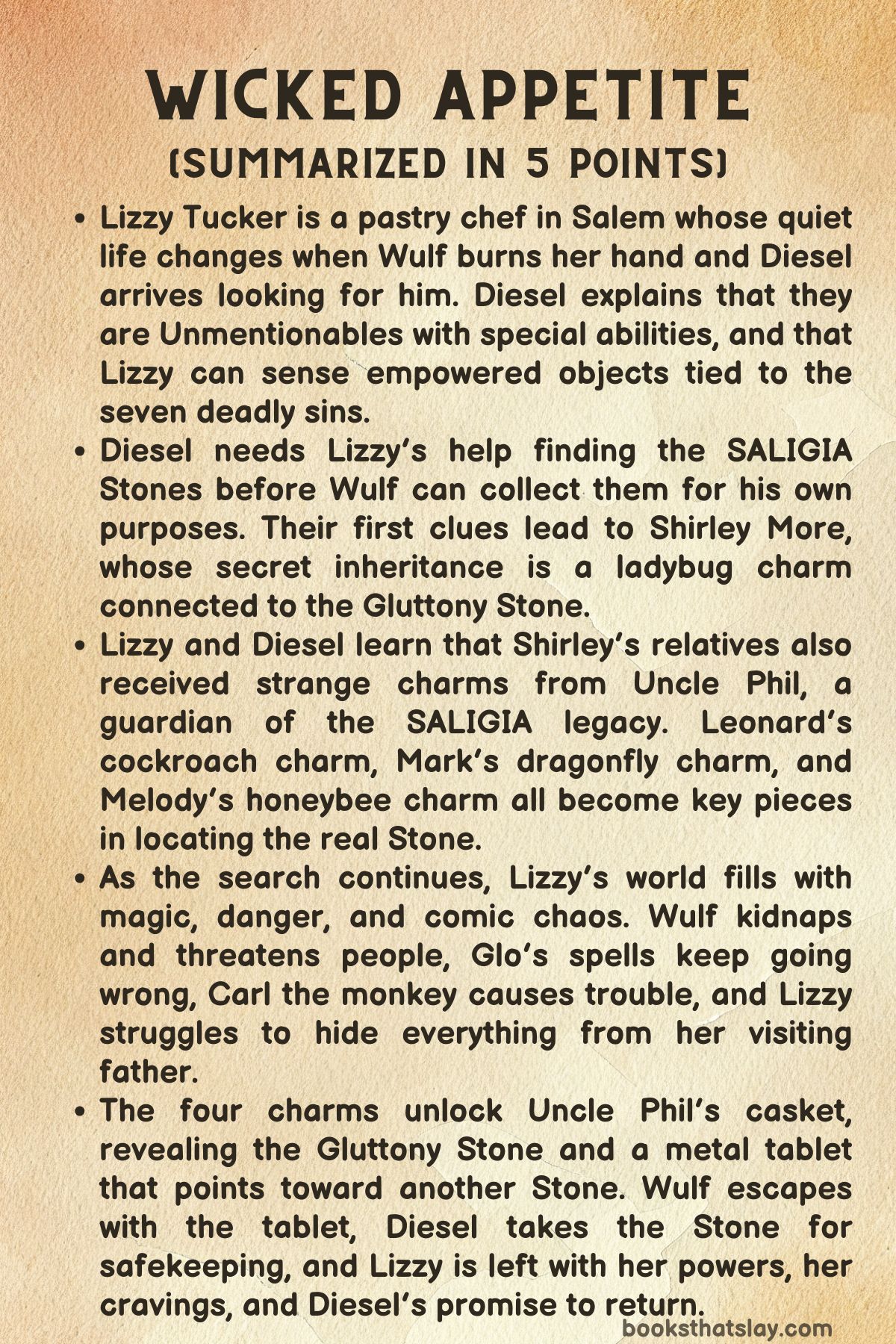
Lizzy Tucker works as a pastry chef at Dazzle’s Bakery in Salem and lives in an old house in Marblehead that she inherited from her Aunt Ophelia. Her life is peaceful, practical, and mostly ordinary until Gerwulf Grimoire, known as Wulf, appears outside the bakery.
He is strange, intense, and clearly dangerous. When he touches Lizzy’s hand, the contact leaves a painful burn.
Lizzy does not understand what has happened, but the encounter marks the start of a series of events that pull her out of her normal routine.
Soon after Wulf’s appearance, another unusual man enters Lizzy’s life. Diesel arrives looking for Wulf and follows Lizzy home.
He breaks into her house and gives her an explanation that sounds impossible: he and Wulf are “Unmentionables,” people with supernatural abilities. Diesel tells Lizzy that she is one too.
Her gift allows her to detect empowered objects, and that makes her important in a dangerous search. Diesel needs her help finding the SALIGIA Stones, ancient objects connected to the seven deadly sins.
Wulf is also looking for the Stones, and Diesel wants to stop him from collecting them.
Lizzy’s friend Glo adds another layer of disorder to the situation. Glo buys an old spell book called Ripple’s Book of Spells and quickly becomes convinced that she can perform magic.
She brings Lizzy a one-eyed cat, Cat 7143, claiming the animal will protect her. Glo’s attempts at spellcasting are enthusiastic but unreliable, and they often create more problems than they solve.
Appliances behave wildly, fires start, objects move, and Glo’s broom even escapes. Lizzy has to manage the supernatural threat around her while also dealing with her friend’s chaotic experiments.
The first real lead in the search is Shirley More, a customer at Dazzle’s Bakery who buys unusually large amounts of cupcakes. Diesel suspects Shirley’s family may be connected to the Gluttony Stone.
He believes her family once guarded it, and that one of the objects in Shirley’s possession may be a clue. Lizzy and Diesel search Shirley’s apartment but find nothing at first.
Glo then tries to use a truth spell on Shirley, but because she does not have a required ingredient, the spell goes wrong and causes Shirley to speak nonsense. Eventually, Lizzy learns that Shirley received a secret inheritance from her Uncle Phil: a ladybug charm.
When Lizzy holds it, the charm heats in her hand, confirming that it is empowered.
Shirley explains that her stepbrothers, Leonard and Mark More, also received secret inheritances from Uncle Phil. This gives Lizzy and Diesel their next leads.
Leonard has become obsessed with punishment and bondage, an obsession that seems tied to the influence of one of the charms. His charm is hidden inside a booby-trapped rubber chicken.
When the trap goes off, Leonard’s house is destroyed, but Lizzy later finds the cockroach charm in the wreckage. The search then moves to Mark, who runs a mint business and has developed a strange fixation on locks.
Mark’s charm is a dragonfly, but Wulf reaches him too. Wulf burns Mark and takes the dragonfly charm before Lizzy and Diesel can secure it.
The investigation expands when Lizzy and Diesel discover another relative, Melody. She is overwhelmed by children, and her life reflects another form of uncontrolled craving.
Lizzy identifies Melody’s honeybee charm as the fourth piece connected to the hidden Gluttony Stone. As more charms appear, Lizzy starts feeling their effects directly.
When she is near them, she experiences powerful cravings for food, possessions, babies, sex, and nearly anything else that can be desired. The charms do not simply point toward gluttony in the narrow sense of overeating; they stir up a wider hunger for excess.
Wulf remains a threat throughout the search. He kidnaps people, manipulates events, and stays one step ahead whenever he can.
He is helped by Steven Hatchet, an unstable man from Florida who can also sense empowered objects. Hatchet serves Wulf while dressing like a medieval knight, complete with sword and strange behavior.
He is ridiculous, but he is also dangerous because he is unpredictable and armed. Wulf’s presence keeps pressure on Diesel and Lizzy, while Hatchet adds a constant risk of violence.
Diesel’s own life becomes messier when he ends up responsible for Carl, a rude monkey with terrible manners. Carl causes trouble everywhere he goes, but he also proves useful when the situation becomes dangerous.
At the same time, Lizzy’s father visits, making it even harder for her to hide what is happening. She has to explain Diesel’s presence, Carl’s behavior, Wulf’s threat, and the strange events happening around her while trying not to reveal the truth.
Her home, which once represented stability, becomes crowded with secrets, lies, magical objects, and unwanted visitors.
At one point, Wulf abducts Lizzy and gives her important information. He tells her there are four charms, not three, and all four are needed to locate the real Gluttony Stone.
This confirms that the bug charms are not the Stone itself but keys or markers connected to it. The trail leads back to Uncle Phil, who had been a SALIGIA guardian.
His grave has been disturbed, and Wulf has obtained Phil’s ornate casket. The casket becomes the central object in the final stage of the search.
Wulf arranges a meeting involving Diesel, Lizzy, Hatchet, Cat, and Carl. The four bug charms fit into carvings on the casket.
When placed correctly, they unlock it. Inside are the Gluttony Stone and a metal tablet, but Uncle Phil’s body is missing.
The discovery shows that Phil’s death and burial were not as simple as they seemed, and that the casket was designed to protect more than one powerful object. Wulf wants the tablet because it can lead to another Stone.
Diesel wants the Gluttony Stone so it can be delivered to the BUM for safekeeping.
Diesel and Wulf agree to divide the objects: Wulf will take the tablet, and Diesel will take the Gluttony Stone. Before the exchange can settle, Hatchet acts on his own.
He grabs the tablet and takes Lizzy hostage with his sword. The danger quickly turns physical.
Cat attacks Hatchet’s arm, and Carl bites his ankle, giving Diesel the opening he needs to stop him. The rescue works, and Lizzy is freed.
Wulf keeps the tablet and disappears, while Diesel takes possession of the Gluttony Stone.
When Lizzy touches the Stone, its power rushes through her, proving that her ability to sense empowered objects is still active and strong. The Stone is secured for the moment, but the larger danger is not finished because Wulf has escaped with the tablet, which may help him find another SALIGIA Stone.
Lizzy returns home still affected by the Gluttony Stone’s power and struggling with intense cravings. Diesel tells her to stay put until he comes back, then kisses her before leaving.
The story ends with the immediate search resolved, but with Lizzy’s strange new life clearly continuing beyond this first adventure.
Characters
In Wicked Appetite, Janet Evanovich builds the story around characters whose ordinary lives collide with supernatural temptation, ancient power, and comic disorder. Each character contributes to the novel’s mixture of mystery, fantasy, romance, and humor, while also showing a different response to desire, fear, control, and chaos.
Lizzy Tucker
Lizzy Tucker is the central character of the book and the emotional anchor of the story. At first, she appears to be an ordinary pastry chef living a quiet life in Salem and Marblehead, focused on her work at Dazzle’s Bakery and on maintaining the peaceful home she inherited from Aunt Ophelia.
Her normal routine makes the arrival of Diesel, Wulf, and the SALIGIA mystery feel especially disruptive. Lizzy’s importance comes from her hidden ability to detect empowered objects, a power she does not fully understand at first but gradually accepts as part of herself.
This makes her valuable to both Diesel and Wulf, placing her in danger even though she never asked to be involved.
Lizzy is practical, cautious, and often overwhelmed, but she is not weak. Her strength lies in her ability to keep functioning even when her life becomes absurdly chaotic.
She deals with break-ins, magical objects, strange men with supernatural abilities, a troublesome monkey, a one-eyed cat, failed spells, and dangerous kidnappings, yet she continues moving forward. Her reactions are believable because she does not instantly become fearless or heroic; instead, she learns to cope with danger while still being confused, annoyed, frightened, and tempted.
Her character also shows the theme of temptation very clearly. As the charms begin affecting her, Lizzy experiences intense cravings for food, possessions, babies, sex, and other desires.
These moments reveal how vulnerable even a sensible person can be when desire is amplified beyond normal limits. Lizzy’s struggle is not only external, against Wulf and Hatchet, but also internal, as she has to resist forces that distort her own wants.
By the end of the story, she remains imperfect and still affected by the Gluttony Stone, but she has become more aware of her power and more deeply tied to the supernatural world she once knew nothing about.
Diesel
Diesel is one of the most important supernatural figures in the novel, acting as Lizzy’s protector, guide, and unpredictable partner. He enters her life abruptly and without much respect for normal boundaries, even breaking into her house, but his role is not purely threatening.
Unlike Wulf, Diesel’s purpose is to keep dangerous magical objects away from those who would misuse them. He explains the existence of Unmentionables and introduces Lizzy to the hidden world connected to the SALIGIA Stones.
Diesel is confident, physically powerful, humorous, and often casual in dangerous situations. His relaxed attitude can make him seem irresponsible, but beneath that ease is a serious commitment to preventing Wulf from gaining too much power.
He understands the stakes better than Lizzy does and often tries to keep her alive while also needing her ability. His relationship with Lizzy is complicated because he uses her help, invades her space, and withholds some control over events, yet he also protects her and gradually becomes someone she can depend on.
As a character, Diesel brings both romantic tension and comic energy to the story. His connection with Lizzy is marked by attraction, teasing, irritation, and trust.
He is not presented as a conventional hero who explains everything neatly or behaves politely; instead, he is a disruptive force who pulls Lizzy into danger while helping her survive it. His kiss before leaving at the end suggests that his bond with Lizzy has become more personal than professional, leaving their relationship open, charged, and unresolved.
Gerwulf “Wulf” Grimoire
Gerwulf “Wulf” Grimoire is one of the darkest and most mysterious characters in the book. From his first appearance outside the bakery, he creates a sense of danger through his ability to burn Lizzy simply by touching her hand.
Wulf is an Unmentionable like Diesel, but his goals and methods are far more sinister. He wants the empowered objects for his own purposes, and he is willing to kidnap, manipulate, threaten, and injure others to get them.
Wulf’s character is effective because he is not merely loud or openly chaotic; he is controlled, elegant, and frightening. He often behaves with calm confidence, which makes his violence feel more chilling.
His knowledge of the charms, the casket, and the hidden structure of the Gluttony Stone mystery shows that he is intelligent and patient. He is dangerous not only because of his powers, but because he understands how to use fear, secrecy, and temptation to move people into the positions he wants.
Wulf also serves as a contrast to Diesel. Both men belong to the supernatural world, both are powerful, and both seek the objects connected to the Stones, but their moral directions differ sharply.
Diesel wants containment and protection, while Wulf wants access and advantage. Wulf’s decision to take the tablet rather than the Gluttony Stone shows that he is thinking beyond the immediate prize.
He remains a continuing threat because his real ambition extends past one object, making him one of the most morally dangerous figures in the story.
Glo
Glo is Lizzy’s friend and one of the book’s main sources of comic chaos. Her purchase of Ripple’s Book of Spells leads her to believe that she has magical power, even though her attempts at magic usually go wrong.
Glo’s spells create confusion, danger, and absurd humor, from failed truth spells to wild appliances, fires, and a flying broom. Her actions often complicate Lizzy’s already difficult life, but they also make her a lively and memorable presence in the story.
Glo’s character is defined by enthusiasm. She is curious, impulsive, and eager to believe in magic.
Unlike Lizzy, who is hesitant about the supernatural world, Glo embraces it almost immediately, even when she does not understand what she is doing. This makes her funny, but it also shows a deeper desire to feel special and powerful.
She wants to participate in the mystery, not merely watch from the side.
Despite her mistakes, Glo is not portrayed as cruel or selfish. She genuinely wants to help Lizzy and protect her, even when her methods are disastrous.
Bringing Cat 7143 to Lizzy as protection shows her loyalty, even if the situation is strange. Glo adds warmth to the book because her friendship with Lizzy remains constant amid the danger.
She represents the comic side of belief: the willingness to leap into magic before fully understanding its consequences.
Cat 7143
Cat 7143 is a strange and memorable animal character who becomes part of Lizzy’s unusual household. As a one-eyed cat brought by Glo for protection, Cat initially seems like another odd detail in a life that is becoming increasingly bizarre.
However, the cat eventually proves useful, especially when Hatchet takes Lizzy hostage. By attacking Hatchet’s arm, Cat helps create the opening that allows Lizzy to survive the confrontation.
Cat’s role is important because the story repeatedly turns seemingly ridiculous details into meaningful ones. At first, Cat may appear to be only comic decoration, but the animal’s protective action gives it real value.
Cat also strengthens the atmosphere of magical oddity surrounding Lizzy’s home. The name itself, Cat 7143, sounds impersonal and strange, which makes the cat feel less like an ordinary pet and more like another mysterious object in Lizzy’s new world.
Symbolically, Cat represents unexpected protection. Lizzy is often surrounded by forces stronger than she is, and she cannot always rely on human control or careful planning.
Cat’s intervention suggests that help can come from unlikely places. In a story filled with dangerous supernatural powers, this small creature becomes a surprisingly effective defender.
Carl
Carl is the rude and troublesome monkey who brings constant comic disruption into the book. At first, he seems mainly like a burden attached to Diesel’s chaotic presence.
His behavior is irritating, inappropriate, and unpredictable, and he often makes Lizzy’s life more difficult. However, like Cat, Carl eventually becomes useful during the confrontation with Hatchet by biting his ankle and helping Diesel stop him.
Carl’s character works as comic relief, but he also reflects the disorder that follows Diesel into Lizzy’s life. Diesel does not arrive alone; he brings danger, explanations, supernatural conflict, and a monkey who refuses to behave.
Carl’s presence makes the supernatural plot feel more absurd and less traditionally serious, which matches the tone of the novel. He turns tense situations into ridiculous ones, preventing the story from becoming too dark.
At the same time, Carl’s usefulness at the end gives him more purpose than simple mischief. The monkey’s actions show that even chaotic characters can matter when danger becomes real.
Carl may not be noble or disciplined, but he helps save Lizzy at a crucial moment. His role reinforces the book’s playful idea that survival sometimes depends on the strangest allies.
Shirley More
Shirley More is an important early figure in the search for the Gluttony Stone. As a Dazzle’s Bakery customer who buys huge quantities of cupcakes, she immediately connects the ordinary world of Lizzy’s bakery to the supernatural theme of gluttony.
Her behavior appears humorous at first, but it becomes significant once Diesel suspects that Shirley’s family guarded the Gluttony Stone.
Shirley is not a villain; she is more of an affected victim of a larger magical inheritance. Her secret ladybug charm links her to Uncle Phil and to the hidden structure of the Stone’s protection.
The charm’s heat in Lizzy’s hand confirms Lizzy’s power and moves the investigation forward. Shirley also provides important information about her stepbrothers and the other inheritances, making her a key bridge between the mystery’s first clues and the wider More family.
The failed truth spell cast on Shirley adds comedy while also showing how innocent people can be caught in the confusion created by Glo, Diesel, and Lizzy’s investigation. Shirley’s role is significant because she shows how the SALIGIA legacy has entered normal family life in distorted and absurd ways.
Through her, the theme of gluttony becomes both literal and magical, tied to appetite, inheritance, and loss of self-control.
Leonard More
Leonard More is one of Shirley’s stepbrothers and another person affected by the strange inheritance connected to Uncle Phil. His obsession with punishment and bondage makes him one of the more disturbing but darkly comic characters in the book.
Like Shirley, Leonard is not simply strange for no reason; his behavior reflects the corrupting influence of the charms and the larger power surrounding the Gluttony Stone.
Leonard’s hidden cockroach charm, placed inside a booby-trapped rubber chicken, fits the novel’s style of combining danger with absurdity. The trap’s explosion and the destruction of his house show how the search for the charms turns ridiculous objects into serious threats.
Leonard’s world is exaggerated and unstable, suggesting that the magical influence has pushed his private impulses into extreme behavior.
As a character, Leonard helps show that the Stone’s protective pieces do not merely sit quietly in the possession of ordinary people. They distort lives.
His obsession reveals how desire and compulsion can take different forms, not only as hunger for food but also as fixation, punishment, and control. Leonard’s role deepens the book’s exploration of appetite by showing that appetite can mean craving for pain, power, ritual, or emotional intensity.
Mark More
Mark More is another of Shirley’s stepbrothers and the keeper of the dragonfly charm. He runs a mint business and has developed an obsession with locks, which makes him another example of how the magical inheritances affect personality and behavior.
His fixation on locks suggests a desire for security, secrecy, and control, all of which connect to the hidden nature of the charms.
Mark’s role becomes especially important because Wulf eventually takes his dragonfly charm after burning him. This moment shows the danger of Wulf’s pursuit more directly.
Mark is not merely questioned or inconvenienced; he is harmed. Through Mark, the story reminds the reader that although the tone is often comic, the stakes are real.
Wulf’s violence turns the charm hunt from a strange investigation into a serious conflict.
Mark’s obsession with locks also has symbolic meaning. He is surrounded by the idea of keeping things closed, protected, and contained, yet he cannot protect the charm from Wulf.
This failure reflects the larger problem of the SALIGIA objects: no ordinary hiding place or personal fixation can truly contain their danger once powerful people begin searching for them. Mark’s character helps advance the plot while reinforcing the theme of control breaking down.
Melody
Melody is another relative connected to the set of charms, and her honeybee charm becomes the fourth piece needed to unlock the casket. Her defining condition is being overwhelmed by children, which connects her to the charm’s influence through feelings of excess, responsibility, fertility, and emotional exhaustion.
Like the other relatives, she is caught in the effects of a magical legacy she does not fully understand.
Melody’s role is quieter than Shirley’s, Leonard’s, or Mark’s, but she is still important because she completes the pattern of the four charms. Her situation also expands the meaning of appetite beyond food or possessions.
In her case, the craving or excess is linked to babies and family life, which affects Lizzy strongly when she is near the charms. This shows that the supernatural force can awaken desires that feel personal and intimate, not merely material.
Through Melody, the book shows that the charm-related compulsions invade ordinary domestic life. Children, family, and caregiving become part of the same magical disorder affecting food, control, and possessions.
Melody’s character helps complete the puzzle while also showing how the Stone’s influence can attach itself to deeply human experiences.
Steven Hatchet
Steven Hatchet is one of the most unstable and dangerous supporting characters in the story. He is a Florida man who can also sense empowered objects, which makes him similar to Lizzy in ability but very different in judgment and personality.
His service to Wulf places him on the threatening side of the conflict, and his medieval knight costume adds a bizarre comic image to his menace.
Hatchet’s character is unsettling because he combines absurdity with real danger. His appearance and behavior may seem ridiculous, but he is capable of taking Lizzy hostage with a sword.
This mixture of foolishness and violence makes him unpredictable. He is not as controlled or elegant as Wulf, but that makes him dangerous in another way.
Wulf is strategic; Hatchet is unstable.
His attempt to grab the tablet shows his greed and impulsiveness. Even though he serves Wulf, he is not fully disciplined.
He wants power for himself, and that desire causes the final confrontation to become more chaotic. Hatchet’s defeat through the combined actions of Cat, Carl, and Diesel gives the scene a comic edge, but his role remains serious because he nearly turns the exchange deadly.
He represents what happens when supernatural ability is joined with obsession, foolishness, and a hunger for importance.
Uncle Phil
Uncle Phil is one of the most important absent characters in the book. Although he is not active in the present action, his role as a SALIGIA guardian shapes the entire mystery.
The secret inheritances he leaves behind lead Lizzy and Diesel to the bug charms, and those charms become the key to unlocking the ornate casket containing the Gluttony Stone and the metal tablet.
Phil’s character is defined through legacy rather than direct action. He appears to have understood the danger of the objects he guarded and arranged for the charms to be separated among relatives.
This suggests caution, secrecy, and responsibility. However, his plan also leaves later generations confused and vulnerable.
Shirley, Leonard, Mark, and Melody inherit objects they do not understand, and their lives become distorted by the charms’ influence.
The disturbance of Phil’s grave and the discovery that the casket contains the Stone and tablet but no body deepen the mystery around him. His absence becomes more intriguing than a simple death.
Phil represents the older generation of guardianship, the hidden history behind the present conflict, and the burden of protecting dangerous power. His choices set the plot in motion, even though the consequences fall heavily on Lizzy and the others.
Aunt Ophelia
Aunt Ophelia is another absent but meaningful figure in Lizzy’s life. Lizzy inherits her old Marblehead house from Ophelia, and that home becomes the main place where Lizzy tries to hold onto normalcy while supernatural chaos invades her life.
Even though Ophelia does not participate directly in the action, her house gives Lizzy a physical and emotional base.
The inherited house matters because it connects Lizzy to family, memory, and independence. Before Diesel and Wulf appear, the house represents Lizzy’s quiet life and her attempt to live on her own terms.
After the supernatural events begin, the same house becomes a place of break-ins, strange visitors, magical confusion, animals, and secrets. This contrast makes Ophelia’s legacy important to Lizzy’s character arc.
Aunt Ophelia’s role is subtle, but she helps establish Lizzy as someone rooted in the ordinary world before being pulled into the extraordinary one. The home she leaves behind becomes a symbol of Lizzy’s old life, which is no longer fully safe or simple.
Through Ophelia’s inheritance, the book gives Lizzy both independence and a stage for the chaos that follows.
Lizzy’s Father
Lizzy’s father appears as a complicating force in her increasingly disorderly life. His visit creates tension because Lizzy has to hide Diesel, Carl, Wulf, and the supernatural chaos surrounding her.
His presence reminds the reader that Lizzy still belongs to an ordinary family world, even though she is now involved in a hidden supernatural conflict.
His role is important because he increases the pressure on Lizzy without being a villain. He represents normal expectations, family concern, and the kind of everyday reality that Lizzy can no longer easily explain.
When he visits, Lizzy is forced to manage two worlds at once: the familiar world of family and the bizarre world of Unmentionables, magical charms, and dangerous Stones.
Lizzy’s father also helps reveal how isolated Lizzy has become in her new situation. She cannot simply tell him everything without sounding impossible or exposing him to danger.
His presence makes the comedy sharper because Lizzy must behave as though things are normal when they clearly are not. In Wicked Appetite, he functions as a reminder of the ordinary life Lizzy is trying, and failing, to preserve.
Themes
Greed and the Pull of Desire
Desire in Wicked Appetite is shown as something comic on the surface but dangerous underneath. The search for the Gluttony Stone turns ordinary wants into overpowering cravings, making people lose control over food, possessions, children, pleasure, and power.
Lizzy’s reactions to the charms show how temptation can enter quietly and then take over the body and mind before a person fully understands what is happening. The charm holders are not simply greedy people; they become exaggerated versions of human weakness.
Shirley’s appetite, Mark’s obsession with locks, Leonard’s fixation on punishment, and Melody’s need for babies all show desire becoming distorted when it is fed by supernatural force. This gives the story its humor, but it also suggests that unchecked appetite can reduce people to impulses.
Lizzy’s struggle matters because she can feel these temptations while still trying to stay rational. Her resistance shows that self-control is not the absence of desire, but the ability to recognize it before it controls every choice.
Ordinary Life Disrupted by the Supernatural
Lizzy begins as someone attached to routine, work, home, and familiar comforts, but her life is quickly invaded by forces she cannot explain. The contrast between her bakery life and the world of Unmentionables creates much of the story’s energy.
Salem, cupcakes, inherited houses, pets, and family visits belong to a recognizable everyday world, while burning touches, empowered stones, broken spells, and magical abilities belong to something far stranger. The humor comes from the fact that these two worlds do not stay separate.
Diesel moves into Lizzy’s personal space, Wulf appears without warning, Glo treats magic like a hobby, and even Lizzy’s home becomes crowded with strange guests and threats. This theme shows how quickly stability can collapse when hidden truths enter ordinary life.
Lizzy’s challenge is not only to solve the mystery of the charms, but to adjust her sense of reality. She has to accept that her quiet life was never as simple as she believed.
Identity and Hidden Ability
Lizzy’s discovery that she is an Unmentionable forces her to reconsider who she is. Before Diesel’s arrival, she defines herself through ordinary roles: pastry chef, friend, daughter, homeowner, and niece.
Her ability to detect empowered objects adds a new identity that she neither asked for nor fully understands. The power is useful, but it is also invasive because touching the charms affects her physically and emotionally.
This makes her gift feel less like a glamorous talent and more like a burden that places her in danger. Diesel treats her ability as essential, while Wulf sees it as something to exploit, leaving Lizzy caught between guidance and manipulation.
Her growing awareness of her power marks a shift from passive confusion to reluctant participation. She does not instantly become fearless or heroic, which makes her development more believable.
Instead, she learns through discomfort, mistakes, and pressure. Her identity expands because circumstances force her to accept a hidden part of herself.
Chaos, Humor, and Survival
Chaos is not just background comedy; it is a way the characters survive fear, danger, and uncertainty. The story repeatedly places serious threats beside absurd situations: kidnappings occur alongside flying brooms, magical mistakes, rude monkeys, strange pets, and awkward family interruptions.
This mixture prevents the supernatural conflict from becoming too dark, while still allowing real danger to remain present. Glo’s failed spells, Carl’s bad behavior, and Lizzy’s attempts to hide impossible events from her father all create a sense that life cannot be neatly controlled.
Yet the chaos also becomes useful. Cat and Carl help during the final confrontation, proving that the ridiculous elements are not meaningless distractions.
They become part of the solution. This theme suggests that survival does not always come from perfect planning or heroic seriousness.
Sometimes people move through danger by adapting quickly, accepting help from unlikely sources, and laughing at situations that would otherwise feel overwhelming. Laughter becomes a form of resilience.