Wings by Aprilynne Pike Summary, Characters and Themes
Wings by Aprilynne Pike is a young adult fantasy novel about identity, belonging, and the shock of discovering that ordinary life has been built on a hidden truth. The story follows Laurel Sewell, a homeschooled teenager who enters public school and tries to adjust to friendships, classes, and family stress.
When her body begins changing in impossible ways, Laurel learns she is not human but a faerie connected to a secret world. The novel blends school life, first love, danger, and magical heritage as Laurel must choose how to protect both her human family and her true origin.
Summary
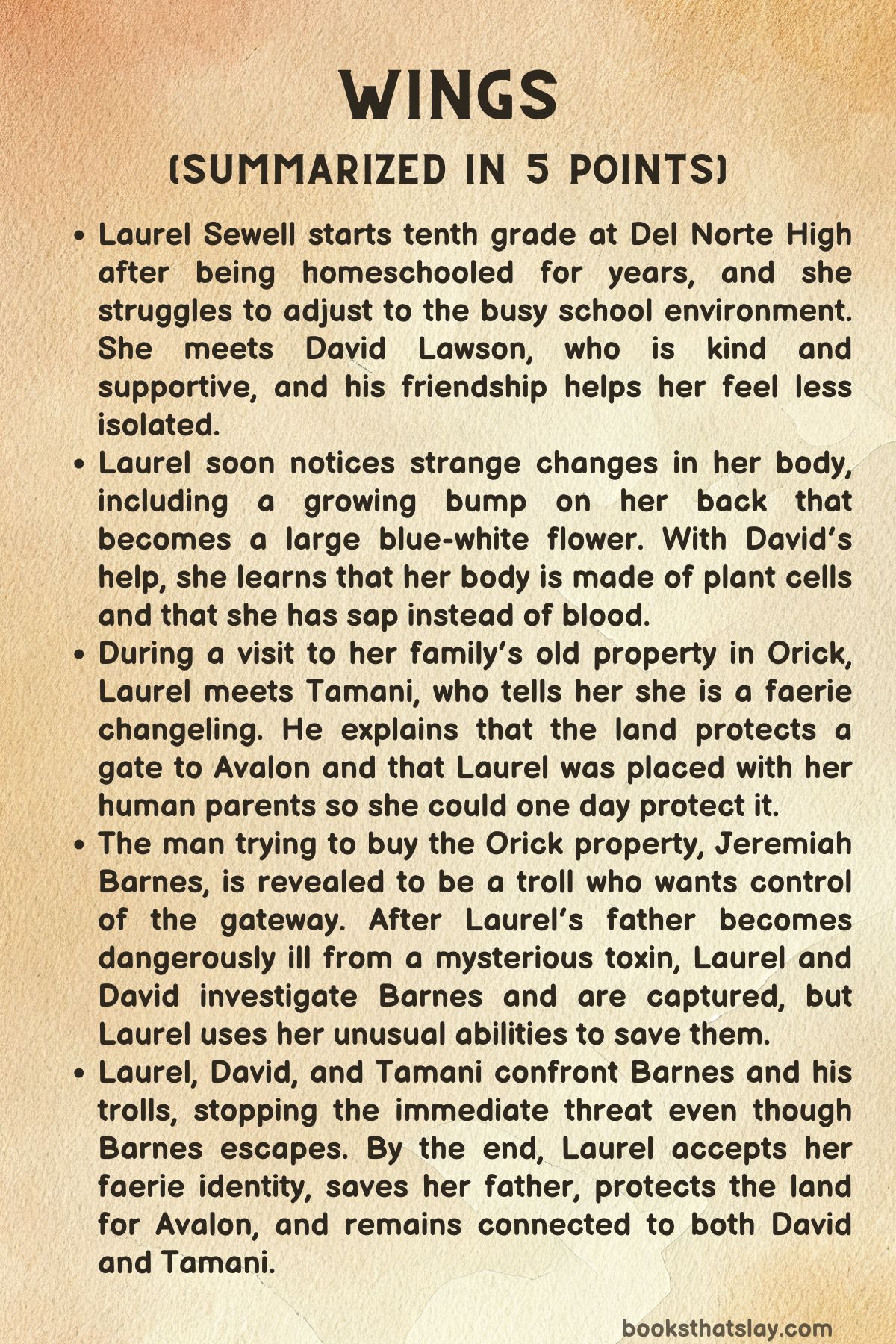
Laurel Sewell begins tenth grade at Del Norte High after spending most of her life homeschooled in Orick. The shift is difficult for her.
The school feels loud, crowded, and unnatural compared with the outdoor life she is used to. She is not comfortable with the noise, the people, or the constant structure of public school.
Laurel has always felt most at ease outside, surrounded by trees and open air, so the halls and classrooms make her feel trapped.
Her first real connection at school comes through David Lawson, a friendly and thoughtful boy in her biology class. David is interested in science and quickly notices Laurel, not in a pushy way, but with genuine kindness.
He makes her feel welcome and introduces her to his group of friends, including Chelsea. At first, Laurel is nervous around them, but David’s patience helps her begin to adjust.
She starts to feel less isolated, even though she still feels different from everyone around her.
At home, Laurel’s parents, Sarah and Mark Sewell, are facing their own problems. They have bought a bookstore in Crescent City, hoping to begin a new life, but they are under financial pressure because their old property in Orick has not yet sold.
A man named Jeremiah Barnes has shown interest in buying it, and the sale seems important to the family’s future. Still, there is something strange and unsettling about Barnes, even if Laurel does not fully understand why at first.
Laurel herself has always been unusual. She does not eat like other people.
She prefers fruits and vegetables, avoids processed foods, and rarely seems to feel truly hungry. She does not get cold easily, has no ordinary teenage skin problems, and has never had a period.
Her parents have mostly accepted these differences as part of who she is, but as Laurel grows older, these odd details begin to feel less harmless. They hint at something much larger.
Soon after she starts school, Laurel notices a bump on her back. At first, she assumes it is a pimple or some kind of skin problem, but it grows quickly.
The change frightens her because it is unlike anything she has ever experienced. She hides it as best she can, trying not to panic.
Then one morning, the lump disappears and is replaced by a large blue-white blossom growing from her back. It looks like a flower, but it is part of her body.
Laurel is terrified and confused. She hides the blossom under loose clothes and a scarf, afraid of what her parents or classmates would think if they saw it.
Since David is skilled with biology and has already earned her trust, she cuts off a tiny piece and asks him to examine it under his microscope. She does not immediately tell him where it came from, but the results are impossible to explain in ordinary terms.
David discovers that the sample is made of plant cells. When Laurel finally admits that the piece came from her own body, they begin testing more carefully.
They examine her cheek cells and find the same thing: they are plant cells too. When David pricks her finger, clear sap comes out instead of blood.
The evidence points to an unbelievable truth. Laurel is not biologically human.
Around this time, Laurel visits the old Orick property and meets Tamani, a mysterious young man who seems to know far more about her than he should. He is beautiful, confident, and connected to the land in a way Laurel does not understand.
Tamani knows about the blossom on her back and is not shocked by it. Instead, he explains that Laurel is a faerie.
Laurel struggles to accept this. Everything about it sounds impossible, yet Tamani’s explanation matches what she and David have discovered.
He tells her that faeries are not tiny winged humans from stories but plant-like beings. Laurel’s blossom is natural for her kind.
Her strange diet, her lack of normal human development, and her unusual body all make sense once she understands that she is a faerie.
Tamani later reveals an even bigger truth. Laurel’s family’s land in Orick is not ordinary property.
It protects a gate to Avalon, the hidden world of the faeries. Tamani has been guarding the area for years.
Laurel was placed with her human parents as a changeling so she could grow up connected to the land and eventually inherit it. Her role was never random.
She was meant to protect the property and, through it, Avalon.
This revelation leaves Laurel torn. She loves her parents and the life she knows, even with all its problems.
She also feels a strong pull toward Tamani and the faerie world he represents. At the same time, David remains steady and loyal.
He is the first human friend who truly helps her understand what is happening to her. Laurel’s feelings become complicated as she grows closer to both boys.
David offers trust and normalcy, while Tamani offers answers and a connection to the truth of what she is.
The danger surrounding the Orick property becomes more serious when Laurel’s father, Mark, becomes gravely ill. His sickness is mysterious, and the doctors cannot cure him.
Laurel begins to suspect that Barnes may be involved. His interest in the property now seems threatening rather than merely strange.
She and David decide to investigate Barnes’s supposed real-estate office, hoping to find evidence of what he is doing.
Their investigation quickly turns dangerous. At the office, they discover ugly, inhuman men who are clearly not ordinary people.
Laurel and David are captured, tied up, and thrown into a river to die. The situation reveals another part of Laurel’s nature: she can survive underwater much longer than a human.
She manages to free herself and David, saving them both from drowning. Hurt and frightened, she makes her way to Tamani and tells him what happened.
Tamani and another faerie named Shar identify Barnes and his men as trolls. The trolls are enemies of the faeries, and Barnes’s goal is to gain control of the Orick land.
If he buys it, he can weaken or destroy the protections around the gate and expose Avalon to danger. The property sale is no longer just a family financial issue.
It is part of a larger threat against an entire hidden world.
Laurel, David, and Tamani return to confront the trolls. Tamani fights fiercely and kills two of them, but Barnes captures him and shoots him.
Laurel is forced to act. She grabs Barnes’s gun and wounds him when he attacks her, though he manages to escape.
David helps Laurel get the badly injured Tamani back to the faerie land, where Shar and the other faeries take him through the gate to Avalon for healing.
Before Laurel leaves, she receives an elixir that can save her father. She takes it to the hospital and gives it to Mark.
The medicine works, and he begins to recover from the mysterious toxin. Laurel also uses the elixir to heal David’s injuries, showing how deeply both her human and faerie worlds now matter to her.
By the end of Wings, Laurel has accepted that she is a faerie changeling. She understands that her life with her human parents was part of a larger plan, but her love for them is still real.
The Orick property remains essential to the protection of Avalon, and Barnes’s plan has been stopped for the moment, though the danger has not vanished completely. David stays loyal to Laurel despite everything he has seen, and Tamani remains tied to the faerie side of her identity.
Laurel’s ordinary life is gone, but she now knows the truth about herself and the responsibility that comes with it.
Characters
Laurel Sewell
Laurel Sewell is the central character of Wings, and her journey is built around confusion, discovery, fear, and gradual acceptance. At the beginning of the book, she is shown as a girl who feels out of place in ordinary human life.
Her discomfort at Del Norte High is not just because she has been homeschooled for years; it also reflects the deeper truth that she does not fully belong to the human world. Her love of nature, her unusual eating habits, her resistance to cold, and the absence of normal human physical changes all quietly separate her from the people around her.
These details make Laurel seem fragile and strange at first, but they later become signs of her hidden identity.
Laurel’s transformation becomes the emotional center of the story when the blossom grows from her back. Her first reaction is fear because the change threatens everything she believes about herself.
She tries to hide it, control it, and explain it scientifically through David’s help. This shows that Laurel is not reckless or easily convinced; she needs evidence before accepting something impossible.
Her struggle is not only physical but also deeply personal because learning she is a faerie changeling forces her to question her family, her body, her past, and her future.
As the book progresses, Laurel becomes braver and more active. She does not remain a frightened girl waiting for others to protect her.
She investigates Barnes, survives a deadly attack, saves David, reaches Tamani for help, and later uses the elixir to save her father. Her courage grows from love and loyalty rather than a desire for power.
By the end of the story, Laurel has not solved every conflict in her life, but she has taken an important step toward accepting that she belongs to both the human world and the faerie world. Her character is compelling because she is caught between two identities, yet she does not abandon either side of herself.
David Lawson
David Lawson is one of the most important human characters in the book because he represents kindness, trust, intelligence, and emotional steadiness. From the moment Laurel enters school, David helps her feel less isolated.
He is welcoming without being forceful, curious without being cruel, and supportive without demanding immediate answers. His role in Laurel’s life begins as friendship, but it quickly becomes much deeper because he becomes the first person in her human world to share the truth of what is happening to her.
David’s scientific curiosity is central to his character. When Laurel asks him to examine the sample from her blossom, he does not dismiss her or panic.
Instead, he studies the evidence carefully and helps her understand the impossible through observation and testing. This makes him a bridge between the ordinary world and Laurel’s extraordinary identity.
He grounds the magical elements of the story in logic, which also helps Laurel process her fear. His reaction to discovering her plant-like nature shows maturity because he does not treat her as a monster or a problem.
He continues to see her as Laurel.
Emotionally, David is loyal and brave. His loyalty becomes especially clear when he helps Laurel investigate Barnes and remains with her even when the danger becomes life-threatening.
After he and Laurel are captured and thrown into the river, his vulnerability shows that he is human and physically limited, but his courage is still real. David’s importance is not based on supernatural strength; it is based on devotion, trust, and moral steadiness.
He cares for Laurel as she is, even when her identity becomes more complicated than either of them expected.
Tamani
Tamani is one of the most mysterious and emotionally significant characters in the story because he connects Laurel to her faerie identity and to the hidden world of Avalon. Unlike David, who helps Laurel understand herself through science and human loyalty, Tamani helps her understand herself through memory, magic, history, and belonging.
When Laurel first meets him, he already knows more about her than she knows about herself, which makes him both fascinating and unsettling. His confidence and beauty make him seem almost otherworldly, but his deep attachment to Laurel gives him emotional warmth.
Tamani’s role as a guardian shows that his life has been shaped by duty. He has spent years protecting the Orick property because it guards the gate to Avalon.
This makes him more than a romantic figure; he is a protector whose responsibilities are tied to the survival of an entire hidden world. His knowledge of Laurel’s past also creates tension because he understands the meaning of her existence before she is ready to accept it.
He does not simply reveal information; he forces Laurel to face a truth that changes everything.
Tamani is also important because he complicates Laurel’s emotional life. He represents a part of her that David cannot fully understand: her faerie nature, her connection to Avalon, and the life she might have had outside the human world.
His feelings for her appear deep and long-standing, but they are also tied to duty and destiny. When he risks himself in the fight against the trolls and is injured, his courage becomes undeniable.
Tamani’s character adds romance, danger, and emotional conflict to the book because he pulls Laurel toward a world that is both beautiful and dangerous.
Chelsea
Chelsea is a supporting character, but she plays an important role in Laurel’s adjustment to school life. As one of David’s friends, Chelsea helps create the social environment that makes Del Norte High less frightening for Laurel.
She represents the normal teenage world Laurel is trying to enter: friendships, school conversations, group dynamics, and ordinary social experiences. In a story filled with secrets and supernatural discovery, Chelsea helps remind the reader of the everyday life Laurel is still trying to maintain.
Chelsea’s importance lies in how she contrasts with Laurel’s hidden reality. While Laurel is dealing with a blossom growing from her back and the discovery that she is not human, Chelsea belongs to the world of normal school relationships.
This contrast makes Laurel’s isolation stronger because even when she is surrounded by classmates, she is carrying a secret that separates her from them. Chelsea does not have the same depth of involvement in Laurel’s supernatural life as David or Tamani, but her presence helps show what Laurel risks losing if her secret becomes impossible to hide.
Sarah Sewell
Sarah Sewell, Laurel’s mother, represents love, family, and the emotional safety of Laurel’s human life. Even though Laurel later learns that she was placed with her human parents as a changeling, Sarah’s role as her mother remains meaningful.
Her love is not weakened by biology because she has raised Laurel, cared for her, and helped shape the person Laurel becomes. Sarah’s importance in the book comes from the stability she provides, especially as Laurel’s identity begins to fall apart.
Sarah is also part of the family’s financial struggle, which gives the story a realistic human problem alongside the fantasy conflict. The bookstore and the unsold Orick property create pressure on the family, making Barnes’s interest in the land seem practical at first.
Sarah does not fully understand the danger surrounding the property, but her life is directly affected by it. Through Sarah, the book shows how Laurel’s supernatural identity is tied to ordinary family worries, including money, security, and trust.
As Laurel begins revealing the truth about herself, Sarah’s role becomes even more emotionally important. For Laurel, telling her parents means risking their fear, disbelief, or rejection.
Sarah therefore represents one of Laurel’s greatest emotional stakes: the hope that love can survive the truth. Her character helps show that family in the story is not only about origin, but also about care, loyalty, and the years spent loving someone.
Mark Sewell
Mark Sewell, Laurel’s father, is important because his illness raises the danger of the story from distant threat to immediate personal crisis. Like Sarah, he represents Laurel’s human family and the life she has known.
His struggle with the mysterious toxin makes Barnes’s villainy personal because the threat is no longer only about land or Avalon; it is about Laurel’s father’s life. This gives Laurel a powerful reason to act.
Mark’s character also shows the vulnerability of the human world when it comes into contact with supernatural danger. Doctors cannot cure him because they do not understand what has harmed him.
His illness exposes the limits of ordinary human knowledge and pushes Laurel closer to the faerie world, where the cure exists. In this way, Mark becomes a turning point in Laurel’s acceptance of her identity.
She must use the truth she has learned about herself to save someone she loves.
Although Mark is not as active in the main conflict as Laurel, David, or Tamani, his presence matters deeply. He represents the emotional cost of Barnes’s plan and the strength of Laurel’s attachment to her human family.
When Laurel saves him with the elixir, it shows that her faerie identity does not separate her from her parents. Instead, it gives her the ability to protect them.
Mark’s recovery becomes one of the clearest signs that Laurel’s two worlds can be connected rather than completely opposed.
Jeremiah Barnes
Jeremiah Barnes is the main villain of Wings, and his character is built around deception, greed, and hidden violence. At first, he appears to be a strange man interested in buying the Sewells’ old Orick property, but his true nature is far more dangerous.
He is actually a troll who wants control of the land because it protects the gate to Avalon. This makes him a threat not only to Laurel’s family but also to the faerie world.
Barnes is frightening because he hides his evil behind ordinary human behavior. His interest in real estate seems suspicious but still believable, which allows him to move close to the Sewell family without immediately revealing what he is.
This deception makes him an effective antagonist. He understands the value of the land and is willing to use manipulation, poison, kidnapping, and violence to get what he wants.
His attack on Mark shows that he has no moral limits when pursuing power.
As a villain, Barnes also forces Laurel to become stronger. His actions push her into danger and make her confront the reality that her identity is tied to a larger conflict.
He is not merely an enemy who wants property; he wants access to Avalon, and that desire threatens an entire hidden world. His escape at the end keeps the danger alive, suggesting that Laurel’s struggle is not fully over.
Barnes matters because he transforms Laurel’s personal discovery into a battle with real consequences.
Shar
Shar is a faerie connected to Tamani and the protection of Avalon. His role is smaller than Tamani’s, but he is important because he represents the organized strength and seriousness of the faerie world.
When Laurel reaches Tamani after escaping Barnes’s attack, Shar helps identify the danger and confirms that Barnes and his men are trolls. This gives Laurel’s fear a clearer shape and shows that the conflict is part of a much larger struggle between faeries and trolls.
Shar’s presence also helps show that Tamani is not acting alone. The protection of the gate is not only a personal mission but part of a broader duty shared by other faeries.
Shar brings authority and knowledge to the situation, especially when Tamani is injured and must be taken through the gate to Avalon for healing. He represents the practical, guarded side of the faerie world, where survival depends on secrecy, discipline, and quick action.
Although Shar is not explored as deeply as the central characters, he adds weight to the story’s fantasy world. Through him, the reader sees that Avalon has defenders, rules, and dangers beyond Laurel’s personal experience.
His character helps expand the book beyond Laurel’s school and family life, showing that her identity connects her to a hidden society with its own responsibilities and conflicts.
Barnes’s Troll Men
Barnes’s troll men serve as physical extensions of his threat. They are ugly, inhuman, violent, and frightening, making the danger around Barnes visible before everything is fully explained.
When Laurel and David discover them at the supposed real-estate office, the situation shifts from suspicion to terror. These men show that Barnes is not working alone and that the threat to the Orick property is organized.
Their cruelty is most obvious when they capture Laurel and David, tie them up, and throw them into the river to die. This moment reveals how merciless the trolls are and how little they value human or faerie life.
They are not complicated characters in an emotional sense, but they are important because they create immediate danger and force Laurel to use abilities she did not fully understand. Her survival underwater becomes a powerful reminder that she is not human.
The troll men also help define the difference between the faerie world and the troll threat. While Tamani and Shar are connected to protection, duty, and healing, the trolls are connected to violence, invasion, and destruction.
Their role in the book is to make Barnes’s plan feel larger and more dangerous. They turn the conflict into a battle for survival, not just a mystery about Laurel’s identity.
Themes
Identity and Self-Acceptance
Laurel’s journey in Wings centers on the shock of discovering that her body, history, and place in the world are not what she believed. Her unusual habits once seemed like private oddities, but the blossom on her back forces her to face the truth that she is fundamentally different from the people around her.
This theme becomes powerful because Laurel does not accept her identity immediately. She questions the evidence, fears what it means, and worries that becoming part of the faerie world will separate her from the human life she values.
Her self-acceptance is not simple happiness; it is a gradual process of fear, denial, investigation, and courage. By learning that her differences have meaning, Laurel begins to see herself not as defective but as someone with a hidden purpose.
Her identity becomes both a burden and a source of strength, especially when her knowledge of herself helps her survive danger and protect those she loves.
Belonging Between Two Worlds
Laurel stands between ordinary human life and the secret faerie world, and much of her conflict comes from not fully belonging to either side. At school, she feels out of place because she has been homeschooled, prefers nature, and does not easily fit into the crowded social world around her.
David gives her warmth and stability, helping her feel accepted in human society. Tamani, however, connects her to a life she never knew she had, offering answers about her origin, body, and purpose.
This creates an emotional divide: David represents comfort, loyalty, and the present, while Tamani represents memory, mystery, and an older identity. Laurel’s struggle is not only romantic; it is about where she can be fully herself.
The theme shows that belonging is not always found in one place. Sometimes a person must carry two worlds inside them and learn how to honor both without losing their own voice.
Protection, Duty, and Sacrifice
The Orick property is more than family land; it is a place tied to responsibility, danger, and the safety of Avalon. Laurel’s discovery that she was placed with her human parents as a changeling changes her understanding of family inheritance into something much larger.
The land is not simply connected to her childhood memories; it is a barrier that protects an entire hidden world from trolls who want access to it. This makes duty personal and frightening.
Laurel does not choose this responsibility at first, yet she is forced to act when Barnes threatens her family and the gateway. David risks his life because of his loyalty to Laurel, while Tamani’s role as a guardian shows long-term devotion to protecting something greater than himself.
Sacrifice appears through physical danger, emotional pain, and the need to make decisions before fully understanding them. The theme suggests that courage often begins when someone protects others despite fear and confusion.
Trust, Loyalty, and Human Connection
Even though Laurel’s true nature separates her from ordinary humanity, her relationships prove that love and loyalty are not limited by biology. David’s reaction to Laurel’s secret is central to this theme.
Instead of rejecting her, he helps her investigate the truth with patience and care. His trust allows Laurel to face terrifying discoveries without being completely alone.
Her parents also matter deeply because, although they do not know the truth at first, their love has shaped the life Laurel is afraid to lose. Tamani’s loyalty is different but equally important; he has watched over her and the land for years, carrying knowledge that Laurel is only beginning to understand.
These relationships give Laurel the courage to act against Barnes and save her father. The theme shows that connection is built through action: keeping secrets safe, staying present during fear, risking danger, and choosing to believe someone when the truth seems impossible.