Last First Kiss Summary, Characters and Themes
Last First Kiss by Julian Winters is a contemporary romance set in Atlanta and California that follows Jordan Carter, a high-achieving event coordinator who’s good at planning everything except his own feelings. After an awkward first date with a woman leaves him rattled, Jordan is pulled back into his past when Jamie Peters—the childhood best friend who gave him his first kiss and later shut down a second chance—reappears as part of Jordan’s biggest wedding client.
With family pressure, workplace competition, and his own uncertainty about identity and desire, Jordan has to decide whether he’ll keep hiding behind professionalism or finally choose the relationship he actually wants. It’s the 2nd book in the 24 Carter Gold series.
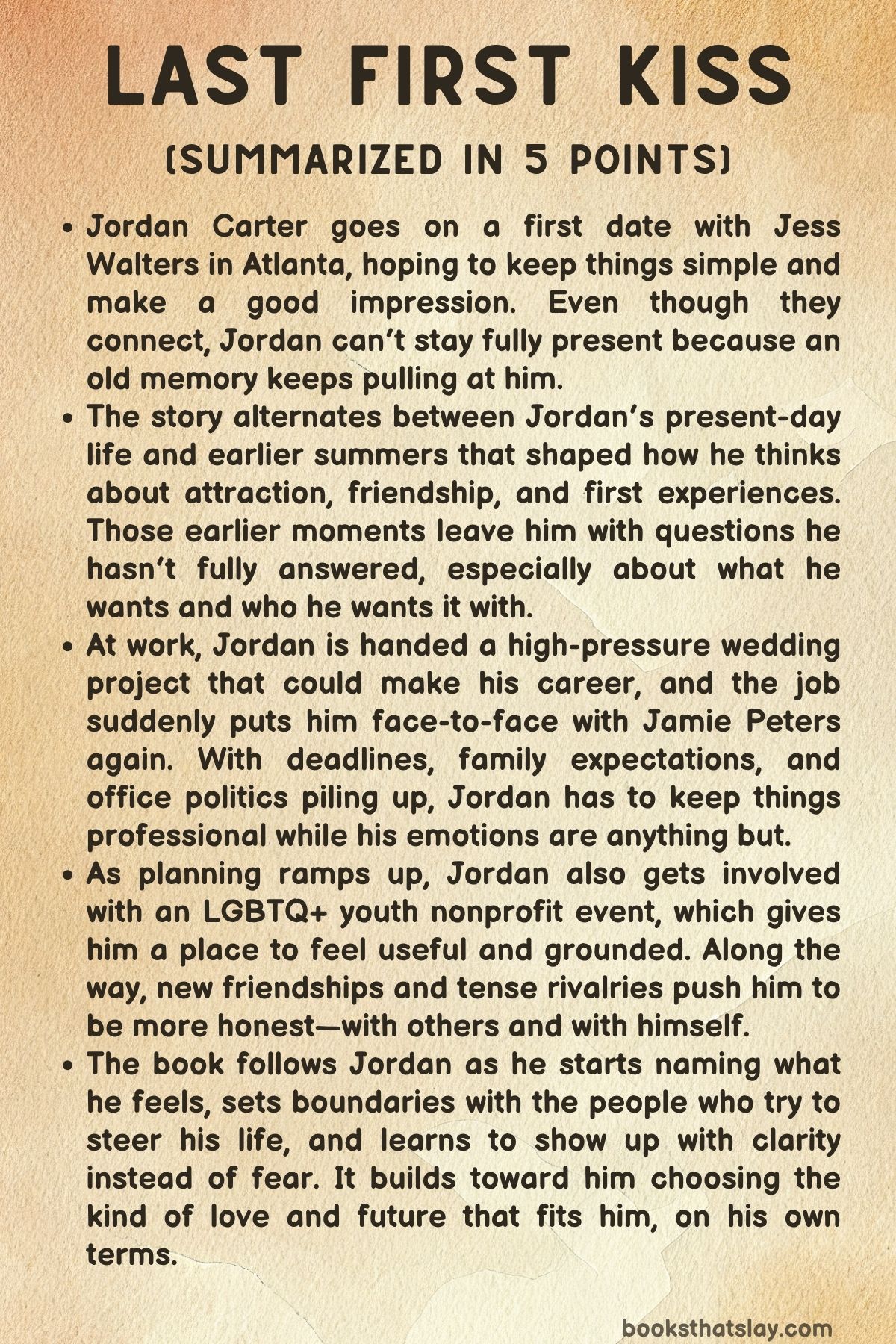
Summary
Jordan Carter goes on a first date with Jess Walters at an Atlanta restaurant, determined to be charming and composed. The conversation is easy at first, and Jess is clearly interested, teasing him about his famous family’s event-planning business and the perks that come with it.
Midway through the date, Jordan spots a bartender whose posture and build trigger a sudden memory. For a few breathless seconds, Jordan thinks he’s seeing Jamie Peters, the friend who left him bruised by a near-kiss months earlier.
The panic throws Jordan off. He fumbles, spills wine, gets tequila splashed on his blazer, and ends up feeling exposed in front of the entire restaurant.
Jess laughs it off at first, but when she invites him back to her place afterward and he declines, her mood turns sharp. She calls the night “tragic” and leaves.
Jordan stays behind, humiliated and angry that thoughts of Jamie can still wreck his focus.
Jordan’s thoughts jump back ten summers to a sleepover in California at his cousin Denz’s house. Denz is out cold after eating too much of a weed brownie, leaving Jordan awake with Jamie, Denz’s best friend.
Jamie is loud, playful, and nosy in a way that makes Jordan feel both cornered and seen. When Jamie brings up a girl who asked Jordan out, he presses Jordan about dating and kissing.
Jordan admits he has never been on a real date and has never kissed anyone. Jamie offers to help him “practice,” teasing him until Jordan realizes Jamie means practicing with him.
Jordan, flustered and competitive, agrees after Jamie makes it a challenge tied to Mario Kart. Jamie cups Jordan’s face and kisses him.
The kiss hits Jordan with a clarity he doesn’t understand yet, and afterward he covers his reaction with jokes, calling Jamie an “average” kisser, even though the moment stays lodged in his mind.
In the present, Jordan wakes the next morning still replaying the disaster with Jess. His routine feels shaky, and even his usual discipline at the gym can’t settle him.
A FaceTime call with Denz adds noise instead of comfort—Denz is dramatic about trivial problems, then cheerfully checks in about Jordan’s life. Jordan insists he’s fine, but the call leaves him thinking about who he is and what he wants.
A Grindr notification pushes him into another spiral. He tries to focus on work as an escape.
Jordan works at 24 Carter Gold, a high-profile event company run by Kami. On the day of a major client meeting, his mother Cheryl corners him at the office, already acting like his date with Jess is step one toward marriage.
Jordan dodges her and heads into the meeting, where Kami announces the company is taking wedding clients again, and Jordan will lead their first major wedding account. The couple is Sam McClintock and Amy Welch, and the meeting includes Sam’s powerful parents, Tom and Lydia, who want a big wedding on an impossible timeline because Tom is leaving for London soon and the family wants Sam’s brother home for the date.
Jordan steels himself to deliver confidence and results.
Then Amy mentions her best man will join them. The elevator doors open, and Jamie Peters walks in.
Jordan’s composure cracks instantly. He scrambles to the restroom, trying to understand how he missed this connection in his research—Amy went to school with Denz and Jamie.
As he’s trying to regroup, the restroom door swings open and smacks him in the forehead, sending him stumbling back. Jamie rushes in, kneels to check him, and jokes through the concern, but when Kami appears, the scene looks suspicious.
Jordan blurts out a clumsy explanation and forces himself back into professional mode.
In the conference room, Jordan runs the meeting successfully, presenting options and promising he can handle the short timeline. Sam and Amy want something practical but romantic, with an engagement dinner in late July and the wedding in late August.
Tom makes it clear money isn’t an obstacle, but reliability is. Jordan agrees, even as he privately panics about spending the summer around Jamie.
After the clients leave, Kami pushes Jordan to move fast. Jordan tries to downplay how thrown he is, but his reaction makes it obvious this isn’t just an inconvenient client detail.
Before Jordan can back out, the company introduces a new hire, Javier “Javi” Velasco, a talented coordinator from a rival firm. Javi needles Jordan with competitive little comments about nepotism and ambition.
He also makes it clear he’d love to take over the McClintock wedding if Jordan slips. Jordan’s pride kicks in.
Determined not to hand Javi a career-making opportunity, Jordan commits fully to the wedding.
Jordan and Jamie’s history keeps resurfacing. Jordan remembers earlier closeness, like the night Jamie met him for pie after Jordan worked a gala, when their joking felt like flirting that neither of them named out loud.
In the present, Jordan tries to avoid Jamie by handling planning logistics remotely, but he can’t dodge in-person vendor meetings forever.
The first major in-person milestone is venue touring with Sam, Amy, and Jamie. Jordan shows them multiple options, but nothing lands until he takes them to Piedmont Conservatory, a botanical property with gardens and a greenhouse.
Amy loves it immediately; Sam worries about heat and rain. Jordan proposes a sunset ceremony with lighting, and explains the greenhouse can serve as a weather backup or even host everything.
He suggests a distinctive detail: Sam and Amy walking down the aisle together. Amy is excited, but Sam still hesitates about using one place for both ceremony and reception.
Jamie steps in and asks Sam to let him demonstrate something. Before Jordan can protest, Jamie takes Jordan’s hand and leads him into the greenhouse.
With music playing, Jamie slow-dances with Jordan while describing how the first dance would look in that space. The demonstration works—Sam is moved and agrees to the venue.
Jordan is left rattled, not only because of the public intimacy of the moment, but because his body reacts to Jamie in a way he can’t talk himself out of.
Immediately afterward, a woman named Sloane Smith arrives and links herself to Jamie with easy familiarity. Amy introduces her as someone Jamie has been seeing.
Jordan’s reaction surprises him: irritation that feels sharper than jealousy should, given that he has no claim on Jamie. Later he broods, scrolls through Sloane’s social media, and tries to shake the feeling by reopening Grindr.
An unsolicited explicit message pushes him to delete the app instead, making him feel even more out of place in his own uncertainty.
Pressure comes from every direction. Javi continues to provoke him at work.
Cheryl keeps trying to set him up with women and treats his love life like a project she can manage. Jordan escapes to brunch with his cousin Nic, who asks him to help plan a one-day basketball tournament for teens at an LGBTQ+ nonprofit, Skye’s the Limit.
Jordan agrees, partly to stay busy and partly because the project feels meaningful in a way his job sometimes doesn’t.
As wedding planning intensifies, Jordan and Jamie spend more time together. During a cake-related appointment in a Pride-decorated neighborhood, Jordan finds himself googling different LGBTQ+ flags, trying to put words to feelings he’s never comfortably named.
Jamie’s presence is steady and complicated. Amy confirms Sloane isn’t in the wedding party and won’t be part of most planning meetings, meaning Jamie will be around Jordan constantly.
Another memory surfaces from the previous summer: Jordan visiting Jamie while he bartended a trivia night, where Jamie flirted openly, hovered close, and acted proud of Jordan’s promotion. Jamie even claimed Jordan as his after-work plan to fend off a bachelorette-party flirtation, then admitted he never needs a special reason to want Jordan around.
Those moments felt like something, even if neither of them dared define it.
During Amy’s wedding-dress fitting, Jordan sees that Amy is anxious and constrained by the McClintock family’s expectations. She admits she once wanted a different kind of life—school, independence, choices that don’t revolve around Sam’s parents.
Jamie tries to lighten the mood, then escalates it by producing weed gummies as a “mood lifter.” The gummies loosen Amy’s fear, and with the help of two strangers who hype her up, she tries on more dresses and finds one she genuinely loves. In the haze of that day, Jordan and Jamie sit close and talk with unusual honesty.
Jordan tells Jamie he has a gift for making hard moments easier for people. The compliment hits Jamie like he’s been waiting to hear it his whole life.
The warmth turns charged when Jamie admits he’s been thinking about the night Jordan tried to kiss him in a parking lot the previous December. Jamie describes what he imagined, and his touch slides into a boundary Jordan is struggling to keep.
The moment breaks when Amy returns, thrilled about the dress. Soon after, Sloane arrives irritated that Jamie hasn’t answered her calls, and she pulls him away for lunch with his parents.
Jordan is left staring after them, repeating to himself that it means nothing.
Jordan’s stress bleeds into everything. He forgets a meeting at Skye’s the Limit and ends up bringing Javi along under pressure.
At the center, Javi surprises Jordan by being genuinely helpful, lining up donations and resources through connections, even booking entertainment. Later, over drinks, Javi shares why he left his previous job: a client pulled a wedding after seeing Pride photos, and his boss didn’t defend him.
Javi also talks about figuring out he was queer through messy trial and error. Seeing Jordan’s confusion, he offers to listen.
Outside, Javi kisses him. Jordan tries, but feels nothing, and pulls away, leaving both of them embarrassed and off-balance.
When Jamie gets sick, Jordan learns Sloane is away and Jamie is alone. Despite his own mess, Jordan drives over in the rain with groceries and medicine.
Jamie’s apartment is chaotic and full of evidence of a life lived half in jokes and half in exhaustion. Jordan makes soup, checks Jamie’s temperature, and takes care of him with a tenderness that feels more honest than any label Jordan has tried on in his head.
Jamie, worn down, finally admits why he has been seen with Sloane: he quit his bartending jobs because he needed stability and health insurance, accepted money from his wealthy parents, and their condition was that he appear with the “right” woman so he looks acceptable at their social events. Jamie says it’s temporary, that he needs space to sort himself out, and that Jordan is his peace.
Jordan is furious for him and protective of him, and he promises he can help.
Then everything collapses at the engagement dinner. Amy is outside crying, feeling small in the McClintocks’ world.
Jordan sits with her, talks too openly, and drinks too much. His frustration with wealthy families spills out, and he encourages Amy to recognize how trapped she feels.
Amy reaches a breaking point and storms back inside declaring it’s over. Jordan tries to follow, trips on the lawn, and ends up sick and helpless.
Javi finds him and, instead of letting the disaster ruin Jordan completely, steps in and manages the aftermath.
At work, Kami calls Jordan in and reveals the wedding is off. The official story is that Jordan got sick and left early and Javi took over.
Jordan realizes Javi covered for him. Jordan confesses the truth to Kami: he crossed professional boundaries and helped push Amy toward the confrontation.
Kami suspends him with pay and pulls him from work, furious that he forgot his role as a planner and treated clients like friends.
Jordan spirals hard during the suspension. Cheryl senses something is wrong and forces her way past his deflections.
Jordan breaks down, admitting the professional disaster and also exposing deeper hurt tied to lifelong rejection and the absence of his biological father. Cheryl and Tevin rally around him, showing up with food, movies, and presence instead of lectures.
At Nic’s basketball tournament, Jordan sees the work he agreed to do actually come to life. He notices Javi helping and understands more clearly what Javi did for him at the engagement dinner.
Nic confronts Jordan directly about Jamie and about his fear of naming himself. She shares that she’s pansexual and tells him he has the right to decide what fits and when to share it.
Jordan admits he isn’t straight but doesn’t know which label fits. He even runs into Jess and learns she’s bisexual and happily dating a woman now, which softens the shame Jordan still carries about that awkward first date.
Jordan and Javi talk honestly afterward, and their rivalry resets into something closer to mutual respect. Then Kami calls Jordan back, admitting she lost sight of the company’s values while chasing publicity.
Jordan isn’t fired, but his promotion is delayed. Someone advocated for him, and Jordan realizes how many people have quietly been in his corner.
Amy appears at Jordan’s office to give closure. She thanks him for saying what he did, even if it wasn’t professional, and tells him she called off the engagement because she refused to lose herself.
She plans to visit her grandfather in Korea and won’t change her goals for Sam. She believes Sam can change if he stops choosing his parents over her.
Before she leaves, she pushes Jordan to stop walking away from Jamie and to let Jamie speak for himself.
Jordan finally chooses honesty. With Nic’s help, he meets Jamie at Skye’s the Limit and proposes a simple game on the basketball court: for each shot Jordan makes, he shares something true; if he misses, Jamie can walk away.
Jordan makes every shot. He tells Jamie he believes he’s demisexual, that he’s never wanted romance the way people expect until Jamie, that kissing Javi felt like nothing compared to what he feels with Jamie, and that he loves Jamie and wants him exactly as he is.
Jamie responds with his own truth: he ended things with Sloane, confronted his parents, and wants to stand up for himself rather than be “saved.” He explains he never wanted Jordan to pick a label to be acceptable—he wanted Jordan to feel like himself. They admit they’ve wanted each other for years, and this time they finally kiss and choose each other openly.
Three months later, Jordan and Jamie are solid. Jordan is in therapy, his nightmares have eased, and his work life has stabilized, even as he and Javi still compete.
Jamie becomes part of Jordan’s loud, loving family world rather than something Jordan keeps separate. At a family dinner, Kami gets engaged, and Jamie tells Jordan he wants a future like that someday.
Jordan agrees, and together they look ahead—messy, real, and no longer hidden.
Characters
Jordan Carter
Jordan is the emotional center of Last First Kiss—a man who performs confidence as a survival skill while privately living in a near-constant state of self-audit. On the surface he’s polished, competitive, and hyper-capable, the kind of person who can run a room, run a timeline, and run from his own feelings all at once.
That tight control is not just personality; it’s armor. The date with Jess shows how fragile that armor becomes when Jamie’s presence—real or imagined—pierces his composure.
Jordan’s spiral isn’t simply about embarrassment; it’s about how desire and memory expose the parts of him he’s tried to keep neatly categorized. His work identity at 24 Carter Gold is built on reliability and precision, but his internal life is messy, tender, and undefined, and he’s terrified that if anyone sees the mess, they’ll decide he’s unfit for love, leadership, or both.
Jordan’s arc is ultimately about choosing honesty over perfection. He’s someone who has spent years treating uncertainty as failure, especially around sexuality and intimacy, and his panic around labels shows how badly he wants a “right answer” that will make him safe.
The story makes it clear that his attraction isn’t casual for him—it’s intensely specific, rooted in trust, history, and emotional closeness—which is why he clings to Jamie while simultaneously fearing what Jamie represents. When he finally speaks plainly at Skye’s the Limit, it’s not a sudden transformation so much as the first time he stops negotiating against himself.
The confession game with basketball is Jordan translated into his own language: he can only tell the truth when it’s structured, measurable, and earned shot by shot. By the end, his growth isn’t that he becomes fearless; it’s that he becomes willing—willing to be seen, to be imperfect, and to let love be something he chooses rather than something he qualifies for.
Jessamine “Jess” Walters
Jess functions as both a genuine romantic possibility and a mirror that reveals Jordan’s unavailability. She’s witty, perceptive, and socially agile—someone who reads subtext quickly and doesn’t need to be spoon-fed what’s happening in a room.
Her teasing about Jordan’s family and the company isn’t mean-spirited; it’s a way of testing whether he can laugh at himself and meet her as an equal. The date initially works because Jess is open and curious, and Jordan, when he’s present, is charming and attentive.
But the night turns into a demonstration of emotional mismatch: Jess wants momentum and clarity, while Jordan is trying to stay upright under the weight of unresolved longing and confusion.
Jess’s cooling after Jordan declines her invitation underscores that she’s not a villain—she’s someone with expectations and boundaries. She interprets his refusal as rejection or disinterest because that’s the most reasonable explanation from her side, and her “tragic” comment lands partly because it’s accurate: it’s not tragic because of spilled wine, but because Jordan is unable to access what he actually wants.
Later, when she reappears content and happy in a relationship that fits her, she becomes a quiet correction to Jordan’s shame. Her life doesn’t stall because of his awkwardness; she moves forward.
That contrast helps Jordan understand that his confusion isn’t a moral failing, but it is something he must take responsibility for—especially if he doesn’t want to keep collateral-damaging the people who offer him real connection.
Jamie Peters
Jamie is the story’s catalyst and its emotional counterpart: where Jordan is controlled and self-policing, Jamie is expressive, physical, and daringly sincere—yet he’s also carrying his own set of restraints. He’s charismatic in a way that can look effortless, but the narrative keeps showing that his ease is often labor.
He knows how to manage a room, soothe people in crisis, and turn discomfort into laughter, which makes him feel safe to others—and ironically makes him feel unseen himself. Jamie’s talent is emotional caretaking, and the ache underneath is that he’s rarely cared for in the same wholehearted way.
That’s why Jordan’s simple recognition—telling him he makes people’s worst days bearable—hits Jamie so hard. He’s not just flattered; he’s starved for that kind of naming.
Jamie’s intimacy with Jordan is consistent across timelines: the “practice kiss” as teens, the near-kiss in December, the slow-dance demonstration, the charged moment in the boutique, and the quiet caretaking in his apartment when he’s sick. Each scene shows that Jamie isn’t toying with Jordan; he’s been drawn to him for years.
At the same time, Jamie’s hesitation is not purely fear of feelings—it’s also ethics and self-awareness. He repeatedly tries not to be the person who pushes Jordan into an identity crisis.
But Jamie is also complicated by family pressure and image management. Accepting his parents’ money and agreeing to be seen with Sloane is a survival compromise that costs him dignity and autonomy, and it exposes the painful split between who he is privately and who he’s expected to perform publicly.
His eventual choice to end things with Sloane and confront his parents isn’t just romantic resolution; it’s Jamie reclaiming authorship of his own life.
What makes Jamie compelling is that he doesn’t become “the solution” to Jordan’s confusion—he refuses that role. He wants Jordan as himself, not as a completed project.
In the end, Jamie’s love is not conditional on Jordan having a label, but it is conditional on honesty. That boundary is the healthiest thing he brings into the relationship, because it forces Jordan to meet him in reality rather than fantasy.
Denz Carter
Denz provides the story’s grounding humor, but his deeper role is relational safety. He’s family, history, and unconditional belonging—someone who can be chaotic and dramatic about fancy tea while still showing up as a steady emotional anchor.
The sleepover flashback positions Denz as the connective tissue between Jordan and Jamie; his house becomes the accidental origin point of Jordan’s first kiss and first real confrontation with desire. Even passed out on pot brownies, Denz’s presence frames the intimacy as something that happened inside friendship, not outside it, which is why it marks Jordan so deeply.
In the present, Denz’s FaceTime call demonstrates the kind of intimacy Jordan can handle easily: affectionate banter, supportive check-ins, and a relationship where Jordan doesn’t have to perform competence. Denz also functions as a symbol of what Jordan is afraid to lose—if Jordan claims himself more openly, will the easy familiarity of those bonds change?
The irony is that Denz is unlikely to be the source of rejection; instead, Denz’s existence quietly argues that Jordan has a family network capable of holding him. Even when Denz isn’t in the room, he represents the version of home Jordan can trust.
Braylon
Braylon appears mostly through Denz’s anxious devotion, which tells you everything you need to know about their dynamic: Braylon is the “fancy tea,” the stable partner energy, the person whose routines and preferences Denz treats as sacred. Even without much page-time, Braylon functions as a model of a queer relationship that is ordinary, domestic, and real—exactly the kind of normalcy Jordan secretly craves but doesn’t think he’s allowed to want yet.
Braylon’s presence in the story is less about plot and more about atmosphere: love exists in Jordan’s orbit, not as a distant concept but as something lived.
Kami
Kami is both mentor and pressure source, embodying how professional ambition can distort values. She’s sharp, strategic, and willing to take bold risks for the company, but she’s also susceptible to external validation—publicity, reputation, and the fear of being seen as failing.
Her decision to reenter wedding planning and place Jordan at the center is flattering but also loaded; she’s asking him to prove himself in a high-stakes arena where one mistake becomes a headline. When the engagement dinner implodes, Kami’s anger isn’t only about professionalism—it’s about control slipping and the company’s image being threatened.
What makes Kami more than a boss archetype is her capacity for self-correction. She eventually admits she pushed a flashy strategy out of insecurity, suggesting she’s not interested in winning at any cost so much as she’s terrified of being judged unworthy.
Her suspension of Jordan is harsh but not cruel; it reads like someone enforcing boundaries because she has to protect the business, while still leaving the door open for growth. Her later engagement also creates a parallel to Jordan’s romantic arc: commitment becomes something chosen publicly, not just felt privately.
Kami ends up representing a version of adulthood Jordan wants—competent, loved, and not ruled by fear.
Cheryl Carter
Cheryl is comic pressure and fierce love braided together. She’s meddlesome in a way that can be exhausting—collecting embarrassing photos, fantasizing about engagement rings, setting up dates, trusting psychics—but her behavior stems from investment, not control for its own sake.
Cheryl wants Jordan safe and happy, and because she believes happiness follows a familiar script, she tries to shepherd him toward it. The story lets her be wrong about the script without making her love suspect.
When Jordan finally cracks, Cheryl’s response reveals her true function: she is the person who turns crisis into care. She doesn’t shame him for the professional mess or for the emotional one.
Instead she rallies support, brings warmth, and reminds Jordan that he’s not alone even when he feels most unlovable. Her presence also connects to Jordan’s deeper wound around his absent biological father; Cheryl’s love is the counterweight to that absence, a living argument that abandonment is not the only story Jordan gets to inherit.
Tevin
Tevin’s role is quiet steadiness, the supportive partner who helps make the Carter family’s loud love functional rather than chaotic. He joins the “sleepover” support night not as an outsider but as part of the emotional infrastructure around Jordan.
Tevin doesn’t need big speeches to be important; his importance is that he shows up, cooks, watches movies, and helps hold the room together when Jordan is unraveling. In a story where Jordan is terrified of being “too much” or “not enough,” Tevin models a kind of acceptance that is uncomplicated.
Kim
Kim operates as workplace normalcy and social glue at 24 Carter Gold. By greeting Jordan and existing as part of the office rhythm, she helps establish what Jordan is trying to protect: competence, reputation, forward motion.
Characters like Kim matter because they represent the audience Jordan imagines judging him. Even if Kim isn’t overtly critical, her presence reinforces why Jordan feels he must keep everything tidy—because people at work see the version of him he’s curated.
Connor
Connor adds another layer of office ecosystem: coworkers who know Jordan as capable and embedded in the company culture. Like Kim, Connor helps show that Jordan’s identity isn’t only romantic confusion; he also has a professional world where he’s respected and expected to lead.
That makes his eventual wobble more threatening to him, because the fallout isn’t just personal embarrassment—it risks the one arena where he feels legible.
Javier “Javi” Velasco
Javi starts as a rival and becomes an unexpected ally, and that shift is one of the story’s most meaningful commentaries on queer solidarity. He enters with sharp edges—needling Jordan about nepotism, hinting he could take the wedding, and pushing competitive buttons Jordan can’t resist.
But the more time they share, the clearer it becomes that Javi’s provocation is partly armor too. He understands how precarious respect can be when you’re queer in image-driven industries, and he’s learned to stay a step ahead by being bold, competent, and a little frightening.
Javi’s backstory with Elite Events reframes him: he’s not simply ambitious, he’s been betrayed by institutions that valued his labor until his queerness became inconvenient. That wound explains his refusal to be naive and his instinct to secure leverage.
His kiss with Jordan is especially revealing because it’s not predatory or manipulative; it’s a human misread, an attempt to connect, and when it doesn’t land, his embarrassment is real. Jordan’s lack of feeling doesn’t make Javi lesser—it clarifies Jordan.
Later, Javi covering for Jordan at the engagement dinner shows the best of him: he protects Jordan not because they’re friends yet, but because he recognizes pain and because he won’t let wealthy clients turn them into disposable staff. By the end, Javi becomes a complicated mirror of what Jordan could be—open, experienced, and still imperfect—while also becoming a teammate in the broader fight to be taken seriously on their own terms.
Nic
Nic is the story’s truth-teller, the person who refuses to let Jordan hide behind competence and jokes. Her involvement with Skye’s the Limit places her values in action: she’s building community, protecting queer teens, and creating spaces where identity isn’t a crisis.
When she confronts Jordan, she does it with the blunt love of family—she’s not demanding a label, she’s demanding honesty with himself. Her own pansexuality matters not as a reveal, but as an invitation: proof that the family circle can hold queerness without drama or exile.
Nic also provides Jordan a path forward that isn’t purely romantic. The tournament planning gives him purpose and structure while he’s unraveling, and it shifts his focus from “What am I?” to “What can I do that helps?” That movement is part of his healing.
Nic’s support during Jordan’s final confrontation with Jamie shows her as both strategist and witness—someone who helps him set the stage, then steps back so he can speak.
Sam McClintock
Sam is positioned as likable but passive, a man whose comfort with privilege has trained him to avoid conflict rather than resolve it. He wants a practical, romantic wedding and seems to care for Amy, but his defining flaw is that he lets his parents’ gravity determine everyone else’s orbit.
His hesitations about venue logistics and his absence from key planning moments reveal a pattern: when pressure rises, he defaults to letting others handle it—Amy, Jordan, or his family machine.
Sam isn’t painted as malicious; he’s painted as underdeveloped in autonomy. When Amy calls off the engagement, his apology and desire for another chance suggest he’s capable of change, but only if he learns to choose partnership over parental approval.
In that sense, Sam functions as a warning model: love without backbone becomes another form of abandonment, even when it’s unintentional.
Amy Welch
Amy is the quiet heart of the wedding storyline and, in many ways, the story’s clearest example of self-reclamation. She begins as someone trying to be agreeable—wanting something big, practical, romantic—yet the narrative consistently shows that her preferences are being edited in real time by other people’s expectations.
Her anxiety at the dress fitting is especially telling: she’s wearing a life someone else picked, trying to convince herself it fits. When she confesses her hopes for a master’s degree and the way Sam discouraged her, you see the deeper cost of her relationship structure: her future is being negotiated as if it’s a shared asset rather than her own life.
Amy’s breakdown at the engagement dinner is a rupture that has been building for a long time. Jordan’s role in it is complicated—he crosses a professional boundary—but the emotional truth he offers her acts like permission.
She doesn’t end the engagement because of one drunken conversation; she ends it because the conversation exposes what she already knows. Her later gratitude to Jordan shows that she’s not naive about boundaries, but she’s also not willing to pretend that politeness is more important than personhood.
Amy becomes the person who chooses herself, and in doing so, she becomes an unexpected guide for Jordan—urging him not to walk away from Jamie, and reminding him that love must include the whole self, not the curated version.
Tom McClintock
Tom represents power that is genial on the surface and absolute underneath. As a successful film director with international commitments, he treats the wedding as a production that must hit a release date—late August—because his schedule demands it.
His willingness to pay “whatever it costs” is not generosity; it’s control framed as convenience. Tom’s influence sets the tone for the entire wedding arc: urgency, spectacle, and a sense that money can compress reality into compliance.
He likely believes he’s being helpful, but his help comes with strings that tighten around Amy and Sam until they can’t breathe.
Lydia McClintock
Lydia embodies the social expectations of the McClintock world: polish, presentation, and tradition as performance. Even when she isn’t loudly domineering, her presence amplifies the pressure Amy feels to fit into a family culture that prizes optics over authenticity.
Lydia, alongside Tom, forms the parental wall Sam struggles to push against. She’s part of why Amy feels like she’s marrying not just Sam, but a dynasty.
Wyatt McClintock
Wyatt’s role is more symbolic than active. As Sam’s older brother in the navy, he represents the version of masculinity and duty the McClintock family can publicly celebrate—structured, respectable, uncomplicated for outsiders to applaud.
The fact that his availability influences the wedding timing highlights how the family’s priorities operate: the event is arranged around what best supports the family narrative, not necessarily what best supports the couple’s emotional needs.
Sloane Smith
Sloane is less a romantic competitor and more a mechanism of social conformity. She arrives linked to Jamie physically—arm in arm, hand in hand—as if her job is to signal “normal” to observers before anyone asks questions.
Her relationship with Jamie is presented as recent and somewhat performative, and the later reveal confirms why: she’s part of an arrangement that allows Jamie’s parents to display him acceptably. That doesn’t mean Sloane is purely an antagonist; she’s operating within the same high-society logic that uses people as props.
Her irritation at Jamie’s unresponsiveness suggests she expects access and priority, which fits the role she’s been given in that ecosystem.
For Jordan, Sloane becomes the trigger for jealousy and clarity. His anger at her existence forces him to admit he isn’t neutral about Jamie.
In that way, Sloane functions narratively as the line Jordan keeps tripping over until he finally realizes he’s already crossed into love.
Meg
Meg injects chaotic social energy and acts as a quick test of Jamie’s impulses. She flirts, she recruits, she drags the scene toward bar-crawl spontaneity, and her presence highlights how easily Jamie can attract attention.
Jamie’s discomfort at the mention of Lucky Mickey’s hints at history—something about that place doesn’t feel safe or simple for him—which gives the reader a glimpse that Jamie’s charm isn’t the whole story. Meg also serves an important purpose: she gives Jamie the chance to publicly claim Jordan (“celebration pie” plans) in a casual way that still carries emotional weight.
It’s one of those moments where Jamie’s default intimacy with Jordan slips out before Jordan is ready to interpret it.
Esteban
Esteban is part of the boutique scene’s mini-chorus of affirmation. He shows up as a stranger willing to intervene kindly, which matters because it demonstrates that support can come from community, not just from the people closest to you.
His encouragement helps Amy move from resignation to agency, and that shift becomes one of the pivotal emotional turns of the wedding plot.
Lach
Like Esteban, Lach functions as a voice of liberating honesty in a setting built on appearances. He helps normalize the idea that Amy is allowed to want something different, and his presence reinforces a theme running throughout Last First Kiss: sometimes the brave thing is not the grand confrontation, but the simple permission to choose what feels true.
Marisol
Marisol, the seamstress, represents craft, competence, and the quiet care that makes reinvention possible. In the dress fitting arc, she’s the person who can actually make the new choice real—altering, adjusting, helping Amy step into a version of herself she recognizes.
Marisol’s role is small but symbolic: transformation isn’t only emotional; it’s also practical, made tangible by people who know how to shape something into fit.
Suraj
Suraj appears as Kami’s partner and eventual fiancé, providing a mature, hopeful parallel to Jordan and Jamie’s trajectory. Their engagement signals stability and future-forward love within the same workplace orbit that has been so stressful and image-conscious.
Suraj’s significance is that he anchors Kami’s softer side and reinforces the story’s closing sense that commitment can be joyful and public without being performative.
Yazzie and Yasmine Romero
Yazzie and Yasmine function primarily as touchstones for Jordan’s earlier attempts to map himself onto heterosexual expectations. Their presence isn’t about romance in itself; it’s about the social script Jordan tried to follow and the confusion he felt when the script didn’t spark real desire.
They embody the “should” that haunted Jordan through high school and into adulthood, making his later realization—his desire is tied to emotional connection, and specifically to Jamie—feel less like a twist and more like a long-delayed recognition.
Juliet
Juliet’s brief appearance is deceptively meaningful because it exposes Cheryl’s assumptions and Jordan’s panic in the same beat. Cheryl arrives ready to orchestrate Jordan’s romantic future, and Juliet’s actual role as an assistant punctures that plan, underscoring how far Cheryl’s matchmaking energy can run ahead of reality.
Juliet also illustrates how Jordan’s life is being watched and managed by people who think they know what he needs, even when they don’t.
Cheryl’s psychic
The psychic is a comic emblem of external narratives imposed on Jordan. Even as a throwaway reference, the idea of a prediction about Jordan’s love life captures how other people try to explain him from the outside, offering tidy certainty where Jordan feels only complexity.
The psychic’s “certainty” contrasts with Jordan’s eventual choice to live without perfect certainty—and to choose Jamie anyway.
Themes
Identity, Self-Definition, and the Pressure to Pick a Label
Jordan moves through his days with a kind of disciplined competence that looks like confidence from the outside, yet his inner life is crowded with questions he has never allowed himself to answer out loud. His reaction to the bartender on the first date with Jess shows how quickly the past can override the present when someone has been avoiding a central truth about themselves.
The panic is not really about mistaken identity; it is about how easily his body remembers Jamie and how that memory threatens the neat, controlled version of Jordan that he tries to perform for other people. Throughout Last First Kiss, Jordan keeps testing himself against expectations—family expectations, workplace expectations, dating expectations—and each test is shaped by the fear that he will be “wrong” in a way that can’t be smoothed over with politeness or hard work.
The Grindr notification that sends him spiraling captures the mismatch between what he thinks he is supposed to do and what actually feels meaningful to him. It isn’t casual desire that organizes his romantic world; it’s emotional safety, history, and connection, and that realization takes time because so much messaging around sexuality focuses on quick certainty and visible proof.
Jordan’s eventual belief that he is demisexual lands as relief rather than a final answer, because the deeper change is his permission to define himself from the inside instead of negotiating his identity through other people’s reactions. Even then, the story does not treat a label as a magic fix.
Jamie’s insistence that Jordan does not need to rush into naming himself pushes Jordan toward something more stable than terminology: self-trust. By the time Jordan chooses to speak plainly about what he wants, he is no longer trying to solve himself like a problem; he is learning to live as himself without apology, even when that means disappointing others or stepping outside the role they preferred him to play.
Emotional Intimacy as the Foundation of Love
The relationship between Jordan and Jamie is charged from the beginning because it is built on closeness that predates romance. The early kiss at the sleepover is not framed as a simple awakening; it functions as a marker of how intensely Jordan experiences connection when it is paired with safety and attention.
He is stunned not only by physical sensation, but by the fact that Jamie is present with him—hands steady, gaze focused, unafraid of the moment. Years later, Jordan’s response to Jamie is still rooted in that same emotional language.
When Jordan declines Jess’s invitation to continue the night, it is not a moral judgment or a lack of interest in intimacy; it is a sign that intimacy without the right emotional conditions feels wrong to him. The story keeps returning to scenes where care and understanding create the real turning points: Jordan making soup for Jamie when he is sick, Jordan noticing Amy’s unhappiness even when it is inconvenient, Jamie’s talent for making hard days bearable for strangers and friends alike.
These moments show love as a practice, not a performance. They also reveal why Jordan cannot force himself into a romance that is primarily about momentum or optics.
His attempt to respond to Javi’s kiss demonstrates the difference between affection as an idea and affection as a lived experience; Jordan can respect Javi, even like him, but his body and heart remain unmoved because the connection is not the kind he needs. With Jamie, the opposite is true: a hand held during a venue tour, a slow dance used as a demonstration, a lingering conversation in a booth—small acts carry enormous weight because they are part of a shared history and an ongoing sense of being seen.
The final confession game on the basketball court works precisely because it matches Jordan’s inner logic. He speaks when he can prove to himself, in real time, that he is choosing honesty over fear.
The romance succeeds not because it becomes louder, but because it becomes clearer, grounded in the specific intimacy they have been building for years.
Class, Reputation, and Control Over Personal Choices
Money and status operate as quiet forces that shape nearly every major conflict, not through melodrama but through the constant tug of what looks acceptable to powerful people. The McClintock wedding is a professional opportunity for Jordan and a public stage for the family, and that imbalance turns wedding planning into a negotiation over control.
Amy’s discomfort reveals how quickly a “dream wedding” can become a disguised demand: the dress her mother chose, the scale she never wanted, the expectation that her future will orbit the McClintocks’ lifestyle. Jordan’s workplace is not immune to the same pressures.
The company’s decision to chase flashy weddings for publicity shows how reputation can replace purpose, especially when leadership feels insecure. Jordan’s ambition is sincere, yet he is repeatedly pushed to treat visibility as the main goal, even when visibility comes at the cost of human needs.
Jamie’s situation with Sloane makes the theme more personal and more painful. His parents’ wealth offers safety, but the support is conditional on him acting as a symbol of the “right” kind of life: a polished partner, a respectable image, a son who can be displayed at high-society events without raising questions.
The arrangement is not presented as simple cruelty; it is presented as a system where love is mixed with leverage, and where acceptance can be revoked if someone refuses to play along. The engagement dinner disaster shows what happens when someone finally says what polite environments forbid.
Jordan’s drunken rant is professionally inappropriate, yet the story also treats it as a release of truth that everyone else has been trained to swallow. The fallout—suspension, reputational fear, silence from clients—demonstrates how institutions protect wealth and appearance first.
At the same time, the resolution does not pretend that individual honesty instantly defeats class power. Amy leaves because she wants her life back, not because she “wins” against the McClintocks.
Jamie confronts his parents because he wants dignity, not because he can guarantee their approval. Jordan learns that career success cannot be built on pleasing influential people at any cost.
The theme ultimately argues for agency: the right to choose one’s partner, one’s future, and one’s values even when money and reputation insist that comfort must be earned through compliance.
Family Influence, Support, and the Long Shadow of Rejection
Jordan’s family is loud, involved, and often comedic in how aggressively they try to manage his romantic life, but beneath the humor sits something more serious: Jordan has been carrying old wounds that make him vulnerable to shame and desperate to appear “fine.” His mother’s eagerness to push him toward women is not just meddling; it reflects a worldview where a “normal” path is safer, and where certainty is treated as protection. Jordan’s instinct is to hide his confusion rather than invite conflict, and that habit is strengthened by a lifetime of trying to be the dependable one.
The revelation about his absent biological father explains why rejection lands so hard for him. When Jamie pulls away from the almost-kiss in December, Jordan experiences it not only as romantic disappointment but as confirmation of an older fear: that wanting someone openly will end with him being left behind.
That fear leaks into everything—his rigid routines, his desire to control outcomes, his overinvestment in professional success as proof of worth. What changes the trajectory is that Jordan is not actually alone, even when he acts like he is.
His cousin Nic offers a model of openness without pressure; she shares her own pansexuality as a way of creating space, not forcing a conclusion. Denz provides warmth and chaos that keeps Jordan tethered to friendship rather than isolation.
Even Javi, initially framed as a rival, becomes part of Jordan’s support system when he covers for him and later speaks honestly about discrimination and the cost of being visible. Most importantly, Jordan’s mother shifts from being a source of pressure to being a source of care once Jordan finally breaks and tells the truth about how badly he is struggling.
The “sleepover” support night with Cheryl and Tevin matters because it rewrites Jordan’s assumption that vulnerability leads to punishment. Jamie’s arc mirrors this theme from another angle: his parents’ conditional acceptance shows how family can become a stage where love is traded for obedience.
The ending does not offer a fantasy of perfect families; it offers something more grounded. Jordan’s family learns, adjusts, and shows up.
Jamie chooses honesty even when it threatens comfort. Jordan chooses therapy and openness as a way to stop living in fear of abandonment.
By the end, family is defined less by who demands performance and more by who stays present when performance drops—who makes room for the messy truth and still chooses you.