A Novel Love Story Summary, Characters and Themes
A Novel Love Story by Ashley Poston is a contemporary romance with a light touch of fantasy, built around the idea of what books can mean to people who feel stuck, lonely, or uncertain about their lives. The story follows Eileen “Elsy” Merriweather, an English professor and devoted romance reader who accidentally finds herself inside the fictional town from her favorite unfinished book series.
What begins as an escape turns into a turning point. Through small-town routines, unresolved grief, and unexpected love, the novel explores healing, friendship, and the difference between hiding in stories and choosing to live fully in your own.
Summary
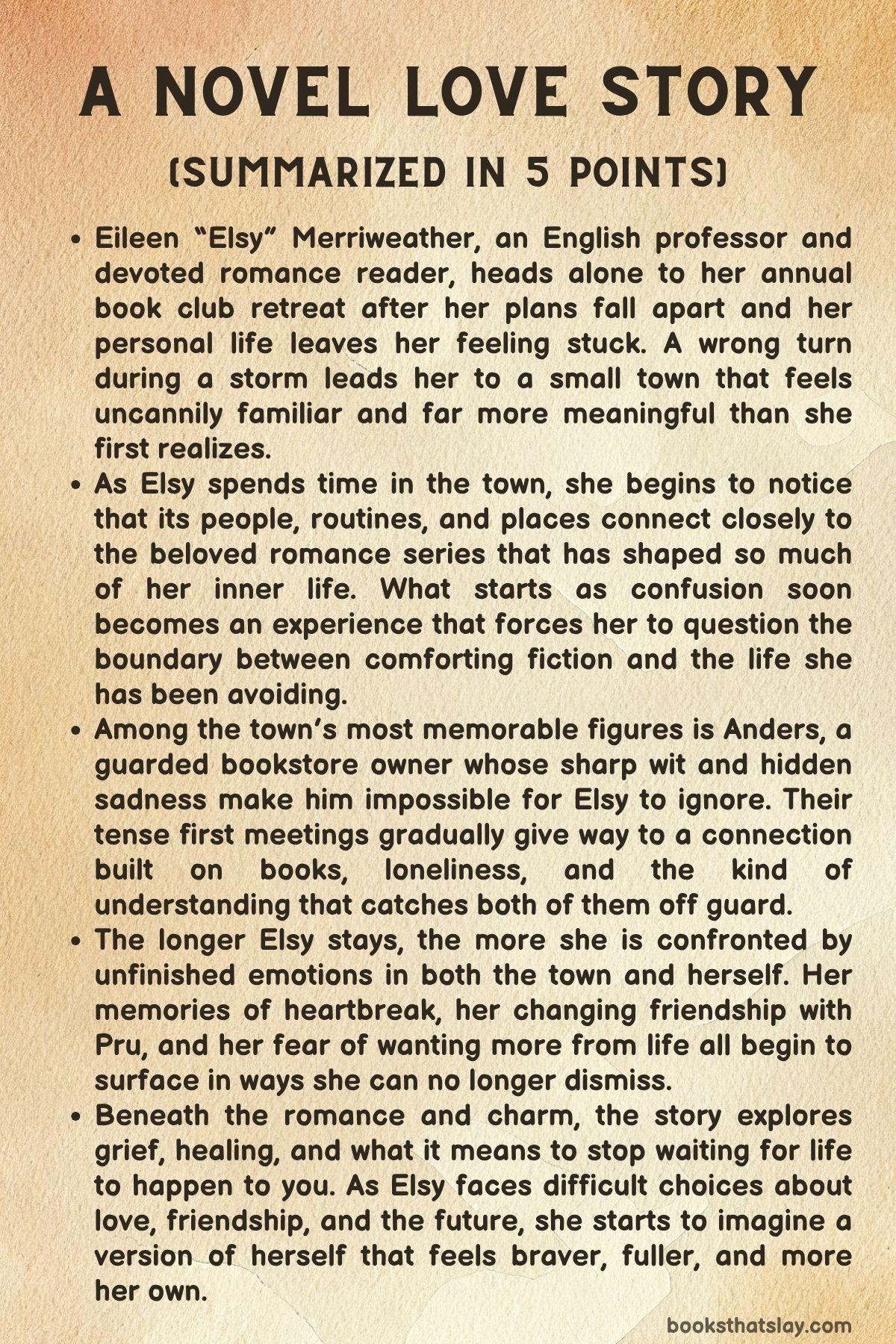
Eileen “Elsy” Merriweather is on her way to a yearly retreat with her online romance book club when a storm knocks her off course in upstate New York. Her old car breaks down near a small town that feels strangely familiar.
Almost at once, Elsy begins to notice details she knows by heart: the town square, the businesses, the rain that falls at noon, even the rhythm of daily life. She slowly realizes that she has somehow entered Eloraton, the setting of the Quixotic Falls series written by her favorite author, Rachel Flowers.
For Elsy, this discovery is overwhelming in the best and worst ways. These books carried her through one of the hardest periods of her life.
Years earlier, her fiancé Liam ended their engagement just before the wedding, telling her that he did not know what she truly wanted because she had shaped herself around his life instead of building one of her own. Not long after that, Rachel Flowers died in a car accident before she could finish the final book in the beloved series.
Elsy clung to the novels, and to her book club, as a way to survive heartbreak and disappointment. So arriving in Eloraton feels like stepping into the safest place she can imagine.
She is taken in by Anders Sinclair, a guarded bookseller who seems to know more than he first admits. He is sharp, private, and clearly unsettled by Elsy’s presence.
He warns her not to interfere with the people of Eloraton. Unlike Elsy, most of the town’s residents do not know they are fictional characters.
As Elsy meets them, she is stunned to find them exactly as she imagined and yet more human than she expected. Junie, Ruby, Maya, Gemma, Will, Jake, and the others all move through their lives as if the novels never ended, though small cracks are beginning to show.
Elsy’s first instinct is to treat the town like a dream she should enjoy before waking up. But she quickly discovers that Eloraton is not frozen as neatly as she once believed.
Some places are incomplete, blurred at the edges where Rachel never filled in details. Some relationships are no longer stable.
Ruby begins to question her life with Jake. Maya feels trapped in a role too small for what she wants.
Lyssa carries feelings she has never confessed. The town is full of unfinished emotional business, as though the missing final book left everyone suspended in place.
While Elsy tries to understand how this impossible place works, she also starts to spend more time with Anders. Their early interactions are tense and funny, shaped by attraction, irritation, and mutual defensiveness.
Yet as they talk, they discover shared habits, private disappointments, and a common devotion to books. Elsy sees that Anders understands romance in a deep, unsentimental way.
He is not simply living in Eloraton; he is protecting it. That protectiveness makes more sense when Elsy uncovers a hidden courtyard filled with statues and markers representing deleted scenes and abandoned versions of a character who all resemble Anders.
She first assumes he must be the hero of the unfinished final novel, left incomplete when Rachel died.
At the same time, Elsy is forced to confront why she does not want to leave. Her car cannot be repaired right away, which keeps her in town longer.
But the delay also exposes a truth she has avoided for years: she is tired of waiting for life to happen to her. She feels left behind by her best friend Prudence, who is moving forward into marriage while Elsy still feels defined by an old breakup.
She has built her identity around being the woman who was hurt, the woman who reads about love instead of risking it. Eloraton offers her an appealing alternative.
In a fictional town, the patterns are known. The emotions are heightened but manageable.
She can belong there without having to invent a new future for herself.
Yet the longer she stays, the less passive she becomes. She apologizes when she oversteps with the town’s residents.
She encourages difficult conversations. She starts to imagine a life that belongs to her, including an old dream of owning a romance bookstore.
Her time with Anders also changes shape. Their banter softens into trust, and trust grows into longing.
He treats her with care and attention she has not allowed herself to expect. He notices what she needs without making her feel small.
Their connection becomes real enough that Elsy begins to hope there may be a place for her in Eloraton after all.
A major revelation changes everything. In a hidden space where reality seems thin, Elsy receives messages from Pru and the rest of her book club.
At the same time, she notices a dedication in one of Rachel’s books to “A. S.” Suddenly she understands that Anders is not a fictional hero waiting for his book. He is Rachel Flowers’s real-life fiancé, a man who found his way into Eloraton after her death and stayed there because it was the closest thing he had left of her.
He preserved the town because it held her imagination, her voice, and traces of their shared life. He was never protecting only a story; he was protecting his grief.
When Elsy learns this, the emotional center of the novel shifts. She and Anders finally speak honestly about Rachel, about loss, and about the way both of them became stuck in the aftermath of people they loved.
Anders shows Elsy the unfinished manuscript Rachel had been writing, which reveals that the final love story was meant to belong to Maya and Lyssa. Rachel had not abandoned her world; she had simply not lived long enough to complete it.
Elsy’s arrival has stirred the town into motion again, allowing people to make choices instead of endlessly repeating old ones.
This leads to a series of small but meaningful resolutions. Ruby and Jake confront their problems.
Junie and Will move toward marriage. Lyssa and Maya finally acknowledge their feelings.
Elsy also sees that she cannot remain in Eloraton forever, no matter how much she loves it. To stay would mean becoming a side character in a world that was never truly hers.
For the first time, she understands that wanting safety is not the same as wanting a life.
At Junie and Will’s wedding, Elsy shares one last beautiful evening with Anders. He admits that Rachel would not have wanted him to remain suspended in memory forever.
Elsy helps him see that Rachel did write pieces of him into the series, even if not as one clear character. He belongs to her story, but not as a man condemned to live inside it.
Then Bea returns to town, a figure closely tied to Rachel’s self-image in the books. When Elsy sees the charged recognition between Bea and Anders, she realizes she does not need to force an ending.
She chooses to leave with gratitude rather than bitterness, trusting what they had without demanding certainty from it.
Back in the real world, Elsy reunites with Pru and finally tells the truth about what has happened to her, not just the impossible parts but the emotional ones. She begins making choices that reflect who she is now.
She goes on a date and refuses to accept disrespect. She stands up for herself at work.
Most importantly, she acts on her dream. With Pru and the support of their book club friends, she opens a romance bookstore called The Grand Romantic.
Building it is messy and risky, but it is hers.
Months later, at the bookstore’s successful opening, Elsy feels something she has not felt in years: at home in her own life. Then Anders appears.
He has left Eloraton behind and taken time to rebuild himself before finding her. He tells her he does not want to be a perfect ending.
He wants to be part of a real life with her, including all its uncertainty. Elsy accepts that love does not need a guaranteed conclusion to be worth choosing.
In the end, home is no longer a fictional town from a beloved series. Home is the life she has made, the people she has chosen, and the future she is finally willing to enter.
Characters
Eileen “Elsy” Merriweather
Elsy is the emotional center of the novel and the character through whom its biggest ideas are examined. At the start, she is intelligent, funny, deeply well read, and emotionally stalled.
She has built a life around books, routines, and safe forms of longing because real disappointment has wounded her confidence. Her failed engagement did not simply leave her heartbroken; it left her unsure of who she is when she is not adjusting herself to someone else’s wants.
That is why her arrival in Eloraton matters so much. The town offers her something she has been craving for years: a place where she feels seen, comforted, and protected by story.
What makes Elsy compelling is that her conflict is not merely about romance. Her deeper struggle is with agency.
She has spent so long identifying herself through loss that she has almost stopped imagining a future she can shape. Even her attachment to fiction carries two meanings.
On one hand, books have genuinely saved her, giving her hope, language, and community. On the other, she has started using them as shelter from risk.
Her journey is about learning that stories can guide a person without replacing a life. She does not reject fantasy or romance by the end; instead, she learns how to take what they taught her and act on it.
Elsy is also defined by her tenderness. She cares about fictional people as if they are real, and once she arrives in town, that instinct turns out to be useful as well as messy.
She oversteps because she feels she already knows everyone, but this flaw comes from empathy rather than arrogance. She wants to fix things, protect people, and help them reach the endings she thinks they deserve.
Over time she learns that love is not the same as control, and that people must choose for themselves, even in a world shaped by narrative.
Her growth is especially clear in the final section of the novel. She stops waiting for life to choose her and begins making decisions that reflect her actual desires.
Opening a bookstore with Pru is important not only because it fulfills a dream but because it proves she is no longer living in reaction to old pain. By the end, Elsy becomes what she had not been for years: the main character of her own life.
Anders Sinclair
Anders begins as the classic guarded romantic lead, but the novel steadily reveals that his distance comes from grief rather than simple temperament. He is sharp, observant, dryly funny, and often impatient, especially when Elsy first disrupts the fragile balance of the town.
He seems to know more than anyone else and carries himself like someone used to holding things together alone. That makes him appear stern or dismissive at first, yet beneath that surface is a man who has built his identity around memory and preservation.
His most important trait is that he lives between worlds. He belongs to the fictional town in practice, but not in origin.
This gives him a haunting quality long before the truth is revealed. He is not frozen because he lacks feeling; he is frozen because he feels too much.
He remains in Rachel’s imagined world because leaving would mean accepting that love cannot be preserved by standing still. In that sense, Anders mirrors Elsy.
Both of them are caught in grief, and both have mistaken emotional stasis for loyalty.
Anders is at his best in the quieter moments of the story. His care shows in practical gestures rather than dramatic speeches.
He finds space for Elsy, notices what comforts her, and offers help without making it performative. This matters because her past relationship trained her to expect a love that overlooked her needs.
Anders becomes meaningful not because he is idealized but because he is attentive. He listens.
He adjusts. He treats her like a person with her own inner world.
His arc is about releasing the idea that love is best honored by remaining inside the place where it once existed. He must stop searching for himself only in Rachel’s memory and accept that being loved by her does not require him to stay unchanged forever.
By the end, he chooses movement over preservation. That decision gives his romance with Elsy its real weight.
He does not arrive as a reward or fantasy figure. He arrives as someone who has done the hard work of stepping back into life.
Prudence “Pru”
Pru plays a crucial role even when she is physically absent for much of the central action. She represents the life Elsy still has outside fantasy, and she is the person who knows Elsy well enough to challenge the version of herself she has been hiding behind.
Their friendship is one of the strongest emotional anchors in the book because it is loving without being sentimental. Pru is supportive, funny, loyal, and deeply invested in Elsy’s happiness, but she is also willing to say difficult things.
What makes Pru important is that she refuses to let Elsy confuse passivity with healing. She sees that Elsy has survived heartbreak without fully rebuilding a self beyond it.
Her frustration comes from love, not judgment. The tension between them is believable because it grows from change.
Pru is moving into a new stage of her life, and Elsy fears being left behind. That fear gives their conflict real emotional force.
The novel understands that even strong friendships can be strained when two people are growing at different speeds.
Pru also functions as a reminder that romance is not the only transformative love in a person’s life. The story values her friendship with Elsy as much as any love interest.
Their shared history, their bookish rituals, and even their disagreements show that friendship can be a place of truth and rescue. Pru pushed Elsy toward community when she was drowning in loneliness, and later she helps create the future Elsy finally chooses.
By the end, Pru becomes part of Elsy’s renewal in a direct, practical way through the bookstore. That outcome feels right because Pru has always represented action, momentum, and belief.
She is not just the friend waiting at the edge of the heroine’s story. She is one of the people who helps make that story possible.
Rachel Flowers
Rachel exists mostly through memory, absence, and traces left behind, yet she is one of the most influential presences in the novel. She is not treated like a distant literary icon.
Instead, she feels startlingly human: talented, warm, observant, and capable of creating a fictional world that holds pieces of her deepest emotional life. The novel takes care to show that the connection readers feel to an author can be real and life changing without turning that author into something unreal.
Rachel matters because she is both creator and absence. Her unfinished work leaves a literal gap in the fictional world and an emotional gap in the lives of those who loved her.
For Elsy, Rachel’s books were companionship and comfort during a period of personal collapse. For Anders, Rachel was not merely a beloved writer but the person with whom he built a shared life.
Because of that, Rachel becomes the point where readerly devotion and personal grief meet.
She is also central to one of the novel’s most thoughtful ideas: stories carry their creators, but they do not fully contain them. Eloraton includes pieces of Rachel’s imagination, her emotional preoccupations, and even aspects of her relationship with Anders, yet it is not a complete substitute for her.
That distinction matters. The world she made can offer beauty, healing, and direction, but it cannot undo death.
The people left behind must still decide how to live.
The brief memory Elsy has of meeting Rachel gives her character depth. She comes across as approachable and sincere, someone who loved talking about stories not as products but as shared emotional experiences.
That memory explains why readers inside the novel feel such devotion to her. Rachel is written as someone whose art mattered because she herself cared so deeply about what stories do for people.
Junie Bray
Junie is one of the clearest examples of how the characters in Eloraton exceed Elsy’s fan knowledge. Elsy arrives thinking of Junie as the heroine she adored on the page, but in person Junie is more than a beloved lead.
She is kind, practical, emotionally perceptive, and capable of offering grounded advice without sounding self important. She carries warmth, but she is not soft in a vague way.
She is someone actively building a life.
Her connection to the inn is especially significant. The restoration project reflects Junie’s larger symbolic role in the novel.
She represents the possibility of making a home from damaged things, of choosing care over abandonment, of turning a place with problems into a place where people can rest. This naturally resonates with Elsy, who recognizes in Junie a kind of emotional steadiness she longs for.
Junie is also one of the first people in town to meet Elsy with genuine openness rather than suspicion. She offers hospitality without much fuss, and that generosity allows Elsy to feel welcomed rather than merely tolerated.
At the same time, Junie does not flatter Elsy’s desire to hide. When they speak honestly, Junie encourages her toward communication and courage, especially in relation to Pru.
She understands that avoiding difficult truth only delays real change.
As a character, Junie embodies a mature version of romance. She is loving and hopeful, but not naïve.
Her relationship with Will is secure enough to include renovation stress, strange household problems, and ordinary mess. That grounded quality helps the novel argue that happily ever after is less about perfection than about choosing a shared life again and again.
Will
Will adds warmth, humor, and steadiness to the ensemble. He helps create the sense that Eloraton is not only magical but lived in.
His presence with Junie gives the town a domestic texture that matters a great deal, especially for Elsy, who is drawn to spaces that feel safe, bookish, and welcoming. He is not written as flashy or dominating.
Instead, he is memorable because he feels reliable and sincere.
One of Will’s strengths as a character is the way he supports the tone of the novel. He helps keep the story playful even when larger emotional matters are unfolding.
His comments about the supposedly haunted toilet, his partnership in the inn renovations, and his comfortable familiarity with Junie all contribute to the sense that love lives in ordinary routines as much as in grand declarations.
At a deeper level, Will represents a form of partnership Elsy has not yet experienced: one where affection and daily work coexist. He and Junie do not simply symbolize romance fulfilled.
They symbolize a relationship that continues to require effort, humor, patience, and adaptability. Their wedding near the end carries such emotional meaning because it feels like the continuation of shared labor and care, not just the completion of a romantic arc.
Will’s role may be quieter than that of some others, but he is essential to the emotional architecture of the novel. He helps show Elsy that stability can be joyful rather than limiting, and that home can be built through small, repeated acts of commitment.
Ruby
Ruby is one of the clearest illustrations of how fictional endings can leave unresolved human questions behind. Elsy knows Ruby from the page and has strong opinions about the choices made in her story, especially the decision to stay with Jake instead of pursuing a music career.
Meeting Ruby in person forces Elsy to confront the difference between reading a character and allowing that character an interior life beyond what was published.
Ruby initially reacts badly when Elsy pushes her toward a future she assumes Ruby secretly wants. That moment is important because it humbles Elsy.
Ruby is not a vessel for fan debate. She is a person living with the consequences of her own decisions.
This gives Ruby a quiet dignity. She may be uncertain, restless, or dissatisfied, but those feelings belong to her, not to the readers who interpreted her ending.
Her temporary break with Jake suggests that the novel refuses simplistic ideas of closure. A romantic choice made once is not enough to sustain a relationship forever.
Ruby’s storyline asks what happens after the final page, after the declared ending, after the public moment that readers remember. In that sense, she serves the book’s larger meditation on what stories omit.
People continue changing. Desire shifts.
Commitment requires renewal.
Ruby’s eventual reconciliation with Jake does not erase her doubts; instead, it suggests that repair is more meaningful when both people recognize what has been missing. Through Ruby, the novel makes room for the idea that love must remain alive and active, not just remembered as a decision once made.
Jake
Jake begins as someone Elsy mostly understands through Ruby’s story, but he gains dimension as the novel progresses. He is not malicious or careless in a dramatic way.
His problem is more ordinary and therefore more recognizable: he has become complacent. He loves Ruby, but he has failed to keep showing her that love in a way she can feel.
This makes him a useful counterpoint to Anders, whose care is visible in attention and action.
What makes Jake sympathetic is that he is not presented as beyond growth. When Elsy prompts him to think honestly about his relationship, he does not lash out or retreat into self pity.
He recognizes that his feelings are not enough on their own if he has stopped expressing them. That willingness to reflect allows his reconciliation with Ruby to feel earned rather than convenient.
Jake’s character also helps the novel explore the distance between romantic myth and daily partnership. He is someone who probably assumed that because the big choice had already been made, the relationship would naturally continue on its own.
Through him, the story suggests that love does not disappear through one dramatic betrayal alone; it can also weaken through neglect, habit, and silence.
Though he is not among the most layered figures in the cast, Jake serves an important purpose. He turns one of the series’ old endings into an ongoing emotional reality and helps reinforce the novel’s interest in what comes after the moment readers usually stop watching.
Maya Shah
Maya is one of the most important supporting characters because she directly reflects the condition of incompletion at the heart of the story. She feels trapped, underseen, and secondary in a way that goes far beyond romance.
She senses that her life is smaller than it should be, that she has been denied the fullness of her own narrative. This makes her one of the most self-aware and quietly frustrated people in town.
Her dissatisfaction gives emotional shape to the unfinished manuscript. While other characters are living in suspended development, Maya feels the cost of that suspension most clearly.
She knows there is more to her life than the role she has been assigned. That hunger makes her especially moving.
She is not asking for fantasy or perfection. She is asking for the right to become fully herself.
Her relationship with Lyssa becomes the most direct expression of that possibility. The hesitations, awkwardness, and longing between them carry the emotional charge of something delayed too long.
Maya’s story is not just a side romance waiting to be completed. It is a statement about narrative worth.
She deserves focus, movement, and joy. The revelation that Rachel had in fact been writing her love story gives Maya’s presence an almost restorative power.
She is proof that the future of the town was never meant to be static.
Maya also parallels Elsy in meaningful ways. Both feel sidelined by their own lives.
Both need to believe they are worth risk, change, and centrality. That parallel helps tie the internal and external plots together.
Lyssa Greene
Lyssa is quieter than Maya, but she carries equal emotional significance. She appears at first as one more familiar figure from the town, yet over time she emerges as someone living with fear, restraint, and deeply buried feeling.
Her awkwardness around Maya suggests the damage that can come not from open rejection alone but from years of silence and hesitation.
What defines Lyssa is that she has love but lacks the courage to trust it. She is afraid of making things worse, of saying too much, of risking the fragile normalcy that exists in place of happiness.
That makes her a strong example of one of the novel’s central concerns: how often people remain in emotional limbo because uncertainty feels safer than truth.
Her later conversation with Elsy is one of her most revealing moments. By asking how Elsy can leave someone she loves, Lyssa exposes both her own fear and her own desire.
She is looking for permission, but also for evidence that love is worth the danger of confession. Elsy’s encouragement matters because it allows Lyssa to begin seeing herself as worthy of being chosen.
Lyssa’s eventual movement toward Maya contributes to the sense that the town is waking up from suspension. Through her, the novel suggests that unfinished stories are not only about missing pages.
They are also about people who have not yet allowed themselves to speak.
Gemma Shah
Gemma brings a grounded, lived-in energy to the cast. As the owner of the candy shop and as Lily’s mother, she broadens the emotional range of the town beyond first love and longing.
She represents adulthood that has already moved into domestic reality, complete with routines, marriage, parenting, and practical concerns. That makes her valuable in a story otherwise filled with suspended romantic possibility.
Her presence shows that settled life does not mean life without complexity. Her marriage to Thomas is affectionate, but not static in an idealized way.
Their conversations about intimacy suggest a relationship still capable of adjustment, embarrassment, and curiosity. This lends humor to the story, but it also reinforces a serious point: even established love requires continued openness.
Gemma’s role as a mother matters too. Through Lily, and through her own easy participation in town life, she helps make Eloraton feel multigenerational and textured.
She is part of what gives the town its feeling of home rather than mere concept. She is not just a remembered heroine from an earlier book.
She is a person with responsibilities, history, and a future that continues beyond a romantic ending.
Thomas
Thomas is often used for humor, but he is more than comic relief. His awkward request for help with intimacy advice reveals both vulnerability and trust.
He is a man who loves his wife and wants to meet her honestly, even when the subject embarrasses him. That small scene is funny, but it also humanizes him and grounds the broader romantic atmosphere in something recognizable and ordinary.
He helps show that long-term relationships remain active and adaptive. Rather than being presented as a finished couple who no longer need growth, he and Gemma are allowed to keep changing.
This is a subtle but important rejection of static endings. Thomas is part of the novel’s insistence that love continues in practical, sometimes awkward ways.
His role also contributes to Elsy’s shifting perspective. She starts out overwhelmed by the chance to meet beloved characters, but moments with people like Thomas teach her to see them less as icons and more as full individuals.
He becomes part of her education in what it means to move from consuming stories to actually understanding lives.
Lily
Lily may be young, but she has a meaningful function in the story. She embodies innocence, continuity, and the tactile love of books that runs through the novel.
Her damaged favorite book and Elsy’s effort to help repair it create one of the clearest links between Elsy’s past, her mother’s care, and the nurturing side of her own character. With Lily, Elsy is not performing fandom or escaping pain.
She is simply giving comfort.
Lily also has a quietly revealing effect on the adults around her. She sees things with directness that others avoid.
Her comments about Anders, books, and relationships often cut through awkwardness with surprising clarity. In that sense, she helps move the plot forward not by grand action but by making emotional truths harder to ignore.
She represents what stories are at their best: beloved, worn from use, held close, repaired when needed, and passed from hand to hand. Through Lily, the novel affirms that reading is not only an intellectual or escapist act.
It is also an act of attachment.
Bea
Bea appears late, but her entrance carries major symbolic power. She has long been associated with Rachel’s self-image, which means her return feels charged before she even says much.
She stands at the intersection of fiction and biography more sharply than almost anyone else. When Anders reacts so strongly to seeing her, the moment reveals how deeply memory, creation, and grief are entangled in the town.
Bea’s importance lies less in detailed development and more in what she represents. She is a reminder that Elsy cannot control the shape of other people’s stories, especially when those stories are tied to a past she can never fully inhabit.
Bea’s presence interrupts the temptation to believe Elsy can simply remain and claim a completed ending inside the fictional world.
In this way, Bea becomes part of Elsy’s final lesson. Love does not become less real just because it is not permanent in the form one imagined.
Sometimes the right choice is to leave a story with gratitude and let uncertainty remain. Bea’s arrival helps crystallize that understanding.
Liam Black
Liam is not present for most of the plot, but his influence is substantial because he represents the life Elsy accepted when she did not yet know how to choose for herself. He is not written as a melodramatic villain.
In some ways, that makes his role more effective. He did hurt Elsy deeply, but the relationship failed not only because he left.
It failed because Elsy disappeared inside it, and Liam recognized that imbalance before she fully did.
His role in the novel is to embody a love that was based on accommodation rather than mutual recognition. Elsy organized herself around his preferences, his pace, and his version of adulthood.
That pattern left her with almost no language for her own wants. The damage was emotional, but also existential.
Liam becomes the symbol of the life she might have continued living if she had never been forced to stop.
His late appearance at the bookstore is useful because it confirms how far Elsy has come. She can meet him without collapse, resentment, or longing.
That composure matters. It shows that healing is not just finding someone new.
It is becoming someone who is no longer defined by the person who hurt her.
Mr. Butterscotch
Though not a major figure in the dramatic sense, Mr. Butterscotch adds warmth and tonal balance to the story. As the bookstore cat who trails around Anders, he helps soften the bookseller’s guarded image and reinforces the sense that the store is a place of comfort, eccentricity, and life.
Animals in stories like this often serve as emotional shorthand, but Mr. Butterscotch feels integrated into the world rather than decorative.
He also supports one of the novel’s recurring associations between love and caretaking. A town, a bookstore, a damaged book, a friendship, a grieving heart, even a cat: all of these require attention.
His presence strengthens the atmosphere of domestic affection that makes the final vision of home feel convincing.
Taken together, the characters in A Novel Love Story are effective because they are not arranged only as romantic types. They are people caught between expectation and change, between endings they were given and lives they still need to make.
The novel’s strongest achievement is that it allows both central and supporting figures to ask the same essential question in different forms: what happens when the story you were living in is no longer enough, and you have to choose what comes next?
Themes
Stories as Shelter and as a Way Back to Life
Elsy’s relationship with books gives this novel one of its richest ideas: stories can protect a person, but they can also become a place to hide. For years, romance novels have helped Elsy survive disappointment, loneliness, and the emotional wreckage left by her broken engagement.
Reading is not shown as silly escapism or a lesser substitute for life. It is a real source of comfort, meaning, and survival.
Through books, Elsy finds language for desire, hope after heartbreak, and eventually the friendships that come through her book club. The novel takes her love of fiction seriously, and that matters because it refuses the old assumption that devotion to romance is naïve or unserious.
Instead, stories are presented as emotional architecture, helping people endure periods when ordinary life feels flat, humiliating, or painful.
At the same time, the novel is careful to show the danger of staying too long inside a protected world. Elsy’s arrival in Eloraton externalizes that temptation.
She literally enters the place that has comforted her most, and for a while, the appeal is obvious. In a fictional town, she already knows the rules, the people, the emotional rhythms, and even the weather.
It feels safer than her own future, which remains unwritten and therefore frightening. The town offers not just wonder but predictability.
That is exactly what Elsy has been craving, because uncertainty hurt her before. Yet the novel never allows this fantasy to remain purely comforting.
Eloraton is incomplete, stalled, and fragile. Characters are left suspended because the final story was never finished, and that incompletion becomes a warning.
Fiction can preserve beauty, but it cannot replace motion, choice, and growth.
This theme becomes especially moving because the novel does not ask Elsy to reject books in order to mature. That would be far too easy and far too dismissive.
Instead, it asks her to change the way she lives with stories. She learns that books can inspire action rather than replace it.
They can teach courage, tenderness, and imagination, but eventually she must carry those qualities back into her own life. That is why opening a bookstore matters so much in the ending.
Elsy does not leave behind the world of romance novels. She builds a real life that honors what those books gave her.
In A Novel Love Story, fiction is not the opposite of reality. It is the bridge that helps a person return to reality with more honesty, more bravery, and a clearer idea of what kind of life she wants to make.
Grief, Memory, and the Cost of Standing Still
Grief shapes the emotional climate of the novel even when the scenes are funny, romantic, or whimsical. Both Elsy and Anders are living in the aftermath of losses that froze them in place, and the story pays close attention to how grief can disguise itself as loyalty.
Elsy’s heartbreak over Liam is not only about being left. It is also about losing the version of herself she thought she was building toward.
After the relationship ends, she does not immediately create a new life. She remains paused, caught between who she used to be and who she might become.
Rachel Flowers’s death deepens that paralysis because Elsy loses not just an author but the future of a fictional world that meant a great deal to her. The unfinished series becomes a symbol of her own interrupted emotional life.
Anders offers a more literal and haunting version of the same condition. He has attached himself to Eloraton because it is the closest surviving piece of Rachel, the woman he loved.
His grief is tied to memory, preservation, and repetition. He has chosen a world where nothing has to be fully surrendered, where traces of Rachel’s imagination still shape daily life, where he can feel near her by protecting what she left behind.
This is moving because it comes from love, but the novel also shows the cost. Preservation becomes stagnation.
He is not keeping Rachel alive in any real sense; he is keeping himself from fully entering a life where she is absent. The difference is painful but important.
What gives this theme depth is that the novel refuses to mock either character for holding on. Both Elsy and Anders have understandable reasons for becoming still.
The problem is not that they remember too much; it is that they have confused remembrance with refusal to move. The story gradually teaches them that love does not require permanent suspension.
Rachel can still matter if Anders leaves Eloraton. Liam’s betrayal can still matter if Elsy builds something joyful afterward.
Memory does not become false because life continues.
The resolution of this theme is especially satisfying because it is not about neat closure. Neither Elsy nor Anders stops caring about the past.
Instead, they learn to carry it differently. They allow grief to become part of their history rather than the whole structure of their present.
That change is what makes the final chapters emotionally convincing. The past remains real, but it no longer dictates every choice.
In A Novel Love Story, healing is not forgetting. It is learning that honoring what was lost does not mean giving up the possibility of what might still be found.
Choosing a Life Instead of Waiting for an Ending
One of the novel’s sharpest ideas is that many people live as if they are waiting for a final scene to give everything meaning. Elsy begins the story with that mindset.
She has spent years thinking in terms of arrival, rescue, and emotional completion. The failed engagement left her stranded because she had built her identity around a destination she never reached.
Even her attachment to romance narratives sometimes reflects this habit. She loves stories that promise transformation, but she has trouble imagining how transformation happens through everyday decisions rather than dramatic turning points.
Eloraton, with its set pieces and familiar emotional patterns, intensifies that desire for a shaped and satisfying ending.
The novel steadily pushes against this way of thinking. Inside the fictional town, Elsy sees that endings are not as stable as they look from the outside.
Characters whose stories seemed complete are still dealing with dissatisfaction, miscommunication, longing, and uncertainty. Ruby’s relationship with Jake needs renewal.
Maya and Lyssa remain trapped by hesitation. Junie and Will are loving and secure, yet their life still involves stress, repair, and work.
Even the unfinished manuscript reveals that what readers thought was silence was actually interrupted continuation. The point is not that endings are meaningless.
The point is that they are never the whole story. Life keeps going after the page turns, and people must keep choosing one another, choosing honesty, and choosing themselves.
This theme is most powerfully expressed through Elsy’s final decisions. She realizes she cannot remain in Eloraton simply because it feels magical.
To stay would be to become passive again, to let a ready-made world carry her instead of building one of her own. Leaving is painful because it means accepting uncertainty.
There is no guarantee that her future outside the town will be romantic, easy, or stable. But that uncertainty is also what makes it real.
When she returns to ordinary life and decides to open a bookstore with Pru, she acts without knowing the ending in advance. That choice marks a profound shift in her character.
She is no longer waiting to be gathered into a complete narrative. She is willing to live inside the middle.
The final reunion with Anders reinforces this idea beautifully. He does not come to offer a perfect conclusion or a sealed forever.
He comes offering presence, effort, and a willingness to share an unfinished life. That distinction matters.
The romance becomes stronger because it is no longer about fantasy closure. It is about choosing to begin again without guarantees.
In A Novel Love Story, maturity is not learning to stop wanting romance. It is learning that a meaningful life is not built by chasing endings alone.
It is built in the middle, where risk, work, and love continue without certainty.
Home, Belonging, and Becoming the Main Character of Your Own Life
The novel returns again and again to the idea of home, but it treats home as something more complex than a physical place. At first, Eloraton seems to embody everything Elsy has been missing.
It is warm, bookish, intimate, and emotionally legible. Its bookstore, café, inn, and small-town rhythms feel custom made for her.
More importantly, it offers a sense of belonging that she has not fully felt in her own life. Because she knows the books so well, she enters the town already carrying affection for its people and spaces.
This gives home an almost immediate emotional quality. She is not simply visiting somewhere charming.
She is stepping into a place that has long lived inside her imagination.
Yet the novel gradually complicates this feeling. Belonging cannot rest on recognition alone.
Elsy may love Eloraton, but it is still a world created by someone else, shaped by someone else’s imagination, and suspended within someone else’s unfinished story. To remain there forever would mean surrendering her own authorship.
This is where the theme of home becomes inseparable from identity. Elsy has spent too much time adapting herself to structures built by others, first in her relationship with Liam and then in her emotional dependence on fiction as a safe refuge.
Eloraton gives her insight and healing, but it cannot be the final answer because it is not a life she has chosen into existence for herself.
The contrast between Eloraton and the bookstore she later builds is essential. The Grand Romantic is messy, risky, financially uncertain, and fully real.
It is not magical in the supernatural sense, but it is magical in a human one because it emerges from choice, labor, friendship, and desire. Elsy does not inherit it.
She makes it. She chooses its name, its purpose, and the community it will hold.
In doing so, she transforms her understanding of belonging. Home is no longer the place where she can disappear most comfortably.
It becomes the place where she can appear most fully as herself.
This theme is also connected to friendship and love. Pru is part of home.
Anders becomes part of home. Even Mr. Butterscotch and the rhythms of the shop become part of home.
The ending does not suggest that home must be perfect or permanent. It suggests that home is built through chosen attachments and the courage to inhabit your own life honestly.
That is why the final emotional movement feels so earned. Elsy does not lose her love for stories; she stops needing to live inside someone else’s.
In A Novel Love Story, belonging becomes real only when she claims centrality in her own existence and allows herself to build a future rather than borrow one.