Lost and Lassoed Summary, Characters and Themes
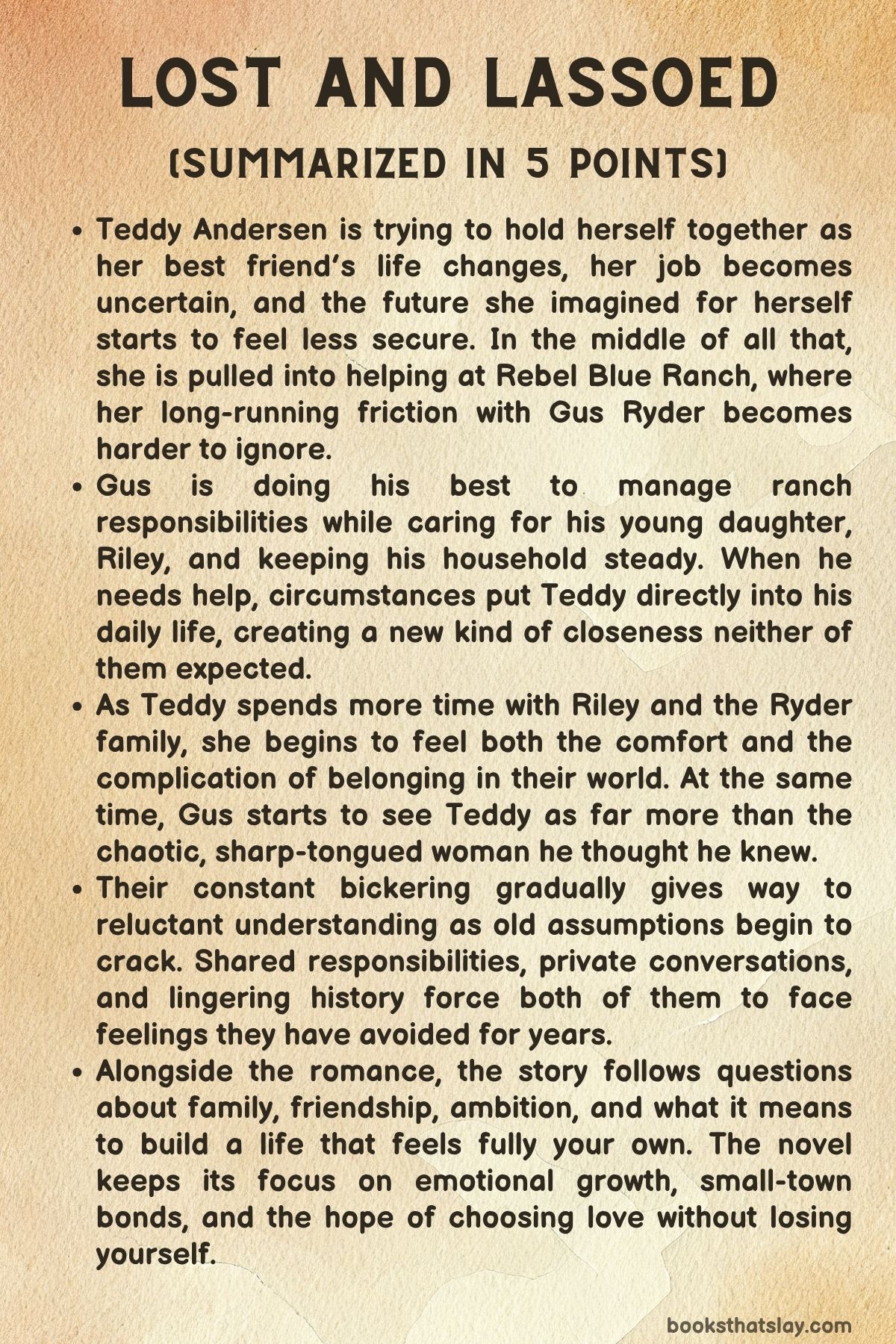
Lost and Lassoed by Lyla Sage is a contemporary small-town romance set in Meadowlark, Wyoming, where family ties, long memories, and old frustrations shape daily life. The novel follows Theodora “Teddy” Andersen and Augustus “Gus” Ryder, two people who have spent years trading insults while hiding a deeper and more complicated history.
As summer changes the rhythm of life at Rebel Blue Ranch, they are pushed into close proximity through Gus’s daughter, Riley, and Teddy’s own uncertain future. Warm, funny, and emotionally grounded, the story is about love, caregiving, friendship, second chances, and learning to build a life that feels truly your own.
Summary
Teddy Andersen has always seen herself as someone people can count on. She lives in Meadowlark with her father, Hank, and stays closely connected to Rebel Blue Ranch, where her best friend Emmy Ryder’s family lives and works.
Teddy has spent years at the center of other people’s needs, whether that means helping Emmy, caring for Hank, or stepping in whenever something goes wrong. Even so, she has started to feel left behind.
Emmy is focused on her future with Brooks, the man she loves, and Teddy can feel the distance growing between them. At the same time, Teddy’s job at a local western wear boutique is the one place where her creativity has room to breathe.
When the store is sold and closed, she loses not only her income but also a piece of the future she had quietly imagined for herself.
Gus Ryder, Emmy’s older brother, has his own pressure to carry. He works hard at the ranch and is trying to balance his responsibilities there with raising his six-year-old daughter, Riley, while Riley’s mother, Cam, spends the summer away preparing for the next step in her legal career.
Gus loves Riley completely, but he is stretched thin and trying to hide how close he is to losing control of everything. He is proud, practical, and reluctant to ask for help, especially from Teddy, the woman he has spent years calling reckless and impossible.
Their latest round of hostility begins during a cleanup project at the old bar Brooks wants to reopen. Teddy and Gus get trapped together in a dark basement closet, and the encounter quickly turns into the usual exchange of insults.
Yet even in that tense moment, it is clear there is more between them than simple dislike. They share an old secret, one neither of them has forgotten, and being forced into each other’s space starts to wake up feelings they have both kept buried.
Soon after, Gus forgets to pick up Riley from soccer practice, and Teddy ends up stepping in. What begins as an emergency favor becomes something larger.
Gus’s family sees that he needs help and pushes him to hire Teddy for part of the week to care for Riley and help around the house. Teddy resists because she and Gus can barely stand being in the same room without fighting, but she agrees for Riley’s sake and because she knows Cam should not have to give up her plans because Gus is overwhelmed.
Their arrangement places Teddy in Gus’s home several days a week, and that new closeness changes the balance between them.
As Teddy settles into the house, she quickly becomes part of Riley’s daily routine. She cooks, explores the ranch with her, and brings a sense of fun and imagination into her days.
Riley adores Teddy, and Teddy grows even more attached to her in return. The bond feels natural, almost startlingly so.
For Teddy, who has quietly feared that life is moving on without her, being with Riley stirs thoughts about what she wants from the future. For Gus, watching Teddy care for his daughter forces him to revise his view of her.
She is not careless. She is steady, warm, funny, and far more giving than he has ever allowed himself to admit.
Their attraction grows in small, charged moments. A late-night conversation reveals that Gus has dyslexia and practices Riley’s books before reading them to her.
Teddy sees the tenderness and vulnerability beneath his rough exterior. On another day, when Teddy is in pain from cramps, Gus looks after her without awkwardness or hesitation, bringing her medicine and a heating pad and talking to her with an openness she has never seen from him before.
They begin to confide in each other about the things they rarely say aloud: the fear of running out of time, the wish for children, the loneliness of carrying too much, and the longing to build a full life with the right person.
These conversations create a new kind of intimacy, but the past still hangs over them. Years earlier, when Teddy got herself into trouble at a bar while defending another woman, Gus had stepped in, taken her outside, and kissed her.
For Teddy, that moment had mattered. For Gus, frightened by what it meant and clouded by alcohol and his own confusion, he had walked away and told her to forget it.
Teddy never did. The memory became a wound, especially because it proved that what passed between them had not been entirely imagined.
Now, with the summer drawing them together again, that unfinished history resurfaces. After one near kiss, Teddy stops things and makes it clear she cannot go through the same hurt another time.
Gus, who has slowly realized that his feelings are serious, approaches her more honestly after that. He asks before kissing her again, giving her the choice he failed to give her years earlier.
This time the moment is gentle, deliberate, and impossible to dismiss. Their relationship shifts from tension into something real.
Even then, neither of them is entirely certain what their connection means. Teddy worries that she is only filling a temporary role in Gus’s life while Cam is away.
Gus worries about wanting too much and about what it would mean to let Teddy fully into his life with Riley. Still, desire and affection overtake caution.
They begin a secret relationship, sharing nights together and finding comfort in a closeness that feels both new and long overdue. For Gus, Teddy’s presence starts to feel essential.
For Teddy, being wanted and cared for in return is deeply moving because she is so used to being the one everyone leans on.
The emotional stakes rise sharply when Hank suffers a heart attack. Teddy is shocked and overwhelmed with guilt, convinced she failed her father by not being there.
Gus brings her to the hospital and stays beside her, even when he does not know exactly what to say. What matters is that he does not leave.
He supports her through the fear, exhaustion, and grief that follow, caring for her with patience and tenderness. In one of the novel’s most intimate stretches, he takes her home, helps her shower, and simply holds her while she cries.
For Teddy, that care breaks through the tough exterior she has maintained for years. For Gus, it becomes clear that loving Teddy is no passing thing.
As Hank recovers, Teddy takes time away to help him at home and starts to think more seriously about her own future. She misses Gus and Riley, and the absence clarifies how much they have come to matter to her.
At the same time, she must face parts of herself she has long avoided: her fear of being left behind, her habit of building her worth around being needed, and her uncertainty about whether she can stand on her own. She also begins to return to her dream of designing clothes.
Encouraged by the love of the people around her, she imagines converting the garage into a workspace and starting again.
Their romance becomes impossible to hide, and when Emmy learns the truth, she reacts badly at first. She is shocked and worried about what could happen if things go wrong between her best friend and her brother.
Her response hurts Teddy deeply, especially because Teddy already feels the strain of how much their friendship has changed. The conflict forces both women to be honest.
Teddy finally tells Emmy how lonely she has felt and how painful it has been to watch their bond shift. Later, Emmy apologizes sincerely and gives Teddy her blessing, recognizing that Teddy and Gus are serious and good for each other.
The last obstacle is internal rather than external. Cam returns, and although she is supportive, Teddy cannot ignore the practical questions.
If she is going to be with Gus and Riley, she does not want it to happen because she drifted into their lives without building one of her own. She wants love, but she also wants independence, work, and a future she can claim with confidence.
Hank, understanding more than she realizes, reassures her that he will be okay and encourages her to pursue what makes her happy. That support gives her room to imagine a life that includes both her ambitions and the family she is growing into.
Gus reaches his own clarity. With help from Amos and the perspective of the summer behind him, he recognizes that he does not want Teddy only for a season.
He wants a whole future with her, one built openly and without hesitation. He takes Teddy and Riley out to a meadow to find the last flower from their summer project, creating a moment that gathers together everything they have shared: Riley’s joy, the beauty of the ranch, and the sense that they already belong with one another.
Back at the house, Gus returns Teddy’s repaired suede jacket and tells her he wants to help her get her sewing machine fixed so she can begin her business. More importantly, he tells her he does not want the summer to end as a finished chapter between them.
He wants it to be the start of their life together. He confesses that he loves her, wants to marry her, and wants children with her.
Teddy, overwhelmed but certain, tells him she loves him too.
In the epilogue, their commitment has deepened into an engagement. Riley is delighted in her own straightforward way, already seeing Teddy as part of the family.
Hank is doing better, Teddy is moving forward with her design work, and the future they spoke about is taking shape. The story closes with the sense that love has not solved everything by magic, but it has given Teddy and Gus the courage to choose each other fully and to build a life rooted in care, trust, family, and home.
Characters
Teddy Andersen
Teddy Andersen is the emotional center of Lost and Lassoed, a woman whose bright, funny, and outwardly fearless personality covers a deep fear of being left behind. She has built much of her identity around being needed, whether by her father, her best friend Emmy, or the people around her in Meadowlark.
That instinct makes her generous and dependable, but it also leaves her vulnerable when life begins to shift. As Emmy moves toward marriage and Teddy loses her job at the boutique, she is forced to confront how much of her self-worth has been tied to being useful to others instead of fully building a life for herself.
Her pain does not come from weakness but from the uncomfortable realization that she has spent years helping everyone else move forward while quietly postponing her own future.
Teddy’s creativity is one of her defining qualities. Her work in fashion and design is not just a hobby or a side talent but a genuine expression of who she is.
She sees beauty where others see scraps, and she turns ordinary things into something personal and memorable. That creative instinct also shows up in the way she relates to Riley, bringing playfulness, imagination, and warmth into the child’s life.
Teddy’s embroidery project, her clothing designs, and her eye for detail reveal a woman with vision, taste, and emotional intelligence. Even so, her artistic ambition has been stalled by circumstance, money, and fear.
Part of her growth comes from finally allowing herself to believe that her dream deserves structure, space, and commitment.
Her relationship with Gus brings out the most layered parts of her character. At first, she hides behind teasing, sarcasm, and old irritation, but those reactions are clearly defensive.
The history between them matters because Teddy remembers the emotional impact of their earlier kiss while also carrying the hurt of being dismissed afterward. That history makes her cautious, especially when their attraction returns.
She refuses to be treated casually, and that refusal shows her strength. She may be uncertain in many parts of her life, but she is clear about not wanting to be half chosen.
As the relationship develops, Teddy becomes more open about her fears, her desire for children, and her uncertainty about the future. What makes her compelling is that she is not simply looking for romance; she is trying to understand how to love someone without losing herself.
Teddy’s bond with her father also defines her in important ways. She loves Hank with fierce loyalty and has taken on the role of caregiver without resentment.
Yet that devotion has also kept her emotionally anchored in place. When his health declines, her instinct is to put herself second, and when he suffers a heart attack, her guilt is immediate and overwhelming.
She believes she must always be present, always strong, always capable. The story gently challenges that belief by showing her that love does not disappear when she steps back and that she is allowed to want more than survival and service.
By the end, Teddy becomes someone who still loves deeply and gives generously, but who also begins to claim a future that belongs to her.
Gus Ryder
Gus Ryder is introduced as controlled, competent, and often infuriatingly rigid, but beneath that surface he is a man driven by responsibility and fear of failure. He has shaped himself into someone others can rely on, especially at the ranch and in his role as Riley’s father.
He is practical, hardworking, and deeply loyal, yet those admirable traits can harden into defensiveness when he feels judged or overwhelmed. He does not easily admit weakness, and that makes him slow to ask for help even when he desperately needs it.
His tension with Teddy initially seems rooted in irritation, but it becomes clear that part of his problem is that she unsettles the order he depends on to feel in control.
Gus is at his most human in his role as a father. His love for Riley is not abstract or performative; it shapes every choice he makes.
He worries about failing her, worries about keeping up with her needs, and quietly carries the stress of raising her well while also managing his work. His mistake at soccer practice is important because it punctures his sense of competence.
He cannot dismiss it, and neither can the people around him. That moment opens the door to change because it forces him to accept support.
Through Riley, the narrative shows his tenderness, his patience, and the emotional depth he usually keeps hidden. He is not simply a rugged rancher figure.
He is a loving parent whose vulnerability is most visible when his daughter is involved.
His emotional development is closely tied to how his view of Teddy changes. For years, he has reduced her to a category: reckless, disruptive, immature.
That judgment allows him to keep his distance from feelings he does not want to examine. Once Teddy enters his home and daily life, however, he has to face the gap between his assumptions and reality.
He sees how natural she is with Riley, how observant she can be, how much care she puts into the smallest things, and how deeply she feels even when she masks it with humor. His attraction grows alongside his respect, and that combination is what gives his character arc real weight.
He does not merely desire her; he comes to value her presence, her mind, and the life she brings into his home.
Gus also has his own emotional wounds. He carries the pressure of family expectations, the burden of ranch work, and a longstanding habit of putting everyone else’s needs ahead of his own balance.
His protective instincts, especially toward Emmy, show how seriously he takes family roles, but they also reveal how easily he can confuse control with care. Over time, he learns to become more emotionally direct.
He apologizes, admits when he is jealous, supports Teddy during her father’s health crisis, and eventually articulates what he wants from life. By the end of Lost and Lassoed, he grows from a man who reacts and retreats into one who speaks clearly, loves openly, and chooses partnership instead of distance.
Riley Ryder
Riley is far more than a cute child in the background. She is one of the clearest emotional forces in the story because she brings honesty, affection, and perspective to the adults around her.
Through Riley, the novel shows what stability, trust, and love look like in everyday form. She misses her mother, loves her father, and quickly embraces Teddy, not because she is naïve but because she responds to care without the layers of pride and hesitation that complicate adult relationships.
Her openness often exposes truths that the adults are trying to avoid.
She also serves as the bridge between Teddy and Gus. Teddy’s connection with Riley allows Gus to see her differently, and Riley’s comfort with Teddy gives their growing relationship a natural emotional foundation.
Riley is not used as a device to force them together in an artificial way. Instead, her presence reveals what each of them is capable of giving.
Teddy becomes softer, more confident, and more future-facing around Riley. Gus becomes more reflective and more willing to imagine a fuller family life.
Riley, in turn, responds to Teddy with trust and joy, making it impossible for either adult to pretend that their bond is temporary or shallow.
What makes Riley especially effective as a character is that she reflects pieces of the whole family. Teddy notices traits from different relatives in her, and that observation reinforces how children often carry emotional traces of the people who love them.
Riley is playful, expressive, and deeply attached, but she also has a straightforward wisdom. Her assumption that Teddy is already part of the family captures the emotional truth long before the adults are ready to say it out loud.
She becomes the clearest sign that love, in this story, is not just about attraction but about building a shared life.
Emmy Ryder
Emmy is one of the most important supporting characters because she sits at the intersection of friendship, family, and change. As Teddy’s lifelong best friend, she represents both comfort and loss.
Teddy loves her deeply, but Emmy’s engagement and shifting priorities force Teddy to face the reality that even the strongest friendships evolve. Emmy is not cruel or neglectful, yet she has become less emotionally available, and that distance affects Teddy more than Emmy initially understands.
Their friendship carries years of shared history, and because of that closeness, the changes between them feel especially painful.
Emmy’s role in the larger story is shaped by her position within the Ryder family. She knows both Teddy and Gus intimately, which puts her in a complicated emotional position once their relationship begins to change.
Her initial reaction to their romance is important because it is messy, protective, and imperfectly expressed. She worries about what could happen if things fall apart, and she also has trouble immediately adjusting to the idea of her best friend and her brother together.
Her response hurts Teddy, but it also feels believable. Emmy is trying to protect the people she loves, even if she does so clumsily.
What makes Emmy a strong character is that she is capable of self-correction. She does not remain fixed in defensiveness.
She recognizes that she has spoken from shock rather than trust, and she apologizes sincerely. That apology matters because it restores dignity to the friendship rather than treating the conflict as a minor misunderstanding.
Emmy’s growth is quieter than Teddy’s or Gus’s, but it is still meaningful. She learns that loving her friend and loving her brother does not mean managing their choices.
It means respecting the truth of what they feel and trusting them to build something real.
Hank Andersen
Hank is one of the most vivid parental figures in the novel, not only because of his colorful past but because of the emotional security he has given Teddy throughout her life. Once a drummer who traveled with a band, he could have been written as an eccentric side character, but he is much more than that.
He is warm, tough, affectionate, and entirely devoted to his daughter. His history explains why Teddy grew up in a life shaped more by personality and improvisation than by convention.
He chose her fully, raised her fully, and gave her a life that felt full despite the absence of her mother.
Hank’s importance to Teddy cannot be overstated. He is not only her father but also the person around whom much of her adult life has been organized.
His health struggles have made Teddy increasingly protective and responsible, and her caregiving role has become central to how she understands love. Because of that, Hank’s vulnerability is one of the strongest emotional pressures in the story.
His heart attack is a turning point not only because it frightens Teddy, but because it forces her to confront the limits of what devotion can do. She cannot prevent all pain.
She cannot be everywhere at once. She cannot hold her entire life still in order to protect him.
At the same time, Hank is not written as a burden. He actively wants Teddy to live fully.
His support for her dream of building a workspace and designing again shows real parental generosity. He understands her more than she realizes, including her love for Gus and her fear of moving forward.
By encouraging her to claim happiness beyond caregiving, he becomes part of her liberation rather than the reason she stays stuck. His presence adds emotional depth and tenderness to Lost and Lassoed, grounding the romance in a larger story about family loyalty and release.
Cam
Cam is a particularly effective character because she could easily have been reduced to a source of conflict, yet she is treated with maturity and respect. As Riley’s mother and Gus’s co-parent, she remains an important part of the family structure even while living elsewhere for part of the story.
Her relationship with Gus is built on mutual trust and shared love for their daughter rather than lingering bitterness. That dynamic allows the story to explore co-parenting in a grounded way, without turning her into an obstacle for the central couple.
Cam is practical, observant, and emotionally intelligent. She knows Gus well enough to recognize when something matters to him, and she understands the value Teddy brings to Riley’s life.
Her support of Teddy is especially significant because it removes the easy drama of rivalry and replaces it with adult clarity. She does not see Teddy as a threat.
She sees her as someone who could become a meaningful and healthy addition to Riley’s world. That perspective gives the story emotional stability and reinforces that family can expand through trust rather than competition.
Her own life choices also carry weight. She is pursuing her goals, protecting Riley carefully, and facing questions about love and commitment in her relationship with Graham.
In that sense, Cam acts as a foil to both Teddy and Gus. She shows another version of adulthood, one shaped by responsibility but also by the effort to make choices honestly.
Her presence strengthens the emotional realism of the novel.
Amos Ryder
Amos functions as the quiet moral center of the Ryder family. He is steady, observant, and deeply rooted in the life of the ranch.
Though he is not flashy, his influence is felt everywhere. He has made Rebel Blue into a place defined not only by labor but by care, as seen in his practice of taking in old horses and giving them peace.
That detail says a great deal about his character. He values dignity, patience, and stewardship, and those values shape the family around him.
As a father, Amos leads more through presence than speeches, but when he does speak, people listen. His concern about Gus taking on too much is not critical for the sake of control; it comes from genuine wisdom about what unbalanced responsibility can do to a person.
He understands that pride can become a trap, and he pushes Gus toward accepting help not because Gus is failing, but because he wants him to live better. Amos can see more than he says, especially where Teddy and Gus are concerned, and that quiet awareness gives his character warmth and humor.
He also has a symbolic role in the story. Amos represents continuity, tradition, and the possibility of a family structure that makes room for both duty and tenderness.
He is part of the reason the ranch feels like more than a backdrop. Through him, it becomes a lived-in world shaped by memory, care, and belonging.
Brooks
Brooks is an important supporting presence because he brings both loyalty and emotional perspective into the story. As Gus’s childhood best friend and Emmy’s fiancé, he occupies a position that allows him to move between different relationships with ease.
He understands Gus’s habits, can call him out when needed, and also supports Emmy in ways that show emotional maturity. His reopening of the Devil’s Boot gives the story a sense of local history and community change, but his greater value lies in the way he helps reveal other characters more clearly.
With Gus, Brooks often acts as a sounding board. Their friendship has endured strain, especially after the secrecy surrounding Brooks and Emmy’s relationship, so there is already emotional history between them.
Because of that history, Brooks can challenge Gus directly without it feeling empty or superficial. He sees both Gus’s strengths and his blind spots.
His observations about fatherhood, partnership, and emotional honesty help move Gus toward greater self-awareness.
Brooks also represents a model of chosen commitment. He is nervous about the future, uncertain about the responsibilities he is stepping into, and still fully willing to move forward.
That combination makes him a useful contrast to Gus, who spends much of the story trying to contain and delay what he feels. Brooks is not at the center of the romance, but he adds texture and emotional support to the larger narrative world.
Wes Ryder
Wes adds sharpness, humor, and family realism to the story. He is one of those characters who helps make the Ryder family feel fully alive because he interacts with his siblings in a way that suggests years of affection, irritation, and shared habit.
He is willing to push Gus, argue with him, and call out behavior that others might let slide. That dynamic keeps family scenes from becoming overly sentimental and adds a lived-in quality to their relationships.
He also contributes to the sense that the people around Gus can see his limitations before Gus admits them himself. Wes does not appear to romanticize responsibility the way Gus sometimes does.
He recognizes that help is necessary and that stubbornness is not strength. His relationship with Ada also offers another example of love developing alongside work and creativity, which subtly reflects the novel’s larger interest in partnership as something built through both affection and daily life.
Ada
Ada brings a thoughtful and calming energy to the story. As an interior designer and Wes’s partner, she represents another form of creativity in a world often dominated by ranch work and practicality.
Her presence matters because Teddy responds to her as a fellow creative person, someone who understands the value of making things beautiful and meaningful. That connection gives Teddy a space, however brief, to speak more honestly about matters of the heart and about the uncertainty of wanting more from life.
Ada’s role is not loud, but it is significant. She offers insight without judgment and becomes one of the few people Teddy can test her feelings around before everything is out in the open.
Her character supports the story’s broader interest in women who build, design, shape, and imagine. In that sense, she complements Teddy well and helps reinforce the creative thread running through the novel.
Dusty
Dusty serves as both a friend and a contrast point for Teddy. He understands what it means to feel somewhat out of step with the expected timeline of adulthood in Meadowlark, and his conversations with Teddy allow her anxieties about falling behind to come into clearer focus.
He is easy to talk to, emotionally aware, and useful as a reminder that Teddy does have people in her life beyond Emmy and the Ryder family. Their friendship reveals parts of Teddy’s insecurity that she does not always voice elsewhere.
At the same time, Dusty also provokes jealousy in Gus, which helps expose feelings Gus is still trying to deny. Dusty’s continued attachment to Cam adds another note of longing and unfinished emotion to the broader cast.
He is not central to the main romance, but he is important in showing how desire, timing, and missed chances can shape a person’s life in quieter ways.
Aggie
Aggie may not dominate the page, but she represents an important shift in Teddy’s world. Her growing relationship with Hank is kind, stabilizing, and emotionally unsettling for Teddy in ways Teddy does not always want to admit.
On one level, Aggie’s presence is a comfort because it means Hank has companionship and care. On another, it challenges Teddy’s role as the person her father depends on most.
That tension is subtle but meaningful because it connects directly to Teddy’s fear of no longer being essential.
Aggie’s kindness and reliability help make this shift feel safe rather than threatening. She is not written as someone intruding into Teddy’s bond with Hank.
Instead, she becomes part of the support system that allows Teddy to imagine more freedom for herself. In that way, Aggie quietly contributes to Teddy’s growth by showing that love can expand rather than replace.
Nicole
Nicole functions as a useful minor character because she helps sharpen both Teddy’s and Gus’s emotional responses. Her interest in Gus and her presence around Riley create a situation in which outside assumptions about compatibility become visible.
She appears to fit a more obvious model for Gus’s life, especially from a distance, and Teddy is quick to joke about that possibility even while feeling more affected than she wants to admit. Gus’s discomfort during those interactions also reveals how his feelings for Teddy have already changed.
Nicole is less important as an individual romantic possibility than as a mirror for what the main characters are trying not to say. Through her, the story highlights the difference between what looks convenient on paper and what feels emotionally true.
Cloma
Cloma plays a smaller role, but she is central to Teddy’s career arc. By closing the boutique, she unintentionally pushes Teddy into crisis.
That loss is painful, but it also breaks the illusion that Teddy can keep waiting for her life to happen around the edges of other people’s plans. Cloma’s affection for Teddy and recognition of her talent matter because they affirm that Teddy’s creative ambitions are real and worth taking seriously.
She also symbolizes the end of one phase of adulthood and the beginning of another. The boutique had given Teddy structure, identity, and a place for her designs, but it was never fully hers.
Once it is gone, Teddy has to decide whether she will keep mourning what she lost or finally build something of her own. That makes Cloma an important turning-point figure in the novel.
Jake
Jake, the vet, has a fairly limited role, but he is effective as a source of tension and contrast. Teddy’s flirtation with him is partly playful and partly strategic, yet it triggers a strong reaction in Gus.
Jake’s main narrative function is to reveal jealousy that Gus can no longer hide. Through that reaction, the story shows that Gus is emotionally involved long before he openly admits it.
Because Jake is presented as a plausible, attractive option without becoming a serious emotional contender, he helps underline the difference between surface chemistry and real attachment. His presence briefly complicates things, but only in a way that pushes the central relationship toward honesty.
Graham
Graham remains more distant than many other characters, but his significance lies in what he reveals about Cam’s life and the standards she applies to love. He exists on the edge of the story until the closing development involving his wedding, yet even before that, there are signs that something about that relationship may not be fully settled.
His role helps underline one of the novel’s recurring ideas: partnership should be chosen with clarity, sincerity, and emotional truth, not simply because it seems like the next step.
In that sense, Graham is less a fully developed personal force than a structural contrast to the kind of future Gus and Teddy are trying to create.
Themes
Caregiving, Dependence, and the Fear of No Longer Being Needed
Caregiving shapes the emotional lives of the central characters in Lost and Lassoed in ways that go far beyond simple acts of kindness. Teddy has built much of her identity around being the person who shows up, helps, fixes, and fills in the gaps for others.
She cares for her father through his health struggles, supports Emmy through major life changes, and almost instinctively steps into Riley’s world with warmth and attentiveness. On the surface, this makes her appear strong, generous, and dependable, and she is all of those things.
Yet the novel is equally interested in the cost of that role. Teddy does not only enjoy being needed; she depends on it as proof of her worth.
When Emmy begins leaning more on Brooks, when Aggie becomes part of Hank’s life, and when Teddy loses the job that gave her a sense of purpose, she is forced to confront an unsettling question: who is she when she is not the one holding everything together?
Gus faces a related but different version of this theme. He is deeply committed to caring for Riley, managing ranch work, and protecting the people around him, but his version of caregiving is tied to control and endurance.
He wants to be the one who can handle everything alone, even when he is clearly overwhelmed. His resistance to hiring help is not just pride in a casual sense; it reflects a fear that admitting strain might make him seem inadequate as a father and as a man.
The story treats that fear with sympathy while also exposing its limits. Forgetting Riley’s soccer practice becomes a turning point because it reveals that devotion alone is not the same as balance.
Good intentions do not erase exhaustion.
What makes this theme especially strong is that the novel does not reject caregiving as a burden to escape. Instead, it asks what happens when care becomes the only language through which a person understands love and value.
Teddy and Gus both have to learn that accepting help is not failure and that being loved does not require self-erasure. Hank’s health scare sharpens this idea even further.
Teddy’s guilt after his heart attack is immediate and devastating because she believes she should have been able to prevent harm simply by being present. The emotional force of that moment comes from the collapse of a belief she has carried for years: that if she gives enough, she can keep loss at bay.
The story gently but firmly challenges that illusion. Love matters, care matters, presence matters, but none of them can make a person all-powerful.
By the end, caregiving remains central to the characters’ lives, yet it begins to exist alongside mutual support, personal ambition, and emotional honesty rather than replacing them.
Love as Choice, Repair, and Emotional Maturity
Romance in Lost and Lassoed is not treated as a sudden force that erases the past. It grows through recognition, reconsideration, and emotional repair.
Teddy and Gus do not begin from a neutral place. They have years of irritation, misunderstanding, and unresolved hurt between them, along with a buried memory that still carries emotional charge.
Because of that history, their relationship has weight from the beginning. The story is not asking whether attraction exists; it is asking whether attraction can become something trustworthy.
That distinction matters. Physical pull is present early and often, but the novel keeps returning to a harder question: can two people who have misread and wounded each other learn how to see one another clearly?
A large part of the answer lies in how love is shown through changed behavior rather than dramatic declarations alone. Gus does not simply realize that Teddy is attractive.
He begins to understand her labor, her softness, her longing, and her seriousness. He notices the emotional care she gives Riley, the creativity she brings into ordinary life, and the vulnerability beneath her humor.
Teddy, in turn, begins to see that beneath Gus’s stubbornness is a man carrying intense responsibility, quiet insecurity, and genuine tenderness. Their love becomes convincing because it grows out of revised perception.
They are not falling for imagined versions of each other. They are learning how wrong their old assumptions were.
Repair is central to this theme. Years earlier, Gus kissed Teddy and then dismissed the moment, leaving her with confusion and hurt.
That history could have remained only a source of tension, but the novel uses it to show the difference between immature desire and responsible love. When they move toward each other again, Teddy makes clear that she will not accept being treated lightly.
Gus’s eventual willingness to approach her carefully, honestly, and with emotional clarity shows real growth. He asks, explains, supports, and stays.
These actions matter because they answer the wound he once created. Love here is not just confession.
It is correction.
The novel also resists the idea that maturity in love means being detached or guarded. Instead, emotional maturity is shown as the courage to say what one wants and to build toward it openly.
Gus eventually admits that he wants a shared life, marriage, and children. Teddy admits that she wants love, family, and meaningful work, but not at the cost of losing herself.
Their relationship works because both desires are taken seriously. The story presents love not as fantasy or rescue, but as a choice to remain present, repair past harm, and meet another person with intention rather than avoidance.
Identity, Creative Ambition, and the Need to Build a Life of One’s Own
The question of who Teddy is outside of her usefulness to others runs through the entire novel, and that question is tied closely to work, creativity, and independence. Her job at the boutique is more than employment.
It is one of the few places where her artistic talent has visible form and social value. She designs pieces, works with clothing, and inhabits a space where her taste and imagination matter.
When the store closes, the loss hits with unusual force because it strips away not only financial stability but also a version of herself she has relied on. The crisis is not merely practical.
It is existential. Without that role, and with her best friend moving into a new phase of life, Teddy is left staring at the possibility that she has spent years orbiting other people’s futures while postponing her own.
Her creative identity gives this theme emotional depth. Teddy is not vaguely artistic in a decorative sense.
She thinks through fabric, design, stitching, alteration, and visual detail. Her creativity appears in clothing, embroidery, and the way she transforms objects into keepsakes that carry memory and feeling.
This matters because her ambition is presented as real labor, not as an indulgence. The narrative treats her skill with respect, showing that what she makes carries emotional intelligence and value.
That is especially important in a romance setting, where women’s creative desires can sometimes be softened into background texture. Here, creativity is part of Teddy’s becoming.
She does not only need love; she needs room to make, earn, decide, and claim authorship over her life.
The relationship between independence and intimacy is handled with notable care. Teddy does not resist love because she rejects closeness.
She resists disappearing into a ready-made family structure before she knows how to stand on her own terms. Her fear is not commitment itself but the possibility of becoming absorbed into someone else’s world before fully shaping her own.
This is why Hank’s support becomes so meaningful. When he tells her he will be okay and encourages her to create a workspace for her designs, he gives her permission to imagine a future not built entirely around caretaking.
That permission is emotional as much as practical.
The novel suggests that selfhood is not discovered in isolation but built through choices, risks, and acts of belief. Teddy’s movement toward starting her own design work is part of the same emotional arc that allows her to accept Gus’s love.
She can move toward partnership because she is also moving toward a stronger sense of self. The story refuses the false choice between romance and ambition.
Instead, it argues that the healthiest love makes room for a person’s work, identity, and becoming.
Family, Belonging, and the Shape of a Shared Future
Family in this novel is not defined narrowly by blood, legality, or convention. It is shown as a living structure built through care, loyalty, routine, forgiveness, and chosen presence.
The ranch is central to this idea because it functions as more than a setting. It is a space where people repeatedly gather, argue, support one another, eat together, work together, and step into crisis for each other without hesitation.
That daily closeness creates a broad understanding of family in which parents, siblings, close friends, co-parents, children, and new partners all contribute to the emotional fabric of life. The effect is a story in which belonging feels active and communal rather than abstract.
Riley plays a vital role in developing this theme because she experiences family with a kind of directness that the adults often overcomplicate. Her attachment to Teddy is immediate not because she is careless, but because she responds to care as something real and legible.
She does not divide love according to adult categories. If Teddy comforts her, plays with her, helps her, and remains present, then Teddy belongs.
That child’s perspective becomes quietly transformative. It forces Gus and Teddy to recognize that what is growing between them is not limited to romance.
It has implications for home, continuity, and the everyday structure of life. Riley’s emotional certainty often arrives before the adults can name what they feel.
The treatment of Cam deepens this theme considerably. Rather than turning co-parenting into rivalry, the story presents it as an evolving system that can expand when trust exists.
Cam’s willingness to see Teddy as a positive presence in Riley’s life shows a mature understanding of family as something strengthened by good people rather than threatened by them. That choice gives the novel unusual emotional steadiness.
It suggests that belonging does not have to depend on exclusion. A child can be loved by more than two adults.
A family can grow without betrayal. Care can be shared rather than hoarded.
At the same time, the theme of belonging is tied to the fear of not fitting into the future. Teddy worries about whether there is really a place for her once summer ends and once temporary arrangements give way to long-term realities.
Gus worries about whether he can ask for the life he wants without overreaching. Their eventual coming together matters because it answers those fears with intention.
The closing movement toward engagement and plans for a future together is not framed as a reward for surviving conflict. It is the culmination of a deeper realization: they already have the beginnings of a family, and what remains is the courage to claim it fully.
Through that movement, the novel presents family as both inheritance and choice, something received but also something built.