Abundance: What Progress Takes Summary and Analysis
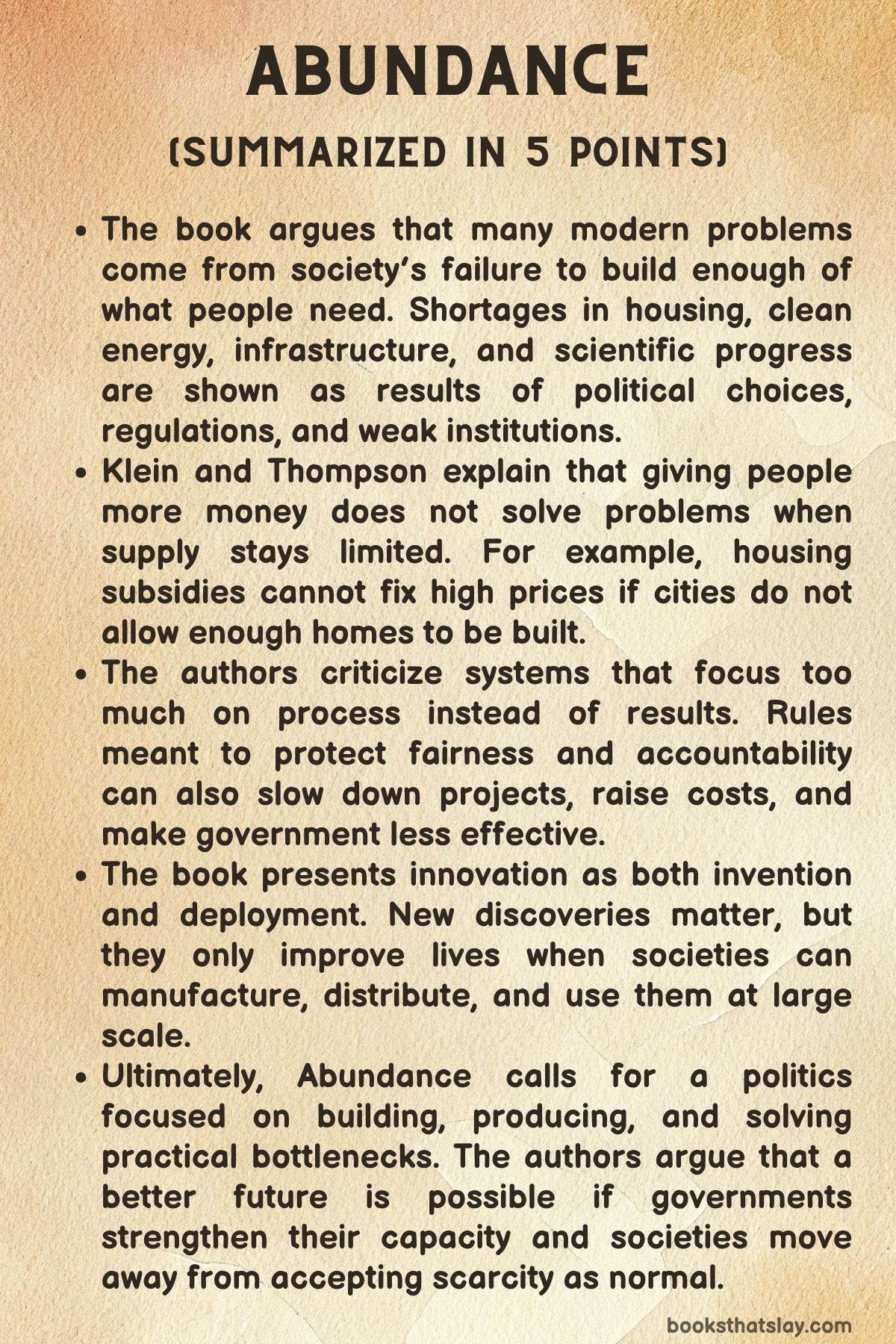
Abundance by Ezra Klein and Derek Thompson is a political and economic analysis that argues modern societies suffer not from a lack of wealth or technology but from an inability to build the things people actually need. The authors claim that many problems—housing shortages, slow infrastructure development, climate change responses, and stalled scientific progress—exist because systems meant to protect society now block progress.
They propose a new political vision centered on increasing supply: building more homes, generating more clean energy, investing in innovation, and strengthening the government’s ability to accomplish large projects. The book explores how politics, regulation, and culture shape production and asks how societies can move from a mindset of scarcity toward one focused on abundance.
Summary
Abundance opens by imagining a future where the crises of the early twenty-first century have largely been solved. In this possible future, clean energy is inexpensive and widely available, desalination technology ensures access to water, food production has become sustainable and efficient, and artificial intelligence helps people work less while still maintaining prosperity.
The authors suggest that such a future is technologically possible, but reaching it requires societies to confront the obstacles that prevent progress today.
The central argument of the book is that many shortages in modern society are not inevitable. Instead, they are the result of political choices, regulations, and cultural attitudes that limit the production of important goods.
The authors argue that the United States has become a country that produces plenty of consumer products but struggles to build the foundations of a good life, such as housing, infrastructure, and scientific breakthroughs.
They explain that political debates have often focused on ideological conflicts rather than practical outcomes. Conservatives frequently argue for smaller government and lower taxes, believing markets should handle most problems.
Progressives often focus on providing financial assistance to help people afford essential goods. Both approaches, according to the authors, overlook the importance of supply.
When the availability of something like housing or healthcare is limited, giving people more money does not solve the problem; it can simply increase prices.
Examples from housing, healthcare, and education illustrate this dynamic. Housing prices have risen dramatically because construction has slowed while demand has grown.
Healthcare costs have increased even as governments spend more money subsidizing insurance. College tuition has expanded far beyond its earlier levels.
These changes reflect a system in which demand is supported while supply remains constrained.
The authors argue that economic growth does not simply expand what already exists. Growth creates a different future by introducing new technologies, industries, and opportunities.
Earlier periods of rapid innovation transformed daily life, as seen in the technological changes between the late nineteenth and early twentieth centuries. In contrast, many modern cities and systems feel familiar even decades later, suggesting that productivity and innovation have slowed.
One major area where scarcity appears is housing. Cities, historically, have been places where people could move to find better jobs and opportunities.
Dense urban environments allow ideas and talent to concentrate, increasing productivity and innovation. However, rising housing costs have limited who can live in these areas.
As a result, many people are forced to live far from economic centers or remain in places with fewer opportunities.
The housing shortage is linked to zoning rules, local opposition to development, and regulations that make construction more difficult. In earlier decades, American communities built large numbers of homes to accommodate growing populations.
Over time, rules intended to protect neighborhoods and the environment restricted new development. These policies gradually reduced the number of homes being built, creating shortages and driving prices higher.
Environmental laws also played a role in shaping this landscape. Regulations designed to prevent pollution and protect natural resources became powerful tools for opposing construction projects.
Although these policies produced important environmental benefits, they also created processes that can delay or halt projects for years. As a result, even projects that would support environmental goals, such as renewable energy infrastructure, often face lengthy legal battles.
Climate change represents another challenge that requires large-scale construction and innovation. Some thinkers propose reducing economic growth to protect the environment, but the authors argue that such strategies are politically unrealistic and unlikely to succeed.
Instead, they suggest that solving climate problems requires building large amounts of clean energy infrastructure, electrifying transportation and industry, and expanding the power grid.
These tasks demand enormous investments in technology and construction. Renewable energy sources such as solar and wind power require new transmission lines and storage systems.
Electrifying transportation means replacing billions of machines worldwide. The scale of the challenge highlights the importance of institutions that can coordinate large projects.
The book also examines why construction and infrastructure development have become so slow and expensive. Modern projects often require navigating layers of regulatory review, legal challenges, and bureaucratic procedures.
While these systems were created to ensure accountability and fairness, they can make it extremely difficult to complete major projects.
The authors illustrate this issue with the example of California’s high-speed rail project. Although the idea was approved by voters and supported by government funding, years of negotiations, lawsuits, and regulatory hurdles slowed progress.
Costs rose dramatically while little physical infrastructure was completed. In contrast, other countries are able to build similar projects faster and at lower cost.
Another problem involves what the authors call excessive proceduralism. Government agencies often focus on following detailed rules and processes rather than achieving results.
Laws designed to allow public input and oversight can produce endless delays. This system reflects a deep mistrust of government authority, leading policymakers to create complicated procedures to ensure accountability.
The authors argue that political debates about whether government should be large or small miss a more important question: whether government has the capacity to accomplish its goals. Effective government requires skilled workers, technical expertise, and the ability to manage projects.
Without these capabilities, even well-funded programs struggle to deliver results.
Scientific innovation also faces challenges within modern systems. Although research funding and the number of scientists have increased, progress in some fields appears to be slowing.
The authors highlight the story of Katalin Karikó, a researcher who spent decades studying messenger RNA despite repeated funding rejections. Her work eventually became the basis for the rapid development of COVID-19 vaccines.
Karikó’s experience reflects broader issues in the research funding system. Grant processes often favor established researchers and predictable projects rather than risky ideas.
Young scientists may spend large amounts of time applying for funding instead of conducting experiments. This environment can discourage the kind of bold exploration that leads to major breakthroughs.
Government institutions have historically played a major role in supporting innovation. Agencies created during the twentieth century funded projects that produced technologies such as radar, GPS, and the internet.
The authors argue that similar institutional creativity is necessary today to accelerate research and address major challenges.
However, invention alone is not enough. The authors emphasize that implementing new technologies often determines whether they transform society.
Discoveries may remain unused for years unless systems exist to manufacture, distribute, and refine them. The development of penicillin illustrates this point: the discovery was important, but the effort to produce it at scale during World War II made it truly revolutionary.
Modern technology faces similar barriers. The United States has invented many important technologies but has sometimes struggled to manufacture or deploy them widely.
Solar energy is one example. Although American researchers pioneered the technology, other countries became leaders in producing solar panels at large scale.
The COVID-19 pandemic provides a different example. The United States launched Operation Warp Speed to accelerate vaccine development.
The program combined government funding, scientific research, manufacturing support, and logistical coordination. By identifying and removing bottlenecks in the process, it enabled vaccines to be developed and distributed far faster than expected.
The authors view this approach as a model for future policy. Governments can act as “bottleneck detectives,” identifying obstacles that prevent progress and working to remove them.
Different sectors require different solutions, but the underlying principle is the same: focus on building and deploying what society needs.
Looking ahead, emerging technologies such as artificial intelligence will create new demands. Large AI systems require enormous amounts of electricity, increasing pressure on energy infrastructure.
If energy supplies remain limited, technological development may slow or move to other countries. Expanding clean energy production therefore becomes central to economic and technological progress.
The conclusion argues that modern politics stands at a crossroads. One path emphasizes scarcity, focusing on limits, restrictions, and conflicts over resources.
The other path emphasizes abundance, focusing on expanding production and opportunity. The authors believe that a new political vision must prioritize building more homes, generating more clean energy, investing in science, and strengthening institutions capable of delivering results.
Rather than presenting a detailed list of policies, the authors offer a framework for thinking about political challenges. They encourage readers to ask which essential goods remain scarce and why.
By examining the systems that prevent progress, societies can redesign institutions to produce more of what people need.
The vision presented throughout Abundance is ultimately optimistic. The authors believe that many of today’s most pressing problems can be addressed through innovation, construction, and institutional reform.
Achieving that future requires shifting political priorities away from managing scarcity and toward enabling growth, invention, and production.
Key People
Ezra Klein and Derek Thompson
The most important presences are the authors themselves, not as dramatic participants in events, but as the shaping intelligence behind the book’s worldview. They come across as reform-minded liberals who are dissatisfied with both right-wing anti-government rhetoric and left-wing habits of procedural delay.
Their role is not merely to report facts. They interpret crises, connect policy failures across sectors, and argue that many modern shortages are chosen outcomes rather than unavoidable realities.
Their perspective is notable because it is self-critical. They do not spend their energy attacking only ideological opponents; they turn inward and scrutinize the political tradition they broadly belong to.
That gives them a dual role in Abundance: they are both narrators and internal critics of modern liberal governance.
American Liberalism
American liberalism functions almost like the book’s central conflicted protagonist. It is portrayed as morally ambitious, full of worthy goals such as environmental protection, affordable housing, better healthcare, and decarbonization.
At the same time, it is shown as having trapped itself inside rules, lawsuits, review processes, and layered demands that make delivery painfully slow. This is not presented as corruption of purpose so much as a distortion of method.
Liberalism wants fairness, voice, and accountability, but in trying to guard against abuse, it weakens its own ability to act. The result is a political tradition that promises justice yet often cannot build the material conditions that justice requires.
Its tragedy is that it can diagnose problems correctly while still contributing to their persistence.
Aaron Bastani
Aaron Bastani appears as an intellectual foil who helps widen the imaginative scope of the argument. His value in the book is less about his own program than about the permission he gives readers to think beyond present constraints.
He represents an effort to imagine a future transformed by technology rather than merely to manage existing injustice. In the authors’ hands, he functions as a voice of speculative optimism.
He pushes against the deadened political habit of assuming that the future will look much like the present, only slightly worse or slightly more expensive. His role is brief but important because he helps define the emotional difference between a politics of management and a politics of possibility.
Ralph Nader
Ralph Nader is one of the most complicated figures in the book because he is treated with both admiration and suspicion. He represents a form of liberal activism that achieved major public benefits, especially in safety and accountability, by challenging powerful institutions.
Yet he also symbolizes the rise of procedural combat as a governing style. In building a system where lawsuits, oversight, and legal resistance became central tools of reform, he helped create a political culture that can now be used to stall action of all kinds.
His character is therefore marked by irony. He sought to protect the public and discipline both corporations and the state, but the methods associated with his activism also fed the process-heavy liberalism the authors think has gone too far.
He stands for reform that succeeded so well it generated new obstacles.
Nicholas Bagley
Nicholas Bagley appears as a clarifying thinker, someone who gives language to a larger institutional pathology. His idea that modern governance has become obsessed with procedure rather than outcomes helps the authors explain why apparently well-meaning systems perform so poorly.
He is not presented as a political celebrity or central actor, but as an intellectual guide who identifies the hidden logic behind administrative failure. His importance lies in diagnosis.
He names the tendency to confuse legitimacy with endless process, and by doing so he sharpens one of the book’s core claims: that people trust government not because it follows every rule, but because it gets necessary things done fairly and competently.
Jen Pahlka
Jen Pahlka represents practical reform and administrative realism. Her work on government technology shows how dysfunction often comes not from one dramatic failure but from years of accumulated patches, workarounds, outdated systems, and procedural sediment.
She stands out because she is not framed mainly as an ideologue. She is a translator between technical systems and public service, someone who understands that institutions fail when they cannot simplify, modernize, or make clear choices.
Her presence adds a grounded quality to the book. Through her, the authors show that state capacity is not an abstraction.
It lives or dies in software systems, staffing decisions, procurement habits, and the ability to clear away old layers that no longer serve their purpose.
Josh Shapiro
Josh Shapiro appears as an example of decisive governance. His response to the I-95 bridge collapse is important because it offers a rare demonstration of public institutions acting quickly, visibly, and effectively.
He is used less as a richly developed political personality than as proof that government can still deliver when empowered to focus on results. His significance lies in contrast.
Against chapters full of delay, litigation, review, and administrative sprawl, he represents urgency paired with competence. The episode associated with him suggests that a different style of public action is possible, one where emergency authority reveals what ordinary governance has forgotten how to do.
Katalin Karikó
Katalin Karikó is one of the most fully realized human figures in the book. She embodies persistence, neglected brilliance, and the cost of a system that undervalues risky work.
Her career is marked by rejection, demotion, and institutional indifference, yet she remains committed to an idea that later proves transformative. What makes her so powerful as a character is that she personifies the gap between real innovation and the structures meant to support it.
She is not framed as a flawless genius floating above institutions; rather, she is someone whose work survives despite those institutions. Her eventual recognition gives her story emotional force, but the larger point is darker: how many people like her are filtered out before their ideas can change the world?
Drew Weissman
Drew Weissman complements Karikó as a collaborator whose openness helps make breakthrough possible. His importance lies in intellectual receptivity.
He listens, recognizes value in an unconventional line of research, and becomes part of a partnership that changes medical history. In a book deeply concerned with bottlenecks, he represents what happens when a system briefly works through human connection rather than formal design.
His role also highlights that discovery is rarely solitary. Major advances often depend on encounters, partnerships, and cross-disciplinary trust.
He gives the scientific sections a collaborative texture, reminding readers that innovation is social as well as technical.
Elon Musk
Elon Musk appears in a more symbolic than personal capacity. He represents the contradiction between anti-government rhetoric and dependence on public support.
The authors use him to show how political mythmaking distorts the real story of innovation. He may publicly celebrate entrepreneurial self-reliance, but the development of his company benefited from state backing.
This makes him a useful figure in the book’s larger argument against the fiction that markets alone produce transformative technology. He is not explored for his psychology so much as for what he reveals about modern capitalism’s selective memory.
His character exposes how public investment is often erased once private success becomes glamorous.
Benjamin Jones
Benjamin Jones functions as an explanatory figure in the discussion of scientific slowdown. He gives structure to a difficult problem by arguing that knowledge itself becomes heavier as fields mature.
His importance is conceptual rather than dramatic. He helps the authors explain why more researchers and more money do not automatically lead to faster progress.
In narrative terms, he acts as the thinker who reveals that modern science faces not just budget problems but cognitive and institutional burdens. He deepens the book’s treatment of invention by showing that discovery gets harder over time, which makes institutional design even more important.
Franklin D. Roosevelt
Franklin D. Roosevelt appears as a historical example of leadership willing to organize public power at scale. His significance lies in how he authorized institutions that linked science, government, and national purpose.
He represents a period when the state could act with boldness and confidence, particularly under wartime pressure. The authors do not romanticize the entire era, but his presence reminds readers that government once built systems capable of extraordinary coordination.
He stands for a vanished sense of public ambition, one that the book suggests must be recovered in new form.
Alexander Fleming
Alexander Fleming is used to challenge the myth of discovery as a single magical instant. His finding of penicillin matters enormously, but the book refuses to let that moment stand alone as the whole story.
He becomes the emblem of the initial spark, the first step that is often glorified out of proportion to the labor that follows. By placing him in a longer chain of development, the authors reduce the romance of solitary genius and redirect attention toward implementation.
His role is therefore important precisely because it is incomplete.
Howard Florey and Ernst Chain
Howard Florey and Ernst Chain are the figures who carry the penicillin story from possibility to practical usefulness. They matter because they embody the unglamorous but decisive stage after discovery: testing, refining, scaling, and coordinating.
Their work supports one of the book’s strongest claims, which is that progress depends not just on breakthrough ideas but on the systems that make those ideas usable. As characters, they correct the public tendency to overpraise the first insight and underappreciate the long effort of deployment.
They are builders in an intellectual and industrial sense, and that makes them central to the argument’s moral structure.
Themes
Scarcity as a Political and Institutional Choice
Modern shortages are often treated as natural outcomes of limited resources, but Abundance argues that scarcity frequently results from human decisions embedded in policy, regulation, and political culture. The book repeatedly illustrates that societies today possess the technical knowledge and financial capacity to solve many material problems, yet systems designed to regulate growth and ensure fairness have gradually become barriers to production.
Housing shortages, energy bottlenecks, and slow infrastructure development are not portrayed as unavoidable consequences of population growth or environmental limits. Instead, they emerge from accumulated choices about zoning laws, environmental review processes, and political incentives that discourage building.
This idea reframes debates about economic inequality and social welfare. Instead of focusing only on distributing existing goods more fairly, the authors suggest that many public debates overlook the more basic question of supply.
If a society builds too few homes, subsidies or vouchers simply intensify competition for limited housing. If healthcare services remain scarce, financial assistance may increase demand without solving the underlying shortage.
By placing supply at the center of political discussion, the theme challenges both conservative and progressive assumptions about economic policy.
Scarcity also shapes public imagination. When political leaders assume that resources must be rationed, policy debates revolve around who deserves access rather than how to expand production.
This mentality encourages defensive politics in which communities resist development, fearing that growth will damage local stability or property values. Over time, these local decisions accumulate into national crises, as cities become unaffordable and infrastructure projects stall.
The theme ultimately suggests that societies must confront the stories they tell about limits. A scarcity mindset encourages protection, restriction, and caution, while an abundance mindset encourages construction and experimentation.
The argument does not deny environmental constraints or economic trade-offs, but it emphasizes that many shortages persist because institutions reward preventing change rather than enabling progress. Reversing this pattern requires recognizing scarcity as a product of choices and redesigning institutions to make building easier rather than harder.
The Decline of State Capacity
Government often occupies a contradictory position in modern political debates. Critics portray it as bloated and inefficient, while supporters see it as the primary tool for addressing inequality and environmental risk.
The discussion in Abundance focuses on a different issue: whether governments still possess the ability to accomplish large tasks effectively. State capacity refers to the practical ability of public institutions to plan projects, coordinate resources, and deliver results.
The authors argue that this capacity has weakened in many areas of American governance.
Several historical developments contributed to this decline. Public distrust of government grew during the late twentieth century, leading policymakers to impose layers of oversight designed to prevent abuse of power.
Environmental review laws, procurement regulations, and judicial oversight mechanisms expanded dramatically. While these reforms were intended to increase accountability, they also created complex procedures that slow decision-making and encourage litigation.
Projects that once took months to approve can now take years as agencies navigate administrative requirements and legal challenges.
Another factor is the outsourcing of expertise. Government agencies often rely heavily on consultants and private contractors rather than maintaining in-house technical knowledge.
This arrangement reduces long-term institutional competence because the state becomes dependent on external actors to design and manage projects. When agencies lack experienced engineers, planners, and technologists, they struggle to supervise complex initiatives or respond quickly to emergencies.
The theme emphasizes that effective government requires more than funding or political support. Institutions must have the authority, expertise, and organizational clarity to act.
When procedures become more important than outcomes, the system rewards compliance rather than accomplishment. This dynamic erodes public confidence because citizens experience government primarily through delays and visible failures.
Restoring state capacity involves rethinking how legitimacy is earned. Instead of relying solely on procedural safeguards, institutions must demonstrate competence by delivering tangible results.
Building infrastructure, implementing technology systems, and managing scientific programs successfully can rebuild trust. The book suggests that democratic governments should aim not merely to regulate society but to develop the institutional strength necessary to shape the future.
Innovation and the Politics of Scientific Progress
Scientific discovery occupies a central place in modern prosperity, yet the systems that support research have developed their own constraints. Abundance examines how institutional habits within academia, funding agencies, and regulatory structures can slow innovation even when resources and talent are abundant.
The theme emphasizes that technological progress depends not only on brilliant ideas but also on the structures that support experimentation and risk-taking.
One important challenge involves how research funding is allocated. Grant systems often reward incremental projects that promise predictable results rather than bold proposals that might fail.
Younger researchers, who frequently generate unconventional ideas, struggle to secure funding because evaluation committees favor established scientists with proven records. This dynamic encourages caution and conformity in scientific work.
Researchers spend significant portions of their time writing grant applications and administrative reports instead of conducting experiments.
The theme also addresses the growing complexity of knowledge. As scientific fields expand, mastering existing research requires years of training.
This accumulation of knowledge raises the difficulty of making new breakthroughs because researchers must climb a taller intellectual ladder before reaching the frontier of discovery. While this challenge reflects the success of past research, it also means that institutions must adapt if they want to sustain innovation.
Government plays a major role in shaping this environment. Many transformative technologies originated from publicly funded research programs that accepted high levels of uncertainty.
Agencies such as the Defense Advanced Research Projects Agency demonstrated how flexible management and ambitious goals could generate breakthroughs. These programs empower project managers to pursue unconventional ideas and assemble interdisciplinary teams without the constraints of traditional peer review.
The broader lesson is that invention cannot be left entirely to markets or bureaucratic routines. Breakthrough technologies often require sustained investment, coordination, and tolerance for failure.
Scientific progress flourishes when institutions encourage exploration rather than merely maintaining established research agendas. The politics of innovation therefore involve not only funding levels but also the design of systems that allow bold ideas to emerge.
Building and Deploying the Future
Technological progress often receives attention during moments of discovery, yet the process that turns an invention into a widely used system requires different forms of effort. The argument in Abundance emphasizes that deployment can be as important as invention.
A scientific breakthrough achieves little unless it can be manufactured, distributed, and integrated into everyday life. This theme highlights the gap between discovering new technologies and building the infrastructure necessary for their use.
The history of many innovations demonstrates this gap. Early discoveries often appear in laboratories years or decades before they transform society.
Engineers, manufacturers, and policymakers must refine designs, develop supply chains, and establish standards that allow technologies to scale. These steps involve thousands of small improvements rather than a single dramatic breakthrough.
The myth of the lone inventor can obscure the collaborative work required to make new tools practical.
Government policies strongly influence this stage of development. Public institutions can accelerate deployment by funding infrastructure, guaranteeing markets for emerging technologies, and coordinating research with industrial production.
When governments identify bottlenecks in supply chains or regulatory systems, they can remove barriers that slow adoption. The rapid development and distribution of vaccines during the COVID-19 pandemic illustrates how coordinated policy can shorten timelines that once seemed unavoidable.
The theme also applies to the transition toward clean energy and new digital systems. Electrifying transportation, expanding renewable power, and supporting artificial intelligence all require massive investments in physical infrastructure.
Power grids, factories, and data centers must be built before new technologies can reshape the economy. These projects depend on political decisions about land use, financing, and environmental regulation.
Deployment therefore becomes a test of institutional effectiveness. A society may lead in research but still fall behind if it cannot translate discoveries into practical systems.
The authors suggest that progress depends on identifying where processes stall and focusing public attention on clearing those obstacles. When policymakers treat development as a series of solvable bottlenecks rather than abstract ideological debates, they create conditions where new technologies can move from possibility to reality.