The Autobiography of Malcolm X Summary and Analysis
The Autobiography of Malcolm X is the life story of Malcolm X, written with Alex Haley, tracing his journey from a childhood marked by racist violence and family separation to crime, imprisonment, religious conversion, public leadership, and political transformation. The book presents Malcolm not as a fixed symbol, but as a man constantly remaking himself through pain, study, discipline, conflict, and moral reckoning.
It is also a severe critique of racism in America, showing how oppression shapes personal lives, families, communities, and political movements. At its center is a search for dignity, truth, faith, and freedom.
Summary
The Autobiography of Malcolm X begins before Malcolm’s birth, with his family already under threat from white supremacist violence. His father, Earl Little, is a Baptist minister and follower of Marcus Garvey, preaching Black pride and self-reliance at a time when such ideas draw hatred from racist groups.
Malcolm’s mother, Louise Little, faces terror from the Ku Klux Klan while pregnant, and the family later suffers another attack when their home is burned by the Black Legion. These early events shape Malcolm’s understanding of America as a place where Black families can be punished simply for wanting independence and dignity.
Earl Little’s death deepens the family’s suffering. Though officials call it an accident, Malcolm’s family and community believe white supremacists murdered him.
The insurance company refuses to pay the larger policy by claiming Earl killed himself, leaving Louise to support her children through poverty and housework. Her emotional health declines under the pressure of grief, hunger, surveillance by welfare officials, and the constant threat of losing her children.
Eventually, she is committed to a state hospital, and the children are scattered among foster homes. For Malcolm, this is one of the great wounds of his life: the state does not simply fail his family, but helps break it apart.
As a teenager, Malcolm is bright, energetic, and popular, but he is also treated as a racial curiosity in white spaces. In school, he does well and dreams of becoming a lawyer.
That dream is crushed when a teacher tells him that becoming a lawyer is not realistic for a Black boy and suggests carpentry instead. Malcolm later sees this moment as a turning point.
It exposes the limits placed on him by white society, even when that society appears polite. After visiting his older half-sister Ella in Boston, he sees a different world: Black neighborhoods full of confidence, culture, music, and social life.
He moves to Boston and begins to reinvent himself.
In Boston, Malcolm is attracted less to the respectable Black middle class than to the life of bars, poolrooms, dance halls, and hustlers. Through Shorty, he gets work shining shoes and learns the codes of street survival.
He buys a zoot suit, straightens his hair, smokes, drinks, gambles, and becomes drawn to the excitement of nightlife. His relationship with Laura, a studious and talented young woman, shows a better path he might have taken.
Yet Malcolm abandons her for Sophia, a white woman whose attention gives him status among other men. Looking back, he carries guilt over the damage this rejection caused Laura, who later falls into addiction and sex work.
Malcolm moves between Boston and Harlem, where he becomes known as Detroit Red because of his hair and Michigan background. Harlem fascinates him with its music, gambling, underground economy, and social codes.
He works at clubs, sells marijuana, runs numbers, commits robberies, and learns how to read people quickly. The street teaches him courage, suspicion, performance, and survival, but it also traps him in drugs, violence, and fear.
His dispute with West Indian Archie shows how fragile street honor can be. A small argument over money becomes a possible death sentence because neither man can afford to appear weak.
Back in Boston, Malcolm joins a burglary ring with Shorty, Sophia, Sophia’s sister, and others. Their crimes succeed for a time, but Malcolm is arrested after taking a stolen watch for repair.
He and Shorty receive harsh prison sentences, which Malcolm believes are especially severe because white women were involved in the case. In prison, he first responds with rage, atheism, and contempt, earning the nickname Satan.
He curses religion and authority, but he also begins to notice the power of language through another prisoner, Bimbi, whose intelligence and speech command respect. This plants the seed for Malcolm’s transformation.
His siblings introduce him to the Nation of Islam, especially through letters and visits. At first Malcolm suspects a trick, but the movement’s teachings speak to his anger and his experience of racial injustice.
The Nation tells him that Black people have been robbed of history, names, pride, and power, and that Christianity has been used to control them. Malcolm begins writing to Elijah Muhammad, who becomes a father figure and spiritual guide.
Realizing that his writing is weak, Malcolm copies the dictionary by hand and educates himself through intense reading. Books on history, slavery, religion, and empire reshape his view of the world.
Prison becomes the place where he builds his mind.
After his release, Malcolm moves to Detroit, joins the Nation of Islam fully, and takes the name Malcolm X. The X represents the lost African name taken from his ancestors through slavery. He becomes an energetic recruiter, speaking to people in bars, streets, and working-class neighborhoods.
His discipline, intelligence, and speaking ability help him rise quickly. He becomes a minister, builds temples, and turns the Nation into a national force.
In New York, his leadership becomes visible during the Johnson Hinton incident, when he calmly directs a large crowd after police brutality. The police realize that Malcolm has unusual influence over the Black community.
As the Nation of Islam gains media attention, Malcolm becomes its best-known public voice. He defends its ideas against journalists, politicians, and critics, arguing that white America has no moral authority to condemn Black anger after centuries of slavery, segregation, poverty, and violence.
He attacks integration as a weak goal if it only means Black people begging for acceptance into a racist society. He also criticizes mainstream civil rights leaders for relying too much on white approval.
His language is sharp and uncompromising, and the media often presents him as a preacher of hate, while he sees himself as exposing the truth of oppression.
Malcolm’s loyalty to Elijah Muhammad begins to fracture when he hears rumors of corruption and sexual misconduct within the Nation’s leadership. The accusations are especially painful because the Nation demands strict moral discipline from ordinary members.
Malcolm confirms that Elijah Muhammad has fathered children with secretaries and that these women were punished while he remained protected. This discovery breaks Malcolm’s faith in him.
At the same time, jealousy grows within the organization because Malcolm’s fame has become too large. After President Kennedy’s assassination, Malcolm’s comment about violence returning to America is used against him, and he is silenced by the Nation.
He recognizes this as the beginning of his expulsion.
Separated from the Nation, Malcolm begins to rethink his mission. He plans new organizations that will include Black people of different religions and political views.
He also travels to Mecca for the Hajj, an experience that changes his understanding of race. Among Muslims from many countries, he sees people of different complexions treating one another as brothers.
This does not make him ignore racism in America, but it teaches him that whiteness is not merely skin color; it is a system of behavior, domination, and belief. He takes the name El-Hajj Malik El-Shabazz and returns with a broader international vision.
In his final year, Malcolm tries to frame the Black struggle in America as a human rights issue connected to Africa, Asia, and the wider postcolonial world. He remains committed to Black nationalism and self-defense, but his views are changing rapidly.
He becomes more open to working with other civil rights leaders and more careful in distinguishing between individual white people and racist systems. At the same time, he lives under constant threat.
His home is firebombed while his family is inside, and he knows he may soon be killed. Alex Haley’s epilogue shows Malcolm as a man still growing, still reconsidering his ideas, and still searching for the most effective path to justice.
His assassination at the Audubon Ballroom ends his life, but not his influence.
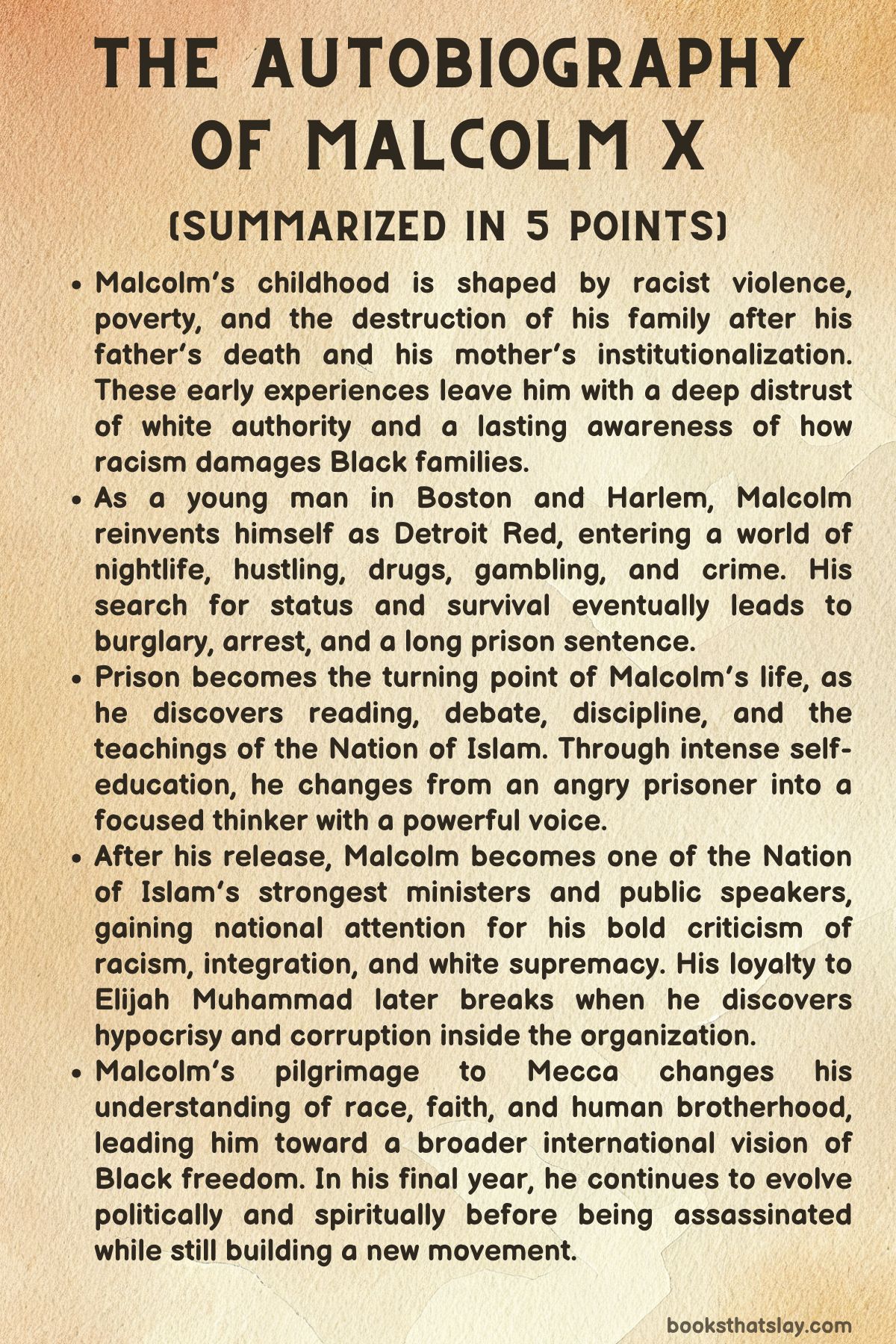
Key Figures
Malcolm X
Malcolm X is the central figure of The Autobiography of Malcolm X, and the book presents him as a man shaped by constant transformation. He begins life as Malcolm Little, a child exposed to racial terror, poverty, family loss, and institutional neglect.
These early wounds do not simply make him angry; they teach him that racism is not abstract but physical, economic, psychological, and domestic. His father’s death, his mother’s breakdown, and his separation from his siblings leave him with deep distrust toward authority.
As a young man, he tries to escape pain through performance, style, crime, drugs, and status. The figure known as Detroit Red is clever, bold, restless, and self-destructive, surviving through instinct but moving toward collapse.
His prison years mark the great shift in his character. Malcolm discovers discipline through reading, writing, debate, and religious study.
The same intensity that once made him a successful hustler becomes the force behind his intellectual growth. He is never passive; once he believes something, he gives himself to it completely.
His conversion to the Nation of Islam gives him structure, purpose, and a language for understanding racial oppression. As Malcolm X, he becomes a powerful speaker because his arguments come from lived experience as well as study.
Yet his greatest strength is also a source of danger: his loyalty can become absolute, and his faith in Elijah Muhammad delays his recognition of hypocrisy inside the organization.
By the end of the book, Malcolm becomes more flexible without becoming weak. His pilgrimage to Mecca expands his thinking, allowing him to separate racist systems from individual human beings in a way he had not fully done before.
He remains angry at injustice, but his anger becomes more global, political, and mature. He is one of the rare figures in the story who is willing to publicly change.
That willingness gives his life its force. Malcolm’s character is not built around perfection; it is built around growth, self-criticism, courage, and an urgent need to tell the truth as he understands it.
Louise Little
Louise Little is one of the most tragic and important figures in the book. She is Malcolm’s mother, a proud and capable woman who tries to hold her family together after years of racist harassment, poverty, and grief.
Her background carries its own violence, since she is the child of a Black woman and a white man who raped her mother. This history makes Louise’s light complexion a painful part of her identity.
She can sometimes pass as white, and this helps her find domestic work, but it also reminds the reader that race in the story is bound up with exploitation and power.
Louise’s decline is not presented as personal weakness. The book shows her as a woman crushed by forces larger than herself: the murder of her husband, the refusal of insurance money, the hunger of her children, the humiliation of welfare, and the interference of social workers.
She fights to feed her family and preserve her dignity, but every institution around her seems to reduce her authority. The state’s decision to separate her children adds to her emotional collapse.
Malcolm’s later anger toward American society is partly rooted in what he saw happen to his mother. Louise represents the hidden cost of racism on Black women, especially those expected to endure suffering silently while keeping families alive.
Earl Little
Earl Little is Malcolm’s father and one of the first models of Black pride in his life. As a Baptist preacher and follower of Marcus Garvey, Earl believes in Black self-reliance, racial dignity, and a future beyond dependence on white society.
His work makes him a target of white supremacist groups, but he continues preaching despite the risks. In Malcolm’s memory, Earl is strong, fearless, and politically committed, though also stern and sometimes harsh at home.
He represents a form of Black manhood that refuses submission.
Earl’s death becomes one of the defining events of Malcolm’s childhood. Whether or not officials call it an accident, the family understands it as the result of racial violence.
His murder shows Malcolm that Black leadership can be punished brutally when it challenges white power. Earl’s presence in the book is brief but lasting.
He gives Malcolm an inheritance of pride and resistance, even though Malcolm only fully understands that inheritance much later. In many ways, Malcolm’s adult speeches continue the work Earl began, though in a different religious and political language.
Ella Little-Collins
Ella is Malcolm’s older half-sister and a major force in his development. She is independent, confident, financially secure, and proud of being Black.
When Malcolm visits her in Boston, she opens his eyes to a Black world far larger and more self-assured than the white-controlled spaces he has known in Michigan. Her home, social standing, and personality challenge the narrow image of Black life Malcolm has been taught to accept.
She becomes a living example of dignity without apology.
Ella also provides Malcolm with practical support at crucial moments. She helps bring him to Boston, giving him access to freedom, excitement, and danger all at once.
Later, she helps secure his transfer to a better prison facility and eventually lends him money for his pilgrimage to Mecca. Ella does not always share Malcolm’s beliefs, and she refuses to join the Nation of Islam despite his efforts.
That refusal matters because it shows her independence. She loves Malcolm, but she is not easily controlled by him.
In The Autobiography of Malcolm X, Ella stands as one of the strongest women in Malcolm’s life, a person whose pride and resources help make his transformation possible.
Shorty
Shorty is Malcolm’s friend and guide during his early Boston years. He introduces Malcolm to nightlife, street fashion, music, and hustling.
As an older companion, he helps Malcolm find work and teaches him how to move through a world of bars, dance halls, and informal economies. Shorty is warm, funny, loyal, and streetwise, and his friendship gives Malcolm a sense of belonging after the disruptions of childhood.
At the same time, Shorty is part of the environment that pulls Malcolm deeper into self-destructive habits. Their shared love of style and excitement turns into criminal partnership, and both men eventually pay for it with prison sentences.
Shorty does not undergo the same dramatic public transformation as Malcolm, but he remains emotionally important because he represents Malcolm’s past without becoming only a symbol of failure. When Malcolm later reconnects with him, their laughter over old times shows that Malcolm has not simply erased his earlier life.
Shorty helps the reader see that Malcolm’s street years included friendship and energy as well as danger and moral loss.
Sophia
Sophia is a white woman whose relationship with Malcolm reveals the racial and sexual tensions of his young adulthood. To Malcolm, being seen with Sophia gives him status in the street world.
Her whiteness becomes a kind of social currency, proof that he can cross a forbidden line and attract attention. Yet the relationship is unhealthy and exploitative.
Malcolm uses Sophia for money, status, and pleasure, while also abusing her. She continues to visit him even after marrying a white man, and later becomes involved in the burglary ring that leads to their arrests.
Sophia’s role in the book is not romanticized. She represents temptation, racial performance, and the distorted values of a society where proximity to whiteness can seem like power.
Malcolm’s treatment of her also exposes his own cruelty during this period. He is not only a victim of racism; he is capable of harming others.
The harsh prison sentence he receives is tied to the court’s outrage over Black men and white women crossing racial boundaries. Through Sophia, the story shows how racism polices intimacy and sexuality while also revealing Malcolm’s moral confusion before his transformation.
Laura
Laura is one of the clearest examples of a life Malcolm believes he damaged. She is intelligent, disciplined, religiously supervised by her grandmother, and full of promise.
Her love of dancing reveals a freer and more joyful side of her personality, and her connection with Malcolm briefly suggests that he might choose a healthier path. Their time together is marked by youth, talent, and possibility.
Malcolm’s decision to abandon Laura for Sophia becomes one of his lasting regrets. He understands later that choosing a white woman over Laura was not only a personal betrayal but also a racial wound.
Laura’s later addiction and involvement in sex work haunt him because he feels his rejection helped push her toward despair. The book does not reduce Laura to Malcolm’s guilt, but his memory of her serves as a moral checkpoint.
She represents the people harmed along the way by Malcolm’s insecurity, vanity, and hunger for status. Her character also shows how easily a young Black woman’s promise can be destroyed when emotional injury meets a harsh social world.
Elijah Muhammad
Elijah Muhammad is one of the most influential and complicated figures in the book. To Malcolm, he first appears as a savior, teacher, and father figure.
His letters from prison give Malcolm a new explanation for his life, turning shame and anger into discipline and purpose. Elijah Muhammad’s teachings help Malcolm reject drugs, crime, and self-hatred.
Under his influence, Malcolm becomes a minister, organizer, and national spokesman. For a long period, Malcolm’s devotion to him is absolute.
The later revelation of Elijah Muhammad’s sexual misconduct breaks the moral structure on which Malcolm has built his life. The betrayal is not only personal; it is ideological.
The Nation of Islam demands strict behavior from its members, punishing those who violate its rules, yet its leader secretly breaks those same rules and allows women to suffer the consequences. Elijah Muhammad’s jealousy of Malcolm’s fame adds another layer to the conflict.
In The Autobiography of Malcolm X, he functions as both mentor and betrayer, the man who helps create Malcolm X and then becomes one of the reasons Malcolm must change again. His character shows how movements built around one leader can become dangerous when loyalty replaces truth.
Betty Shabazz
Betty Shabazz, introduced as Betty X, is Malcolm’s wife and a steady presence during his years of public struggle. She is disciplined, intelligent, and committed to the Nation of Islam when Malcolm meets her.
Their courtship is practical rather than conventionally romantic, reflecting Malcolm’s guarded attitude toward marriage and his heavy commitment to his work. Yet Betty becomes central to his domestic life, raising their daughters while Malcolm travels, speaks, organizes, and faces growing danger.
Her importance becomes especially clear near the end of the story. Betty lives with the consequences of Malcolm’s conflicts, including financial pressure, public hostility, and direct threats to the family.
The firebombing of their home shows that she and the children are not separate from Malcolm’s political life; they are placed in danger by it. Betty’s role is quieter than Malcolm’s, but her endurance is significant.
She represents the emotional and domestic cost carried by the families of public leaders. The book presents her as loyal and brave, even when Malcolm’s path leaves little room for safety or stability.
Reginald Little
Reginald Little is Malcolm’s younger brother and a key figure in his religious conversion. During Malcolm’s prison years, Reginald’s mysterious advice to stop eating pork and smoking cigarettes catches Malcolm’s attention.
When Reginald later explains the Nation of Islam’s teachings, Malcolm is deeply affected. Because Reginald is family, his words reach Malcolm in a way that official preaching might not have done.
He helps open the door to Malcolm’s transformation.
Reginald’s later expulsion from the Nation for sexual misconduct becomes important in retrospect. Malcolm initially pleads for him but eventually accepts Elijah Muhammad’s decision.
Later, when Malcolm learns of Elijah Muhammad’s own misconduct, Reginald’s punishment appears in a new light. It exposes the double standard within the organization and adds to Malcolm’s disillusionment.
Reginald’s character therefore serves two roles: he helps bring Malcolm into the Nation, and his treatment helps reveal the hypocrisy that pushes Malcolm away from it.
Alex Haley
Alex Haley is the collaborator, interviewer, and epilogue writer, and his presence shapes how readers understand Malcolm’s public and private selves. Haley does not present himself as the center of the story, but his observations are valuable because he sees contradictions that outsiders often miss.
He notices Malcolm’s humor, warmth, curiosity, and private respect for some white individuals, even when Malcolm’s public language is severe. This helps complicate the image of Malcolm as only angry or hostile.
Haley’s role also raises questions about memory, storytelling, and timing. He works with Malcolm while Malcolm’s beliefs are changing, especially after the break with the Nation of Islam and the pilgrimage to Mecca.
Haley worries that Malcolm may want to rewrite earlier sections to match his later views, but he persuades him to preserve the record of what he believed at each stage. This decision is crucial to the power of The Autobiography of Malcolm X because it allows the book to show development rather than hide contradiction.
Haley becomes not just a recorder of Malcolm’s life, but a witness to a mind in motion.
Bimbi
Bimbi is a fellow prisoner whose influence on Malcolm is brief but meaningful. In prison, Malcolm first admires him because of his command of language.
Bimbi can speak with such force and intelligence that others listen, even in a place where power is usually physical or institutional. For Malcolm, this is a revelation.
He begins to understand that words can control attention, change minds, and create authority.
Bimbi matters because he appears before Malcolm’s full intellectual awakening. He is not the source of Malcolm’s religious conversion, but he helps prepare Malcolm for it by showing what disciplined speech can do.
Malcolm’s later career as a speaker depends on this lesson. His ability to debate, persuade, challenge, and expose contradictions has roots in the admiration he felt for Bimbi’s verbal skill.
Bimbi represents the first stage of Malcolm’s respect for education as a form of power.
West Indian Archie
West Indian Archie is an older Harlem numbers runner who represents both the brilliance and limits of street life. He has an extraordinary memory, able to track large amounts of betting information without writing it down.
Malcolm recognizes that Archie’s mind, under different social conditions, might have made him successful in mathematics or another respected field. This recognition is important because it shows how racism and poverty waste talent.
Archie also represents the danger of the hustler’s code. His dispute with Malcolm over a bet becomes deadly because pride matters as much as money.
Neither man can easily back down once their reputations are involved. Archie’s role in the story shows how street systems create their own rules, punishments, and forms of honor.
He is not simply a threat to Malcolm; he is also a mirror of what Malcolm could become if intelligence remains trapped in survival games.
Johnson Hinton
Johnson Hinton is a member of the Nation of Islam whose beating by police becomes a turning point in Malcolm’s public reputation. Hinton himself is not developed as fully as Malcolm or Elijah Muhammad, but his role is vital because his injury exposes the violence of policing and the power Malcolm has gained in Harlem.
When Malcolm organizes Nation members and a growing crowd outside the police precinct, Hinton’s suffering becomes the center of a larger confrontation.
Through Hinton, the book shows Malcolm’s discipline as a leader. He does not allow the crowd to become chaotic; he directs it with control and purpose.
He insists that Hinton receive medical treatment, then signals the crowd to disperse. The incident frightens the police because it reveals that Malcolm can command respect where official authority has lost legitimacy.
Hinton’s character therefore represents the ordinary Black victim of state violence whose mistreatment reveals the strength of organized collective response.
Themes
Racial Violence and the Making of Consciousness
Racial violence in the story is not limited to public events or political arguments; it enters homes, childhood memories, schools, police stations, prisons, and courtrooms. Malcolm’s earliest world is shaped by threats against his parents, the burning of the family home, and the suspicious death of his father.
These events teach him that racism is not merely prejudice but a structure that can decide where a family lives, whether it eats, whether it remains together, and whether its suffering is believed. Later, the same pattern appears in education when Malcolm is told that his ambition to become a lawyer is unrealistic for a Black boy.
It appears again in the legal system, where his punishment is intensified by racial panic over white women. Police brutality against Johnson Hinton shows that Black bodies remain vulnerable even when they are part of a disciplined religious community.
This theme gives Malcolm’s anger its context. His sharp public language is not born from theory alone; it comes from a life spent watching institutions excuse, hide, or normalize violence against Black people.
Self-Education as Liberation
Education in the book is not confined to classrooms. In fact, formal schooling often fails Malcolm by minimizing Black history and discouraging his ambition.
His real education begins in painful places: the street, prison, religious debate, and independent reading. Prison becomes the unlikely setting where Malcolm rebuilds himself.
By copying the dictionary, he gains access to language; by reading history, he gains access to a stolen past; by joining debates, he learns how to test ideas in public. His intellectual growth is inseparable from his moral growth because words allow him to name forces that once only trapped him.
The more he reads, the more he sees connections between slavery, Christianity, empire, capitalism, and racial hierarchy. Self-education gives him power because it turns private anger into analysis.
It also allows him to speak to ordinary people in a way that feels direct and earned. The Autobiography of Malcolm X treats reading not as escape from the world, but as preparation to confront it with greater force and clarity.
Reinvention, Identity, and the Search for a True Name
Malcolm’s life is marked by a series of names and identities: Malcolm Little, Detroit Red, Satan, Malcolm X, and El-Hajj Malik El-Shabazz. Each name reflects a stage in his understanding of himself and his place in the world.
Malcolm Little belongs to a childhood shaped by family, loss, and racial limitation. Detroit Red belongs to the street world, where style and survival hide insecurity and pain.
Satan belongs to prison rage, when Malcolm rejects religion and authority. Malcolm X marks a disciplined rejection of the slave name and a claim to a lost African inheritance.
El-Hajj Malik El-Shabazz signals a broader spiritual and political identity after Mecca. These changes are not cosmetic.
They show a man trying to free himself from names imposed by others and from roles created by oppression. The theme of naming also raises a larger question: how can people know themselves when history has deliberately erased their origins?
Malcolm’s search for a true name becomes a search for truth itself.
Faith, Betrayal, and Moral Independence
Faith gives Malcolm discipline, purpose, and a community after years of disorder, but the book refuses to present belief as simple comfort. The Nation of Islam helps Malcolm stop destroying himself and gives him a framework for understanding Black suffering.
Elijah Muhammad becomes a guide whose authority Malcolm trusts almost completely. For a time, obedience feels like salvation because it replaces chaos with order.
Yet this same devotion becomes dangerous when Malcolm discovers hypocrisy within the organization. Elijah Muhammad’s misconduct forces Malcolm to face a painful truth: a leader can teach useful lessons and still fail morally.
This betrayal does not destroy Malcolm’s faith in God, but it changes the way he relates to authority. After leaving the Nation and traveling to Mecca, he becomes more willing to revise his beliefs through experience.
The theme is not faith versus unbelief; it is dependent faith versus moral independence. Malcolm’s final transformation comes when he learns to keep his spiritual seriousness while refusing to surrender his conscience to any single leader.