The Autumn of the Patriarch Summary, Characters and Themes
The Autumn of the Patriarch is a dark, surreal novel by Gabriel García Márquez, translated by Gregory Rabassa, about an unnamed Caribbean dictator whose rule has lasted so long that history, myth, fear, and memory can no longer be separated. The book presents power as both absolute and empty: the ruler commands time, bodies, cities, and even faith, yet he dies lonely, confused, and unloved.
Its world is full of decaying palaces, public worship, private terror, political murder, and strange legends. At its center is a man who seems immortal to others but is deeply trapped by his own authority.
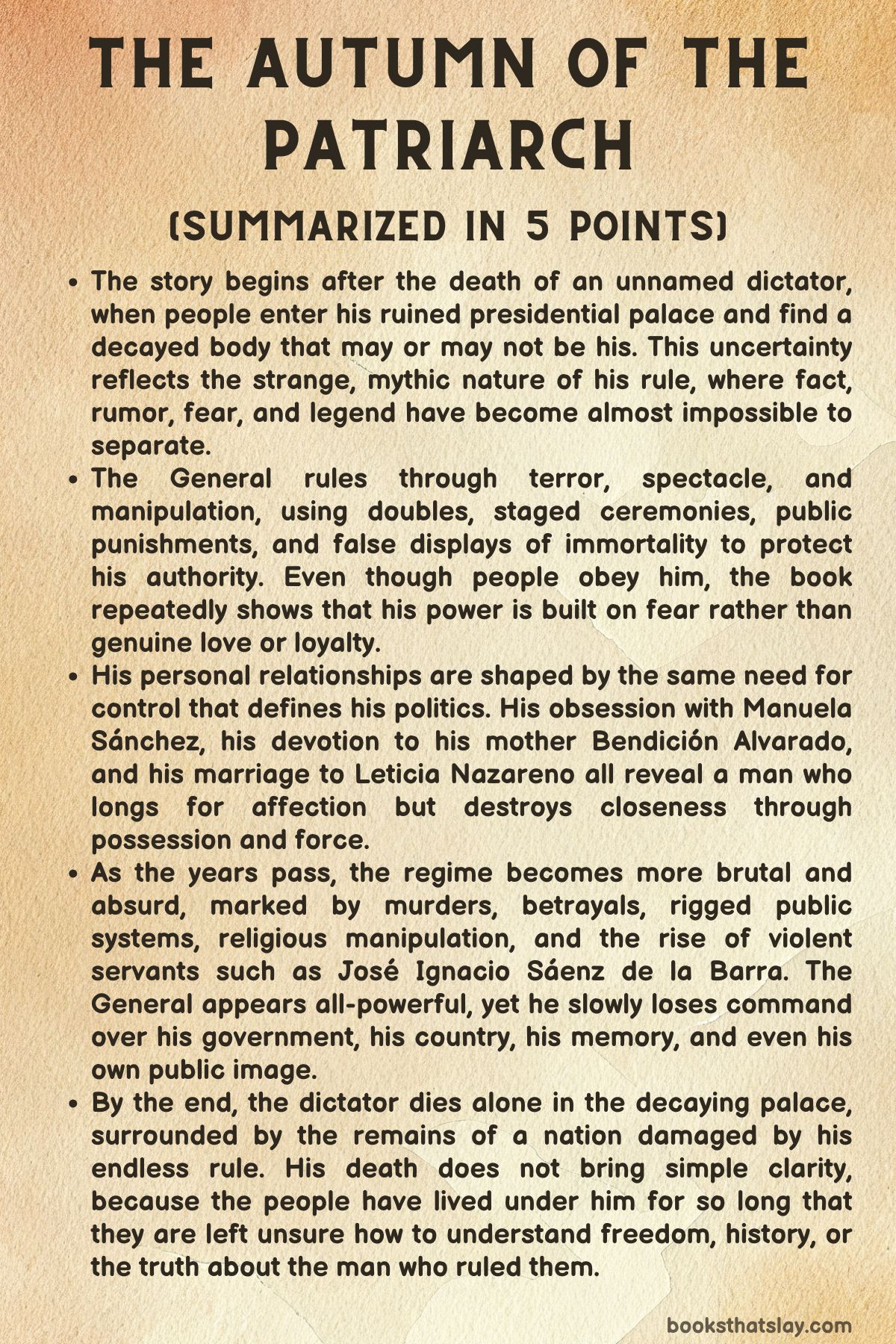
Summary
The Autumn of the Patriarch begins with a collective voice entering the presidential palace after years, perhaps centuries, of uncertainty about whether the dictator still lives inside. The palace is no longer a place of power but a ruin invaded by cows, dung, dust, plants, cobwebs, and rot.
The city outside appears abandoned, and even the sea has become a lifeless stretch of dust. Inside this ruined space, the visitors discover a body lying face down, one arm under the head, in the sleeping position the ruler was said to have used every night.
Yet even this discovery does not bring certainty. The body may belong to the General, but no one truly knows what he looked like, and this is not the first time the nation has believed him dead.
The earlier false death involves Patricio Aragonés, a poor man who resembles the General so closely that he can pass as him. The General first sees Patricio performing a crude public imitation of him and bringing in money from the crowd.
When Patricio is brought to the palace, the General is disturbed by their likeness, even down to the lines on their palms. Instead of killing him, he turns him into a double.
Patricio is physically altered, humiliated, and used as a shield against assassination attempts, while the real ruler moves through the city in disguise, visits his mother Bendición Alvarado, and spends time with other fallen dictators sheltered in his palace.
The General is consumed by fear. He suspects plots everywhere, reads omens into public spectacles, and tortures innocent people when his imagination turns against them.
After a cockfight in which one bird kills and eats another while a tuba player performs, he convinces himself that the musician is part of a conspiracy. He sends Patricio into public because he fears poison.
Eventually Patricio is killed by a poisoned dart. As Patricio dies, he tells the General that no one loves him, that his power is hollow, and that if he ever leaves the presidency, the people will destroy him.
The General stages Patricio’s funeral as if it were his own, only to witness the public’s hatred. The corpse is attacked, dragged through the streets, and dishonored.
When politicians, generals, and ambassadors gather to manage the aftermath of his supposed death, the General reveals himself alive, and his guards massacre them. His return is treated by supporters as proof of immortality.
Afterward, the General punishes those who celebrated his death and rewards those who mourned. He tells himself that the uprising was caused by ambitious generals, not by popular hatred.
He restores public order through entertainments, school projects, labor schemes, and spectacles. Yet the pattern of his rule has been exposed: fear hides behind ceremony, and obedience is mistaken for love.
The book then circles back through legends about the General’s origin. His mother, Bendición Alvarado, is said to have conceived him without a known father, and the truth of his birth is hidden beneath myth.
Bendición lives near the center of power but never truly belongs to it. She prefers simpler company and is embarrassed by palace life.
During a period of foreign occupation, British marines mock the General, strip away his authority, and treat the country as theirs until an epidemic drives them out. The General responds by reclaiming power violently.
Bendición remembers the poverty and uncertainty before his rule and sees how power has changed him.
The General also eliminates his fellow military leaders from the old Federalist struggle, fearing they may kill him. Most are murdered or destroyed by suspicion and rivalry.
General Saturno Santos survives for a time because the General admires his strength and believes him nearly impossible to kill. Still, every relationship in the ruler’s life is shaped by calculation, fear, or domination.
His obsession with Manuela Sánchez reveals another form of tyranny. After hearing that she is the most beautiful woman in one of the poorest districts, he first dismisses her, then becomes fixated on her.
She appears in his dream, and he becomes determined to possess her. He visits her neighborhood repeatedly, believing his movements are secret while guards protect him from unseen danger.
To please her, he improves the district with running water, electricity, lawns, and houses, but these gifts erase her world. He removes her family, friends, and familiar surroundings.
When a comet appears in the sky, Manuela understands that the General’s love has trapped her. Later, during an eclipse arranged as a substitute spectacle because he cannot command a comet, she vanishes without explanation.
Her disappearance wounds him, but he survives, still bound to the prophecy that he will die naturally in his sleep at an impossible age.
The General’s violence grows more grotesque as the story continues. He assaults Francisca Linero in her home and kills her husband, treating human life as disposable whenever it threatens his desires.
A hurricane strikes the city, and he tries to order the world itself to resist it, commanding animals, houses, and objects to be tied down. The city suffers, yet the people still praise his survival as if it proves his protection.
His government also commits crimes hidden behind routine administration. A lottery is rigged so the General always wins, using children trained to select cold billiard balls bearing the winning numbers.
To conceal the fraud, the children are imprisoned in palace dungeons. As the number of captive children grows, the problem becomes impossible to hide.
The General first has them sent away, then orders them placed on a barge and bombed at sea. Their murder becomes one of the clearest signs of a regime that sacrifices innocence to preserve appearances.
Another plot against the General leads him to discover the betrayal of General Rodrigo de Aguilar, his trusted aide. Rodrigo has built a power structure within the regime and plans to have the General declared insane.
The General responds with theatrical brutality. At a banquet, Rodrigo is served on a platter, cooked and decorated with his medals, and the guests are forced to eat him.
Political loyalty becomes a scene of horror, and the ruler proves that intimacy with him offers no safety.
The death of Bendición Alvarado becomes another national drama. Sick, decaying, and attended mainly by her son, she tries to tell him the uncertain truth of his birth.
He refuses to accept her dying. After her death, her body is preserved, carried through the country, and treated as miraculous by the people.
The General tries to have her canonized by the Church, presenting false evidence of sainthood. When Church officials resist, he attacks the papal representative and pressures the institution.
A priest, Monsignor Demetrius Aldous, investigates and discovers that Bendición’s history is far from saintly and that many supposed miracles are tricks or effects of preservation. When the Church suspends the case, the people revolt in anger.
The General declares his mother a civil saint and turns against the Church.
During this anti-Church purge, the General abducts the nun Leticia Nazareno. At first she is a prisoner, but she later becomes his wife and the mother of Emanuel, the only child among thousands to bear his surname.
Leticia teaches him to read and write, influences his public image, and persuades him to restore the Church. Yet she also exploits the state, spends freely, and becomes hated.
Their son is treated like a military figure from birth. The more the public sees the General’s family, the less distant and godlike he appears.
Eventually Leticia and Emanuel are killed by dogs in the marketplace. The General suppresses mourning, hides reminders of them, and unleashes a new wave of vengeance.
José Ignacio Sáenz de la Barra, known as Nacho, offers to find the killers. With his Doberman, Lord Kochel, he begins murdering people in large numbers and sending heads to the General.
Instead of solving the crime, he creates a new terror system and gradually takes control of the regime. Torture centers operate while the aging General pretends not to know the full extent of the horror.
The ruler becomes increasingly isolated, manipulated, and obsolete. Public appearances are staged through doubles and recordings, and the General’s own rule continues without his real presence.
Eventually the people rise against Nacho, who is beaten and tied to a lamppost. The General is briefly celebrated again, but he now sees the country’s ruin and its crushing debts.
Foreign powers demand repayment, and in the end he sells the sea, leaving the nation with only an artificial wind machine. This sale marks the final emptiness of his power: he has surrendered even the natural symbol of the country.
In his last days, the General wanders through the palace in confusion, remembering fragments of his mother, Leticia, Emanuel, his early rule, and the long years of command. The nation has been trained to live under his orders and fears what freedom may mean.
He dies alone, face down with his arm beneath his head, as foretold. Even then, the people cannot fully confirm who he was.
The corpse is dressed and repaired to resemble the legend, but the man behind the legend has vanished into decay, rumor, and fear.
Characters
The General
The General is the central figure of The Autumn of the Patriarch, a ruler whose authority seems endless but whose inner life is ruled by fear, loneliness, appetite, and suspicion. He is not presented as a conventional political leader with a clear biography; he is closer to a living myth produced by terror, propaganda, and public memory.
His body itself becomes legendary, with stories of impossible age, strange physical features, and repeated deaths. Yet behind these myths is a man who cannot trust anyone.
He uses doubles, punishes imagined enemies, reads omens into ordinary events, and destroys people before they can become threats. His rule depends on spectacle as much as violence.
Funerals, public ceremonies, staged miracles, fake appearances, and military displays all support the illusion that he is larger than human life.
The General’s greatest weakness is his need to be loved by the people he has brutalized. Patricio tells him the truth that no one truly loves him, and this truth haunts the book.
The General tries to transform obedience into affection and fear into loyalty, but every major event proves that the nation’s worship is unstable. When people think he has died, many celebrate.
When his mother’s corpse appears miraculous, they adore her with a passion he cannot command honestly. When Nacho becomes too cruel, the people revolt and then return to praising the General because they have known no other center of order.
His emotional life follows the same pattern. He pursues Manuela, Leticia, and schoolgirls not through mutual love but through power, possession, and need.
Even when he feels tenderness, it is destructive because he cannot imagine love without control.
Patricio Aragonés
Patricio Aragonés is the General’s double, but he is more than a political decoy. He becomes a living reflection of the ruler’s emptiness.
When he is first found, he is a poor imitator using the General’s image to earn money from the crowd. Once brought into the palace, his resemblance becomes both his value and his curse.
He is altered, endangered, and stripped of his own life so that he can absorb the risks meant for the ruler. The physical changes he suffers show how dictatorship consumes bodies, even those it appears to spare.
He survives assassination attempts for the General, but he is never treated as fully human.
His death scene is one of the strongest moments in the book because he speaks what others cannot. Covered in misery and nearing death, Patricio tells the General that his power is false, that he rules nobody in any meaningful sense, and that the people would destroy him if he gave them the chance.
Patricio’s hatred is intimate because he has lived inside the General’s image. He knows the difference between the public mask and the private prison.
His role also exposes the fragility of political identity in the novel. If another man can wear the ruler’s face, receive public hatred, and be buried as him, then the General’s authority depends less on the man himself than on the machinery of belief around him.
Bendición Alvarado
Bendición Alvarado is the General’s mother and one of the few figures connected to a time before absolute rule. In The Autumn of the Patriarch, she represents origin, memory, poverty, and the stubborn ordinariness that the General’s regime tries to cover with myth.
Her background is uncertain, and the stories around her are full of contradiction. She may have been poor, practical, sexually stigmatized, and socially marginal, yet the General attempts to transform her into a saint after her death.
This contrast between the real woman and the public image created for her is central to her role in the story.
Bendición is not comfortable inside power. She does not fully adapt to the presidential palace and seems to prefer the company of servants and ordinary people.
Her discomfort exposes the artificiality of the General’s grandeur. She remembers his earlier life and sees the gap between the son she knew and the patriarch he becomes.
Her death intensifies his need to command reality. He refuses to accept her dying, then tries to control the meaning of her corpse through national mourning and sainthood.
The people’s response to her body also reveals something he lacks: they gather around her with a kind of belief that feels spontaneous, even if that belief is later shown to rest on illusion. Bendición’s character shows how personal grief becomes political theater under tyranny.
Manuela Sánchez
Manuela Sánchez is the woman who becomes the object of the General’s romantic obsession. She comes from a poor district, and her beauty draws the attention of men in power before the General even meets her properly.
At first he dismisses her as ordinary, but after she enters his dream, he becomes fixated on finding and possessing her. His pursuit is presented as love from his point of view, yet it is a form of conquest.
He does not simply court her; he changes her neighborhood, removes the people and places that define her life, and surrounds her with the consequences of his desire.
Manuela’s importance lies in her quiet resistance and final disappearance. She sees that the General’s love does not free or honor her; it traps her inside the world of his power.
The improvements he brings to her district are not gifts in any true sense, because they erase her reality and replace it with a version designed to please him. Her vanishing during the eclipse is one of the novel’s most mysterious acts of escape.
It denies the General the possession he expects and proves that even a ruler who commands armies, ceremonies, and public time cannot fully command another person’s will. She becomes a reminder of the limits of domination.
General Rodrigo de Aguilar
General Rodrigo de Aguilar is one of the General’s closest aides and one of the clearest examples of hidden power within the regime. On the surface, he appears loyal, useful, and deeply trusted.
In practice, he builds another authority beneath the General’s own, signing documents, managing relationships, and preparing to remove the ruler by having him confined as insane. Rodrigo’s betrayal is especially threatening because it comes not from an open enemy but from the inside of the palace.
He shows that a dictatorship filled with fear does not eliminate ambition; it drives ambition into secrecy.
His fate is among the book’s most shocking displays of punishment. By having Rodrigo served at a banquet, the General turns betrayal into a ritual of forced loyalty.
The guests must consume the body of the man who tried to replace or control the ruler. This act reveals how the General uses horror to bind people to him.
Rodrigo’s character also shows the weakness of absolute power: the more the ruler depends on intermediaries, the more those intermediaries can quietly rule in his name. Rodrigo is both a traitor and a product of the system he serves.
Leticia Nazareno
Leticia Nazareno begins as a nun caught in the General’s campaign against the Church, and her abduction shows the ruler’s habit of turning desire into possession. She is taken from religious life and imprisoned in the palace, where her relationship with the General gradually changes into marriage and political influence.
Unlike Manuela, who disappears from his reach, Leticia remains and learns how to shape him. She teaches him to read and write, alters his public presentation, and persuades him to restore the Church.
Her power over him is real, but it is built inside a violent and unequal relationship.
Leticia is neither simply victim nor simply manipulator. The story allows her to become politically active, ambitious, and corrupt.
She spends public money, benefits from her position, and draws public resentment. Her presence also humanizes the General in a dangerous way.
Once the people see his wife and child, his distance from ordinary life weakens. He is no longer only an immortal patriarch; he is a husband and father whose private life can be attacked.
Leticia’s death by dogs is brutal and symbolic. It destroys the General’s domestic fantasy and returns him to paranoia, vengeance, and emotional emptiness.
Emanuel
Emanuel is the son of the General and Leticia, and he is the only one among the General’s thousands of children to carry his surname. From birth, he is transformed into a political symbol rather than allowed to exist as an ordinary child.
He is appointed Major General immediately and decorated as if he were already part of the military order. His life shows how dictatorship absorbs even infancy into ceremony, rank, and display.
Emanuel does not have much agency, but that absence is part of his meaning. He is used to extend the General’s image into the future.
His death with Leticia shatters the illusion of dynasty. The General’s power appears endless, yet his legitimate line is destroyed violently in a public place.
Emanuel’s murder also exposes the hatred surrounding the ruler’s family. The child carries the burden of his father’s public crimes, even though he cannot understand them.
In this way, Emanuel represents the cruelty of inherited power: he is elevated before he can choose anything and punished by history before he can become himself.
José Ignacio Sáenz de la Barra
José Ignacio Sáenz de la Barra, also called Nacho, is one of the most frightening figures in the story because he enters as a servant of vengeance and becomes a ruler in practice. After Leticia and Emanuel are killed, he offers the General a way to find the supposed assassins.
With his Doberman, Lord Kochel, he begins a campaign of murder that grows far beyond the original crime. He sends heads to the General, creates torture spaces, feeds bodies to his dog, and turns investigation into a system of terror.
Nacho’s character shows what happens when a weakened ruler allows another man to administer fear on his behalf. The General thinks he is using Nacho, but Nacho gradually controls the machinery of violence and public appearance.
He even manages the General’s image through recordings and doubles. Nacho does not replace the patriarch openly; he hollows out the regime from within.
His fall comes when the people finally revolt against his cruelty, but his rise proves that tyranny can survive even when the tyrant himself is old, confused, and passive. Power continues through those willing to manage its violence.
Saturno Santos
Saturno Santos is one of the old military figures connected to the General’s rise. Unlike many generals who are killed by rivalry, suspicion, or political cleansing, Saturno survives long enough to become almost legendary in the General’s mind.
The ruler sees him as powerful and perhaps invincible, which gives him a strange kind of protection. Saturno’s value in the story lies in the contrast between raw military strength and the General’s paranoid cunning.
He also reflects the violent brotherhood from which the regime emerged. The General’s rule is not born from peaceful legitimacy but from war, betrayal, and the elimination of former allies.
Saturno’s survival does not make him free. He is spared because the General finds him useful or impressive, not because mercy governs the regime.
His presence reminds the reader that under tyranny even survival can be another form of captivity.
Monsignor Demetrius Aldous
Monsignor Demetrius Aldous is the Church investigator assigned to examine the case for Bendición Alvarado’s sainthood. His role is important because he represents an institution that can challenge the General’s command over truth.
The ruler wants his mother declared a saint, not because of spiritual humility, but because sainthood would confirm his own mythic status. Monsignor Aldous investigates beneath the official stories and uncovers fraud, manipulation, and inconvenient facts about Bendición’s past.
His conversations with the General reveal a rare contest over reality. He tells the ruler that the miracles surrounding Bendición were staged or misunderstood and that her preserved body was the result of physical treatment rather than divine power.
Yet he also recognizes the political danger of saying such things openly. Monsignor Aldous is not a heroic liberator, but he does expose the limits of state-made holiness.
Through him, the story shows how religion can be pressured by power, but also how truth can survive briefly in private speech.
Francisca Linero
Francisca Linero appears in one of the book’s most brutal episodes. The General enters her home, sexually assaults her, and kills her husband, Poncio Daza.
Her presence in the story is brief, but it is important because she represents the ordinary people whose lives are destroyed by the ruler’s desires. The violence against her is not politically necessary; it is an expression of entitlement.
The General acts as though the bodies, homes, and marriages of his subjects belong to him.
Francisca’s scene strips away any illusion that the General’s violence is limited to statecraft or war. His tyranny is personal, physical, and domestic.
It enters bedrooms and marriages. Through her, the book shows that absolute power does not remain in offices, armies, or decrees.
It reaches into the most private spaces and leaves victims with no protection.
The Collective Narrator
The collective narrator gives The Autumn of the Patriarch its unstable and haunting shape. This voice often speaks as “we,” suggesting the people, the nation, memory itself, or generations trying to understand what happened under the General’s rule.
The narrator is never fully separate from the society it describes. It carries fear, rumor, awe, hatred, uncertainty, and fascination all at once.
Because of this, the story feels less like a neat biography and more like a national memory struggling to organize centuries of trauma.
The narrator’s uncertainty is central. It cannot always confirm whether the body is truly the General’s, whether certain legends are true, or where history ends and invention begins.
This uncertainty does not weaken the story; it shows how dictatorship damages truth. When one man controls public life for too long, facts become mixed with propaganda, myth, terror, and wishful thinking.
The narrator preserves that confusion while also exposing the cruelty beneath it.
Themes
The Emptiness of Absolute Power
In The Autumn of the Patriarch, power appears unlimited on the surface, yet it is repeatedly shown to be hollow at its core. The General commands soldiers, alters public life, punishes enemies, stages ceremonies, manipulates religion, controls news of his own death, and even tries to impose his will on natural events.
People call him immortal, and the state treats his body as a sacred object. Still, his authority depends on fear, illusion, and constant performance.
He must use doubles, false funerals, public spectacles, and punishment because his rule has no stable moral foundation. The more power he gathers, the less secure he becomes.
He cannot trust friends, aides, lovers, priests, generals, or the people. Even loyalty becomes suspicious because it may hide ambition or hatred.
His final condition reveals the truth that grandeur has covered: he is old, confused, isolated, and nearly irrelevant inside the system built around him. The sale of the sea marks the ultimate failure of his rule.
A dictator who once seemed to own the nation ends by surrendering one of its essential elements to pay debts. Absolute power does not make him free; it traps him inside fear, decay, and dependence on the very machinery that outlives his control.
Myth, Rumor, and the Destruction of Truth
Truth in the story is never simple because the General’s rule has lasted so long that memory itself has become damaged. The people cannot be certain whether the corpse in the palace belongs to him, how old he was, where he came from, or which stories about him are factual.
His mother’s history is uncertain, his birth records contradict one another, and his body is surrounded by impossible legends. This uncertainty is not just a stylistic choice; it reflects what dictatorship does to public knowledge.
When a ruler controls institutions, ceremonies, punishments, religion, and official speech, reality becomes something that can be staged. Patricio can be buried as the General.
Bendición can be turned into a saintly figure through preserved remains and false miracles. Public appearances can be created through doubles and recordings.
Even death can be delayed as a political fact because people are trained to believe in the ruler’s permanence. Rumor becomes the only form of history available to the people, but rumor is unstable.
It carries truth and distortion together. The book shows that tyranny does not only kill bodies; it also injures memory, making later generations unsure how to separate fact from fear.
Love as Possession and Control
Relationships in the story are rarely allowed to exist outside power. The General wants love, but he does not know how to receive it without command.
His pursuit of Manuela Sánchez begins as desire and quickly becomes a campaign of control. He changes her neighborhood, removes her familiar world, and surrounds her with gifts that function like a cage.
His marriage to Leticia Nazareno also begins in captivity. Though Leticia later gains influence over him, the relationship is rooted in abduction and imbalance.
Even his attachment to his mother becomes political after her death, as grief is converted into national mourning, public procession, and a campaign for sainthood. The General’s need for affection is genuine in the sense that he fears loneliness and wants to be adored, but his methods destroy the possibility of real closeness.
He cannot accept another person as independent. Love, for him, means possession, preservation, display, and obedience.
This is why his relationships end in disappearance, death, fraud, or silence. The book suggests that a person trained by absolute authority cannot easily understand mutual love.
The ruler’s emotional poverty is inseparable from his political violence, because both come from the same inability to recognize limits.
National Trauma and Collective Dependence
The people suffer under the General’s rule, but they are also shaped by it so deeply that freedom becomes frightening. The nation lives for generations under his commands, ceremonies, punishments, lies, and sudden acts of generosity.
Public life is organized around him, even when people hate him. They celebrate his apparent death, then fear disorder; they revolt against agents of terror, then return to praising the old ruler; they accept myths because myths offer structure in a world where institutions have been weakened or destroyed.
This dependence is one of the book’s darkest insights. Tyranny does not simply stand above society; over time, it enters habits, language, expectations, and fears.
The palace may decay, the ruler may lose memory, and the machinery of government may collapse into fraud and violence, yet the people still struggle to imagine what comes after him. The final discovery of the body does not produce clean liberation.
It produces uncertainty, dread, and confusion. The nation has been trained to orbit one man for so long that his death leaves a void.
The book treats dictatorship as a wound carried by the whole society, not only as the crime of one ruler.