The Awakening by Kate Chopin Summary, Characters and Themes
The Awakening by Kate Chopin is a novel about a woman who begins to recognize the limits placed on her by marriage, motherhood, social duty, and the expectations of her class. Set in Louisiana, the book follows Edna Pontellier as a summer at Grand Isle changes the way she sees herself.
What begins as restlessness becomes a deeper demand for emotional, artistic, and bodily freedom. Chopin writes with clear restraint, letting Edna’s choices, silences, desires, and contradictions speak for her. The result is a daring story about selfhood in a world that gives women little room to own themselves.
Summary
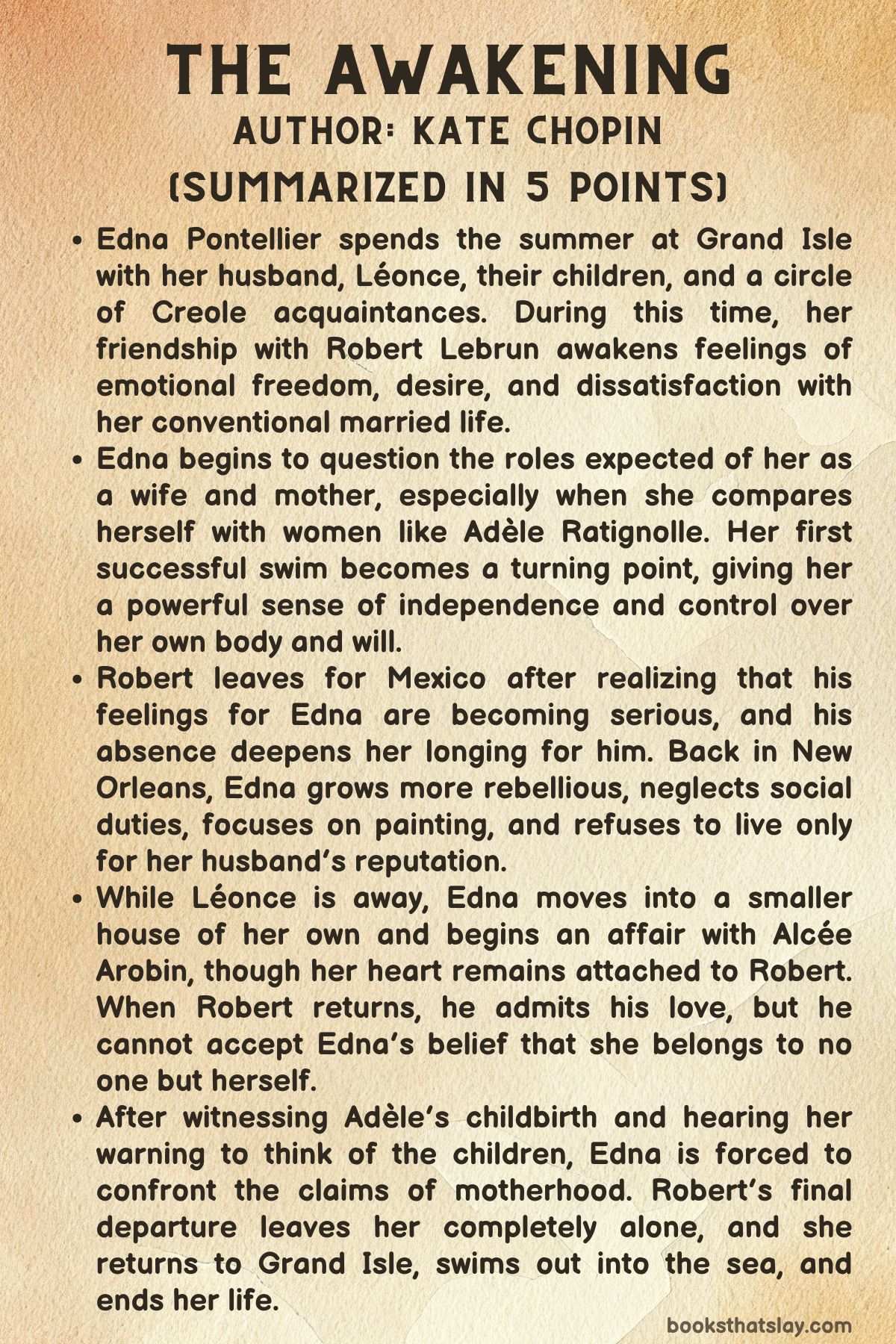
Edna Pontellier spends the summer at Grand Isle with her husband, Léonce, their two young sons, and a circle of Creole acquaintances. Léonce is a wealthy New Orleans businessman who cares about order, reputation, property, and social habits.
He sees himself as a generous husband, and in many ways society agrees with him. He gives Edna comforts, money, gifts, and a respectable place in the world.
Yet from the beginning, there is a quiet distance between them. He treats Edna less as a full person than as a wife whose duties should naturally include devotion to him, attention to the children, and proper management of her social role.
At Grand Isle, Edna spends much of her time with Robert Lebrun, the charming young son of Madame Lebrun, who owns the cottages where the vacationers stay. Robert has a habit of attaching himself each summer to one woman, often a married one, in a manner that Creole society considers playful and harmless.
With Edna, however, the connection grows more serious. They talk, walk, swim, and share time together in a way that makes Edna feel noticed and alive.
She is drawn to his attention, and he is drawn to her in a way that unsettles even those who know his flirtatious nature.
Edna is not like the “mother-women” around her, especially Adèle Ratignolle. Adèle is affectionate, openly expressive, domestic, and devoted to husband and children.
She represents the accepted model of womanhood in this society. Edna likes Adèle and grows close to her, but she cannot become like her.
Through conversations with Adèle, Edna begins to speak about feelings she has long kept private. She remembers her childhood in Kentucky, her habit of inward questioning, and her early emotional fantasies.
She also begins to understand that her marriage to Léonce was not built on passion. She had accepted his devotion partly because it pleased her and partly because it helped her escape earlier romantic illusions.
The sea becomes central to Edna’s change. At first she cannot swim, despite repeated attempts.
One night, after hearing Mademoiselle Reisz perform music that deeply affects her, Edna joins the others at the beach and suddenly learns to swim. The act gives her a powerful sense of control over her body and spirit.
She swims away from the group, thrilled by her new ability and frightened when she realizes how far she has gone. This moment marks a turning point.
She has felt independence physically, and afterward she cannot return easily to the obedient role she had accepted before.
That same night, Léonce tells Edna to come inside and go to bed. For the first time, she refuses simply because she wants to remain outside.
The refusal is small but meaningful. She realizes that throughout her marriage she has obeyed him without serious resistance, not because she truly agreed with him, but because she had never imagined doing otherwise.
Now she can imagine it. She spends the night in a state of wakeful defiance, aware that something within her has changed.
Edna and Robert soon spend a day together at Chênière Caminada after attending church. Edna becomes faint during the service and leaves, with Robert following her.
At Madame Antoine’s house, she rests, sleeps deeply, wakes refreshed, and shares an intimate, dreamlike day with him. The experience increases her sense that she and Robert inhabit a private world.
When she returns home, she expects Robert to remain near her, and his departure for the evening leaves her disappointed.
Robert, sensing the danger of his feelings, abruptly decides to leave for Mexico. Edna is hurt that he did not tell her sooner.
Their farewell is strained because both feel more than they can say. After he leaves, Edna misses him intensely.
His absence changes the color of her days. She visits his mother, searches for news of him, and becomes jealous when she hears of his interactions with other women.
She does not fully admit to herself at once that she loves him, but her feelings become impossible to ignore.
When the summer ends, Edna returns with Léonce to New Orleans. There, her inner rebellion becomes outward behavior.
She neglects her weekly reception day, refuses expected social duties, and spends more time painting. Léonce is irritated and embarrassed, especially because her behavior may damage his business relationships.
When he scolds her, she reacts with anger, throwing down her wedding ring and smashing a vase. The ring cannot be damaged, but the gesture reveals her desire to break something connected to her confinement.
Edna visits Adèle and observes her marriage to Monsieur Ratignolle. Their home is warm, affectionate, and harmonious, but Edna realizes that such domestic contentment does not satisfy her.
She does not want a life in which her identity disappears inside wifehood and motherhood. She also begins visiting Mademoiselle Reisz, an unmarried pianist who lives apart from conventional society.
Reisz is sharp, difficult, and honest. She recognizes something restless and artistic in Edna and gives her access to Robert’s letters, which reveal that he thinks of Edna constantly.
Reisz also warns Edna that an artist needs courage strong enough to withstand pain and judgment.
Léonce consults Doctor Mandelet, worried that Edna is mentally unwell or influenced by strange ideas about women’s rights. The doctor suspects that another man may be involved, but he advises Léonce to leave Edna alone and not force her.
Léonce later leaves for New York on business, and the children go to stay with their grandmother. Alone in the house, Edna feels peaceful and free.
Without husband and children nearby, she experiences the space as her own for the first time.
During this period, Edna becomes involved with Alcée Arobin, a socially experienced man known for affairs with women. Arobin is flirtatious, persistent, and physically bold.
Edna responds to him not with love but with awakened desire. Their intimacy makes her feel guilty, yet the guilt centers less on Léonce than on Robert.
She sees Arobin as part of her sensual awakening, but Robert remains the person connected to her emotional longing.
Edna decides to move out of Léonce’s house into a smaller home nearby, which she calls the pigeon house. She wants to support the move through her own small earnings and take only what belongs to her.
This decision is one of her clearest attempts to claim independence. Léonce, away from home, responds not with concern for her inner life but with worry about appearances.
To prevent gossip that he cannot afford his mansion, he arranges renovations and announces that the family will travel abroad.
Before moving, Edna hosts a dinner party. The evening is beautiful, rich, and strange.
She appears powerful and solitary, surrounded by guests yet emotionally apart from them. As the party continues, Victor Lebrun sings a song connected to Edna’s memories of Robert, and she reacts sharply, ordering him to stop.
The event exposes the tension between her performance of control and the longing underneath. After the guests leave, Arobin walks her to the pigeon house, where their physical relationship continues.
Edna’s new home gives her a brief sense of liberty. She visits her children and enjoys their company, but once she returns to the city, the force of motherhood no longer holds her in the same way.
Adèle visits and warns her about her reputation, especially concerning Arobin. Edna hears the warning but does not let it govern her.
Robert returns to New Orleans. Edna meets him unexpectedly at Mademoiselle Reisz’s apartment and is hurt that he did not come to her sooner.
He accompanies her home, and the meeting is tense. Both are guarded.
Robert is jealous when he sees evidence of Arobin’s presence, and Edna feels the distance between them even more sharply than when he was in Mexico. Later, after another period of waiting and disappointment, Edna meets Robert at a small garden café.
This time she speaks more directly, accusing him of selfishness and refusing to hide her feelings simply because society would call such openness unwomanly.
Robert finally admits that he left for Mexico to escape his love for her. He had imagined that Léonce might free her so they could marry.
Edna rejects the idea that she belongs to Léonce and insists that she can give herself as she chooses. Robert is shaken because, though he loves her, he still thinks within the rules of marriage and social legitimacy.
Their understanding is incomplete. Edna believes they can belong to each other freely, while Robert cannot imagine love outside the structures he has been taught to respect.
Their conversation is interrupted when Edna is called to Adèle, who is giving birth. The experience horrifies Edna.
Watching Adèle suffer brings back memories of her own childbirth and forces her to confront the bodily demands placed on women. Before Edna leaves, Adèle tells her to think of the children.
The words strike Edna deeply. Doctor Mandelet walks Edna home and senses her distress.
He offers help and understanding, but Edna does not fully confide in him.
When Edna returns to the pigeon house, Robert is gone. He has left a note saying that he loves her and leaves because he loves her.
Edna spends the night awake. She realizes that Robert, like Léonce and society itself, cannot truly understand the freedom she seeks.
He loves her, but his love still imagines her within limits.
Edna returns alone to Grand Isle. The place is quiet and nearly empty.
She tells Victor and Mariequita she needs rest, then goes to the beach. She sees a bird with a broken wing fall, an image that reflects failed flight and damaged freedom.
She puts on her old bathing clothes, then removes them and stands naked before the sea, feeling newly born and exposed. She swims out into the water without looking back.
As she grows tired, she thinks of her children, Robert, and Mademoiselle Reisz’s words about courage. She understands that her children would bind her to a life of self-surrender, that Robert would not understand her, and that no available life can hold the self she has awakened.
The sea receives her as her strength fades.
Characters
Edna Pontellier
Edna Pontellier is the central figure in The Awakening, and her journey is shaped by the painful gap between the self she has been taught to perform and the self she gradually begins to recognize. She enters the book as a wife and mother who appears to occupy a secure social position, but her inner life is restless, private, and dissatisfied.
Her marriage to Léonce is comfortable but emotionally limited; it offers status and material ease without passion, equality, or real understanding. Edna’s connection with Robert does not simply create her transformation, but it helps bring to the surface feelings that were already present.
Her learning to swim, her response to music, her desire to paint, and her move into the pigeon house all show her attempt to claim her body, her imagination, her time, and her choices. Edna is not presented as a simple heroine.
She can be impulsive, self-absorbed, inconsistent, and emotionally careless toward others. Yet these flaws make her struggle more human.
She wants freedom, but she lives in a world where female freedom is treated as selfishness, madness, or sin. Her final act grows from the realization that neither marriage, motherhood, art, nor romantic love can give her a livable form of independence within her society.
Léonce Pontellier
Léonce Pontellier is Edna’s husband, and he represents the respectable patriarchal order that defines women through marriage, property, social duty, and reputation. He is not cruel in an openly violent way, which makes his role more complex.
He provides money, gifts, comfort, and social position, and the women around Edna often praise him as an ideal husband. Yet his kindness is tied to ownership.
He sees Edna as part of his household, much like his home, furniture, and public image. When she neglects her reception day or moves into the pigeon house, his first concern is not her unhappiness but the effect her behavior may have on his business standing and social reputation.
Léonce believes that a wife should manage domestic duties, care properly for children, receive guests, and reflect well on her husband. His confusion over Edna’s behavior shows how little he understands her as an individual.
He thinks in terms of duty and order, while she begins to think in terms of personal truth. Léonce is not written as a monster; he is ordinary, accepted, and even admired by his society.
That ordinariness is important because the book suggests that Edna’s confinement comes not from one unusually bad man, but from a whole system of assumptions that men like Léonce rarely question.
Robert Lebrun
Robert Lebrun is the man who awakens Edna’s romantic longing, but he is also a character limited by the very conventions he seems at first to challenge. At Grand Isle, Robert appears playful, attentive, and emotionally available.
His summer habit of devoting himself to married women has been treated as harmless entertainment, but with Edna the game becomes serious. He listens to her, spends time with her, and gives her the feeling of being seen in a way Léonce never offers.
Yet Robert’s love is cautious and bound by social rules. When he realizes the seriousness of his feelings, he escapes to Mexico rather than confront them.
His absence intensifies Edna’s desire, but it also reveals his fear. When he returns, he imagines a future in which Léonce somehow releases Edna, allowing their love to become socially acceptable.
This shows that Robert does not fully understand Edna’s new sense of self. She does not want to be passed from one man’s possession to another’s.
She wants to belong to herself. Robert’s final note is loving but also evasive.
He leaves because he believes renunciation is noble, but his departure confirms Edna’s loneliness. In The Awakening, Robert is both the object of Edna’s love and proof that love alone cannot free her.
Adèle Ratignolle
Adèle Ratignolle is Edna’s close friend and one of the clearest examples of accepted feminine virtue in the book. She is beautiful, affectionate, maternal, socially graceful, and fully devoted to her husband and children.
Adèle’s life centers on domestic harmony, and she appears content within that role. Her marriage is warm and mutually affectionate, unlike Edna’s more distant relationship with Léonce.
Because of this, Adèle is not merely a flat symbol of oppression. She shows that some women can find meaning within marriage and motherhood, or at least can live successfully according to those expectations.
Yet her presence also sharpens Edna’s difference. Edna admires Adèle but cannot share her complete self-effacement.
Adèle’s openness helps Edna speak more honestly about her own feelings, but Adèle cannot truly understand Edna’s refusal to surrender her inner self, even for her children. Her warning at childbirth, telling Edna to think of the children, is one of the most powerful moments in the story because it reminds Edna of the claims motherhood will always make upon her.
Adèle’s love is sincere, but her advice pulls Edna back toward the social and biological duties from which Edna has been trying to escape.
Mademoiselle Reisz
Mademoiselle Reisz stands apart from the social world that surrounds Edna. She is unmarried, blunt, physically unattractive by conventional standards, and often disliked by others, but she possesses artistic seriousness and emotional insight.
Her music reaches Edna more deeply than polite entertainment ever could. When Edna hears her play, she does not merely imagine emotions; she feels them directly.
Reisz becomes a kind of severe guide, showing Edna that art and independence demand strength. Her statement that the bird who rises above tradition must have strong wings becomes central to Edna’s fate.
Unlike Adèle, who represents domestic womanhood, Reisz represents a possible life outside marriage and motherhood. Yet that life is lonely, difficult, and socially isolated.
She does not offer Edna comfort in any simple sense. Instead, she tests her, questions her, and recognizes the danger of half-formed rebellion.
Reisz also serves as a link between Edna and Robert through the letters she receives from him. She knows more than she says and seems to understand that Edna’s emotional and artistic awakening may lead to suffering.
Within The Awakening, she is the character most closely connected to the cost of freedom, especially for a woman who wants both art and desire.
Alcée Arobin
Alcée Arobin is the figure most closely associated with Edna’s sensual awakening. He is charming, experienced, bold, and skilled in pursuing women.
Unlike Robert, who retreats from forbidden feeling, Arobin moves toward desire without much moral hesitation. His relationship with Edna is important because it separates physical passion from romantic love.
Edna does not love Arobin as she loves Robert, but she responds to him physically in a way that surprises and changes her. Through him, she discovers a part of herself that marriage has not awakened.
Arobin’s role is morally ambiguous. He is not deeply invested in Edna’s freedom as a person; he is drawn to her beauty, mystery, and availability.
Yet he does not pretend to offer spiritual love or permanent rescue. He gives Edna contact with desire, but not understanding.
Her guilt after their intimacy is telling because she feels she has betrayed Robert more than Léonce. This shows how far her emotional allegiance has moved away from her marriage.
Arobin’s presence also damages Edna’s reputation, as Adèle warns, reminding the reader that society judges women’s sexual behavior far more harshly than men’s. He helps reveal Edna’s body to herself, but he cannot meet her deeper need for recognition.
Doctor Mandelet
Doctor Mandelet is one of the few male characters who senses that Edna’s situation is more serious and complex than ordinary moodiness. When Léonce consults him, the doctor listens carefully and suspects that Edna’s behavior may involve emotional or romantic unrest.
Yet he does not immediately expose or condemn her. His advice to Léonce is unusually restrained: he tells him not to force Edna and to let her be.
This shows a degree of psychological insight that other men in the book lack. Doctor Mandelet still belongs to his time, and his language about women, youth, and motherhood reflects conventional assumptions.
Even so, he comes closer than most to understanding that Edna is in real distress. His conversation with her after Adèle’s childbirth is especially important.
He recognizes that she is vulnerable and offers himself as someone she can speak to without judgment. Edna almost sees in him a possible listener, but by then she feels beyond help.
The tragedy of his character is that he may have understood enough to offer some relief, but he arrives too late and remains outside the innermost circle of Edna’s decision.
Madame Lebrun
Madame Lebrun is Robert and Victor’s mother and the owner of the Grand Isle cottages. She helps create the social environment in which much of Edna’s transformation begins.
Her household is lively, noisy, social, and full of overlapping conversations, entertainments, and relationships. As Robert’s mother, she also becomes a point of connection for Edna after Robert leaves for Mexico.
Edna visits her because she wants news, letters, traces, and memories of him. Madame Lebrun herself is practical and socially aware.
She does not always grasp the depth of Edna’s feelings, but she notices changes in people and participates in the culture that treats Robert’s flirtations as familiar behavior. Her conversations about Robert’s letters intensify Edna’s longing because they reveal how little direct claim Edna has over him.
Madame Lebrun’s role is not as emotionally central as Adèle’s or Reisz’s, but she belongs to the network of Grand Isle society that makes flirtation seem safe until it becomes real. She also reflects the older generation’s acceptance of social forms, gossip, family ties, and reputation.
Victor Lebrun
Victor Lebrun, Robert’s younger brother, is bold, flirtatious, careless, and theatrical. He lacks Robert’s emotional restraint and often behaves with a kind of youthful arrogance.
His presence adds energy to the social scenes, but he also exposes how easily charm can become provocation. At Edna’s dinner party, Victor sings a song associated with Robert and the emotional life Edna is trying to control.
Her sharp reaction to him shows how fragile her composure is beneath the appearance of command. Victor does not fully understand what he stirs up in Edna; to him, the moment is part of the party’s excitement.
To Edna, it touches longing, memory, and pain. His connection with Mariequita also contrasts with Robert’s more restrained behavior, suggesting a freer but shallower form of desire.
Victor is important because he often says or does things without measuring their emotional effect. He represents youthful appetite and social boldness, but without the depth that would allow him to understand the suffering around him.
Mariequita
Mariequita is a young Spanish girl connected to the island world around Grand Isle and Chênière Caminada. She appears in moments that unsettle Edna’s feelings about Robert, especially when Edna sees Robert talking with her and later hears of tensions involving her.
Mariequita’s role is small but meaningful because she introduces jealousy and uncertainty into Edna’s imagination. To Edna, she becomes a possible rival, not necessarily because Robert truly loves her, but because Edna is newly vulnerable to possessive feeling.
Mariequita also represents a freer, more openly sensual world than the polished respectability of New Orleans society. Her manner with Robert appears casual and direct, which contrasts with the coded restraint that shapes Edna and Robert’s relationship.
Near the end, Mariequita’s presence at Grand Isle helps mark the return to the place where Edna’s transformation began. She remains outside Edna’s inner crisis, but her youth, curiosity, and ease with the island environment help frame Edna’s final isolation.
The Colonel
Edna’s father, often referred to through his former military rank, represents another form of patriarchal authority. He is proud, commanding, conventional, and accustomed to being obeyed.
His visit to New Orleans gives Edna temporary pleasure because she enjoys sketching him and finds his presence entertaining for a time. Yet their relationship is not deeply intimate, and their disagreement over her refusal to attend her sister’s wedding reveals the limits of his affection.
He believes women should be controlled firmly and even advises Léonce that a husband must use authority to manage a wife. His view of marriage is bluntly hierarchical, making explicit what Léonce often expresses in more polished social terms.
The Colonel helps show that Edna’s resistance is not only against her husband but against a broader inheritance of male command, family duty, religion, and social expectation. He is part of the world that shaped Edna before marriage and continues to claim power over her after it.
The Pontellier Children
Raoul and Etienne, Edna’s sons, are innocent children, but in the book they also carry the heavy symbolic weight of motherhood. Edna loves them, though not in the constant, self-erasing way society expects.
Her affection is real but uneven, and she feels relief when they are absent. This does not make her unfeeling; rather, it reveals her inability to disappear completely into the role of mother.
The children are cared for largely by nurses and relatives, which reflects the customs of their class, but emotionally they remain the strongest claim society has upon Edna. Adèle’s final warning forces Edna to confront this claim directly.
Edna believes she could give her life for her children, but not herself. By the end, she sees them as figures who would pull her back into lifelong surrender.
This perception is tragic because the children are not personally oppressive; they are young and dependent. Yet the institution of motherhood surrounding them becomes, for Edna, the most powerful barrier to full self-possession.
Themes
Freedom and the Cost of Self-Ownership
Freedom in The Awakening is not treated as a simple escape from an unhappy marriage. It is a difficult and often frightening movement toward self-ownership.
Edna does not merely want more leisure, more romance, or fewer duties; she wants to belong to herself in a society that defines her through others. Her husband sees her as a wife, her children make claims upon her as a mother, Robert imagines her freedom only through another socially approved arrangement, and polite society measures her worth through reputation.
Edna’s acts of independence begin quietly: refusing to go inside when Léonce commands her, neglecting reception duties, painting when she wishes, and moving into the pigeon house. Each act gives her a stronger sense of personal control, but each also separates her from the structures that once gave her identity and protection.
The book refuses to pretend that freedom is painless. Edna’s awakening gives her clarity, desire, and moments of joy, yet it also leaves her isolated.
She can reject the roles assigned to her, but she cannot create a sustainable life outside them. Her tragedy comes from seeing freedom clearly while finding no world ready to receive it.
Marriage, Possession, and Social Respectability
Marriage in the story operates less as a union of equal souls and more as a social contract built around ownership, duty, and public appearance. Léonce does not think of himself as oppressive because he fulfills the visible obligations of a husband.
He provides wealth, comfort, a respected home, gifts, and social standing. Yet his understanding of marriage assumes that Edna’s time, behavior, body, and public identity should align with his needs.
When she fails to receive visitors, he worries about business consequences. When she moves out, he manages the situation by creating a public explanation that protects his reputation.
These responses show that social respectability matters more to him than emotional truth. Robert’s love also remains shaped by marriage’s rules.
He imagines Edna becoming available only if Léonce releases her, as though her freedom must still pass through male permission. Edna’s insistence that she is not a possession challenges the foundation of this world.
Her rebellion exposes how deeply marriage, property, gender, and reputation are tied together. The book does not present marriage only as personal failure; Adèle’s marriage is affectionate and stable.
Still, even happy marriage in this society depends on roles that Edna cannot accept for herself.
Motherhood and the Limits of Sacrifice
Motherhood is one of the most painful themes in the book because it is shown as both love and constraint. Edna cares for her children and feels tenderness toward them, especially when she visits them away from New Orleans.
She enjoys their voices, their presence, and the sweetness of being with them for a short time. Yet she does not experience motherhood as a complete identity.
This separates her from women like Adèle, whose maternal devotion appears constant, natural, and socially admired. Edna’s statement that she would give her life for her children but not herself is the key to her conflict.
A life can be sacrificed in one dramatic act, but the self can be consumed slowly through daily surrender. The society around Edna expects the second kind of sacrifice from mothers without naming it as sacrifice at all.
Adèle’s childbirth scene forces Edna to confront the physical and emotional demands of maternity. Her final thoughts about her children are not filled with hatred, but with terror at being claimed forever.
The tragedy lies in the fact that the children are innocent, yet the role attached to them threatens the self Edna has only just begun to know.
Art, Desire, and Awakening
Edna’s awakening is not limited to romantic love; it includes art, music, physical sensation, memory, and a new awareness of her own body. Mademoiselle Reisz’s music reaches Edna with a force that polite social performances do not.
It breaks through her habits of restraint and allows her to feel emotions directly. Painting gives Edna another way to claim perception and expression, even though her talent remains uncertain.
The question is not whether she becomes a great artist, but whether she can live with the honesty and courage that art requires. Desire is part of the same awakening.
Robert stirs emotional longing, while Arobin awakens physical passion. Neither man fully answers Edna’s need, but each reveals something she had not fully understood about herself.
The sea gathers these forms of awakening into one image. Learning to swim gives Edna bodily power, and her final swim returns her to the place where that power first became real.
The broken-winged bird near the end shows the danger of attempting flight without a world that permits it. Edna’s senses open, her will strengthens, and her vision clears, but awakening also makes ordinary compromise impossible.