The Awakening by Nora Roberts Summary, Characters and Themes
The Awakening by Nora Roberts is a fantasy novel about identity, courage, inherited power, and the difficult process of becoming oneself. The story follows Breen O’Kelly, a young woman in Philadelphia whose life feels small, controlled, and unsatisfying until she discovers a hidden fortune left by her father.
That discovery sends her to Ireland, where old memories, strange dreams, and a mysterious portal lead her to Talamh, a magical realm tied to her bloodline. What begins as a personal search for family becomes a larger struggle between light and darkness, choice and duty.
Summary
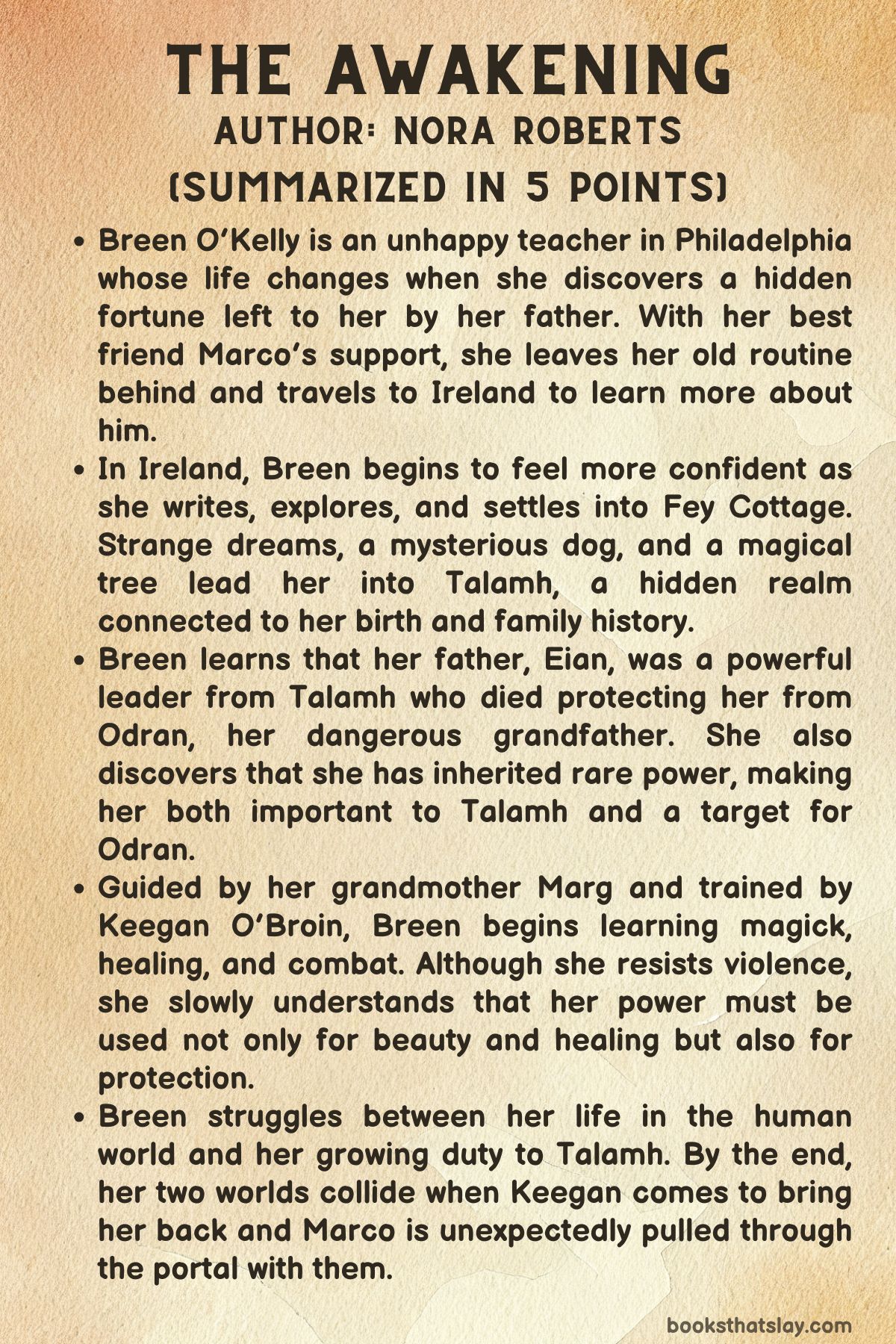
Breen O’Kelly begins the story as a twenty-six-year-old middle school teacher in Philadelphia, worn down by anxiety, self-doubt, and a life that feels more assigned than chosen. Her mother, Jennifer Wilcox, is polished, successful, and critical, and Breen has spent years feeling inadequate beside her.
Breen’s warmest memories are of her father, Eian Kelly, who disappeared from her life when she was a child. She believes he left her behind, and that old wound shapes much of her unhappiness.
A strange shift begins when Breen sees a silver-haired man who seems to call her home. Soon after, while visiting her mother’s house, a sudden breeze exposes papers hidden in a desk drawer.
Breen discovers an investment account in her name worth nearly four million dollars. The money came from her father, but Jennifer kept it secret.
This revelation changes Breen’s life immediately. With the support of her best friend and roommate Marco, she decides to quit teaching, pay off her debts, and travel to Ireland to look for answers about her father.
Before leaving, Breen begins to change outwardly and inwardly. Marco encourages her to replace her plain clothes and timid habits with choices that reflect who she might become.
She gets a tattoo of the Irish word for courage, and she starts to imagine a life beyond fear. Strange dreams follow her.
She sees forests, water, a dragon, a black tower, and hears voices telling her to awaken. These dreams feel impossible, yet they also feel familiar, as if they come from a memory rather than imagination.
Breen and Marco travel to Ireland and stay first in a castle, where Breen begins a blog called Finding Me. The blog gives her a new way to speak in her own voice.
During their travels, they visit a pub connected to her father’s past. The owner remembers Eian Kelly as a musician who played with a band called Sorcery and gives Breen a photograph of him.
This image deepens her longing for the father she lost. Breen also meets Morena, a mysterious woman connected to a hawk, but when Breen asks about her later, no one seems to know who Morena is.
Eventually, Breen and Marco reach Fey Cottage, the place Breen has rented for the summer. The cottage feels like home almost immediately.
After Marco returns to the United States, Breen settles into a quieter life of writing, walking, cooking, gardening, and exploring. She feels freer than she has in years.
During one walk, she follows a friendly dog into the woods and reaches a great tree surrounded by stones. When she follows the dog through the tree, the world changes.
Breen arrives in Talamh, the green and magical land from her dreams. There she meets Harken and Aisling, who care for her, and then Mairghread, called Marg, who reveals that she is Breen’s grandmother.
Breen learns that she was born in Talamh, that her father is dead, and that she was taken away from this realm as a child after being kidnapped. Her mother brought her to the human world to protect her, but in doing so also cut her off from her history, family, and power.
Marg explains that Talamh is a realm where magick exists openly. It is home to witches, faeries, elves, trolls, weres, mers, dragons, and other beings.
Breen struggles to accept this truth, but pieces of her life begin to make sense. Her dreams, her ability to make flowers grow, the silver-haired man, and her father’s hidden money all point toward the same reality.
The silver-haired man is Sedric, Marg’s companion, a were who can take the form of a cat. He came to Philadelphia to help guide Breen toward the secret her mother had buried.
Breen learns that her bloodline makes her powerful and dangerous to those who want power for themselves. Her grandfather Odran is not merely cruel but a god who was cast out for using blood sacrifice and dark magick.
He once seduced Marg and fathered Eian, but he tried to drain his own child’s power. Later, he kidnapped Breen when she was very young.
Eian fought to protect his daughter and Talamh, and he eventually died because of the conflict with Odran. Breen’s grief over her father changes as she learns he did not abandon her willingly.
He was a warrior, a leader, and a father trying to protect two worlds.
Keegan O’Broin, the Taoiseach of Talamh, becomes an important force in Breen’s awakening. He is the chieftain chosen by the sword Cosantoir, and years earlier, during the ritual that named him leader, he saw Breen’s face in the lake.
Keegan does not treat Breen as fragile. He believes she must learn to defend herself and Talamh because Odran will come for her.
Breen resists the violence of training, but Keegan pushes her to understand that power cannot exist only for beauty and healing when darkness threatens everything she loves.
Marg teaches Breen spells, healing, charms, herbs, and the use of will. Breen learns to make fire, call light, and shape magick through focus.
She also continues to write. Her children’s story about the dog gains interest from an agent, and her larger fantasy work grows alongside her own experiences.
Her life in Ireland and Talamh becomes a balance between creativity, family, training, and discovery. She wants both worlds, but both worlds demand different versions of her.
Odran’s threat becomes more direct. Breen sees visions of his cruelty and learns that he wants to drain her power because she carries a unique bloodline.
He sends Yseult, a dark faerie, to capture her. Yseult tricks Breen in the fog and uses snake venom against her, but Keegan arrives in time to save her.
The attack confirms that Breen is not simply learning history; she is standing in the center of an active conflict.
As Breen trains, her relationship with Keegan deepens. Their attraction grows from tension, argument, and mutual challenge.
Keegan’s hardness frustrates her, but his commitment to Talamh also forces her to face the seriousness of her role. When Breen receives news that her writing has earned her a three-book deal, she shares the joy with Keegan, and they become lovers.
Yet their bond does not erase the conflict between them. Keegan sees duty first.
Breen still needs to return to Philadelphia, confront her mother, and decide who she is outside everyone else’s expectations.
Back in the human world, Breen sees her old apartment and understands it is no longer truly home. She tells Marco about her publishing success and faces her mother with new strength.
Jennifer still dismisses her writing and tries to pull her back toward the controlled life Breen has left behind. This time Breen does not collapse under her mother’s judgment.
She recognizes that love cannot be built on control and that her father’s divided life was more complicated than Jennifer allowed her to believe.
Breen also reconnects with Sally, whose love and acceptance remind her of the chosen family that helped her survive. She hires Marco to help market her books, giving him a role in her new life.
Meanwhile, Keegan realizes he cannot make a future with Shana and follows Breen to Philadelphia. When he appears at Sally’s, Marco and Sally meet him, and the truth of Breen’s hidden life begins to break open.
Breen is angry that Keegan expects her to return at once, but she also knows that Talamh remains unfinished business. When Marco bursts in and demands the truth, Breen tells him about her birthright and the magical realm.
Marco thinks the explanation sounds impossible, but when Keegan opens a portal to take Breen back, Marco grabs on and is pulled with them. The story closes with Breen no longer able to keep her worlds separate, as her ordinary life and magical inheritance collide.
Characters
Breen O’Kelly
In The Awakening, Breen O’Kelly is the central figure of transformation. At the beginning of the book, she is a woman living under the weight of other people’s judgments, especially her mother’s.
Her job, appearance, finances, and sense of self all reflect a life shaped by fear rather than desire. Breen’s discovery of the hidden investment account does more than give her money; it gives her permission to question the story she has been told about herself.
Her journey to Ireland is both a search for her father and a search for the person she might have become without shame and control. As she discovers Talamh, Breen must accept truths that challenge her practical understanding of the world.
Her power grows slowly, and that gradual process is important because her greatest obstacle is not lack of ability but lack of belief in herself. Breen is compassionate and creative, drawn toward writing, healing, friendship, and beauty, but the book forces her to face the fact that goodness sometimes requires defense.
Her struggle between the human world and Talamh makes her more than a chosen figure; she is someone trying to honor every part of her identity without losing her freedom.
Keegan O’Broin
As a central figure in The Awakening, Keegan O’Broin represents duty, discipline, and the burden of leadership. He becomes Taoiseach unwillingly, yet once chosen, he accepts the role with seriousness and loyalty.
Keegan’s vision of Breen in the lake connects his destiny with hers long before they meet in person, but he does not romanticize that connection. He sees Breen first as someone Talamh needs and someone who must be prepared.
His harshness as a trainer comes from fear as much as authority: he understands Odran’s danger and knows that hesitation could cost lives. Keegan can be blunt, impatient, and emotionally guarded, but he is not careless.
His actions show devotion to Talamh and a willingness to risk himself for others. His relationship with Breen is charged because they challenge each other’s assumptions.
She pushes against his rigid sense of duty, while he pushes her to claim strength she would rather avoid. Keegan’s complexity lies in the tension between his role as protector and his need to learn tenderness, patience, and trust.
Marco
Marco is Breen’s closest friend and one of the emotional anchors of the book. He gives Breen the encouragement she has not received from her mother and sees her potential before she fully sees it herself.
His support is practical, affectionate, and honest. He helps her change her wardrobe, travel to Ireland, start fresh, and later celebrate her writing success.
Marco’s importance lies in the way he shows chosen family as a real source of strength. He is not part of Breen’s magical bloodline, but he is central to her courage because he reminds her that love does not have to control or diminish.
His humor and grounded personality also balance the strangeness of Breen’s discoveries. When he is pulled into Talamh at the end, his presence suggests that Breen’s two lives can no longer remain separate.
Marco’s disbelief is natural, but his instinct to follow Breen shows that loyalty, for him, comes before understanding.
Mairghread, or Marg
Marg is Breen’s grandmother and one of the wisest figures in the story. She carries the pain of past mistakes, especially her relationship with Odran and the danger that came from it, but she does not allow grief to make her passive.
As a former Taoiseach and a powerful witch, Marg understands leadership, sacrifice, healing, and consequence. Her relationship with Breen is tender but not weak.
She gives Breen love, information, training, and space to grow. Marg also represents the family history stolen from Breen by fear and secrecy.
Through her, Breen learns that her father loved her, that her origins are rich and meaningful, and that power can be used to heal as well as protect. Marg’s guilt over Odran and Eian adds depth to her character.
She has known betrayal and loss, yet she remains committed to light, truth, and preparation. Her guidance helps Breen move from confusion into self-recognition.
Eian Kelly
Eian Kelly is absent from the present action, yet his influence shapes the entire story. For much of Breen’s life, she believes he left her, and that belief damages her sense of worth.
When she learns the truth, Eian becomes a tragic and heroic figure rather than an abandoning father. He was a musician, a husband, a father, a demi-god, and a leader of Talamh, forced to carry duties that pulled him between worlds.
His love for Breen is clear through the money he left her, the memories others share, and the sacrifices he made to protect her. Eian’s life reveals the cost of standing against evil when that evil is tied to one’s own blood.
He fought Odran not only as a leader but as a son resisting a corrupt father. His story helps Breen understand that love can exist alongside absence when danger and duty complicate choice.
Jennifer Wilcox
Jennifer Wilcox is Breen’s mother and one of the most emotionally complicated characters in the book. She is not presented as warm or nurturing; instead, she is controlling, critical, and deeply invested in success as measured by status and practicality.
Her decision to hide Breen’s money is a serious betrayal because it keeps Breen dependent and limited. Yet Jennifer’s actions are also tied to fear.
After the danger surrounding Talamh and Odran, she chooses safety through denial, distance, and control. The problem is that her version of protection becomes another kind of harm.
She tries to erase the parts of Breen that connect to Eian, creativity, magick, and independence. Jennifer’s inability to accept Breen’s writing as real work shows how narrow her idea of a good life is.
She helps create the insecurity Breen must overcome, making her an important force in Breen’s personal conflict.
Odran
Within The Awakening, Odran is the chief force of darkness and corruption. He is dangerous not only because of his power but because of his hunger to possess and consume the power of others.
His history with Marg and Eian reveals a pattern of seduction, betrayal, and exploitation. He does not love family; he uses blood ties as channels for control.
His attempt to drain Eian and later Breen makes him a direct opposite to the book’s idea of love as protection and generosity. Odran’s use of blood sacrifice marks him as someone who rejects moral limits entirely.
He wants Breen because her bloodline gives her rare strength, and his ambition extends beyond one realm. He threatens all worlds, which makes his evil both personal and cosmic.
For Breen, resisting Odran means refusing the old fear that she is not enough. His attacks on her mind and spirit show that he understands insecurity as a weapon.
Morena
Morena is one of Breen’s first living links to Talamh and to the childhood she cannot remember clearly. As one of the Sidhe, she brings wonder into the story through her wings, her connection to the hawk, and her ease in moving between the ordinary and magical.
She is friendly, direct, and confident, and she helps Breen adjust to truths that would otherwise feel overwhelming. Morena also gives Breen companionship outside the heavier roles of teacher, leader, or romantic interest.
Through Morena, Breen sees Talamh not only as a place of danger and duty but as a living community full of beauty, humor, and friendship. Her presence softens Breen’s entry into the realm and gives her a peer connection to balance Marg’s guidance and Keegan’s intensity.
Sedric
Sedric is a quiet but essential guardian figure. His ability to appear as the silver-haired man and as a cat gives him a mysterious role early in the story, when Breen does not yet understand who is watching over her.
He helps set her awakening in motion by guiding her toward the hidden money, which becomes the practical key to her journey. Sedric’s loyalty to Marg and Talamh is steady and understated.
He does not dominate scenes, but his presence carries trust and purpose. As a were, he also reflects the variety of life in Talamh and the idea that identity can have more than one form.
His role in Breen’s life shows that protection is not always dramatic; sometimes it means waiting, watching, and helping at exactly the right moment.
Sally
Sally is a nurturing and affirming presence in Breen’s human-world life. As the owner of the drag club where Breen and Marco spend time, Sally represents acceptance, celebration, and chosen community.
Sally gives Breen a kind of emotional shelter that contrasts strongly with Jennifer’s criticism. The going-away party Sally throws for Breen shows genuine care and pride in Breen’s attempt to change her life.
Later, when Breen returns to Philadelphia, Sally remains supportive rather than judgmental. This matters because Breen’s growth is not only about discovering magick; it is also about recognizing where real love has existed all along.
Sally’s role proves that family can be built through kindness, respect, and encouragement rather than blood alone.
Shana
Shana is connected mainly to Keegan’s life in Talamh and his struggle between expectation and desire. She has a romantic relationship with Keegan and hopes for a deeper future with him, but Keegan ultimately knows she is not the person he wants as wife or partner.
Shana’s hurt is understandable because she is not simply an obstacle; she is someone whose hopes are disappointed by Keegan’s emotional shift toward Breen. Her role adds realism to the romantic side of the story by showing that choices create pain for others, even when they are necessary.
Shana also reflects the expectations surrounding leadership and partnership in Talamh. Through her, the book shows that Keegan’s personal decisions are tied to social and political assumptions, not just private feeling.
Aisling
Aisling is one of the first people to care for Breen when she arrives in Talamh. Her presence is warm, steady, and domestic in the best sense.
She helps make Talamh feel like a real community rather than only a magical realm of battles and prophecies. Aisling’s healing knowledge also contributes to Breen’s education, giving her another model of power used for care.
As the daughter of Kavan, who died in the conflict caused by Odran, Aisling belongs to a family shaped by sacrifice. Yet she is not defined only by loss.
Her children, home, and kindness show the life Talamh is trying to protect. She helps Breen understand that the stakes are not abstract; they involve families, homes, and ordinary peace.
Harken
Harken helps receive Breen when she first arrives in Talamh, and his role supports the sense of community surrounding her return. Like Aisling, he is tied to the history of sacrifice through his father Kavan, whose death remains part of Talamh’s memory.
Harken’s presence shows that Breen is entering a world where people already know more about her story than she does. He belongs to the generation that has inherited the consequences of Odran’s violence and Eian’s choices.
Although he is not as central as Keegan or Marg, he helps establish Talamh as a place of relationships, shared history, and loyalty. His steadiness gives Breen a safer first encounter with the realm before she must face its harsher truths.
Finola and Seamus
Finola and Seamus connect Breen’s life in Ireland with the hidden reality of Talamh. Finola first appears as the woman who shows Breen Fey Cottage, while Seamus helps Breen learn about plants and gardening.
Their ordinary roles conceal deeper ties to the magical world, which reflects the story’s larger idea that truth often sits beneath familiar surfaces. Finola’s Sidhe nature and connection to earth, air, and growing things match the comfort Breen finds in the cottage and its surroundings.
Seamus helps Breen form a relationship with the land before she fully understands why it matters. Together, they make the bridge between Ireland and Talamh feel gentle, natural, and rooted in daily life.
Themes
Self-Discovery and the Courage to Become Whole
Breen’s journey is built around the painful but freeing process of discovering who she is beyond fear, family pressure, and old stories. At the start of The Awakening, she lives as if she has already failed at being the person her mother wanted.
She is anxious, financially burdened, dissatisfied with teaching, and unsure of her own worth. The hidden investment account becomes more than a plot device; it is the first proof that the life she accepted was built on concealment.
Once Breen travels to Ireland, every new discovery forces her to revise her understanding of herself. She is not abandoned, not powerless, not ordinary in the way she believed, and not bound to her mother’s narrow expectations.
Her tattoo of courage captures the emotional center of her growth. Courage for Breen is not sudden fearlessness.
It is the repeated choice to act while afraid: quitting her job, traveling alone, writing seriously, facing her mother, training in magick, and accepting Talamh. Her awakening is both magical and psychological.
She must learn spells, but more importantly, she must trust her own voice, desires, anger, grief, and strength.
The Conflict Between Duty and Personal Freedom
The story repeatedly asks how much a person owes to others when their own life has finally begun to feel free. Breen wants the right to choose, especially after years of being controlled by her mother.
Her time in Ireland gives her independence, creative purpose, and peace. Talamh, however, brings responsibility.
Her bloodline makes her important to a realm she barely remembers, and Odran’s threat means her choices affect more than herself. Keegan stands at the opposite end of this conflict.
As Taoiseach, he has accepted duty so completely that he often has little patience for hesitation or personal desire. His frustration with Breen comes from his belief that power creates obligation.
Breen’s resistance is not selfishness; it is the understandable reaction of someone who has only just gained freedom and is being asked to surrender part of it. The strongest tension in the book comes from this clash.
Duty without choice can become another form of control, but freedom without responsibility can leave others vulnerable. Breen’s growth depends on finding a way to choose duty freely, not because she is pressured, but because she understands what and whom she is protecting.
Family, Secrecy, and Inherited Pain
Family in the story is both a source of love and a source of deep harm. Breen grows up believing her father left her, and that belief becomes one of the wounds beneath her insecurity.
Jennifer’s secrecy about Eian, the money, and Talamh is presented as protection, but it also steals Breen’s history. By hiding the truth, Jennifer shapes Breen’s life around absence and shame.
When Breen learns about Eian, Marg, and Odran, family becomes even more complicated. Her bloodline carries love, sacrifice, power, betrayal, and danger.
Eian loved Breen and tried to protect her, but his duties kept him divided. Marg loved her son and granddaughter, but her past with Odran helped create the danger they face.
Odran twists family into possession, treating children and descendants as sources of power to consume. Against this darker inheritance, the book also offers chosen family through Marco and Sally.
They are not tied to Breen by blood, yet they give her the acceptance that helps her grow. The contrast suggests that family is not proven by control or even biology, but by whether love allows a person to become more fully themselves.
Light, Power, and Moral Responsibility
Magick in the story is never treated as only wonder. It can grow flowers, heal wounds, create warmth, and protect life, but it can also be stolen, corrupted, and used for sacrifice.
This contrast gives the theme of power a moral weight. Breen naturally prefers the beautiful and healing side of magick.
She wants to write, learn herbs, spend time with Marg, and live peacefully between worlds. Her discomfort with weapons and combat shows that she does not crave violence.
Keegan’s training forces her to face a harsh truth: refusing to fight does not make danger disappear. Odran’s existence proves that power without moral limits becomes hunger.
He drains, manipulates, and destroys because he sees others as fuel for his own rise. Breen’s challenge is to claim power without becoming like him.
The light she learns to summon is not only a magical force but a symbol of ethical choice. It must be used for healing when possible and defense when necessary.
The book’s treatment of power suggests that innocence is not enough against cruelty. Goodness must be active, disciplined, and brave enough to stand between darkness and the lives it wants to consume.