The American Revolution Summary and Analysis
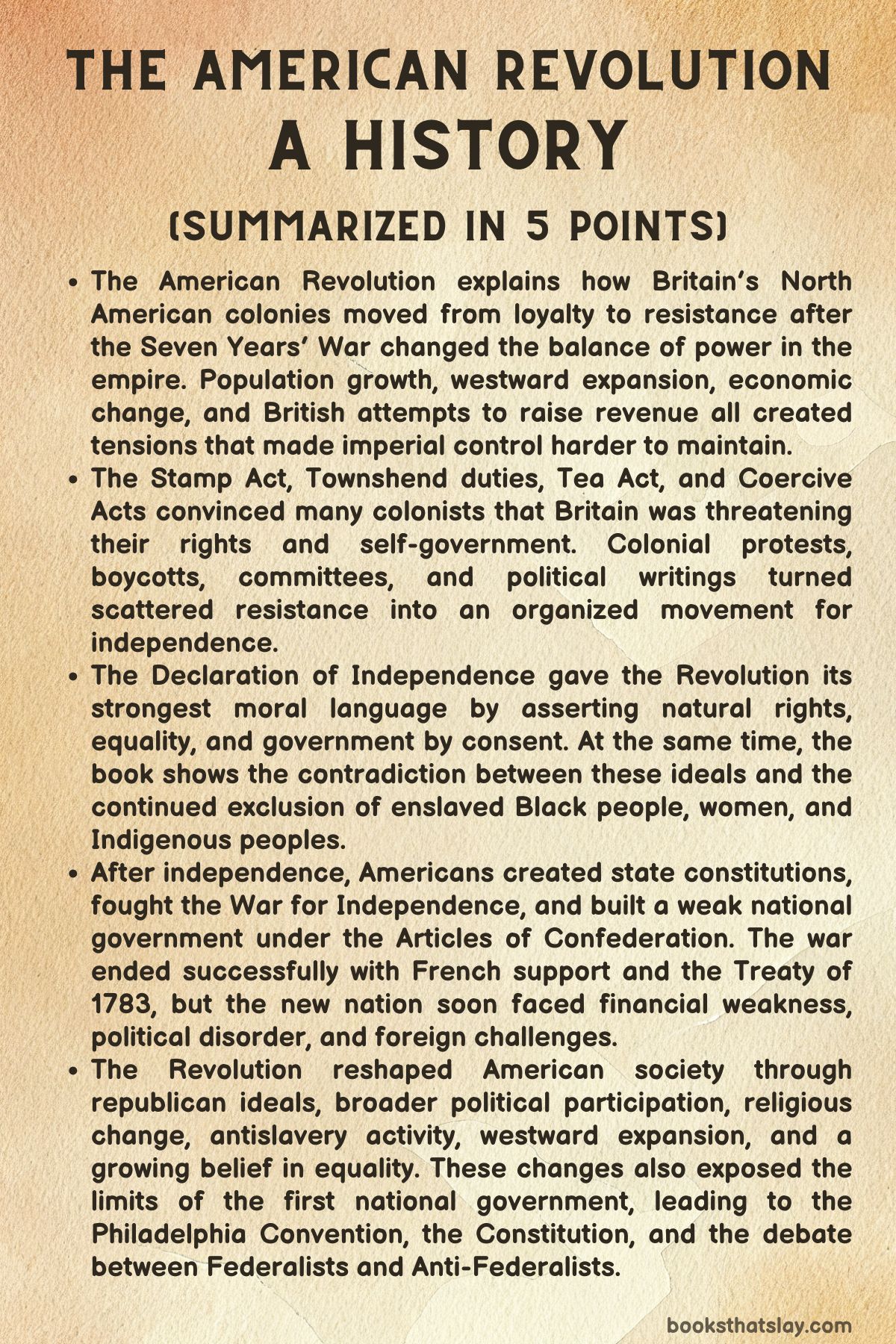
The American Revolution: A History by Gordon S. Wood is a historical study of how Britain’s North American colonies moved from imperial loyalty to independence, republican government, and constitutional union. Rather than treating the Revolution only as a war, Wood presents it as a broad change in political thought, social relationships, economic life, religion, and ideas of equality.
The book explains how colonial growth, British imperial reform, popular resistance, republican ideology, and the failures of early government pushed Americans toward independence and then toward the Constitution.
Summary
The American Revolution begins by placing the Revolution within a long history of American memory and interpretation. Abraham Lincoln looked back to the Revolution as the source of the nation’s deepest ideals: liberty, equality, constitutional government, and a larger public purpose.
Early Americans saw the Revolution as a moral struggle against tyranny, while later historians gave it different meanings. Some portrayed it as the fulfillment of democratic destiny, others as a struggle over class and power, and still others criticized it for failing to free enslaved people, include women politically, or treat Indigenous peoples as citizens.
Gordon S. Wood argues that while these criticisms matter, they can also impose modern expectations on an eighteenth-century world that operated under very different assumptions.
The book’s historical movement begins with the rapid growth of the colonies. By the middle of the eighteenth century, British North America had become large, restless, and increasingly difficult to govern.
Its population doubled in only two decades, and expansion pushed settlers westward into regions where imperial authority was weak and Indigenous nations faced rising pressure. The Seven Years’ War removed France as Britain’s major rival in North America, but that victory created new problems.
Indigenous peoples could no longer balance European powers against each other, and conflicts such as Pontiac’s uprising showed British officials that the frontier would require military control. At the same time, settlers in backcountry regions formed their own groups to resist distant authority, corrupt officials, and unequal representation.
These local conflicts foreshadowed the arguments colonists would soon direct against Parliament.
Economic growth also changed colonial society. Trade expanded, port cities grew, and ordinary colonists began buying goods that had once been associated with the wealthy.
This consumer culture tied Americans more closely to Britain, yet it also increased debt and dependence on British credit. At the same time, market growth weakened older social hierarchies.
Small farmers became less dependent on traditional elites, religious dissent increased, and popular figures such as Patrick Henry gained influence by attacking royal interference. These changes meant that when Britain tried to tighten imperial control, it faced societies already becoming more independent, mobile, and politically alert.
After the Seven Years’ War, Britain attempted to reform its empire. The war had left Britain with a massive debt, and officials believed the colonies should help pay the cost of their own defense.
The Proclamation of 1763 tried to regulate western settlement, while later measures aimed to raise revenue and improve imperial administration. The Sugar Act and Stamp Act marked turning points because they suggested that Parliament intended to tax colonists directly.
Americans objected not merely because of the money involved, but because taxation without consent challenged their understanding of political liberty. Colonial assemblies protested, merchants organized boycotts, and popular groups such as the Sons of Liberty used intimidation to prevent enforcement.
Parliament repealed the Stamp Act, but the Declaratory Act insisted that Parliament had authority over the colonies in all cases, leaving the central dispute unresolved.
The crisis deepened with the Townshend duties, new customs enforcement, and the stationing of troops in colonial cities. In Massachusetts, Samuel Adams helped turn resistance into a disciplined political movement.
The seizure of John Hancock’s ship, the arrival of British troops in Boston, and the Boston Massacre intensified resentment. Even when Britain repealed most of the Townshend duties, it kept the tax on tea, and this symbolic issue revived conflict.
The Tea Act gave the East India Company special access to the colonial tea trade, leading to the Boston Tea Party. Parliament answered with the Coercive Acts, which restricted Massachusetts’s self-government and convinced many colonists that Britain intended to destroy their liberties.
Behind these events stood a constitutional argument about power. Americans insisted that taxes required consent through representatives chosen by the people being taxed.
British officials argued that Parliament virtually represented all British subjects, even those who could not vote. Americans rejected this view because the colonies had separate interests and were not actually represented in Parliament.
Writers such as Daniel Dulany and John Dickinson argued that representation required direct election and local accountability. Over time, colonists moved from objecting to particular taxes to denying Parliament’s authority over their internal affairs.
British leaders, committed to parliamentary sovereignty, saw no room for this distinction. By the mid-1770s, both sides had taken positions that made compromise nearly impossible.
The approach to independence was marked by the collapse of royal authority in America. After the Coercive Acts, local committees, mass meetings, and popular organizations began performing the functions once held by royal officials.
The First Continental Congress gathered delegates from twelve colonies and endorsed organized resistance through a continent-wide boycott. The Congress also rejected more conservative plans for imperial union.
Ordinary artisans, farmers, religious dissenters, and local leaders entered politics in new ways, demanding representation by people closer to themselves rather than by traditional elites. Political life became more democratic, disorderly, and active.
By 1775, Britain had turned to force. Fighting broke out at Lexington and Concord when British troops moved to seize colonial arms.
The battle at Bunker Hill showed that colonial forces could stand against regular British troops, even at great cost. The Second Continental Congress still tried to balance loyalty and resistance, sending the Olive Branch Petition while also creating the Continental Army under George Washington.
Events soon outran compromise. Thomas Paine’s Common Sense attacked monarchy directly and argued that independence was the only logical path.
Its plain language and biblical style helped turn public opinion toward separation.
The Declaration of Independence, adopted in 1776, transformed the conflict into a universal statement of rights. Written largely by Thomas Jefferson, it blamed George III for the colonies’ grievances and asserted that all men were created equal and possessed natural rights.
Yet the document also revealed a major contradiction: Congress removed Jefferson’s criticism of the slave trade, and hundreds of thousands of Black people remained enslaved. Even so, the Declaration gave the Revolution a language of liberty and equality that would later be used by many groups excluded from its immediate promises.
The Revolution was also an ideological event. Americans drew heavily from English opposition thought, especially writers who warned that power naturally sought to corrupt liberty.
They believed Britain’s actions were not isolated mistakes but part of a larger design to reduce them to dependence. Many saw America as the last refuge of liberty in a world where freedom was declining.
This belief gave the struggle a larger moral meaning and helped Americans imagine their new country as an asylum for liberty.
Once independence became likely, Americans began forming new governments. State constitutions placed authority in written documents created by the people, rather than in inherited institutions or unwritten tradition.
Governors were weakened, legislatures were strengthened, and representation was expanded. Backcountry regions gained greater political recognition.
These constitutions reflected deep suspicion of executive power and great confidence in elected assemblies.
At the national level, the Articles of Confederation created a loose union of sovereign states. Congress could conduct diplomacy, request money and troops, regulate certain affairs, and settle disputes, but it lacked the power to tax directly or regulate commerce.
The Confederation did achieve one major success: the Northwest Ordinance, which established a process for western territories to become equal states. Still, the government remained weak and dependent on state cooperation.
The war itself lasted nearly eight years. Britain had superior military resources, but it faced major problems: distance, supply difficulties, unfamiliar terrain, and the absence of a single target that would end resistance.
Washington avoided destruction by using a defensive strategy. Victories at Trenton and Princeton restored morale, while Saratoga brought France openly into the war.
With French support, and later wider European pressure on Britain, the conflict became international. In the South, British forces won early victories but failed to secure lasting control.
Local resistance, guerrilla warfare, and Nathanael Greene’s strategy weakened British plans. Cornwallis’s surrender at Yorktown in 1781 effectively ended the war, and the Treaty of 1783 secured American independence and broad territorial claims.
Wood then turns to the Revolution’s social meaning. Republicanism became the guiding ideal of the new nation.
Americans rejected monarchy, hierarchy, patronage, and dependence, arguing that a republic required virtuous citizens who placed the public good above private interest. Independent landowners were treated as ideal citizens because they were thought to be free from dependence.
Americans also believed their new society would become a center of learning, science, culture, and moral improvement.
The Revolution encouraged ideas of equality, though unevenly. Birth and inherited rank lost much of their authority, while talent and merit gained importance.
Ordinary people increasingly challenged deference and claimed social respect. Yet equality remained limited by race, gender, and assumptions about civilization.
Indigenous peoples were pushed aside by westward settlement, women remained excluded from formal politics, and slavery continued, especially in the South.
The war and Revolution reshaped the economy. Loyalists departed, property changed hands, markets expanded, and new elites arose.
Internal commerce grew, manufacturing increased, and labor relations became more impersonal. Reform movements gained strength in education, charity, criminal justice, family law, religion, and antislavery activity.
In the North, slavery began to decline, while in the South it remained deeply rooted despite early antislavery hopes.
By the 1780s, many leaders worried that republican government was failing. State legislatures issued paper money, aided debtors, changed laws frequently, and seemed driven by local interests.
The Confederation could not tax, regulate trade, pay debts effectively, or handle foreign threats. Shays’s Rebellion intensified fears that popular government had become unstable.
These concerns led to the Philadelphia Convention, where delegates replaced the Articles with a stronger Constitution. The new system created a national government with separate branches, a powerful executive, an independent judiciary, and authority over taxation and commerce.
The Constitution sparked a major debate. Anti-Federalists feared centralized power, monarchy, and the destruction of state independence.
Federalists answered that sovereignty rested with the people, not with any single institution, and that power could be divided between state and national governments. Madison argued that a large republic could control factions better than a small one.
Ratification succeeded, partly because Federalists promised amendments, which became the Bill of Rights. The book ends by showing that the Revolution did not simply create independence; it transformed ideas of power, society, equality, religion, reform, and constitutional government.
Key Figures
Abraham Lincoln
Abraham Lincoln appears as a later interpreter of the Revolution rather than as a participant in the central events of the book. His importance lies in the way he looked back to the founding struggle during the Civil War and treated it as the source of American national purpose.
For Lincoln, the Revolution was not only a successful break from Britain; it was the moral foundation of the United States. He saw in it the ideals of freedom, constitutionalism, and equality that could guide the nation through its greatest internal crisis.
In The American Revolution, Lincoln’s role helps frame the Revolution as an event whose meaning continued to develop long after independence. He represents historical memory: the way later Americans used the founding moment to define what the country should become.
George Bancroft
George Bancroft is presented as a nineteenth-century historian who gave the Revolution a grand, providential meaning. He interpreted it as the fulfillment of democratic destiny and emphasized principle, moral progress, and intellectual purpose.
Bancroft’s version made the Revolution appear heroic, conservative, and almost inevitable. His role in the book is not that of a political actor but of a maker of historical interpretation.
Through him, Wood shows how later generations reshaped the Revolution to match their own values. Bancroft’s view celebrated American democracy, but it also simplified the event by reducing social conflict and material pressures.
He stands for a confident national story in which the Revolution appears as the natural arrival of liberty.
Carl Becker
Carl Becker represents a more modern and critical approach to the Revolution. Unlike Bancroft, Becker argued that the Revolution involved two struggles: one over home rule against Britain and another over who would rule at home within American society.
This made class conflict, power, and internal social change central to the event. Becker’s importance comes from his challenge to purely heroic or constitutional interpretations.
He shows that the Revolution was not only a fight over abstract rights, but also a struggle shaped by ordinary people, local rivalries, competing interests, and changing social relations. In the book, Becker’s perspective helps open the Revolution to questions about democracy, power, and the widening of political participation.
Benjamin Franklin
Benjamin Franklin appears as a clear observer of the empire’s changing balance. His prediction that the center of the British Empire might one day shift to America reflects the astonishing growth of the colonies.
Franklin understood that the colonies were no longer weak settlements on the edge of empire; they were becoming populous, economically important, and politically self-aware. He also warned that the imperial connection was fragile and needed careful handling.
His insight contrasts sharply with British officials who treated the colonies as subordinate possessions to be taxed and managed. Franklin’s importance lies in his ability to recognize both American potential and imperial danger before many others fully grasped the consequences.
George III
George III is one of the central figures in the imperial crisis. He appears as a young king determined to rule actively and restore authority, but his personal involvement contributed to instability in British politics.
His reign coincided with a period of short-lived ministries, political unrest, and growing imperial tension. To Americans, he gradually became the symbol of tyranny, especially after the Declaration of Independence placed responsibility for colonial grievances directly on him.
The book does not treat him as a simple villain; rather, he represents the British state’s inability to understand colonial political culture. His commitment to imperial authority made him a focal point for American anger and helped transform resistance to Parliament into rejection of monarchy itself.
Pontiac
Pontiac, the Ottawa leader, stands at the center of Indigenous resistance after the Seven Years’ War. His uprising showed the deep consequences of Britain’s victory over France.
With France removed as a balancing power, Indigenous nations faced a more aggressive British presence and increasing colonial expansion. Pontiac’s rebellion destroyed most British western posts and exposed how unstable the frontier had become.
His role in the book is crucial because it shows that the Revolution’s origins were not limited to taxes and constitutional debate. Western land, Indigenous sovereignty, military occupation, and settler expansion all shaped the imperial crisis.
Pontiac represents Native resistance to a new imperial order that threatened Indigenous independence and land.
Patrick Henry
Patrick Henry emerges as a powerful voice of colonial resistance and popular political energy. His role in the Parson’s Cause made him famous because he argued that royal interference with colonial law could turn a king into a tyrant who forfeited obedience.
Henry’s appeal came from his ability to express growing colonial frustration in bold, memorable language. He represented a shift away from deferential politics controlled by older elites and toward a more aggressive popular style.
In the book, Henry’s significance lies in how his rise shows the weakening of traditional authority. He gave public voice to ideas that many colonists were beginning to feel: that distant power, even royal power, could be judged and resisted.
John Wilkes
John Wilkes appears as a British radical whose struggle helped shape colonial political imagination. His conflict with Parliament and the slogan associated with him became symbols of liberty on both sides of the Atlantic.
Americans saw in Wilkes’s treatment evidence that corruption and threats to representation were not limited to the colonies. His case strengthened the belief that liberty was under pressure throughout the English-speaking world.
Wilkes is important because he linked colonial resistance to wider British reform politics. He helped Americans see their own struggle as part of a larger fight against arbitrary power, restricted representation, and government corruption.
Samuel Adams
Samuel Adams is one of the most important organizers of resistance in Massachusetts. He understood how to turn constitutional argument, popular anger, and local organization into sustained political action.
Through circular letters, committees, public pressure, and ideological discipline, he helped make Massachusetts the center of resistance. Adams’s strength lay in his ability to connect elite arguments about rights with popular action in streets, towns, and assemblies.
He was not merely a protest leader; he helped create a political culture in which ordinary colonists could see themselves as guardians of liberty. In The American Revolution, Adams represents the organized radicalism that made reconciliation with Britain increasingly unlikely.
John Hancock
John Hancock appears as both a wealthy merchant and a symbol of resistance to British customs enforcement. The seizure of his ship, Liberty, triggered one of Boston’s fiercest riots and intensified opposition to imperial authority.
Hancock’s role shows how economic regulation and political resistance became linked. For merchants, British customs enforcement threatened trade and autonomy; for crowds, it became proof that officials were using power against colonial liberty.
Hancock’s prominence also demonstrates how elite figures could gain popular support when they were seen as victims of imperial overreach. His case helped turn commercial conflict into public protest.
Thomas Hutchinson
Thomas Hutchinson represents the colonial elite that remained committed to imperial order and struggled to understand the rise of popular politics. As a royal official in Massachusetts, he believed that there was no middle ground between parliamentary supremacy and colonial independence.
This view made the constitutional conflict sharper, because it forced colonists to confront the full implications of their claims. Hutchinson’s tragedy is political and social: he belonged to a world of hierarchy, deference, and royal authority that was rapidly losing legitimacy.
He saw popular leaders as demagogues and disorderly agitators, but he failed to understand that political authority itself was changing. In the book, he stands for loyalist incomprehension in the face of a democratic political awakening.
John Dickinson
John Dickinson is presented as a careful constitutional thinker who tried to defend colonial rights while preserving some form of imperial connection. His writings rejected parliamentary taxation and revived nonimportation as a political tool.
Dickinson’s importance lies in his attempt to draw a line between legitimate imperial supervision and illegitimate internal taxation. He was not initially a simple advocate of separation; he hoped that constitutional balance could still be restored.
His position shows how many Americans moved gradually toward independence. They began by defending traditional rights within the empire, only to find that Britain’s doctrine of sovereignty left little space for compromise.
Daniel Dulany
Daniel Dulany is important for his criticism of virtual representation. He accepted that the idea might make sense within Britain, where interests could be imagined as connected, but he denied that it applied to the colonies.
America, separated by distance and interest, could not be represented by members of Parliament whom colonists did not elect. Dulany’s reasoning helped sharpen the American concept of actual representation.
His role in the book is intellectual: he shows how colonial political experience led Americans toward a more direct, election-centered understanding of legitimacy. Through his argument, representation became not a legal fiction but a practical relationship between voters and accountable representatives.
Thomas Jefferson
Thomas Jefferson is one of the book’s major figures because he embodies both the Revolution’s ideals and its contradictions. He helped articulate the meaning of independence through the Declaration, giving the Revolution its most famous language of equality and natural rights.
He also believed that forming new state governments was central to preventing future tyranny. Yet Jefferson’s world was marked by slavery, and Congress removed his criticism of the slave trade from the Declaration.
His role therefore carries both moral power and deep tension. He expressed universal principles while living in a society that denied those principles to many.
In the book, Jefferson represents the Revolution’s capacity to inspire reform and its failure to fulfill its own promises.
John Adams
John Adams appears as a thinker who understood the Revolution as a change in the minds and hearts of the people before it became a war. His insight is central to Wood’s interpretation.
Adams saw that independence was not simply declared in 1776; it had been prepared through years of argument, resistance, and shifting assumptions about authority. He also contributed to constitutional thinking and the development of republican government.
Adams’s importance lies in his understanding that political transformation begins before formal institutions change. He helps explain why the Revolution was not only a military event, but a change in how Americans understood power, citizenship, and legitimacy.
Joseph Galloway
Joseph Galloway represents the conservative possibility that the Revolution rejected. His plan for imperial union offered a way to preserve connection with Britain while giving the colonies a more formal role in imperial governance.
The First Continental Congress narrowly rejected this proposal, showing that moderate solutions were losing ground. Galloway’s significance lies in what he reveals about the range of choices still available in the early crisis.
Not every colonist wanted independence, and some believed reform within the empire was possible. His defeat shows how rapidly resistance had moved beyond negotiation and toward a more radical restructuring of authority.
Thomas Paine
Thomas Paine is the figure who helped transform elite constitutional debate into popular revolutionary conviction. Common Sense attacked monarchy in direct, accessible language and presented independence as urgent, reasonable, and morally necessary.
Paine’s style mattered as much as his argument. He spoke to ordinary readers, used biblical references, and stripped away the inherited reverence surrounding kingship.
His influence came from making independence feel obvious to people who had previously imagined themselves as loyal British subjects. Paine’s role in the book is catalytic.
He did not create the crisis, but he gave it a language that moved public opinion decisively toward separation.
George Washington
George Washington stands at the center of the military struggle and later lends authority to constitutional reform. As commander of the Continental Army, he faced the challenge of fighting a stronger empire with limited resources, inexperienced troops, and uncertain political support.
His defensive strategy helped preserve the army, which was essential because Britain could not win unless it destroyed organized resistance. Washington’s victories at Trenton and Princeton restored morale, while his cooperation with French forces helped bring success at Yorktown.
Later, his presence at the Philadelphia Convention gave the meeting legitimacy. In The American Revolution, Washington represents steadiness, public trust, and the disciplined leadership needed to hold political and military resistance together.
Nathanael Greene
Nathanael Greene plays a major role in the southern phase of the war. Rather than seeking dramatic direct victories, he used a strategy of movement, endurance, and pressure.
His aim was to weaken British control by forcing their forces to divide, stretch supply lines, and confront constant local resistance. Greene’s significance lies in his understanding that the war in the South could be won by preventing Britain from securing stable authority.
His actions helped turn British success into frustration. He represents the practical intelligence of American military leadership, especially in a conflict where survival and persistence often mattered more than battlefield glory.
Charles Cornwallis
Charles Cornwallis represents Britain’s southern strategy and its final failure. He achieved important victories, including major success in the South, but he could not convert battlefield strength into lasting political control.
His move into Virginia placed him in a vulnerable position, where American and French forces, supported by the French navy, trapped him at Yorktown. Cornwallis’s surrender did not formally end the war at once, but it destroyed Britain’s hope of military victory.
His role shows the limits of imperial power in a conflict where territory could be occupied but allegiance could not be easily restored. He becomes the figure through whom British strategy reaches its decisive collapse.
James Madison
James Madison is central to the shift from revolutionary constitutional experimentation to the creation of the federal Constitution. He studied the weaknesses of the Confederation and argued that state legislatures had become unstable, local, and too responsive to narrow interests.
Madison’s importance lies in his ability to diagnose the problem of republican government after independence: how to preserve liberty while controlling faction and legislative excess. At Philadelphia, his Virginia Plan gave the Convention its starting point, and in the ratification debate he argued that a large republic could better manage competing interests.
Madison represents the Revolution’s second stage, when Americans turned from resisting power to designing power.
Alexander Hamilton
Alexander Hamilton appears as one of the nationalists who believed the Confederation was too weak to secure American interests. He wanted stronger central authority, especially in finance, commerce, and national defense.
Hamilton’s importance comes from his recognition that independence alone did not create an effective nation. Without taxation, commercial regulation, and executive energy, the United States could not handle debt, foreign pressure, or internal instability.
He represents the more forceful side of postwar nationalism. While many Americans feared centralized power, Hamilton feared national weakness and disorder.
His political outlook helped prepare the ground for the Constitution and later federal authority.
Robert Morris
Robert Morris is important as a financial administrator who tried to stabilize the revolutionary and postwar economy. During a period of inflation, debt, weak credit, and state resistance, Morris attempted to create stronger fiscal mechanisms for the national government.
His efforts reveal the Confederation’s limitations: even capable leadership could not succeed when Congress lacked reliable taxing power and depended on state cooperation. Morris represents the practical financial problems behind constitutional reform.
The ideals of republican liberty had to be supported by money, credit, and administration, and the Confederation struggled to provide them.
William Livingston
William Livingston appears as one of the leaders who worried that Americans lacked the virtue needed to sustain republican government. His concern reflects the anxiety of the 1780s, when many elites believed that private interest, debtor laws, paper money, and restless popular politics were undermining the public good.
Livingston’s role is not as a founder of a specific institution, but as a voice of republican fear. He represents the belief that liberty could decay into selfishness if citizens did not act with restraint.
Through figures like Livingston, the book shows why constitutional reform seemed necessary to many Revolutionary leaders.
Abraham Yates
Abraham Yates represents the new kind of political figure who emerged after the Revolution expanded participation. He stood for a more popular politics that worried many established elites.
The rise of leaders like Yates showed that state legislatures were no longer dominated only by older gentlemen and traditional elites. Rural, local, and less wealthy interests now had greater influence.
His significance lies in what he reveals about democratic change. To some, he represented healthy representation; to others, he symbolized dangerous instability.
In the story of the Revolution’s aftermath, Yates helps show why the politics created by independence alarmed many national reformers.
William Findley
William Findley, like Abraham Yates, represents the widening of political participation after independence. He belonged to a political world in which ordinary citizens expected more direct representation and more responsive government.
His rise reflected the decline of older deference and the emergence of leaders closer to local and popular interests. Findley’s importance lies in the social change he represents.
The Revolution did not simply replace British officials with American elites; it opened space for new men, new demands, and new forms of political competition. His presence helps explain why some founders began to fear state legislatures and popular politics during the 1780s.
Indigenous Peoples
Indigenous peoples are not background figures in the book; they are central to the story of land, empire, and expansion. The British victory over France weakened their diplomatic position, and American settlement after independence placed them under even greater pressure.
Native nations had their own political interests, land systems, alliances, and forms of resistance, but British and American officials often treated them as obstacles to imperial or republican expansion. The Treaty of 1783 transferred sovereignty over their lands without their consent, and American settlers often ignored treaty boundaries.
Their role exposes one of the Revolution’s harshest contradictions: a movement for liberty among white Americans helped accelerate dispossession for Native communities.
Enslaved Black Americans
Enslaved Black Americans occupy a crucial moral and political position in the book. The Revolution’s language of liberty made slavery harder to justify, and Black Americans used that language to challenge bondage.
Some gained freedom by serving in armies, some escaped during wartime disruption, and free Black communities grew in the North. Yet slavery remained powerful, especially in the South, where law, wealth, fear, and racial control protected the institution.
Their role reveals the deepest contradiction in Revolutionary republicanism. The claim that all men were created equal became a weapon against slavery, but the new nation did not apply that principle fully.
Their presence forces the story of liberty to confront exclusion and injustice.
Loyalists
Loyalists represent the Americans who chose empire, monarchy, stability, or caution over revolutionary resistance. Many came from elite political, commercial, or officeholding backgrounds, though loyalism was not limited to one class.
Their departure after the war reshaped American society by opening positions of wealth and influence for patriots. Loyalists are important because they show that independence was not unanimous or inevitable.
They also reveal the personal cost of revolution: families divided, property confiscated, communities disrupted, and political identity transformed into a test of loyalty. In the book, loyalists stand for the defeated American alternative, the path of continued connection to Britain.
Women
Women appear most clearly in the book through the social and religious consequences of the Revolution. They did not gain formal political equality, but republican ideals changed expectations about education, marriage, family, and moral influence.
Female education gained importance because women were increasingly seen as essential to forming virtuous citizens. Changes in inheritance, divorce, contracts, and business rights gave some women limited legal gains.
In religious life, women found wider roles in evangelical and radical sects, with groups such as the Shakers recognizing female leadership. Women’s role shows both expansion and limitation: the Revolution altered their social position but did not grant them full public equality.
Religious Dissenters and Evangelical Leaders
Religious dissenters and evangelical leaders represent the Revolution’s impact on spiritual life and ordinary people’s authority. Baptists, Methodists, and other groups expanded rapidly as older established churches declined.
Many ministers supported resistance and translated republican ideas into religious language that common people could understand. Evangelical religion gave ordinary men and women new forms of community, expression, and leadership.
It also challenged older hierarchies of education, refinement, and clerical authority. The rise of popular religion shows that the Revolution did not only change politics; it changed how Americans imagined truth, equality, emotion, and public voice.
Themes
Liberty and the Problem of Power
The struggle over liberty begins with British attempts to reform the empire after the Seven Years’ War and expands into a broader argument about the nature of political authority. Americans did not at first reject empire altogether; many initially claimed they were defending traditional English rights.
Yet every new tax, customs measure, military deployment, and assertion of parliamentary sovereignty made them more suspicious of power. Liberty, in this context, was not simply freedom from taxation.
It meant government by consent, protection from arbitrary rule, and representation that was direct and accountable. The American Revolution shows how Americans came to believe that power naturally threatened freedom when it was distant, unchecked, or separated from the people it governed.
This fear shaped the resistance movement, the Declaration, the state constitutions, and even the later Constitution. The irony is that Americans had to create new governments after rejecting old authority, and this forced them to confront a difficult question: how could a society give government enough power to function without allowing it to become oppressive?
The Revolution’s answer changed over time. Early state governments trusted legislatures and weakened executives, but by the 1780s many leaders feared legislative power as much as royal power.
Liberty therefore became not the absence of government, but the careful design of government.
Republican Virtue and Social Change
Republicanism demanded more than independence from Britain; it required a new kind of citizen. In a monarchy, order was thought to depend on hierarchy, patronage, inherited authority, and dependence.
In a republic, Americans claimed that citizens had to govern themselves through virtue, independence, and concern for the public good. This ideal gave moral dignity to ordinary landowning farmers, who were seen as independent enough to participate responsibly in politics.
It also attacked older forms of deference by suggesting that birth alone did not entitle anyone to rule. Yet republican virtue placed heavy expectations on people.
Citizens were supposed to put common welfare above private interest, but the postwar years showed how difficult that demand could be. Debtors, creditors, merchants, artisans, western settlers, and local communities all pursued competing goals.
State legislatures responded to these pressures with laws that alarmed many national leaders. The theme matters because it shows both the ambition and fragility of the Revolution’s political vision.
Americans believed they had created a society capable of self-rule, but they also feared that freedom would collapse if citizens became selfish, factional, or dependent. Republicanism therefore changed manners, politics, education, religion, and reform, while also creating anxiety about whether ordinary people could sustain the moral burden of liberty.
Equality, Exclusion, and Contradiction
The Revolution gave new power to the idea of equality, but it did not apply that idea evenly. Americans increasingly rejected inherited rank, aristocratic privilege, and social deference.
Ordinary people claimed greater respect, challenged old titles, entered politics more actively, and measured status more by achievement than birth. Republican thought encouraged the belief that talent and virtue, not ancestry, should determine leadership.
This was a major social change, especially in a society that had once accepted hierarchy as natural. At the same time, the limits of equality were severe.
Women remained outside formal politics, Indigenous peoples were pushed aside by settlers and government policy, and slavery survived despite revolutionary language that condemned dependency. Black Americans understood the contradiction clearly and used the Revolution’s own principles to challenge enslavement.
Northern emancipation showed that the language of liberty could produce real change, but the South’s dependence on slavery prevented broader abolition. The theme is powerful because the Revolution both expanded equality and exposed how restricted it remained.
It weakened old hierarchies among white men while leaving other systems of domination intact. Its ideals became larger than the society that produced them, creating promises that later generations would continue to use against exclusion.
From Confederation Weakness to Constitutional Government
Independence created a new nation, but it did not immediately create an effective national government. The Articles of Confederation reflected Revolutionary suspicion of centralized authority.
They preserved state sovereignty, denied Congress direct taxing power, and treated national action as dependent on state cooperation. This arrangement made sense to people who had recently resisted imperial power, yet it proved difficult in practice.
Congress struggled with debt, inflation, foreign threats, western lands, interstate tensions, and commercial weakness. Britain held frontier posts, Spain restricted Mississippi River access, and American ships faced danger abroad.
At the same time, state legislatures passed unstable laws, responded to local pressures, and sometimes seemed to threaten property and order. Shays’s Rebellion sharpened fears that republican government might fall into disorder.
The Philadelphia Convention responded by creating a stronger national structure with separated powers, an executive, a judiciary, and authority over taxation and commerce. The ratification debate then forced Americans to rethink sovereignty itself.
Federalists argued that ultimate authority rested with the people, allowing power to be divided between state and national governments. This theme shows the Revolution moving from resistance to construction.
Americans first fought against power they considered illegitimate; then they had to build power that could preserve liberty, union, and stability.