The Age of Reason Summary and Analysis
The Age of Reason by Thomas Paine is a bold work of religious criticism and Deist philosophy. It is not a novel but an argument against organized religion, especially Christianity as upheld by churches, priests, scripture, miracles, and prophecy.
Paine does not reject God; instead, he argues for one Creator whose existence is best understood through reason, nature, and the study of the universe. Written in the atmosphere of revolution, imprisonment, and political danger, the book attacks religious authority with the same energy Paine once directed against monarchy and tyranny.
Summary
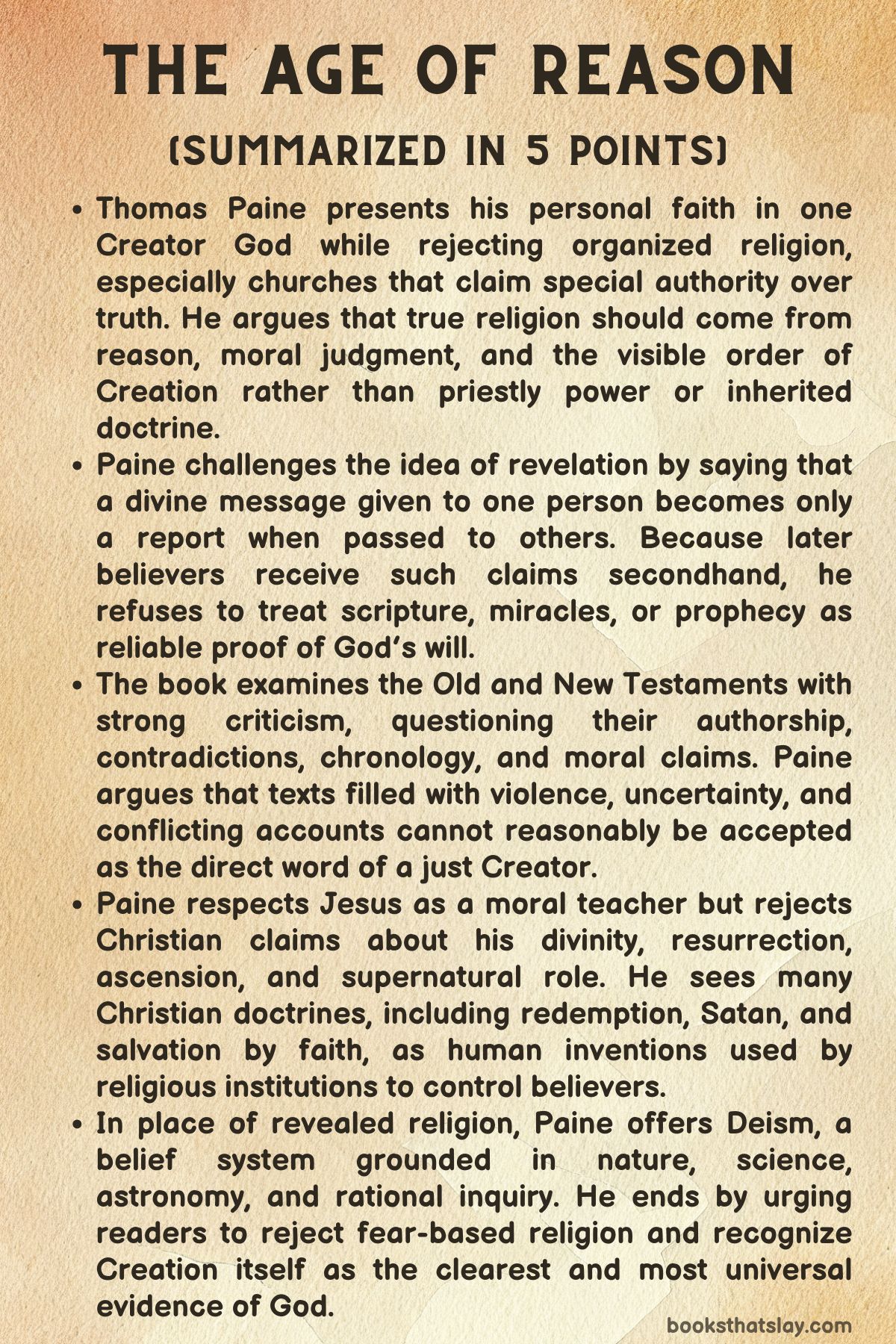
The Age of Reason begins with Thomas Paine making a direct declaration of faith. He believes in one God, and he expects happiness beyond this life, but he rejects every organized church that claims special authority over the human soul.
For Paine, Judaism, Christianity, and Islam are all built on human inventions rather than divine truth. He sees churches as institutions that use fear, mystery, and inherited belief to control people.
The American and French Revolutions matter deeply to him because they weaken the old alliance between church and state. In his view, once political freedom breaks priestly power, people will be able to think about religion without coercion.
Paine’s religion is Deism: belief in a Creator understood through reason, moral sense, and the observable world.
Paine’s first major target is revelation. He argues that even if God reveals something to one person, that message cannot become certain truth for everyone else.
To the first person it may be revelation, but to all later hearers it is only a report. This makes scripture unreliable as a foundation for universal belief.
Paine applies this argument to the Ten Commandments, the Christian account of the virgin birth, and the claim that Jesus is the Son of God. He does not deny that people may believe these stories sincerely, but he denies that anyone else is obligated to accept them as divine fact.
Human testimony, especially about supernatural events, is too weak to carry the authority of God.
Paine treats Jesus with respect as a moral teacher while rejecting Christian claims about his divinity. He argues that Jesus did not write the New Testament, and that the texts about him come from uncertain authors.
In Paine’s reading, Jesus likely lived, preached, angered the religious authorities, and was executed because his teachings threatened existing power. Paine admires the moral clarity of Jesus’s message, but he regards the resurrection and ascension as unsupported claims.
He also points out that the Jewish people, whose ancestors would have been closest to the events, did not accept the Christian version of what happened. This becomes part of Paine’s broader claim that Christianity turned a human moral reformer into the center of a supernatural system.
The Christian story of Satan, original sin, and redemption receives some of Paine’s sharpest criticism. He argues that the figure of Satan resembles ancient myth more than reasoned theology.
To Paine, the idea of a rival evil power opposing God diminishes the Almighty rather than honoring Him. If God is supreme, then Satan cannot truly threaten divine rule; if Satan can threaten God, then Christian theology has weakened its own God.
Paine also believes churches benefit from keeping Satan alive in the minds of believers because fear makes people obedient. The doctrine of redemption, in which Christ’s suffering repairs the fall of humanity, seems to Paine both morally strange and intellectually unsound.
After rejecting Christian theology, Paine presents what he calls the true theology: the study of Creation. The natural world, unlike scripture, is open to all people.
It is not trapped in one language, one culture, one priesthood, or one historical document. The heavens, the earth, and the laws of nature speak universally.
Paine believes God’s real word is found in Creation because Creation cannot be forged, mistranslated, edited, or voted into doctrine by church councils. Human beings discover God’s wisdom through observation, science, mathematics, astronomy, and moral reflection.
This is why Paine gives so much attention to the stars, planets, and the structure of the universe. For him, science does not destroy religion; it restores religion to its purest form.
Paine then turns to the Bible, beginning with the Old Testament. He questions its authorship and argues that many books attributed to famous figures could not have been written by them.
Moses, for example, could not have written accounts that refer to places, events, or conditions from later periods. Paine uses internal evidence from the biblical texts themselves to challenge traditional claims.
He also attacks the violence, cruelty, obscenity, and moral confusion he finds in the Old Testament. A book that presents God as approving slaughter and revenge cannot, in Paine’s view, be the word of a just Creator.
He is especially severe toward stories involving Moses and Joshua, whom he sees not as holy leaders but as morally troubling figures when judged by the actions attributed to them.
Paine also reinterprets the biblical prophets. He argues that the word “prophet” has been misunderstood.
Rather than future-seeing messengers, the prophets were often poets, musicians, or political speakers tied to their own time. He examines figures such as Saul, Samuel, Deborah, Barak, and David to support the idea that prophecy was closer to inspired performance or public speech than prediction.
This matters because Christianity depends heavily on the claim that Old Testament prophecies foretold the life of Jesus. If those passages referred instead to local events, rulers, wars, or political crises of their own age, then Christianity’s claim of fulfilled prophecy collapses.
The New Testament fares no better in Paine’s analysis. He emphasizes that Jesus did not write it and that its authorship is uncertain.
The Gospels provide only limited details about Jesus’s life and disagree about major events. Paine points to contradictions in the genealogies of Jesus, the story of the angelic announcement, the crucifixion, the resurrection, and the ascension.
One Gospel includes dramatic events, such as darkness, an earthquake, and the rising of saints, while others omit them. The resurrection appearances happen privately and differ in timing, location, and detail.
For Paine, these inconsistencies show that the Gospel writers were not reliable eyewitnesses. He concludes that the New Testament is a later church construction rather than a divine record.
Paine also criticizes Paul’s letters and the doctrines that grew from them. He regards much of the New Testament after the Gospels as speculative writing about resurrection, immortality, salvation, and faith.
He objects strongly to the idea that belief alone can secure salvation, especially when compared with teachings that emphasize good works. In his view, priests prefer doctrines that encourage dependence on the church because such doctrines help them collect money, maintain authority, and build large institutions.
Purgatory, redemption, priestly mediation, and prayers for the dead all appear to Paine as systems designed to exploit fear and hope.
In the second part, Paine explains the difficult circumstances under which he wrote the earlier portion of the book. He had been in France during the violent phase of the French Revolution and was imprisoned under suspicion because of his English birth and political position.
He says that he finished the first part shortly before his arrest. Later, with access to the Old and New Testaments, he reexamined them more carefully and found them even worse than he had remembered.
This gives the later sections a more detailed and combative style. Paine moves through biblical books one by one, pointing out chronological problems, contradictions, uncertain authorship, broken passages, and moral defects.
In the third part, Paine focuses especially on prophecy. He addresses ministers and preachers directly, accusing them of building false doctrines on misunderstood Old Testament passages.
He begins with a discussion of dreams because many biblical prophecies are connected to dreams and visions. Paine proposes that dreams come from the imagination acting while judgment and memory are inactive.
This makes dreams unreliable as divine messages. From there, he examines claims that the Book of Matthew uses Old Testament prophecies to prove Jesus’s divine mission.
Paine argues repeatedly that these supposed prophecies referred to people and events from the time in which they were written, not to Jesus.
Paine’s analysis of Matthew is especially detailed. He challenges the prophecy of the virgin birth, the flight into Egypt, Herod’s fear of a rival king, the slaughter of infants, and several claims connected to Jesus’s ministry and death.
In each case, he argues that the New Testament either misreads the Old Testament, removes passages from their context, or combines unrelated lines to create the appearance of prediction. He then turns to Mark, Luke, and John, finding fewer prophetic claims but more contradictions.
Mark, Luke, and John differ from Matthew in ways that Paine considers damaging to the Christian case.
The book ends by restating Paine’s core conviction: God has not revealed His will through the Bible, churches, miracles, mysteries, or priestly systems. The true evidence of God lies in Creation, and the proper use of the human mind is reason.
Paine rejects the Trinity, revealed religion, and the idea that Christianity has a unique claim to moral truth. He also gives his private view of life after death.
He believes continued existence is likely, but he refuses to build a full doctrine around it. Judgment, in his view, cannot be a simple division between the saved and the damned, because human character exists in many degrees.
The righteous may be happy hereafter, and the very wicked may face punishment, but the final decision belongs to the Creator alone.
Key Figures
Thomas Paine
Thomas Paine is the central voice and driving force of The Age of Reason. He appears not as a detached scholar but as a writer with a mission: to free religious thought from inherited fear, priestly control, and untested claims.
His personality is sharp, fearless, and impatient with what he sees as fraud. Paine’s tone often becomes severe because he believes the stakes are high.
To him, false religion does not merely produce mistaken ideas; it damages education, morality, politics, and the human mind. At the same time, he is not an atheist.
His belief in one Creator is sincere, and his reverence for nature gives the book its spiritual center. Paine trusts reason as the proper tool for religious understanding, and this trust shapes every argument he makes.
He reads scripture not with devotional obedience but with suspicion, testing it through chronology, internal contradiction, moral judgment, and common sense. His character is defined by a rare combination of religious belief and anti-clerical rebellion.
He wants faith without fear, God without priests, morality without superstition, and inquiry without punishment.
The Creator
The Creator in the book is not a character in the ordinary narrative sense, but Paine’s idea of God has a powerful presence throughout the work. God is presented as singular, supreme, rational, just, and visible through Creation rather than through scripture.
Paine’s God does not need mystery, miracles, church councils, sacred languages, or priestly interpretation. The universe itself is the divine text.
This understanding gives the Creator a grandeur that organized religion, in Paine’s view, has reduced through crude stories and human inventions. Paine rejects any theology that makes God appear cruel, jealous, vengeful, inconsistent, or dependent on intermediaries.
The Creator’s wisdom is shown through natural law, astronomy, order, and moral goodness. Because God is perfect, Paine believes divine communication must be universal and dependable.
That is why he rejects scripture as God’s word: books can be altered, mistranslated, misunderstood, or hidden from people who do not know the language. Creation, by contrast, is open to all.
The Creator therefore represents both religious truth and intellectual freedom.
Jesus Christ
Jesus Christ is treated with a mixture of respect and rejection in The Age of Reason. Paine respects Jesus as a human moral teacher whose ethical ideas had value, but he rejects the claim that Jesus was divine.
This distinction is crucial to Paine’s argument. He does not attack Jesus in the same way he attacks churches, priests, and scriptural systems.
Instead, he separates the historical man from the supernatural figure created by Christian doctrine. Paine suggests that Jesus likely challenged religious authorities and may have been executed because his teachings disturbed the interests of priests and rulers.
However, Paine does not accept the resurrection, ascension, virgin birth, or divine sonship as reliable truths. He argues that Jesus wrote none of the New Testament and that the accounts of his life are inconsistent and uncertain.
In the book, Jesus becomes a figure whose moral reputation has been used to support claims he may never have made. Paine’s Jesus is admirable as a reforming teacher, but he is not the foundation of a supernatural religion.
Priests, Preachers, and Church Authorities
Priests, preachers, and church authorities are among the main objects of Paine’s criticism. In The Age of Reason, they represent organized religious power rather than personal spirituality.
Paine portrays them as guardians of systems that depend on mystery, fear, and submission. Their authority rests on persuading people that scripture is divine, miracles are real, prophecies have been fulfilled, and salvation depends on belief in doctrines managed by the church.
Paine believes these authorities have a practical interest in keeping people ignorant because education and scientific inquiry weaken their control. He repeatedly connects priestcraft with money, power, and social obedience.
The church’s historical opposition to science, especially in cases such as Galileo, becomes evidence for Paine that religious institutions fear knowledge. These figures are not developed as individuals but as a class, and their function in the book is to show how belief can become a political and economic instrument.
Paine’s anger toward them comes from his conviction that they place themselves between humanity and God.
The Biblical Prophets
The biblical prophets occupy an important place in Paine’s argument because Christianity relies heavily on prophecy to connect the Old and New Testaments. Paine challenges the traditional image of prophets as men who saw the future through divine inspiration.
Instead, he presents them as poets, musicians, speakers, or political figures whose words belonged to their own historical moment. This interpretation changes their role completely.
They are no longer witnesses to a future Christ but voices responding to immediate circumstances. Paine also suggests that many supposed prophecies were vague, misapplied, or later forced into Christian meaning.
In his view, the prophets have been misunderstood because later religious authorities gave the word “prophet” a meaning it did not originally carry. This makes the prophets less supernatural but more human.
They become part of a literary and political culture rather than messengers delivering precise predictions from God. Paine’s treatment of them is central to his attempt to break the claimed bond between Hebrew scripture and Christian doctrine.
Moses
Moses is treated severely in the book because Paine challenges both his authorship and his moral reputation. Traditional belief credits Moses with writing the first five books of the Old Testament, but Paine argues that internal evidence makes this impossible.
References to later places, events, and conditions suggest to him that these texts were written after Moses’s time. This matters because Mosaic authorship had long been used to support biblical authority.
Paine also judges Moses by the actions attributed to him in scripture, especially acts of violence and conquest. Rather than accepting Moses as a sacred lawgiver beyond criticism, Paine reads him as a human figure implicated in cruelty.
His analysis turns Moses from a holy founder into a test case for whether scripture should be judged by moral reason. If the stories about Moses are true, Paine finds them morally troubling; if they are false, then the Bible’s authority weakens.
Either way, Moses becomes a challenge to the idea that the Old Testament is the pure word of God.
Joshua
Joshua is closely connected to Moses in Paine’s critique of the Old Testament. Like Moses, he is traditionally regarded as a divinely guided leader, but Paine reads him through the violence associated with conquest.
The military actions attributed to Joshua lead Paine to reject the idea that such conduct could reflect the command of a just Creator. Joshua therefore becomes a symbol of the moral problem Paine finds in biblical history.
If readers are asked to believe that God approved mass violence, then Paine believes they are being asked to accept a degraded image of God. He also questions whether the Book of Joshua was actually written by Joshua, using the same method of internal evidence and chronological doubt that he applies elsewhere.
Joshua’s role in the book is not emotionally complex, but it is philosophically important. Through him, Paine asks whether religious reverence has caused people to excuse actions they would otherwise condemn.
Joshua becomes part of Paine’s larger argument that moral reason must stand above inherited scriptural authority.
Paul
Paul appears mainly through Paine’s criticism of the New Testament letters. Paine does not give Paul the reverence that Christian tradition gives him as a major apostle and theologian.
Instead, he treats Paul’s writings as human reflections on resurrection, salvation, and immortality. Paine sees these letters as speculative and often less convincing than the moral clarity he attributes to Jesus himself.
Paul matters because many Christian doctrines depend heavily on his writings, especially ideas about faith, redemption, and the meaning of Christ’s death. Paine believes this shifts religion away from direct moral conduct and toward belief in theological claims.
Paul’s role in the book is therefore connected to the transformation of Jesus from moral teacher into the center of a doctrinal system. Paine is especially suspicious of teachings that make salvation depend on belief, because he thinks such doctrines can be used by priests to bind people to the church.
Paul represents the movement from simple morality to complex theology, a movement Paine strongly distrusts.
The Gospel Writers
The Gospel writers are central to Paine’s attack on the New Testament because their accounts provide the main evidence for Christian claims about Jesus. Paine questions whether Matthew, Mark, Luke, and John were true eyewitnesses or reliable authors.
His criticism focuses on contradiction. The writers differ on Jesus’s genealogy, the announcement of his birth, details of the crucifixion, the resurrection appearances, and the ascension.
For Paine, these differences are not minor variations; they are signs that the accounts cannot bear the weight of divine authority. He also argues that if the writers had acted together or reported certain knowledge, their stories would have aligned more closely.
The Gospel writers become examples of how human testimony can be uncertain, inconsistent, and later elevated into sacred truth. Paine does not treat them as evil in the same way he treats priestly institutions, but he does not trust them.
Their writings are, for him, the weak foundation on which a vast religious system has been built.
Mary Magdalene
Mary Magdalene appears in Paine’s discussion of the resurrection accounts. She matters because all four Gospels place her at or near the empty tomb, yet the surrounding details differ across the narratives.
Paine uses this agreement and disagreement to question the reliability of the resurrection story. Mary herself is not deeply analyzed as a person; rather, she functions as part of the evidence Paine examines.
He even makes a dismissive insinuation about her reputation, reflecting the harshness of his polemical style. In the structure of the book, Mary’s role shows how Paine handles biblical figures: he is less interested in devotional meaning than in whether the text can stand up to scrutiny.
The fact that the Gospels agree on her presence but disagree on key circumstances allows him to argue that the resurrection accounts are uncertain. Mary Magdalene therefore becomes connected to one of Paine’s largest objections to Christianity: private, inconsistent testimony cannot establish a universal religious truth.
The Reader
The reader is an implied character in the book because Paine writes with the clear intention of changing someone’s mind. He often addresses readers as people who may already feel doubts but have been trained to fear those doubts.
Paine assumes that many people continue to accept Christianity because of habit, social pressure, childhood instruction, or fear of punishment. His purpose is to give such readers permission to use reason.
The reader is asked to look at scripture as a human document, to judge religious claims by moral sense, and to look at the natural world as the true revelation of God. Paine’s ideal reader is not passive.
He wants the reader to compare texts, notice contradictions, reject inherited terror, and trust the evidence of Creation. This makes the reader part of the book’s moral drama.
Paine is not merely presenting conclusions; he is trying to produce intellectual independence.
Themes
Reason as the Foundation of True Religion
Reason stands at the center of Paine’s religious vision. In The Age of Reason, belief in God does not require submission to scripture, church authority, miracle stories, or inherited doctrine.
It requires the honest use of the mind. Paine treats reason as a divine gift, not an enemy of faith.
Because the Creator made human beings capable of judgment, Paine believes they are responsible for using that judgment. This is why he refuses to accept revelation secondhand.
A message given to one person may convince that person, but it cannot rationally bind everyone else. Paine’s emphasis on reason also explains his method of reading the Bible.
He compares passages, checks chronology, questions authorship, and judges moral claims. He does not allow sacred reputation to protect a text from examination.
For him, any religion that demands the surrender of reason insults both humanity and God. True religion must be clear, universal, and open to inquiry.
If a doctrine depends on fear of questioning, Paine sees that as evidence of weakness rather than holiness.
Creation as the Real Word of God
Creation replaces scripture as Paine’s sacred text. The natural world is available to every person, while written scripture is limited by language, geography, translation, copying, and priestly control.
Paine sees the universe as a direct expression of divine wisdom because it cannot be forged by human hands. The order of the planets, the predictability of eclipses, the laws of motion, and the vastness of space all reveal a Creator whose power is rational and majestic.
Astronomy becomes especially important because it expands the human idea of God. A universe filled with countless worlds makes narrow religious systems seem small and self-centered.
Paine’s attention to science is not cold or anti-spiritual. On the contrary, scientific study becomes a form of reverence.
To understand natural law is to understand something of the Creator’s design. This theme also allows Paine to connect religion with education.
If nature is God’s word, then studying science, mathematics, and the living universe is a religious act. Ignorance, therefore, is not piety; it is a refusal to read the clearest evidence God has provided.
The Danger of Priestly Power
Paine repeatedly argues that organized religion becomes dangerous when priests and preachers claim authority over truth. The danger is not simply that they teach mistaken doctrines, but that they turn those doctrines into systems of obedience.
Mystery, miracle, prophecy, purgatory, redemption, and salvation by belief all become tools through which religious authorities can shape fear and dependence. Paine is especially concerned with the alliance between church and state.
When religious authority joins political authority, disagreement becomes dangerous, education becomes controlled, and ordinary people are trained to accept what they are told. This explains Paine’s joy at revolutionary movements that separate church from government.
He sees such separation as necessary for freedom of conscience. Priestly power also harms education by discouraging scientific inquiry and favoring dead languages or inherited systems over useful knowledge.
Paine’s criticism is harsh because he believes religious institutions have often placed themselves between the individual and God. By doing so, they replace direct moral and intellectual responsibility with dependence on authority.
For Paine, the liberation of religion requires the defeat of priestcraft.
Scripture, Contradiction, and Moral Judgment
Paine’s attack on the Bible depends on two linked ideas: scripture contains contradictions, and scripture must be judged morally. He does not accept the claim that a book becomes holy merely because tradition says so.
Instead, he reads biblical texts as historical documents that can be tested. When the Gospels disagree about the birth, death, resurrection, and ascension of Jesus, Paine sees those disagreements as serious evidence against divine authorship.
When Old Testament books contain chronological problems or refer to places and events from later periods, he uses those details to question traditional authorship. Yet Paine’s critique is not only technical.
It is also moral. Stories of cruelty, conquest, revenge, and divine approval of violence offend his idea of a just Creator.
A book that presents God as cruel cannot be accepted as God’s own word. This theme gives Paine’s argument its strongest ethical force.
He is not rejecting scripture because he rejects God; he is rejecting scripture because he thinks scripture often misrepresents God. Moral reason becomes the standard by which religious claims must be judged.