The Age of Surveillance Capitalism Summary and Analysis
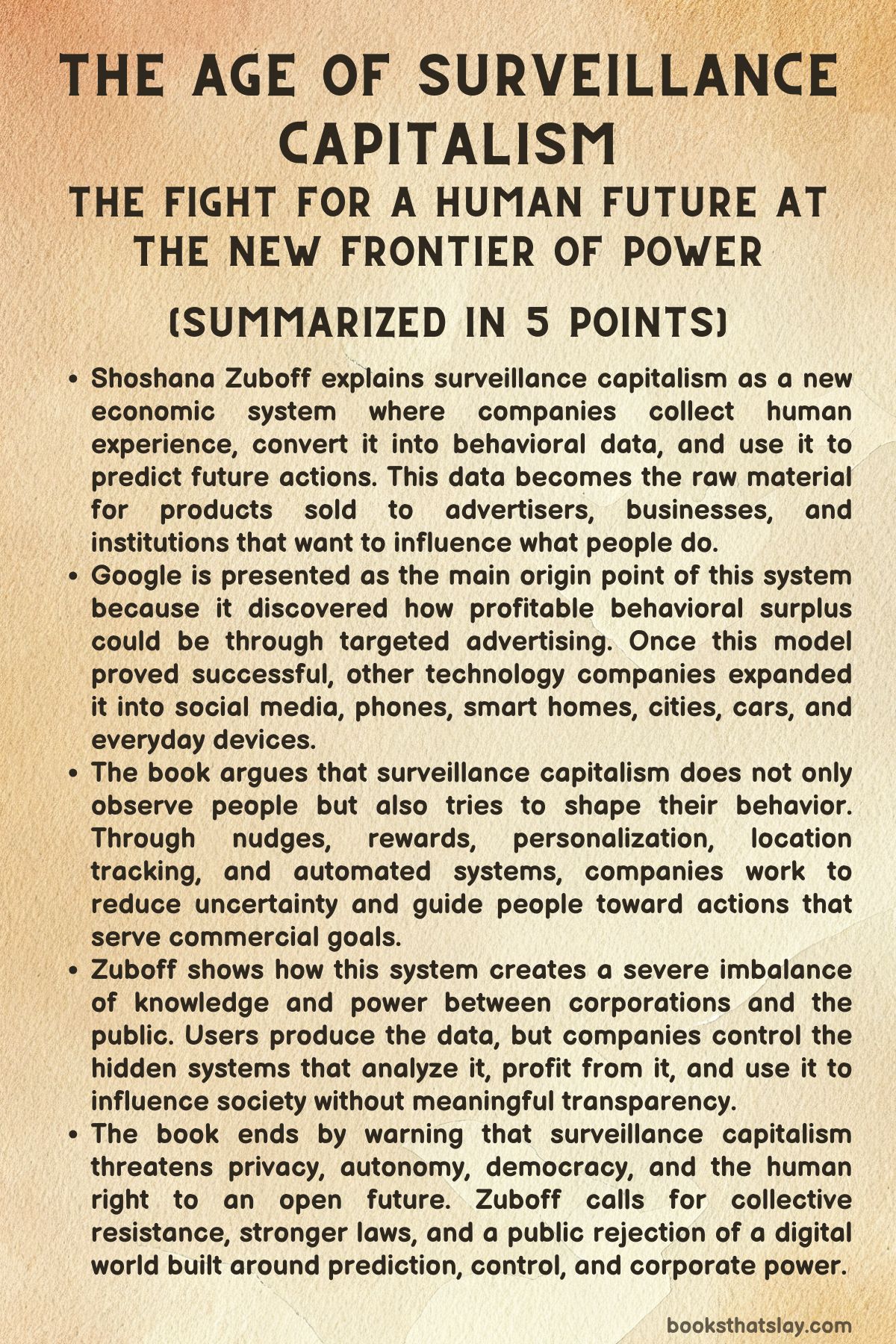
The Age of Surveillance Capitalism: The Fight for a Human Future at the New Frontier of Power by Shoshana Zuboff is a major nonfiction work about the rise of a new economic order built on the extraction, prediction, and modification of human behavior. Zuboff argues that digital companies no longer merely provide tools or services; they collect personal experience as raw material, convert it into data, and use it to create products that predict and shape what people will do next.
The book examines Google, Facebook, Microsoft, Apple, and other firms to show how privacy, democracy, autonomy, and human freedom are threatened by this model.
Summary
Shoshana Zuboff’s The Age of Surveillance Capitalism explains how a new form of capitalism emerged from the digital world and began reshaping society. The book defines surveillance capitalism as an economic system in which companies collect human experience as raw material, translate it into behavioral data, and use that data to build prediction products.
These products are sold to businesses and institutions that want to forecast and influence what people will do. Zuboff argues that this is not simply a new advertising method or a natural result of technological progress.
It is a new economic logic that depends on taking private human experience without proper consent and turning it into profit.
The book begins by showing why this new system is so dangerous. Earlier forms of capitalism depended on labor, land, factories, and markets.
Surveillance capitalism depends on the capture of behavior. It does not merely observe people; it aims to shape them.
The digital services people use every day appear helpful, convenient, and personal, but behind them sits an enormous machinery of extraction. Search engines, phones, smart devices, social media platforms, maps, thermostats, cars, toys, and even household appliances become channels for gathering data.
This data is not only used to improve services. Much of it becomes behavioral surplus, meaning extra information gathered beyond what is needed to provide the service itself.
That surplus is then analyzed by machine intelligence to predict future actions.
Google becomes the central example of this new economic order. In its early years, Google presented itself as a company devoted to organizing the world’s information and making it accessible.
At first, there was a kind of balance between the company and its users. People used Google to search the internet, and Google used search behavior to improve the service.
This balance changed when investors pushed the company to become more profitable. Google discovered that user behavior could be analyzed to create highly targeted advertising.
The company learned that searches, clicks, browsing habits, and other forms of online activity could reveal what people were likely to want, buy, or think. This discovery created a new revenue model and showed how profitable behavioral data could be.
Once Google proved the value of behavioral surplus, other companies followed. The book shows how surveillance capitalism spread from search advertising into social media, mobile phones, smart homes, cars, cities, and workplaces.
Companies began competing not only to collect more data but also to collect deeper and more varied data. Zuboff describes this expansion as driven first by an extraction imperative, the need to gather as much behavioral surplus as possible.
Later, this became a prediction imperative, the need to make predictions more accurate. Eventually, it turned into a drive toward behavioral modification, where companies do not simply predict behavior but intervene in people’s lives to guide choices and produce more certain outcomes.
The political and historical conditions that allowed surveillance capitalism to grow are also examined in detail. Zuboff links its rise to neoliberalism, which promoted deregulation, free markets, and reduced state oversight.
This environment helped technology companies operate with little interference. After the September 11 attacks, the American government’s interest in surveillance also expanded.
National security concerns created new demand for data analysis and prediction. Technology firms gained power because their tools seemed useful to the state.
Instead of being restrained, companies were protected by political relationships, lobbying, legal arguments, and cultural admiration for technological innovation.
The book also shows how companies defend their actions. They often claim that data collection improves user experience, helps innovation, or provides personalization.
Zuboff argues that personalization frequently becomes a cover for deeper forms of extraction. A smart device may promise convenience, but it also creates a data stream from intimate spaces.
A digital assistant may appear helpful, but it learns voice patterns, habits, routines, and preferences. A smart TV, toy, mattress, thermostat, or vacuum can become part of a larger system that observes private life.
Homes, once understood as places of privacy and safety, become targets for data capture.
Zuboff gives special attention to the movement from the online world into physical life. Location data from smartphones allows companies to track movement across cities.
Smart city projects promise efficiency, free Wi-Fi, better transportation, and improved services, but they also create urban environments filled with sensors and monitoring systems. In this model, streets, buildings, vehicles, and public spaces become sources of behavioral data.
The book warns that when physical environments are designed for data extraction, citizens become objects of continuous observation.
A major concern in the book is the division of knowledge. Zuboff argues that surveillance capitalism creates a deep imbalance between what companies know about people and what people know about companies.
Users see the visible layer of the internet: posts, likes, searches, messages, photos, and videos. Behind this visible layer is a hidden layer of behavioral data that companies collect, analyze, and profit from.
This hidden text is not available to ordinary users, even though it is produced from their lives. The result is an unequal distribution of knowledge and power.
Companies gain the ability to study populations at scale, while individuals often do not understand what is being taken from them or how it is being used.
The book then moves toward the concept of instrumentarian power. Zuboff distinguishes this from totalitarianism.
Totalitarian power uses violence, fear, and direct domination. Instrumentarian power works through observation, prediction, nudging, conditioning, and automated control.
It does not necessarily need to terrorize people. Instead, it builds environments where choices are shaped in advance.
The goal is not to control the soul through ideology, but to control behavior through systems. Zuboff connects this idea to behavioral psychology, especially the work of B. F. Skinner, who studied how behavior could be shaped through reinforcement.
Surveillance capitalism takes such ideas and applies them at vast scale through digital systems.
The book’s discussion of behavioral modification becomes especially clear through examples such as Pokémon Go. The game used phones, GPS, cameras, rewards, and sponsored locations to guide people through real-world spaces.
Players believed they were simply playing, but the system could also direct movement toward businesses and locations that benefited commercially. This becomes a model for actuation, where digital systems produce action in the physical world.
Zuboff argues that this is a central shift: the aim is not only to know what people will do but to make them do it.
The book also examines the emotional and psychological effects of surveillance capitalism, especially on young people. Social media platforms create systems of comparison, reward, anxiety, and dependency.
The “Like” button, curated feeds, targeted ads, and constant notifications encourage compulsive checking and self-presentation. Young users may begin to see themselves as objects to display and market.
Zuboff argues that this is not a side effect but part of a larger structure that profits from attention, emotion, and repeated engagement. The psychological vulnerability of adolescence and emerging adulthood makes young people especially exposed to these systems.
Privacy, sanctuary, and solitude become central concerns near the end of the book. Zuboff argues that sanctuary is necessary for freedom because people need spaces where they are not watched, scored, analyzed, or influenced.
Yet surveillance capitalism treats hidden spaces as barriers to profit. Legal protections are often inadequate because many privacy laws were designed to protect citizens from the state, not from corporations.
The book presents the European Union’s data protection efforts as stronger than many American protections, but Zuboff still argues that individual actions are not enough. Real resistance requires collective political and social action.
The conclusion frames surveillance capitalism as a threat to democracy. Zuboff argues that this system differs from traditional market capitalism because it claims both freedom and knowledge.
Market actors once argued for freedom because no one fully knew the future. Surveillance capitalists, however, seek to know and shape the future while also demanding freedom from regulation.
They do not depend on genuine reciprocity with the public; users are not the real customers but the raw material. The future they imagine is a society organized through prediction, certainty, and automated control.
Zuboff calls this antidemocratic and tyrannical. Yet the book ends with a call to resistance, insisting that people can reject this future and demand a democratic digital world.
Key Figures
Shoshana Zuboff
Shoshana Zuboff functions as the central intellectual presence of the book.
Her role is that of a critic, historian, theorist, and warning figure who tries to name a force that many people experience daily but do not fully understand. In The Age of Surveillance Capitalism, she presents herself as someone trying to break the spell of inevitability surrounding digital technology.
She does not treat surveillance capitalism as a natural stage of progress or as a harmless business model. Instead, she frames it as a human-made system that can be studied, challenged, and resisted.
Her analysis is driven by a deep concern for autonomy, democracy, privacy, and the human right to an open future. She repeatedly insists that naming this new form of power is the first step toward opposing it.
Her presence in the book is intense and argumentative, because she is not only explaining a system but also asking readers to recognize its danger before it becomes too normalized to confront.
Google is presented as the foundational corporate figure in the book, almost like the origin point of surveillance capitalism’s rise. At first, Google appears as an idealistic company built around organizing information and serving users.
Its early relationship with users seems mutually useful: people search the web, and their activity helps improve the service. That image changes when the company discovers the profit potential of behavioral surplus.
Google becomes the first major example of how a digital firm can turn user behavior into prediction products and then sell those predictions to advertisers. In the story of The Age of Surveillance Capitalism, Google is not shown merely as a successful technology company.
It is shown as the inventor and leader of a new economic logic. Its transformation reveals how convenience, innovation, and access can mask extraction.
Google’s power comes not only from its products but from its ability to establish a model that others copy. The company’s role expands from search into mapping, advertising, mobile systems, smart cities, artificial intelligence, and political influence, making it one of the most important forces in the book’s argument.
Facebook represents the emotional and social reach of surveillance capitalism. While Google is associated with search, prediction, and the discovery of behavioral surplus, Facebook shows how deeply this system can enter relationships, identity, social comparison, and personal expression.
The platform encourages users to share photos, feelings, preferences, opinions, friendships, and daily experiences. On the surface, this appears to create connection.
In the book, however, these acts of connection become streams of data that can be analyzed, ranked, targeted, and monetized. Facebook is especially important in the sections dealing with young people and social media dependency.
Its design features, such as likes, feeds, ads, and curation systems, are presented as tools that intensify comparison and compulsive use. The company also illustrates the hidden nature of the shadow text, since user activity creates a deeper layer of information that remains largely inaccessible to the people who produce it.
Facebook’s role in the book is therefore social, psychological, and political. It shows how surveillance capitalism does not only track behavior but also reshapes the conditions under which people understand themselves and relate to others.
Hal Varian
Hal Varian appears as an important intellectual figure connected to Google and the economic theory behind surveillance capitalism. As Google’s chief economist, he helps represent the internal logic of the system: the belief that digital technology can reduce uncertainty, improve transactions, and create more efficient forms of coordination.
Zuboff treats his ideas critically because they show how surveillance capitalism justifies itself through the language of innovation, efficiency, and better contracts. His concept of automated arrangements is especially important because Zuboff reframes it as the “uncontract.” This idea suggests a future in which human relationships, negotiation, trust, and consent are replaced by automated systems that monitor, enforce, and adjust behavior.
Varian’s role in the book is not that of a villain in a simple sense; rather, he represents the technocratic confidence of surveillance capitalism. He gives intellectual form to a worldview in which more data, more automation, and more prediction are assumed to be improvements.
Through him, the book shows how economic theory can become a language that makes invasive systems appear rational and progressive.
Mark Zuckerberg
Mark Zuckerberg is portrayed as one of the clearest voices of surveillance capitalism’s utopian ambition. His language about connecting the world, building community, and creating a knowledge economy presents Facebook’s mission as socially beneficial and historically important.
Zuboff treats this rhetoric with suspicion because it turns corporate expansion into a moral project. Zuckerberg’s importance lies in the way he frames Facebook not merely as a company but as a force capable of organizing human connection on a global scale.
In the book, this kind of vision becomes dangerous because it presents private corporate power as if it were public leadership. Zuckerberg’s dream of connection hides the reality that connection produces data, and data produces profit and control.
He represents the public-facing confidence of surveillance capitalism: optimistic, global, fluent in the language of progress, and largely unwilling to confront the deeper consequences of behavioral extraction. His role shows how easily people can be persuaded to accept systems of monitoring when those systems are described as community, convenience, and progress.
B. F. Skinner
B. F. Skinner is one of the key historical figures in the book because his work on behaviorism helps Zuboff explain instrumentarian power. Skinner studied how behavior could be shaped through reinforcement, reward, and controlled environments.
His ideas matter because surveillance capitalism also depends on the belief that behavior can be observed, predicted, and modified from the outside. Zuboff uses Skinner to show that the dream of engineered behavior did not begin with digital platforms, but digital platforms gave that dream new scale and precision.
Skinner’s view of human beings as observable organisms becomes a foundation for the book’s critique of instrumentarianism. He represents a world where inner life, choice, and freedom are treated as less important than measurable behavior.
His utopian imagination is especially troubling because it suggests that social harmony can be achieved by removing uncertainty and guiding people toward preferred actions. In The Age of Surveillance Capitalism, Skinner becomes a bridge between older behavioral science and the modern digital systems that seek to automate influence.
Alex Pentland
Alex Pentland is presented as an influential academic figure whose work reflects the institutional development of instrumentarian thinking. His studies of social behavior, phones, wearable sensors, and group dynamics show how social life can be converted into data and analyzed for patterns.
Pentland’s idea of social physics is important because it imagines society as something that can be measured and guided according to laws similar to those in the physical sciences. Zuboff treats this as deeply troubling because it reduces individuality, disagreement, and democratic debate to problems of coordination.
Pentland’s role in the book is to show how surveillance capitalism’s logic can move from corporations into universities, research labs, public policy, and visions of social management. His work appears to promise better systems, better governance, and improved collective outcomes.
Yet the cost is high: personal freedom becomes a source of friction, and social pressure becomes a tool for producing harmony. Pentland therefore represents the intellectual normalization of a future where monitoring and behavioral guidance are treated as reasonable tools for managing society.
Paul-Olivier Dehaye
Paul-Olivier Dehaye stands as a figure of resistance and exposure. His attempt to obtain his personal data from Facebook reveals the difficulty ordinary people face when trying to understand what corporations know about them.
He is important because his experience makes the hidden structure of surveillance capitalism visible. When Facebook explains that some data is stored separately for analytics and not directly tied to the visible user experience, the book uses this moment to reveal the existence of the shadow text.
Dehaye’s role is not based on corporate power or theory, but on the act of demanding accountability. He shows that individual resistance is possible, but also that the system is designed to frustrate such resistance.
His struggle demonstrates the imbalance between citizens and corporations. Even an informed, determined person faces barriers when trying to access the information produced from his own life.
Dehaye therefore represents both the necessity and the limits of individual action in the book’s larger call for collective change.
Themes
Surveillance as an Economic System
Surveillance in the book is not treated as a narrow matter of cameras, spies, or state monitoring. It becomes the foundation of a new economic order.
Human experience is captured, translated into data, analyzed, and used to make predictions that can be sold. This changes the meaning of privacy because the issue is not only that companies know personal details.
The deeper issue is that private life becomes raw material for profit. Search histories, movements, voice patterns, emotional signals, home layouts, social ties, and habits all become valuable because they help companies predict and influence behavior.
This system grows because prediction improves when more data is gathered, so there is always pressure to expand into new areas of life. The result is an economy that depends on reducing zones of privacy.
In The Age of Surveillance Capitalism, surveillance is not an accident or a side effect of technology. It is the business model itself, and that makes it far more difficult to control through ordinary consumer choice.
The Loss of Human Autonomy
Autonomy is threatened when systems move from observing behavior to shaping it. The book argues that surveillance capitalism does not stop at prediction because prediction always contains uncertainty.
Human beings may choose differently, hesitate, refuse, or act unpredictably. To reduce this uncertainty, companies develop methods of nudging, herding, conditioning, and environmental control.
Digital interfaces can be designed to encourage certain actions. Games can direct people to sponsored locations.
Social media can guide attention and emotion through feeds and rewards. Smart devices can alter the conditions in which choices are made.
This is dangerous because freedom can be weakened without people feeling directly forced. A person may still feel that a choice is personal, even when the environment has been arranged to make one action more likely than another.
The book’s concern is that the future tense of human life, the ability to imagine and choose one’s own path, becomes smaller when behavior is continuously shaped by systems built for profit.
Knowledge, Power, and Inequality
The book repeatedly returns to the unequal distribution of knowledge. Ordinary users create the data, but companies control the systems that collect, analyze, and profit from it.
People see the visible world of posts, searches, likes, apps, and services, while corporations hold the deeper behavioral records and predictive models. This creates a major power imbalance.
Knowledge about individuals and populations becomes concentrated inside private institutions that are not democratically accountable. These companies know far more about users than users know about them.
They can test, adjust, and optimize systems while keeping their methods hidden. This inequality matters because knowledge is a form of power.
Whoever controls the data can shape markets, influence behavior, support political campaigns, assist state agencies, and define the future of technology. The book shows that privacy violations are only one part of the problem.
The larger danger is a new social order in which a small number of corporations gain authority over the division of learning in society.
Democracy and Collective Resistance
Democracy depends on debate, consent, accountability, and the ability of citizens to act freely. Surveillance capitalism threatens these conditions by moving power into private systems that operate beyond ordinary public understanding.
When companies gather data without meaningful consent, influence behavior invisibly, and defend themselves through lobbying, legal claims, and cultural prestige, democratic control weakens. The book argues that individual solutions are not enough.
Opting out is often unrealistic because digital systems are woven into work, communication, transportation, education, and daily life. Privacy settings and personal caution cannot solve a structural problem.
Collective resistance is therefore necessary. Laws, social movements, public pressure, and democratic institutions must challenge the right of corporations to claim human experience as free raw material.
The book’s final political message is that the digital future has not been fully decided. People can still reject a world organized around prediction and control, but only if they recognize surveillance capitalism as a political and economic threat rather than a neutral form of innovation.