The Age Of Miracles Summary, Characters and Themes
The Age Of Miracles by Karen Thompson Walker is a coming-of-age novel set during a quiet global disaster: the Earth’s rotation begins to slow, stretching days and nights far beyond their natural limits. Told through Julia, a shy girl growing up in California, the book places ordinary adolescence beside planetary collapse.
Friendship, first love, family strain, illness, and social fear all unfold while birds fall, crops fail, and sunlight becomes dangerous. The novel’s power comes from the way it treats the end of the world not as spectacle, but as something that enters kitchens, classrooms, bedrooms, and childhood memories.
Summary
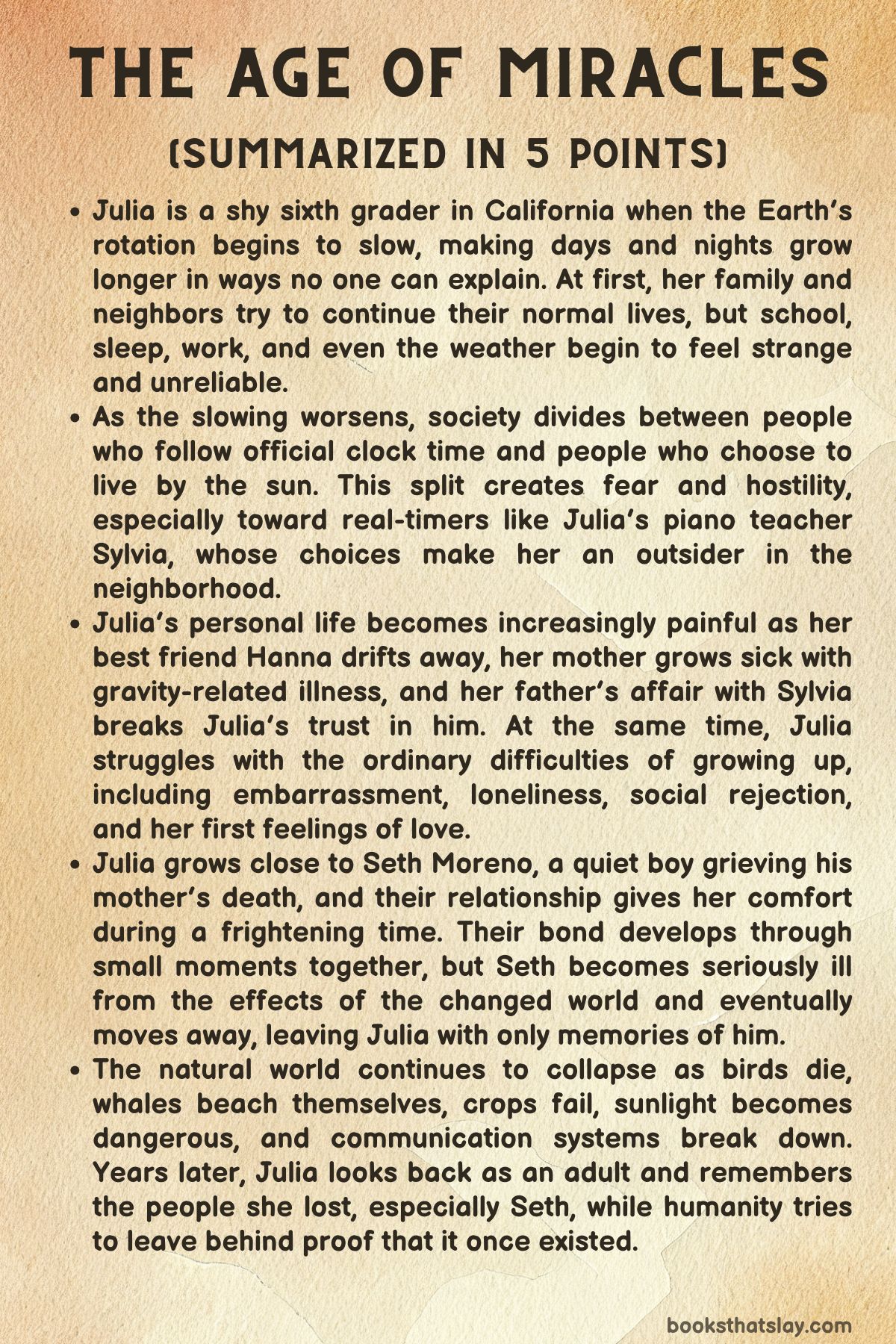
The Age Of Miracles begins with Julia looking back on the time when the world changed, not through war or a sudden explosion, but through something almost invisible at first. The Earth’s rotation starts slowing.
No one feels it immediately. People are busy with ordinary concerns, and the earliest changes are measured only in minutes.
Yet those minutes are enough to disturb the rhythms of the planet. Freeways clog as frightened people try to leave cities, even though there is no safe place to escape to, because the disaster is global.
Julia is a shy sixth grader living in suburban California with her parents, Helen and Joel. Her best friend, Hanna, has spent the night at her house when the news breaks.
At first, life continues with strange normalcy. Julia’s parents read the paper, the cats behave oddly, and everyone watches television for updates.
Scientists do not know why the slowing is happening or what it means. Julia’s mother, already prone to anxiety, begins scanning the cupboards and preparing for emergency.
Her father, an obstetrician who works long hospital hours, tries to stay calm and suggests ordinary activities, as though normal habits might protect them.
Julia’s world is already fragile. She is an only child and feels lonely when Hanna leaves.
At school, she is quiet, awkward, and highly aware of social humiliation. She has a crush on Seth Moreno, a quiet boy whose mother is dying of cancer.
Early in the crisis, Hanna’s Mormon family leaves for Salt Lake City, and Julia feels abandoned. At the same time, her neighborhood begins to reveal different ways of responding to fear.
Her piano teacher Sylvia, a free-spirited naturalist, accepts the planet’s changes with a calm that irritates Julia’s mother. Julia’s grandfather Gene, suspicious of authority and resistant to modern life, treats the crisis as something tied to conspiracy.
The lengthening of days soon becomes impossible to ignore. School continues, but the bells no longer match the sun.
Some children stop attending. Julia suffers a cruel moment at the bus stop when a boy named Daryl humiliates her for not wearing a bra.
Her private discomfort with growing up becomes public shame. Later, an unexpected eclipse throws the school into panic, and Julia briefly shares a moment with Seth.
Wanting to comfort him about his sick mother, she says the wrong thing, and he pulls away angrily. The global crisis does not pause the small injuries of adolescence; instead, those injuries feel sharper because Julia is losing the people and routines that once steadied her.
The government eventually announces that citizens should remain on the usual twenty-four-hour clock, even though natural days are growing longer. This creates a split between “clock-timers,” who follow official time, and “real-timers,” who live by the rising and setting sun.
Public institutions, including schools, stay on clock time. For Julia’s family, this means waking, sleeping, eating, and working according to a schedule that no longer matches the sky.
Helen’s anxiety grows worse, and people begin buying blackout curtains, sleeping pills, alcohol, and anything that might force the body to obey an artificial rhythm.
The natural world begins to fail in alarming ways. Birds fall from the sky, dead or dying.
Sylvia’s pet finches grow weak. Gravity changes subtly, making Julia’s body feel different and making ordinary activities harder.
Reports of “gravity sickness,” later called the syndrome, spread across the world. People experience dizziness, faintness, fatigue, and collapse.
As time stretches further, nights and days become long enough to make clock time feel increasingly absurd. Still, people cling to rituals: soccer practice, school lunches, holidays, birthday parties, and family meals.
Julia’s personal life grows more painful. Hanna returns from Utah, but their friendship has changed.
Hanna now sits with Tracey, another Mormon girl, and behaves as though Julia is almost a stranger. Julia’s old neighborhood friend Gabby is also changing, becoming rebellious and distant.
Julia’s mother forbids her from taking lessons with Sylvia after Sylvia chooses real time. Real-timers are increasingly viewed with suspicion and hostility.
Their homes are vandalized, their power lines are cut, and neighbors begin to treat them as threats rather than people making a different choice.
Julia’s family begins to fracture from within. Her father buys her a telescope, and through it she starts looking not only at the sky but also at the private lives of neighbors.
One night, she sees Sylvia with a man and realizes the man is her father. Joel is having an affair.
The discovery changes the way Julia sees him. He is no longer simply the calm parent who balances Helen’s fear.
He becomes a source of secrecy, betrayal, and confusion. Julia keeps the knowledge to herself, and the silence becomes another burden she must carry.
On New Year’s Eve, Julia’s mother, affected by gravity sickness, passes out while driving and hits a man dressed in robes who had been shouting Scripture. Helen is horrified, fearing she has killed him.
Later, Julia overhears that the man died on arrival at the hospital, but Joel tells Helen that he survived. Julia knows this is a lie.
She hates the dishonesty but also sees that it brings Helen relief. This becomes one of the book’s important moral tensions: a lie can be wrong and still ease suffering.
Julia begins to understand that adult life contains contradictions she cannot neatly resolve.
As the slowing worsens, crops begin to fail. Lawns die, farms move into greenhouses, and food shortages become a real threat.
Julia quits caring about soccer and skips practice, using the time to buy herself a bra, though she later throws it away in disappointment. Her attempt to cross into maturity feels awkward and unsatisfying.
Around her, other children are growing up in different ways. Dance parties become important social events, but Julia is often excluded.
Gabby plans to run away to Circadia, a real-timer settlement. Julia eventually tells Gabby’s parents, and Gabby is retrieved and sent away to boarding school.
Julia loses another friend.
At Michaela’s party, Julia experiences another painful social moment. Michaela now has access to wealth through her mother’s boyfriend Harry, and the party takes place in a large mansion.
Julia is paired with Harry’s son Josh, who tries to kiss her in a safe room during a game. When she refuses, he lashes out and tells her she was invited only because Michaela’s mother wanted her there.
Julia calls her father early the next morning to take her home. The event leaves her feeling unwanted and exposed.
Soon after, Julia and Seth begin to grow closer. A group of whales beaches near the coast, and Seth invites Julia to see them.
They try to help one by pouring small cups of water over its body, only to learn it is already dead. Their helplessness in front of the whale mirrors the larger helplessness of the world, but for Julia the afternoon becomes precious because she spends it with Seth.
Their bond strengthens after they watch the failed return of the Orion astronauts, who die when their spacecraft disintegrates before landing. In the shadow of death and uncertainty, Julia and Seth begin spending more time together.
Their relationship becomes one of the few bright parts of Julia’s life. They sit together at school, skateboard, wander canyons, watch television, and share secrets.
During a power outage, Julia tells Seth about her father and Sylvia. Seth responds with gentleness, and soon afterward they share their first kiss.
Julia’s first love grows inside a world where everything is unstable. The planet is becoming less livable, but her feelings for Seth make certain days feel full and unforgettable.
Meanwhile, Julia’s grandfather Gene disappears on her birthday. His house has been cleared of valuables, and clues suggest he may have gone to Circadia.
Julia’s family drives into the desert to find him, but the residents are guarded and unhelpful. They locate Chip, Gene’s teenage neighbor, who says Gene never came there.
The family returns home without answers. Later, Gene is found dead in a bomb shelter beneath his property.
He had been preparing the space, likely for Julia’s birthday, when he fell from a ladder and struck his head. His death is Julia’s first direct encounter with loss, and it removes another figure from her shrinking world.
The environmental danger intensifies. Earth’s magnetic field begins to fail, allowing harmful solar radiation to reach the surface.
Sunlight becomes dangerous. Julia and Seth sneak out during a white night to watch Sylvia’s house and discover that she is leaving.
Joel emerges from Sylvia’s home carrying suitcases, confirming the affair in a way that can no longer be hidden from Julia. Seth stands by her.
The next morning, Julia and Seth suffer severe burns from exposure to the dangerous light. Julia recovers, but Seth becomes increasingly ill.
He develops symptoms of the syndrome, grows weak, and eventually has a seizure.
As summer arrives, days stretch to seventy-two hours. Food shortages, radiation shelters, dying crops, and power failures become part of daily life.
Julia’s parents draw closer again, though the affair is never properly discussed. Sylvia disappears from Julia’s life.
Seth’s condition worsens, and his father takes him to Mexico, hoping the move will help. Seth gives Julia his skateboard before leaving.
He sends her one email after arriving, saying he is safe and misses her. Then a major power outage damages communication systems, and Julia loses contact with him forever.
The novel closes years later, when Julia is twenty-three. The slowing has never been explained.
Days are now as long as weeks, and humanity faces an uncertain future. A spacecraft called The Explorer is prepared to carry a record of human life into space, an attempt to preserve proof that people existed if Earth can no longer sustain them.
Julia still lives in her childhood home and thinks often about Seth. She remembers the wet cement where they once wrote their names, the date, and the words “We were here.” In the end, The Age Of Miracles becomes not only a story about planetary disaster, but also about memory, love, and the human need to leave some mark behind.
Characters
Julia
Julia is the emotional center of The Age Of Miracles, and the book’s power depends on the way she observes disaster through the mind of a young girl. She is shy, watchful, lonely, and deeply sensitive to embarrassment.
Her life is shaped by ordinary sixth-grade concerns: friendship, clothes, crushes, parties, parents, and the fear of being disliked. What makes her compelling is that these concerns do not disappear when the Earth begins to slow.
Instead, they become sharper. Hanna’s absence wounds her because Julia already feels uncertain about belonging.
Daryl’s cruelty at the bus stop stays with her because her body is changing and she is painfully aware of what others see. Her crush on Seth carries the intensity of first love, especially because it develops in a world where time itself has become unstable.
Julia is also a witness. She sees her father’s affair, her mother’s illness, her grandfather’s disappearance, Seth’s decline, and the world’s physical collapse.
Yet she rarely acts with certainty. She often absorbs events silently, trying to understand adults who lie, friends who leave, and systems that fail.
As an adult narrator, she looks back with a reflective sadness, but she does not exaggerate her younger self into a hero. She remains believable because she is often confused, passive, hopeful, afraid, and observant all at once.
Helen
Helen, Julia’s mother, represents the terror of uncertainty in a household that is trying to appear normal. From the beginning, she responds to the slowing by preparing: checking cupboards, gathering supplies, storing food, and worrying over every possible danger.
Her anxiety can seem excessive, but the book gradually proves that her fear is not irrational. The world really is becoming unsafe.
Her problem is not that she notices danger, but that she cannot escape the mental pressure of noticing it all the time. Gravity sickness worsens her condition, bringing faintness, insomnia, loss of appetite, and emotional instability.
After the accident on New Year’s Eve, Helen becomes trapped inside guilt and dread, believing she may have killed a man. Joel’s lie that the man survived gives her relief, but it also shows how fragile her emotional state has become.
Helen is also a woman whose marriage is quietly damaged by betrayal. She does not know everything Julia knows about Joel and Sylvia, but the distance between husband and wife is visible.
Her character is not only a portrait of panic; she is also a mother trying to protect her child with the limited tools she has. In The Age Of Miracles, Helen shows how fear can be both a burden and a form of care.
Joel
Joel is a complicated father because he combines tenderness, intelligence, secrecy, and moral failure. As a doctor, he is trained to respond to crisis with composure, and this shapes the way he handles the slowing.
He tries to calm Julia and Helen, sometimes by minimizing what is happening and sometimes by lying. His lies are not all the same.
When he denies that a woman died under his care, he is trying to shield Julia. When he tells Helen that the man she struck survived, he is protecting his wife from a truth that might destroy her.
Yet his affair with Sylvia cannot be treated as protective. It is a betrayal that Julia discovers accidentally, and it forces her to see her father as a flawed adult rather than a stable authority.
Joel’s relationship with Julia contains real affection. He buys her a telescope, spends time with her, takes her to the coast, and later tries to explain the idea of paradox.
That lesson matters because Joel himself becomes a paradox in the story: he can be loving and dishonest, responsible and selfish, comforting and harmful. In The Age Of Miracles, Joel’s character shows that adulthood is not a place of clear answers.
It is often a place where people make choices that help and hurt at the same time.
Seth Moreno
Seth Moreno is Julia’s first love and one of the saddest figures in the book. He is quiet, guarded, and marked by grief even before the larger disaster begins.
His mother’s cancer makes him familiar with loss in a way Julia is not, which partly explains his sharp reaction when she first tries to speak to him about it. He does not want easy sympathy because his pain is too private and too real.
As the story continues, Seth reveals a gentler and more thoughtful nature. He tries to save dying birds and whales, not because he can truly rescue them, but because he cannot bear unfair suffering.
This instinct makes him deeply important to Julia. He gives her companionship when she has lost Hanna and Gabby, and he listens without cruelty when she tells him about her father’s affair.
Their romance is tender because it is built from small acts: sitting together, sharing secrets, skateboarding, watching the sky, and kissing during a power outage. Seth’s illness later changes the emotional direction of the relationship.
The severe sunburn, his seizures, and his move to Mexico turn first love into permanent memory. His final absence gives Julia’s adulthood much of its ache.
He becomes someone she cannot recover, contact, or fully know again.
Hanna
Hanna is Julia’s first close friend, and her importance comes from the pain of her disappearance and return. At the beginning, she is the person whose presence makes Julia’s house feel alive.
Because Julia is an only child and socially unsure, Hanna’s friendship gives her a sense of safety. When Hanna’s Mormon family leaves for Utah after the slowing begins, Julia experiences it as a personal abandonment, even though the move is caused by family and religious concerns.
The hurt deepens when Hanna returns and no longer fits easily into Julia’s life. Their conversation is awkward, and Hanna’s closeness with Tracey signals that she has shifted into another social and religious circle.
Hanna is not cruel in an obvious way, but her distance shows how childhood friendships can end without a dramatic fight. The disaster speeds up changes that might have happened anyway: loyalties move, identities harden, and old intimacy becomes uncomfortable.
Hanna’s role in the book is important because she is one of Julia’s first lessons in loss. Before death, before Seth’s illness, before Gene’s disappearance, Julia learns that someone can come back and still be gone.
Sylvia
Sylvia is Julia’s piano teacher and one of the clearest representatives of resistance to official order. She is artistic, unconventional, and closely connected to nature.
Her decision to live by real time places her outside the approved structure of society, and this choice gradually makes her a target. Julia admires Sylvia’s freedom at first: her bare feet, jewelry, ease with music, and calm attitude toward the planet’s changes.
Helen distrusts her, partly because Sylvia does not fit the rules Helen values. As real-timers become hated, Sylvia loses students, faces isolation, and eventually has her property threatened.
Her affair with Joel complicates the reader’s view of her. She is not simply a symbol of freedom or victimhood; she is also involved in a relationship that damages Julia’s family.
This complexity gives Sylvia a strong place in the story. She is both vulnerable to social cruelty and capable of causing private pain.
Her departure suggests that people who refuse dominant systems may be pushed out, but it also leaves unresolved questions about desire, escape, and responsibility.
Gene
Gene, Julia’s grandfather, is stubborn, eccentric, suspicious, and deeply attached to older ways of living. His house, filled with objects and memories, stands against the clean modern development around it.
He refuses to renovate, refuses to blend in, and resists easy trust in official explanations. His belief that the slowing may be a conspiracy makes him seem difficult, but his distrust also fits his larger personality: he is a man who does not want to be managed by institutions or trends.
His gift of the pocket watch to Julia is meaningful because time is the central crisis of the book, and the watch connects family memory to a world where time has lost its old reliability. Gene’s disappearance creates a mystery that seems tied to the real-timer settlement, but the truth is more intimate and tragic.
He dies alone in a bomb shelter while preparing games for Julia’s birthday. This detail changes the emotional meaning of his character.
Beneath his oddness and suspicion, he loves his granddaughter and is trying to prepare a space where she might be safe or happy. His death is one of Julia’s first encounters with the finality of loss.
Gabby
Gabby is Julia’s neighborhood friend and another example of adolescence moving in a different direction under pressure. She and Julia once shared a childhood environment, but they grow apart as Gabby becomes rebellious, smokes, skips classes, changes her appearance, and attaches herself to an older boyfriend.
Her desire to run away to Circadia reflects both teenage defiance and a deeper hunger for escape. The official world of parents, schools, clock time, and social rules feels unbearable to her, so the real-timer compound becomes a fantasy of freedom.
Julia’s decision to tell Gabby’s parents where she has gone is morally painful. Julia betrays Gabby’s confidence, but she also acts out of fear for her safety.
The result is that Gabby is sent away, leaving Julia even more alone. Gabby’s character shows how young people respond differently to collapse.
Julia watches and internalizes; Gabby acts out and runs. Neither response gives them control over the world, but both reveal the emotional strain of growing up when the future has become unstable.
Michaela
Michaela represents social confidence, early maturity, and the painful hierarchies of school life. From Julia’s perspective, Michaela seems more advanced, more noticed, and more comfortable with the codes of adolescence.
She wears a bra before she needs one, has a boyfriend, attends and hosts parties, and occupies a social world Julia longs to enter but also fears. Michaela’s life changes when her mother becomes involved with Harry, giving Michaela access to wealth and status through his mansion.
Yet her power is not complete. She is still a child shaped by adult choices, social performance, and insecurity.
Her invitation to Julia may seem generous, but Josh’s later cruelty reveals that Julia’s presence at the party may not have been rooted in true friendship. Michaela’s anger when Julia and Seth refuse her birthday invitation also shows how social status depends on being seen and validated.
In the book, Michaela is not a villain; she is a girl using the limited forms of power available to her.
Daryl
Daryl is a minor but memorable figure because he embodies the casual cruelty of childhood groups. His humiliation of Julia at the bus stop is not only an act of teasing; it is a public attempt to define her body as wrong in front of others.
The scene matters because it captures the violence of social exposure at the exact age when Julia is becoming more aware of gender, maturity, and shame. Daryl’s later act of throwing the weak bird into the canyon shows a similar lack of tenderness.
He responds to vulnerability with aggression. Seth’s anger at him reveals Seth’s moral instinct, but Daryl himself functions as a reminder that crisis does not automatically make people kinder.
Even when the planet is changing, children still compete for status, mock weakness, and test power over one another.
Themes
Growing Up During Collapse
Julia’s adolescence does not pause for the end of the world. That is what makes the story so effective.
The slowing changes the length of days, damages the environment, divides communities, and threatens human survival, yet Julia still has to face the ordinary confusion of becoming twelve. She worries about bras, parties, friendships, school humiliation, and whether Seth likes her.
These concerns may seem small beside dying birds and failing crops, but the book refuses to treat them as meaningless. For a child, embarrassment can feel as huge as disaster.
A lost friendship can feel like the end of a world. Julia’s coming-of-age is shaped by the strange fact that private and global crises arrive together.
When Hanna leaves, when Gabby is sent away, when Julia discovers her father’s affair, and when Seth becomes ill, she learns that growing up means losing the belief that life is stable. The Age Of Miracles presents adolescence as a period when the world becomes newly visible in all its danger and contradiction.
Julia’s memories show that catastrophe is not only measured in scientific reports. It is also measured in the moment a girl realizes her parents lie, her friends can leave, and love may not last.
Time, Routine, and the Human Need for Order
The slowing destroys the old relationship between clocks and nature, but people continue clinging to schedules because routine gives them the feeling of control. The government’s decision to follow clock time is practical, but it is also emotional.
Schools, offices, markets, and families need a shared structure, even when that structure no longer matches sunrise or sunset. This creates a strange form of denial.
People wake in darkness, eat lunch at sunrise, and sleep while the sun is still high, all because society has agreed that the clock matters more than the sky. The split between clock-timers and real-timers shows how threatening alternative rhythms can seem.
Real-timers are not merely choosing a different schedule; they are rejecting the official story that civilization can continue as before. That rejection makes others angry, because it exposes how fragile the official order really is.
Julia’s life is full of rituals that continue past the point of reason: soccer practice, school, Christmas cookies, birthday dinners, parties. These rituals are not foolish.
They are ways of saying that human life needs pattern, repetition, and ceremony. Yet the book also shows the cost of forcing life into old forms when reality has changed beyond recognition.
Fear, Blame, and Social Division
As conditions worsen, fear searches for targets. Real-timers become convenient outsiders because they visibly refuse the rules that clock-timers follow.
At first they seem eccentric or impractical; later they are treated as dangerous. Their homes are vandalized, their power lines are cut, and they are pushed toward isolation or flight.
The hostility toward them reveals how quickly communities can turn against difference during crisis. People who are frightened often want someone to blame, even when the true cause of suffering is unknown.
The slowing itself remains mysterious, which makes the social reaction more intense. Without a clear enemy, suspicion spreads among neighbors.
Sylvia, Tom, Carlotta, the Kaplans, and others become marked by their choices or identities. This theme also appears in smaller social settings.
Julia’s school world is full of exclusion, teasing, status, and judgment. The same human impulse that makes children mock Julia at the bus stop also makes adults punish real-timers for living differently.
The book suggests that disaster does not create cruelty from nothing. It exposes habits of fear and control that were already present.
Under pressure, people often protect themselves by narrowing their circle of sympathy.
Love, Loss, and the Desire to Be Remembered
The story is filled with disappearances: Hanna leaves emotionally, Gabby is sent away, Sylvia vanishes, Gene dies unseen, and Seth moves beyond Julia’s reach. These losses teach Julia that love does not always end with explanation or closure.
Her relationship with Seth is especially important because it gives her joy in the middle of decline, but it also becomes one of her deepest wounds. Their time together is brief, shaped by beaches, skateboards, secrets, and a first kiss.
When illness takes him away and the power outage cuts off communication, Seth becomes a permanent absence. Gene’s death carries a different kind of grief.
He dies while preparing for Julia, turning his strange private shelter into proof of care. Even Joel and Helen’s marriage contains a form of loss, as trust is damaged and then partly rebuilt through silence.
The final image of Julia remembering the words written in wet cement gives this theme its clearest expression. Human beings want evidence that they mattered.
When the future is uncertain and the planet itself may not last, a name in cement becomes a small act of resistance. To say “We were here” is to answer disappearance with memory.