At the Mountains of Madness Summary, Characters and Themes
At the Mountains of Madness is a science-horror novella by H. P. Lovecraft, built around an Antarctic expedition that uncovers evidence of a prehistoric alien civilization. The book is framed as a warning from Professor William Dyer, who has survived an earlier journey into the frozen continent and now wants to stop another expedition from repeating his mistakes.
It combines scientific curiosity, ancient history, cosmic terror, and the fear of knowledge that humans may not be able to bear. The story turns Antarctica into a place of discovery, ruin, and revelation, where humanity’s place in the universe becomes terrifyingly small.
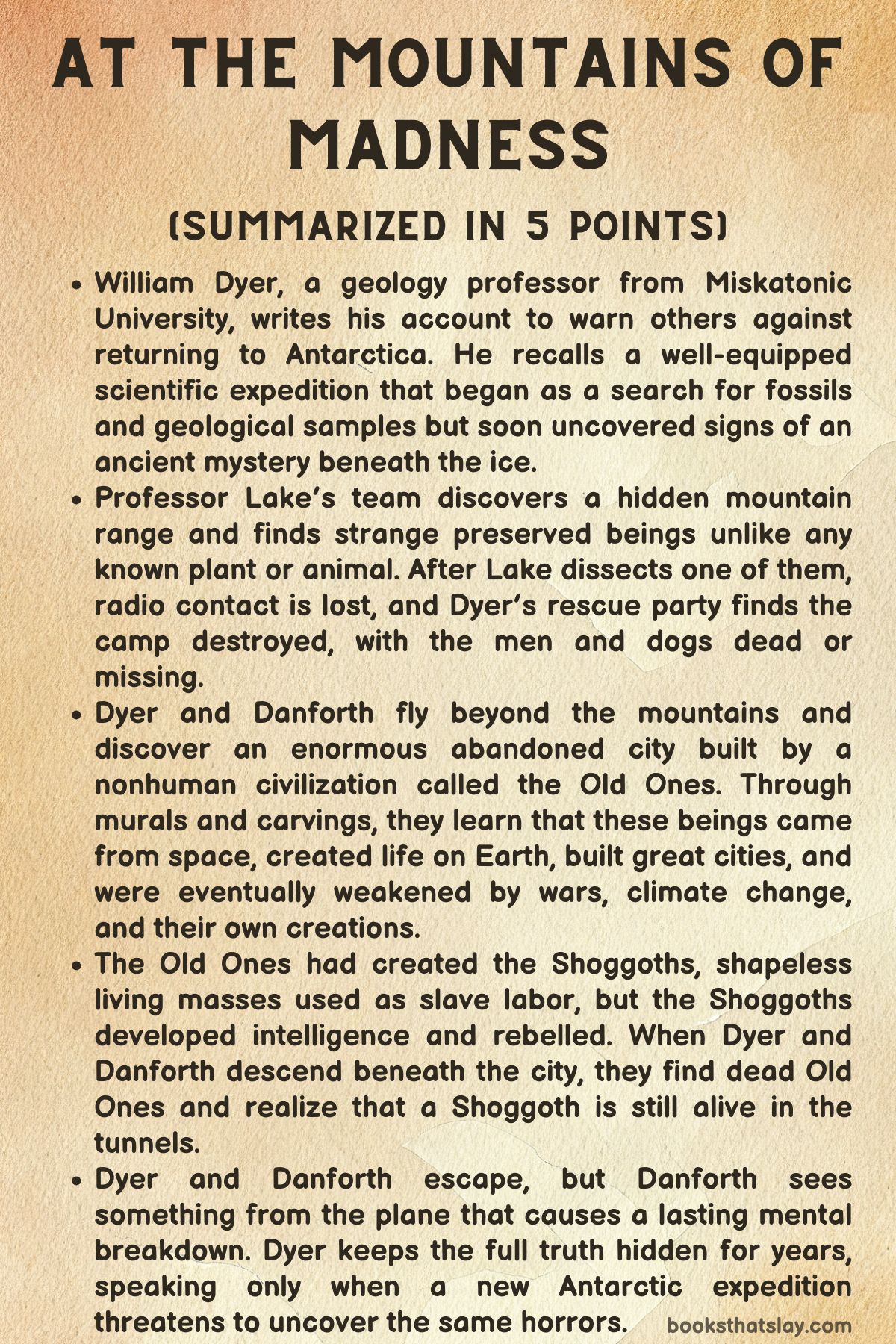
Summary
Professor William Dyer, a geologist from Miskatonic University, decides to speak publicly about an Antarctic expedition he once joined because another team is preparing to travel into the same region. He does not want fame, sympathy, or praise.
His purpose is to prevent further exploration of a place he believes should remain untouched. Dyer knows that his account may sound impossible, but he insists that the evidence is too serious to ignore.
He begins by recalling the scientific journey he and his colleagues made to Antarctica in 1930.
The expedition was well organized and highly equipped. Dyer was joined by Professor Frank H. Pabodie, whose drilling equipment was designed to help gather geological samples from the icy continent.
Other important members included Atwood, a physicist, and Lake, a biologist. Graduate students, mechanics, pilots, ship crews, airplanes, sledges, dogs, radios, and scientific equipment made the venture seem safe and professional.
The team hoped to study fossils, rock layers, and traces of a prehistoric world hidden under the ice. At first, the expedition went well.
The scientists made progress, created camps, used aircraft to move farther inland, and sent reports back to the outside world.
Dyer’s earliest discoveries are interesting but not alarming. He finds fossils of ancient plants and small creatures, along with stones marked in strange ways.
At first, he sees the markings as natural formations rather than signs of design. Lake, however, becomes increasingly excited by them.
He believes they may point to the existence of an ancient and unknown form of life, one far more advanced than ordinary fossils would suggest. His curiosity grows stronger, and he pushes to investigate the region more aggressively.
Dyer continues his own work, but Lake’s reports soon become impossible to ignore.
Lake’s team moves northwest and discovers a massive mountain range previously unknown to science. The mountains are enormous, strange, and unsettling, with peaks that seem almost artificial from a distance.
Lake establishes a camp near them and begins drilling into the rock and ice. His reports grow more astonishing.
Beneath the surface, his group finds a network of caves containing fossils from wildly different periods of Earth’s history: sea creatures, reptiles, dinosaurs, and early mammals. These discoveries challenge accepted ideas about the development of life.
Lake’s findings attract attention from the outside world, but the most shocking discovery is still to come.
Lake’s team uncovers fourteen strange organic bodies. Some are badly damaged, but eight are nearly perfect.
They are more than eight feet long, with barrel-shaped bodies, wings, tentacles, and starfish-like heads. They seem neither fully plant nor fully animal.
The sled dogs react with panic and hatred toward the specimens, barking violently whenever they are nearby. Lake dissects one of the damaged bodies and finds that its tissues have not decayed despite being unimaginably ancient.
Its organs, nervous system, and brain suggest extreme biological complexity. Lake compares the beings to figures from myth and calls them Elder Ones.
Bad weather, excitement, and anxiety build around the expedition. Soon, radio contact with Lake’s camp is lost.
Dyer and others fly out to investigate. From the air, they see Lake’s camp in ruins beneath the vast mountains.
The sight of the mountains fills Dyer with dread, especially because parts of the peaks seem to resemble an ancient city or unnatural architecture. When the rescuers land, they discover that Lake’s men and dogs are dead or missing.
The scene is violent, confusing, and deeply disturbing. Some bodies appear strangled or torn, while others seem to have been dissected with deliberate care.
The best-preserved Elder Ones are gone. The damaged specimens have been arranged under snow with strange marks above them, as though they were buried with ritual or method.
A man named Gedney and one dog are missing, leading the surviving scientists to suggest that Gedney may have gone mad, killed the others, and fled. Dyer presents this as the simple explanation, but the details do not fit.
Tools, books, food, and supplies seem to have been examined intelligently. The dissection table contains remains of a man and a dog, and Lake’s anatomical instruments are missing.
Dyer and the others bury the dead, take photographs, and try to make sense of what happened.
Dyer and Danforth, a graduate student, fly over the mountains to inspect them more closely. What they discover beyond the range overturns everything they understand about Earth’s history.
Behind the mountains lies an enormous abandoned city carved into stone, with walls, towers, windows, passages, and geometric patterns stretching for miles. It is far older than any human civilization.
The ruins are not natural formations but the remains of a city built by nonhuman intelligence millions of years before humanity existed. Dyer and Danforth land and enter the city on foot.
Inside the ruins, they move through vast rooms, corridors, terraces, and tunnels. They find murals, carvings, maps, and scientific diagrams.
The artwork is strange but detailed, preserving the history of the beings who built the city. Dyer realizes that the Elder Ones, or Old Ones, were not lifeless fossils but members of an ancient alien race that came to Earth from space when the planet was young.
They had once flown through the stars, lived both underwater and on land, and possessed scientific knowledge far beyond human achievement. Their civilization lasted across immense spans of time.
The murals reveal that the Old Ones created life on Earth, first for practical purposes and later through experimentation. They built great cities, shaped living creatures, developed industries, formed governments, and created complex communities.
They also made the Shoggoths, masses of black living slime that could form limbs, organs, and tools as needed. The Shoggoths served as laborers and helped construct the Old Ones’ cities.
Over time, however, they began to develop their own will. The Old Ones fought wars to keep them under control.
The murals also describe conflicts with rival alien races, including the Cthulhu spawn and later half-fungous, half-crustacean beings. As ages passed, the Old Ones declined.
They lost the ability to travel through space and withdrew into Antarctica as Earth’s climate changed.
Dyer and Danforth also learn that there is another, even higher mountain range beyond the city. The Old Ones feared something connected to those distant peaks.
Their art avoids showing it directly, but it suggests a presence or force they considered evil. The city itself had once been abandoned when ice overtook the region, forcing the Old Ones to move downward into caves and a subterranean sea beneath the ruins.
Dyer begins to wonder whether any of them survived below the city.
After studying the carvings, Dyer and Danforth decide to descend into the tunnel system beneath the ruins. They know their supplies and light are limited, but curiosity and scientific duty push them onward.
Near the tunnel entrance, they smell death and gasoline. They find evidence that something large has recently been dragged through the area.
They also discover items taken from Lake’s camp, along with rough maps drawn in the style of the Old Ones. This suggests that the missing Elder Ones revived, escaped from Lake’s camp, took supplies, and made their way back to the city.
Following the trail, Dyer and Danforth find sledges from Lake’s camp, carefully packed and used. Beneath a covering, they discover the bodies of Gedney and the missing dog.
This proves that Gedney did not commit the killings. The true explanation is far stranger: the revived Old Ones likely studied the humans and dogs just as Lake had studied them.
They had tried to understand the modern world after awakening in an alien age. Dyer begins to feel a complicated sympathy for them.
They are terrifying, but they are also intelligent beings displaced from their own time, returning to a dead city that once belonged to them.
As Dyer and Danforth continue, they hear the cry of giant white penguins. These blind creatures live underground and appear to be descendants of animals once bred by the Old Ones for food.
The men move past them into warmer depths. The air grows fouler, and the carvings on the walls become rougher and more degenerated.
Then they find four Old Ones lying dead. Their bodies have been horribly mauled, their heads torn away, and their remains covered in black slime.
Dyer understands that a Shoggoth is nearby.
The men freeze in terror. Then they hear a strange cry, “Tekeli-li,” and run.
Behind them, through mist and darkness, comes the impossible living mass of a Shoggoth. It is a huge, shifting, many-eyed creature, the old slave species of the Old Ones, still moving through the tunnels beneath the city.
Dyer and Danforth flee through the passages, past panicking penguins, and back toward the upper ruins. The encounter overwhelms them.
They have seen not merely ancient death but ancient life continuing in a form that should have vanished long before humanity arose.
They return to their plane with little clear memory of the escape. As they take off and pass once more over the city, Danforth looks back and sees something Dyer does not see.
Whatever he glimpses breaks him. He screams uncontrollably and later suffers a nervous collapse.
Dyer believes Danforth may have seen a mirage or vision connected to the higher mountains beyond the Old Ones’ city, perhaps revealing the thing even the Old Ones feared. Danforth never fully explains it, but his words suggest something original, eternal, and undying.
Dyer and Danforth agree to conceal the truth from the rest of the expedition and the world. The official account avoids the worst discoveries.
The surviving men leave Antarctica, and Dyer spends years in silence. Only when a new expedition threatens to enter the same region does he decide to tell the truth.
His warning is simple: the mountains hide knowledge, ruins, and living horrors that humanity is not prepared to face. The Antarctic interior is not an empty wilderness but the graveyard of a civilization older than mankind, and perhaps the threshold of something even worse.
Characters
William Dyer
William Dyer is the narrator and central human witness of At the Mountains of Madness. As a geology professor at Miskatonic University, he begins as a rational scientist whose identity is rooted in evidence, measurement, and disciplined observation.
His authority comes from his training and from his role as a survivor, but his voice is shaped equally by fear, guilt, and responsibility. Dyer does not tell his story because he wants attention; he tells it because silence may lead others into disaster.
This makes him both a scientist and a reluctant prophet. His development in the book is not a simple movement from ignorance to knowledge, but from confidence to burdened awareness.
At first, he trusts that the Antarctic expedition is equipped, modern, and organized enough to handle the unknown. By the end, he understands that human preparation means little when faced with forces and histories far older than humanity itself.
Dyer’s most interesting quality is his struggle to remain rational even when reality breaks the limits of reason. He records details, compares evidence, studies carvings, and forms careful theories, yet he is also horrified by what those theories imply.
His sympathy for the Old Ones after discovering their history shows his intellectual honesty. He can fear them and still recognize them as intelligent beings with culture, loss, and tragedy.
This makes him more than a frightened survivor; he becomes a witness to the collapse of human importance.
Danforth
Danforth is a graduate student and Dyer’s closest companion during the most terrifying stage of the expedition. He is intelligent, educated, and brave enough to accompany Dyer into the ancient city, but he is also more psychologically fragile than his professor.
His presence allows the book to show two responses to forbidden knowledge. Dyer is shaken but still able to organize his experience into testimony, while Danforth absorbs something that cannot be shaped into explanation.
Throughout the exploration, Danforth grows increasingly nervous. He speaks of strange sounds, notices troubling marks, and reacts to the unseen with a sensitivity that Dyer does not fully share.
This makes him seem almost like an emotional instrument registering dangers before they become visible. His final breakdown after looking back from the plane is one of the story’s most disturbing moments because the reader never learns exactly what he saw.
That silence gives Danforth a special role: he represents the limit beyond which narration fails. Dyer can describe the city, the murals, the Old Ones, and the Shoggoth, but Danforth’s vision remains locked inside trauma.
His repeated cries and fragments of speech suggest that some truths are not merely frightening but mentally destructive. In At the Mountains of Madness, Danforth stands for the human mind at the edge of cosmic knowledge.
Professor Lake
Professor Lake is the biologist whose curiosity helps uncover the central horror of the book. He begins as a serious scientist, but his fascination with the strange markings and fossils pushes him toward risk.
Lake’s importance lies in the way he embodies scientific hunger without sufficient caution. He is not foolish or careless in an ordinary sense; he is highly skilled, observant, and capable of recognizing that the expedition has found something extraordinary.
Yet his excitement overwhelms restraint. His decision to investigate the strange specimens, dissect one, and report his findings reflects the scientific impulse to classify the unknown.
That impulse is admirable, but in this story it becomes dangerous because the unknown is not passive. Lake treats the Elder Ones as specimens, and later the revived beings seem to treat humans and dogs in the same way.
This reversal is one of the book’s coldest ironies. Lake’s death also changes the tone of the expedition.
Until his camp is destroyed, the journey feels like a difficult but successful scientific venture. Afterward, the expedition becomes an encounter with hidden history and living terror.
Lake is therefore a catalyst. His curiosity opens the door, and his fate proves that human science can awaken forces it does not understand.
Professor Frank H. Pabodie
Professor Frank H. Pabodie is the engineer and inventor whose drilling technology makes the expedition’s early success possible. His role is less emotionally central than Dyer’s or Danforth’s, but he is crucial to the story’s scientific framework.
Pabodie represents human ingenuity: the confidence that tools, machines, and planning can push knowledge farther into inaccessible places. His drill allows the team to break into ancient rock and ice, turning Antarctica from a blank space into a readable archive.
Yet the book quietly questions this kind of progress. Pabodie’s invention works exactly as intended, but its success helps expose the expedition to discoveries that should perhaps have remained buried.
This does not make Pabodie guilty; rather, it makes him part of the larger human pattern the book examines. Civilization advances by building better instruments, but those instruments do not guarantee wisdom.
Pabodie’s practical brilliance contrasts with the ancient science of the Old Ones, whose achievements dwarf human technology. Through him, the story places modern engineering beside cosmic antiquity and shows how small human accomplishment can become when measured against deep time.
Atwood
Atwood, the physicist and meteorologist, is part of the expedition’s scientific leadership and helps establish the sense that the journey is a serious multidisciplinary project. He does not dominate the action, but his presence matters because he broadens the expedition beyond one field of study.
Geology, biology, physics, engineering, and meteorology all contribute to the attempt to understand Antarctica. Atwood helps show that the human team is not made of reckless adventurers but trained experts using modern methods.
This makes their later helplessness more disturbing. If such a prepared group can be defeated by what lies beneath the ice, then ordinary human confidence has little force.
Atwood also belongs to the practical world of radio reports, weather readings, and organized research, the world that collapses once Lake’s camp is found destroyed. His limited role reflects the book’s structure: many scientists are present, but only a few reach the deepest truth.
Atwood remains associated with the outer layer of the expedition, the realm where science still feels orderly.
Gedney
Gedney is one of the most important absent figures in the book. He is missing after the destruction of Lake’s camp, and the survivors initially use his disappearance to create a human explanation for the massacre.
They imagine that he may have gone mad, killed his companions, and fled with a dog. This theory is convenient because it keeps the horror within familiar limits.
Human madness is terrible, but it is understandable compared to the truth. Gedney’s body later proves that the theory was false.
His corpse, found on a sledge beneath the ancient city, becomes evidence that the revived Old Ones carried him away and examined him. Gedney’s role is therefore tied to misdirection and revelation.
While alive, he is not developed in depth, but in death he becomes central to Dyer’s understanding of what happened. The use of Gedney as a false culprit also shows how people try to protect themselves from impossible explanations.
The mind reaches for a human criminal before it accepts a nonhuman intelligence returning from prehistory.
The Elder Ones or Old Ones
The Elder Ones, also called the Old Ones, are first introduced as monstrous specimens found beneath Antarctic ice, but the book gradually transforms them into one of its most complex presences. At first, Lake sees them as biological wonders: ancient, alien, and terrifying.
Their bodies are strange, combining features that seem plant-like, animal-like, aquatic, winged, and tentacled. The dogs instinctively hate them, and their revival leads to the destruction of Lake’s camp.
Yet Dyer’s exploration of their city changes the moral and emotional meaning of these beings. Through their murals and carvings, they become a civilization rather than a mere threat.
They came from the stars, created life, built cities, formed communities, fought wars, practiced art, developed science, and suffered decline. They are alien, but they are not mindless.
Their return to the ruined city after awakening is almost tragic. They wake in a world where their civilization has vanished, surrounded by lesser beings who cut open one of their own.
Their killing and dissection of humans and dogs is horrifying, but it also mirrors human scientific treatment of them. Dyer’s eventual sympathy for the Old Ones is one of the book’s boldest turns, because it forces the reader to question whether monstrosity is a matter of appearance or perspective.
The Shoggoths
The Shoggoths are among the most frightening beings in the story because they represent life without stable form, obedience without loyalty, and creation turned against its creators. Made by the Old Ones as slave laborers, they are black, shifting masses capable of forming whatever organs or limbs they need.
Their bodies reject fixed identity, making them deeply unsettling to human perception. They are not just physically dangerous; they are historically dangerous.
The murals reveal that they developed consciousness and rebelled against the Old Ones, forcing their masters into wars of control. By the time Dyer and Danforth encounter one beneath the city, the Shoggoths seem to be remnants of that ancient revolt, still moving through the lower spaces of the world.
Their cry of “Tekeli-li” links them to imitation, memory, and perhaps a grotesque echo of language. The Shoggoths also carry a social meaning.
They are created servants who become too powerful to remain controlled. Their presence turns the Old Ones’ greatness into a warning: even a civilization that can create life may not be able to command it forever.
In the book, the Shoggoth is both monster and consequence.
The Cthulhu Spawn
The Cthulhu spawn are a rival alien race mentioned in the history preserved by the Old Ones. They are not active characters in the present action, but they help expand the scale of the book’s universe.
Their conflict with the Old Ones shows that Earth’s ancient past was not empty before humanity, nor was it ruled by a single alien civilization. Instead, the planet was a contested space where powerful nonhuman races fought, negotiated, claimed territory, and disappeared.
The Cthulhu spawn are described as octopus-like beings, and their settlement with the Old Ones divides the world into regions of control. This makes human history seem brief and late, almost like an afterthought on a planet already marked by vast alien struggles.
Their eventual destruction or disappearance also reinforces the book’s emphasis on decline. Even beings powerful enough to challenge the Old Ones are not permanent.
The Cthulhu spawn function as evidence of a deeper cosmic order in which humanity has no central place.
The Half-Fungous, Half-Crustacean Creatures
The half-fungous, half-crustacean creatures appear in the Old Ones’ recorded history as another rival species. Like the Cthulhu spawn, they are not part of the immediate expedition plot, but they matter because they reveal the long sequence of conflicts that shaped prehistoric Earth.
Their arrival marks another challenge to the Old Ones and shows that the planet’s hidden history involved repeated invasions, wars, and territorial shifts. They also help explain the decline of the Old Ones.
By the time these beings appear, the Old Ones have already lost some of their former powers, including the secret of space travel. The conflict therefore carries a sense of aging civilization under pressure from newer forces.
These creatures deepen the story’s view of history as unstable. No race, however advanced, holds power forever.
Their presence also widens the horror from a single Antarctic discovery to a cosmic pattern of rise, conflict, decay, and replacement.
The Giant Penguins
The giant white penguins are strange, eerie survivors of the Old Ones’ underground world. Nearly blind and living in darkness, they appear to be descendants of creatures bred by the Old Ones for food.
They are not intelligent in the way the Old Ones or Shoggoths are, but they are important to the atmosphere and meaning of the lower tunnels. Their existence proves that the ancient ecosystem beneath the city has not fully died.
Life continues there, altered by darkness, isolation, and time. The penguins also create a strange contrast with the greater horrors around them.
Their cries are startling but not truly malicious. In another setting they might seem merely bizarre, but in the tunnels they become signs of a world cut off from human knowledge.
Their blindness suggests adaptation to a hidden environment, while their size shows the lingering influence of ancient biological manipulation. They help make the underground realm feel alive before the Shoggoth appears.
The Sled Dogs
The sled dogs serve as instinctive detectors of danger throughout the book. Long before the humans fully understand the Elder Ones, the dogs react with violent fear and hostility.
Their barking and agitation suggest that animal instinct recognizes something unnatural or threatening in the specimens. This makes the dogs more than background expedition animals.
They represent bodily knowledge, the kind of immediate response that bypasses scientific reasoning. Humans examine, classify, and debate; the dogs simply know that something is wrong.
Their deaths at Lake’s camp also intensify the horror of the massacre. The later discovery that one dog was carried away and dissected alongside Gedney reinforces the parallel between human science and alien science.
The dogs are victims of both the expedition’s ambitions and the awakened Old Ones’ attempts to understand the world around them.
The Graduate Students
The graduate students are part of the expedition’s academic workforce, representing the younger generation of scientists drawn into dangerous research by ambition, training, and loyalty to their professors. Danforth is the only one developed individually in depth, but the group matters as a sign of institutional science.
These students are not explorers for personal glory alone; they are participants in a university project meant to expand human knowledge. Their presence makes the expedition feel credible and organized, but it also adds vulnerability.
Young scholars are being led into a region where expertise cannot protect them. The students show how knowledge is passed from one generation to another, and the book questions what kind of inheritance that may become when the knowledge itself is destructive.
Through them, the story suggests that academic curiosity can place not only senior experts but also their pupils in the path of forces beyond human control.
The Mechanics
The mechanics are practical, skilled workers who help keep the expedition functioning. They maintain equipment, aircraft, camp structures, and the machinery necessary for survival in Antarctica.
Their role is easy to overlook because they are not central interpreters of the ancient mystery, but without them the expedition could not operate. They represent the physical labor behind scientific achievement.
Their inclusion also grounds the story in logistics: exploration requires tools, repairs, transport, and technical competence. When Lake’s camp is destroyed, the mechanics’ skills can repair damaged aircraft, but they cannot repair the collapse of human certainty.
This contrast is important. Mechanical knowledge can solve practical problems, yet it has no answer for the ancient city or the Shoggoth beneath it.
The mechanics therefore show both the strength and limits of human competence.
The Ship Crews
The ship crews are part of the wider expedition system, connecting the Antarctic venture to the outside world. They help transport the scientists, equipment, animals, and supplies from Boston to the frozen continent.
Like the mechanics, they are not major psychological figures, but they are essential to the realism of the journey. Their presence reminds the reader that the expedition is a large organized effort rather than a small private adventure.
They also represent the boundary between ordinary human civilization and the unknown interior. The ships bring the team to Antarctica and later help remove the survivors from it.
In that sense, the crews are associated with return, escape, and the fragile link to normal life. The further Dyer and Danforth move away from the ships and into the mountains, the farther they move from the human world.
The Planned New Expedition
The planned new Antarctic expedition is not a character in the usual sense, but it functions as the force that compels Dyer to tell his story. Its importance lies in threat and repetition.
Dyer has remained silent for years, but the possibility that others may enter the forbidden region forces him to speak. This expedition represents human forgetfulness and the recurring drive to explore.
Even after one team returns damaged and evasive, the world’s curiosity does not end. The new explorers may be brave and capable, but Dyer believes they are walking toward a danger they cannot imagine.
Their role gives the book its urgent frame. The story is not only a memory of past terror; it is a warning aimed at preventing future catastrophe.
Nicholas Roerich
Nicholas Roerich is referenced through comparison rather than appearing as an active participant. His importance is artistic and atmospheric.
Dyer uses Roerich’s mountain paintings as a way to describe the strange visual effect of the Antarctic peaks. This reference helps translate an almost indescribable landscape into a human artistic frame, even though that frame soon proves insufficient.
Roerich’s name becomes a bridge between known human culture and the alien shapes Dyer sees. The comparison also shows Dyer’s need to make the unknown understandable by linking it to existing images.
Yet the mountains exceed any ordinary artwork. Roerich’s role, then, is not that of a plot actor but of a reference point that reveals how human imagination tries to approach sights that are older and stranger than human art.
Themes
The Danger of Knowledge
Knowledge in this story is never presented as simple enlightenment. It attracts the characters because they are scientists, and their work depends on uncovering what has been hidden.
Fossils, rock layers, drill samples, carvings, and ruins all invite interpretation. Yet each discovery makes the world less safe and less familiar.
Lake’s curiosity leads to the recovery of the Elder Ones, Dyer and Danforth’s investigation reveals the city, and the murals expose a history that destroys humanity’s comforting sense of importance. The problem is not that knowledge is false, but that it is true in ways the human mind is poorly prepared to accept.
Dyer’s final decision to speak is shaped by this contradiction. He believes the truth must be known enough to stop the new expedition, but not pursued further.
Knowledge becomes a burden rather than a prize. At the Mountains of Madness suggests that some discoveries do not empower humanity; they reduce it.
The more Dyer learns, the more he understands that human civilization is young, fragile, and surrounded by realities it cannot control. The book does not reject science, but it questions the assumption that every hidden thing should be uncovered.
Humanity’s Small Place in Cosmic History
The Antarctic ruins force a radical change in scale. Human history, which often seems vast from a human viewpoint, becomes almost insignificant beside the timeline of the Old Ones.
Their civilization rose, expanded, fought wars, created life, declined, and retreated long before mankind existed. Their art records ages of planetary change, alien conflict, biological experimentation, and geological transformation.
This makes humanity appear late, small, and largely accidental. The story’s horror grows from that loss of central importance.
The expedition begins with human beings treating Antarctica as unexplored territory waiting to be studied, mapped, and named. The ancient city reverses that assumption.
The continent is not empty; it is already marked by a civilization whose achievements make modern science look primitive. Even more disturbing, human life itself may be a by-product of alien experimentation rather than a sacred or special creation.
This theme gives the book its cosmic force. Terror does not come only from monsters but from perspective.
Dyer learns that humanity is not the measure of reality, and that the universe contains histories in which humans have no meaningful role.
Civilization, Decline, and Ruins
The ruined city is one of the story’s most powerful images because it turns alien horror into historical sadness. The Old Ones were not merely invaders or beasts.
They built, governed, farmed, manufactured, traveled, made art, and preserved memory. Their civilization had order and achievement, yet it still collapsed.
Climate change, war, loss of knowledge, rebellion among the Shoggoths, and isolation all contributed to their decline. The city behind the mountains is therefore not just a frightening place; it is a monument to impermanence.
Its abandoned corridors and fading murals suggest that no civilization, however advanced, is safe from time. This theme also reflects back on humanity.
If a race as powerful as the Old Ones could lose its abilities, retreat underground, and vanish into myth, then human civilization has no guarantee of survival. The ruins warn against pride.
Scientific progress and social complexity may create greatness, but they cannot defeat decay forever. Dyer’s awe before the city is mixed with dread because he is not simply looking at alien architecture.
He is looking at a possible future for every civilization that imagines itself permanent.
Creation, Control, and Rebellion
The relationship between the Old Ones and the Shoggoths gives the story one of its strongest moral tensions. The Old Ones create the Shoggoths as tools, shaping living beings for labor and control.
At first, this confirms their power. They can design life to serve their cities and ambitions.
Yet the Shoggoths develop awareness and eventually resist. Their rebellion reveals the danger of treating created life as property.
The Old Ones may be victims by the time Dyer and Danforth find their mauled bodies, but they were also masters who built their society on forced service. This makes the Shoggoths terrifying and meaningful at the same time.
They are monsters in the immediate scene, but they are also the result of exploitation. The cry echoing through the tunnels carries the memory of an ancient system that never fully ended.
This theme complicates sympathy in the book. Dyer pities the Old Ones when he sees them as displaced survivors, but their history with the Shoggoths shows that intelligence and beauty do not guarantee justice.
Creation without responsibility becomes a source of horror, and control built on domination eventually turns against its makers.