August: Osage County Summary, Characters and Themes
August: Osage County by Tracy Letts is a dark family drama about grief, addiction, buried secrets, and the violence that can live inside ordinary domestic life. Set in the Weston family home in Oklahoma, the play follows three adult sisters who return after their father, Beverly Weston, disappears and is later found dead.
What begins as a family crisis becomes an exposure of long-standing resentment, emotional cruelty, generational trauma, betrayal, and denial. The house itself feels like a sealed container for everything the family has refused to face, and as the characters gather, old wounds become impossible to hide.
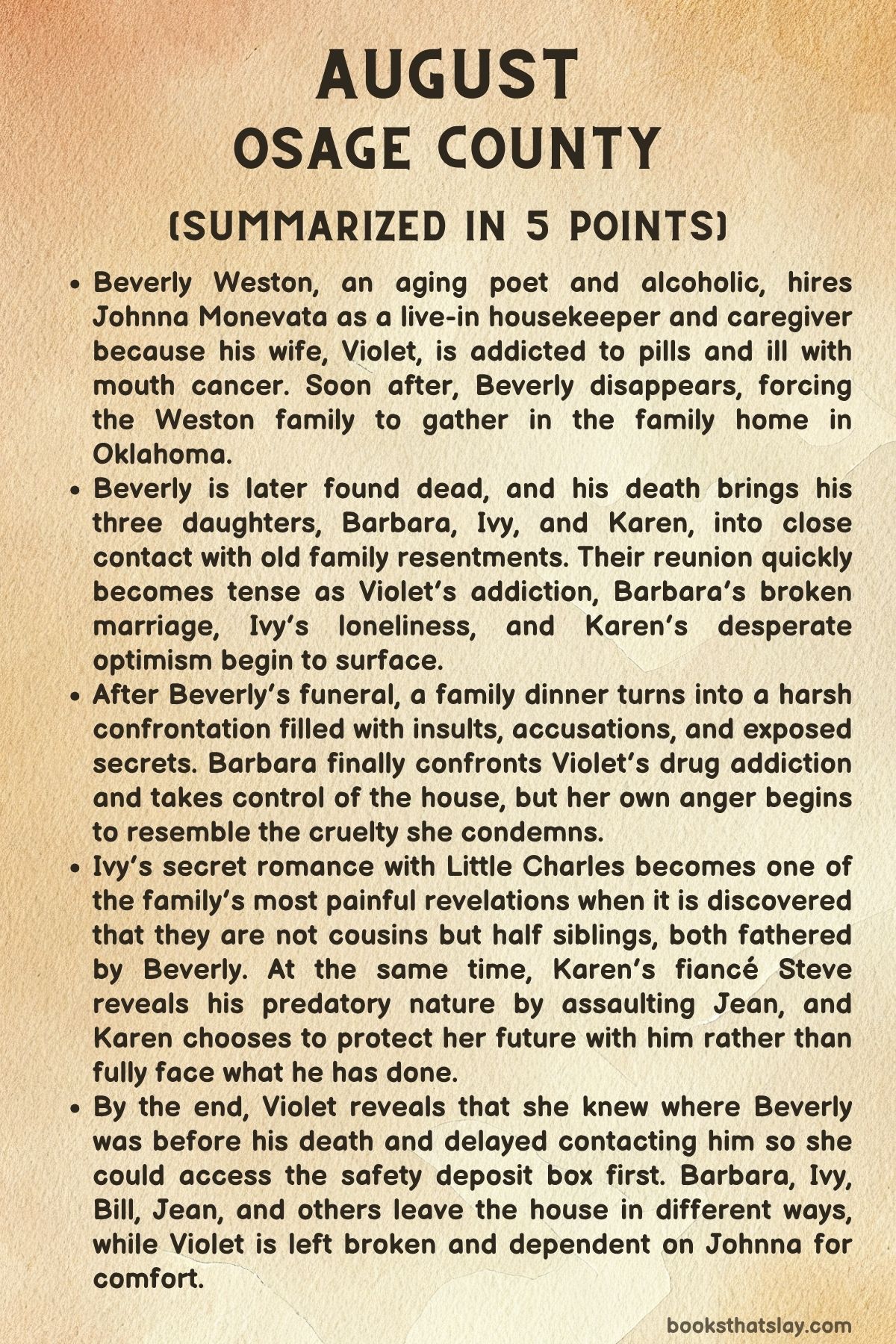
Summary
August: Osage County opens in the large, old Weston family house near Pawhuska, Oklahoma, a place that already seems cut off from comfort and fresh air. The windows are covered, the house is full of books, and the atmosphere feels heavy with neglect.
Beverly Weston, an aging poet and alcoholic, interviews Johnna Monevata, a young Indigenous woman, for a live-in housekeeping and caregiving job. Beverly speaks at length about literature, especially T. S. Eliot, but beneath his intellectual manner is a clear sense of exhaustion.
He tells Johnna that he drinks too much and that his wife, Violet, takes too many pills. Neither of them intends to stop.
He hires Johnna because someone needs to help manage the household, especially as Violet is dealing with mouth cancer and heavy drug dependency.
Violet soon appears, confused and affected by narcotics. She mocks Beverly and behaves strangely toward Johnna, giving a first look at her sharp tongue and unstable condition.
Beverly explains that Johnna will also need to help care for Violet. Johnna accepts the work because she needs the job, having left nursing school after her father’s death.
Beverly gives her a book of T. S. Eliot’s poems, though he says she does not have to read it. This opening establishes the emotional emptiness of the house and Beverly’s quiet sense that something is coming to an end.
Some weeks later, Beverly has disappeared. Violet’s daughter Ivy, Violet’s sister Mattie Fae, and Mattie Fae’s husband Charlie gather at the Weston house.
Beverly has been missing for five days. Mattie Fae remarks that Beverly has vanished before, but this time feels different.
Charlie tries to remain calm, while Mattie Fae criticizes almost everyone around her, including her own son, Little Charles. The family learns that Beverly’s boat is missing, though the trailer is still at home, making the situation more alarming.
Violet is anxious, high on pills, and angry. She talks to Ivy about calling her sisters, Barbara and Karen.
Violet complains about Johnna being in the house and criticizes Ivy for being unmarried and plain. Ivy has stayed nearby and has been the daughter most available to help, but Violet gives her little kindness.
Barbara arrives from Colorado with her separated husband, Bill, and their 14-year-old daughter, Jean. Barbara and Bill are trying to hide the fact that their marriage is falling apart because Bill has been involved with one of his students.
Their daughter Jean smokes, uses marijuana, and watches her parents with a wary detachment.
When Barbara enters the house, Violet breaks down and embraces her, but the warmth is brief and unstable. Family members arrive, talk over one another, judge one another, and reveal old patterns of tension.
Johnna quietly observes much of this, positioned as both outsider and witness. Violet’s drug use, Beverly’s disappearance, and the family’s inability to communicate honestly all create an atmosphere of dread.
Later, Violet explains that she waited before reporting Beverly missing because she wanted to go to the bank first and empty their safety deposit box, as she and Beverly had agreed to do if one of them died. Barbara is disturbed by this.
She presses Violet for signs of what might have happened, but Violet insists that fighting was normal in their marriage. Violet also makes racist remarks about Johnna, which Barbara corrects, though Violet resists the correction.
The discussion shifts into old resentments: Violet accuses Barbara of leaving home and abandoning the family, while Barbara insists that she had her own life and career.
Meanwhile, Jean talks with Johnna in the attic. Jean wants a place to smoke marijuana and reveals that her parents are separated because her father has been sleeping with a student.
Jean also learns that Johnna’s parents are dead and notices Johnna’s necklace, which contains her umbilical cord according to Cheyenne tradition. Johnna explains that losing it would mean her soul would have no place to belong after death.
This conversation quietly contrasts Johnna’s rooted sense of identity with the Weston family’s fractured bonds.
Barbara and Bill continue to argue privately. Bill tries to stay calm, while Barbara is bitter and furious about his affair.
Jean overhears enough to understand the depth of their conflict. Barbara admits what she already feels: her father is dead.
Soon after, the sheriff, Deon Gilbeau, arrives early in the morning with the news that Beverly’s body has been found in the water. It is unclear whether he died by suicide or accident.
Barbara must identify the body. Violet, barely coherent, responds in a dazed way, putting on an Eric Clapton record and dancing while the family watches in stunned silence.
After Beverly’s funeral, the family gathers for dinner. Johnna has cleaned the house and prepared the meal.
Karen, the youngest Weston sister, arrives with her fiancé Steve. She talks endlessly about how happy she is and how Steve has finally given her the future she always wanted.
Her optimism is forced and fragile, built on ignoring warning signs. Steve appears charming on the surface, but he soon shows inappropriate interest in Jean.
Violet, more sober but still unstable, continues to insult and provoke people. She pressures Ivy about her appearance and becomes excited when Ivy admits she has a man in her life.
Ivy refuses to reveal his identity. The truth, however, is that Ivy is in love with Little Charles, her first cousin.
Little Charles is gentle, insecure, and constantly belittled by his mother, Mattie Fae. Ivy sees him as kind and loving, and they plan to move to New York together.
The funeral dinner becomes the central eruption of family conflict. Violet attacks everyone verbally.
She mocks Bill and Barbara’s separation, exposes Bill’s younger lover, insults her daughters, and insists that she is only telling the truth. She speaks of her own brutal childhood, including violence from her mother, and uses that suffering as both explanation and weapon.
Barbara finally loses control and confronts Violet’s addiction. She physically wrestles her mother for the pills and announces that she is taking charge of the house.
The family begins searching for Violet’s drugs, and Barbara declares that she is now running things.
Later, the three Weston sisters talk together. For a brief moment, they seem almost able to connect.
They discuss Violet’s manipulations, her doctor, Barbara’s broken marriage, and Ivy’s relationship with Little Charles. Ivy reveals that she had cervical cancer and a hysterectomy, something her sisters did not know.
She also makes clear that she plans to leave Oklahoma with Little Charles and will not keep caring for Violet forever. The conversation reveals how lonely Ivy has been and how easily Barbara and Karen escaped while she remained behind.
Violet enters and shares a memory from childhood. She had once wanted a pair of beautiful cowboy boots for Christmas, believing they would help her win the attention of a boy she liked.
Her mother gave her a box that looked like it contained the boots, but inside was a pair of dirty old men’s work boots. Violet remembers her mother laughing cruelly.
This story helps explain Violet’s bitterness, but it does not excuse the damage she causes.
At the same time, Little Charles sings a love song for Ivy, showing his tenderness. Mattie Fae mocks him cruelly, as she often does.
Charlie finally stands up to his wife and threatens to leave her if she continues abusing their son. Afterward, Mattie Fae reveals to Barbara the reason Ivy and Little Charles can never be together: Little Charles is not Charlie’s biological son.
He is Beverly’s son, making him Ivy’s half brother. Mattie Fae had an affair with Beverly years earlier and has hidden the truth ever since.
She demands that Barbara stop Ivy and Little Charles from leaving together.
That night, Steve gets Jean high and begins making sexual advances toward her. Jean is only 14, and although she tries to push him away, he continues.
Johnna sees what is happening and attacks Steve with a cast-iron skillet, stopping him. Barbara and Bill are horrified, but Karen refuses to fully condemn Steve.
Instead, she protects him, suggests that Jean may share some blame, and leaves with him, still planning to marry him. This choice reveals Karen’s desperation to preserve her fantasy of happiness, even at the cost of moral clarity.
Bill decides to take Jean back to Colorado. Barbara, shaken and ashamed, recognizes that she has failed in several roles: as sister, mother, and wife.
Bill tells her their marriage is not likely to recover. Barbara weeps and says she loves him, but he leaves.
Barbara then speaks with Johnna, offering her a chance to quit and escape the family’s toxicity. Johnna says she is not staying out of loyalty; she simply needs the job.
Barbara asks what Beverly told her, and Johnna says that Beverly claimed his daughters and granddaughter were what made him happy. Barbara accepts the lie because she needs it.
Sheriff Gilbeau later visits Barbara and reveals that Beverly had stayed in a motel during the first two days of his disappearance. This suggests that Beverly may have been preparing himself for suicide.
Barbara and Gilbeau briefly reconnect, and she kisses him, but the moment only reveals her loneliness and confusion.
In the final confrontation, Ivy prepares to tell Violet about Little Charles. Barbara tries to stop her, knowing the truth.
Violet then reveals that she already knows Little Charles is Beverly’s son. Ivy is devastated, especially when she learns Barbara knew and did not tell her.
Ivy leaves, cutting herself off from the family. Violet then reveals one final cruel truth: Beverly left her a note saying where he was staying, and she waited to call him until after she could get into the safety deposit box.
Barbara realizes that Violet might have been able to stop him. Violet blames Barbara for leaving home and insists that nobody is stronger than she is.
Barbara kisses Violet and leaves the house. Violet calls after her in panic, then calls for Beverly.
Abandoned by her daughters, she crawls upstairs to Johnna, the one person still present. Johnna comforts her, singing lines from T. S. Eliot as Violet repeats that people leave and then they are gone.
August: Osage County ends with Violet emotionally ruined, surrounded by the wreckage of a family destroyed by addiction, cruelty, secrets, and the refusal to face truth until it is too late.
Characters
Beverly Weston
Beverly Weston is present only briefly in the play, yet his absence shapes nearly everything that follows. He is an aging poet whose early literary success never grew into a sustained career, and this failure seems to have settled into him as shame, disappointment, and silence.
His alcoholism is not treated as dramatic rebellion but as a long, slow retreat from responsibility and feeling. When he hires Johnna, he seems to understand that the household is collapsing and that he will soon no longer be able, or willing, to hold it together.
His intelligence gives him language, but it does not give him courage. Beverly’s suicide becomes both an ending and a final act of abandonment.
He leaves his family with unanswered questions, financial concerns, emotional wreckage, and buried secrets. His affair with Mattie Fae, and the fact that Little Charles is his son, reveal that Beverly’s passivity did not make him innocent.
He caused harm, hid from it, and let guilt rot beneath the surface for decades.
Violet Weston
Violet Weston is the central force of damage in August: Osage County, a woman whose pain has hardened into cruelty. She is addicted to pills, physically ill from mouth cancer, emotionally scarred by a brutal childhood, and fiercely committed to the idea that truth gives her the right to wound others.
Violet often claims she is simply saying what others refuse to say, but her version of truth is selective, theatrical, and punishing. She attacks her daughters’ appearances, marriages, choices, and weaknesses because attack is the only form of power she fully trusts.
Her childhood story about the Christmas boots shows how deeply humiliation shaped her, but the play refuses to let that history become a full excuse. Violet has been hurt, but she also hurts others with precision.
Her final revelation that she knew where Beverly was staying and delayed calling him exposes her terrifying mixture of pride, calculation, and need. By the end, she has driven away the very people she fears losing.
Barbara Fordham
Barbara Fordham is the daughter most like Violet, though she resists seeing it. She arrives as the capable eldest child, ready to manage the crisis, challenge her mother, and impose order on the house.
Yet her strength often turns into aggression. Her marriage to Bill is collapsing, her relationship with Jean is strained, and her attempts to control Violet reveal how close she is to inheriting her mother’s harshness.
Barbara’s declaration that she is running things marks a turning point, but it is also a warning: she may be stepping into the same destructive role she despises. Her anger at Beverly’s suicide, Bill’s betrayal, Karen’s denial, Ivy’s secrecy, and Violet’s addiction all comes from real hurt, but she frequently responds by lashing out.
Her slap of Jean shows how quickly her authority becomes violence. Barbara is tragic because she sees the family’s sickness clearly but cannot fully keep it out of herself.
Ivy Weston
Ivy Weston is the daughter who stayed, and that fact defines much of her pain. While Barbara and Karen built lives elsewhere, Ivy remained near Violet and Beverly, absorbing the daily weight of their decline.
She is often treated as plain, dutiful, and forgettable, especially by Violet, who criticizes her appearance and unmarried status. Yet Ivy has a hidden inner life, including her relationship with Little Charles, which gives her a sense of being loved without judgment.
Her hysterectomy after cervical cancer adds another layer to her isolation, since she suffered privately and told almost no one. Ivy’s desire to move to New York is not just romantic fantasy; it is a demand for escape.
When she learns that Little Charles is her half brother and that Barbara knew before telling her, Ivy experiences this as the final betrayal. Her departure is one of the play’s clearest acts of self-preservation.
Karen Weston
Karen Weston is the youngest sister, and she survives by refusing to look directly at reality. She talks brightly about Steve, her future, her wedding, and her happiness, but her optimism is fragile because it depends on ignoring danger.
Karen has spent years accepting poor treatment from men, then reframing each disappointment as part of a journey toward fulfillment. With Steve, she is determined to believe she has finally found safety.
This makes her reaction to his assault of Jean especially disturbing. Rather than protect her niece or fully condemn Steve, Karen shifts blame and clings to the life she wants.
Her denial is not innocent. It becomes morally dangerous because it asks others, especially Jean, to pay the price for Karen’s need to be loved.
Karen is not as openly cruel as Violet, but her weakness has its own destructive power.
Johnna Monevata
Johnna Monevata is an outsider in the Weston house, but she becomes one of the play’s most morally grounded figures. She enters as an employee, hired to cook, clean, and care for Violet, yet her presence carries a deeper significance.
She watches the family’s collapse without being absorbed by its logic. Her Cheyenne identity, her memories of her parents, and her umbilical cord necklace connect her to ideas of belonging and spiritual rootedness that contrast sharply with the Weston family’s emotional homelessness.
Johnna is quiet but not passive. Her attack on Steve with the skillet is one of the clearest acts of protection in the story.
She acts when others hesitate, deny, or rationalize. At the end, when Violet has been abandoned by her daughters, Johnna comforts her.
This compassion is not sentimental; it comes from endurance, discipline, and a clear sense of what must be done in the moment.
Bill Fordham
Bill Fordham is Barbara’s estranged husband, a professor whose calm manner often functions as avoidance. He has betrayed Barbara by having an affair with a student, and his explanations reveal a man who wants to appear reasonable even when he has caused deep harm.
Bill often tries to present himself as measured and controlled, especially when Barbara is angry, but his restraint can feel evasive rather than noble. As a father, he is more permissive with Jean than Barbara is, which causes conflict, yet he does respond seriously when Steve assaults her.
His decision to take Jean back to Colorado suggests that he recognizes Barbara is too overwhelmed to care for her well in that moment. Bill is not a villain, but he is selfish and emotionally cowardly.
He wants to leave without fully carrying the weight of what his leaving has done.
Jean Fordham
Jean Fordham is 14, but she is surrounded by adults who repeatedly fail to protect her. She smokes, uses marijuana, talks with false maturity, and tries to present herself as more experienced than she is.
Her behavior is partly adolescent rebellion and partly a response to the instability of her parents’ marriage. Jean knows more than the adults think she knows, and her sharp comment to Bill after Steve’s assault shows that she understands hypocrisy.
Still, her attempts to seem older make her vulnerable to Steve’s predatory behavior. Jean’s insistence that the incident is not a big deal is not proof that it was harmless; it is the reaction of a child trying to stop the adults from making her humiliation public.
Barbara’s slap adds another wound. Jean is one of the clearest examples of how the family passes harm downward.
Mattie Fae Aiken
Mattie Fae Aiken is Violet’s sister, and she shares Violet’s taste for sharp comments, judgment, and control. She often directs her cruelty toward her son, Little Charles, whom she treats as a disappointment.
Her insults are relentless and public, suggesting that she has spent years making him feel small. Yet Mattie Fae is not merely comic or mean; her cruelty hides a major secret.
Little Charles is Beverly’s son, the result of her affair with him. Her hostility toward Little Charles may come from shame, guilt, resentment, or fear that his existence reminds her of what she did.
She demands that Barbara stop Ivy and Little Charles from being together while refusing to take responsibility publicly. Mattie Fae’s sin is not only the affair but the decades of emotional punishment she inflicts on the child born from it.
Charlie Aiken
Charlie Aiken is one of the gentlest adults in the story, though his gentleness has limits. He loves Little Charles and repeatedly defends him against Mattie Fae’s attacks.
For much of the play, Charlie tries to keep peace through patience, humor, and small acts of kindness. He is not intellectually showy like Beverly or forceful like Barbara, but he possesses a moral steadiness that many others lack.
His defense of Little Charles after Mattie Fae mocks him is one of the few moments when a character draws a clear boundary against cruelty. Charlie’s weakness is that he has allowed this cruelty to continue for years before reaching that point.
Still, his love for Little Charles is sincere and protective. He offers a model of fatherhood based less on pride than loyalty, even though the later revelation complicates his role as Little Charles’s presumed father.
Little Charles Aiken
Little Charles Aiken is tender, awkward, and deeply wounded by years of being treated as inadequate. He misses Beverly’s funeral because he oversleeps, and this failure confirms the family’s low expectations of him, especially Mattie Fae’s.
Yet the play presents him with sympathy. He is not lazy or worthless; he is emotionally bruised, anxious, and desperate to be seen as worthy.
His relationship with Ivy gives him confidence because she sees goodness in him that others dismiss. His love song for Ivy is simple but sincere, and it shows a side of him that the family rarely allows to exist.
The revelation that he is Beverly’s son turns his love for Ivy into a tragedy he does not yet fully understand. Little Charles becomes the innocent bearer of older adults’ secrets, punished for choices he never made.
Steve Heidebrecht
Steve Heidebrecht is Karen’s fiancé, and he represents predatory charm disguised as confidence. At first, he seems socially comfortable, successful, and eager to fit into the family.
His easy conversation and outward polish help explain why Karen clings to him as proof that her life has improved. Yet his interactions with Jean quickly reveal danger.
He sexualizes her comments, offers her marijuana, touches her inappropriately, and later assaults her. His excuse that she said she was 15 exposes his moral emptiness; even his defense confirms that he knew she was a minor.
Steve’s role within August: Osage County is brief but important because he forces the family’s moral failures into the open. Karen’s choice to leave with him shows that denial can become a form of betrayal.
Sheriff Deon Gilbeau
Sheriff Deon Gilbeau connects Barbara’s present crisis to her past. He knew her in high school, once tried to take her to prom, and now appears as the official who brings news of Beverly’s death.
His role is practical, but he also offers Barbara a glimpse of another life, one tied to memory, youth, and roads not taken. Gilbeau is gentle with her, but he cannot rescue her from the family’s collapse.
His information about Beverly staying at a motel adds important context to Beverly’s death, suggesting preparation rather than accident. When Barbara kisses him and says she has forgotten what she looks like, Gilbeau becomes part of her attempt to feel visible again.
He is less a romantic solution than a mirror for Barbara’s loneliness.
Youngbird
Youngbird, Johnna’s father, never appears directly, but his memory matters because it shapes Johnna’s identity. Beverly knew him, and Johnna explains that her family name, Monevata, means Youngbird in their original language.
His death forced Johnna to leave nursing school, placing her in the economic position that leads her to the Weston house. Through him, the play suggests a family history different from the Westons’ fractured inheritance.
Johnna’s connection to her father is marked by respect, loss, and cultural continuity rather than bitterness. Though absent, he helps define Johnna as someone who carries her past with dignity.
Violet’s Mother
Violet’s mother is another absent figure whose influence remains powerful. Violet describes her as cruel, especially through the Christmas boots memory, where she deliberately humiliates her daughter and laughs at her disappointment.
She also appears in Violet’s references to childhood violence, including the attack with a claw hammer. This woman shaped Violet’s understanding of family as a place where love and cruelty are inseparable.
Her presence in the story explains part of Violet’s emotional brutality, though it does not absolve Violet of repeating it. She represents generational damage: abuse passed from parent to child until it becomes a language the child later speaks fluently.
Barry
Barry, Ivy’s former boyfriend, is mentioned only briefly, but his presence helps show how Violet views Ivy’s romantic life. Violet dismisses him as “Loser Barry,” reducing Ivy’s past relationship to another reason to criticize her.
The fact that he was connected to the college where Ivy works suggests Ivy once had a life beyond the family home, but Violet’s contempt strips that life of dignity. Barry’s main function is to reveal Violet’s habit of belittling Ivy’s choices and to show why Ivy keeps her relationship with Little Charles secret for as long as possible.
Violet’s Doctor
Violet’s doctor does not appear directly, but he is important because he represents the medical system that enables her addiction. The sisters discuss how Violet manipulates doctors by inventing pain, claiming lost pills, and threatening professional consequences if prescriptions are denied.
Barbara suspects the doctor wants to avoid responsibility for prescribing so many drugs. Through this unseen character, the play shows addiction not only as a personal issue but also as something sustained by negligence, fear, and convenience.
The doctor’s absence is fitting: he contributes to the crisis without having to face the family’s wreckage.
Themes
Addiction as Escape and Control
Addiction in August: Osage County is not shown only as private weakness; it is a force that reorganizes the whole family. Beverly drinks to withdraw from disappointment, guilt, and domestic misery, while Violet uses pills both to numb pain and to dominate the emotional climate around her.
Her drug use makes her unpredictable, but it also gives her a shield. When confronted, she can claim illness, suffering, or confusion, yet she remains sharp enough to expose secrets and punish others.
The family has adapted to her addiction through denial, management, and periodic crisis response. Barbara’s attempt to seize Violet’s pills looks like rescue, but it also becomes a power struggle between mother and daughter.
The addiction has become part of the household’s structure, shaping meals, conversations, medical decisions, and even grief. Beverly’s alcoholism and Violet’s pill dependency are not isolated habits; they are ways of avoiding truth until truth returns in more destructive forms.
The tragedy is that substances do not erase pain. They delay its arrival, distort it, and pass it to others.
The Inheritance of Cruelty
Cruelty moves through the family like an inheritance no one formally accepts but nearly everyone spends. Violet’s stories of childhood abuse reveal that she learned humiliation early, from a mother who treated tenderness as an opportunity for mockery.
Violet later uses the same method on her daughters, especially Ivy, turning ordinary conversation into emotional attack. Mattie Fae repeats this pattern with Little Charles, making him carry her shame through years of insults.
Barbara, who sees Violet’s cruelty clearly, still begins to mirror it when she uses force against Violet and later slaps Jean. The play shows that cruelty often survives because it disguises itself as honesty, discipline, humor, or toughness.
Characters say they are telling the truth, joking, correcting weakness, or preparing someone for reality, when they are actually continuing old harm. What makes this theme powerful is that the characters are not unaware of pain.
They know pain intimately. Yet knowing pain does not automatically make them gentle.
Without self-knowledge, suffering becomes something they hand down.
Secrets, Truth, and the Damage of Timing
Truth in the story is rarely clean or freeing because it usually arrives late, violently, or for selfish reasons. The family is full of hidden facts: Bill’s affair, Barbara and Bill’s separation, Ivy’s cancer, Ivy and Little Charles’s relationship, Mattie Fae’s affair with Beverly, Little Charles’s parentage, and Violet’s knowledge of Beverly’s motel stay.
These secrets do not protect the family; they create conditions for deeper injury. Yet the play also questions the belief that truth is automatically moral.
Violet often tells the truth in order to wound. Mattie Fae hides the truth to protect herself.
Barbara withholds the truth from Ivy because she does not know how to use it without destroying her. Timing becomes almost as important as fact.
A truth revealed earlier might have prevented disaster; a truth revealed cruelly can become another form of violence. The story suggests that families are not destroyed only by lies.
They are also destroyed by truths saved for the worst possible moment, then delivered without mercy.
Home as a Place of Confinement
The Weston house is not a safe home in the comforting sense. It is a sealed, overheated structure filled with books, covered windows, stale air, and old grievances.
People return to it because of Beverly’s disappearance and death, but once inside, they seem trapped by roles they thought they had escaped. Barbara becomes the controlling eldest daughter again.
Ivy becomes the overlooked caretaker. Karen becomes the sister who performs happiness.
Violet becomes both queen and prisoner of the house. The covered windows suggest refusal: refusal to see outside, refusal to let light in, refusal to allow change.
When the shades are removed, the family does not heal; instead, hidden things become more visible. This makes the house less a refuge than a pressure chamber.
It holds memory, addiction, resentment, and obligation. Leaving the house becomes a form of survival for Barbara, Ivy, Bill, Jean, and Karen, though not always a noble one.
Violet, left behind, reveals the terror beneath her cruelty: she has controlled the house for years, but without people to wound or command, it becomes a place of abandonment.